Solving Relational Similarity Problems Using the Web as a Corpus
Preslav Nakov∗ EECS, CS division
University of California at Berkeley Berkeley, CA 94720, USA [email protected]
Marti A. Hearst School of Information University of California at Berkeley
Berkeley, CA 94720, USA
Abstract
We present a simple linguistically-motivated method for characterizing the semantic rela-tions that hold between two nouns. The ap-proach leverages the vast size of the Web in order to build lexically-specific features. The main idea is to look for verbs, preposi-tions, and coordinating conjunctions that can help make explicit the hidden relations be-tween the target nouns. Using these fea-tures in instance-based classifiers, we demon-strate state-of-the-art results on various rela-tional similarity problems, including mapping noun-modifier pairs to abstract relations like TIME,LOCATIONandCONTAINER, charac-terizing noun-noun compounds in terms of ab-stract linguistic predicates likeCAUSE,USE, andFROM, classifying the relations between nominals in context, and solving SAT verbal analogy problems. In essence, the approach puts together some existing ideas, showing that they apply generally to various semantic tasks, finding that verbs are especially useful features.
1 Introduction
Despite the tremendous amount of work on word similarity (see (Budanitsky and Hirst, 2006) for an overview), there is surprisingly little research on the important related problem ofrelational similarity– semantic similarity between pairs of words. Stu-dents who took the SAT test before 2005 or who
∗
After January 2008 at the Linguistic Modeling Depart-ment, Institute for Parallel Processing, Bulgarian Academy of Sciences,[email protected]
are taking the GRE test nowadays are familiar with an instance of this problem – verbal analogy ques-tions, which ask whether, e.g., the relationship be-tween ostrich and bird is more similar to that be-tween lion andcat, or rather between primateand monkey. These analogies are difficult, and the aver-age test taker gives a correct answer 57% of the time (Turney and Littman, 2005).
Many NLP applications could benefit from solv-ing relational similarity problems, includsolv-ing but not limited to question answering, information re-trieval, machine translation, word sense disambigua-tion, and information extraction. For example, a relational search engine likeTextRunner, which serves queries like “find all X such that X causes wrinkles”, asking for all entities that are in a par-ticular relation with a given entity (Cafarella et al., 2006), needs to recognize that laugh wrinkles is an instance of CAUSE-EFFECT. While there are not many success stories so far, measuring seman-tic similarity has proven its advantages for textual entailment (Tatu and Moldovan, 2005).
In this paper, we introduce a novel linguistically-motivated Web-based approach to relational simi-larity, which, despite its simplicity, achieves state-of-the-art performance on a number of problems. Following Turney (2006b), we test our approach on SAT verbal analogy questions and on mapping noun-modifier pairs to abstract relations likeTIME,
LOCATIONandCONTAINER. We further apply it to (1) characterizing noun-noun compounds using abstract linguistic predicates likeCAUSE,USE, and
FROM, and (2) classifying the relation between pairs of nominals in context.
2 Related Work
2.1 Characterizing Semantic Relations
Turney and Littman (2005) characterize the relation-ship between two words as a vector with coordinates corresponding to the Web frequencies of 128 fixed phrases like “XforY” and “Y forX” instantiated from a fixed set of 64 joining terms like for, such as, not the, is *, etc. These vectors are used in a nearest-neighbor classifier to solve SAT verbal anal-ogy problems, yielding 47% accuracy. The same ap-proach is applied to classifying noun-modifier pairs: using theDiversedataset of Nastase and Szpakow-icz (2003), Turney&Littman achieve F-measures of 26.5% with 30 fine-grained relations, and 43.2% with 5 course-grained relations.
Turney (2005) extends the above approach by in-troducing the latent relational analysis (LRA), which uses automatically generated synonyms, learns suit-able patterns, and performs singular value decom-position in order to smooth the frequencies. The full algorithm consists of 12 steps described in detail in (Turney, 2006b). When applied to SAT questions, it achieves the state-of-the-art accuracy of 56%. On theDiversedataset, it yields an F-measure of 39.8% with 30 classes, and 58% with 5 classes.
Turney (2006a) presents an unsupervised algo-rithm for mining the Web for patterns expressing implicit semantic relations. For example, CAUSE
(e.g.,cold virus) is best characterized by “Y * causes X”, and “Y in * early X” is the best pattern for
TEMPORAL (e.g., morning frost). With 5 classes, he achieves F-measure=50.2%.
2.2 Noun-Noun Compound Semantics
Lauer (1995) reduces the problem of noun com-pound interpretation to choosing the best paraphras-ing preposition from the followparaphras-ing set: of, for, in, at,on,from,withorabout. He achieved 40% accu-racy using corpus frequencies. This result was im-proved to 55.7% by Lapata and Keller (2005) who used Web-derivedn-gram frequencies.
Barker and Szpakowicz (1998) use syntactic clues and the identity of the nouns in a nearest-neighbor classifier, achieving 60-70% accuracy.
Rosario and Hearst (2001) used a discriminative classifier to assign 18 relations for noun compounds from biomedical text, achieving 60% accuracy.
Rosario et al. (2002) reported 90% accuracy with a “descent of hierarchy” approach which character-izes the relationship between the nouns in a bio-science noun-noun compound based on the MeSH categories the nouns belong to.
Girju et al. (2005) apply both classic (SVM and decision trees) and novel supervised models (seman-tic scattering and iterative seman(seman-tic specialization), using WordNet, word sense disambiguation, and a set of linguistic features. They test their system against both Lauer’s 8 prepositional paraphrases and another set of 21 semantic relations, achieving up to 54% accuracy on the latter.
In a previous work (Nakov and Hearst, 2006), we have shown that the relationship between the nouns in a noun-noun compound can be characterized us-ing verbs extracted from the Web, but we provided no formal evaluation.
Kim and Baldwin (2006) characterized the se-mantic relationship in a noun-noun compound us-ing the verbs connectus-ing the two nouns by compar-ing them to predefined seed verbs. Their approach is highly resource intensive (usesWordNet,CoreLex andMoby’s thesaurus), and is quite sensitive to the seed set of verbs: on a collection of 453 examples and 19 relations, they achieved 52.6% accuracy with 84 seed verbs, but only 46.7% with 57 seed verbs.
2.3 Paraphrase Acquisition
Our method of extraction of paraphrasing verbs and prepositions is similar to previous paraphrase ac-quisition approaches. Lin and Pantel (2001) ex-tract paraphrases from dependency tree paths whose ends contain semantically similar sets of words by generalizing over these ends. For example, given “X solves Y”, they extract paraphrases like “X finds a solution to Y”, “X tries to solve Y”, “X resolves Y”, “Y is resolved by X”, etc. The approach is ex-tended by Shinyama et al. (2002), who use named entity recognizers and look for anchors belong-ing to matchbelong-ing semantic classes, e.g.,LOCATION,
2.4 Word Similarity
Another important group of related work is on us-ing syntactic dependency features in a vector-space model for measuringwordsimilarity, e.g., (Alshawi and Carter, 1994), (Grishman and Sterling, 1994), (Ruge, 1992), and (Lin, 1998). For example, given a noun, Lin (1998) extracts verbs that have that noun as a subject or object, and adjectives that modify it.
3 Method
Given a pair of nouns, we try to characterize the semantic relation between them by leveraging the vast size of the Web to build linguistically-motivated lexically-specific features. We mine the Web for sentences containing the target nouns, and we ex-tract the connecting verbs, prepositions, and coordi-nating conjunctions, which we use in a vector-space model to measure relational similarity.
The process of extraction starts with exact phrase queries issued against a Web search engine (Google) using the following patterns:
“inf l1 THAT * inf l2” “inf l2 THAT * inf l1”
“inf l1 * inf l2”
“inf l2 * inf l1”
where: inf l1 and inf l2 are inflected variants of
noun1 andnoun2 generated using the Java Word-Net Library1;THATis a complementizer and can be that,which, orwho; and*stands for 0 or more (up
to 8) instances ofGoogle’s star operator.
The first two patterns are subsumed by the last two and are used to obtain more sentences from the search engine since including e.g. that in the query changes the set of returned results and their ranking. For each query, we collect the text snippets from the result set (up to 1,000 per query). We split them into sentences, and we filter out all incomplete ones and those that do not contain the target nouns. We further make sure that the word sequence follow-ing the second mentioned target noun is nonempty and contains at least one nonnoun, thus ensuring the snippet includes the entire noun phrase: snippets representing incomplete sentences often end with a period anyway. We then perform POS tagging us-ing theStanford POS tagger(Toutanova et al., 2003)
1
JWNL:http://jwordnet.sourceforge.net
Freq. Feature POS Direction
2205 of P 2→1
1923 be V 1→2
771 include V 1→2
382 serve on V 2→1
189 chair V 2→1
189 have V 1→2
169 consist of V 1→2
148 comprise V 1→2
106 sit on V 2→1
81 be chaired by V 1→2
78 appoint V 1→2
77 on P 2→1
66 and C 1→2
66 be elected V 1→2
58 replace V 1→2
48 lead V 2→1
47 be intended for V 1→2
45 join V 2→1
. . . .
[image:3.612.328.521.57.315.2]4 be signed up for V 2→1
Table 1: The most frequent Web-derived features for
committee member. Here V stands for verb (possibly
+preposition and/or +particle),P for preposition andC
for coordinating conjunction; 1 → 2 means committee
precedes the feature andmemberfollows it;2→1means
memberprecedes the feature andcommitteefollows it.
and shallow parsing with theOpenNLP tools2, and we extract the following types of features:
Verb: We extract a verb if the subject NP of that verb is headed by one of the target nouns (or an in-flected form), and its direct object NP is headed by the other target noun (or an inflected form). For ex-ample, the verbincludewill be extracted from “The committee includes many members.” We also ex-tract verbs from relative clauses, e.g., “This is a com-mitteewhich includes manymembers.” Verb parti-cles are also recognized, e.g., “Thecommitteemust rotate off 1/3 of its members.” We ignore modals and auxiliaries, but retain the passivebe. Finally, we lemmatize the main verb usingWordNet’s morpho-logical analyzerMorphy(Fellbaum, 1998).
Verb+Preposition: If the subject NP of a verb is headed by one of the target nouns (or an inflected form), and its indirect object is a PP containing an NP which is headed by the other target noun (or an inflected form), we extract the verb and the
preposi-2
tion heading that PP, e.g., “The thesis advisory com-mittee consists of three qualified members.” As in the verb case, we extract verb+preposition from rel-ative clauses, we include particles, we ignore modals and auxiliaries, and we lemmatize the verbs.
Preposition:If one of the target nouns is the head of an NP containing a PP with an internal NP headed by the other target noun (or an inflected form), we extract the preposition heading that PP, e.g., “The membersof thecommitteeheld a meeting.”
Coordinating conjunction: If the two target nouns are the heads of coordinated NPs, we extract the coordinating conjunction.
In addition to the lexical part, for each extracted feature, we keep a direction. Therefore the preposi-tion of represents two different features in the fol-lowing examples “member of the committee” and “committeeofmembers”. See Table 1 for examples. We use the above-described features to calculate relational similarity, i.e., similarity between pairs of nouns. In order to downweight very common fea-tures likeof, we use TF.IDF-weighting:
w(x) =T F(x)×log
N DF(x)
(1)
In the above formula, T F(x) is the number of times the feature x has been extracted for the tar-get noun pair,DF(x)is the total number of training noun pairs that have that feature, andN is the total number of training noun pairs.
Given two nouns and their TF.IDF-weighted fre-quency vectorsAandB, we calculate the similarity between them using the following generalized vari-ant of the Dice coefficient:
Dice(A, B) = 2× Pn
i=1min(ai, bi)
Pn
i=1ai+Pni=1bi
(2)
Other variants are also possible, e.g., Lin (1998).
4 Relational Similarity Experiments
4.1 SAT Verbal Analogy
Following Turney (2006b), we useSAT verbal anal-ogy as a benchmark problem for relational similar-ity. We experiment with the 374 SAT questions collected by Turney and Littman (2005). Table 2 shows two sample questions: the top word pairs
ostrich:bird palatable:toothsome
(a) lion:cat (a) rancid:fragrant (b) goose:flock (b) chewy:textured (c) ewe:sheep (c) coarse:rough
[image:4.612.318.538.62.135.2](d) cub:bear (d) solitude:company (e) primate:monkey (e) no choice
Table 2: SAT verbal analogy: sample questions. The stem is inbold, the correct answer is initalic, and the distractors are in plain text.
are called stems, the ones in italic are the solu-tions, and the remaining ones aredistractors. Tur-ney (2006b) achieves 56% accuracy on this dataset, which matches the average human performance of 57%, and represents a significant improvement over the 20% random-guessing baseline.
Note that the righthand side example in Table 2 is missing one distractor; so do 21 questions. The dataset also mixes different parts of speech: whilesolitudeandcompanyare nouns, all remaining words are adjectives. Other examples contain verbs and adverbs, and even relate pairs of different POS. This is problematic for our approach, which requires that both words be nouns3. After having filtered all examples containing nonnouns, we ended up with 184 questions, which we used in the evaluation.
Given a verbal analogy example, we build six fea-ture vectors – one for each of the six word pairs. We then calculate the relational similarity between the stem of the analogy and each of the five candidates, and we choose the pair with the highest score; we make no prediction in case of a tie.
The evaluation results for a leave-one-out cross-validation are shown in Table 3. We also show 95%-confidence intervals for the accuracy. The last line in the table shows the performance of Turney’s LRA when limited to the 184 noun-only examples. Our best modelv+p+cperforms a bit better, 71.3% vs. 67.4%, but the difference is not statistically sig-nificant. However, this “inferred” accuracy could be misleading, and the LRA could have performed bet-ter if it was restricted to solvenoun-onlyanalogies, which seem easier than the general ones, as demon-strated by the significant increase in accuracy for LRA when limited to nouns: 67.4% vs. 56%.
3It can be extended to handle adjective-noun pairs as well,
Model X × ∅ Accuracy Cover.
v+p+c 129 52 3 71.3±7.0 98.4
v 122 56 6 68.5±7.2 96.7
v+p 119 61 4 66.1±7.2 97.8
v+c 117 62 5 65.4±7.2 97.3
p+c 90 90 4 50.0±7.2 97.8
p 84 94 6 47.2±7.2 96.7
[image:5.612.76.296.60.171.2]baseline 37 147 0 20.0±5.2 100.0 LRA 122 59 3 67.4±7.1 98.4
Table 3:SAT verbal analogy: 184 noun-only examples.
vstands for verb,pfor preposition, andcfor coordinating conjunction. For each model, the number of correct (X), wrong (×), and nonclassified examples (∅) is shown,
fol-lowed by accuracy and coverage (in %s).
Model X × ∅ Accuracy Cover.
v+p 240 352 8 40.5±3.9 98.7
v+p+c 238 354 8 40.2±3.9 98.7
v 234 350 16 40.1±3.9 97.3
v+c 230 362 8 38.9±3.8 98.7
p+c 114 471 15 19.5±3.0 97.5
p 110 475 15 19.1±3.0 97.5
[image:5.612.75.297.255.364.2]baseline 49 551 0 8.2±1.9 100.0 LRA 239 361 0 39.8±3.8 100.0
Table 4:Head-modifier relations, 30 classes:evaluation on theDiversedataset, micro-averaged (in %s).
4.2 Head-Modifier Relations
Next, we experiment with the Diverse dataset of Barker and Szpakowicz (1998), which consists of 600 head-modifier pairs: noun-noun, adjective-noun and adverb-noun. Each example is annotated with one of 30 fine-grained relations, which are fur-ther grouped into the following 5 coarse-grained classes (the fine-grained relations are shown in parentheses): CAUSALITY (cause, effect, purpose, detraction), TEMPORALITY (frequency, time at, time through), SPATIAL (direction, location, lo-cation at, lolo-cation from), PARTICIPANT (agent, beneficiary, instrument, object, object property, part, possessor, property, product, source, stative, whole) and QUALITY (container, content, equa-tive, material, measure, topic, type). For example, exam anxietyis classified aseffectand therefore as
CAUSALITY, andblue book ispropertyand there-fore alsoPARTICIPANT.
Some examples in the dataset are problematic for our method. First, in three cases, there are two
mod-ifiers, e.g., infectious disease agent, and we had to ignore the first one. Second, seven examples have an adverb modifier, e.g.,daily exercise, and 262 ex-amples have an adjective modifier, e.g., tiny cloud. We treat them as if the modifier was a noun, which works in many cases, since many adjectives and ad-verbs can be used predicatively, e.g., ‘This exercise is performed daily.’ or ‘This cloud looks very tiny.’
For the evaluation, we created a feature vector for each head-modifier pair, and we performed a leave-one-out cross-validation: we left one example for testing and we trained on the remaining 599 ones, repeating this procedure 600 times so that each ex-ample be used for testing. Following Turney and Littman (2005) we used a 1-nearest-neighbor classi-fier. We calculated the similarity between the feature vector of the testing example and each of the train-ing examples’ vectors. If there was a unique most similar training example, we predicted its class, and if there were ties, we chose the class predicted by the majority of tied examples, if there was a majority.
The results for the 30-class Diverse dataset are shown in Table 4. Our best model achieves 40.5% accuracy, which is slightly better than LRA’s 39.8%, but the difference is not statistically significant.
Table 4 shows that the verbs are the most impor-tant features, yielding about 40% accuracy regard-less of whether used alone or in combination with prepositions and/or coordinating conjunctions; not using them results in 50% drop in accuracy.
The reason coordinating conjunctions do not help is that head-modifier relations are typically ex-pressed with verbal or prepositional paraphrases. Therefore, coordinating conjunctions only help with some infrequent relations likeequative, e.g., finding player and coachon the Web suggests an equative relation forplayer coach(and forcoach player).
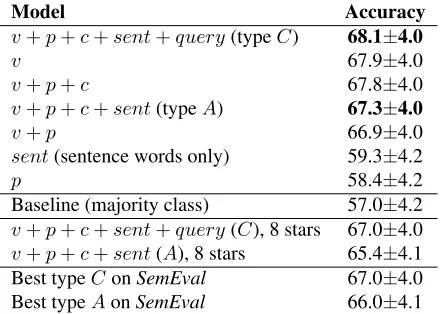
Model Accuracy
v+p+c+sent+query(typeC) 68.1±4.0
v 67.9±4.0
v+p+c 67.8±4.0
v+p+c+sent(typeA) 67.3±4.0
v+p 66.9±4.0
sent(sentence words only) 59.3±4.2
p 58.4±4.2
Baseline (majority class) 57.0±4.2
v+p+c+sent+query(C), 8 stars 67.0±4.0
[image:6.612.75.295.60.217.2]v+p+c+sent(A), 8 stars 65.4±4.1 Best typeConSemEval 67.0±4.0 Best typeAonSemEval 66.0±4.1
Table 5:Relations between nominals:evaluation on the
SemEval dataset. Accuracy is macro-averaged (in %s), up to 10Googlestars are used unless otherwise stated.
4.3 Relations Between Nominals
We further experimented with the SemEval’07task 4 dataset (Girju et al., 2007), where each example consists of a sentence, a target semantic relation, two nominals to be judged on whether they are in that re-lation, manually annotatedWordNetsenses, and the Web query used to obtain the sentence:
"Among the contents of the <e1>vessel</e1> were a set of
carpenter’s <e2>tools</e2>, several large storage jars, ceramic utensils, ropes and remnants of food, as well as a heavy load of ballast stones." WordNet(e1) = "vessel%1:06:00::", WordNet(e2) = "tool%1:06:00::", Content-Container(e2, e1) = "true", Query = "contents of the * were a"
The following nonexhaustive and possibly over-lapping relations are possible: Cause-Effect
(e.g., hormone-growth), Instrument-Agency
(e.g., laser-printer), Theme-Tool (e.g., work-force), Origin-Entity (e.g., grain-alcohol),
Content-Container (e.g., bananas-basket),
Product-Producer (e.g., honey-bee), and
Part-Whole (e.g., leg-table). Each relation is considered in isolation; there are 140 training and at least 70 test examples per relation.
Given an example, we reduced the target entities
e1 ande2 to single nouns by retaining their heads only. We then mined the Web for sentences
con-taining these nouns, and we extracted the above-described feature types: verbs, prepositions and co-ordinating conjunctions. We further used the follow-ing problem-specific contextual feature types:
Sentence words: after stop words removal and stemming with the Porter (1980) stemmer;
Entity words:lemmata of the words ine1ande2;
Query words:words part of the query string. Each feature type has a specific prefix which pre-vents it from mixing with other feature types; the last feature type is used for typeConly (see below). The SemEval competition defines four types of systems, depending on whether the manually anno-tatedWordNetsenses and theGooglequery are used:
A (WordNet=no, Query=no), B (WordNet=yes, Query=no), C (WordNet=no, Query=yes), and D
(WordNet=yes, Query=yes). We experimented with typesAandConly since we believe that having the manually annotatedWordNetsense keys is an unre-alistic assumption for a real-world application.
As before, we used a 1-nearest-neighbor classifier with TF.IDF-weighting, breaking ties by predicting the majority class on the training data. The evalu-ation results are shown in Table 5. We studied the effect of different subsets of features and of more Google star operators. As the table shows, using up to ten Google stars instead of up to eight (see section 3) yields a slight improvement in accuracy for systems of both typeA(65.4% vs. 67.3%) and type C (67.0% vs. 68.1%). Both results represent a statistically significant improvement over the ma-jority class baseline and over using sentence words only, and a slight improvement over the best typeA
and typeCsystems onSemEval’07, which achieved 66% and 67% accuracy, respectively.4
4.4 Noun-Noun Compound Relations
The last dataset we experimented with is a subset of the 387 examples listed in the appendix of (Levi, 1978). Levi’s theory is one of the most impor-tant linguistic theories of the syntax and semantics ofcomplex nominals– a general concept grouping
4
USINGTHAT NOT USINGTHAT Model Accuracy Cover. ANF ASF Accuracy Cover. ANF ASF
Human: allv 78.4±6.0 99.5 34.3 70.9 – – –
Human: firstvfrom each worker 72.3±6.4 99.5 11.6 25.5 – – – –
v+p+c 50.0±6.7 99.1 216.6 1716.0 49.1±6.7 99.1 206.6 1647.6
v+p 50.0±6.7 99.1 208.9 1427.9 47.6±6.6 99.1 198.9 1359.5
v+c 46.7±6.6 99.1 187.8 1107.2 43.9±6.5 99.1 177.8 1038.8
v 45.8±6.6 99.1 180.0 819.1 42.9±6.5 99.1 170.0 750.7
p 33.0±6.0 99.1 28.9 608.8 33.0±6.0 99.1 28.9 608.8
p+c 32.1±5.9 99.1 36.6 896.9 32.1±5.9 99.1 36.6 896.9
[image:7.612.73.548.60.197.2]Baseline 19.6±4.8 100.0 – – – – – –
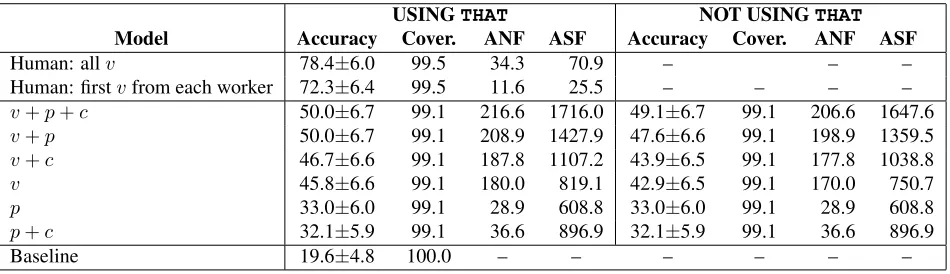
Table 6: Noun-noun compound relations, 12 classes: evaluation onLevi-214dataset. Shown are micro-averaged accuracy and coverage in %s, followed by average number of features (ANF) and average sum of feature frequencies (ASF) per example. The righthand side reports the results when the query patterns involvingTHATwere not used. For comparison purposes, the top rows show the performance with the human-proposed verbs used as features.
together the partially overlapping classes of nom-inal compounds (e.g., peanut butter), nominaliza-tions (e.g.,dream analysis), and nonpredicate noun phrases (e.g.,electric shock).
In Levi’s theory, complex nominals can be derived from relative clauses by removing one of the fol-lowing 12 abstract predicates: CAUSE1 (e.g., tear gas),CAUSE2 (e.g.,drug deaths),HAVE1 (e.g., ap-ple cake), HAVE2 (e.g., lemon peel), MAKE1 (e.g., silkworm),MAKE2(e.g.,snowball),USE(e.g.,steam iron),BE(e.g., soldier ant),IN(e.g.,field mouse),
FOR(e.g.,horse doctor),FROM(e.g.,olive oil), and
ABOUT(e.g.,price war). In the resulting nominals, the modifier is typically the object of the predicate; when it is the subject, the predicate is marked with the index 2. The second derivational mechanism in the theory is nominalization; it produces nominals whose head is a nominalized verb.
Since we are interested in noun compounds only, we manually cleansed the set of 387 examples. We first excluded all concatenations (e.g.,silkworm) and examples with adjectival modifiers (e.g., electric shock), thus obtaining 250 noun-noun compounds (Levi-250dataset). We further filtered out all nom-inalizations for which the dataset provides no ab-stract predicate (e.g.,city planner), thus ending up with 214 examples (Levi-214dataset).
As in the previous experiments, for each of the 214 noun-noun compounds, we mined the Web for sentences containing both target nouns, from which we extracted paraphrasing verbs, prepositions
and coordinating conjunctions. We then performed leave-one-out cross-validation experiments with a 1-nearest-neighbor classifier, trying to predict the correct predicate for the testing example. The re-sults are shown in Table 6. As we can see, us-ing prepositions alone yields about 33% accuracy, which is a statistically significant improvement over the majority-class baseline. Overall, the most impor-tant features are the verbs: they yield 45.8% accu-racy when used alone, and 50% together with prepo-sitions. Adding coordinating conjunctions helps a bit with verbs, but not with prepositions. Note how-ever that none of the differences between the differ-ent feature combinations involving verbs are statis-tically significant.
The righthand side of the table reports the results when the query patterns involvingTHAT(see section 3) were not used. We can observe a small 1-3% drop in accuracy for all models involving verbs, but it is not statistically significant.
We also show the average number of distinct fea-tures and sum of feature counts per example: as we can see, there is a strong positive correlation be-tween number of features and accuracy.
5 Comparison to Human Judgments
followed by prepositions, that could be used in a paraphrase involving that. For example, olive oil can be paraphrased as ‘oil that comes from olives’, ‘oil that is obtained from olives’ or ‘oil that is from olives’. Note that this implicitly allows for prepo-sitional paraphrases – when the verb is tobe and is followed by a preposition, as in the last paraphrase.
We used theAmazon Mechanical Turk Web ser-vice5 to recruit human subjects, and we instructed them to propose at least three paraphrasing verbs per noun-noun compound, if possible. We randomly distributed the noun-noun compounds into groups of 5 and we requested 25 different human subjects per group. Each human subject was allowed to work on any number of groups, but not on the same one twice. A total of 174 different human subjects pro-duced 19,018 verbs. After filtering the bad submis-sions and normalizing the verbs, we ended up with 17,821 verbs. See (Nakov, 2007) for further de-tails on the process of extraction and cleansing. The dataset itself is freely available (Nakov, 2008).
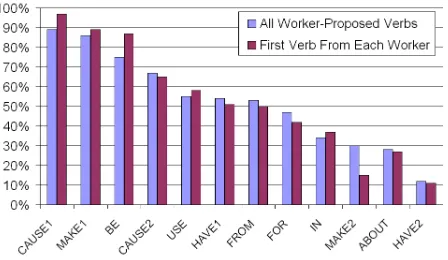
We compared the human-proposed and the Web-derived verbs forLevi-214, aggregated by relation. Given a relation, we collected all verbs belong-ing to noun-noun compounds from that relation to-gether with their frequencies. From a vector-space model point of view, we summed their correspond-ing frequency vectors. We did this separately for the human- and the program-generated verbs, and we compared the resulting vectors using Dice co-efficient with TF.IDF, calculated as before. Figure 1 shows the cosine correlations using all human-proposed verbs and the first verb from each judge. We can see a very-high correlation (mid-70% to mid-90%) for relations like CAUSE1, MAKE1, BE, but low correlations of 11-30% for reverse relations likeHAVE2andMAKE2. Interestingly, using the first verb only improves the results for highly-correlated relations, but negatively affects low-correlated ones. Finally, we repeated the cross-validation exper-iment with the Levi-214 dataset, this time using the human-proposed verbs6 as features. As Table 6 shows, we achieved 78.4% accuracy using all verbs (and and 72.3% with the first verb from each worker), which is a statistically significant
improve-5http://www.mturk.com
6Note that the human subjects proposed their verbs without
[image:8.612.317.541.62.192.2]any context and independently of our Web-derived sentences.
Figure 1: Cosine correlation (in %s) between the human- and the program- generated verbs by rela-tion:using all human-proposed verbs vs. the first verb.
ment over the 50% of our best Web-based model. This result is strong for a 12-way classification prob-lem, and confirms our observation that verbs and prepositions are among the most important features for relational similarity problems. It further suggests that the human-proposed verbs might be an upper bound on the accuracy that could be achieved with automatically extracted features.
6 Conclusions and Future Work
We have presented a simple approach for character-izing the relation between a pair of nouns in terms of linguistically-motivated features which could be useful for many NLP tasks. We found that verbs were especially useful features for this task. An im-portant advantage of the approach is that it does not require knowledge about the semantics of the indi-vidual nouns. A potential drawback is that it might not work well for low-frequency words.
The evaluation on several relational similarity problems, including SAT verbal analogy, head-modifier relations, and relations between complex nominals has shown state-of-the-art performance. The presented approach can be further extended to other combinations of parts of speech: not just noun-noun and adjective-noun-noun. Using a parser with a richer set of syntactic dependency features, e.g., as proposed by Pad´o and Lapata (2007), is another promising direction for future work.
Acknowledgments
References
Hiyan Alshawi and David Carter. 1994. Training and scaling preference functions for disambiguation.
Computational Linguistics, 20(4):635–648.
Ken Barker and Stan Szpakowicz. 1998. Semi-automatic recognition of noun modifier relationships. InProc. of Computational linguistics, pages 96–102.
Alexander Budanitsky and Graeme Hirst. 2006. Evalu-ating wordnet-based measures of lexical semantic re-latedness.Computational Linguistics, 32(1):13–47. Michael Cafarella, Michele Banko, and Oren Etzioni.
2006. Relational Web search. Technical Report 2006-04-02, University of Washington, Department of Com-puter Science and Engineering.
Christiane Fellbaum, editor. 1998. WordNet: An Elec-tronic Lexical Database. MIT Press.
Roxana Girju, Dan Moldovan, Marta Tatu, and Daniel Antohe. 2005. On the semantics of noun compounds.
Journal of Computer Speech and Language - Special Issue on Multiword Expressions, 4(19):479–496. Roxana Girju, Preslav Nakov, Vivi Nastase, Stan
Sz-pakowicz, Peter Turney, and Deniz Yuret. 2007. Semeval-2007 task 04: Classification of semantic rela-tions between nominals. InProceedings of SemEval, pages 13–18, Prague, Czech Republic.
Ralph Grishman and John Sterling. 1994. Generalizing automatically generated selectional patterns. In Pro-ceedings of the 15th conference on Computational lin-guistics, pages 742–747.
Su Nam Kim and Timothy Baldwin. 2006. Interpret-ing semantic relations in noun compounds via verb se-mantics. InProceedings of the COLING/ACL on Main conference poster sessions, pages 491–498.
Mirella Lapata and Frank Keller. 2005. Web-based models for natural language processing. ACM Trans. Speech Lang. Process., 2(1):3.
Mark Lauer. 1995. Designing Statistical Language Learners: Experiments on Noun Compounds. Ph.D. thesis, Dept. of Computing, Macquarie University, Australia.
Judith Levi. 1978. The Syntax and Semantics of Complex Nominals. Academic Press, New York.
Dekang Lin and Patrick Pantel. 2001. Discovery of infer-ence rules for question-answering. Natural Language Engineering, 7(4):343–360.
Dekang Lin. 1998. An information-theoretic definition of similarity. InProceedings of ICML, pages 296–304. Preslav Nakov and Marti Hearst. 2006. Using verbs to characterize noun-noun relations. InAIMSA, volume 4183 ofLNCS, pages 233–244. Springer.
Preslav Nakov, Ariel Schwartz, and Marti Hearst. 2004. Citances: Citation sentences for semantic analysis of bioscience text. InProceedings of SIGIR’04 Workshop
on Search and Discovery in Bioinformatics, pages 81– 88, Sheffield, UK.
Preslav Nakov. 2007. Using the Web as an Implicit Training Set: Application to Noun Compound Syntax and Semantics. Ph.D. thesis, EECS Department, Uni-versity of California, Berkeley, UCB/EECS-2007-173. Preslav Nakov. 2008. Paraphrasing verbs for noun com-pound interpretation. InProceedings of the LREC’08 Workshop: Towards a Shared Task for Multiword Ex-pressions (MWE’08), Marrakech, Morocco.
Vivi Nastase and Stan Szpakowicz. 2003. Exploring noun-modifier semantic relations. In Fifth Interna-tional Workshop on ComputaInterna-tional Semantics (IWCS-5), pages 285–301, Tilburg, The Netherlands.
Sebastian Pad´o and Mirella Lapata. 2007. Dependency-based construction of semantic space models. Compu-tational Linguistics, 33(2):161–199.
Martin Porter. 1980. An algorithm for suffix stripping.
Program, 14(3):130–137.
Barbara Rosario and Marti Hearst. 2001. Classifying the semantic relations in noun compounds via a domain-specific lexical hierarchy. InProceedings of EMNLP, pages 82–90.
Barbara Rosario, Marti Hearst, and Charles Fillmore. 2002. The descent of hierarchy, and selection in rela-tional semantics. InProceedings of ACL, pages 247– 254.
Gerda Ruge. 1992. Experiment on linguistically-based term associations. Inf. Process. Manage., 28(3):317– 332.
Yusuke Shinyama, Satoshi Sekine, and Kiyoshi Sudo. 2002. Automatic paraphrase acquisition from news ar-ticles. InProceedings of HLT, pages 313–318. Marta Tatu and Dan Moldovan. 2005. A semantic
ap-proach to recognizing textual entailment. In Proceed-ings of HLT, pages 371–378.
Kristina Toutanova, Dan Klein, Christopher Manning, and Yoram Singer. 2003. Feature-rich part-of-speech tagging with a cyclic dependency network. In Pro-ceedings of HLT-NAACL, pages 252–259.
Peter Turney and Michael Littman. 2005. Corpus-based learning of analogies and semantic relations. Machine Learning Journal, 60(1-3):251–278.
Peter Turney. 2005. Measuring semantic similarity by latent relational analysis. In Proceedings of IJCAI, pages 1136–1141.
Peter Turney. 2006a. Expressing implicit semantic re-lations without supervision. InProceedings of ACL, pages 313–320.
Peter Turney. 2006b. Similarity of semantic relations.