Contextual Preferences
Idan Szpektor, Ido Dagan, Roy Bar-Haim
Department of Computer Science Bar-Ilan University
Ramat Gan, Israel
{szpekti,dagan,barhair}@cs.biu.ac.il
Jacob Goldberger
School of Engineering Bar-Ilan University
Ramat Gan, Israel
Abstract
The validity of semantic inferences depends on the contexts in which they are applied. We propose a generic framework for handling contextual considerations within applied in-ference, termed Contextual Preferences. This framework defines the various context-aware components needed for inference and their relationships. Contextual preferences extend and generalize previous notions, such as se-lectional preferences, while experiments show that the extended framework allows improving inference quality on real application data.
1 Introduction
Applied semantic inference is typically concerned with inferring a target meaning from a given text. For example, to answer “Who wrote Idomeneo?”, Question Answering (QA) systems need to infer the target meaning ‘Mozart wrote Idomeneo’ from a given text “Mozart composed Idomeneo”. Following common Textual Entailment terminology (Giampic-colo et al., 2007), we denote the target meaning by h (for hypothesis) and the given text by t.
A typical applied inference operation is matching. Sometimes, h can be directly matched int (in the example above, if the given sentence would be liter-ally “Mozart wrote Idomeneo”). Generliter-ally, the tar-get meaning can be expressed in t in many differ-ent ways. Indirect matching is then needed, using inference knowledge that may be captured through rules, termed here entailment rules. In our exam-ple, ‘Mozart wrote Idomeneo’ can be inferred using the rule ‘X composeY → X write Y’. Recently,
several algorithms were proposed for automatically learning entailment rules and paraphrases (viewed as bi-directional entailment rules) (Lin and Pantel, 2001; Ravichandran and Hovy, 2002; Shinyama et al., 2002; Szpektor et al., 2004; Sekine, 2005).
A common practice is to try matching the struc-ture ofh, or of the left-hand-side of a ruler, within t. However, context should be considered to allow valid matching. For example, suppose that to find acquisitions of companies we specify the target
tem-plate hypothesis (a hypothesis with variables) ‘X ac-quireY’. Thishshould not be matched in “children
acquire language quickly”, because in this context
Y is not a company. Similarly, the rule ‘X charge Y → X accuse Y’ should not be applied to “This
store charged my account”, since the assumed sense
of ‘charge’ in the rule is different than its sense in the text. Thus, the intended contexts for h and r and the context within the given tshould be prop-erly matched to verify valid inference.
Context matching at inference time was of-ten approached in an application-specific manner (Harabagiu et al., 2003; Patwardhan and Riloff, 2007). Recently, some generic methods were pro-posed to handle context-sensitive inference (Dagan et al., 2006; Pantel et al., 2007; Downey et al., 2007; Connor and Roth, 2007), but these usually treat only a single aspect of context matching (see Sec-tion 6). We propose a comprehensive framework for handling various contextual considerations, termed
Contextual Preferences. It extends and generalizes
previous work, defining the needed contextual com-ponents and their relationships. We also present and implement concrete representation models and
supervised matching methods for these components. While our presentation focuses on semantic infer-ence using lexical-syntactic structures, the proposed framework and models seem suitable for other com-mon types of representations as well.
We applied our models to a test set derived from the ACE 2005 event detection task, a standard In-formation Extraction (IE) benchmark. We show the benefits of our extended framework for textual in-ference and present component-wise analysis of the results. To the best of our knowledge, these are also the first unsupervised results for event argument ex-traction in the ACE 2005 dataset.
2 Contextual Preferences
2.1 Notation
As mentioned above, we follow the generic Tex-tual Entailment (TE) setting, testing whether a target meaning hypothesish can be inferred from a given textt. We allowhto be either a text or a template, a text fragment with variables. For example, “The
stock rose 8%” entails an instantiation of the
tem-plate hypothesis ‘XgainY’. Typically,hrepresents an information need requested in some application, such as a target predicate in IE.
In this paper, we focus on parse-based lexical-syntactic representation of texts and hypotheses, and on the basic inference operation of matching. Fol-lowing common practice (de Salvo Braz et al., 2005; Romano et al., 2006; Bar-Haim et al., 2007), h is syntactically matched intif it can be embedded in t’s parse tree. For template hypotheses, the matching induces a mapping betweenh’s variables and their instantiation int.
Matchinghintcan be performed either directly or indirectly using entailment rules. An entailment
ruler: ‘LHS → RHS’ is a directional entailment relation between two templates.his matched int us-ingr ifLHS is matched intandhmatchesRHS. In the example above,r: ‘XriseY →XgainY’ al-lows us to entail ‘XgainY’, with “stock” and “8%” instantiatingh’s variables. We denote vars(z) the set of variables ofz, wherezis a template or a rule.
2.2 Motivation
When matching considers only the structure of hy-potheses, texts and rules it may result in incorrect
inference due to contextual mismatches. For exam-ple, an IE system may identify mentions of public demonstrations using the hypothesish: ‘X demon-strate’. However,hshould not be matched in
“Engi-neers demonstrated the new system”, due to a
mis-match between the intended sense of ‘demonstrate’ inh and its sense int. Similarly, when looking for physical attack mentions using the hypothesis ‘X at-tackY’, we should not utilize the ruler: ‘Xaccuse Y →XattackY’, due to a mismatch between a ver-bal attack inr and an intended physical attack inh. Finally, r: ‘X produceY → X layY’ (applicable whenXrefers to poultry andY to eggs) should not be matched int: “Bugatti produce the fastest cars”, due to a mismatch between the meanings of ‘pro-duce’ inrandt. Overall, such incorrect inferences may be avoided by considering contextual informa-tion fort,handrduring their matching process.
2.3 The Contextual Preferences Framework
We propose the Contextual Preferences (CP) frame-work for addressing context at inference time. In this framework, the representation of an objectz, where zmay be a text, a template or an entailment rule, is enriched with contextual information denotedcp(z). This information helps constraining or disambiguat-ing the meandisambiguat-ing ofz, and is used to validate proper matching between pairs of objects.
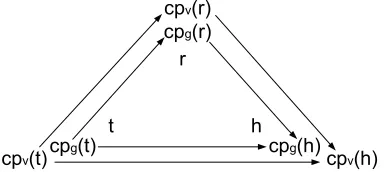
We consider two components within cp(z): (a) a representation for the global (“topical”) context in which z typically occurs, denoted cpg(z); (b) a representation for the preferences and constraints (“hard” preferences) on the possible terms that can instantiate variables withinz, denotedcpv(z). For example, cpv(‘X produce Y → X lay Y’) may specify thatX’s instantiations should be similar to “chicken” or “duck”.
Figure 1: The directional matching relationships between a hypothesis (h), an entailment rule (r) and a text (t) in the Contextual Preferences framework.
components ofh,tandr.
Like Textual Entailment inference, Contextual Preferences matching is directional. When matching h with t we require that the global context prefer-ences specified bycpg(h)would subsume those in-duced by cpg(t), and that the instantiations of h’s variables in t would adhere to the preferences in cpv(h) (sincet should entailh, but not necessarily vice versa). For example, if the preferred global con-text of a hypothesis is sports, it would match a con-text that discusses the more specific topic of basketball.
To implement the CP framework, concrete models are needed for each component, specifying its repre-sentation, how it is constructed, and an appropriate matching procedure. Section 3 describes the specific CP models that were implemented in this paper.
The CP framework provides a generic view of contextual modeling in applied semantic inference. Mapping from a specific application to the generic framework follows the mappings assumed in the Textual Entailment paradigm. For example, in QA the hypothesis to be proved corresponds to the affir-mative template derived from the question (e.g. h: ‘X invented the PC’ for “Who invented the PC?”). Thus, cpg(h) can be constructed with respect to the question’s focus while cpv(h) may be gener-ated from the expected answer type (Moldovan et al., 2000; Harabagiu et al., 2003). Construction of hypotheses’ CP for IE is demonstrated in Section 4.
3 Contextual Preferences Models
This section presents the current models that we im-plemented for the various components of the CP framework. For each component type we describe its representation, how it is constructed, and a
cor-responding unsupervised match score. Finally, the different component scores are combined to yield an overall match score, which is used in our exper-iments to rank inference instances by the likelihood of their validity. Our goal in this paper is to cover the entire scope of the CP framework by including spe-cific models that were proposed in previous work, where available, and elsewhere propose initial mod-els to complete the CP scope.
3.1 Contextual Preferences for Global Context
To represent the global context of an object z we utilize Latent Semantic Analysis (LSA) (Deerwester et al., 1990), a well-known method for representing the contextual-usage of words based on corpus sta-tistics. We use LSA analysis of the BNC corpus1, in which every term is represented by a normalized vector of the top 100 SVD dimensions, as described in (Gliozzo, 2005).
To constructcpg(z)we first collect a set of terms that are representative for the preferred general con-text ofz. Then, the (single) vector which is the sum of the LSA vectors of the representative terms be-comes the representation ofcpg(z). This LSA vec-tor captures the “average” typical contexts in which the representative terms occur.
The set of representative terms for a text t con-sists of all the nouns and verbs in it, represented by their lemma and part of speech. For a rule r: ‘LHS → RHS’, the representative terms are the words appearing inLHS and in RHS. For exam-ple, the representative terms for ‘XdivorceY →X marryY’ are {divorce:v, marry:v}. As mentioned earlier, construction of hypotheses and their contex-tual preferences depends on the application at hand. In our experiments these are defined manually, as described in Section 4, derived from the manual de-finitions of target meanings in the IE data.
The score of matching thecpgcomponents of two objects, denoted bymg(·,·), is the Cosine similarity of their LSA vectors. Negative values are set to 0.
3.2 Contextual Preferences for Variables
3.2.1 Representation
For comparison with prior work, we follow (Pan-tel et al., 2007) and represent preferences for
vari-1
able instantiations using a distributional approach, and in addition incorporate a standard specification of named-entity types. Thus,cpv is represented by two lists. The first list, denoted cpv:e, contains ex-amples for valid instantiations of that variable. For example, cpv:e(X kill Y → Y die ofX) may be [X: {snakebite, disease},Y: {man, patient}]. The second list, denoted cpv:n, contains the variable’s preferred named-entity types (if any). For exam-ple,cpv:n(Xborn inY) may be [X: {Person}, Y: {Location}]. We denotecpv:e(z)[j]andcpv:n(z)[j] as the lists for a specific variablejof the objectz.
For a textt, in which a templatepis matched, the preferencecpv:e(t)for each template variable is sim-ply its instantiation int. For example, when ‘Xeat Y’ is matched int: “Many Americans eat fish
reg-ularly”, we constructcpv:e(t)= [X: {Many
Ameri-cans},Y: {fish}]. Similarly,cpv:n(t)for each vari-able is the named-entity type of its instantiation in t(if it is a named entity). We identify entity types using the default Lingpipe2 Named-Entity Recog-nizer (NER), which recognizes the types Location,
Person and Organization. In the above example,
cpv:n(t)[X]would be{Person}.
For a rule r: LHS → RHS, we automatically add to cpv:e(r) all the variable instantiations that were found common for bothLHS andRHSin a corpus (see Section 4), as in (Pantel et al., 2007; Pen-nacchiotti et al., 2007). To construct cpv:n(r), we currently use a simple approach where each individ-ual term incpv:e(r)is analyzed by the NER system, and its type (if any) is added tocpv:n(r).
For a template hypothesis, we currently repre-sentcpv(h)only by its list of preferred named-entity types,cpv:n. Similarly tocpg(h), the preferred types for each template variable were adapted from those defined in our IE data (see Section 4).
To allow compatible comparisons with previous work (see Sections 5 and 6), we utilize in this paper only cpv:e when matching between cpv(r) and cpv(t), as only this representation was exam-ined in prior work on context-sensitive rule applica-tions.cpv:nis utilized for context matches involving cpv(h). We denote the score of matching two cpv components bymv(·,·).
2
http://www.alias-i.com/lingpipe/
3.2.2 Matchingcpv:e
Our primary matching method is based on repli-cating the best-performing method reported in (Pan-tel et al., 2007), which utilizes the CBC distribu-tional word clustering algorithm (Pantel, 2003). In short, this method extends eachcpv:elist with CBC clusters that contain at least one term in the list, scor-ing them accordscor-ing to their “relevancy”. The score of matching twocpv:elists, denoted hereSCBC(·,·), is the score of the highest scoring member that ap-pears in both lists.
We applied the final binary match score presented in (Pantel et al., 2007), denoted herebinaryCBC: mv:e(r, t)is 1 ifSCBC(r, t)is above a threshold and 0 otherwise. As a more natural ranking method, we also utilize SCBC directly, denoted rankedCBC, havingmv:e(r, t) =SCBC(r, t).
In addition, we tried a simpler method that di-rectly compares the terms in two cpv:e lists, uti-lizing the commonly-used term similarity metric of (Lin, 1998a). This method, denotedLIN, uses the same raw distributional data as CBC but computes only pair-wise similarities, without any clustering phase. We calculated the scores of the 1000 most similar terms for every term in the Reuters RVC1 corpus3. Then, a directional similarity of term a to termb, s(a, b), is set to be their similarity score if ais in b’s 1000 most similar terms and 0 other-wise. The final score of matchingr withtis deter-mined by a nearest-neighbor approach, as the score of the most similar pair of terms in the correspond-ing two lists of the same variable: mv:e(r, t) =
maxj∈vars(r)[maxa∈cpv:e(t)[j],b∈cpv:e(r)[j][s(a, b)]].
3.2.3 Matchingcpv:n
We use a simple scoring mechanism for compar-ing between two named-entity typesaandb,s(a, b): 1 for identical types and 0.8 otherwise.
A variable j has a single preferred entity type in cpv:n(t)[j], the type of its instantiation in t. However, it can have several preferred types forh. When matching h with t, j’s match score is that of its highest scoring type, and the final score is the product of all variable scores: mv:n(h, t) =
Q
j∈vars(h)(maxa∈cpv:n(h)[j][s(a, cpv:n(t)[j])]).
Variablej may also have several types in r, the
3
types of the common arguments incpv:e(r). When matchinghwithr,s(a, cpv:n(t)[j])is replaced with the average score foraand each type incpv:n(r)[j].
3.3 Overall Score for a Match
A final score for a given match, denoted allCP, is obtained by the product of all six matching scores of the various CP components (multiplying by 1 if a component score is missing). The six scores are the results of matching any of the two compo-nents of h, t andr: mg(h, t), mv(h, t), mg(h, r), mv(h, r),mg(r, t)andmv(r, t)(as specified above, mv(r, t)is based on matchingcpv:ewhilemv(h, r) andmv(h, t)are based on matchingcpv:n). We use rankedCBC for calculatingmv(r, t).
Unlike previous work (e.g. (Pantel et al., 2007)), we also utilize the prior score of a rule r, which is provided by the rule-learning algorithm (see next section). We denote by allCP+pr the final match score obtained by the product of the allCP score with the prior score of the matched rule.
4 Experimental Settings
Evaluating the contribution of Contextual Prefer-ences models requires: (a) a sample of test hypothe-ses, and (b) a corresponding corpus that contains sentences which entail these hypotheses, where all hypothesis matches (either direct or via rules) are an-notated. We found that the available event mention annotations in the ACE 2005 training set4provide a
useful test set that meets these generic criteria, with the added value of a standard real-world dataset.
The ACE annotation includes 33 types of events, for which all event mentions are annotated in the corpus. The annotation of each mention includes the instantiated arguments for the predicates, which rep-resent the participants in the event, as well as general attributes such as time and place. ACE guidelines specify for each event type its possible arguments, where all arguments are optional. Each argument is associated with a semantic role and a list of possible named-entity types. For instance, an Injure event may have the arguments{Agent, Victim, Instrument, Time, Place}, where Victim should be a person.
For each event type we manually created a small set of template hypotheses that correspond to the
4
http://projects.ldc.upenn.edu/ace/
given event predicate, and specified the appropri-ate semantic roles for each variable. We consid-ered only binary hypotheses, due to the type of available entailment rules (see below). For
In-jure, the set of hypotheses included ‘A injure V’
and ‘injure V in T’ where role(A)={Agent, In-strument}, role(V)={Victim}, and role(T)={Time, Place}. Thus, correct match of an argument corre-sponds to correct role identification. The templates were represented as Minipar (Lin, 1998b) depen-dency parse-trees.
The Contextual Preferences for h were con-structed manually: the named-entity types for cpv:n(h)were set by adapting the entity types given in the guidelines to the types supported by the Ling-pipe NER (described in Section 3.2). cpg(h) was generated from a short list of nouns and verbs that were extracted from the verbal event definition in the ACE guidelines. For Injure, this list included
{injure:v, injury:n, wound:v}. This assumes that when writing down an event definition the user would also specify such representative keywords.
Entailment-rules for a given h (rules in which
RHS is equal to h) were learned automatically by
the DIRT algorithm (Lin and Pantel, 2001), which also produces a quality score for each rule. We im-plemented a canonized version of DIRT (Szpektor and Dagan, 2007) on the Reuters corpus parsed by Minipar. Each rule’s arguments forcpv(r)were also collected from this corpus.
We assessed the CP framework by its ability to correctly rank, for each predicate (event), all the candidate entailing mentions that are found for it in the test corpus. Such ranking evaluation is suit-able for unsupervised settings, with a perfect rank-ing placrank-ing all correct mentions before any incor-rect ones. The candidate mentions are found in the parsed test corpus by matching the specified event hypotheses, either directly or via the given set of en-tailment rules, using a syntactic matcher similar to the one in (Szpektor and Dagan, 2007). Finally, the mentions are ranked by their match scores, as de-scribed in Section 3.3. As detailed in the next sec-tion, those candidate mentions which are also an-notated as mentions of the same event in ACE are considered correct.
de-noted by a specific predicate. Therefore, we elim-inated four ACE event types that correspond to mul-tiple distinct predicates. For instance, the
Transfer-Money event refers to both donating and lending
money, which are not distinguished by the ACE an-notation. We also omitted three events with less than 10 mentions and two events for which the given set of learned rules could not match any mention. We were left with 24 event types for evaluation, which amount to 4085 event mentions in the dataset. Out of these, our binary templates can correctly match only mentions with at least two arguments, which appear 2076 times in the dataset.
Comparing with previous evaluation methodolo-gies, in (Szpektor et al., 2007; Pantel et al., 2007) proper context matching was evaluated by post-hoc judgment of a sample of rule applications for a sam-ple of rules. Such annotation needs to be repeated each time the set of rules is changed. In addition, since the corpus annotation is not exhaustive, re-call could not be computed. By contrast, we use a standard real-world dataset, in which all mentions are annotated. This allows immediate comparison of different rule sets and matching methods, without requiring any additional (post-hoc) annotation.
5 Results and Analysis
We experimented with three rule setups over the ACE dataset, in order to measure the contribution of the CP framework. In the first setup no rules are used, applying only direct matches of template hy-potheses to identify event mentions. In the other two setups we also utilized DIRT’s top 50 or 100 rules for each hypothesis.
A match is considered correct when all matched arguments are extracted correctly according to their annotated event roles. This main measurement is de-noted All. As an additional measurement, dede-noted
Any, we consider a match as correct if at least one
argument is extracted correctly.
Once event matches are extracted, we first mea-sure for each event its Recall, the number of correct mentions identified out of all annotated event men-tions5and Precision, the number of correct matches out of all extracted candidate matches. These figures
5For Recall, we ignored mentions with less than two
argu-ments, as they cannot be correctly matched by binary templates.
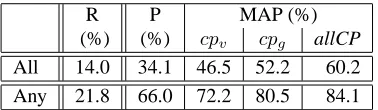
quantify the baseline performance of the DIRT rule set used. To assess our ranking quality, we measure for each event the commonly used Average Preci-sion (AP) measure (Voorhees and Harmann, 1998), which is the area under the non-interpolated recall-precision curve, while considering for each setup all correct extracted matches as 100% Recall. Overall, we report Mean Average Precision (MAP), macro average Precision and macro average Recall over the ACE events. Tables 1 and 2 summarize the main re-sults of our experiments. As far as we know, these are the first published unsupervised results for iden-tifying event arguments in the ACE 2005 dataset.
Examining Recall, we see that it increases sub-stantially when rules are applied: by more than
100% for the top 50 rules, and by about150% for the top 100, showing the benefit of entailment-rules to covering language variability. The difference be-tween All and Any results shows that about 65% of the rules that correctly match one argument also match correctly both arguments.
We use two baselines for measuring the CP rank-ing contribution: Precision, which corresponds to the expected MAP of random ranking, and MAP of ranking using the prior rule score provided by
DIRT. Without rules, the baseline All Precision is
34.1%, showing that even the manually constructed hypotheses, which correspond directly to the event predicate, extract event mentions with limited accu-racy when context is ignored. When rules are ap-plied, Precision is very low. But ranking is consider-ably improved using only the prior score (from 1.4% to 22.7% for 50 rules), showing that the prior is an informative indicator for valid matches.
Our main result is that the allCP and allCP+pr methods rank matches statistically significantly bet-ter than the baselines in all setups (according to the Wilcoxon double-sided signed-ranks test at the level of 0.01 (Wilcoxon, 1945)). In the All setup, ranking is improved by 70% for direct matching (Table 1). When entailment-rules are also utilized, prior-only ranking is improved by about 35% and 50% when using allCP and allCP+pr, respectively (Table 2). Figure 2 presents the average Recall-Precision curve of the ‘50 Rules, All’ setup for applying allCP or
allCP+pr, compared to prior-only ranking baseline
signif-R P MAP (%) (%) (%) cpv cpg allCP
All 14.0 34.1 46.5 52.2 60.2
[image:7.612.92.281.59.114.2]Any 21.8 66.0 72.2 80.5 84.1
Table 1: Recall (R), Precision (P) and Mean Average Pre-cision (MAP) when only matching template hypotheses directly.
# R P MAP (%)
Rules (%) (%) prior allCP allCP+pr
All 50 29.6 1.4 22.7 30.6 34.1
100 34.9 0.7 20.5 26.3 30.2
Any 50 46.5 3.5 41.2 43.7 48.6
[image:7.612.316.536.61.253.2]100 52.9 1.8 35.5 35.1 40.8
Table 2: Recall (R), Precision (P) and Mean Average Pre-cision (MAP) when also using rules for matching.
icantly slower when CP is used. The behavior of CP with and without the prior is largely the same up to 50% Recall, but later on our implemented CP mod-els are noisier and should be combined with the prior rule score.
Templates are incorrectly matched for several rea-sons. First, there are context mismatches which are not scored sufficiently low by our models. Another main cause is incorrect learned rules in whichLHS andRHSare topically related, e.g. ‘XconvictY →
XarrestY’, or rules that are used in the wrong en-tailment direction, e.g. ‘XmarryY →XdivorceY’ (DIRT does not learn rule direction). As such rules do correspond to plausible contexts of the hypothe-sis, their matches obtain relatively high CP scores. In addition, some incorrect matches are caused by our syntactic matcher, which currently does not han-dle certain phenomena such as co-reference, modal-ity or negation, and due to Minipar parse errors.
5.1 Component Analysis
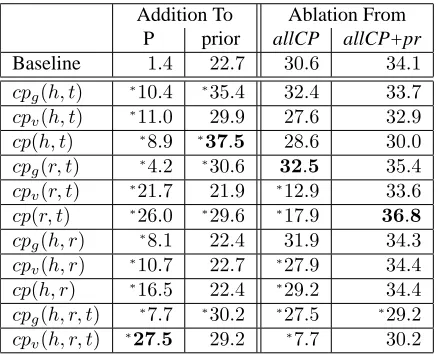
Table 3 displays the contribution of different CP components to ranking, when adding only that com-ponent’s match score to the baselines, and under ab-lation tests, when using all CP component scores ex-cept the tested component, with or without the prior. As it turns out, matching h witht (i.e. cp(h, t), which combinescpg(h, t)andcpv(h, t)) is most use-ful. With our current models, using only cp(h, t)
along with the prior, while ignoringcp(r), achieves
50 Rules - All
0 10 20 30 40 50 60 70 80 90 100
0 10 20 30 40 50 60 70 80 90 100
Relative Recall
P
r
e
c
is
io
n
[image:7.612.72.298.161.244.2]baseline CP CP + prior
Figure 2: Recall-Precision curves for ranking using: (a) only the prior (baseline); (b) allCP; (c) allCP+pr.
the highest score in the table. The strong impact of matchinghandt’s preferences is also evident in Ta-ble 1, where ranking based on eithercpg orcpv sub-stantially improves precision, while their combina-tion provides the best ranking. These results indicate that the two CP components capture complementary information and both are needed to assess the cor-rectness of a match.
When ignoring the prior rule score,cp(r, t)is the major contributor over the baseline Precision. For cpv(r, t), this is in synch with the result in (Pantel et al., 2007), which is based on this single model without utilizing prior rule scores. On the other hand,cpv(r, t)does not improve the ranking when the prior is used, suggesting that this contextual model for the rule’s variables is not stronger than the context-insensitive prior rule score. Furthermore, relative to this cpv(r, t) model from (Pantel et al., 2007), our combined allCP model, with or without the prior (first row of Table 2), obtains statistically significantly better ranking (at the level of 0.01).
Comparing between the algorithms for match-ing cpv:e (Section 3.2.2) we found that while rankedCBCis statistically significantly better than
binaryCBC, rankedCBC and LIN generally
Addition To Ablation From P prior allCP allCP+pr
Baseline 1.4 22.7 30.6 34.1
cpg(h, t) ∗10.4 ∗35.4 32.4 33.7
cpv(h, t) ∗11.0 29.9 27.6 32.9
cp(h, t) ∗8.9 ∗37.5 28.6 30.0 cpg(r, t) ∗4.2 ∗30.6 32.5 35.4
cpv(r, t) ∗21.7 21.9 ∗12.9 33.6
cp(r, t) ∗26.0 ∗29.6 ∗17.9 36.8 cpg(h, r) ∗8.1 22.4 31.9 34.3
cpv(h, r) ∗10.7 22.7 ∗27.9 34.4
cp(h, r) ∗16.5 22.4 ∗29.2 34.4 cpg(h, r, t) ∗7.7 ∗30.2 ∗27.5 ∗29.2
cpv(h, r, t) ∗27.5 29.2 ∗7.7 30.2
∗Indicates statistically significant changes compared to the baseline,
[image:8.612.77.296.59.236.2]according to the Wilcoxon test at the level of 0.01.
Table 3: MAP(%), under the ‘50 rules, All’ setup, when adding component match scores to Precision (P) or prior-only MAP baselines, and when ranking with allCP or
allCP+pr methods but ignoring that component scores.
Currently, some models do not improve the re-sults when the prior is used. Yet, we would like to further weaken the dependency on the prior score, since it is biased towards frequent contexts. We aim to properly identify also infrequent contexts (or meanings) at inference time, which may be achieved by better CP models. More generally, when used on top of all other components, some of the mod-els slightly degrade performance, as can be seen by those figures in the ablation tests which are higher than the corresponding baseline. However, due to their different roles, each of the matching compo-nents might capture some unique preferences. For example,cp(h, r)should be useful to filter out rules that don’t match the intended meaning of the given h. Overall, this suggests that future research for bet-ter models should aim to obtain a marginal improve-ment by each component.
6 Related Work
Context sensitive inference was mainly investigated in an application-dependent manner. For exam-ple, (Harabagiu et al., 2003) describe techniques for identifying the question focus and the answer type in QA. (Patwardhan and Riloff, 2007) propose a super-vised approach for IE, in which relevant text regions
for a target relation are identified prior to applying extraction rules.
Recently, the need for context-aware inference was raised (Szpektor et al., 2007). (Pantel et al., 2007) propose to learn the preferred instantiations of rule variables, termed Inferential Selectional Prefer-ences (ISP). Their clustering-based model is the one we implemented formv(r, t). A similar approach is taken in (Pennacchiotti et al., 2007), where LSA similarity is used to compare between the preferred variable instantiations for a rule and their instanti-ations in the matched text. (Downey et al., 2007) use HMM-based similarity for the same purpose. All these methods are analogous to matchingcpv(r) withcpv(t)in the CP framework.
(Dagan et al., 2006; Connor and Roth, 2007) pro-posed generic approaches for identifying valid appli-cations of lexical rules by classifying the surround-ing global context of a word as valid or not for that rule. These approaches are analogous to matching cpg(r)withcpg(t)in our framework.
7 Conclusions
We presented the Contextual Preferences (CP) framework for assessing the validity of inferences in context. CP enriches the representation of tex-tual objects with typical contextex-tual information that constrains or disambiguates their meaning, and pro-vides matching functions that compare the prefer-ences of objects involved in the inference. Experi-ments with our implemented CP models, over real-world IE data, show significant improvements rela-tive to baselines and some previous work.
In future research we plan to investigate improved models for representing and matching CP, and to ex-tend the experiments to additional applied datasets. We also plan to apply the framework to lexical infer-ence rules, for which it seems directly applicable.
Acknowledgements
References
Roy Bar-Haim, Ido Dagan, Iddo Greental, and Eyal Shnarch. 2007. Semantic inference at the lexical-syntactic level. In Proceedings of AAAI.
Michael Connor and Dan Roth. 2007. Context sensitive paraphrasing with a global unsupervised classifier. In
Proceedings of the European Conference on Machine Learning (ECML).
Ido Dagan, Oren Glickman, Alfio Gliozzo, Efrat Mar-morshtein, and Carlo Strapparava. 2006. Direct word sense matching for lexical substitution. In
Proceed-ings of the 21st International Conference on Compu-tational Linguistics and 44th Annual Meeting of ACL.
Rodrigo de Salvo Braz, Roxana Girju, Vasin Pun-yakanok, Dan Roth, and Mark Sammons. 2005. An inference model for semantic entailment in natural lan-guage. In Proceedings of the National Conference on
Artificial Intelligence (AAAI).
Scott C. Deerwester, Susan T. Dumais, Thomas K. Lan-dauer, George W. Furnas, and Richard A. Harshman. 1990. Indexing by latent semantic analysis. Jour-nal of the American Society of Information Science,
41(6):391–407.
Doug Downey, Stefan Schoenmackers, and Oren Etzioni. 2007. Sparse information extraction: Unsupervised language models to the rescue. In Proceedings of the
45th Annual Meeting of ACL.
Danilo Giampiccolo, Bernardo Magnini, Ido Dagan, and Bill Dolan. 2007. The third pascal recognizing tex-tual entailment challenge. In Proceedings of the
ACL-PASCAL Workshop on Textual Entailment and Para-phrasing.
Alfio Massimiliano Gliozzo. 2005. Semantic Domains
in Computational Linguistics. Ph.D. thesis.
Advisor-Carlo Strapparava.
Sanda M. Harabagiu, Steven J. Maiorano, and Marius A. Pas¸ca. 2003. Open-domain textual question answer-ing techniques. Nat. Lang. Eng., 9(3):231–267. Dekang Lin and Patrick Pantel. 2001. Discovery of
in-ference rules for question answering. In Natural
Lan-guage Engineering, volume 7(4), pages 343–360.
Dekang Lin. 1998a. Automatic retrieval and clustering of similar words. In Proceedings of COLING-ACL. Dekang Lin. 1998b. Dependency-based evaluation of
minipar. In Proceedings of the Workshop on
Evalua-tion of Parsing Systems at LREC.
Dan Moldovan, Sanda Harabagiu, Marius Pasca, Rada Mihalcea, Roxana Girju, Richard Goodrum, and Vasile Rus. 2000. The structure and performance of an open-domain question answering system. In
Pro-ceedings of the 38th Annual Meeting of ACL.
Patrick Pantel, Rahul Bhagat, Bonaventura Coppola, Timothy Chklovski, and Eduard Hovy. 2007. ISP:
Learning inferential selectional preferences. In
Hu-man Language Technologies 2007: The Conference of NAACL; Proceedings of the Main Conference.
Patrick Andre Pantel. 2003. Clustering by committee. Ph.D. thesis. Advisor-Dekang Lin.
Siddharth Patwardhan and Ellen Riloff. 2007. Effec-tive information extraction with semantic affinity pat-terns and relevant regions. In Proceedings of the
2007 Joint Conference on Empirical Methods in Nat-ural Language Processing and Computational NatNat-ural Language Learning (EMNLP-CoNLL).
Marco Pennacchiotti, Roberto Basili, Diego De Cao, and Paolo Marocco. 2007. Learning selectional prefer-ences for entailment or paraphrasing rules. In
Pro-ceedings of RANLP.
Deepak Ravichandran and Eduard Hovy. 2002. Learning surface text patterns for a question answering system. In Proceedings of the 40th Annual Meeting of ACL. Lorenza Romano, Milen Kouylekov, Idan Szpektor, Ido
Dagan, and Alberto Lavelli. 2006. Investigating a generic paraphrase-based approach for relation extrac-tion. In Proceedings of the 11th Conference of the
EACL.
Satoshi Sekine. 2005. Automatic paraphrase discovery based on context and keywords between ne pairs. In
Proceedings of IWP.
Yusuke Shinyama, Satoshi Sekine, Sudo Kiyoshi, and Ralph Grishman. 2002. Automatic paraphrase acqui-sition from news articles. In Proceedings of Human
Language Technology Conference.
Idan Szpektor and Ido Dagan. 2007. Learning canonical forms of entailment rules. In Proceedings of RANLP. Idan Szpektor, Hristo Tanev, Ido Dagan, and
Bonaven-tura Coppola. 2004. Scaling web-based acquisition of entailment relations. In Proceedings of EMNLP 2004, pages 41–48, Barcelona, Spain.
Idan Szpektor, Eyal Shnarch, and Ido Dagan. 2007. Instance-based evaluation of entailment rule acquisi-tion. In Proceedings of the 45th Annual Meeting of
ACL.
Ellen M. Voorhees and Donna Harmann. 1998. Overview of the seventh text retrieval conference (trec–7). In The Seventh Text Retrieval Conference. Frank Wilcoxon. 1945. Individual comparisons by