Trainable, Scalable S u m m a r i z a t i o n
Using R o b u s t N L P and Machine Learning*
C h i n a t s u A o n e ~ , M a r y E l l e n O k u r o w s k i +, J a m e s G o r l i n s k y ~
t S R A I n t e r n a t i o n a l + D e p a r t m e n t o f D e f e n s e 4 3 0 0 F a i r L a k e s C o u r t 9800 S a v a g e R o a d
F a i r f a x , V A 2 2 0 3 3 F o r t M e a d e , M D 2 0 7 5 5 - 6 0 0 0 { a o n e c , g o r l i n s k } @ s r a . c o m m e o k u r o @ a f t e r l i f e . n c s c . m i l
A b s t r a c t
We describe a trainable and scalable sum- marization system which utilizes features derived from information retrieval, infor- mation extraction, and NLP techniques and on-line resources. The system com- bines these features using a trainable fea- ture combiner learned from summary ex- amples through a machine learning algo- rithm. We demonstrate system scalability by reporting results on the best combina- tion of summarization features for different document sources. We also present prelim- inary results from a task-based evaluation on summarization o u t p u t usability.
1 I n t r o d u c t i o n
Frequency-based (Edmundson, 1969; Kupiec, Ped- ersen, and Chen, 1995; Brandow, Mitze, and Rau, 1995), knowledge-based (Reimer and Hahn, 1988; McKeown and l:Ladev, 1995), and discourse- based (Johnson et al., 1993; Miike et al., 1994; Jones, 1995) approaches to automated summarization cor- respond to a continuum of increasing understanding of the text and increasing complexity in text pro- cessing. Given the goal of machine-generated sum- maries, these approaches a t t e m p t to answer three central questions:
• How does the system count words to calculate worthiness for summarization?
• How does the system incorporate the knowledge of the domain represented in the text?
• How does the system create a coherent and co- hesive summary?
Our work leverages off of research in these three approaches and attempts to remedy some of the dif- ficulties encountered in each by applying a combina- tion of information retrieval, information extraction,
"We would like to thank Jamie Callan for his help with the INQUERY experiments.
and NLP techniques and on-line resources with ma- chine learning to generate summaries. Our DimSum system follows a common paradigm of sentence ex- traction, but automates acquiring candidate knowl- edge and learns what knowledge is necessary to sum- marize.
We present how we automatically acquire candi- date features in Section 2. Section 3 describes our training methodology for combining features to gen- erate summaries, and discusses evaluation results of both batch and machine learning methods. Section 4 reports our task-based evaluation.
2 E x t r a c t i n g F e a t u r e s
In this section, we describe how the sys- tem counts linguistically-motivated, automatically- derived words and multi-words in calculating wor- thiness for summarization. We show how the sys- tem uses an external corpus to incorporate domain knowledge in contrast to text-only statistics. Fi- nally, we explain how we a t t e m p t to increase the co- hesiveness of our summaries by using name aliasing, WordNet synonyms, and morphological variants.
2.1 Defining Single and Multi-word T e r m s
Frequency-based summarization systems typically use a single word string as the unit for counting fre- quency. Though robust, such a method ignores the semantic content of words and their potential mem- bership in multi-word phrases and may introduce noise in frequency counting by treating the same strings uniformly regardless of context.
Our approach, similar to (Tzoukerman, Klavans, and Jacquemin, 1997), is to apply NLP tools to ex- tract multi-word phrases automatically with high ac- curacy and use them as the basic unit in the sum- marization process, including frequency calculation. Our system uses both text statistics (term frequency, or t]) and corpus statistics (inverse docmnent fre- quency, or
id])
(Salton and McGill, 1983) to deriveintroduced both in t e r m frequency and inverse doc- ument frequency.
First, we extracted two-word noun collo- cations by pre-processing a b o u t 800 MB of L.A. T i m e s / W a s h i n g t o n Post newspaper articles us- ing a POS tagger and deriving two-word noun collo- cations using mutual information. Secondly, we em- ployed SRA's N a m e T a g T M system to tag the afore- mentioned corpus with names of people, entities, and places, and derived a baseline database for
t]*idfcal-
culation. Multi-word names (e.g., "Bill Clinton") are treated as single tokens and disambiguated by semantic types in the database.
2.2 A c q u i r i n g K n o w l e d g e o f t h e D o m a i n
Knowledge-based summarization approaches often have difficulty acquiring enough domain knowledge to create conceptual representations for a text. We have a u t o m a t e d the acquisition of
some
domain knowledge from a large corpus by calculatingidfval-
ues for selecting signature words, deriving colloca- tions statistically, and creating a word association index (Jing aim Croft, 1994).
2.3 R e c o g n i z i n g S o u r c e s o f D i s c o u r s e K n o w l e d g e t h r o u g h L e x l c a l C o h e s i o n
Our approach to acquiring sources of discourse knowledge is much shallower than those of discourse- based approaches. For a target text for summariza- tion, we tried to capture lexical cohesion of signa- ture words through name aliasing with the N a m e T a g tool, synonyms with WordNet, and morphological variants with morphological pre-processing.
3 C o m b i n i n g F e a t u r e s
We experinaented with combining summarization features in two stages. In the first batch stage, we experimented to identify what features are most ef- fective for signature words. In the second stage, we took the best combination of features determined by the first stage and used it to define "high scoring sig- nature words." Then, we trained D i m S u m over high- score signature word feature, along with conven- tional length and positional information, to deter- mine which training features are most useful in ren- dering useful summaries. We also experimented with the effect of training and different corpora types.
3.1 B a t c h F e a t u r e C o m b i n e r 3.1.1 M e t h o d
In DirnSum, sentences are selected for a s u m m a r y based upon a score calculated from the different combinations of signature word features and their expansion with the discourse features of aliases, syn- onyms, and morphological variants. Every token in a document is assigned a score based on its
tf*idf
value. The token score is used, in turn, to calculate the score of each sentence in the document. T h e
score of a sentence is calculated as the average of the scores of the tokens contained in t h a t sentence. To obtain the best combination of features for sen- tence extraction, we experimented extensively.
The summarizer allows us to experiment with both how we count and what we count for both in- verse document frequency and t e r m frequency val- ues. Because different baseline databases can affect
idfvalues,
we examined the effect on summarization of multiple baseline databases based upon nmltiple definitions of the signature words. Similarly, the dis- course features, i.e., synonyms, morphological vari- ants, or name aliases, for signature words, can affecttf
values. Since these discourse features boost the t e r m frequency score within a text when they are treated as variants of signature words, we also ex- amined their impact upon summarization.After every sentence is assigned a score, the top n highest scoring sentences are chosen as a s u m m a r y of the content of the document. Currently, the Dim- Sum system chooses the number of sentences equal to a power k (between zero and one) of the total number of sentences. This scheme has an advantage over choosing a given percentage of document size as it yields more information for longer documents while keeping s u m m a r y size manageable.
3.1.2 E v a l u a t i o n
Over 135,000 combinations of the above pa- rameters were performed using 70 texts from L.A. T i m e s / W a s h i n g t o n Post. We evaluated the s u m m a r y results against the human-generated ex- tracts for these 70 texts in terms of F-Measures. As the results in Table 1 indicate, name recognition, alias recognition and WordNet (for synonyms) all make positive contributions to the system s u m m a r y performance.
The most significant result of the batch tests was the d r a m a t i c improvement in performance from withholding person names from the feature combi- nation algorithm.The most probable reason for this is that personal names usually have high
idf
values, but they are generally not good indicators of topics of articles. Even when names of people are associ- ated with certain key events, documents are not usu- allyabout
these people. Not only do personal names appear to be very misleading in terms of signature word identification, they also tend to mask synonym group performance. WordNet synonyms appear to be effective only when names are suppressed.3.2 ' I Y a i n a b l e F e a t u r e C o m b i n e r
3.2.1 M e t h o d
I Entity I Place I Person [Alias [Syn. II F-M I
+ +
+ +
+ +
+ +
+ + +
+ + +
+ + +
+ + +
+ + 41.3 + 40.7
+ 40.4
39.6 ÷ 39.5 39.0 37.4 + + 37.4
+ 37.2
q- 36.7
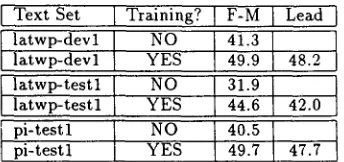
Text. Set Training? I F-M Lead ,latwp-devl NO 41.3
latwp-devl YES 49.9 48.2 latwp-testl NO I 31.9 latwp-testl YES I 44.6 42.0 pi-test 1 NO t 40.5 pi-testl YES I 49.7 47.7
Table 2: Results on Different Test Sets with or with- out Training
Table h Results for Different Feature Combinations
tion. From manually extracted summaries, the sys- t e m automatically learns to combine the following extracted features for summarization:
• short sentence length (less than 5 words)
• inclusion high-score tJaidfsignature words in a sentence
• sentence position in a document (lst, 2nd, 3rd or 4th quarter)
• sentence position in a p a r a g r a p h (initial. me- dial, final)
Inclusion in the high scoring t]* idf signature word set was determined by a variable system p a r a m e t e r (identical to t h a t used in the pre-trainable version of the system). Unlike Kupiec et al.'s experiment, we did not use the cue word feature. Possible values of the p a r a g r a p h feature are identical to how Kupiec et al. used this feature, but applied to all paragraphs because of the short length of the newspaper articles.
3 . 2 . 2 E v a l u a t i o n
We performed two different rounds of experi- ments, the first with newspaper sets and the second with a broader set from the T R E C - 5 collection (Har- m a n and Voorhees, 1996). In both rounds we exper- imented with
* different feature sets
• different d a t a sources
• the effects of training.
In the first round, we trained our system on 70 texts from the L.A. T i m e s / W a s h i n g t o n Post (latwp- d e v l ) and then tested it against 50 new texts from the L.A. T i m e s / W a s h i n g t o n Post (latwp-testl) and 50 texts from the Philadelphia Inquirer (pi-testl). T h e results are shown in Table 2. In b o t h cases, we found t h a t the effects of training increased system scores by as much as 10% F-Measure or greater. Our results are similar to those of Mitra (Mitra, Sing- hal, and Buckley, 1997), but our system with the trainable combiner was able to o u t p e r f o r m the lead sentence summaries.
F-M Sentence] High I Document Length Score Position 24.6
24.6 + 39.2 + 39.7 39.7 39.7 + 39.7 39.7 + 43.8 45.1 45.5 + 45.7 + 46.6 46.6 + 48.4 49.9 +
+ + + +
+ + + +
Paragraph Position
+ +
+ + +
+ +
+ +
+ + +
+ +
+ +
Table 3: Effects of Different Training Features
Table 3 summarizes the results of using dif- ferent training features on the 70 texts from L.A. T i m e s / W a s h i n g t o n Post (latwp-devl). It is ev- ident that positional information is the most valu- able. while the sentence length feature introduces the most noise. High scoring signature word sen- tences contribute, especially in conjunction with the positional information and the p a r a g r a p h feature. High Score refers to using ant]* idfmetric with Word- Net synonyms and name aliases enabled, person names suppressed, but all other name types active.
[image:3.612.340.512.82.163.2] [image:3.612.80.288.82.200.2] [image:3.612.317.535.220.408.2]Text Set ap-testl cr-testl fr-testl ft-testl wsj-testl zf-testl
] F-M I Precision ] Recall ] Short [ High Score [ Doc. Position
49.7 47.5 52.1 Y E S YES YES
36.1 35.1 37.0 YES NO YES
38.4 33.8 44.5 YES NO YES
46.5 41.8 52.3 YES YES YES
51.5 48.5 54.8 YES NO YES
46.6 45.0 48.3 NO YES YES
Para. Position YES YES YES NO
Table 4: Results of Summaries for Different C o r p o r a
4 T a s k - b a s e d E v a l u a t i o n
The goal of our task-based evaluation was to de- termine whether it was possible to retrieve auto- matically generated summaries with similar preci- sion to that of retrieving the full texts. Underpin- ning this was the intention to examine whether a generic s u m m a r y could substitute for a full-text doc- ument given that a common application for s u m m a - rization is assumed to be browsing/scanning sum- marized versions of retrieved documents. The as- sumption is t h a t summaries help to accelerate the browsing/scanning without information loss.
Miike et al. (1994) described preliminary experi- ments comparing browsing of original full texts with browsing of dynamically generated abstracts and re- ported t h a t abstract browsing was about 80% of the original browsing function with precision and recall about the same. There is also an assumption that summaries, as encapsulated views of texts, m a y actually improve retrieval effectiveness. (Brandow, Mitze, and Rau, 1995) reported t h a t using program- matically generated sulnmaries improved precision significantly, but with a d r a m a t i c loss in recall.
We identified 30 T R E C - 5 topics, classified by the e a s y / h a r d retrieval schema of (Voorhees and Har- man, 1996), five as hard, five as easy, and the re- maining twenty were randomly selected. In our eval- uation, I N Q U E R Y (Allan et al., 1996) retrieved and ranked 50 documents for these 30 T R E C - 5 topics. Our s u m m a r y system summarized these 1500 texts at 10%.reduction, 20%, 30%, and at what our sys- t e m considers the B E S T reduction. For each level of reduction, a new index database was built for IN- QUERY, replacing the full texts with summaries.
The 30 queries were run against the new database, retrieving 10,000 documents per query. At this point, some of the summarized versions were dropped as these documents no longer ranked in the 10,000 per topic, as shown in Table 5. For each query, all results except for the documents s u m m a - rized were thrown away. New rankings were com- puted with the remaining summarized documents. Precision for the I N Q U E R Y baseline (INQ.base) was then compared against each level of the reduction. Table 6 shows that at each level of reduction the overall precision dropped for the summarized ver- sions. With more reduction, the drop was more dra-
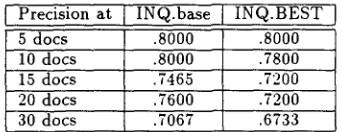
Precision at INQ.BEST I
5 docs .8000 .8000
10 docs .8000 .7800 15 docs .7465 .7200 20 docs .7600 .7200 30 docs .7067 .6733
Table 7: Precision for 5 High Recall Queries
matic. However, the B E S T s u m m a r y version per- formed better than the percentage methods.
We examined in more detail document-level aver- ages for five "easy" topics for which the I N Q U E R Y system had retrieved a high number of texts. Ta- ble 7 reveals t h a t for topics with a high I N Q U E R Y retrieval rate the precision is comparable. We posit t h a t when queries have a high number of relevant documents retrieved, the s u m m a r y system is more likely to reduce information rather than lose infor- mation. Query topics with a high retrieval rate are likely to have documents on the subject m a t t e r and therefore the s u m m a r y just reduces the information, possibly alleviating the browsing/scanning load.
We are currently examining documents lost in the re-ranking process and are cautious in interpreting results because of the difficulty of closely correlating the t e r m selection and ranking algorithms of auto- matic I R systems with h u m a n performance. Our ex- perimental results do indicate, however, that generic summarization is more useful when there are m a n y documents of interest to the user and the user wants to scan summaries and weed out less relevant docu- ment quickly.
5 S u m m a r y
[image:4.612.112.498.88.162.2] [image:4.612.341.512.207.273.2]Run INQ.base I INQ.10% ] INQ.20% I INQ.30% [ INQ.BEST I
Retrieved 1500 1500 1500 1500 1500
Relevant 4551 Rel-ret 415
4551 4551 4551 4551
294 (-29.2%) 332 (-20.0%) 335 (-19.3%) 345 (-16.9%)
Table 5: INQUERY Baseline Recall vs. Summarized Versions
Precision at
5 docs 0.4133 10 docs 0.3700 15 docs 0.3511 0.3383 30 docs 0.3067
0.3267 (-21.0) 0.2600 (-29.7) 0.2400 (-31.6) 0.2217 (-34.5) 0.2056 (-33.0)
INQ.2O% I INQ.30% 0.3800 (- 8.1) 0.3067 (-25.8) 0.2800 (-24.3) 0.2933 (-20.7) 0.2800 (-20.3) 0.2867 (-18.3) 0.2600 (-23.1) 0.2733 (-19.2) 0.2400 (-21.7) 0.2522 (-17.8)
INQ.BEST 0.3333 (-19.4) 0.3100 (-16.2) 0.2867 (-18.3) 0.2717 (-19.7) 0.2556 (-16.7)
Table 6: INQUERY Baseline Precision vs. Summarized Versions
R e f e r e n c e s
Allan, J., J. Callan, B. Croft, L. Ballesteros, J. Broglio, J. Xu, and H. Shu Ellen. 1996. In- query at trec-5. In Proceedings of The Fifth Text REtrieval Conference (TREC-5).
Brandow, Ron, Karl Mitze, and Lisa Rau. 1995. Automatic condensation of electronic publications by sentence selection. Information Processing and Management, 31:675-685.
Edmundson, H. P. 1969. New methods in automatic abstracting. Journal of the Association for Com- puting Machinery, 16(2):264-228.
Harman, Donna and Ellen M. Voorhees, editors. 1996. Proceedings of The Fifth Text REtrieval Conference (TREC-5). National Institute of Stan- dards and Technology, Department of Commerce.
Jing, Y. and B. Croft. 1994. An Association The- saurus for Information Retrieval. Technical Re- port 94-17. Center for Intelligent Information Re- trieval, University of Massachusetts.
Johnson, F. C., C. D. Paice, W. J. Black, and A. P. Neal. 1993. The application of linguistic process- ing to automatic abstract generation. Journal of Documentation and Text Management, 1(3):215- 241.
Jones, Karen Sparck. 1995. Discourse modeling for automatic summaries. In E. Hajicova, M. Cer- venka, O. Leska, and P. Sgall, editors, Prague Lin- guistic Circle Papers, volume 1, pages 201-227. Kupiec, Julian, Jan Pedersen, and Francine Chen.
1995. A trainable document summarizer. In Pro- ceedings of the 18th Annual International SIGIR Conference on Research and Development in In- formation Retrieval, pages 68-73.
McKeown, Kathleen and Dragomir Radev. 1995. Generating summaries of multiple news articles. In Proceedings of the 18th Annual International
SIGIR Conference on Research and Development in Information, pages 74-78.
Miike, Seiji, Etsuo Itho, Kenji Ono, and Kazuo Sumita. 1994. A full text retrieval system with a dynamic abstract generation function. In Pro- ceedings of 17th Annual International ACM SI- GIR Conference on Research and Development in Information Retrieval, pages 152-161.
Mitra, Mandar, Amit Singhal, and Chris Buckley. 1997. An Automatic Text Summarization and Text Extraction. In Proceedings of Intelligent Scalable Text Summarization Workshop, Associa- tion for Computational Linguistics (ACL), pages 39-46.
Nomoto, T. and Y. Matsumoto. 1997. Data relia- bility and its effects on automatic abstraction. In Proceedings of the Fifth Workshop on Very Large Corpora.
Reimer, Ulrich and Udo Hahn. 1988. Text con- densation as knowledge base abstraction. In Pro- ceedings of the 4th Conference on Artificial Intel- ligence Applications (CAIA), pages 338-344. Salton, G. and M. McGill, editors. 1983. hdroduc-
lion to Modern Information Retrieval. McGraw- Hill Book Co., New York, New York.
Tzoukerman, E., J. Klavans, and C. Jacquemin. 1997. Effective use of naural language processing techniques for automatic conflation of multi-word terms: the role of derivational morphology, part of speech tagging and shallow parsing. In Pro- ceedings of the Annual International ACM SIGIR Conference on Research and Development of In- formation Retrieval, pages 148-155.
[image:5.612.95.479.78.128.2]