The Effects of Lexical Resource Quality on Preference Violation Detection
Jesse Dunietz
Computer Science Department Carnegie Mellon University Pittsburgh, PA, 15213, USA [email protected]
Lori Levin and Jaime Carbonell Language Technologies Institute
Carnegie Mellon University Pittsburgh, PA, 15213, USA {lsl,jgc}@cs.cmu.edu
Abstract
Lexical resources such as WordNet and VerbNet are widely used in a multitude of NLP tasks, as are annotated corpora such as treebanks. Often, the resources are used as-is, without question or exam-ination. This practice risks missing sig-nificant performance gains and even entire techniques.
This paper addresses the importance of resource quality through the lens of a challenging NLP task: detecting selec-tional preference violations. We present DAVID, a simple, lexical resource-based preference violation detector. With as-is lexical resources, DAVID achieves an F1-measure of just 28.27%. When the
resource entries and parser outputs for a small sample are corrected, however, the F1-measure on that sample jumps
from 40% to 61.54%, and performance on other examples rises, suggesting that the algorithm becomes practical given re-fined resources. More broadly, this pa-per shows that resource quality matters tremendously, sometimes even more than algorithmic improvements.
1 Introduction
A variety of NLP tasks have been addressed using selectional preferences or restrictions, in-cluding word sense disambiguation (see Navigli (2009)), semantic parsing (e.g., Shi and Mihalcea (2005)), and metaphor processing (see Shutova (2010)). These semantic problems are quite chal-lenging; metaphor analysis, for instance, has long been recognized as requiring considerable seman-tic knowledge (Wilks, 1978; Carbonell, 1980). The advent of extensive lexical resources, an-notated corpora, and a spectrum of NLP tools
presents an opportunity to revisit such challenges from the perspective of selectional preference vio-lations. Detecting these violations, however, con-stitutes a severe stress-test for resources designed for other tasks. As such, it can highlight shortcom-ings and allow quantifying the potential benefits of improving resources such as WordNet (Fellbaum, 1998) and VerbNet (Schuler, 2005).
In this paper, we present DAVID (Detector of Arguments of Verbs with Incompatible Denota-tions), a resource-based system for detecting pref-erence violations. DAVID is one component of METAL (Metaphor Extraction via Targeted Anal-ysis of Language), a new system for identifying, interpreting, and cataloguing metaphors. One pur-pose of DAVID was to explore how far lexical resource-based techniques can take us. Though our initial results suggested that the answer is “not very,” further analysis revealed that the problem lies less in the technique than in the state of exist-ing resources and tools.
Often, it is assumed that the frontier of perfor-mance on NLP tasks is shaped entirely by algo-rithms. Manning (2011) showed that this may not hold for POS tagging – that further improvements may require resource cleanup. In the same spirit, we argue that for some semantic tasks, exemplified by preference violation detection, resource qual-ity may be at least as essential as algorithmic en-hancements.
2 The Preference Violation Detection Task
DAVID builds on the insight of Wilks (1978) that the strongest indicator of metaphoricity is the vi-olation of selectional preferences. For example, only plants can literally be pruned. If laws is the object ofpruned, the verb is likely metaphori-cal. Flagging such semantic mismatches between verbs and arguments is the task of preference vio-lation detection.
We base our definition of preferences on the Pragglejaz guidelines (Pragglejaz Group, 2007) for identifying the most basic sense of a word as the most concrete, embodied, or precise one. Sim-ilarly, we define selectional preferences as the se-mantic constraints imposed by a verb’s most basic sense. Dictionaries may list figurative senses of
prune, but we take the basic sense to be cutting plant growth.
Several types of verbs were excluded from the task because they have very lax preferences. These include verbs of becoming or seeming (e.g., trans-form,appear), light verbs, auxiliaries, and aspec-tual verbs. For the sake of simplifying implemen-tation, phrasal verbs were also ignored.
3 Algorithm Design
To identify violations, DAVID employs a simple algorithm based on several existing tools and re-sources: SENNA (Collobert et al., 2011), a seman-tic role labeling (SRL) system; VerbNet, a com-putational verb lexicon; SemLink (Loper et al., 2007), which includes mappings between Prop-Bank (Palmer et al., 2005) and VerbNet; and WordNet. As one metaphor detection component of METAL’s several, DAVID is designed to favor precision over recall. The algorithm is as follows: 1. Run the Stanford CoreNLP POS tagger (Toutanova et al., 2003) and the TurboParser dependency parser (Martins et al., 2011). 2. Run SENNA to identify the semantic
argu-ments of each verb in the sentence using the PropBank argument annotation scheme (Arg0,
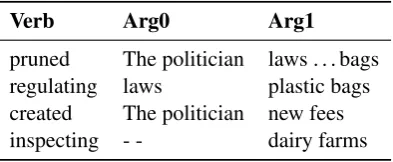
Arg1, etc.). See Table 1 for example output. 3. For each verb V, find all VerbNet entries for
V. Using SemLink, map each PropBank argu-ment name to the corresponding VerbNet the-matic roles in these entries (Agent, Patient, etc.). For example, the VerbNet class forprune
iscarve-21.2-2. SemLink mapsArg0 to the Agent of carve-21.2-2 and Arg1 to the Patient.
4. Retrieve from VerbNet the selectional restric-tions of each thematic role. In our running example, VerbNet specifies +int control
and+concretefor the Agent and Patient of
carve-21.2-2, respectively.
5. If the head of any argument cannot be inter-preted to meetV’s preferences, flagV as a vi-olation.
“The politician pruned laws regulating plastic bags, and created new fees for inspecting dairy
farms.”
Verb Arg0 Arg1
pruned The politician laws . . . bags
regulating laws plastic bags
created The politician new fees
[image:2.595.319.516.98.179.2]inspecting - - dairy farms
Table 1: SENNA’s SRL output for the example sentence above. Though this example demon-strates only two arguments, SENNA is capable of labeling up to six.
Restriction WordNet Synsets
animate animate being.n.01
people.n.01 person.n.01
concrete physical object.n.01
matter.n.01 substance.n.01
organization social group.n.01 district.n.01
Table 2: DAVID’s mappings between some common VerbNet restriction types and WordNet synsets.
Each VerbNet restriction is interpreted as man-dating or forbidding a set of WordNet hypernyms, defined by a custom mapping (see Table 2). For example, VerbNet requires both the Patient of a verb in carve-21.2-2 and the Theme
of a verb in wipe manner-10.4.1-1 to
be concrete. By empirical inspection, concrete nouns are hyponyms of the WordNet synsets
physical object.n.01, matter.n.03, or substance.n.04. Laws (the Patient of
prune) is a hyponym of none of these, so prune
would be flagged as a violation.
4 Corpus Annotation
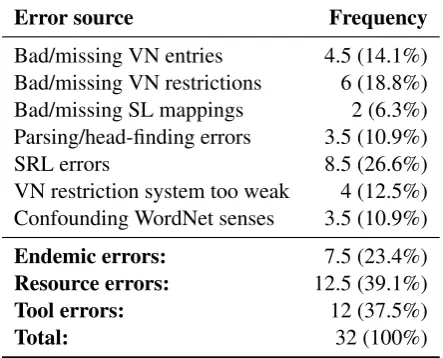
[image:2.595.311.521.255.389.2]dis-Error source Frequency
Bad/missing VN entries 4.5 (14.1%)
Bad/missing VN restrictions 6 (18.8%)
Bad/missing SL mappings 2 (6.3%)
Parsing/head-finding errors 3.5 (10.9%)
SRL errors 8.5 (26.6%)
VN restriction system too weak 4 (12.5%) Confounding WordNet senses 3.5 (10.9%)
Endemic errors: 7.5 (23.4%)
Resource errors: 12.5 (39.1%)
Tool errors: 12 (37.5%)
[image:3.595.71.293.64.243.2]Total: 32 (100%)
Table 3: Sources of error in 90 randomly selected sentences. For errors that were due to a combi-nation of sources, 1/2 point was awarded to each source. (VN stands for VerbNet and SL for Sem-Link.)
cussing until consensus.
5 Initial Results
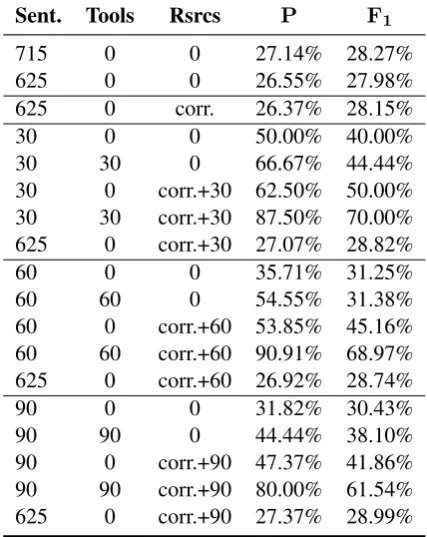
As the first row of Table 4 shows, our initial eval-uation left little hope for the technique. With such low precision and F1, it seemed a lexical
resource-based preference violation detector was out. When we analyzed the errors in 90 randomly selected sentences, however, we found that most were not due to systemic problems with the ap-proach; rather, they stemmed from SRL and pars-ing errors and misspars-ing or incorrect resource entries (see Table 3). Armed with this information, we de-cided to explore how viable our algorithm would be absent these problems.
6 Refining The Data
To evaluate the effects of correcting DAVID’s in-puts, we manually corrected the tool outputs and resource entries that affected the aforementioned 90 sentences. SRL output was corrected for ev-ery sentence, while SemLink and VerbNet entries were corrected only for each verb that produced an error.
6.1 Corrections to Tool Output (Parser/SRL) Guided by the PropBank database and annotation guidelines, we corrected all errors in core role assignments from SENNA. These corrections in-cluded relabeling arguments, adding missed argu-ments, fixing argument spans, and deleting
anno-tations for non-verbs. The only parsrelated er-ror we corrected was a mislabeled noun.
6.2 Correcting Corrupted Data in VerbNet The VerbNet download is missing several sub-classes that are referred to by SemLink or that have been updated on the VerbNet website. Some roles also have not been updated to the latest ver-sion, and some subclasses are listed with incor-rect IDs. These problems, which caused SemLink mappings to fail, were corrected before reviewing errors from the corpus.
Six subclasses needed to be fixed, all of which were easily detected by a simple script that did not depend on the 90-sentence subcorpus. We there-fore expect that few further changes of this type would be needed for a more complete resource re-finement effort.
6.3 Corpus-Based Updates to SemLink Our modifications to SemLink’s mappings in-cluded adding missing verbs, adding missing roles to mappings, and correcting mappings to more ap-propriate classes or roles. We also added null map-pings in cases where a PropBank argument had no corresponding role in VerbNet. This makes the system’s strategy for ruling out mappings more re-liable.
No corrections were made purely based on the sample. Any time a verb’s mappings were edited, VerbNet was scoured for plausible mappings for every verb sense in PropBank, and any nonsensi-cal mappings were deleted. For example, when the phrase go dormant caused an error, we in-spected the mappings forgo. Arguments of all but 2 of the 7 available mappings were edited, either to add missing arguments or to correct nonsensi-cal ones. These changes actually had a net neg-ative impact on test set performance because the bad mappings had masked parsing and selectional preference problems.
6.4 Corpus-Based Updates to VerbNet Nineteen VerbNet classes were modified, and one class had to be added. The modifications gener-ally involved adding, correcting, or deleting se-lectional restrictions, often by introducing or re-arranging subclasses. Other changes amounted to fixing clerical errors, such as incorrect role names or restrictions that had been ANDed instead of ORed.
An especially difficult problem was an inconsis-tency in the semantics of VerbNet’s subclass sys-tem. In some cases, the restrictions specified on a verb in a subclass did not apply to subcatego-rization frames inherited from a superclass, but in other cases the restrictions clearly applied to all frames. The conflict was resolved by duplicating subclassed verbs in the top-level class whenever different selectional restrictions were needed for the two sets of frames.
As with SemLink, samples determined only
whichclasses were modified, not what modifica-tions were made. Any non-obvious changes to selectional restrictions were verified by examin-ing dozens of verb instances from SketchEngine’s (Kilgarriff et al., 2004) corpus. For example, the Agent of seek was restricted to +animate, but the corpus confirmed that organizations are com-monly described non-metaphorically as seeking, so the restriction was updated to +animate | +organization.
7 Results After Resource Refinement
After making corrections for each set of 10 sen-tences, we incrementally recomputedF1 and
pre-cision, both on the subcorpus corrected so far and on a test set of all 625 sentences that were never corrected. (The manual nature of the correction ef-fort made testingk-fold subsets impractical.) The results for 30-sentence increments are shown in Table 4.
The most striking feature of these figures is how much performance improves on corrected sen-tences: for the full 90 sentences, F1 rose from
30.43% to 61.54%, and precision rose even more dramatically from 31.82% to 80.00%. Interest-ingly, resource corrections alone generally made a larger difference than tool corrections alone, sug-gesting that resources may be the dominant fac-tor in resource-intensive tasks such as this one. Even more compellingly, the improvement from correcting both the tools and the resources was
nearly double the sum of the improvements from each alone: tool and resource improvements inter-act synergistically.
The effects on the test corpus are harder to interpret. Due to a combination of SRL prob-lems and the small number of sentences cor-rected, the scores on the test set improved little with resource correction; in fact, they even dipped slightly between the 30- and 60-sentence incre-ments. Nonetheless, we contend that our results testify to the generality of our corrections: after each iteration, every altered result was either an error fixed or an error that should have appeared before but had been masked by another. Note also that all results on the test set are without corrected tool output; presumably, these sentences would also have improved synergistically with more ac-curate SRL. How long corrections would continue to improve performance is a question that we did not have the resources to answer, but our results suggest that there is plenty of room to go.
Some errors, of course, are endemic to the ap-proach and cannot be fixed either by improved re-sources or by better tools. For example, we con-sider every WordNet sense to be plausible, which produces false negatives. Additionally, the selec-tional restrictions specified by VerbNet are fairly loose; a more refined set of categories might cap-ture the range of verbs’ restrictions more accu-rately.
8 Implications for Future Refinement Efforts
Although improving resources is infamously labor-intensive, we believe that similarly refining the remainder of VerbNet and SemLink would be doable. In our study, it took about 25-35 person-hours to examine about 150 verbs and to mod-ify 20 VerbNet classes and 25 SemLink verb en-tries (excluding time for SENNA corrections, fix-ing corrupt VerbNet data, and analysis of DAVID’s errors). Extrapolating from our experience, we es-timate that it would take roughly 6-8 person-weeks to systematically fix this particular set of issues with VerbNet.
With the addition of some metadata from the gen-eration process, it would then be possible to follow the corrected mappings back to annotations from which they were generated and fix those annota-tions. One downside of this approach is that if the mappings were ever regenerated from the anno-tated corpus, any mappings not encountered in the corpus would have to be added back afterwards.
Null role mappings would be particularly thorny to implement. To add a null mapping, we must know that a role definitely does not belong, and is not just incidentally missing from an exam-ple. For instance, VerbNet’s defend-85 class truly has no equivalent to Arg2 in PropBank’s
defend.01, butArg0orArg1may be missing for other reasons (e.g., in a passive). It may be best to simply omit null mappings, as is currently done. Alternatively, full parses from the Penn Treebank, on which PropBank is based, might allow distin-guishing phenomena such as passives where argu-ments are predictably omitted.
The maintainers of VerbNet and PropBank are aware of many of the issues we have raised, and we have been in contact with them about possi-ble approaches to fixing them. They are particu-larly aware of the inconsistent semantics of selec-tional restrictions on VerbNet subclasses, and they hope to fix this issue within a larger attempt at re-tooling VerbNet’s selectional restrictions. In the meantime, we are sharing our VerbNet modifica-tions with them for them to verify and incorporate. We are also sharing our SemLink changes so that they can, if they choose, continue manual correc-tion efforts or trace SemLink problems back to the annotated corpus.
9 Conclusion
Our results argue for investing effort in developing and fixing resources, in addition to developing bet-ter NLP tools. Resource and tool improvements interact synergistically: better resources multiply the effect of algorithm enhancements. Gains from fixing resources may sometimes even exceed what the best possible algorithmic improvements can provide. We hope the NLP community will take up the challenge of investing in its resources to the extent that its tools demand.
Acknowledgments
Thanks to Eric Nyberg for suggesting building a system like DAVID, to Spencer Onuffer for his
an-Sent. Tools Rsrcs P F1
715 0 0 27.14% 28.27%
625 0 0 26.55% 27.98%
625 0 corr. 26.37% 28.15%
30 0 0 50.00% 40.00%
30 30 0 66.67% 44.44%
30 0 corr.+30 62.50% 50.00%
30 30 corr.+30 87.50% 70.00%
625 0 corr.+30 27.07% 28.82%
60 0 0 35.71% 31.25%
60 60 0 54.55% 31.38%
60 0 corr.+60 53.85% 45.16%
60 60 corr.+60 90.91% 68.97%
625 0 corr.+60 26.92% 28.74%
90 0 0 31.82% 30.43%
90 90 0 44.44% 38.10%
90 0 corr.+90 47.37% 41.86%
90 90 corr.+90 80.00% 61.54%
[image:5.595.309.523.65.334.2]625 0 corr.+90 27.37% 28.99%
Table 4: Performance on preference violation de-tection task. Column 1 shows the sentence count. Columns 2 and 3 show how many sentences’ SRL/parsing and resource errors, respectively, had been fixed (“corr.” indicates corrupted files).
notation efforts, and to Davida Fromm for curating METAL’s corpus of Engish sentences.
This work was supported by the Intelligence Advanced Research Projects Activity (IARPA) via Department of Defense US Army Research Laboratory contract number W911NF-12-C-0020. The U.S. Government is authorized to reproduce and distribute reprints for Governmental purposes notwithstanding any copyright annotation thereon. Disclaimer: The views and conclusions contained herein are those of the authors and should not be interpreted as necessarily representing the official policies or endorsements, either expressed or im-plied, of IARPA, DoD/ARL, or the U.S. Govern-ment.
References
Jaime G. Carbonell. 1980. Metaphor: a key to ex-tensible semantic analysis. In Proceedings of the 18th annual meeting on Association for Computa-tional Linguistics, ACL ’80, pages 17–21, Strouds-burg, PA, USA. Association for Computational Lin-guistics.
Karlen, Koray Kavukcuoglu, and Pavel P. Kuksa. 2011. Natural language processing (almost) from scratch. J. Mach. Learn. Res., 12:2493–2537, November.
Christiane Fellbaum, editor. 1998. WordNet: An Elec-tronic Lexical Database. Bradford Books.
Adam Kilgarriff, Pavel Rychly, Pavel Smrz, and David Tugwell. 2004. The Sketch Engine. InProceedings of EURALEX.
Edward Loper, Szu-ting Yi, and Martha Palmer. 2007. Combining lexical resources: Mapping between PropBank and VerbNet. In Proceedings of the 7th International Workshop on Computational Linguis-tics, Tilburg, the Netherlands.
Christopher D Manning. 2011. Part-of-speech tag-ging from 97% to 100%: is it time for some linguis-tics? In Computational Linguistics and Intelligent Text Processing, pages 171–189. Springer.
Andr´e F. T. Martins, Noah A. Smith, Pedro M. Q. Aguiar, and M´ario A. T. Figueiredo. 2011. Dual de-composition with many overlapping components. In Proceedings of the Conference on Empirical Meth-ods in Natural Language Processing, EMNLP ’11, pages 238–249, Stroudsburg, PA, USA. Association for Computational Linguistics.
Roberto Navigli. 2009. Word sense disambiguation: A survey. ACM Computing Surveys (CSUR), 41(2):10.
Martha Palmer, Daniel Gildea, and Paul Kingsbury. 2005. The Proposition Bank: An annotated cor-pus of semantic roles. Computational Linguistics, 31(1):71–106.
Pragglejaz Group. 2007. MIP: A method for iden-tifying metaphorically used words in discourse. Metaphor and Symbol, 22(1):1–39.
Karin K. Schuler. 2005. VerbNet: A Broad-Coverage, Comprehensive Verb Lexicon. Ph.D. the-sis, University of Pennsylvania, Philadelphia, PA. AAI3179808.
Lei Shi and Rada Mihalcea. 2005. Putting pieces to-gether: Combining FrameNet, VerbNet and Word-Net for robust semantic parsing. In Alexander Gelbukh, editor,Computational Linguistics and In-telligent Text Processing, volume 3406 of Lec-ture Notes in Computer Science, pages 100–111. Springer Berlin Heidelberg.
Ekaterina Shutova. 2010. Models of metaphor in NLP. InProceedings of the 48th Annual Meeting of the As-sociation for Computational Linguistics, ACL ’10, pages 688–697, Stroudsburg, PA, USA. Association for Computational Linguistics.
Kristina Toutanova, Dan Klein, Christopher D. Man-ning, and Yoram Singer. 2003. Feature-rich part-of-speech tagging with a cyclic dependency network. InProceedings of the 2003 Conference of the North
American Chapter of the Association for Computa-tional Linguistics on Human Language Technology - Volume 1, NAACL ’03, pages 173–180, Strouds-burg, PA, USA. Association for Computational Lin-guistics.