Proceedings of the 49th Annual Meeting of the Association for Computational Linguistics, pages 1278–1287,
Adjoining Tree-to-String Translation
Yang Liu, Qun Liu, and Yajuan L ¨u
Key Laboratory of Intelligent Information Processing Institute of Computing Technology
Chinese Academy of Sciences P.O. Box 2704, Beijing 100190, China
{yliu,liuqun,lvyajuan}@ict.ac.cn
Abstract
We introduce synchronous tree adjoining grammars (TAG) into tree-to-string transla-tion, which converts a source tree to a target string. Without reconstructing TAG deriva-tions explicitly, our rule extraction algo-rithm directly learns tree-to-string rules from aligned Treebank-style trees. As tree-to-string translation casts decoding as a tree parsing problem rather than parsing, the decoder still runs fast when adjoining is included. Less than 2 times slower, the adjoining tree-to-string system improves translation quality by +0.7 BLEU over the baseline system only al-lowing for tree substitution on NIST Chinese-English test sets.
1 Introduction
Syntax-based translation models, which exploit hi-erarchical structures of natural languages to guide machine translation, have become increasingly pop-ular in recent years. So far, most of them have been based on synchronous context-free grammars (CFG) (Chiang, 2007), tree substitution grammars (TSG) (Eisner, 2003; Galley et al., 2006; Liu et al., 2006; Huang et al., 2006; Zhang et al., 2008), and inversion transduction grammars (ITG) (Wu, 1997; Xiong et al., 2006). Although these for-malisms present simple and precise mechanisms for describing the basic recursive structure of sentences, they are not powerful enough to model some impor-tant features of natural language syntax. For ex-ample, Chiang (2006) points out that the transla-tion of languages that can stack an unbounded num-ber of clauses in an “inside-out” way (Wu, 1997)
provably goes beyond the expressive power of syn-chronous CFG and TSG. Therefore, it is necessary to find ways to take advantage of more powerful syn-chronous grammars to improve machine translation. Synchronous tree adjoining grammars (TAG) (Shieber and Schabes, 1990) are a good candidate. As a formal tree rewriting system, TAG (Joshi et al., 1975; Joshi, 1985) provides a larger domain of lo-cality than CFG to state linguistic dependencies that are far apart since the formalism treats trees as basic building blocks. As a mildly context-sensitive gram-mar, TAG is conjectured to be powerful enough to model natural languages. Synchronous TAG gener-alizes TAG by allowing the construction of a pair of trees using the TAG operations of substitution and adjoining on tree pairs. The idea of using syn-chronous TAG in machine translation has been pur-sued by several researchers (Abeille et al., 1990; Prigent, 1994; Dras, 1999), but only recently in its probabilistic form (Nesson et al., 2006; De-Neefe and Knight, 2009). Shieber (2007) argues that probabilistic synchronous TAG possesses appealing properties such as expressivity and trainability for building a machine translation system.
However, one major challenge for applying syn-chronous TAG to machine translation is computa-tional complexity. While TAG requiresO(n6)time for monolingual parsing, synchronous TAG requires
oÚ zˇongtˇong
NN NP
President X ,
α1
{I mˇeigu´o
NR NP
US X ,
α2
NP∗ NP↓
NP
X∗ X↓ X ,
β1
NP
NP∗ NP
NN
oÚ zˇongtˇong
X
X∗ X
President ,
β2
NP
NP
NR
{I mˇeigu´o
NP
NN
oÚ zˇongtˇong
X
X
US X
President ,
[image:2.612.95.514.73.272.2]α3
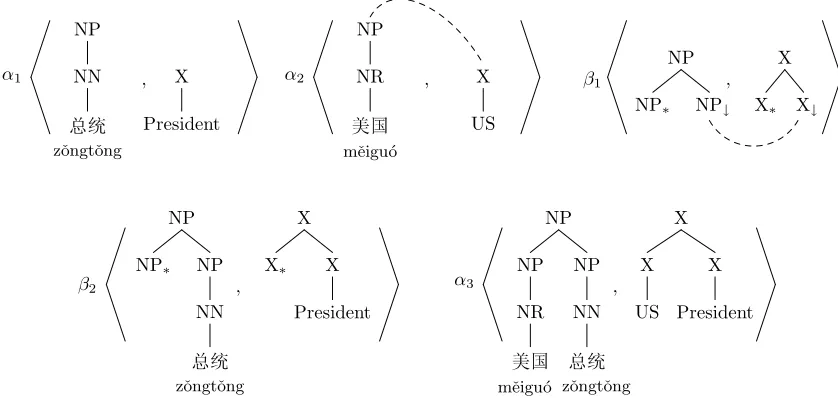
Figure 1: Initial and auxiliary tree pairs. The source side (Chinese) is a Treebank-style linguistic tree. The target side (English) is a purely structural tree using a single non-terminal (X). By convention, substitution and foot nodes are marked with a down arrow (↓) and an asterisk (∗), respectively. The dashed lines link substitution sites (e.g., NP↓and
X↓inβ1) and adjoining sites (e.g., NP and X inα2) in tree pairs. Substituting the initial tree pairα1at the NP↓-X↓
node pair in the auxiliary tree pairβ1yields a derived tree pairβ2, which can be adjoined at NN-X inα2to generate α3.
the use of synchronous TIG for machine translation and report promising results. DeNeefe and Knight (2009) prove that adjoining can improve translation quality significantly over a state-of-the-art string-to-tree system (Galley et al., 2006) that uses syn-chronous TSG with tractable computational com-plexity.
In this paper, we introduce synchronous TAG into tree-to-string translation (Liu et al., 2006; Huang et al., 2006), which is the simplest and fastest among syntax-based approaches (Section 2). We propose a new rule extraction algorithm based on GHKM (Galley et al., 2004) that directly induces a syn-chronous TAG from an aligned and parsed bilingual corpus without converting Treebank-style trees to TAG derivations explicitly (Section 3). As tree-to-string translation takes a source parse tree as input, the decoding can be cast as a tree parsing problem (Eisner, 2003): reconstructing TAG derivations from a derived tree using tree-to-string rules that allow for both substitution and adjoining. We describe how to convert TAG derivations to translation forest (Sec-tion 4). We evaluated the new tree-to-string system on NIST Chinese-English tests and obtained con-sistent improvements (+0.7 BLEU) over the
STSG-based baseline system without significant loss in ef-ficiency (1.6 times slower) (Section 5).
2 Model
A synchronous TAG consists of a set of linked ele-mentary tree pairs: initial and auxiliary. An initial tree is a tree of which the interior nodes are all la-beled with non-terminal symbols, and the nodes on the frontier are either words or non-terminal sym-bols marked with a down arrow (↓). An auxiliary tree is defined as an initial tree, except that exactly one of its frontier nodes must be marked as foot node (∗). The foot node must be labeled with a non-terminal symbol that is the same as the label of the root node.
Synchronous TAG defines two operations to build derived tree pairs from elementary tree pairs:
substi-tution and adjoining. Nodes in initial and auxiliary
tree pairs are linked to indicate the correspondence between substitution and adjoining sites. Figure 1 shows three initial tree pairs (i.e., α1, α2, and α3) and two auxiliary tree pairs (i.e., β1 and β2). The dashed lines link substitution nodes (e.g., NP↓ and
{I
mˇeigu´o
oÚ
zˇongtˇong
nê
` aob¯amˇa
é
du`ı
lÂ
qi¯angj¯ı
¯
sh`ıji`an
±
yˇuyˇı
gI
qiˇanz´e
0 1 2 3 4 5 6 7 8
NR NN NR P NN NN VV NN
NP NP NP NP NP
NP PP VP
NP VP
IP
[image:3.612.118.496.78.272.2]US President Obama has condemned the shooting incident
Figure 2: A training example. Tree-to-string rules can be extracted from shaded nodes.
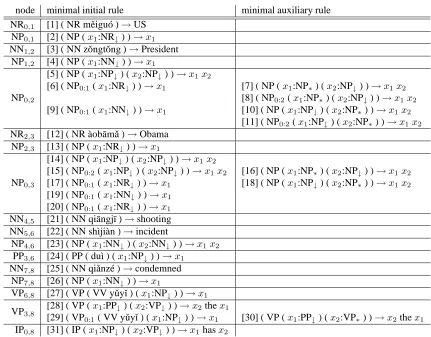
node minimal initial rule minimal auxiliary rule NR0,1 [1] ( NR mˇeigu ´o )→US
NP0,1 [2] ( NP (x1:NR↓) )→x1
NN1,2 [3] ( NN zˇongtˇong )→President
NP1,2 [4] ( NP (x1:NN↓) )→x1
[5] ( NP (x1:NP↓) (x2:NP↓) )→x1x2
[6] ( NP0:1(x1:NR↓) )→x1 [7] ( NP (x1:NP∗) (x2:NP↓) )→x1x2
NP0,2 [8] ( NP0:2(x1:NP∗) (x2:NP↓) )→x1x2
[9] ( NP0:1(x1:NN↓) )→x1 [10] ( NP (x1:NP↓) (x2:NP∗) )→x1x2
[11] ( NP0:2(x1:NP↓) (x2:NP∗) )→x1x2
NR2,3 [12] ( NR `aob¯amˇa )→Obama
NP2,3 [13] ( NP (x1:NR↓) )→x1
[14] ( NP (x1:NP↓) (x2:NP↓) )→x1x2
[15] ( NP0:2(x1:NP↓) (x2:NP↓) )→x1x2 [16] ( NP (x1:NP∗) (x2:NP↓) )→x1x2
NP0,3 [17] ( NP0:1(x1:NR↓) )→x1 [18] ( NP (x1:NP↓) (x2:NP∗) )→x1x2
[19] ( NP0:1(x1:NN↓) )→x1
[20] ( NP0:1(x1:NR↓) )→x1
NN4,5 [21] ( NN qi¯angj¯ı )→shooting
NN5,6 [22] ( NN sh`ıji`an )→incident
NP4,6 [23] ( NP (x1:NN↓) (x2:NN↓) )→x1x2
PP3,6 [24] ( PP ( du`ı ) (x1:NP↓) )→x1
NN7,8 [25] ( NN qiˇanz´e )→condemned
NP7,8 [26] ( NP (x1:NN↓) )→x1
VP6,8 [27] ( VP ( VV y ˇuyˇı ) (x1:NP↓) )→x1
[28] ( VP (x1:PP↓) (x2:VP↓) )→x2thex1
VP3,8 [29] ( VP
0:1( VV y ˇuyˇı ) (x1:NP↓) )→x1 [30] ( VP (x1:PP↓) (x2:VP∗) )→x2thex1
IP0,8 [31] ( IP (x1:NP↓) (x2:VP↓) )→x1hasx2
Table 1: Minimal initial and auxiliary rules extracted from Figure 2. Note that an adjoining site has a span as subscript. For example, NP0:1in rule 6 indicates that the node is an adjoining site linked to a target node dominating the target
string spanning from position 0 to position 1 (i.e.,x1). The target tree is hidden because tree-to-string translation only
[image:3.612.89.520.320.657.2]the NP↓-X↓ node pair in the auxiliary tree pair β1 yields a derived tree pairβ2, which can be adjoined at NN-X inα2to generateα3.
For simplicity, we represent α2as a tree-to-string rule:
( NP0:1( NR mˇeigu ´o ) )→US
where NP0:1 indicates that the node is an adjoin-ing site linked to a target node dominatadjoin-ing the tar-get string spanning from position 0 to position 1 (i.e., “US”). The target tree is hidden because tree-to-string translation only considers the target surface string. Similarly,β1can be written as
( NP (x1:NP∗) (x2:NP↓) )→x1x2
where x denotes a non-terminal and the subscripts indicate the correspondence between source and tar-get non-terminals.
The parameters of a probabilistic synchronous TAG are
X
α
Pi(α) = 1 (1)
X
α
Ps(α|η) = 1 (2)
X
β
Pa(β|η) +Pa(NONE|η) = 1 (3)
where α ranges over initial tree pairs, β over aux-iliary tree pairs, and η over node pairs. Pi(α) is the probability of beginning a derivation with α;
Ps(α|η) is the probability of substituting α at η; Pa(β|η) is the probability of adjoining β at η; fi-nally,Pa(NONE|η)is the probability of nothing ad-joining atη.
For tree-to-string translation, these parameters can be treated as feature functions of a discrimi-native framework (Och, 2003) combined with other conventional features such as relative frequency, lex-ical weight, rule count, language model, and word count (Liu et al., 2006).
3 Rule Extraction
Inducing a synchronous TAG from training data often begins with converting Treebank-style parse trees to TAG derivations (Xia, 1999; Chen and Vijay-Shanker, 2000; Chiang, 2003). DeNeefe and
Knight (2009) propose an algorithm to extract syn-chronous TIG rules from an aligned and parsed bilingual corpus. They first classify tree nodes into heads, arguments, and adjuncts using heuristics (Collins, 2003), then transform a Treebank-style tree into a TIG derivation, and finally extract minimally-sized rules from the derivation tree and the string on the other side, constrained by the alignments. Proba-bilistic models can be estimated by collecting counts over the derivation trees.
However, one challenge is that there are many TAG derivations that can yield the same derived tree, even with respect to a single grammar. It is difficult to choose appropriate single derivations that enable the resulting grammar to translate unseen data well. DeNeefe and Knight (2009) indicate that the way to reconstruct TIG derivations has a direct effect on fi-nal translation quality. They suggest that one possi-ble solution is to use derivation forest rather than a single derivation tree for rule extraction.
Alternatively, we extend the GHKM algorithm (Galley et al., 2004) to directly extract tree-to-string rules that allow for both substitution and adjoining from aligned and parsed data. There is no need for transforming a parse tree into a TAG derivation ex-plicitly before rule extraction and all derivations can be easily reconstructed using extracted rules. 1 Our rule extraction algorithm involves two steps: (1) ex-tracting minimal rules and (2) composition.
3.1 Extracting Minimal Rules
Figure 2 shows a training example, which consists of a Chinese parse tree, an English string, and the word alignment between them. By convention, shaded nodes are called frontier nodes from which tree-to-string rules can be extracted. Note that the source phrase dominated by a frontier node and its corre-sponding target phrase are consistent with the word alignment: all words in the source phrase are aligned to all words in the corresponding target phrase and vice versa.
We distinguish between three categories of
tree-1
to-string rules:
1. substitution rules, in which the source tree is an initial tree without adjoining sites.
2. adjoining rules, in which the source tree is an initial tree with at least one adjoining site.
3. auxiliary rules, in which the source tree is an auxiliary tree.
For example, in Figure 1,α1is a substitution rule,
α2 is an adjoining rule, andβ1is an auxiliary rule. Minimal substitution rules are the same with those in STSG (Galley et al., 2004; Liu et al., 2006) and therefore can be extracted directly using GHKM. By minimal, we mean that the interior nodes are not frontier and cannot be decomposed. For example, in Table 2, rule 1 (for shortr1) is a minimal substi-tution rule extracted from NR0,1.
Minimal adjoining rules are defined as minimal substitution rules, except that each root node must be an adjoining site. In Table 2, r2 is a minimal substitution rule extracted from NP0,1. As NP0,1 is a descendant of NP0,2 with the same label, NP0,1 is a possible adjoining site. Therefore, r6 can be derived fromr2and licensed as a minimal adjoining rule extracted from NP0,2. Similarly, four minimal adjoining rules are extracted from NP0,3 because it has four frontier descendants labeled with NP.
Minimal auxiliary rules are derived from minimal substitution and adjoining rules. For example, in Ta-ble 2,r7 andr10are derived from the minimal sub-stitution rule r5 while r8 and r11 are derived from
r15. Note that a minimal auxiliary rule can have ad-joining sites (e.g.,r8).
Table 1 lists 17 minimal substitution rules, 7 min-imal adjoining rules, and 7 minmin-imal auxiliary rules extracted from Figure 2.
3.2 Composition
We can obtain composed rules that capture rich con-texts by substituting and adjoining minimal initial and auxiliary rules. For example, the composition of r12, r17, r25, r26, r29, and r31 yields an initial rule with two adjoining sites:
( IP ( NP0:1( NR `aob¯amˇa ) ) ( VP2:3( VV y ˇuyˇı )
( NP ( NN qiˇanz´e ) ) ) )→Obama has condemned
Note that the source phrase “`aob¯amˇa. . . y ˇuyˇı qiˇanz´e” is discontinuous. Our model allows both the source and target phrases of an initial rule with adjoining sites to be discontinuous, which goes beyond the ex-pressive power of synchronous CFG and TSG.
Similarly, the composition of two auxiliary rules
r8andr16yields a new auxiliary rule:
( NP ( NP (x1:NP∗) (x2:NP↓) ) (x3:NP↓) )→x1x2x3
We first compose initial rules and then com-pose auxiliary rules, both in a bottom-up way. To maintain a reasonable grammar size, we follow Liu (2006) to restrict that the tree height of a rule is no greater than 3 and the source surface string is no longer than 7.
To learn the probability models Pi(α), Ps(α|η), Pa(β|η), andPa(NONE|η), we collect and normal-ize counts over these extracted rules following De-Neefe and Knight (2009).
4 Decoding
Given a synchronous TAG and a derived source tree
π, a tree-to-string decoder finds the English yield of the best derivation of which the Chinese yield matchesπ:
ˆ
e=e
arg max
Ds.t.f(D)=π P(D)
(4)
This is called tree parsing (Eisner, 2003) as the de-coder finds ways of decomposingπinto elementary trees.
Tree-to-string decoding with STSG is usually treated as forest rescoring (Huang and Chiang, 2007) that involves two steps. The decoder first con-verts the input tree into a translation forest using a translation rule set by pattern matching. Huang et al. (2006) show that this step is a depth-first search with memorization inO(n)time. Then, the decoder searches for the best derivation in the translation for-est intersected with n-gram language models and outputs the target string. 2
Decoding with STAG, however, poses one major challenge to forest rescoring. As translation forest only supports substitution, it is difficult to construct a translation forest for STAG derivations because of
2
α1
IP0,8
NP2,3 VP3,8
↓
NR2,3
↓
α2
NR2,3
nê
` aob¯amˇa
β1
NP0,3
NP1,2 NP2,3
∗
NN1,2
↓
β2
NP0,3
NP0,2
↓ NP
2,3
∗
β3
NP0,2
NP0,1
NP1,2
∗
NR0,1
↓
α3
NN2,3
oÚ
zˇongtˇong
elementary tree translation rule
α1 r1 ( IP ( NP0:1(x1:NR↓) ) (x2:VP↓) )→x1x2 α2 r2 ( NR `aob¯amˇa )→Obama
β1 r3 ( NP ( NP0:1(x1:NN↓) ) (x2:NP∗) )→x1x2 β2 r4 ( NP (x1:NP↓) (x2:NP∗) )→x1x2
[image:6.612.160.454.76.371.2]β3 r5 ( NP ( NP (x1:NR↓) ) (x2:NP∗) )→x1x2 α3 r6 ( NN zˇongtˇong )→President
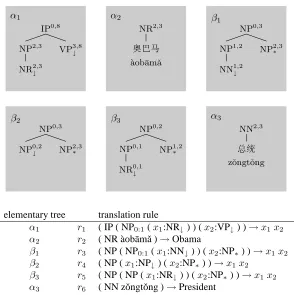
Figure 3: Matched trees and corresponding rules. Each node in a matched tree is annotated with a span as superscript to facilitate identification. For example, IP0,8inα
1indicates that IP0,8in Figure 2 is matched. Note that its left child
NP2,3is not its direct descendant in Figure 2, suggesting that adjoining is required at this site.
α1
α2(1.1) β1(1) β2(1)
β3(1) α3(1.1)
IP0,8
NP0
,2 VP3,8
NR0
,1 NN1,2 NR2,3
e1 e2
e3 e4
hyperedge translation rule
e1 r1+r4 ( IP ( NP (x1:NP↓) ( NP (x2:NR↓) ) ) (x3:VP↓)→x1x2x3
e2 r1+r3+r5 ( IP ( NP ( NP (x1:NP↓) (x2:NP↓) ) ( NP (x3:NR↓) ) ) (x4:VP↓) )→x1x2x3x4 e3 r6 ( NN zˇongtˇong )→President
e4 r2 ( NR `aob¯amˇa )→Obama
Figure 4: Converting a derivation forest to a translation forest. In a derivation forest, a node in a derivation forest is a matched elementary tree. A hyperedge corresponds to operations on related trees: substitution (dashed) or adjoining (solid). We use Gorn addresses as tree addresses.α2(1.1)denotes thatα2is substituted in the treeα1at the node NR
2,3 ↓
[image:6.612.76.546.443.627.2]adjoining. Therefore, we divide forest rescoring for STAG into three steps:
1. matching, matching STAG rules against the in-put tree to obtain a TAG derivation forest;
2. conversion, converting the TAG derivation for-est into a translation forfor-est;
3. intersection, intersecting the translation forest with ann-gram language model.
Given a tree-to-string rule, rule matching is to find a subtree of the input tree that is identical to the source side of the rule. While matching STSG rules against a derived tree is straightforward, it is some-what non-trivial for STAG rules that move beyond nodes of a local tree. We follow Liu et al. (2006) to enumerate all elementary subtrees and match STAG rules against these subtrees. This can be done by first enumerating all minimal initial and auxiliary trees and then combining them to obtain composed trees, assuming that every node in the input tree is fron-tier (see Section 3). We impose the same restrictions on the tree height and length as in rule extraction. Figure 3 shows some matched trees and correspond-ing rules. Each node in a matched tree is annotated with a span as superscript to facilitate identification. For example, IP0,8 inα1 means that IP0,8 in Figure 2 is matched. Note that its left child NP2,3 is not its direct descendant in Figure 2, suggesting that ad-joining is required at this site.
A TAG derivation tree specifies uniquely how a derived tree is constructed using elementary trees (Joshi, 1985). A node in a derivation tree is an ele-mentary tree and an edge corresponds to operations on related elementary trees: substitution or adjoin-ing. We introduce TAG derivation forest, a com-pact representation of multiple TAG derivation trees, to encodes all matched TAG derivation trees of the input derived tree.
Figure 4 shows part of a TAG derivation forest. The six matched elementary trees are nodes in the derivation forest. Dashed and solid lines represent substitution and adjoining, respectively. We use Gorn addresses as tree addresses: 0 is the address of the root node,pis the address of thepthchild of the root node, andp·qis the address of theqthchild of the node at the address p. The derivation forest
should be interpreted as follows:α2is substituted in the treeα1at the node NR2↓,3of address 1.1 (i.e., the first child of the first child of the root node) andβ1is adjoined in the treeα1at the node NP2,3 of address 1.
To take advantage of existing decoding tech-niques, it is necessary to convert a derivation forest to a translation forest. A hyperedge in a transla-tion forest corresponds to a translatransla-tion rule. Mi et al. (2008) describe how to convert a derived tree to a translation forest using tree-to-string rules only allowing for substitution. Unfortunately, it is not straightforward to convert a derivation forest includ-ing adjoininclud-ing to a translation forest. To alleviate this problem, we combine initial rules with adjoining sites and associated auxiliary rules to form equiv-alent initial rules without adjoining sites on the fly during decoding.
Considerα1 in Figure 3. It has an adjoining site NP2,3. Adjoining β2 in α1 at the node NP2,3 pro-duces an equivalent initial tree with only substitution sites:
( IP0,8( NP0,3( NP0,2 ↓ ) ( NP
2,3( NR2,3
↓ ) ) ) ( VP 3,8 ↓ ) )
The corresponding composed rule r1 +r4 has no adjoining sites and can be added to translation forest.
We define that the elementary trees needed to be composed (e.g.,α1andβ2) form a composition tree in a derivation forest. A node in a composition tree is a matched elementary tree and an edge corresponds to adjoining operations. The root node must be an initial tree with at least one adjoining site. The de-scendants of the root node must all be auxiliary trees. For example, (α1(β2 ) ) and (α1 (β1 (β3) ) ) are two composition trees in Figure 4. The number of children of a node in a composition tree depends on the number of adjoining sites in the node. We use
composition forest to encode all possible
composi-tion trees.
category description number
VP verb phrase 12.40
NP noun phrase 7.69
IP simple clause 7.26
[image:8.612.77.296.70.203.2]QP quantifier phrase 0.14 CP clause headed by C 0.10 PP preposition phrase 0.09 CLP classifier phrase 0.02 ADJP adjective phrase 0.02 LCP phrase formed by “XP+LC” 0.02 DNP phrase formed by “XP+DEG” 0.01
Table 2: Top-10 phrase categories of foot nodes and their average occurrences in training corpus.
5 Evaluation
We evaluated our adjoining tree-to-string translation system on Chinese-English translation. The bilin-gual corpus consists of 1.5M sentences with 42.1M Chinese words and 48.3M English words. The Chi-nese sentences in the bilingual corpus were parsed by an in-house parser. To maintain a reasonable grammar size, we follow Liu et al. (2006) to re-strict that the height of a rule tree is no greater than 3 and the surface string’s length is no greater than 7. After running GIZA++ (Och and Ney, 2003) to ob-tain word alignment, our rule extraction algorithm extracted 23.0M initial rules without adjoining sites, 6.6M initial rules with adjoining sites, and 5.3M auxiliary rules. We used the SRILM toolkit (Stol-cke, 2002) to train a 4-gram language model on the Xinhua portion of the GIGAWORD corpus, which contains 238M English words. We used the 2002 NIST MT Chinese-English test set as the develop-ment set and the 2003-2005 NIST test sets as the test sets. We evaluated translation quality using the BLEU metric, as calculated by mteval-v11b.pl with
case-insensitive matching ofn-grams.
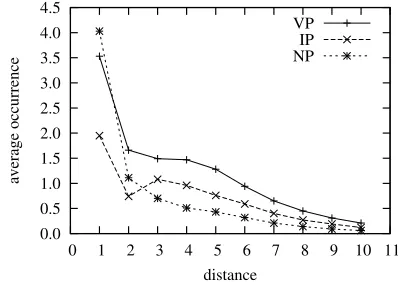
Table 2 shows top-10 phrase categories of foot nodes and their average occurrences in training cor-pus. We find that VP (verb phrase) is most likely to be the label of a foot node in an auxiliary rule. On average, there are 12.4 nodes labeled with VP are identical to one of its ancestors per tree. NP and IP are also found to be foot node labels frequently. Figure 4 shows the average occurrences of foot node labels VP, NP, and IP over various distances. A dis-tance is the difference of levels between a foot node
0.0 0.5 1.0 1.5 2.0 2.5 3.0 3.5 4.0 4.5
0 1 2 3 4 5 6 7 8 9 10 11
average occurrence
distance VP
[image:8.612.323.522.78.219.2]IP NP
Figure 5: Average occurrences of foot node labels VP, NP, and IP over various distances.
system grammar MT03 MT04 MT05
Moses - 33.10 33.96 32.17 hierarchical SCFG 33.40 34.65 32.88
STSG 33.13 34.55 31.94 tree-to-string
[image:8.612.313.539.273.343.2]STAG 33.64 35.28 32.71
Table 3: BLEU scores on NIST Chinese-English test sets. Scores marked in bold are significantly better that those of STSG atpl.01level.
and the root node. For example, in Figure 2, the dis-tance between NP0,1and NP0,3is 2 and the distance between VP6,8 and VP3,8 is 1. As most foot nodes are usually very close to the root nodes, we restrict that a foot node must be the direct descendant of the root node in our experiments.
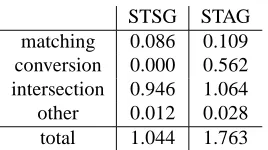
in-STSG STAG matching 0.086 0.109 conversion 0.000 0.562 intersection 0.946 1.064 other 0.012 0.028 total 1.044 1.763
Table 4: Comparison of average decoding time.
tersection phase suffering from severe search errors (only a tiny fraction of the search space can be ex-plored). To produce the 1-best translations on the MT05 test set that contains 1,082 sentences, while the STSG system used 40,169 initial rules without adjoining sites, the STAG system used 28,046 initial rules without adjoining sites, 1,057 initial rules with adjoining sites, and 1,527 auxiliary rules.
Table 4 shows the average decoding time on the MT05 test set. While rule matching for STSG needs 0.086 second per sentence, the matching time for STAG only increases to 0.109 second. For STAG, the conversion of derivation forests to translation forests takes 0.562 second when we restrict that at most 200 rules can be generated on the fly for each node. As we use cube pruning, although the trans-lation forest of STAG is bigger than that of STSG, the intersection time barely increases. In total, the STAG system runs in 1.763 seconds per sentence, only 1.6 times slower than the baseline system.
6 Conclusion
We have presented a new tree-to-string translation system based on synchronous TAG. With translation rules learned from Treebank-style trees, the adjoin-ing tree-to-stradjoin-ing system outperforms the baseline system using STSG without significant loss in effi-ciency. We plan to introduce left-to-right target gen-eration (Huang and Mi, 2010) into the STAG tree-to-string system. Our work can also be extended to forest-based rule extraction and decoding (Mi et al., 2008; Mi and Huang, 2008). It is also interesting to introduce STAG into tree-to-tree translation (Zhang et al., 2008; Liu et al., 2009; Chiang, 2010).
Acknowledgements
The authors were supported by National Natural Science Foundation of China Contracts 60736014, 60873167, and 60903138. We thank the anonymous
reviewers for their insightful comments.
References
Anne Abeille, Yves Schabes, and Aravind Joshi. 1990. Using lexicalized tags for machine translation. In
Proc. of COLING 1990.
John Chen and K. Vijay-Shanker. 2000. Automated ex-traction of tags from the penn treebank. In Proc. of
IWPT 2000.
David Chiang. 2003. Statistical parsing with an au-tomatically extracted tree adjoining grammar.
Data-Oriented Parsing.
David Chiang. 2006. An introduction to synchronous grammars. ACL Tutorial.
David Chiang. 2007. Hierarchical phrase-based transla-tion. Computational Linguistics, 33(2):201–228. David Chiang. 2010. Learning to translate with source
and target syntax. In Proc. of ACL 2010.
Michael Collins. 2003. Head-driven statistical models for natural language parsing. Computational
Linguis-tics, 29(4).
Steve DeNeefe and Kevin Knight. 2009. Synchronous tree adjoining machine translation. In Proc. of
EMNLP 2009.
Mark Dras. 1999. A meta-level grammar: Redefining synchronous tag for translation and paraphrase. In
Proc. of ACL 1999.
Jason Eisner. 2003. Learning non-isomorphic tree map-pings for machine translation. In Proc. of ACL 2003. Michel Galley, Mark Hopkins, Kevin Knight, and Daniel
Marcu. 2004. What’s in a translation rule? In Proc.
of NAACL 2004.
Michel Galley, Jonathan Graehl, Kevin Knight, Daniel Marcu, Steve DeNeefe, Wei Wang, and Ignacio Thayer. 2006. Scalable inference and training of context-rich syntactic translation models. In Proc. of
ACL 2006.
Liang Huang and David Chiang. 2007. Forest rescoring: Faster decoding with integrated language models. In
Proc. of ACL 2007.
Liang Huang and Haitao Mi. 2010. Efficient incremen-tal decoding for tree-to-string translation. In Proc. of
EMNLP 2010.
Liang Huang, Kevin Knight, and Aravind Joshi. 2006. Statistical syntax-directed translation with extended domain of locality. In Proc. of AMTA 2006.
Aravind Joshi, L. Levy, and M. Takahashi. 1975. Tree adjunct grammars. Journal of Computer and System
Sciences, 10(1).
Processing)Theoretical, Computational, and Psy-chological Perspectives.
Philipp Koehn, Hieu Hoang, Alexandra Birch, Chris Callison-Burch, Marcello Federico, Nicola Bertoldi, Brooke Cowan, Wade Shen, Christine Moran, Richard Zens, Chris Dyer, Ondrej Bojar, Alexandra Con-stantin, and Evan Herbst. 2007. Moses: Open source toolkit for statistical machine translation. In
Pro-ceedings of ACL 2007 (poster), pages 77–80, Prague,
Czech Republic, June.
Yang Liu, Qun Liu, and Shouxun Lin. 2006. Tree-to-string alignment template for statistical machine trans-lation. In Proc. of ACL 2006.
Yang Liu, Yajuan L¨u, and Qun Liu. 2009. Improving tree-to-tree translation with packed forests. In Proc. of
ACL 2009.
Haitao Mi and Liang Huang. 2008. Forest-based transla-tion rule extractransla-tion. In Proceedings of EMNLP 2008. Haitao Mi, Liang Huang, and Qun Liu. 2008.
Forest-based translation. In Proceedings of ACL/HLT 2008, pages 192–199, Columbus, Ohio, USA, June.
Rebecca Nesson, Stuart Shieber, and Alexander Rush. 2006. Induction of probabilistic synchronous tree-insertion grammars for machine translation. In Proc.
of AMTA 2006.
Franz J. Och and Hermann Ney. 2003. A systematic comparison of various statistical alignment models.
Computational Linguistics, 29(1):19–51.
Franz Och. 2003. Minimum error rate training in statis-tical machine translation. In Proc. of ACL 2003. Gilles Prigent. 1994. Synchronous tags and machine
translation. In Proc. of TAG+3.
Yves Schabes and Richard Waters. 1995. A cubic-time, parsable formalism that lexicalizes context-free gram-mar without changing the trees produced.
Computa-tional Linguistics, 21(4).
Stuart M. Shieber and Yves Schabes. 1990. Synchronous tree-adjoining grammars. In Proc. of COLING 1990. Stuart M. Shieber. 2007. Probabilistic synchronous
tree-adjoining grammars for machine translation: The ar-gument from bilingual dictionaries. In Proc. of SSST
2007.
Andreas Stolcke. 2002. Srilm - an extensible language modeling toolkit. In Proceedings of ICSLP 2002, pages 901–904.
Dekai Wu. 1997. Stochastic inversion transduction grammars and bilingual parsing of parallel corpora.
Computational Linguistics, 23(3):377–404.
Fei Xia. 1999. Extracting tree adjoining grammars from bracketed corpora. In Proc. of the Fifth Natural
Lan-guage Processing Pacific Rim Symposium.
Deyi Xiong, Qun Liu, and Shouxun Lin. 2006. Maxi-mum entropy based phrase reordering model for sta-tistical machine translation. In Proc. of ACL 2006.