Investigation of the Characteristics of Submicron-Structured Powder-Fabricated
Cr50Ni50 Alloys via Different Hot-Press Sintering Pressures
Shih-Hsien Chang
1,*, Cheng-Liang Liao
1, Kuo-Tsung Huang
2and Ming-Wei Wu
1 1Department of Materials and Mineral Resources Engineering, National Taipei University of Technology,Taipei 10608, Taiwan, R. O. China
2Department of Auto-Mechanics, National Kangshan Agricultural Industrial Senior High School, Kaohsiung 82049, Taiwan, R. O. China
In this study, two different compositions of submicron-structured chromium and nickel powders are mixed to fabricate Cr50Ni50 alloys by vacuum hot-press sintering. The research imposes various hot-press sintering pressures (12, 24, 36 and 48 MPa), while the temperature is maintained at 1275 C for 1 h, respectively. The experimental results show the optimum parameters of the hot-press sintered Cr50Ni50 alloys to be 1275 C at 48 MPa for 1 h. The relative density reaches 96.29%, and the hardness and electrical conductivity increase to 75.2 HRA and 2.01 × 10⁴ Scm−1, respectively. Simultaneously, the transverse rupture strength (TRS) value increases to 1109 MPa. Moreover, the Cr50Ni50 alloys dramatically acquire a more homogeneous microstructure, and the mean grain size decreases to 3.48 μm. Consequently, it is shown that hot-press sintering has a positive influence on the sintering behavior and improves the performance of the refractory metals.
[doi:10.2320/matertrans.M2015400]
(Received October 26, 2015; Accepted March 2, 2016; Published April 25, 2016)
Keywords: Cr50Ni50 alloy, hot-press pressing, electrical conductivity, hardness, TRS
1. Introduction
Nanomaterials have received much recent attentions be-cause they are expected to be used in various applications based on their excellent and unique optical, electrical, mag-netic, biological, or mechanical properties.1) The advantages
of application of chromium-nickel alloys as structural, thin film resistors and device materials have been already recog-nized for decades. Chromium alloyed with iron and cobalt is appreciated particularly due to their high oxidation, corrosion and heat resistance, as well as the excellent creep strength at high temperatures.2–5)
Powder metallurgy (P/M) methods offer two different types of materials with the objective of achieving higher strength, hardness and wear resistance etc. Conventional P/M involves mixing the metal powders, compacting of the mixed powders into molds and then sintering of the compact pow-ders under the different atmospheres.6,7) P/M technology is
the conventional process for the production of Cr-Ni alloys. On the other hand, hot-press sintering technique as a common technique was performed to fabricate the bulk bodies of the alloys. The hot-press sintering is another special P/M tech-nology, which directly pressed and sintering the material through a graphite mold to transmit the pressure to the pow-ders. It can obtain the dense material at relatively lower sin-tering temperature.8–11) Therefore, it is a novel technique to
produce the Cr-Ni alloys.
Previous study indicated that a hot pressing produced Nanometer WC-Co powder can lower the sintering tempera-ture by about 100 C, increases the density (more than 99%) and circumscribes the growth of grain size (smaller than 1 μm) of alloys. Besides, hot pressing is an effective method to get WC-Co cemented carbides with fine grain size and good properties.12) Other literature also pointed out that the
dense microstructure of the W/Cu-Al2O3 composites is
con-sisted of the matrix of the Al2O3 dispersion strengthened
cop-per base and the reinforced phase of homogeneous distributed W particles after hot-press sintering. The composite has rela-tive theoretical density of 99.8%. The bend fracture mecha-nism is brittle cleavage and interface separation.13) However,
a novel technology for fabricating Cr-Ni composite materials needed to be further investigated.
In this work, a Cr-Ni alloy was produced by means of the vacuum hot-press sintering process and the solid-phase sin-tering of powder metallurgy technology. The effects of sub-micron-structured powders and hot-press sintering pressures on the Cr50Ni50 alloys were our chief concerns. A series of experiments on the hot-press sintered specimens were simul-taneously carried out to explore the sintering behaviors and properties of the Cr50Ni50 alloys. The influences of the mi-crostructural features on the mechanical and electrical prop-erties were investigated.
2. Experimental Procedure
In this study, 99.95% submicron-structured chromium and nickel powders were mixed and underwent hot-press sinter-ing to fabricate the Cr50Ni50 alloys. A Microtrac X 100 laser was used to analyze the particle size of the submicron-struc-tured powders. The mean particle size of the gas-atomized chromium and nickel powders was about 588 ± 21 and 610 ± 33 nm, respectively. Generally speaking, the morphology of gas-atomized powders tends toward an obvious round shape. Moreover, gas-atomized powders possess an excellent form-ing mechanism and sinterform-ing characteristics because the par-ticles have a relatively smooth surface.8)
This study explored various pressures of hot-press sinter-ing for Cr50Ni50 alloys and examined the effects on the mi-crostructure, mechanical properties and electrical behavior. The hot-press sintering temperature was maintained at 1275 C for 1 h (the optimal sintering temperature). Various pressures (12, 24, 36 and 48 MPa) were employed in order to investigate the effect on the hot-press sintering characteristics of the Cr50Ni50 alloys. To evaluate the sintered behavior of
*
Corresponding author, E-mail: [email protected]
the Cr50Ni50 alloys via various hot-press sintering (Yu Tai Vacuum Co., Ltd. HPS-1053) pressures, the porosity, hard-ness, transverse rupture strength (TRS) tests, electrical tests and microstructure observations were performed. Micro-structural features of the specimens were examined by X-ray diffraction (XRD, Rigaku D/Max-2200) and scanning elec-tron microscopy (Hitachi-S4700). Porosity tests followed the ASTM B311-08 and C830 standards.
The hardness of the specimens was measured by Rockwell indenter (HRA, Indentec 8150LK) with loading of 588.6 N, which complied with the ASTM B294 and ASTM B163-11 standard methods. The Hung Ta universal material test ma-chine (HT-9501A) with a maximum load of 245 kN was used for the TRS tests (ASTM B528-05). Meanwhile, Rbm was the
transverse rupture strength, which determined as the fracture stress in the surface zone. F was maximum fracture load, L was 30 mm, k was chamfer correction factor (normally 1.00– 1.02), b and h were 5 mm in the equation Rbm = 3FLk/2bh2,
respectively. The specimen dimensions of the TRS test were 5 × 5 × 40 mm3. Moreover, it needs to slightly grind the
sur-face of the specimen and tests at least three pieces. A four-point probe (LRS4-TG2) was used to measure sheet resis-tance. In addition, electrical conductivity (σ) was calculated according to the following formula:14,15)
ρ=R/t=1/σ
Where the ρ is electrical resistivity, R is the resistance, t is the thickness of the test sheet, and σ is the electrical conductivity (Scm−1), respectively.
3. Results and Discussion
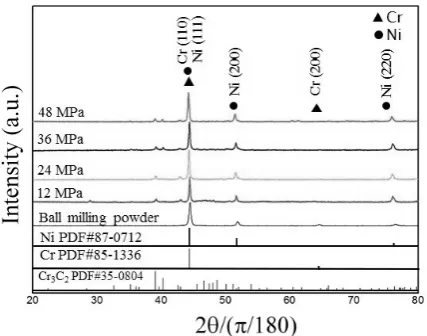
Figure 1 shows the XRD patterns of the Cr50Ni50 alloys following hot-press sintering at different pressures. The ma-jor diffractions appeared in the Cr (110) and Ni (111), (200) and (220) planes, respectively. According to our previous studied16), the intensity of Cr (110) of Cr50Cu50 alloys were
obviously enhanced as the pressure of the hot-pressed sinter-ing increased. Generally, the main densification mechanism of hot-pressed sintering included the initial diffusion creep of high temperature and plastic deformation during the sintering step. When hot-pressed sintering entered the sintering stage,
the assistance in high compressing stress led to effective plas-tic deformation and compaction results. Consequently, it is reasonable to suggest that an increase in sintering-pressure which contributed to the overall improvement of the crystal-line. As a result, the alloy began to effectively generate plastic deformation and compaction. Therefore, as the sintering-pres-sure increasing, the results increased the lattice diffraction of the unit area and enhanced the relative intensity. In this work, the intensity of Cr (110) and Ni (111) was enhanced as the pressure of the hot-press sintering increased. The Cr3C2
dif-fractions (2θ was 39.58 and 42.96 , respectively) clearly ap-peared in the Cr50Ni50 alloys following the hot-press sinter-ing process. It is reasonable to speculate that the chromium produced a chemical reaction with the carbon of the graphite mold, whereby the Cr3C2 compounds were generated.
Be-sides, all the specimens obviously possessed a good crystal-line property after hot-press sintering at different pressures. As the pressure increased (12 → 24 → 36 → 48 MPa), the intensity of the Ni (200) plane displayed a slight variation, as shown in Fig. 1.
There were two possible reasons to explain the phenome-non. Firstly, increasing the hot-press sintering pressure could effectively help and enhance the overall crystallinity of Cr50Ni50 alloys. It was reasonable to assume that the amount of Cr atoms solid-solution in the Ni phase of Ni50Cr50 alloys increased as the pressure increased. This meant that an in-crease of the Cr content in the Ni-rich phases resulted in a larger lattice constant, and further improved the deformabili-ty, and a slight variation in intensity of Ni (200). Secondly, the higher pressure could easily generate compaction and de-formation of Ni-rich phases, which made the lattice diffrac-tion of unit area and the intensity of Ni (200) plane vary. Ac-tually, the main densification mechanism of hot-press sintering included the initial diffusion creep of high tempera-ture and plastic deformation during the sintering steps. When hot-press sintering entered the sintering stage, the assistance in high compressing stress led to effective plastic deformation and compaction results.8,11,16) Thus, the higher pressure of
hot-press sintering easily led lattice diffraction of the unit area to vary and enhance the relative intensity, as shown in Fig. 2. Significantly, increasing the pressure of the hot-press sintering contributed to the overall improvement of the crys-talline, and thus improved the microstructures and properties
Fig. 1 XRD patterns of Cr50Ni50 alloys by hot-press sintering at different pressures.
[image:2.595.62.276.592.760.2] [image:2.595.318.534.610.762.2]of the Cr50Ni50 alloys.
Figure 2 shows the relative density and apparent porosity of the Cr50Ni50 alloys after hot-press sintering at different pressures. The lowest relative density (95.61%) appeared af-ter 1275 C, 12 MPa, 1 h hot-press sinaf-tering, and the highest relative density (96.29%) occurred after 1275 C, 48 MPa for 1 h. From the sintering theory and technological points of view, usually during the final stages of sintering process, the porosities rapidly reduced and grain size significantly growth. Generally speaking, the sintered density of hot-press sinter-ing was greater than 92% theoretical density. In this study, the relative density equals to D/Dth × 100%; where the D was the
sintered density and Dth was the theoretical density of
speci-mens, respectively. In the final stage of hot-pressing sintering, porosity should be eliminated. This can only happen if all pores are connected fast, short diffusion paths along grain boundaries. For this to happen, the pores must follow the movement of grain boundaries. If discontinuous grain growth occurs then pores become trapped inside large grains. These pores are difficult to remove due to diffusion paths being long and slow, as lattice diffusion is the controlling mechanism. Open porosity effectively hinders grain boundary migration. Furthermore, the open porosity cluster loses stability, form-ing closed spherical or ellipsoidal pores, which are located in triple junctions.17) As a result, increase the pressure of the
hot-press sintering only slightly increased the relative density of the specimens, while the apparent porosity level was in-versely proportional to the relative density. The apparent po-rosity had a slight declining trend as the pressure of the hot-press sintering increased. The lowest apparent porosity (0.05%) appeared after 1275 C, 48 MPa, 1 h hot-press sinter-ing. In this work, the melting point of Ni was 1455 C and that of Cr was 1907 C. However, the sintering was carried out at a temperature of 1275 C, so only a 67% melting point (Tm) of
Cr and an 88% of Ni were reached, respectively. As the
sin-tering temperature did not meet the eutectic point of the Cr-Ni alloy (1345 C), it was not possible to reach the liquid-phase sintering (LPS) temperature of the Cr50Ni50 alloys. Thus, the sintering properties were poorer than that of pure Cr or Ni metal, as a result of the solid-phase bonding. Meanwhile, it could be assumed that internal pores mainly existed in the grain boundaries and the necks of the incompletely sintered Cr and Ni phases (as shown in Fig. 3). Moreover, the sinter-ing density of the Cr50Ni50 alloys increased, mainly due to the compaction of the Cr and Ni phases via the enhanced pressure. The results were further confirmed by means of a microstructural inspection.
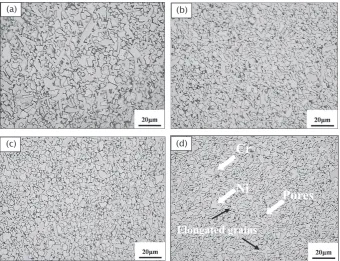
Figure 3 shows the OM morphology observations of the Cr50Ni50 alloys after hot-press sintering at different pres-sures. Particularly, there were two different phases uniformly distributed in the sintered specimens, the white parts are the nickel-rich grains and the gray parts are the chrome-rich grains (as indicated by the arrows), as shown in Fig. 3(d). In addition, Fig. 3(a) clearly shows that dramatically closed pores still remained in the grain boundaries of the Cr50Ni50 alloys after sintering at 1275 C, 12 MPa for 1 h. Thus, the interaction bonding between the phase-boundaries of the Cr50Ni50 specimens was relatively weak, resulting from the incomplete densification during sintering. However, the po-rosities obviously decreased as the sintering pressure (24 → 36 → 48 MPa) increased, as shown in Figs. 3(b)–3(d). More-over, the grain size showed a slight decrease, from 5.05 to 3.45 μm (12 → 48 MPa). It was possible to say that the poros-ities decreased and no measurable grain growth was observed, which were mainly contributed to by the plastic deformation Ni phase and the compaction of chromium particles via en-hanced pressure. Although it was hard to observe the plastic deformation of Ni phase in Fig. 3, it can clearly be found that the compacted Ni phases were elongated (black arrows), and had a tendency to surround the Cr phases after the higher
hot-Cr
Ni
Pores
Elongated grains
[image:3.595.128.469.69.330.2]press sintering (48 MPa), as shown in Fig. 3(d). As a result, increasing the pressure of hot-press sintering was effective in improving the compaction of Ni and Cr phases, and pores decreased and no grain decreased and no grain growth hap-pened in the final stage of densification. The result also agreed with the previous literature.8)
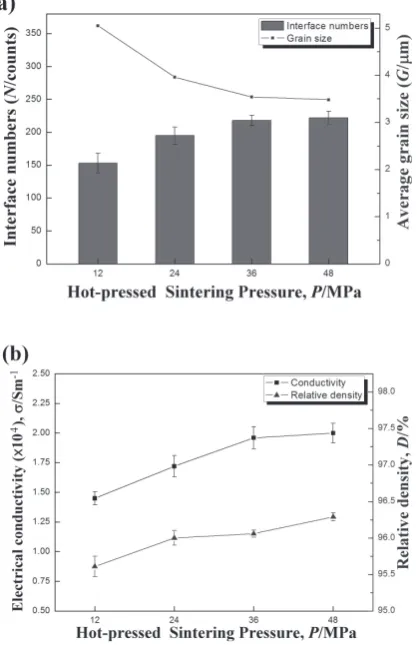
Figure 4(a) shows the relation between the interface num-bers and grain sizes of the Cr50Ni50 alloys after hot-press sintering at different pressures. The interface numbers seemed to be reversely proportional to the grain sizes. Increasing the pressure (12 → 24 → 36 → 48 MPa) of the hot-press sintering resulted in a decrease in grain size (5.05 → 3.96 → 3.54 → 3.48 μm), and the interface numbers also increased (153 → 195 → 218 → 222), as shown in Fig. 4(a). In the research, the interface numbers were calculated by the overall interface numbers of the cross chromium/nickel alloys in the unit length of BEI images. Previous literature indicated that a structure with more interface numbers had a better micro-structure and mechanical properties.8,18) In fact, the structure
is related with physical and mechanical properties of materi-al. Normally the good microstructure significantly possesses better properties. It means that the more interface numbers will result in the better mechanical properties. Notably, the interface numbers of the Cr50Ni50 alloys showed an obvious increase as the pressure of the hot-press sintering increased. Furthermore, the smallest value (153) of interface numbers appeared in 12 MPa hot-press sintering. As the pressure in-creased, the interface numbers rapidly increased. The highest
value (222) of interface numbers appeared in the 1275 C, 48 MPa, 1 h sintered specimens, as shown in Fig. 4(a). It is reasonable to speculate that the 48 MPa-sintered specimens possessed a relatively small grain size and consistent struc-ture, which was helpful to the meticulous microstructure and mechanical properties.
In addition, the electrical resistivity measurement is a use-ful tool when investigating the various phenomena in solids. It is an easy and inexpensive technique, which can be used in the study of phase transformations, impurities, defects and other structural changes in crystalline and amorphous metals/
alloys.19) Figure 4(b) shows the electrical conductivity and
relative density of the Cr50Ni50 alloys after hot-press sinter-ing at different pressures. It can be clearly seen that the elec-trical performance and the relative density of the sintered Cr50Ni50 alloys exhibited similar trends. When the pressure of the hot-press sintering increased, both the electrical con-ductivity and relative density showed obvious increases. In this work, the relative density of the sintered Cr50Ni50 alloys increased to 96.29%, while the electrical conductivity value increased to 2.01 × 10⁴ Scm−1 after the 1275 C, 48 MPa, 1 h
hot-press sintering treatments. A previous study has also proven the relationship of the relative density of Cr-based al-loys to the electrical properties.20) Increasing the relative
den-sity significantly improved the electrical properties of the Cr-based alloys. Thus, it could be inferred that the higher relative density and lower porosity of the hot-press sintered Cr50Ni50 alloys led to the increase in the mean free path of the elec-trons, which improved the electrical performance. As men-tioned previously, the internal closed pores of the sintered specimens were significantly reduced after high-pressure hot-press sintering treatments (Fig. 3). Consequently, increasing the pressure effectively enhanced the relative density and im-proved the electrical properties of the hot-press sintered Cr50Ni50 alloys.
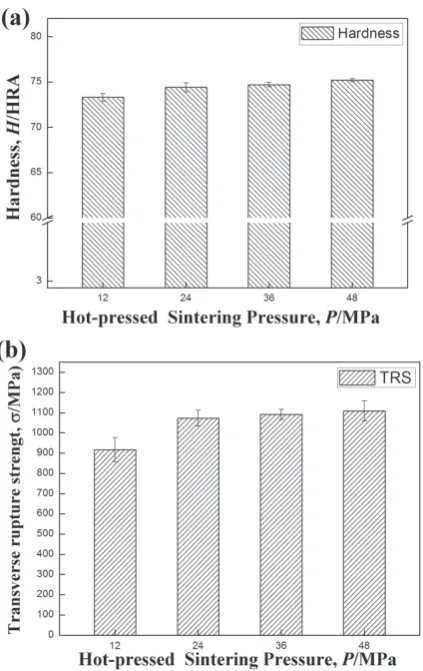
Figure 5 shows the hardness and TRS of the hot-press sin-tered Cr50Ni50 alloys at different pressures. The hardness slightly increased as the pressure of the hot-press sintering increased, as shown in Fig. 5(a). Previous literature also re-vealed a positive relationship between the hardness and the relative density.6,8) The hardness was significantly enhanced
as the sintering density increased. The literature also shows that decreasing the porosities of sintered materials effectively enhances plastic deformation resistance and hardness.8,21)
Generally, the higher pressures of solid-phase sintering (SPS) helped improve the plastic deformation of the Cr50Ni50 al-loys, resulting in the higher hardness. In this study, increasing the pressure (12 → 48 MPa) of the hot-press sintered speci-mens resulted in an obvious increase in the relative density (95.61 → 96.29%), which in turn resulted in the high hard-ness (73.3 → 75.2 HRA). Also, the grain size decreased as the pressure of the hot-press sintering increased. As the load in-creased, the smaller grains possessed a greater area fraction of grain boundaries along the line of the mobile dislocations. Therefore, the number of dislocation tangles was greater, and they were strong enough to hold the mobile dislocations, which was advantageous to the hardness and strength. This result also agreed with our previous findings.20)
Figure 5(b) shows the TRS tests of the hot-press sintered Cr50Ni50 alloys at different pressures. Previous studies have
[image:4.595.68.277.74.397.2]indicated that as the relative density increases, the higher den-sity provides stronger binding to protect the rupture mecha-nism of generation.6,8,15) In the present research, increasing
the pressure (12 → 48 MPa) of the hot-press sintering signifi-cantly improved the relative density (95.61 → 96.29%) and decreased the grain size (5.05 → 3.48 μm) of the Cr50Ni50 alloys. Moreover, the above experimental results suggest that if a structure has more interface numbers, the microstructure presents a better structure. Therefore, the TRS value showed an obvious increase as the pressure was increased. The high-est TRS value (1109 MPa) appeared in the 1275 C, 48 MPa, 1 h hot-press sintered Cr50Ni50 alloys, the higher bonding strength of which hindered the generation of the rupture mechanism. In our previous studied6), the relative density,
electrical conductivity, hardness and TRS of 1325 C, 1 h vac-uum sintered Cr50Ni50 alloys was 90.93%, 2.13 × 10³ Scm−1,
59.6 HRB and 232.2 MPa, respectively. Furthermore, the 1345 C, 1 h vacuum sintered Cr50Ni50 alloys was 98.67%, 2.33 × 10³ Scm−1, 63.8 HRA and 454.3 MPa, respectively. In
this work, the 1275 C, 48 MPa, 1 h hot-press sintered Cr50Ni50 alloys underwent lower sintering temperature and higher pressure. The relative density was slightly decline to 96.29%, however the effective compaction and lower sinter-ing temperatures (avoid the grain coarsensinter-ing phenomenon under high temperatures) resulted in the better properties. Significantly, the electrical conductivity enhanced to 2.01 × 10⁴ Scm−1, hardness increased to 75.2 HRA and TRS reached
1109 MPa. The results confirmed that the hot-pressing was effective in improving sintering properties.
Figure 6 shows the fractographs of the Cr50Ni50 alloys af-ter hot-press sinaf-tering at different pressures. The fracture fractographs of the different hot-press sintered specimens look to be almost the same type. Generally, the brittle fracture surface possesses a relatively flat fracture surface, as show in Fig. 6(a). Conversely, the ductility fracture is one half of a microvoid that formed and then separated during the fracture process. It could be found the difference and consist of num-bers spherical dimple fractures, as show in Fig. 6(b). For all
Fig. 5 Comparison of the mechanical properties of Cr50Ni50 alloys by hot-press sintering at different hot-pressures (a) hardness, and (b) TRS tests.
[image:5.595.64.276.127.463.2] [image:5.595.127.470.510.772.2]the specimens it was found that both ductile and brittle frac-tures (as shown the arrows of Fig. 6(d)) coexisted in the Cr50Ni50 alloys after the TRS tests, as shown in Figs. 6(a)– (d). Taking the specimen of hot-press sintering at 36 MPa as an example, ductile fractures, dimple fractures and brittle fractures can be observed, as shown in Fig. 7. Besides, there were many small pores uniformly distributed in the fracture surface. As the load increased, the pores easily generated the points of stress concentration and formed a continuous rup-ture. Most of the pores located in the grain boundaries caused the small cracks along the grains of the material to form an intergranular brittle fracture. The results can be further com-pared with Fig. 6. Figures 6(a) and 6(b) show more fracto-graphs of the brittle fractures, while Figs. 6(c) and 6(d) show the fractographs of ductile and dimple fractures. The porosity level was a main factor in affecting the TRS value. In addi-tion, the nickel phase provided toughness and generated the dimple fractures in the material. However, as the pressure of the hot-press sintering increased, the average grain size showed a slight decrease, with SEM fractographs the fracture surface generating the refinement trend. It is reasonable to speculate that the grain refinement was another factor which could improve the strength of the hot-press sintered speci-mens. Significantly, more ductile and dimple fractures ap-peared in the 1275 C, 48 MPa, 1 h hot-press sintered speci-mens, as shown in Fig. 6(d). According to the discussion and results, the optimal hot-press sintering pressure for the Cr50Ni50 alloys was 48 MPa. Consequently, a uniform mi-crostructure and excellent electrical conductivity and me-chanical properties were obtained.
4. Conclusions
The microstructural analysis and mechanical tests showed that the hot-press sintering process was effective in
eliminat-ing the internal closed pores of the sintered specimens; thus, high-density and high-strength Cr50Ni50 alloys were ac-quired. In this work, the relative density of the Cr50Ni50 al-loys reached 96.29% and the electrical conductivity increased to 2.01 × 10⁴ Scm−1 after 1275 C, 48 MPa, 1 h hot-press
sin-tering. Significantly, the optimal SPS process was effective in eliminating the internal pores of the Cr50Ni50 alloys, which resulted in ideal electrical and mechanical performances. In addition, increasing the pressure (12 → 48 MPa) of the hot-press sintering process no measurable grain growth was ob-served, which resulted in a slight decreased in the average grain size (5.05 → 3.48 μm). Consequently, the highest hard-ness (75.2 HRA) and highest TRS values (1109 MPa) were obtained.
Acknowledgments
This research is supported by the ASSAB STEELS TAI-WAN CO., LTD. The authors would like to express their ap-preciations for Dr. Harvard Chen.
REFERENCES
1) M. Khajepour and S. Sharafi: Powder Technol. 232 (2012) 124–133.
2) Y. Harada, M. Ohmori, F. Yoshida and R. Nowak: Mater. Lett. 57 (2003) 1142–1150.
3) N. Espallargas and S. Mischler: Wear 270 (2011) 464–471.
4) V. Petley, S. Sathishkumar, K.H. Thulasi Raman, G. Mohan Rao and U. Chandrasekhar: Mater. Res. Bull. 66 (2015) 59–64.
5) M. Danışman and N. Cansever: J. Alloy. Compd. 493 (2010) 649–653.
6) S.H. Chang, J.C. Chen, K.T. Huang and J.K. Chen: Trans. JIM 54 (2013) 1034–1039.
7) S.H. Chang and S.L. Chen: J. Alloy. Compd. 585 (2014) 407–413.
8) C. Liang, S.H. Chang, J.R. Huang, K.T. Huang and S.T. Lin: Trans. JIM
56 (2015) 1127–1132.
9) Z.H. Qiao, X.F. Ma, W. Zhao, H.G. Tang and B. Zhao: J. Alloy. Compd.
462 (2008) 416–420.
10) X.M. Duan, D.C. Jia, Z.L. Wu, Z. Tian, Z.H. Yang, S.G. Wang and Y. Zhou: Scr. Mater. 68 (2013) 104–107.
11) S.H. Chang and P.Y. Chang: Mater. Sci. Eng. A 618 (2014) 56–62.
12) C. Jia, L. Sun, H. Tang and X. Qu: Int. J. Refract. Met. Hard Mater. 25 (2007) 53–56.
13) B.H. Tian, X.W. Zhang, R.L. Zhao, Y. Liu, S.G. Jia and F.Z. Ren: Rev. Adv. Mater. Sci. 33 (2013) 219–223.
14) W. D. Callister JR and D. G. Rethwisch: Materials Science and Engi-neering, 9th ed. John Wiley and Sons Pte Ltd., 2014, pp. 681–683. 15) S.H. Chang, S.H. Chen and K.T. Huang: Trans. JIM 54 (2013) 1857–
1862.
16) S.H. Chang, C. Liang, J.R. Huang and K.T. Huang: Powder. Metall. (2015) in press (DOI:10.1080/00325899.2015.1132033).
17) A. Rafferty, T. Prescott and D. Brabazon: Ceram. Int. 34 (2008) 15–21.
18) H.S. Huang, I.T. Hong, H.G. Dong and C.H. Chiu: Bull. Powder Metall. Assoc. 35 (2010) 161–167.
19) A.A. Al-Aql: Mater. Des. 24 (2003) 547–550.
20) S.H. Chang, S.H. Chen and K.T. Huang: Trans. JIM 53 (2012) 1689– 1694.
21) S.H. Chang, M.H. Chang and K.T. Huang: J. Alloy. Compd. 585 (2014) 407–413.
[image:6.595.71.269.69.217.2]