Proceedings of the 45th Annual Meeting of the Association of Computational Linguistics, pages 200–207,
A Grammar-driven Convolution Tree Kernel for
Se-mantic Role Classification
Min ZHANG
1Wanxiang CHE
2Ai Ti AW
1Chew Lim TAN
3Guodong ZHOU
1,4Ting LIU
2Sheng LI
21
Institute for Infocomm Research
{mzhang, aaiti}@i2r.a-star.edu.sg
2
Harbin Institute of Technology
{car, tliu}@ir.hit.edu.cn
3National University of Singapore
4
Soochow Univ., China 215006
Abstract
Convolution tree kernel has shown promis-ing results in semantic role classification. However, it only carries out hard matching, which may lead to over-fitting and less ac-curate similarity measure. To remove the constraint, this paper proposes a grammar-driven convolution tree kernel for semantic role classification by introducing more lin-guistic knowledge into the standard tree kernel. The proposed grammar-driven tree kernel displays two advantages over the pre-vious one: 1) grammar-driven approximate substructure matching and 2) grammar-driven approximate tree node matching. The two improvements enable the grammar-driven tree kernel explore more linguistically motivated structure features than the previ-ous one. Experiments on the CoNLL-2005 SRL shared task show that the grammar-driven tree kernel significantly outperforms the previous non-grammar-driven one in SRL. Moreover, we present a composite kernel to integrate feature-based and tree kernel-based methods. Experimental results show that the composite kernel outperforms the previously best-reported methods.
1
Introduction
Given a sentence, the task of Semantic Role Label-ing (SRL) consists of analyzLabel-ing the logical forms
expressed by some target verbs or nouns and some constituents of the sentence. In particular, for each predicate (target verb or noun) all the constituents in the sentence which fill semantic arguments (roles) of the predicate have to be recognized. Typical se-mantic roles include Agent, Patient, Instrument, etc. and also adjuncts such as Locative, Temporal, Manner, and Cause, etc. Generally, semantic role identification and classification are regarded as two key steps in semantic role labeling. Semantic role identification involves classifying each syntactic element in a sentence into either a semantic argu-ment or a non-arguargu-ment while semantic role classi-fication involves classifying each semantic argument identified into a specific semantic role. This paper focuses on semantic role classification task with the assumption that the semantic arguments have been identified correctly.
Both feature-based and kernel-based learning methods have been studied for semantic role classi-fication (Carreras and Màrquez, 2004; Carreras and Màrquez, 2005). In feature-based methods, a flat feature vector is used to represent a predicate-argument structure while, in kernel-based methods, a kernel function is used to measure directly the similarity between two predicate-argument struc-tures. As we know, kernel methods are more effec-tive in capturing structured features. Moschitti (2004) and Che et al. (2006) used a convolution tree kernel (Collins and Duffy, 2001) for semantic role classification. The convolution tree kernel takes sub-tree as its feature and counts the number of common sub-trees as the similarity between two predicate-arguments. This kernel has shown very
promising results in SRL. However, as a general learning algorithm, the tree kernel only carries out hard matching between any two sub-trees without considering any linguistic knowledge in kernel de-sign. This makes the kernel fail to handle similar phrase structures (e.g., “buy a car” vs. “buy a red
car”) and near-synonymic grammar tags (e.g., the POS variations between “high/JJ degree/NN” 1 and
“higher/JJR degree/NN”) 2.To some degree,it may
lead to over-fitting and compromise performance. This paper reports our preliminary study in ad-dressing the above issue by introducing more lin-guistic knowledge into the convolution tree kernel. To our knowledge, this is the first attempt in this research direction. In detail, we propose a gram-mar-driven convolution tree kernel for semantic role classification that can carry out more linguisti-cally motivated substructure matching. Experimental results show that the proposed method significantly outperforms the standard convolution tree kernel on the data set of the CoNLL-2005 SRL shared task.
The remainder of the paper is organized as fol-lows: Section 2 reviews the previous work and Sec-tion 3 discusses our grammar-driven convoluSec-tion tree kernel. Section 4 shows the experimental re-sults. We conclude our work in Section 5.
2
Previous Work
Feature-based Methods for SRL: most features used in prior SRL research are generally extended from Gildea and Jurafsky (2002), who used a linear interpolation method and extracted basic flat fea-tures from a parse tree to identify and classify the constituents in the FrameNet (Baker et al., 1998). Here, the basic features include Phrase Type, Parse Tree Path, and Position. Most of the following work focused on feature engineering (Xue and Palmer, 2004; Jiang et al., 2005) and machine learning models (Nielsen and Pradhan, 2004; Pradhan et al., 2005a). Some other work paid much attention to the robust SRL (Pradhan et al., 2005b) and post infer-ence (Punyakanok et al., 2004). These feature-based methods are considered as the state of the art methods for SRL. However, as we know, the stan-dard flat features are less effective in modeling the
1 Please refer to http://www.cis.upenn.edu/~treebank/ for the detailed definitions of the grammar tags used in the paper. 2 Some rewrite rules in English grammar are generalizations of others: for example, “NPÆ DET JJ NN” is a specialized ver-sion of “NPÆ DET NN”. The same applies to POS. The stan-dard convolution tree kernel is unable to capture the two cases.
syntactic structured information. For example, in SRL, the Parse Tree Path feature is sensitive to small changes of the syntactic structures. Thus, a predicate argument pair will have two different Path features even if their paths differ only for one node. This may result in data sparseness and model generalization problems.
Kernel-based Methods for SRL: as an alternative, kernel methods are more effective in modeling structured objects. This is because a kernel can measure the similarity between two structured ob-jects using the original representation of the obob-jects instead of explicitly enumerating their features. Many kernels have been proposed and applied to the NLP study. In particular, Haussler (1999) pro-posed the well-known convolution kernels for a discrete structure. In the context of it, more and more kernels for restricted syntaxes or specific do-mains (Collins and Duffy, 2001; Lodhi et al., 2002; Zelenko et al., 2003; Zhang et al., 2006) are pro-posed and explored in the NLP domain.
Of special interest here, Moschitti (2004) proposed Predicate Argument Feature (PAF) kernel for SRL under the framework of convolution tree kernel. He selected portions of syntactic parse trees as predicate-argument feature spaces, which include salient sub-structures of predicate-arguments, to define convo-lution kernels for the task of semantic role classifi-cation. Under the same framework, Che et al. (2006) proposed a hybrid convolution tree kernel, which consists of two individual convolution kernels: a Path kernel and a Constituent Structure kernel. Che et al. (2006) showed that their method outperformed PAF on the CoNLL-2005 SRL dataset.
The above two kernels are special instances of convolution tree kernel for SRL. As discussed in Section 1, convolution tree kernel only carries out hard matching, so it fails to handle similar phrase structures and near-synonymic grammar tags. This paper presents a grammar-driven convolution tree kernel to solve the two problems
3
Grammar-driven Convolution Tree
Kernel
3.1 Convolution Tree Kernel
# subtreei(T) is the occurrence number of the ith
sub-tree type (subtreei) in T. Since the number of
different sub-trees is exponential with the parse tree size, it is computationally infeasible to directly use the feature vector
φ
( )
T
. To solve this computa-tional issue, Collins and Duffy (2001) proposed the following parse tree kernel to calculate the dot product between the above high dimensional vec-tors implicitly.1 1 2 2
1 1 2 2
1 2 1 2
1 2
1 2 ( , ) ( ), ( )
( ) ( )
( , )
((
subtreei) (
subtreei))
i n N n N n N n N
K T T T T
I n I n
n n
φ
φ
∈ ∈
∈ ∈
=< >
=
= ∆
⋅
∑ ∑
∑
∑ ∑
where N1 and N2 are the sets of nodes in trees T1 and
T2, respectively, and Isubtreei( )n is a function that is
1 iff the subtreei occurs with root at node n and zero
otherwise, and ∆( , )n n1 2 is the number of the com-mon subtrees rooted at n1 and n2, i.e.,
1 2 1 2
( , )
n n
iI
subtreei( )
n
I
subtreei( )
n
∆
=
∑
⋅
1 2
( , )
n n
∆
can be further computed efficiently by the following recursive rules:Rule 1: if the productions (CFG rules) at
n
1 and2
n
are different, ∆( , ) 0n n1 2 = ;Rule 2: else if both
n
1 andn
2 are pre-terminals (POS tags), ∆( , ) 1n n1 2 = ×λ;Rule 3: else, 1
( )
1 2 1 1 2
( , )n n
λ
nc nj= (1 ( ( , ), ( , )))ch n j ch n j∆ =
∏
+ ∆ ,where
nc n
( )
1 is the child number ofn
1, ch(n,j) is the jth child of node n andλ
(0<λ
<1) is the decayfactor in order to make the kernel value less vari-able with respect to the subtree sizes. In addition, the recursive Rule 3 holds because given two nodes with the same children, one can construct common sub-trees using these children and mon sub-trees of further offspring. The time com-plexity for computing this kernel isO N(| 1| |
⋅
N2|).3.2 Grammar-driven Convolution Tree
Kernel
This Subsection introduces the two improvements and defines our grammar-driven tree kernel.
Improvement 1: Grammar-driven approximate matching between substructures. The
conven-tional tree kernel requires exact matching between two contiguous phrase structures. This constraint may be too strict. For example, the two phrase structures “NPÆDT JJ NN” (NPÆa red car) and “NPÆDT NN” (NP->a car) are not identical, thus they contribute nothing to the conventional kernel although they should share the same semantic role given a predicate. In this paper, we propose a grammar-driven approximate matching mechanism to capture the similarity between such kinds of quasi-structures for SRL.
First, we construct reduced rule set by defining optional nodes, for example, “NP->DT [JJ] NP” or “VP-> VB [ADVP] PP”, where [*] denotes op-tional nodes. For convenience, we call “NP-> DT JJ NP” the original rule and “NP->DT [JJ] NP” the reduced rule. Here, we define two grammar-driven criteria to select optional nodes:
1) The reduced rules must be grammatical. It means that the reduced rule should be a valid rule in the original rule set. For example, “NP->DT [JJ] NP” is valid only when “NP->DT NP” is a valid rule in the original rule set while “NP->DT [JJ NP]” may not be valid since “NP->DT” is not a valid rule in the original rule set.
2) A valid reduced rule must keep the head child of its corresponding original rule and has at least two children. This can make the reduced rules retain the underlying semantic meaning of their corresponding original rules.
Given the reduced rule set, we can then formu-late the approximate substructure matching mecha-nism as follows:
1
1 2 , 1 2
( , ) ( ( ,i j) a bi j)
T r r i j
M r r =
∑
I T T ×λ
+ (1)wherer1is a production rule, representing a sub-tree of depth one3, and
1
i r
T is the ith variation of the
sub-treer1by removing one ore more optional nodes4,
and likewise for r2andTr2j . IT( , )• • is a function that is 1 iff the two sub-trees are identical and zero otherwise.
λ
1(0≤λ
1≤1) is a small penalty to
3 Eq.(1) is defined over sub-structure of depth one. The ap-proximate matching between structures of depth more than one can be achieved easily through the matching of sub-structures of depth one in the recursively-defined convolution kernel. We will discuss this issue when defining our kernel.
ize optional nodes and the two parameters ai and
j
b stand for the numbers of occurrence of removed optional nodes in subtrees i1
r
T and 2j
r
T , respectively.
1 2 ( , )
M r r returns the similarity (ie., the kernel
value) between the two sub-trees r1andr2 by sum-ming up the similarities between all possible varia-tions of the sub-trees r1andr2.
Under the new approximate matching mecha-nism, two structures are matchable (but with a small penalty
λ
1) if the two structures are identical after removing one or more optional nodes. In this case, the above example phrase structures “NP->a red car” and “NP->a car” are matchable with a pen-altyλ
1 in our new kernel. It means that one co-occurrence of the two structures contributesλ
1 to our proposed kernel while it contributes zero to the traditional one. Therefore, by this improvement, our method would be able to explore more linguistically appropriate features than the previous one (which is formulated asI r rT( , )1 2 ).Improvement 2: Grammar-driven tree nodes ap-proximate matching. The conventional tree kernel needs an exact matching between two (termi-nal/non-terminal) nodes. But, some similar POSs may represent similar roles, such as NN (dog) and NNS (dogs). In order to capture this phenomenon, we allow approximate matching between node fea-tures. The following illustrates some equivalent node feature sets:
• JJ, JJR, JJS
• VB, VBD, VBG, VBN, VBP, VBZ
• ……
where POSs in the same line can match each other with a small penalty 0≤
λ
2≤1. We call this casenode feature mutation. This improvement further generalizes the conventional tree kernel to get bet-ter coverage. The approximate node matching can be formulated as:
2
1 2 , 1 2
( , ) ( ( ,i j) a bi j)
f i j
M f f =
∑
I f f ×λ + (2)where f1is a node feature, f1i is the ith mutation
of f1andaiis 0 iff f1iand
1
f are identical and 1 oth-erwise, and likewise for f2. If( , )• • is a function
that is 1 iff the two features are identical and zero otherwise. Eq. (2) sums over all combinations of
feature mutations as the node feature similarity. The same as Eq. (1), the reason for taking all the possibilities into account in Eq. (2) is to make sure that the new kernel is a proper kernel.
The above two improvements are grammar-driven, i.e., the two improvements retain the under-lying linguistic grammar constraints and keep se-mantic meanings of original rules.
The Grammar-driven Kernel Definition: Given the two improvements discussed above, we can de-fine the new kernel by beginning with the feature vector representation of a parse tree T as follows:
( )
T
φ
′
=
(# subtree1(T), …, # subtreen(T))where # subtreei(T) is the occurrence number of the
ith sub-tree type (subtree
i) in T. Please note that,
different from the previous tree kernel, here we loosen the condition for the occurrence of a subtree by allowing both original and reduced rules ( Im-provement 1) and node feature mutations ( Im-provement 2). In other words, we modify the crite-ria by which a subtree is said to occur. For example, one occurrence of the rule “NP->DT JJ NP” shall contribute 1 times to the feature “NP->DT JJ NP” and
λ
1 times to the feature “NP->DT NP” in the new kernel while it only contributes 1 times to the feature “NP->DT JJ NP” in the previous one. Now we can define the new grammar-driven kernel1 2
( , )
G
K T T
as follows:1 1 2 2
1 1 2 2
1 2 1 2
1 2
1 2 ( , ) ( ), ( )
( ) ( )
( , )
((
i) (
i))
G
subtree subtree i n N n N n N n N
K T T T T
I n I n
n n
φ
φ
∈ ∈
∈ ∈
′ ′
=< >
′ ′
=
′
= ∆
⋅
∑ ∑
∑
∑ ∑
(3)
where N1 and N2 are the sets of nodes in trees T1 and
T2, respectively. Isubtree′ i( )n is a function that is
1 2
a b
λ λ
• iff the subtreei occurs with root at node nand zero otherwise, whereaandbare the numbers of removed optional nodes and mutated node fea-tures, respectively. ∆′( , )n n1 2 is the number of the common subtrees rooted at n1 and n2, i.e. ,
1 2 1 2
( , )
( )
( )
i i
subtree subtree i
n n
I
n
I
n
′
′
′
============================================================================
Rule A: if
n
1andn
2are pre-terminals, then:1 2 1 2
( , )
n n
λ
M f f
( , )
′
∆
= ×
(5) where f1and f2are features of nodesn
1andn
2 re-spectively, andM f f
( , )
1 2 is defined at Eq. (2). Rule B: else if bothn
1andn
2are the same non-terminals, then generate all variations of the subtrees of depth one rooted byn
1andn
2(denoted byT
n1and
T
n2 respectively) by removing different optional nodes, then:1
1
1 2 , 1 2
( , )
1 2
1
( , ) ( ( , )
(1 ( ( , , ), ( , , )))
a bi j
i j T n n i j
nc n i k
n n I T T
ch n i k ch n j k
λ
λ
+=
′
∆ = × ×
′
× + ∆
∑
∏
(6)where • 1
i n
T and j2
n
T stand for the ith and jth variations in
sub-tree set
T
n1andT
n2, respectively.• IT( , )• • is a function that is 1 iff the two
sub-trees are identical and zero otherwise.
• aiandbjstand for the number of removed
op-tional nodes in subtrees i1 n
T and 2j
n
T , respectively.
• nc n i( , )1 returns the child number of
n
1in its i thsubtree variation Tni1.
• ch n i k( , , )1 is the k
th child of node 1
n
in its ithvariation subtree Tni1, and likewise forch n j k( , , )2 .
• Finally, the same as the previous tree kernel,
λ
(0<λ
<1) is the decay factor (see the discussion in Subsection 3.1).Rule C: else
∆
′
( , ) 0
n n
1 2=
============================================================================
Rule A accounts for Improvement 2 while Rule B accounts for Improvement 1. In Rule B, Eq. (6) is able to carry out multi-layer sub-tree approxi-mate matching due to the introduction of the recur-sive part while Eq. (1) is only effective for sub-trees of depth one. Moreover, we note that Eq. (4) is a convolution kernel according to the definition and the proof given in Haussler (1999), and Eqs (5) and (6) reformulate Eq. (4) so that it can be com-puted efficiently, in this way, our kernel defined by Eq (3) is also a valid convolution kernel. Finally, let us study the computational issue of the new convolution tree kernel. Clearly, computing Eq. (6)
requires exponential time in its worst case. How-ever, in practice, it may only need O N(| 1| |
⋅
N2|). This is because there are only 9.9% rules (647 out of the total 6,534 rules in the parse trees) have tional nodes and most of them have only one op-tional node. In fact, the actual running time is even much less and is close to linear in the size of the trees since∆
′
( , ) 0
n n
1 2=
holds for many node pairs (Collins and Duffy, 2001). In theory, we can also design an efficient algorithm to compute Eq. (6) using a dynamic programming algorithm (Mo-schitti, 2006). We just leave it for our future work.3.3 Comparison with previous work
In above discussion, we show that the conventional convolution tree kernel is a special case of the grammar-driven tree kernel. From kernel function viewpoint, our kernel can carry out not only exact matching (as previous one described by Rules 2 and 3 in Subsection 3.1) but also approximate matching (Eqs. (5) and (6) in Subsection 3.2). From feature exploration viewpoint, although they ex-plore the same sub-structure feature space (defined recursively by the phrase parse rules), their feature values are different since our kernel captures the structure features in a more linguistically appropri-ate way by considering more linguistic knowledge in our kernel design.
Moschitti (2006) proposes a partial tree (PT) kernel which can carry out partial matching be-tween sub-trees. The PT kernel generates a much larger feature space than both the conventional and the grammar-driven kernels. In this point, one can say that the grammar-driven tree kernel is a spe-cialization of the PT kernel. However, the impor-tant difference between them is that the PT kernel is not grammar-driven, thus many non-linguistically motivated structures are matched in the PT kernel. This may potentially compromise the performance since some of the over-generated features may possibly be noisy due to the lack of linguistic interpretation and constraint.
(such as over-generated features) as the PT kernel when used in NLP applications.
Shen el al. (2003) proposed a lexicalized tree kernel to utilize LTAG-based features in parse reranking. Their methods need to obtain a LTAG derivation tree for each parse tree before kernel calculation. In contrast, we use the notion of op-tional arguments to define our grammar-driven tree kernel and use the empirical set of CFG rules to de-termine which arguments are optional.
4
Experiments
4.1 Experimental Setting
Data: We use the CoNLL-2005 SRL shared task data (Carreras and Màrquez, 2005) as our experi-mental corpus. The data consists of sections of the Wall Street Journal part of the Penn TreeBank (Marcus et al., 1993), with information on predi-cate-argument structures extracted from the Prop-Bank corpus (Palmer et al., 2005). As defined by the shared task, we use sections 02-21 for training, section 24 for development and section 23 for test. There are 35 roles in the data including 7 Core (A0–A5, AA), 14 Adjunct (AM-) and 14 Reference (R-) arguments. Table 1 lists counts of sentences and arguments in the three data sets.
Training Development Test Sentences 39,832 1,346 2,416 Arguments 239,858 8,346 14,077
Table 1: Counts on the data set
We assume that the semantic role identification has been done correctly. In this way, we can focus on the classification task and evaluate it more accu-rately. We evaluate the performance with Accu-racy. SVM (Vapnik, 1998) is selected as our classi-fier and the one vs. others strategy is adopted and the one with the largest margin is selected as the final answer. In our implementation, we use the bi-nary SVMLight (Joachims, 1998) and modify the Tree Kernel Tools (Moschitti, 2004) to a grammar-driven one.
Kernel Setup: We use the Constituent, Predicate, and Predicate-Constituent related features, which are reported to get the best-reported performance (Pradhan et al., 2005a), as the baseline features. We use Che et al. (2006)’s hybrid convolution tree
ker-nel (the best-reported method for kerker-nel-based SRL) as our baseline kernel. It is defined as
(1 ) (0 1)
hybrid path cs
K =θK + −θ K ≤ ≤θ (for the de-tailed definitions of
K
pathandK
cs, please refer to Che et al. (2006)). Here, we use our grammar-driven tree kernel to computeK
pathandK
cs, and we call it grammar-driven hybrid tree kernel while Che et al. (2006)’s is non-grammar-driven hybrid convo-lution tree kernel.We use a greedy strategy to fine-tune parameters. Evaluation on the development set shows that our kernel yields the best performance when
λ
(decay factor of tree kernel),λ
1andλ
2(two penalty factors for the grammar-driven kernel),θ
(hybrid kernel parameter) andc
(a SVM training parameter to balance training error and margin) are set to 0.4, 0.6, 0.3, 0.6 and 2.4, respectively. For other parame-ters, we use default setting. In the CoNLL 2005 benchmark data, we get 647 rules with optional nodes out of the total 6,534 grammar rules and de-fine three equivalent node feature sets as below:• JJ, JJR, JJS
• RB, RBR, RBS
• NN, NNS, NNP, NNPS, NAC, NX
Here, the verb feature set “VB, VBD, VBG, VBN, VBP, VBZ” is removed since the voice information is very indicative to the arguments of ARG0 (Agent, operator) and ARG1 (Thing operated).
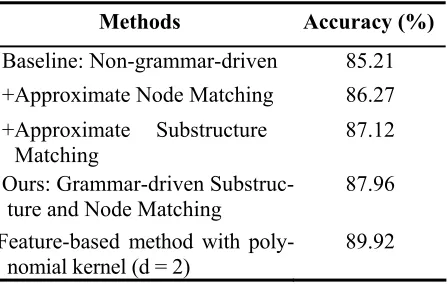
Methods Accuracy (%)
Baseline: Non-grammar-driven 85.21 +Approximate Node Matching 86.27 +Approximate Substructure
Matching
87.12
Ours: Grammar-driven Substruc-ture and Node Matching
87.96
Feature-based method with poly-nomial kernel (d = 2)
[image:6.612.315.539.467.609.2]89.92
Table 2: Performance comparison
4.2 Experimental Results
non-grammar one with an absolute improvement of 2.75 (87.96-85.21) percentage, representing a rela-tive error rate reduction of 18.6% (2.75/(100-85.21)) . It suggests that 1) the linguistically motivated structure features are very useful for semantic role classification and 2) the grammar-driven kernel is much more effective in capturing such kinds of fea-tures due to the consideration of linguistic knowl-edge. Moreover, Table 2 shows that 1) both the grammar-driven approximate node matching and the grammar-driven approximate substructure matching are very useful in modeling syntactic tree structures for SRL since they contribute relative error rate re-duction of 7.2% ((86.27-85.21)/(100-85.21)) and 12.9% ((87.12-85.21)/(100-85.21)), respectively; 2) the grammar-driven approximate substructure matching is more effective than the grammar-driven approximate node matching. However, we find that the performance of the grammar-driven kernel is still a bit lower than the feature-based method. This is not surprising since tree kernel methods only fo-cus on modeling tree structure information. In this paper, it captures the syntactic parse tree structure features only while the features used in the feature-based methods cover more knowledge sources.
In order to make full use of the syntactic structure information and the other useful diverse flat fea-tures, we present a composite kernel to combine the grammar-driven hybrid kernel and feature-based method with polynomial kernel:
(1
)
(0
1)
comp hybrid poly
K
=
γ
K
+ −
γ
K
≤ ≤
γ
Evaluation on the development set shows that the composite kernel yields the best performance when γ is set to 0.3. Using the same setting, the system achieves the performance of 91.02% in Accuracy in the same test set. It shows statistically significant improvement (χ2 test with p= 0.10) over using the
standard features with the polynomial kernel (γ = 0, Accuracy = 89.92%) and using the grammar-driven hybrid convolution tree kernel (γ = 1, Accuracy = 87.96%). The main reason is that the tree kernel can capture effectively more structure features while the standard flat features can cover some other useful features, such as Voice, SubCat, which are hard to be covered by the tree kernel. The ex-perimental results suggest that these two kinds of methods are complementary to each other.
In order to further compare with other methods, we also do experiments on the dataset of English PropBank I (LDC2004T14). The training,
develop-ment and test sets follow the conventional split of Sections 02-21, 00 and 23. Table 3 compares our method with other previously best-reported methods with the same setting as discussed previously. It shows that our method outperforms the previous best-reported one with a relative error rate reduction of 10.8% (0.97/(100-91)). This further verifies the effectiveness of the grammar-driven kernel method for semantic role classification.
Method Accuracy (%)
[image:7.612.314.541.323.422.2]Ours (Composite Kernel) 91.97 Moschitti (2006): PAF kernel only 87.7 Jiang et al. (2005): feature based 90.50 Pradhan et al. (2005a): feature based 91.0
Table 3: Performance comparison between our method and previous work
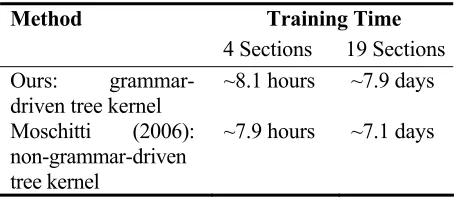
Training Time Method
4 Sections 19 Sections Ours:
grammar-driven tree kernel
~8.1 hours ~7.9 days
Moschitti (2006): non-grammar-driven tree kernel
~7.9 hours ~7.1 days
Table 4: Training time comparison
Table 4 reports the training times of the two ker-nels. We can see that 1) the two kinds of convolu-tion tree kernels have similar computing time. Al-though computing the grammar-driven one requires exponential time in its worst case, however, in practice, it may only need O N(| 1| |
⋅
N2|) or lin-ear and 2) it is very time-consuming to train a SVM classifier in a large dataset.5
Conclusion and Future Work
CFG rule in defining our grammar-driven convolu-tion tree kernel.
The extension of our work is to improve the per-formance of the entire semantic role labeling system using the grammar-driven tree kernel, including all four stages: pruning, semantic role identification, classification and post inference. In addition, a more interesting research topic is to study how to integrate linguistic knowledge and tree kernel methods to do feature selection for tree kernel-based NLP applications (Suzuki et al., 2004). In detail, a linguistics and statistics-based theory that can suggest the effectiveness of different substruc-ture feasubstruc-tures and whether they should be generated or not by the tree kernels would be worked out.
References
C. F. Baker, C. J. Fillmore, and J. B. Lowe. 1998. The Berkeley FrameNet Project. COLING-ACL-1998 Xavier Carreras and Lluıs Màrquez. 2004. Introduction to
the CoNLL-2004 shared task: Semantic role labeling. CoNLL-2004
Xavier Carreras and Lluıs Màrquez. 2005. Introduction to the CoNLL-2005 shared task: Semantic role labeling. CoNLL-2005
Eugene Charniak. 2000. A maximum-entropy-inspired parser. In Proceedings ofNAACL-2000
Wanxiang Che, Min Zhang, Ting Liu and Sheng Li. 2006. A hybrid convolution tree kernel for semantic role labeling. COLING-ACL-2006(poster)
Michael Collins and Nigel Duffy. 2001. Convolution kernels for natural language. NIPS-2001
Daniel Gildea and Daniel Jurafsky. 2002. Automatic la-beling of semantic roles. Computational Linguistics, 28(3):245–288
David Haussler. 1999. Convolution kernels on discrete structures. Technical Report UCSC-CRL-99-10 Zheng Ping Jiang, Jia Li and Hwee Tou Ng. 2005.
Se-mantic argument classification exploiting argument interdependence. IJCAI-2005
T. Joachims. 1998. Text Categorization with Support Vecor Machine: learning with many relevant fea-tures. ECML-1998
Kashima H. and Koyanagi T. 2003. Kernels for Semi-Structured Data. ICML-2003
Huma Lodhi, Craig Saunders, John Shawe-Taylor, Nello Cristianini and Chris Watkins. 2002. Text
classifica-tion using string kernels. Journal of Machine Learn-ing Research, 2:419–444
Mitchell P. Marcus, Mary Ann Marcinkiewicz and Bea-trice Santorini. 1993. Building a large annotated cor-pus of English: the Penn Treebank. Computational Linguistics, 19(2):313–330
Alessandro Moschitti. 2004. A study on convolution ker-nels for shallow statistic parsing. ACL-2004
Alessandro Moschitti. 2006. Syntactic kernels for natu-ral language learning: the semantic role labeling case. HLT-NAACL-2006 (short paper)
Rodney D. Nielsen and Sameer Pradhan. 2004. Mixing weak learners in semantic parsing. EMNLP-2004 Martha Palmer, Dan Gildea and Paul Kingsbury. 2005.
The proposition bank: An annotated corpus of seman-tic roles. Computational Linguisseman-tics, 31(1)
Sameer Pradhan, Kadri Hacioglu, Valeri Krugler, Wayne Ward, James H. Martin and Daniel Jurafsky. 2005a. Support vector learning for semantic argument classi-fication. Journal of Machine Learning
Sameer Pradhan, Wayne Ward, Kadri Hacioglu, James Martin and Daniel Jurafsky. 2005b. Semantic role la-beling using different syntactic views. ACL-2005 Vasin Punyakanok, Dan Roth, Wen-tau Yih and Dav
Zi-mak. 2004. Semantic role labeling via integer linear programming inference. COLING-2004
Vasin Punyakanok, Dan Roth and Wen Tau Yih. 2005. The necessity of syntactic parsing for semantic role labeling. IJCAI-2005
Libin Shen, Anoop Sarkar and A. K. Joshi. 2003. Using LTAG based features in parse reranking. EMNLP-03 Jun Suzuki, Hideki Isozaki and Eisaku Maede. 2004.
Convolution kernels with feature selection for Natu-ral Language processing tasks. ACL-2004
Vladimir N. Vapnik. 1998. Statistical Learning Theory. Wiley
Nianwen Xue and Martha Palmer. 2004. Calibrating features for semantic role labeling. EMNLP-2004 Dmitry Zelenko, Chinatsu Aone, and Anthony
Rich-ardella. 2003. Kernel methods for relation extraction. Machine Learning Research, 3:1083–1106