Munich Personal RePEc Archive
Dollarization, liquidity and performance:
Evidence from Turkish banking
Caglayan, Mustafa and Talavera, Oleksandr
Heriot-Watt University, University of Sheffield
16 July 2016
Online at
https://mpra.ub.uni-muenchen.de/72812/
Dollarization, liquidity and performance: Evidence from
Turkish banking
✩Mustafa Caglayana
, Oleksandr Talaverab
a
School of Management and Languages,Heriot–Watt University, Edinburgh EH14 4AS, UK
b
Management School, University of Sheffield, Sheffield S10 2TN, UK
Abstract
Using a panel of Turkish commercial banks, we examine credit dollarization and its impact on banks’ liquidity and profitability. Our estimates suggest that banks partially pass-through foreign denominated funds to borrowers in the form of foreign denominated credit. Furthermore, banks which lend in foreign denominated currency hold less liquid assets and experience higher return on assets. The results suggest that, when the domestic currency is stable, banks in Turkey manage their liquidity aggressively to earn higher returns on foreign denominated funds.
JEL Classification Numbers: G20, G21
Key words: Financial Dollarization, Commercial Banks, Liquidity, Performance, Pass-through
✩Corresponding author: Mustafa Caglayan, School of Management & Languages; Accountancy,
Economics and Finance, Heriot-Watt University, Edinburgh, EH14 4AS, United Kingdom. Phone: +44 (0)131 451 8373, Email: [email protected].
✩✩Thanks: The authors are grateful to Pınar ¨Ozl¨u for her specific comments, as well as those of
participants in the 2016 International Finance and Banking Society Conference, Barcelona. Standard disclaimer applies.
Email addresses: [email protected](Mustafa Caglayan),[email protected]
Dollarization, liquidity and performance: Evidence from Turkish banking
Abstract
Using a panel of Turkish commercial banks, we examine credit dollarization and its impact
on banks’ liquidity and profitability. Our estimates suggest that banks partially
pass-through foreign denominated funds to borrowers in the form of foreign denominated credit.
Furthermore, banks which lend in foreign denominated currency hold less liquid assets and
experience higher return on assets. The results suggest that, when the domestic currency is
stable, banks in Turkey manage their liquidity aggressively to earn higher returns on foreign
denominated funds.
Keywords: Financial Dollarization, Commercial Banks, Liquidity, Performance,
Pass-through
1. Introduction
An examination of banks’ balance sheets shows that financial dollarization has gained a permanent role in emerging and transition economies.1
This phenomena attracted the interest of researchers and policymakers alike, for dollarization can trigger balance of payments and financial crises following a rapid depreciation of the domestic currency against the hard currencies. In such circumstances, as the foreign investors pull out of the country and the crisis sets in, the IMF or the World Bank designs a rescue package that promises an injection of substantial amounts of funds into the stricken country on the condition that certain structural reforms are implemented.
To explain the factors behind financial dollarization, researchers have developed several analytical models, which subsequently guided the empirical research to date. For instance, realizing that in periods of high inflation and macroeconomic turbulence households and firms use foreign currency for transaction as well as storage purposes, researchers have proposed the monetary substitution view and the asset portfolio view. The monetary substitution view suggests that as the country experiences a period of high inflation and/or macroeconomic turbulence, economic agents use a hard foreign currency to overcome the purchasing power risk. Whereas the asset portfolio view rationalizes how much domesticversus foreign assets one should carry in a risky portfolio. In particular, the theory suggests that a risk-averse household must consider the variance between the two types of assets along with the expected real interest rate differential between foreign and local deposits to construct her portfolio.2
Researchers have also suggested that weak institutions would lead to dollarization if the economic agents within and outside the country are not certain about the credibility of the policies and contract enforcement in the country.3
Lastly, it has been argued that
1
We use the term financial dollarization to describe the denomination of bank deposits and loans in a foreign currency rather than the domestic currency of the country in which they are held.
2See, among others, Uribe (1997), Engineer (2000), and Winkelried and Castillo (2010) on
mon-etary substitution view, and Calvo (2002), Ize and Levy Yeyati (2003) and Luca and Petrova (2008) on portfolio allocation models.
3
market failure may lead to dollarization.4
When we examine the empirical literature, we find that the proposed theories on financial dollarization have been tested using annual aggregate panel datasets con-structed for emerging economies. Surprisingly, to our knowledge, researchers have not focused on one country at a time to examine the impact of financial dollarization on domestic banks. Lack of research along these lines creates a gap in our understanding because those very domestic banks, which accept foreign currency denominated de-posits or raise dollar denominated funds, not only act as an intermediary channeling funds from savers to spenders, but also affect the health of the financial system as they shift risks which may emerge from sudden changes in the value of the domestic currency. Hence, it is important to examine financial dollarization from the perspec-tive of commercial banks which operate in a single country so that we understand the consequences of dollarization.
In this study, different from the rest of the literature, we focus on a panel of commercial banks collected from Turkey to examine credit dollarization and its con-sequences on banks’ liquidity and profitability. In doing so, we also examine to what extent macroeconomic factors affect banks’ dollar denominated loans, liquidity and performance. Given that the country experienced a highly inflationary period, which started as of the mid 1980s and ended with the implementation of a structural re-form package following the 2001 financial crises, financial dollarization has been a major issue in Turkey for quite a long time, reaching 56% in 2001. During these two decades, many businesses, banks and finance houses declared bankruptcy or went into administration for they could not pay back their debt as the value of the domestic currency depreciated on a daily basis.5
Following the 2001 stabilization programme, rate of inflation dropped to less than 10% per annum by 2003 and stayed around the 6-9% level.
Such an examination for Turkish banks is meaningful as the country continued to experience high levels of dollarization even after the implementation of the 2001 structural reforms to date. However, the structural stalled with the establishment
4
See for instance Broda and Levy-Yeyati (2006) and De La Torre and Schmukler (2004).
5
of the right wing government, which singlehandedly ruled the country following the 2002 election. In general, high levels of dollarization in a relatively stable economy is not unexpected for it reflects the continuing public distrust on the government’s economic policies. Yet, this observation for Turkey is surprising because despite the rhetoric of the governing party that the economy was in safe hands, apparently, savers and borrowers did not trust the actions of the government and continued to use foreign denominated assets (currency) for major transactions and portfolio allocation purposes.6
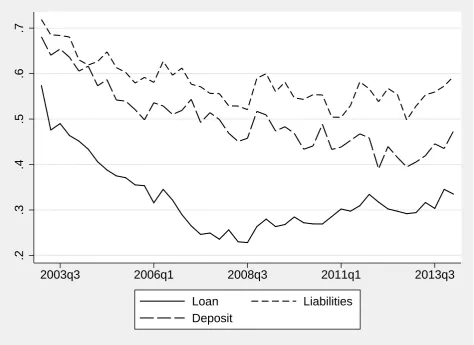
Figure 1 displays the extent of financial dollarization in Turkey since 2003. We see that loan dollarization was well above 50% in the beginning of 2003, yet over the next 5 years it declined to 25% by 2008. Then after, loan dollarization began to increase reaching at approximately 35% by the end of the sample period. Deposit and liability dollarization portray a worse tendency. Both ratios were around 70% in the beginning of the sample, yet we observe a slow downward trend. At the end of 2014, deposit dollarization reached around the 50% mark and foreign liability to total liability ratio was close to the 60% mark. The figure, in fact, suggest that the overall health of the economy is dependent on the resilience of the banking sector in Turkey to shocks. If the health of the banking sector were to deteriorate due to an adverse shock, the Turkish economy, which is suffering from chronic current account deficit and high levels of debt, could experience a recession deeper than that in 2001. We start our empirical investigation by examining whether the availability of for-eign denominated funds lead to credit dollarization. To investigate this issue we estimate a model which captures foreign denominated asset pass-through to borrow-ers. We next explore how dollarization affects liquid assets and bank performance. In doing so, we particularly focus on the role of foreign denominated funds and credit on liquidity and banks’ performance measures. In our examination, we also scrutinize the role of macroeconomic factors such as exchange rate volatility and the interest rate differential between foreign and domestic currency denominated loans and deposits. This is relevant because until around 2011 the government carried out a widespread privatization programme to attract foreign investors’ attention to bring their funds
6
to Turkey while the central bank tried to achieve an inflation rate below double digit figures with a target around 5-6%. These goals required the Turkish central bank to keep a close eye on the value and the volatility of the exchange rate.7
Our investigation covers the period between 2003q1 to 2014q1. All bank level data are collected from the Banks Association of Turkey website. We estimate our empiri-cal models using the generalized linear model (GLM) and instrumental variables fixed effect methodologies. Our examination provides evidence that foreign denominated funds available to the banks are partially passed onto the borrowers in the form of foreign denominated credit. This implies that banks do take advantage of the stabil-ity of the domestic currency as they raised funds cheaply from international money markets to extend credit in foreign or domestic currency. In an environment where the value of the exchange rate is stable this strategy is sensible for banks can manage their liquid assets more aggressively to boost their return. Our investigation further shows that banks that lend in foreign denominated currency experience a significant reduction in performance in response to exchange rate fluctuations. We also find that bank returns decline when the interest rate differentials between domestic and foreign denominated funds (or loans) widens. These results, despite banks fully hedge against fluctuations in the exchange rate, signal that the Turkish banking sector would face significant difficulties in the future as political and financial unrest begin to emerge due to unsustainable policies of the government.8
Lastly, we should note that our results are similar across the estimation methodologies that we implement, providing support for the robustness of our findings. The rest of the paper is organized as follows. Section 2 presents our empirical models and the data. Section 3 discusses the results and Section 4 concludes the paper.
2. Empirical Model
As a result of high and chronic inflation experienced in the late 70s and the lib-eralization of the foreign exchange regime in 1984, foreign exchange deposits became
7The policymakers did their utmost to keep the currency stable so that growth could be achieved
through cheap imported consumption and investment goods. The downside of this policy was a soaring current account deficit.
8
an important financial saving instrument in Turkey by the mid 1980s. This devel-opment increased the availability of funds to corporations which needed large sums for their fixed capital investment projects. However, high inflation and cut-throat competition in the financial markets, which continued throughout the turbulent 80s and 90s, have led to bankruptcy of many brokerage firms as well as established family firms, and paved way to emergence of several new corporations which were able to adapt to the new economic conditions. With the implementation of the structural changes following the 2001 crises, the rate of inflation declined to single digit figures and stabilized around the 6-9% band. Following the 2001 crises, the banking sector had to be restructured but there was no secular changes with respect to the extent of dollarization.
In what follows below, we examine financial dollarization in Turkey for the post 2003-period during which the rate of inflation was in single digits and the exchange rate was stable. However, dollarization which mainly emerged after 1984, continued to be an important source of concern. In particular, we empirically investigate financial dollarization from three facets. We initially examine to what extent foreign denomi-nated liabilities are passed onto borrowers in the form of credit. We then investigate whether dollarization affects management of liquid assets. Lastly, we examine the role of dollarization on bank performance. It is useful to note that all variables are measured in US dollars because banks in Turkey mainly use the US Dollar to extend loans to borrowers, while lending in other hard currencies such as Euros or Japanese Yens is less but not uncommon.
Pass-through
To examine foreign liability pass-through in the banking sector, we use the following form:
DollarizationL
it = α+β1Dollarization D,T
it +β2Ct (1)
+β3DollarizationD,Tit ×Ct+
β4log(T A)it+β5
Equityit
T A +µt+νi+ǫit
The dependent variableDollarizationL, which captures credit dollarization, is defined
we are specifically interested in the coefficient associated with DollarizationD,T,
which measures either the total foreign denominated liabilities (deposits and borrowed funds) to total liabilities (deposits and borrowed funds) ratio (DollarizationT) or the
total foreign currency denominated deposits to total deposits ratio (DollarizationD).
Any estimate of β1 that is less than unity would suggest that the banks do not fully pass foreign currency funds to borrowers. In this context, a low pass-through implies that foreign denominated funds which banks do not lend out in foreign currency are converted into domestic currency and extended as credit in domestic currency to other borrowers. This strategy, although risky, is meaningful when the value of the Turk-ish Lira was relatively stable and it was cheap to raise funds from the international money markets.
Pass-through also might depend on other factors. In particular, we introduce two macroeconomic control (C) variables which have been shown to be important in cross country data. One of the control variables evaluates the role of risks that may emanate from exchange rate fluctuations. To measure exchange rate volatility, we compute the within year standard deviation or the inter quartile range of the exchange rate between Turkish Lira against the US Dollar (CSD or CIQR). We also employ loan
interest rate differential (CCR) or liabilities interest rate differential (CDR) to gauge
the effect of cost or revenue margins between domestic and foreign currencies loans. We expect the coefficient associated with the changes in interest margins will take a negative sign as this will induce banks to exercise a higher pass-through of foreign denominated funds to borrowers. However, the coefficient associated with exchange rate volatility may not be significant because Turkish banks fully hedge against their foreign exchange rate positions.
νi, time effects are captured by µt, and the error term is denoted by ǫit.
Liquidity Management
In an environment with no market imperfections, banks can raise funds from the money markets when demand exceeds the available funds. Furthermore, banks that have opportunities would not hold cash more than the amount required by the central bank, as liquid assets yield no or little return. From the perspective of the Turkish banks, given that the period under investigation was relatively stable, and that banks could find funds from international money markets at low rates, one would expect that banks which raise foreign denominated funds would manage their liquidity more aggressively to earn higher profits. To scrutinize whether this hypothesis holds, we examine the data using the following empirical model:
Liquidityit = α+β1DollarizationLit+β2Ct+
β3DollarizationLit×Ct+β4DollarizationD,Tit + (2)
β5DollarizationD,Tit ×Ct+β6Log(T A)it+µt+νi+ǫit
Given the model above, we are mainly interested in the sign of the coefficient as-sociated with DollarizationL, which measures the ratio of credit given to borrowers
in foreign currency. We expect that the higher this ratio, the more aggressive the liquidity management will be. Hence, β1 will take a negative sign. Similar to Equa-tion 1, this model incorporates several control variables. In particular, the model controls for exchange rate variability and interest rate differentials between loans and deposits. We also incorporate several interaction terms. These interaction terms are between the two control variables and i) foreign denominated loans to assets ratio; ii) total foreign funds to total assets, (DollarizationT); and iii) total foreign currency
deposits to total assets ratio, (DollarizationD). Besides, we have bank level variables
that measures bank size (total assets) and bank strength (equity to total assets ratio). Lastly, the model includes time and bank level fixed effects,νi andµt. The error term
is denoted byǫit.
Finally, we examine the effect of dollarization on bank performance. We expect that banks which lend foreign denominated funds would strive to achieve higher returns in assets. In particular, we examine the following model:
P erf ormanceit = α+β1DollarizationLit+β2Ct+
β3DollarizationLit×Ct+β4DollarizationD,Tit + (3)
β5DollarizationD,Tit ×Ct+β6Log(T A) +µt+νi+ǫit
where performance is measured by banks’ return on equity or net interest margin. In this model we expect thatβ1 will take a positive sign indicating that the ratio of loans denominated in foreign currency to total assets leads banks to higher performance. We measure sources of dollarization by i) total foreign denominated liabilities (deposits and funds) to total liabilities, (DollarizationT); and ii) total foreign currency deposits
to total deposits ratio, (DollarizationD). Although one would expect that the foreign
denominated liabilities would have a negative impact on banks’ performance due to embedded risks in running the operations based on the availability of funds from the international money markets, it should not be too surprising to observe no significant effect for banks fully hedge against exchange rate risks. As in the previous two models, we control for macroeconomic factors, risks associated with exchange rate fluctuations and interest rate differentials. We expect that both exchange rate variability and interest rate differentials will have a negative impact on performance as these variables capture increase in costs associated with raising funds from external sources. However, if exchange rate risks are fully hedged, then it is highly likely that we will not observe significance on variables that gauge exchange rate risk.
Similar to the previous two models, equation 3 contains several interaction terms which allow us to examine whether the effects of dollarization on bank performance relate to changes in control variables. In general these interaction terms are likely to take a negative sign as they capture how dollarization will affect performance as risks increase. The risks will lead to an overall reduction in bank profitability as banks will spend resources to overcome any difficulties that may arise due to fluctuations in the value of the currency. The model also contains bank size (Log(T A)), macro control variable (C), bank strength (Equity/T A) bank specific fixed effects, captured by νi,
2.1. Methodological Issues
There are a number of methodological issues that could arise due to the nature of our dependent variable and potential endogeneity issues. Especially it is important to use the proper estimation approach in modeling a variable which is bounded. In our case, the ratio of foreign currency denominated credit to total assets ratio (Loan$
/T A) is constrained within zero and one. To address this problem, we employ the Generalized Linear Model (GLM) estimator. Another potential problem is linked to endogeneity of the explanatory variables, which could be caused by simultaneity among key bank-level variables. The solution to this problem is not obvious, but we attempt to minimize the severeness of the endogeneity problem by lagging all our bank-level variables in our GLM estimations or by employing panel data instrumental variable approach. Our instrument set includes second and third lags of all bank-level independent variables. The validity of instruments is confirmed by Sargan-type test of overidentifying restrictions. Furthermore, to check for weakness of our instruments we calculate the Kleibergen-Paap LM statistic, which is also known as the underidentification test.
2.1.1. Data
Our dataset contains detailed information on all banks’ balance sheets as pub-lished on the Banks Association of Turkey website.9
The original data set has 2,075 quarterly observations from which we excluded banks that have gone into administra-tion. We also removed investment or development banks from our data. To alleviate the influence of extreme observations, bank-level variables are winsorized at the most extreme (top and bottom) one percent level of the distribution.10
After the screening, our sample consists of 1,614 bank-quarter observations pertaining to 46 banks. The data cover the period between 2003q1 to 2014q1.
9
As of January 2015, available at http://www.tbb.org.tr/en/banks-and-banking-sector-information/statistical-reports/20
10We have also experimented with winsorizing 2% and 3% of distribution of all our bank-level
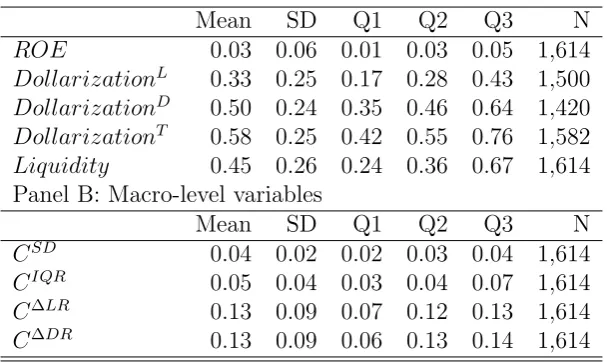
Table 1 provides the descriptive statistics of the variables. We observe that ap-proximately 33% of loans extended by banks in Turkey are denominated in foreign currency. Given that the associated standard deviation is 25%, it is clear that while some banks extend quite a lot credit in foreign currency than the average, others lend much less. Furthermore, on average 50% of all deposits are denominated in foreign currency. Similar to the case of loans the standard deviation is high (24%). Examining the quartiles, we see that for a quarter of the cases deposits in foreign denominated currency is well above sixty percent of the total assets for some banks. Lastly, 58% of the liabilities of banks in Turkey are denominated in a foreign currency. These averages which provide a glimpse of the extent of dollarization in Turkey are substantial. It appears that although the inflation rate has fallen following the imple-mentation of structural reforms that were put into place after the financial meltdown in 2001, public has not developed much trust for the economic policies of the conser-vative government which singlehandedly ruled the country since 2002. Statistics on liquidity are also unusual. We surmise that banks carry high liquidity to overcome any shock that the government polices might inflict on the economy. The statistics on liquidity also suggest that there is room to manage bank liquidity better as liquid assets earn little or no interest. Nevertheless, the reason to hold high levels of liquid assets may be to have the ability to fend off sudden runs to the banks.
Examining bank performance, we find that quarterly return on equity is about 3%, which yields an annual return of about 12%. Quarterly net interest margin, which measures the difference between the interest income generated and the interest expense, is around 1%. Overall, the statistics on bank performance show that banking sector is very profitable, and explain to some degree why the foreign banks strive to enter into the banking sector in Turkey.11
Over the period of investigation, regardless of the method used, average exchange rate volatility has been reasonably low, inducing banks to raise foreign denominated funds from the international money markets. The average difference between domes-tic and foreign denominated loan and deposit rates is in the order of 13% with a standard deviation of 9% suggesting a decline over the years as the rate of inflation
11
fell. However, compared to developed economies the real interest paid to funds is quite high and explains the reason why Turkey was able to attract foreign direct investment since the beginning of the millennium.
3. Empirical Results
We first explore to what extent foreign denominated funds are passed onto bor-rowers in the form of credit. Subsequently, we examine the link between dollarization and liquidity management. Finally, we turn to investigate the impact of dollariza-tion on bank performance. Pass-through effects are estimated by implementing both GLM and instrumental variables fixed effects (IV-FE) methodologies. The remaining models are estimated by implementing instrumental variables IV-FE approach.
Pass-through
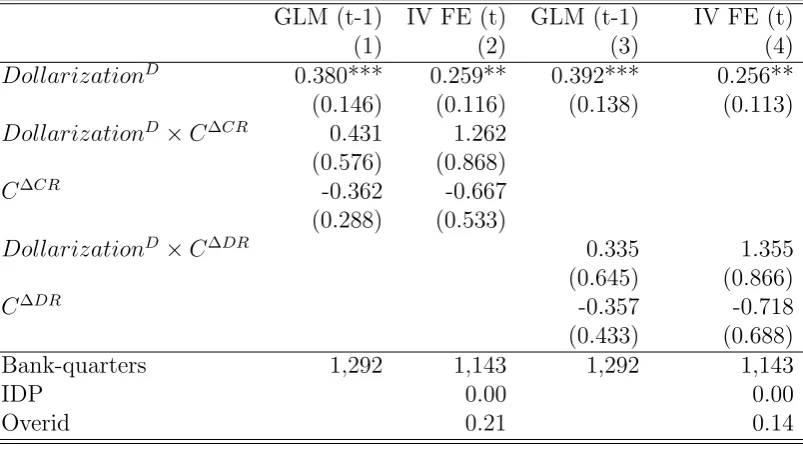
The evidence of pass-through on credit dollarization is given in Tables 2 and 3. Both tables focus on the effects of total foreign denominated funds (DollarizationT) as
well as deposits in foreign denominated currency (DollarizationD). These two tables
differ with respect to the use of control variables. While Table 2 considers the role of exchange rate fluctuations, Table 3 introduces the interest rate differential between loans and deposits on foreign currency. The top panels in both tables present the pass-through results for total foreign denominated funds and the lower panel gives the pass-through results for foreign currency deposits. For all panels, we see that the pass-through is less than unity. In fact, for most of the models pass-through is around or less than 0.6. This suggests that for each unit of foreign currency deposited in a bank, at most 60% of it is passed to borrowers in the form of foreign currency loans. The remainder is either kept as reserves or converted into domestic currency before providing credit in domestic currency.
It is worth stressing that the pass-through coefficient is substantially less than unity. In general one could argue despite hedging, a risk exposure of this magnitude can trigger a series of bankruptcies, jeopardizing the stability of the financial sector. Although, in an environment where exchange rate is stable, these risks can be negli-gible, for an emerging economy, any political or economic turmoil affect the value of the currency and impact the ability of the borrowers to pay back their loans. Failures as such would disrupt the stability of the banking sector and the state of the economy affecting the economy severely. One may object to this argument indicating that the GDP is growing. However, growth is not a consequence of investment or production but of consumption. In fact, despite the reductions in current account deficit due to sharp decline in oil prices, the domestic currency has been devaluated against the major currencies since mid 2015 in the order of 20-30%; signaling for hard times ahead.
Liquidity management
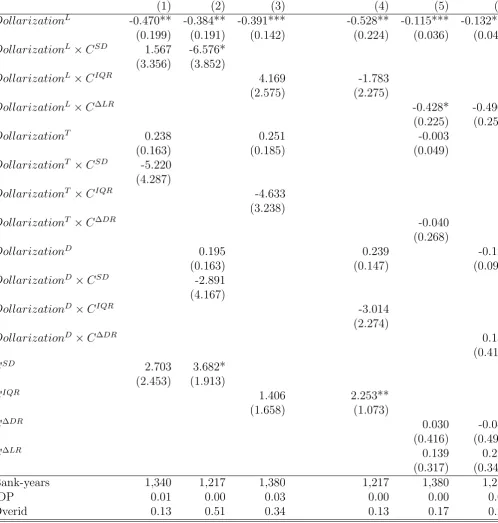
Table 4 demonstrates how financial dollarization affects liquidity management of banks where liquidity is defined as the ratio of liquid assets (cash balances with the Central Bank, trading securities, interbank loans, money market securities, in-vestment securities) to total assets.12
Results consistently show that lending in for-eign currency (DollarizationL) induces banks to use their resources more effectively:
banks reduce their liquid asset holdings as lending in foreign currency increases. Sup-ply of funds in foreign currency, deposit dollarization (DollarizationD) or total foreign
liabilities (DollarizationT), do not appear to impact on liquidity management. The
interaction terms between sources of funds and measures of exchange rate and interest rate risks are significant in columns 2, 5 and 6, implying that risks do not transmit through dollarization on the extent of liquidity that banks hold.
Exchange rate volatility is expected to have a positive effect on banks’ liquid assets. The second and the fourth columns in Table 4 depict a positive coefficient associated with exchange rate volatility. Although this effect is not forthcoming in all models, second and the fourth columns provide support for our expectations. This result suggests that banks hold more liquid assets when the exchange rate volatility
12
increases for exchange rate fluctuations may impose extra stress on bank operations. Interest rate differentials do not seem to impact liquidity preferences of the banks. Although not reported, in all models, bank size affects liquidity positively. We also find that liquidity increases with bank strength. These observations are expected.
Performance
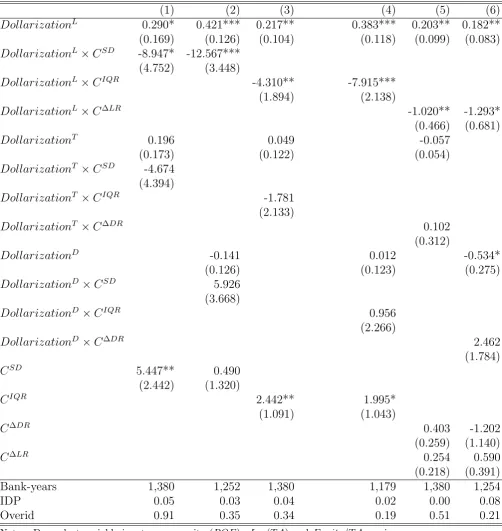
Table 5 focuses on the impact of dollarization on bank performance which we measure using banks’ return on equity (ROE).13
The first four columns of the table present the results when exchange rate uncertainty is used as a control variable and the last two columns show those results when interest rate differentials are used as a control variable.
The results provide evidence that an increase in foreign denominated loans (DollarizationL)
lead to an improvement in performance. We also observe that the interaction coef-ficient between foreign denominated loans and the control variable (exchange rate volatility or interest rate differentials) is negative. This suggests that the positive effect of loans in foreign currency on bank performance will decline as exchange rate volatility increases or the interest rate difference between the liabilities and the assets increase. In other words, bank performance would decline should risk in the economic environment increase. We find no effect of sources of funds on bank returns.
Exchange rate variability has a positive effect on performance. This effect may be a result of better management of liquid assets as exchange rate fluctuates. In the case of interest rate differentials, we find that an increase in lending rate with respect to that of deposits’ improve returns. Although not reported, we observe that the larger the bank size the higher is the performance. These findings are intuitive.
4. Conclusion
In this paper we examine dollarization and its consequences for a panel of com-mercial banks from Turkey. An examination as such on Turkish banks is relevant because dollarization has become an acute problem in Turkey. In our investigation
13
we demonstrate the presence of pass-through of foreign denominated funds to borrow-ers in the form of foreign currency denominated loans. We then examine the effects of dollarization on liquidity management and bank performance. We use quarterly data and cover the period between 2003q1 and 2014q4 during which inflation and the exchange rate were relatively stable as the government was keen to attract foreign funds into the country.
Our investigation shows that there is a partial pass-through of foreign funds into borrowers in the form of foreign denominated loans. The remaining funds are either kept as reserves or converted into domestic currency to lend to other borrowers. We also find that an increase in foreign denominated loans forces banks to reduce their liquid assets. In this context, an increase in foreign denominated loans leads to better management of liquidity, and yield higher bank performance. This claim receives support when we examine bank performance: bank performance improves with an increase in foreign currency denominated loans. However, captured through the interaction terms, we also find that the performance of banks that dollarize decline when risks increase. Our findings hold true controlling for exchange rate volatility or interest rate differentials between domestic and foreign denominated deposits or loans, bank strength and bank size.
References
[1] Baum, C. F., Caglayan, M., and Talavera, O. (2010). Parliamentary election cycles and the Turkish banking sector.Journal of Banking & Finance, 34(11), 2709-2719.
[2] Berger, A. N. and Udell, G. F. (2002). Small business credit availability and rela-tionship lending: The importance of bank organizational structure.The Economic Journal, 112(477):F32-F53.
[3] Broda, C., Levy-Yeyati, E., 2006. Endogeneous Deposit Dollarization. Journal of Credit, Money and Banking 38, 963-88.
[4] Burnside, C., Eichenbaum, M., Rebelo, S., 2001. Hedging and financial fragility in fixed exchange rate regimes. European Economic Review, 45 (7), 1151-1193.
[5] Caballero, R., Krishnamurthy, A., 2003. Excessive dollar debt: financial develop-ment and underinsurance. The Journal of Finance, 58, 867-893.
[6] Calvo, G., 2002. On dollarization. Economics of Transition, 10, 393-403.
[7] De La Torre, A., Schmukler, S. 2004. Coping with risks through mismatches: do-mestic and international financial contracts for emerging economies, International Finance, 7, 349-390.
[8] De Nicol´o, Gianni, Patrick Honohan, and Alain Ize (2003). Dollarization of the Banking System: Good or Bad? Forthcoming, Journal of Banking and Finance.
[9] De Nicol´o, G., P. Honohan, and A. Ize, (2005). Deposit Dollarization: Causes and Consequences. Journal of Banking & Finance 29, 1697-1727.
[10] Engineer, M. (2000): Currency Transaction Costs and Competing Fiat Curren-cies, Journal of International Economics 52, 116-36.
[11] Ize, A., Parrado, E., 2002. Dollarization, monetary policy and the pass-through. IMF Working Paper 02.
[13] Rappoport, V., 2009. Persistence of dollarization after price stabilization.Journal of Monetary Economics, 56, 979-989.
[14] Sapienza, P. (2004). The effects of government ownership on bank lending. Jour-nal of Financial Economics, 72(2), 357-384.
[15] Uribe, M. (1997): Hysteresis in a Simple Model of Currency Substitution, Jour-nal of Monetary Economics 40, 185-202.
[16] Vieira, Fabr´ıcio AC, M´arcio Holland, and Marco F. Resende, 2012. Financial dollarization and systemic risks: New empirical evidence.Journal of International Money and Finance, 31, 1695-1714.
.2
.3
.4
.5
.6
.7
2003q3 2006q1 2008q3 2011q1 2013q3
[image:20.595.73.548.129.474.2]Loan Liabilities Deposit
Figure 1: Dynamics of dollarization in Turkey: 2003q1–2014q1. The panel shows ratio of USD denominated loans to total loans (DollarizationL), ratio of USD denominated deposits to total
de-posits (DollarizationD), ratio of USD denominated liabilities (deposits and funds) to total liabilities
Table 1: Descriptive statistics, 2003q1–2014q1.
Panel A: Bank-level variables
Mean SD Q1 Q2 Q3 N
ROE 0.03 0.06 0.01 0.03 0.05 1,614
DollarizationL 0.33 0.25 0.17 0.28 0.43 1,500
DollarizationD 0.50 0.24 0.35 0.46 0.64 1,420
DollarizationT 0.58 0.25 0.42 0.55 0.76 1,582
Liquidity 0.45 0.26 0.24 0.36 0.67 1,614 Panel B: Macro-level variables
Mean SD Q1 Q2 Q3 N
CSD 0.04 0.02 0.02 0.03 0.04 1,614
CIQR 0.05 0.04 0.03 0.04 0.07 1,614
C∆LR 0.13 0.09 0.07 0.12 0.13 1,614
C∆DR 0.13 0.09 0.06 0.13 0.14 1,614
Notes: The table presents summary statistics of the key variables used in the analysis. Panel A summarizes bank-level variables: return on equity (ROE), ratio of USD denominated loans to total loans (DollarizationL), ratio of USD denominated deposits to total deposits (DollarizationD),
ratio of USD denominated liabilities (deposits and funds) to total liabilities (DollarizationT), ratio
of liquid assets (cash balances with the Central Bank, trading securities, interbank loans, money market securities, investment secutiries) to total assets (Liquidity). Panel B summarizes macro-level variables: inter-quarter standard deviation of US dollar - Turkish Lira exchange rate (CSD),
inter-quarter interquartile range of US dollar - Turkish lira exchange rate (CIQR), difference between US
dollar denominated loan rates and Turkish lira denominated loan rates (C∆LR), difference between
US dollar denominated deposit rate and Turkish Lira denominated deposit rates (CDR). Q1, Q2,
Table 2: GLM and Panel data IV estimates of pass-through and exchange rate risk: CSDandCIQR.
Panel A: Total Liabilities DollarizationT pass-through
GLM (t-1) IV FE (t) GLM (t-1) IV FE (t)
(1) (2) (3) (4)
DollarizationT 0.531*** 0.495*** 0.529*** 0.593***
(0.136) (0.186) (0.137) (0.177)
DollarizationT ×CSD -0.072 3.465
(0.225) (4.361)
CSD 0.211 -1.973
(0.157) (2.645)
DollarizationT ×CIQR -0.025 0.461
(0.146) (2.728)
CIQR 0.086 -0.246
(0.110) (1.683)
Bank-quarters 1,430 1,300 1,430 1,300
IDP 0.00 0.00
Overid 0.34 0.10
Panel B: Deposit DollarizationD pass-through
GLM (t-1) IV FE (t) GLM (t-1) IV FE (t)
(1) (2) (3) (4)
DollarizationD 0.427*** 0.440** 0.426*** 0.521***
(0.144) (0.175) (0.145) (0.156)
DollarizationD ×CSD 0.182 0.279
(0.261) (4.376)
CSD 0.087 0.022
(0.124) (2.291)
DollarizationD ×CIQR 0.153 -1.250
(0.180) (2.474)
CIQR 0.020 0.749
(0.092) (1.314)
Bank-quarters 1,292 1,178 1,292 1,178
IDP 0.00 0.00
Overid 0.39 0.23
Notes: Dependent variable is ratio of USD denominated loans to total loans (DollarizationL). Log(T A) andEquity/T Aare included in specifications, but not reported.
Table 3: GLM and Panel data IV estimates of pass-through and interest rate risk: C∆CRandC∆DR.
Panel A: Total Liabilities DollarizationT pass-through.
GLM (t-1) IV FE (t) GLM (t-1) IV FE (t)
(1) (2) (3) (4)
DollarizationT 0.528*** 0.511*** 0.545*** 0.551***
(0.176) (0.127) (0.168) (0.130)
DollarizationT ×C∆CR 0.008 0.872
(0.622) (0.648)
C∆CR -0.294 -0.556
(0.360) (0.470)
DollarizationT ×C∆DR -0.118 0.477
(0.592) (0.723)
C∆DR -0.168 -0.538
(0.409) (0.678)
Bank-quarters 1,430 1,300 1,430 1,261
IDP 0.00 0.00
Overid 0.72 0.71
Panel B: Deposit DollarizationD pass-through
GLM (t-1) IV FE (t) GLM (t-1) IV FE (t)
(1) (2) (3) (4)
DollarizationD 0.380*** 0.259** 0.392*** 0.256**
(0.146) (0.116) (0.138) (0.113)
DollarizationD ×C∆CR 0.431 1.262
(0.576) (0.868)
C∆CR -0.362 -0.667
(0.288) (0.533)
DollarizationD ×C∆DR 0.335 1.355
(0.645) (0.866)
C∆DR -0.357 -0.718
(0.433) (0.688)
Bank-quarters 1,292 1,143 1,292 1,143
IDP 0.00 0.00
Overid 0.21 0.14
Notes: Dependent variable is ratio of USD denominated loans to total loans (DollarizationL). Log(T A) andEquity/T Aare included in specifications, but not reported.
Table 4: Panel Data IV estimates of Liquidity.
(1) (2) (3) (4) (5) (6)
DollarizationL -0.470** -0.384** -0.391*** -0.528** -0.115*** -0.132***
(0.199) (0.191) (0.142) (0.224) (0.036) (0.041)
DollarizationL×CSD 1.567 -6.576*
(3.356) (3.852)
DollarizationL×CIQR 4.169 -1.783
(2.575) (2.275)
DollarizationL×C∆LR -0.428* -0.490*
(0.225) (0.254)
DollarizationT 0.238 0.251 -0.003
(0.163) (0.185) (0.049)
DollarizationT ×CSD -5.220
(4.287)
DollarizationT ×CIQR -4.633
(3.238)
DollarizationT ×C∆DR -0.040
(0.268)
DollarizationD 0.195 0.239 -0.122
(0.163) (0.147) (0.091)
DollarizationD×CSD -2.891
(4.167)
DollarizationD×CIQR -3.014
(2.274)
DollarizationD×C∆DR 0.137
(0.419)
CSD 2.703 3.682*
(2.453) (1.913)
CIQR 1.406 2.253**
(1.658) (1.073)
C∆DR 0.030 -0.049
(0.416) (0.491)
C∆LR 0.139 0.228
(0.317) (0.343)
Bank-years 1,340 1,217 1,380 1,217 1,380 1,254
IDP 0.01 0.00 0.03 0.00 0.00 0.00
Overid 0.13 0.51 0.34 0.13 0.17 0.28
Table 5: Panel Data IV estimates of Performance.
(1) (2) (3) (4) (5) (6)
DollarizationL 0.290* 0.421*** 0.217** 0.383*** 0.203** 0.182**
(0.169) (0.126) (0.104) (0.118) (0.099) (0.083)
DollarizationL×CSD -8.947* -12.567***
(4.752) (3.448)
DollarizationL×CIQR -4.310** -7.915***
(1.894) (2.138)
DollarizationL×C∆LR -1.020** -1.293*
(0.466) (0.681)
DollarizationT 0.196 0.049 -0.057
(0.173) (0.122) (0.054)
DollarizationT ×CSD -4.674
(4.394)
DollarizationT ×CIQR -1.781
(2.133)
DollarizationT ×C∆DR 0.102
(0.312)
DollarizationD -0.141 0.012 -0.534*
(0.126) (0.123) (0.275)
DollarizationD×CSD 5.926
(3.668)
DollarizationD×CIQR 0.956
(2.266)
DollarizationD×C∆DR 2.462
(1.784)
CSD 5.447** 0.490
(2.442) (1.320)
CIQR 2.442** 1.995*
(1.091) (1.043)
C∆DR 0.403 -1.202
(0.259) (1.140)
C∆LR 0.254 0.590
(0.218) (0.391)
Bank-years 1,380 1,252 1,380 1,179 1,380 1,254
IDP 0.05 0.03 0.04 0.02 0.00 0.08
Overid 0.91 0.35 0.34 0.19 0.51 0.21