Evaluation of High-Temperature Strength of Mo/PSZ Composites
by Modified Small Punch Tests
Zhi Xiong
1, Wan Jiang
1;*, Ying Shi
1, Akira Kawasaki
2and Ryuzo Watanabe
21
State Key Lab of High Performance Ceramics and Superfine Microstructures, Shanghai Institute of Ceramics, Chinese Academy of Sciences, 1295 Dingxi Road, Shanghai 200050, P. R. China
2Department of Materials Processing, Faculty of Engineering, Tohoku University, Sendai 980-8579, Japan
Modified Small Punch (MSP) test techniques have been used to evaluate the strength of Mo/PSZ (partially stabilized zirconia) composites from room temperature to 1573 K. The dependence of deformation, strength and fracture behavior of the composites on temperature, composition and microstructure is discussed in detail. The results show that the high temperature strength, which depends on the composition as well as the microstructure, can be simply measured by the MSP tests. Linear relationship is obtained between the MSP strengths and 4-point bending strengths.
(Received November 12, 2004; Accepted January 31, 2005)
Keywords: molybdenum, partially stabilized zirconia (PSZ), modified small punch tests, high-temperature strength, microstructure
1. Introduction and Background
Small punch (SP) test techniques were first developed in 1980s by Kamedaet al.in Ames lab (Iowa State University) to analyze the ductility loss in steels due to temper or irradiation embrittlement.1) In the early 1990s, Okuda and Misawa modified Small Punch test to evaluate mechanical properties of ceramics and functional graded materials (FGMs).2,3)
Conventional 3- or 4-point bending tests are often employed to evaluate the mechanical properties of brittle materials such as ceramics, but they encounter two problems at elevated temperatures. One is that it is difficult to keep specimen and dies in proper place. The other is the plastic deformation can’t be determined precisely at high temper-ature. However MSP tests can easily solve these problems. Furthermore MSP tests have many other advantages,e.g.the tests only requires very small specimens, it’s easy to fix specimens in place reliably, and elastic Modula, fracture strength and other mechanical properties could also be obtained from the tests.4)So MSP tests are very competitive at elevated temperatures, especially when limited materials are available.5–7)The tests are now widely used for measuring mechanical properties of steels, ceramics, FGMs, polymers and biological materials.8,9)
Due to its unique mechanical and electronic properties, zirconia (ZrO2) ceramic has been widely used as structural
materials, solid-state electrolytes, and thermal barrier coat-ings.10)PSZ (partially stabilized zirconia) has many superior
properties such as high melting point, low thermal con-ductivity, high chemical stability and transformation tough-ening behavior.11)Mo/PSZ is an active system in mechanical
material and FGMs application. In this paper, MSP apparatus is described and mechanical properties of Mo/PSZ compo-sites of different composition including monolithic Mo and PSZ were investigated by MSP tests, and the relationships between strength, fracture behavior and temperatures, com-position, microstructures were discussed in detail.
2. Experimental Procedures
2.1 Sample preparation
The raw materials used were ZrO2-3%Y2O3(PSZ) powder
with the mean particle size of 0.07mmand Mo powder with the mean particle size of 0.96mm. Mo/PSZ powder mixtures containing 0, 10, 20, 30, 40, 60, 80, 100 vol% PSZ were ball milled and dried, and then pressed into cylinders, 14 mm in diameter and 20 mm in height. They were hot isostatic pressed at the temperature of 1773 K for 1 h at 150 MPa. The sintered compact of Mo/PSZ composites were cut into small disks, 10 mm in diameter and 1 mm in thickness, which were then ground to a thickness of about 0.5 mm. One side of the cut disks was ground and diamond-polished for MSP testing and microstructure observation.
2.2 Betti number
The microstructures of samples were observed with an optical microscope (BX51M, Olympus, Japan) and processed with an image processor (Image Pro Plus 4.1). The continuity of each phase in composites was quantified in terms of Betti number, which is a geometrically topological parameter and can be used to characterize three-dimensional continuity of phases. Its value was determined on the polished sections using an image analyzer. When the Betti number for a particular phase is equal to zero, the phase is dispersed, and for the Betti number larger than zero, the phase becomes continuous. Moreover an increase in Betti number means that the phase becomes more connected and complicated.12)
2.3 MSP testing
Figure 1(a) is a schematic diagram of the high temperature MSP testing apparatus and Fig. 1(b) is the model for calculating strength. As shown in Fig. 1(a) the MSP apparatus mainly consists of puncher, upper die, lower die, high accuracy deflection detector and heater. The puncher and dies are made of SiC ceramics. A load is applied to the center of a disk specimen through a small cylinder puncher and the central deflection of the specimen is monitored using a high-accuracy transducer sensor. 2a and 2b in Fig. 1(b) *Corresponding author, E-mail: [email protected]
represent the diameter of the lower die’s hole and that of the upper punch.tis the thickness of the specimens. Strength can be calculated from the following formula,2,4)
¼ 3P
2t2 1
1v2
4
b2
a2þ ð1þvÞln a
b
ð1Þ
WherePis load,vis Poisson’s ratio of the tested specimen. Yield strength is obtained when 0.2% non-linear deformation happened. In case there is no or a small plastic deformation,
maximum load.
For comparison of load-deflection curves, real load (P) was converted to an equivalent load (Peq) to remove the
thickness factor of specimens by following equation,4)
Peq¼ ð0:5=tÞ2P ð2Þ
With load-deflection curves of each composite from room temperature to 1373 K, fracture strength or yield strength of each composite at various temperatures were obtained. The failure behavior of each composite at various temperatures was also investigated. The specimens were soaked for 20 min when the predetermined temperature was reached and then load was applied to the specimens at a crosshead speed of 0.05 mm/min.
2.4 4-point bending tests
In order to compare the mechanical properties obtained from MSP testing with those from bending tests, the 4-point bending tests were performed on the same composites with upper span of 10 mm and lower span of 20 mm under the same load speed.
3. Results and Discussion
3.1 Microstructures
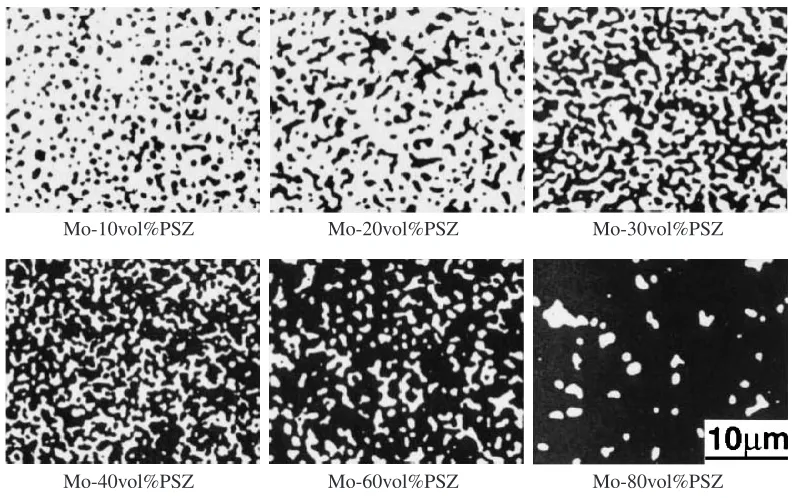
Figure 2 shows the optical microstructure of sintered Mo/ PSZ composites with white and black phases corresponding to Mo and PSZ respectively. As the PSZ volume fraction increases, the microstructure changes from PSZ-particle-dispersed structure (MMC) to metal-ceramic interconnected network structure and then to Mo-particle-dispersed structure (CMC).
Figure 3 shows the relation between the Betti number and composition of the sintered Mo/PSZ composites. When PSZ volume fraction exceeds 20 vol%, the Betti number of PSZ
Fig. 1 Schematic drawing of high temperature MSP-testing apparatus (a) and model for strength calculation (b).
Mo-10vol%PSZ Mo-20vol%PSZ Mo-30vol%PSZ
Mo-40vol%PSZ Mo-60vol%PSZ Mo-80vol%PSZ
[image:2.595.74.267.69.334.2] [image:2.595.99.496.521.770.2]phase gradually increases and the continuity of PSZ phase appears. On the other hand, the Betti number of Mo decreases with increasing PSZ volume fraction and its continuity vanished above 60 vol% PSZ. In the composition range of 20–60 vol% PSZ, the composites have the network structure with both phases interconnected with each other.
Since the starting powder of PSZ is finer than that of Mo, even a small amount of PSZ phase could be connected in the Mo-rich composites. Thus the composition range for the interconnection of two phases is closer to the Mo side. This agrees with the results of computer simulation.13)
3.2 Evaluations of mechanical properties
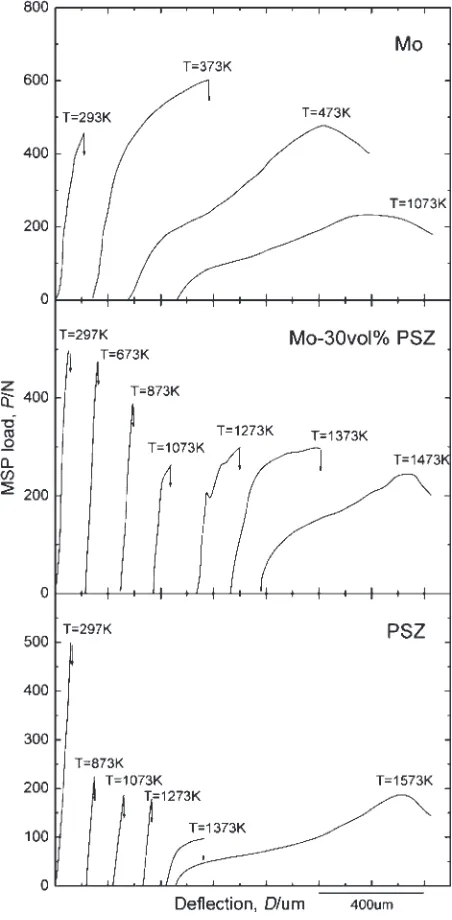
Figure 4 shows the MSP load-deflection curves for the Mo compact, Mo-30 vol%PSZ and PSZ compact tested at differ-ent temperatures. From the curves, the sintered Mo compact shows a small amount of plastic deformation at room temperature, while Mo-30 vol%PSZ only exhibits plastic deformation above 1073 K. With increasing PSZ volume fraction, the composites show plastic deformation at higher temperatures. The temperature for monolithic PSZ to exhibit plastic deformation is above 1373 K.
Figure 5 shows variation in MSP strength of Mo/PSZ composites as a function of testing temperature. The yield strength of the sintered Mo compact decreased rapidly with increasing temperature. The 10 vol% and 20 vol% PSZ composites maintain high fracture strength under 873 K because the dispersed PSZ particles strengthen the compo-sites, whereas the yield strength of the composites decreased at higher temperatures. The strength of the 40% PSZ composite decreases with two gentle slopes probably because of its network microstructure. The first slope corresponds to the strengthening of dispersed PSZ phase; the second one corresponds to the relatively higher strength of PSZ phase at around 1273 K as shown with monolithic PSZ curve. When the PSZ exceeds 60 vol%, Mo phase becomes dispersed in the PSZ matrix, so the strength-temperature curve of these composites are similar to that of monolithic PSZ.12)That is, in low temperature region fracture strength decreases rapidly with increasing temperature, above 873 K the strength shows
a steady region, and then decreases again at higher temper-atures above 1273 K.
Figure 6 shows the compositional dependence of MSP strength for Mo/PSZ composites at various temperatures. At room temperature the strength values exhibit W-shaped curves against composition with two peaks. The first peak, which is in the compositional region of MMC, corresponds to the reinforcement of dispersed PSZ particles. The second peak, which appears in the compositional region for networked structure, is due to the insensitivity of this structure to residual stress and micro-cracks. In the region near monolithic PSZ, the composites’ strength mainly depends on the PSZ matrix. Since PSZ particles and Mo particles have different thermal expansion and the Mo particles are much bigger, there is residual tensile stress in the PSZ matrix, which tends to induce radial cracks. So in this region the composites’ strength increases with increasing
0 20 40 60 80 100
0 200 400 600 800
Betti n
umber
Volume fraction of PSZ, f /% Mo phase PSZ phase
Fig. 3 Relations between Betti number and composition for the sintered Mo/PSZ composites.
[image:3.595.314.540.73.533.2] [image:3.595.55.288.73.248.2]Fig. 6 Compositional dependence of MSP strength for Mo/PSZ composites at different temperatures. Fig. 5 Variation in MSP strength for Mo/PSZ composites as a function of testing temperatures.
Table 1 Fracture mode of Mo/PSZ HIPed composites evaluated by MSP testing.
[image:4.595.107.489.323.432.2] [image:4.595.103.495.497.747.2]PSZ volume fraction. At 873 K the composites show the maximum strength in the region of MMC. At this temper-ature Mo phase has certain plasticity due to pinning of the dispersed PSZ particles, so the composites in the MMC region have high strength. In contrast, the interconnected composites have lower strength because of reduction of plastic phase Mo, which shows as a gentle slope of decreasing strength in Fig. 6. At 1273 K, the Mo phases are much more pliable, and the reinforcement of PSZ particles are apparently weakened. So the MMC composites have higher strength than that of Mo compact while still lower than those of interconnected composites. At 1273 k the maximum strength comes with interconnected composites that are much competent at this temperature.
3.3 Fracture morphology and fracture surface
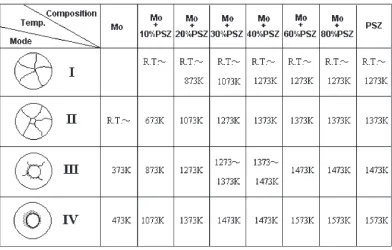
Table 1 lists the fracture modes of the sintered Mo/PSZ composites evaluated by MSP tests. In general, the fracture can be sorted to four different modes. I. Brittle fracture
occurs after elastic deformation, and the cracks propagate from the center of specimens. II. Brittle fracture occurs after a small amount of plastic deformation with a ring crack in the center and little radial cracks. III. Fracture behavior begins to transfer from brittle failure to ductile failure. The fracture morphology represents a bulge showing circumference cracks and little radial cracks. IV. Fracture failure occurs after a large amount of plastic deformation. The facture morphology represents an obvious bulge showing circum-ference cracks without radial cracks. The fracture behavior of different composites mentioned above corresponds to the ductile-brittle transition,5)so by obtaining the fracture energy
from load-deflection curves the ductile-brittle transition temperature (DBTT) could be determined.
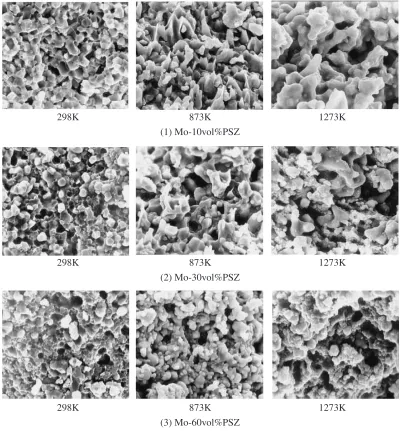
Figure 7 is the SEM micrographs of the fracture surfaces of Mo/PSZ composites tested at various temperatures. Figure 7(1) shows the fracture surface of Mo-10 vol%PSZ composite. The fracture in Mo phase was created predom-inantly by intergranular cracks, and a small amount of
298K 873K 1273K
(1) Mo-10vol%PSZ
298K 873K 1273K
(2) Mo-30vol%PSZ
298K 873K 1273K
(3) Mo-60vol%PSZ
[image:5.595.97.501.73.504.2]boundaries. The grain size is almost the same as the particle size of raw material, which means the refinement of dispersed particles works very well. According to Hall-Petch relation the composites with refined particles have much higher strength than monolithic Mo. In addition, the dispersed PSZ particles do not show plastic deformation easily, so the PSZ particles have pinned and prevented Mo phase from plastic deformation below 873 K, and bring the composite a high strength comparable to room temperature strength. While above 873 K, dislocation in Mo phase and the recrystalliza-tion of matrix phase make it easier for plastic deformarecrystalliza-tion, so the strength of the composites decreased rapidly.
Figure 7(2) shows the fracture surface of Mo-30 vol%PSZ composite. As mentioned above this composite has a structure of interconnected network. Although the grain sizes are similar to those of Fig. 7(1), the strength depends more on PSZ phase. The holes resulting from the pull out of Mo particles increase under 873 K, and Mo phase in Mo-30 vol%PSZ composite shows less plasticity, so the compo-site tends to fail by brittle fracture. Meanwhile PSZ phase in this composite has become interconnected, so its pinning effect has been weakened, which is shown as the first gentle decrease in strength-temperature curves. The micrograph of Mo-30 vol%PSZ at 1273 K displays a large amount of PSZ particles, and the strength of this composite depends more on the PSZ phase. So even Mo phase became pliable, the strength-temperature curve still shows the second gentle slope corresponding to the maximum strength of monolithic PSZ at 1273 K.
Figure 7(3) shows the fracture surface of Mo-60 vol%PSZ composite, which is CMC. From the fracture surface at room temperature, there are a large amount of holes formed by pulling out of Mo particles, which means the binding force between Mo and PSZ particles is fairly feeble. The strength of the composite mainly depends on PSZ matrix. At 1273 K, no bigger PSZ particles are shown, but the facture surface became rougher, which means fractures need more energy.
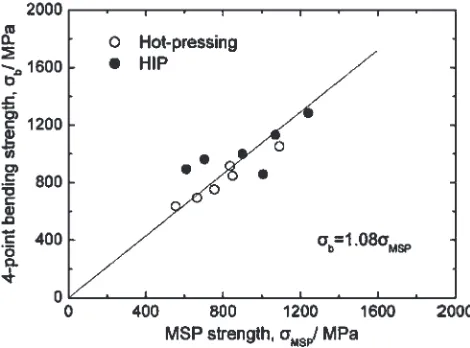
Figure 8 demonstrates the relationship between 4-point bending strength and MSP strength for the sintered Mo/PSZ composites. It is clear that the strength obtained from these two tests agree with each other, which is presented by the linearity of the strength. From the slope of the line, the ratio between 4-point bending strength and MSP strength is 1.08. The fact that MSP strength is little lower than 4-point bending strength is attributed to the complicated two-dimension stress status of MSP tests. With such a relationship it is easy to obtain the bending strength of materials accordingly, so the MSP test can be used as an efficient and convenient way to evaluate the strength of ceramic materials at high temperatures.
4. Conclusion
By measuring accurately the load-deflection curves of
Mo/PSZ composites from MSP tests, we obtained the fracture strength and yield strength of different composites at various temperatures. The compositional dependence of MSP strength for Mo/PSZ composites at room temperature exhibits W-shape, which corresponds to the microstructures such as MMC, CMC or interconnection. The linear relation-ships between MSP strengths and 4-point bending strengths could be used to estimate the bending strength from MSP tests.
Acknowledgements
The authors are grateful to the support of 863 Program, Ministry of Science and Technology, the People’s Republic of China, under Contract No. 2001AA331040, and Develop-ment Program of Science and Technology Fund of Shanghai under Contract No. 01DJGK016.
REFERENCES
1) J. Kameda: Bull. Japan Inst. Metals.25(1986) 520–527.
2) S. Okuda and M. Saito: Proceeding of the Japan Institute of Mechanics (A).57(1991) 940–945.
3) J. Misawa: Bull. Japan Inst. Metals.31(1992) 1008–1009.
4) J. F. Li, A. Kawasaki and R. Watanabe: J. Japan Inst. Metals56(1992) 1450–1456.
5) W. Jiang, J. F. Li, A. Kawasaki and R. Watanabe: J. Japan Inst. Metals 59(1995) 1055–1060.
6) L. M. Zhang, J. F. Li and R. Watanabe:Functionally Graded Materials, (ed. I. Shiota and M. Y. Miyamoto, Elsevier, 1996) pp. 445–450. 7) J. F. Li, W. Pan, F. Sato,et al.: Acta Mater.49(2001) 937–945. 8) J. Kameda, T. E. Bloomer, Y. Sugita,et al.: Mater. Sci. Eng.A229
(1997) 42–54.
9) V. L. Giddings, S. M. Kurtz,et al.: Biomaterials22(2001) 1875–1881. 10) I. Birkby and R. Stevens: Key Eng. Mater.122(1996) 527–532. 11) F. F. Lange: J. Mater. Sci.17(1982) 225–234.
12) W. Jiang, R. Watanabe and A. Kawasaki: J. Japan Inst. Metals 62 (1998) 1018–1024.
13) D. Bouvard and F. F. Lange: Acta Metall. Mater.39(1991) 3083–3090. Fig. 8 Relationship between 4-point bending strength and MSP strength
[image:6.595.308.543.72.246.2]