Conditional Descriptions in
Functional Unification Grammar
Robert T. Kasper
USC/Information Sciences Institute
4676 Admiralty Way, Suite 1001
Marina del Rey, CA 90292 U.S.A.
A b s t r a c t
A grammatical description often applies to a linguistic object only when that object has certain features. Such conditional descriptions can be indirectly modeled in Kay's Functional Unification G r a m m a r (FUG) using functional descriptions that are embedded within disjunctive alternatives. An ex- tension to FUG is proposed that allows for a direct represen- tation of conditional descriptions. This extension has been used to model the input conditions on the systems of systemic grammar. Conditional descriptions are formally defined in terms of logical implication and negation. This formal defi- nition enables the use of conditional descriptions as a general notational extension to any of the unification-based gram° mar representation systems currently used in computational linguistics.
1
I n t r o d u c t i o n
Functional Unification Grammar [Kay79] (FUG) and other grammatical formalisms that use feature structures and uni- fication provide a general basis for the declarative representa- tion of natural language grammars. In order to utilize some of the computational tools available with unification gram- mars, we have developed a mapping from
sVstelnic ¢ram-
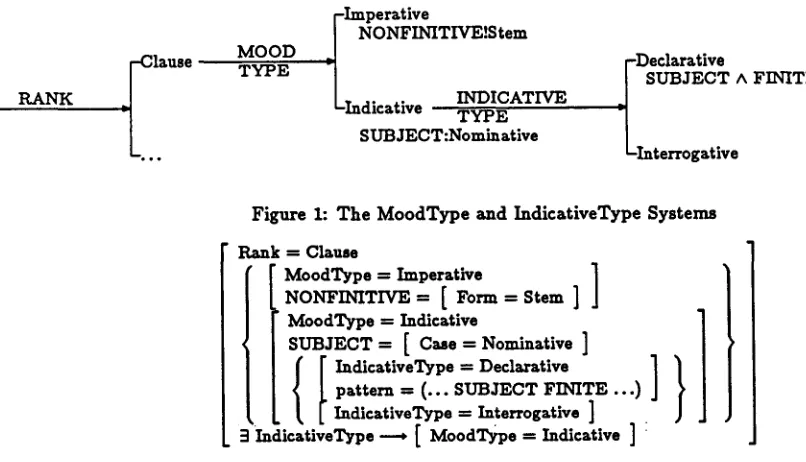
mars [Hall76] into F U G notation. This mapping has been used as the first step in creating a general parsing method for systemic grammars [Kas87a]. The experience of trans- lating systemic grammars into F U G has shown several ways in which the notational resources of F U G may be improved. In particular, F U G has limited notational resources for ex- pressing conditional information. In this paper we describe how FUG has been enhanced by the addition of conditional descriptions, building on research that has already been re- ported [Kas87a,Kas86,Kas87b].Conditional information is stated explicitly in systemic grammars by the input conditions of systems that specify when a system must be used. Consider, for example, the two systems (MoodType and Indicatlve'l~ype) x shown in Figure 1. The input condition for the MoodType system is the feature
IThis example is extracted from Nigel [Mann83], a large sys- temic grammar of English that has been developed in text gener- ation research at USC/ISI.
C/auae, and the input condition for the IndicatlveType sys- tem ls the feature Indicative. Because the features of a sys- temic grammar are normally introduced by a unique system, these input conditions actually express a bidirectional type of logical implication:
I. If a constituent has the feature(s) specified by a sys- tem's input condition, then exactly one of the alterna- tives described by that system must also be yard for the constituent;
2. If a constituent has one of the feature alternatives de- scribed by a system, then it must also have the fea- ture(s) specified by that system's input condition.
Thus the input condition of the Irtd/cative~pe system ex- presses the following implications:
1. If a clause ha~s the feature
Indic,~tive,
then it must also have exactly one of the alternatives from the Zndica-tive23,/pe
system (eitherDeclarative
orInterrogative).
2. If a clause has one of the feature alternatives described by the
Indicativs~3ype
system (eitherDeclarative
o r / n -terrooaties),
then it must also have the featureIndiea-
ties.
While it is theoretically correct to regard the two directions of implication as exact converses of each other, there is a subtle difference between them. The consequent of the first type of implication is the description of the entire system, including systemic features and their realizations. 2 The antecedent of the second type of implication can be safely abbreviated by the systemic features without their realizations, because the presence of a systemic feature implies that its realizations also hold. We will return to this distinction when we provide a formal definition of conditional descriptions in Section 2.
For simple input conditions, the first type of implication can be expressed in FUG, as it was originally formulated by Kay [Kay79], by embedding the description of one system in- side the description of another. For example, we can capture this implication for the IndicativeType system by embedding it within the description of the Indicative alternative of the
RANK
~
-Clause
M O O D
T Y P E~
Imperative
NONFINITIVE!Stem
LIn INDICATIVE
dlcatlve T Y P E SUBJECT:Nominative
Dseclarative
U B J E C T ^ F I N I T E
Llnterrogatlve
F i g u r e 1: T h e M o o d T y p e a n d I n d i c a t i v e T y p e S y s t e m s
Rank = Clause
MoodType = Imperative
NONFI~ITIVE---- [ Form = Stem ] J
MoodType -- Indicative ]
SUBJECT ----" [ Case = Nominative ]
L
f F IndicatlveType = Declarative 1 ~ pattern = ( . . . SUBJECT F I N I T E . . . ) j
J
L ~IndicativeType ---
Interrogative]
. 3 IndicatlveType ~ [ MoodType -- Indicative ] "
F i g u r e 2: T h e M o o d T y p e a n d I n d l c a t i v e T y p e S y s t e m s i n F U G
MoodType system, as shown in Figure 2. Note that the sec- ond type of implication expressed by systemic input condi- tions has not been expressed by embedding one functional description inside another. To express the second type of lm- plicatlon, we have used a different notational device, called a feature existence condition; it will be defined in Section 2.4. Not all systems have simple input conditions consisting of single features. Those input conditious which are com- plex boolea~u expressions over features cannot be expressed directly by embedding. Consider the BenefactiveVolce s sys- tem shown in Figure 3 as an example. Its input condition is the conjunction of two features, Agentive and Benefactive.
One way to express a system with a complex input con- dition in F U G is to use a disjunction with two alternatives, as shown in Figure 4. The first alternative corresponds to what happens when the Benef~ctiveVoice system is entered; the second alternative corresponds to what happens when the BenefactlveVoice system is not entered. The first alternative also includes the features of the input condition. The second alternative includes the features of the negated input condi- tion. Notice that the input condition and its negation must both be stated explicltly, unlike in systemic notation. If the negation of the input condition was not included in the sec- ond alternative, it would be possible to use this alternative
3The BenefactivcVoice system iJ also extracted from the Nigel grammar [Mann83]. It describes the active and passive voice op- tions that are possible in clauses that have both an agent and a beneficiary. The active/passive distinction is not primitive in systemic grammars of English. Instead, it is decomposed into sev- eral cases depending on which participant roles are present in the clause. In this case the subject of a passive clause may be conflated with either beneficiary or medium.
even when the input condition for the system holds. Thus the description of the system would not always be used when it should be. Note that this method of encoding systemic in- put conditions presupposes an adequate treatment of negated features." A formal definition of negation will be developed in Section 2.3.
While it is formally possible to encode complex input con- ditione by disjunction and n e ~ t i o n , such encoding IS not al- together satisfactory: It should not be necessary to state the negated input condition explicitly, since it can always be de- rived automatically from the unne&-~ted condition. It is also rather inefficient to mix the features of the input condition with the other features of the system. The features of the in- put condition contain exactly the information that is needed to choose between the two alternatives of the disjunction (Le., to choose whether the system is entered or not). It would be more efficient and less verbose to have a notation in which the features of the input condition are distlnguished from the other features of the system, and in which the negation of the input condition does not need to be stated explicitly. Therefore, we have developed an extension to FUG that uses a conditional operator (-~), as illustrated by the encoding of the BenefactiveVoice system shown in Figure 5. A descrip- tion corresponding to the input condition appears to the left of the --~ symbol, and the description to be included when the input condition is satisfied appears to its right. A formal definition of what it means for a description to be satisfied will be given in Section 2.1.
[image:2.612.58.461.84.315.2]Agentive
-Benefactive
-B E N E F A C T I V E
V O I C E
f
'Benefact]veActive
AGENT / SUBJECT
lv[EDIUM / D I R E C T C O M P
IvfedloPazslve
MEDIUM / SUBJECT
-BenePsssive
BENEFICIARY / SUBJECT
MEDIUM / D I R E C T C O M P
Figure'3: T h e BenefactiveVoice System.
Rank = Clause
Agentivity = Agentive
Benefaction = Benefacitve
' BenefactiveVoice = BenefactiveActive ]
A G E N T = < S U B J E C T > |
M E D I U M = < D I R E C T C O I q P > ]
BenefactlveVoice = MedioPassive ]
, M E D I U M = < S U B J E C T >BenefactlveVolce = BenePassive
|B E N E F I C I A R Y = < S U B J E C T > |
, M E D I U M = < D I R E C T C O M P >
J
'Agentivity
= N O T AEentive ] ~ ] 'Benefaction = N O T Benefactive ] S /
BenefactlveVolce = NONE
J
Figure 4: BenefactiveVoice s y s t e m in F U G , using disjunction a n d negation.
Rank = Clause
Agentivity = Agentlve
]
---kBenefactiveVoice = lvfedioPasslve
Benefaction = Benefactive
MEDIUM = < S U B J E C T >
BenefactlveVoice = BenePessive
BENEFICIARY = < S U B J E C T >
MEDIUM = <DIRECTCOIVIP>
3 BenefactiveVolce - - , [ Agentivity = Agentlve
]
Benefaction = Benefactlve
BenefactiveVolce = BenefactiveActive ]
]
A G E N T = < S U B J E C T >
M E D I U M = < D I R E C T C O M P >
Figure 5: BenefactiveVoice s y s t e m in extended F U G , using two conditional descriptions.
[image:3.612.122.414.127.218.2] [image:3.612.119.481.480.618.2]Note: A and L are N I L
l : ~
~<p~ > . . . < p .
>]
~ ^ ~ or [ ~ . . . ~.]
~bz V~b~ or {~bz...~b.}denoting no information;
where a E A, to describe atomic values;
where l E L and ~b E FDL, to describe structures
in which the feature labeled by I has a value described by ~; where each p; E L ' , to describe an equivalence class of paths sharing a common value in a feature structure; where ~i E FDL, denoting conjunction;
where ~; E FDL, denoting disjunction.
sets of symbols which are used to denote atomic values and feature labels, respectively.
F i g u r e 6: S y n t a x of F D L Formulas.
2
D e f i n i t i o n s
The feature description logic (FDL) of Kasper and Rounds [Kas86] provides a coherent framework to give a pre- cise interpretation for conditional descriptions. As in previ- ous work, we carefully observe the distinction between fea- ture structures and their descriptions. Feature structures are represented b y directed graphs (DGs), and descriptions of feature structures are represented by logical formulas. The syntax for formulas of FDL is given in Figure 6. We define several new types of formulas for conditional descriptions and negations, b u t the domain of feature structures remains DGs, as before.
2 . 1
S a t i s f a c t i o n a n d C o m p a t i b i l i t y
In order to understand how conditional descriptions are used,it is important to recognize two relations that may hold be- tween a particular feature structure and a description: satis- faction and compatibility. Satisfaction implies compatibility, so there are three possible states that a particular structure may have with respect to a description: the structure may fully 8ati~/X/the description, the structure may be i.eompat. isle with the description, or the structure may be ¢ompatiMe
with (but not satisfy) the description. To define these terms more precisely, consider the state of an arbitra~ 7 structure, /~, with respect to an atomic feature description, f : e:
satisfies f : e if f occurs in A with value e;
is i n c o m p a t i b l e w i t h f : e if j' occurs in g with value z, for some z ~ ~;
/~ is ( m e r e l y ) c o m p a t i b l e w i t h f : e if f does not occur i n A .
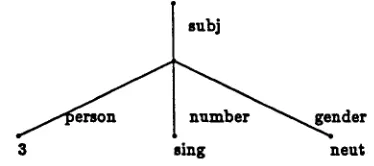
Because feature structures are used to represent partial information, it is possible for a structure that is merely com- patible wlth a description to be extended (i.e., by adding a value for some previously nonexistent feature) so that it ei- ther satisfies or becomes incompatible with the description. Consider, for example, the structure (~z) shown in Figure 7, and the three descriptions:
aubj : (perao.
: 3 A . u m b e r :ai.g)
(I) subj : (perao. : 1 A . u m b e r : . i . g ) (2) 8=by: (case : . o r e ^ . t , , n b e . : s i . g ) (3)subj
~ n d e r
stag neut
F i g u r e 7: E x a m p l e f e a t u r e s t r u c t u r e (AZ)-
Description (I) is satisfied by Az, because •z is fully iustan- tiated with all the required feature values. Description (2) is
i,eompatible with Az, because Az has a different value for the feature aubj : person. Description (3) is merely compatible
with Az (but not satisfied by Az), because Az has no value for the feature aubj : e~se.
I n the following definitions, the notation A ~ ~5 means that the structure A satisfies the description ~, and the notation A ~ ~ means that the structure A is compatible toith the description ~.
Logical combinations of feature descriptions are evaluated with their usual semantics to determine whether they are satisfied by a structure. Thus, a conjunction is satisfied only when every conjunct is satisfied, and a disjunction is satls- fied if any disjunct is satisfied. The formal semantics of the satisfaction relation has been specified in our previous work describing FDL [Kas86]. The semantics of the compatibility relation is given by the following conditions:
I. ~ -- N I L always;
2. A .~ • ¢=¢. /~ is the atomic structure ~;
3. A ~ [< Pz > , - . - , < P. >] ~ = ~ all D G s in the set {~q/ < Pz > ... 4/ < p. > } can be unified (any
member of this set may be undefined; such members are equivalent to null DGs);
4. /~ ~ I : ~ ¢=~ /~/! is undefined or ~/1 ~ ~; 5. A ~ ~ V ~ ¢=~ ~ ~ ~ o r ~ ~ ~ 0 ;
[image:4.612.95.477.84.181.2] [image:4.612.348.535.239.322.2]nonexistent features. For example, consider whether
A,,
shown LU Figure 7, is compatible with the description:
nurnber: pl A |< ~*~mber >, <
aubj
number >].A, is compatible with r~urnber : pl, and d , k also compat- ible with ~< nurnber > , < s u b j n~mber > l , but #~, is not compatible with the conjunction of these two descriptions, because it requires aub] : r ~ m b e r : pl and ,~, has si~,g as the value of that feature.
Thus, in order to determine whether a structure is compat- ible wlth a conjunctive description, it is generally necessary to unify all conjuncts, p u t t i n g the description into the canon- ical form described in [Kas87c]. This canonical form (i.e. the
feature.description data structure) contains definite and in- definite components. The definite component contains no disjunction, and is represented by a DG structure that satis- fies all non-disjunctive parts of a description. The indefinite component is a list of disjunctions. A structure is compatible with a description in canonical form if and only if it is unifi- able with the definite component and it is compa!;ible wlth each disjunction of the indefinite component.
2 . 2
C o n d i t i o n a l
D e s c r i p t i o n
We augment FDL with a new type of formula to represent conditional descriptions, using the notation, n - . ~, and the standard interpretation given for material implication:
A I = ~ -~ p ~ A I = ~ a v # . C4)
This Luterpretatlon of conditionals presupposes an interpre- tation of negation over feature descriptions, which is given below. To simpLify the interpretation of negations, we ex- clude formulas contaiuing path equivalences and path values from the antecedents of conditlonak.
2 . 3
N e g a t i o n
We use the classical interpretation of negation, where /~ ~ -~b ¢=~ /~ ~: #. Negated descriptions are defined for the following types of formulas:
1. A ~ - ~ ¢=~ A is not the atom ~;
2. A ~ -~(l : ~) ~ Jl ~= l : "-~ or .~/!
is
not defined;3. ,~ ~ -~(~ v
,/,) ~ : ~
A ~ -,~ ^ -,,p;
4. ,~ M -,(~ ^ ,p) ~
,~ M -,~ v -,,p.
Note that we have not defined negation for formulas contain- ing path equivalences or path values. Thls restriction makes it possible to reduce all occurrences of negation to a boolean combLuatlon of a fiuite number of negative constraints on atomic values. While the classical interpretation of negation is not strictly monotonic with respect to the normal sub- sumptlon ordering on feature structures, the restricted type of negation proposed here does not suffer from the ineffi- ciencies and order-dependent uuificaticn properties of gen- eral negation or intuiticnistic negation [Mosh87,Per87]. The reason for this is that we have restricted negation so that all negative information can be specified as local constraLuts
on single atomic feature values. Thus, these constraints only come into play when specific atomic values are proposed for a feature, and they can be checked as efficiently as positive atomic value constraints.
2 . 4
F e a t u r e E x i s t e n c e C o n d i t i o n s
A special type of conditional description k needed when the antecedent of a conditional is an existence predicate for a particular feature, and not a regular feature description. We call this type of conditional a [eature ezistence condition, and
use the notation:
B / -+ ~, where A ~ 3 [ 4==~ A / [ is defined.
T h k use of B / i s essentially equivalent to the use of f = A N Y in Kay's FUG, where A N Y l s a place-holder for any substan- tive (i.e., non-NIL) value.
The primary effect of a feature existence condition, such as 3 f --, ~, is that the consequent is asserted whenever a sub- stantive value is introduced for a feature labeled by f . The treatment of feature existence conditions differs slightly from other conditional descriptions in the way that an uusatisfiable consequent is handled. In order to negate the antecedent of 3 f --~ #, we need to state that f may never have any sub- stantive value. This is accomplished by unifying a special atomic value, such as
NONE,
with the value of f . This spe- cial atomic value is incompatible with any other real value that might be proposed as a value for f .Feature existence conditions are needed to model the sec- ond type of implication expressed by systemic input condi- tions - namely, when a constituent has one of the feature alternatives described by a system, it must also have the fea- ture(s) specified by that system's input condition. Generally, a system named f with input condition a and alternatives described by/~, can be represented by two conditional de- scriptlons:
1. a .--. p;
2. B f -* a.
For example, recall the BenfactiveVoice system, which is rep- resented by the two conditionals shown in Figure 5.
It is important to note that feature existence conditions are used for systems with simple input conditions as well as for those with complex input conditions. The use of feature existence conditions is essential in both cases to encode the bidirectional dependency between systems that is implicit in a systemic network.
3
U n i f i c a t i o n
w i t h
C o n d i t i o n a l
D e s c r i p t i o n s
have shown in previous work [Kas87c] how unification can be accomplished for disjunctive descriptions without expanding to disjunctive normal form.
This unification method factors descriptions into a canon- ical form conslstlng of definite and indefinite components. The definite component contains no dlsjunctlon, and is rep- resented by a DG structure that satisfies all non-disjunctive parts of a description. The indefinite component of a de- scription k a list of disjunctions. When two descriptions are unified, the first step is to unlfy their definite compo- nents. Then the indefinite components of each description are checked for compatlbility with the resulting definite com- ponent. Dlsjuncts are eliminated from the description when they are inconsistent with deflnlte information. When only one alternative of a disjunction remains, it is unified with the definite component of the description.
This section details how thls unification method can be extended to handle conditional descriptions. Conditionals may be regarded as another type of indefinite information in the description of a feature structure. They are indefinite ]n the sense that they impose constraints t h a t c a n be satisfied by several alternatives, depending on the values of features already present in a structure.
3.1
H o w t o Satisfy a C o n d i t i o n a l
Description
The constraints imposed on a feature structure by a condi- tional description can usually be determined most emclently by first examining the antecedent of the conditional, because it generally c o n t ~ n l a smaller amount of information than the consequent. F, xamining the antecedent k often sufficient to determine whether the consequent is to be included or discarded.
Given a conditional description, C ---- ~ -+ ~, we can define the coustralnts that it imposes on a feature structure (A) as follows. When:
~ ct, then A ~ ~;6
~ or, then ¢ imposes no further constraint on A, and can therefore be elhnJnated;
A ~, c~, then check whether ~ ls compatible wlth A. If compatible, then C must be retained in the descrip- tion of ~.
If incompatible, then ~ ~ -~a (and ¢ can be elimio nated).
These constraints follow directly from the interpretation (4) that we have given for conditional descriptions. These con- straiuts are logically equivalent to those that would be im- posed on A by the disjunction - ~ V ~, as required. However, the constraints of the conditional can often be imposed more ef~ciently than those of the equivalent dJsjunctlon, because examlnlng the antecedent of the conditional carries the same cost as examining only one of the dkjuncts. When the con- straints of a disjunction are imposed, both of the disjuncts must be examined in all cases.
6Read this constraint as: Umake sure that .4 satisfies ~.t
3.2
E x t e n d i n g t h e U n i f i c a t i o n
A l g o r i t h m
The unification algorithm for dlsjunctlve feature descrip- tions [Kas87c] can be extended to handle conditionals by recognizing two types of indefinite ~uformatlon in a descrip- tion: disjunctions and conditionals. The extended feature-
descriptlon data structure has the components:
d e f i n i t e : a DG structure;
d i s j u n c t i o n s : a llst of disjunctions;
c o n d i t i o n a l s , a list of conditional descriptions.
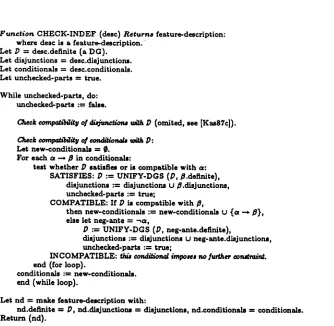
The part of the unification algorithm that checks the compat- ibility of indefinite components of a description with its def- inite component is defined by the function CHECK-INDEF, shown in Figure 8. T h k algorithm checks the disjunctions of a description before conditionals, but an equally correct ver- sion of t h k algorithm might check conditionals before disjunc- tions. In our application of parsing with a systemic grammar it is generally more et~cient to check disjunctions first, but • other applications might be made more efBclent by varylng
this order.
4
P o t e n t i a l
R e f i n e m e n t s
Several topics merit further investlgatlon regarding condi- tional descrlptions. The implementation we describe has the constraints of conditionals and dkjunctions imposed in an ar- bitrary order. Chang|ng the order has no effect on the final result, b u t it is likely that the el~clency of unification could be improved by ordering the conditionals of a grammar in a deliberate way. Another way to improve the efficiency of unification with condltiona~ would involve indexing them by the features that they contain. Then a conditional would not need to be checked against a structure until some feature value of the structure might determine the manner in which it k eat|s fled. The amount of efficiency gained by such tech- niques clearly depends largely on the nature of the particular grammar being used in an appllcatlon.
A slightly different type of conditional might be used as a way to speed up unification with binary disjunctive descrip- tions. If it k known that the values of a relatively small number of features can be used to discrimlnate between two alternative descriptions, then those features can be factored into a separate condition in a description such as
IF cor, ditioa T H E N alt~ E L S E air2.
When the condition is satisfied by a structure, then altl is
selected. When the condition is incompatible with a struc- ture, then air2 is selected. Otherwise both alternatives must remain under consideration. As it often requires a consider- able amount of time to check which alternatives of a dkjunc- tion are applicable, this technlque might offer a significant improvement in an application where large dlsjunctlve de- scriptions are used.
Function
CHECK-INDEF (desc) Returns feature-description: where desc is a featur~description.Let P = desc.deflnite (a DG). Let disjunctions = desc.disjunctions. Let conditionals = desc.conditionals. Let unchecked-parts ---- true.
While unchecked-parts, do:
unchecked-parts := false.
Cheek eomp~h'~/ty oj' d/~nct/onm ~ P (omited, see [Kas87c]).
O~ek eomp~'t~U of ¢ o ~ o ~ b ~ P:
L e t new-conditionals ---- ~. For each ~, --./9 in conditionals:
test w h e t h e r D satisfies o r is c o m p a t i b l e w i t h , - :
SATISFIES: 9 := UNIFY-DGS (9, ~.deflnite),
disjunctions := disjunctions U ~.dlsjunctions, unchecked-parts := true;
COMPATIBLE: If ~) is compatible with ~,
then new-conditionals := new-conditionals U {a --, ~}, else let neg-ante = -~e.
D := UNIFY-DGS (P, neg-ante.deflnite),
disjunctions :---- disjunctions u neg-ante.disjunctions, unchecked-parts := true;
INCOMPATIBLE: t ~ eoad~/on,d imposem no ]urO~ee coaa~v~/nt. end (for loop).
conditionals :---- new-conditionals. end (while loop).
Let nd ---- make feature-description with:
nd.deflnite -~ P, nd.disjunctions = disjunctions, nd.conditionals ---- conditionals. Return (nd).
F i g u r e 8: C H E C K - I N D E F : A l g o r i t h m f o r c h e c k i n g c o m p a t i b i l i t y o f i n d e f i n i t e p a r t s of a f e a t u r e - d e s c r i p t i o n w i t h its d e f i n i t e c o m p o n e n t .
This restriction has been acceptable in our use of condi- tional descriptions to m o d e l systemic g r a m m a r s . It k unclear whether a t r e a t m e n t of conditional descriptions w i t h o u t thls restriction will be needed in o t h e r applications. If this restric- tion is lifted, t h e n further work will be necessary to define the behavior of negation over p a t h equivalences, and to handle such negations in a reasonably e ~ c i e n t m a n n e r .
5
S u m m a r y
We have shown how t h e n o t a t i o n a l resources of F U G can be extended to include descriptions of conditional information about feature structures. C o n d i t i o n a l descriptions have been given a precise logical definition in terms of t h e feature de- scription logic of K a s p e r and Rounds, and we have shown how a unification m e t h o d for feature descriptions can be ex- tended to use conditional descriptions. We have i m p l e m e n t e d this unification m e t h o d and tested it in a parser for systemic grammars, using several hundred conditional descriptions. The definition of conditional descriptions and t h e unifica- tion m e t h o d should be generaily applicable as an extension to o t h e r unificatlon-based g r a m m a r frameworks, as well as to F U G and t h e modeling of systemic g r a m m a r s . In fact, the
i m p l e m e n t a t i o n described has been carried o u t by extending P A T I ~ I I [Shie84], a general representational framework for unificatlon-based g r a m m a r s .
While it is theoretically possible to represent t h e informa- tion of conditional descriptions indirectly using notational devices already present in K a y ' s F U G , there are practical advantages to representing conditional descriptions directly. T h e indirect encoding of conditional descriptions by dlsjunc- tions and negations entails a p p r o x i m a t e l y doubling the size of a description, adding m a n y explicit nonexistence constraints on features
(NONE
values), and slowing the unification pro- cess. In our experiments, unification wlth conditional de- scriptions requires a p p r o x i m a t e l y 5 0 ~ of the t i m e required by unification w i t h an indirect encoding of t h e same descrip- tions. By adding conditional descriptions as a notational resource to F U G , we have not changed the theoretical limits of w h a t F U G can do, b u t we have developed a representation t h a t is more perspicuous, less verbose, and computationaily more e/~clent.A c k n o w l e d g e m e n t s
[image:7.612.117.451.65.391.2]that were only partially formulated in m y dissertation at the /Per87] University of Michigan. Helpful comments on earlier versions
of this paper were provided by Bill M a n n , E d H o v y and John Bateman.
This research was sponsored by the United States Air [Shie84] Force Office of Scientific Research under contract F49620-
87-C-0005; the opinions expressed here are solely those of the author.
References
/Hall76] Gunther R. Kress, editor.
IIallidap:
Systemand
Function in Language.
Oxford University Press, London, England, 1976.[Kas87a I Robert T. Kasper. Systemic Grammar and Func- tional Unification Grammar. In J. Benson and W. Greaves, editors,
SVstemic Functional Approaches
to Discourse,
Norwood, New Jersey: Ablex (in press). Also available as USC/information Sci- ences Institute, Technical Report RS-87-179, May 1987.[Kas86] Robert.T. Kasper and William C. Rounds. A Log- ical Semantics for Feature Structures. In
Proceed-
ings of the
24 taAnnual Meeting of the Association
for Computational Linguistics,
Columbia Unlver- slty, New York, 1~/', June 10-13, 1986.[Kas87b] Robert T. Kasper.
Feature Structures: A Lo~cal
7'heorv ~dth Application to Language Analpds. Phi)
dlssertation, University of Mlchlgan, 1987. [Kas87c] Robert T. Kasper. A Unification Method for DIS-
junctive Feature Descriptions. In Proceed/ng8 o/the 25 ta
Annual Meeting of the Association for Compu-
tational Linguistica,
Stanford University, Stanford, CA, July 6-9, 1987./Kay79] Martin Kay. Functional Grammar. In
Proceeding8
o/the Fifth Annual Meeting of the Bsrkclsp Lingui~-
tica Societp,
Berkeley Linguistics Society, Berkeley, Ca2ifornia, February 17-19, 1979.[Mmm83] Wi]fiam C. Mann and Christian Matthiemen. Nigel: A Systemic Grammar for Text Generation. USC / Information Sciences Institute, RR-83-105. Also appears in R. Benson and J. Greaves, editors,
Spatemie Perapectivs~ on Diacourss: Selected Pa-
per, Paper8 from the Ninth International Spstsmics
WorkJhop,
Ablex, London, England, 1985. [Mosh87] ~ Drew Moshier and William C. Rounds. A Logicfor Partially Specified Data Structures. In
Proceed-
ing8 of the A C M Spmposium on PrinciplcJ of Pro-
graraming Languages,
1987.Fernando C.N. Perelra. Grammars and Logics of Partial Information. In
Proceedings of the
Inter-national Conference on Logic Programming,
Mel- bourne, AustraLia, May 1987.