A U T O M A T I C A L L Y E X T R A C T I N G A N D R E P R E S E N T I N G
C O L L O C A T I O N S F O R L A N G U A G E G E N E R A T I O N *
F r a n k A . S m a d j a t a n d
K a t h l e e n R . M c K e o w n D e p a r t m e n t o f C o m p u t e r S c i e n c e
C o l u m b i a U n i v e r s i t y N e w Y o r k , N Y 10027
A B S T R A C T
Collocational knowledge is necessary for language gener- ation. The problem is that collocations come in a large variety of forms. They can involve two, three or more words, these words can be of different syntactic cate- gories and they can be involved in more or less rigid ways. This leads to two main difficulties: collocational knowledge has to be acquired and it must be represented flexibly so that it can be used for language generation. We address both problems in this paper, focusing on the acquisition problem. We describe a program, X t r a c t , t h a t automatically acquires a range of collocations from large textual corpora and we describe how they can be represented in a flexible lexicon using a unification based formalism.
1 I N T R O D U C T I O N
Language generation research on lexical choice has fo- cused on syntactic and semantic constraints on word choice and word ordering.
Colloca~ional constraints,
however, also play a role in how words can co-occur in the same sentence. Often, the use of one word in a par- ticular context of meaning will require the use of one or more other words in the same sentence. While phrasal lexicons, in which lexical associations are pre-encoded(e.g.,
[Kukich 83], [Jacobs 85], [Danlos 87]), allow for the treatment of certain types of collocations, they also have problems. Phrasal entries must be compiled by hand which is both expensive and incomplete. Furthermore, phrasal entries t e n d to capture rather rigid, idiomatic expressions. In contrast, collocations vary tremendously in the number of words involved, in the syntactic cat- egories of the words, in the syntactic relations between t h e words, and in how rigidly the individual words are used together. For example, in some cases, the words of a collocation must be adjacent, while in others they can be separated by a varying number of other words.*The research reported in this paper was partially sup- ported by DARPA grant N00039-84-C-0165, by NSF grant IRT-84-51438 and by ONR grant N00014-89-J-1782.
tMost of this work is also done in collaboration with Bell Communication Research, 445 South Street, Morristown, NJ 07960-1910
In this paper, we identify a range of collocations t h a t are necessary for language generation, including open compounds of two or more words, predicative relations
(e.g., subject-verb),
and phrasal templates represent- ing more idiomatic expressions. We then describe how X t r a c t automatically acquires the full range of colloca- tions using a two stage statistical analysis of large do- main specific corpora. Finally, we show how collocations can be efficiently represented in a flexible lexicon using a unification based formalism. This is a word based lexicon that has been macrocoded with collocational knowledge. Unlike a purely phrasal lexicon, we thus retain the flexi- bility of word based lexicons which allows for collocations to be combined and merged in syntactically acceptable ways with other words or phrases of the sentence. Unlike pure word based lexicons, we gain the ability to deal with a variety of phrasal entries. Furthermore, while there has been work on the automatic retrieval of lexical informa- tion from text [Garside 87], [Choueka 88], [Klavans 88], [Amsler 89], [Boguraev & Briscoe 89], [Church 89], none of these systems retrieves the entire range of collocations that we identify and no real effort has been made to use this information for language generation [Boguraev & Briscoe 89].In the following sections, we describe the range of col- locations that we can handle, the fully implemented ac- quisition method, results obtained, and the representa- tion of collocations in Functional Unification Grammars (FUGs) [Kay 79]. Our application domain is the domain of stock market reports and the corpus on which our ex- pertise is based consists of more t h a n 10 million words taken from the Associated Press news wire.
S I N G L E W O R D S T O W H O L E P H R A S E S : W H A T K I N D O F L E X I C A L U N I T S A R E N E E D E D ?
this range will require a flexible method of representa- tion.
3
T H E A C Q U I S I T I O N M E T H O D :
X t r a c t
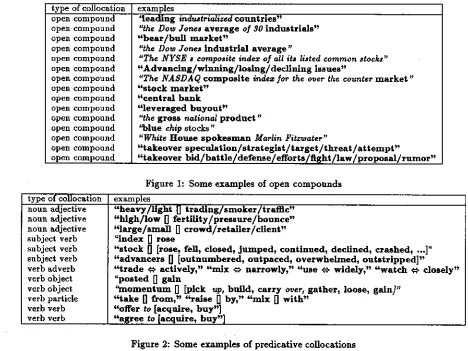
O p e n C o m p o u n d s . Open compounds involve unin- terrupted sequences of words such as "stock mar- ket," "foreign ezchange," "New York Stock Ez- change," "The Dow Jones average of $0 indust~- als." They can include nouns, adjectives, and closed class words and are similar to the type of colloca- tions retrieved by [Choueka 88] or [Amsler 89]. An open compound generally functions as a single con- stituent of a sentence. More open compound exam- ples are given in figure 1. x
P r e d i c a t i v e R e l a t i o n s consist of two (or several) words repeatedly used together in a similar syn- tactic relation. These lexical relations axe harder to identify since they often correspond to inter- rupted word sequences in the corpus. They axe also the most flexible in their use. This class of c o l locations is related to Mel'~uk's Lexical Functions [Mel'~uk 81], and Benson's L-type relations [Ben- son 86]. Within this class, X t r a c t retrieves subject- verb, verb-object, noun-adjective, verb-adverb, verb- verb and verb-particle predicative relations. Church [Church 89] also retrieves verb-particle associations. Such collocations require a representation that al- lows for a lexical function relating two or more words. Examples of such collocations axe given in figure 2. 2
P h r a s a l t e m p l a t e s : consist of idiomatic phrases con- taining one, several or no empty slots. They axe extremely rigid and long collocations. These almost complete phrases are quite representative of a given domain. Due to their slightly idiosyncratic struc- ture, we propose representing and generating them by simple template filling. Although some of these could be generated using a word based lexicon, in general, their usage gives an impression of fluency t h a t cannot be equaled with compositional genera- tion alone. X t r a c t has retrieved several dozens of such templates from our stock market corpus, in- eluding:
"The N Y S E ' s composite indez
of
all its listed com- mon stocks rose*NUMBER* to *NUMBER*"
"On the American Stock Ezchange the market value indez was up
*NUMBER* at *NUMBER*"
"The Dow Jones average of 30 industrials fell *NUMBER* points to *NUMBER*"
"The closely watched indez had been down about *NUMBER* points in
the first hour of trading"
"The average finished the week with a net loss of *NUMBER *"
I All the examples related to the stock market domain have been actually retrieved by Xtract.
2In the examples, the "~" sign, represents a gap of zero, one or several words. The "¢*" sign means that the two words can be in any order.
In order to produce sentences containing collocations, a language generation system must have knowledge about the possible collocations that occur in a given domain. In previous language generation work [Danlos 87], [Ior- danskaja 88], [Nirenburg 88], collocations are identified and encoded by hand, sometimes using the help of lexi- cographers (e.g., Danlos' [Daulos 87] use of Gross' [Gross 75] work). This is an expensive and time-consuming pro- cess, and often incomplete. In this section, we describe how X t r a c t can automatically produce the full range of collocations described above.
X t r a c t has two main components, a concordancing component, X c o n c o r d , and a statistical component, X s t a t . Given one or several words, X c o n c o r d locates all sentences in the corpus containing them. X s t a t is the co-occurrence compiler. Given X c o n c o r d ' s output, it makes statistical observations about these words and other words with which they appear. Only statistically significant word pairs are retained. In [Smadja 89a], and [Smadja 88], we detail an earlier version of X t r a c t and its output, and in [Smadja 891)] we compare our results both qualitatively and quantitatively to the lexicon used in [Kukich 83]. X t r a c t has also been used for informa- tion retrieval in [Maarek & Smadja 89]. In the updated version of X t r a c t we describe here, statistical signifi- cance is based on four parameters, instead of just one, and a second stage of processing has been added t h a t looks for combinations of word pairs produced in the first stage, resulting in multiple word collocations.
S t a g e one- In the first phase, X c o n c o r d is called for
a
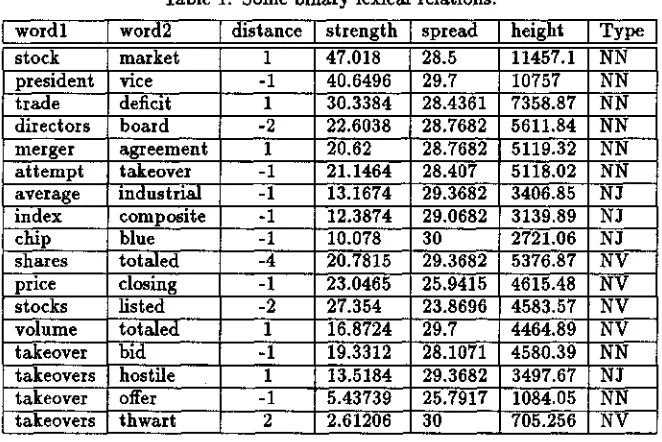
single open class word and its output is pipeIined to X s t a t which then analyses the distribution of words in this sample. The output of this first stage is a list of tuples (wx,w2, distance, strength, spread, height, type), where (wl, w2) is a lexical relation between two open-class words (Wx and w2). Some results are given in Table 1. "Type" represents the syn- tactic categories of wl and w2. 3. "Distance" is the relative distance between the two words, wl and w2 (e.g., a distance of 1 means w~ occurs immediately after wx and a distance o f - i means it occurs imme- diately before it). A different tuple is produced for each statistically significant word pair and distance. Thus, ff the same two words occur equally often sep- arated by two different distances, they will appear twice in the list. "Strength" (also computed in the earlier version of X t r a c t ) indicates how strongly the two words are related (see [Smadja 89a]). "Spread" is the distribution of the relative distance between the two words; thus, the larger the "spread" the more rigidly they are used in combination to one another. "Height" combines the factors of "spread"w o r d l stock p r e s i d e n t t r a d e
T a b l e 1: Some
binary
lexical r e l a t i o n s .word2 m a r k e t vice deficit
d i s t a n c e
-I
strength
47.018 40.6496 30.3384
s p r e a d 28.5 29.7 28.4361 11457.1 10757 7358.87
vre r avmcm'am
;,,,Lo¢,~,c-- i ~ f f t ~ , , , , ~ l , i l l l l ( ; t £ 1 I ~ . ' l g l ~ : l ~ i Ig~llI,~lt:..c o m p o s i t e blue t o t a l e d
closing
-1 12.3874 29.0682 3139.89
i n d e x
chip -1
-4 -1 -2 -1 -1 10.078 shares price stocks v o l u m e
20.7815 23.0465 27.354 16.8724 19.3312 13.5184 5.43739 listed takeover takeovers takeover takeovers 30 29.3682 25.9415 23.8696 29.7 28.1071 29.3682 25.7917 t o t a l e d
b i d hostile o~er 2721.06 5376.87 4615.48 4583.57 4464.89 4580.39 3497.67 1084.05
I ll"i~.~ l ' _ll-~,'l I ~ , [ l l l J i l l '[ Ib']l~$'l
[ T y p e
NN NN NN NN NN NN NJ NJ NJ N V N V NV NV NN NJ i N N
I NV
T a b l e 2: C o n c o r d a n c e s for "average indus~rial"
On Tuesday the Dow Jones industrial average rose 26.28 points to 2 304.69. The Dow
... a selling spurt that sent the Dow On Wednesday the Dow The Dow The Dow ... Thursday with the Dow ... swelling the Dow The rise in the Dow
Jones industrial average Jones industrial average Jones industrial average Jones industrial average Jones industrial average Jones industrial average Jones industrial average Jones industrial average
went up 11.36 points today.
down sharply in the first hour of trading. showed some strength as ...
was down 17.33 points to 2,287.36 ... had the biggest one day gain of its history ... soaring a record 69.89 points to ...
by more than 475 points in the process ... was the biggest since a 54.14 point j u m p on ...
T a b l e
The NYSE s composite index The NYSE s composite index The NYSE s composite index The NYSE s composite index The NYSE s composite index The NYSE s composite index The NYSE s composite index The NYSE s composite index The NYSE s composite index
3: C o n c o r d a n c e s for "composite indez"
of all its listed common stocks fell 1.76 to 164.13. of all its listed common stocks fell 0.98 to 164.91. of all its listed common stocks fell 0.96 to 164.93. of all its listed common stocks fell 0.91 to 164.98. of all its listed common stocks rose 1.04 to 167.08. of all its listed common stocks rose 0.76
of all its listed common stocks rose 0.50 to 166.54. of all its listed common stocks rose 0.69 to 166.73. of all its listed common stocks fell 0.33 to 170.63.
[image:3.612.134.465.170.391.2]open compound open compound open compound open compound open compound open compound open compound open compound open compound open compound open compound open compound open compound open compound open compound
qeading industrialized countries"
"the Dow Jones average of .90 industriais" " b e a r / b u i l m a r k e t "
"the Dow Jones industrial average"
"The NYSE s composite indez of all it8 listed common stocks" "Advancing/winuing/losing/declluing issues"
"The NASDAQ composite indez for the over the counter m a r k e t "
"stock market" "central bank
'qeveraged buyout"
"the gross national p r o d u c t " 'q~lue chip stocks"
"White House spokesman Marlin Fitztoater"
"takeover s p e c u l a t i o n / s t r a t e g i s t / t a r g e t / t h r e a t / a t t e m p t " "takeover bid / b a t t l e / defense/ efforts/ flght / l a w /proposal / r u m o r "
Figure 1: Some examples of open compounds
noun adjective noun adjective noun adjective subject verb subject verb subject verb verb adverb verb object verb object verb particle verb verb verb verb
examples
"heavy/Hght D t r a d l n g / s m o k e r / t r a f f i c " " h l g h / l o w ~ f e r t i l i t y / p r e s s u r e / b o u n c e " "large/small D crowd/retailer/client" "index ~ rose
"stock ~ [rose, fell, closed, jumped, continued, declined, crashed, ...]" "advancers D [outnumbered, outpaced, overwhelmed, outstripped]"
" t r a d e ¢~ actively," "mix ¢~ narrowly," "use ¢~ widely," "watch ¢~ closely" ~posted ~ gain
'~momentum D [pick up, build, carry over, gather, loose, gain]" " t a k e ~ from," "raise ~ by," "mix D with"
"offer to [acquire, buy"] "agree to [acquire, buy"]
Figure 2: Some examples of predicative collocations
and "strength" resulting in a ranking of the two words for their "distances". Church [Church 89] produces results similar to those presented in the table using a different statistical method. However, Church's method is mainly based on the computa- tion of the "strength" attribute, and it does not take into account "spread" and "height". As we shall see, these additional parameters are crucial for pro- ducing multiple word collocations and distinguish- ing between open compounds (words are adjacent) and predicative relations (words can be separated by varying distance).
S t a g e two: In the second phase, X t r a e t first uses the same components but in a different way. It starts with the pairwise lexical relations produced in Stage one to produce multiple word collocations, then classifies the collocations as one of three classes iden- tified above, end finally attempts to determine the syntactic relations between the words of the collo- cation. To do this, X t r a c t studies the lexical re- lations in context, which is exactly what lexicogra- phers do. For each entry of Table 1, X t r a c t calls X c o n c o r d on the two words wl and w~ to pro- duce the concordances. Tables 2 and 3 show the concordances (output of X c o n c o r d ) for the input pairs: "average-industrial" end "indez-composite". X s t a t then compiles information on the words sur-
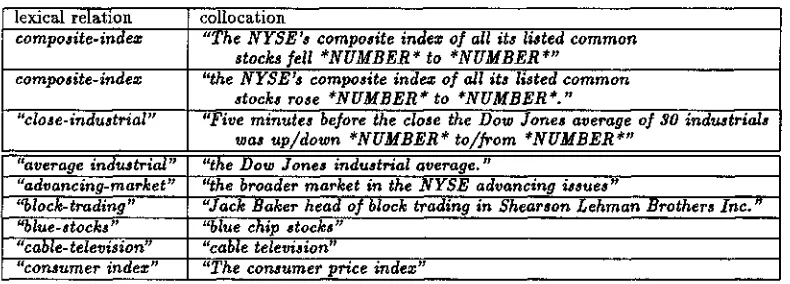
rounding both wl and w2 in the corpus. This stage allows us to filter out incorrect associations such as "blue.stocks" or "advancing-market" and replace them with the appropriate ones, "blue chip stocks," "the broader market in the N Y S E advancing is. sues." This stage also produces phrasal templates such as those given in the previous section. In short, stage two filters inapropriate results and combines word pairs to produce multiple word combinations. To make the results directly usable for language gen- eration we are currently investigating the use of a bottom-up parser in combination with stage two in order to classify the collocations according to syn- tactic criteria. For example if the lexical relation involves a noun and a verb it determines if it is a subject-verb or a verb-object collocation. We plan to do this using a deterministic bottom up parser developed at Bell Communication Research [Abney 89] to parse the concordances. The parser would analyse each sentence of the concordances and the parse trees would then be passed to X s t a t .
[image:4.612.54.522.52.403.2]lexical relation composite-indez
composite-indez
collocation
"The NYSE's composite indez of all its listed common stocks fell *NUMBER* to *NUMBER*"
"the NYSE's composite indez of all its listed common stocks rose *NUMBER* to *NUMBER*."
[ "close-industrial" "Five minutes before the close the Dow Jones average of 30 industrials ~as up/down *NUMBER* to/from *NUMBER*"
"the Dow Jones industrial average." "average industrial"
"advancing-market" "block- trading"
"cable- television"
"the broader market in the N Y S E advancing issues"
"Jack Baker head of block trading in Shearson Lehman Brothers Inc."
"cable television"
Figure 3: Example collocations o u t p u t of stage two.
sentences. T h e lexical relation composite-indez thus pro- duces two phrasal templates. For the lexical relation average-industrial X t r a c t produces an open compound collocation as illustrated in figure 3. Stage two also con- firms pairwise relations. Some examples are given in figure 2. By examining the parsed concordances and extracting recurring patterns, X s t a t produces all three types of collocations.
4
H O W T O R E P R E S E N T
T H E M
F O R L A N G U A G E
G E N E R A T I O N ?
Such a wide variety of lexical associations would be dif- ficnlt to use with any of the existing lexicon formalisms. We need a flexible lexicon capable of using single word entries, multiple word entries as well as phrasal tem- plates and a mechanism that would be able to gracefully merge and combine them with other types of constraints. T h e idea of a flexible lexicon is not novel in itself. T h e lexical representation used in [Jacobs 85] and later re- fined in [Desemer & Jabobs 87] could also represent a wide range of expressions. However, in this language, collocational, syntactic and selectional constraints are mixed together into phrasal entries. This makes the lex- icon both difficnlt to use and difficult to compile. In the following we briefly show how FUGs can be successfully used as they offer a flexible declarative language as well as a powerful mechanism for sentence generation.
We have implemented a first version of C o o k , a sur- face generator t h a t uses a flexible lexicon for express- in~ co-occurrence constraints. C o o k uses F U F [Elhadad 90J, an extended implementation of PUGs, to uniformly represent the lexicon and the syntax as originally sug- gested b y Halliday [Halliday 66]. Generating a sentence is equivalent to unifying a semantic structure (Logical Form) with the grammar. T h e grammar we use is di- vided into three zones, the "sentential," the "lezical" and "the syntactic zone." Each zone contains constraints pertaining to a given domain and the input logical form is unified in turn with the three zones. As it is, full backtracking across the three zones is allowed.
• T h e sentential zone contains t h e phrasal templates against which the logical form is unified first. A sententiai e n t r y is a whole sentence t h a t should be used in a given context. This context is specified by subparts of the logical form given as input. When there is a m a t c h at this point, unification succeeds and generation is reduced to simple template filling. • T h e lezical zone contains the information used to lexicalize the input. It contains collocational infor- mation along with the semantic context in which to use it. This zone contains predicative and open compound collocations. Its role is to trigger phrases or words in the presence of other words or phrases. Figure 5 is a portion of the lexical grammar used in C o o k . It illustrates the choice of the verb to be used when "advancers" is the subject. (See below for more detail).
• T h e syniacgic zone contains the syntactic grammar. It is used last as it is the part of the grammar en- suring the correctness of the produced sentences.
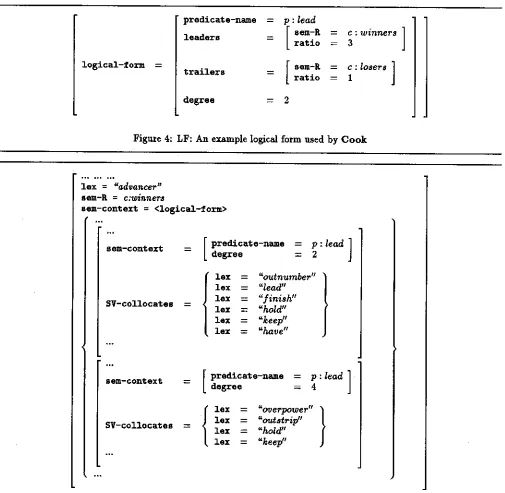
An example input logical form is given in Figure 4. In this example, the logical form represents the fact t h a t on the New York stock exchange, the advancing issues (se- m a n t i c representation or sere-R: c:winners) were ahead (predicate c:lead)of the losing ones (sem-R: c:losers)and that there were 3 times more winning issues than losing ones ratio). In addition, it also says that this ratio is of degree 2. A degree of 1 is considered as a slim lead whereas a degree of 5 is a commanding margin. When unified with the grammar, this logical form produces the sentences given in Figure 6.
As an example of how C o o k uses and merges co- occurrence information with other kind of knowledge consider Figure 5. T h e figure is an edited portion of the lexical zone. It only includes the parts that are rel- evant to the choice of the verb when "advancers" is the subject. T h e l e x and sem-R attributes specify the lex- eme we are considering ("advancers") and its semantic representation (c:winners).
[image:5.612.102.497.67.209.2]l o g i c a l - f o r m
p r e d i c a t e - n a m e = p :
lead
l e a d e r s = [ s e m - R
L
r a t i ot r a i l e r s
: c : w i n n e r s ]
J
: 3
s e m - R : c :
losers
]
: r a t i o ---- I
d e g r e e = 2
Figure 4: LF: An example logical form used by C o o k
o , , ° ° ° o o o
l e x =
"advancer"
s a m - R =
c:~oinners
s e m - c o n t e x t = < l o g i c a l - f o r m >
O O 0
1 0 e o , o
s e m - c o n t e x t
S V - c o l l o c a t e s =
p r e d i c a t e - n a m e = p :
lead ]
d e g r e e = 2
l e x ---- "o.u~nurn, ber" / l e x =
"lead"
l e x =
"finish"
l e x = "hold" l e x = "~eept'l e x = " h a v e "
, , °
s e m - c o n t e x t
S V - c o l l o c a t e s =
p r e d i c a t e - n a m e :
p:lead
= d e g r e e : 4
l e x :
U°verp°~er" 1
l e x =
"outstrip"
l e x :
"hold"
l e x :
"keel'
•
Figure 5: A portion of the lexical grammar showing the verbal collocates of "advancers".
"Advancers outnumbered declining issues by a margin of 3 4o 1."
"Advancers had a slim lead over losing issues wi~h a margin of 3 4o 1."
"Advancers kep~ a slim lead over decliners wi~h a margin of 3 ~o 1"
[image:6.612.45.550.87.580.2]to select among the alternatives classes of verbs. In the figure we only included two alternatives. Both are rela- tive to the predicate p : l e a d but they axe used with dif- ferent values of the degree attribute. When the degree is 2 then the first alternative containing the verbs listed un- der SV-colloca~es (e.g. "outnumber") will be selected. When the degree is 4 the second alternative contain- ing the verbs listed under SV-collocal;es (e.g. "over- power") will be selected. All the verbal collocates shown in this figure have actually been retrieved by X t r a c t at a preceding stage.
The unification of the logical form of Figure 4 with the lexical grammar and then with the syntactic gram- mar will ultimately produce the sentences shown in Fig- ure 6 among others. In this example, the sentencial zone was not used since no phrasal template expresses its semantics. The verbs selected are all listed under the
SV-collocates of the first alternative in Figure 5.
We have been able to use C o o k to generate several sentences in the domain of stock maxket reports using this method. However, this is still on-going reseaxch and the scope of the system is currently limited. We are working on extending Cook's lexicon as well as on de- veloping extensions that will allow flexible interaction among collocations.
5
C O N C L U S I O N
In summary, we have shown in this paper that there axe many different types of collocations needed for lan- guage generation. Collocations axe flexible and they can involve two, three or more words in vaxious ways. We have described a fully implemented program, X t r a c t , that automatically acquires such collocations from large textual corpora and we have shown how they can be represented in a flexible lexicon using FUF. In FUF, co- occurrence constraints axe expressed uniformly with syn- tactic and semantic constraints. The grammax's function is to satisfy these multiple constraints. We are currently working on extending C o o k as well as developing a full sized from X t r a c t ' s output.
A C K N O W L E D G M E N T S
We would like to thank Kaxen Kukich and the Computer Systems Research Division at Bell Communication Re- search for their help on the acquisition part of this work.
R e f e r e n c e s
[Abney 89] S. Abney, "Parsing by Chunks" in C. Tenny~ ed., The MIT Parsing Volume, 1989, to appeax. [Amsler 89] R. Amsler, "Research Towards the Devel-
opment of a Lezical Knowledge Base for Natural Language Processing" Proceedings of the 1989 SI- GIR Conference, Association for Computing Ma-
[Benson 86] M. Benson, E. Benson and R. Ilson, Lezi- cographic Description of English. John Benjamins Publishing Company, Philadelphia, 1986.
[Boguraev & Briscoe 89] B. Boguraev & T. Briscoe, in
Computational Lezicography for natural language processing. B. Boguraev and T. Briscoe editors. Longmans, NY 1989.
[Choueka 88] Y. Choueka, Looking for Needles in a Haystack. In Proceedings of the RIAO, p:609-623, 1988.
[Church 88] K. Church, A Stochastic Par~s Program and Noun Phrase Parser for Unrestricted Tezt In Pro- ceedings of the Second Conference on Applied Nat- ural Language Processing, Austin, Texas, 1988. [Church 89] K. Church & K. Hanks, Word Association
Norms, Mutual Information, and Lezicography. In Proceedings of the 27th meeting of the Associ- ation for Computational Linguistics, Vancouver,
B.C,
1989.[Cruse 86] D.A. Cruse, Lezical Semantics. Cambridge University Press, 1986.
[Danlos 87] L. Danlos, The linguistic Basis of Tezt Generation. Cambridge University Press, 1987. [Desemer & Jabobs 87] D. Desemer & P. Jacobs,
FLUSH: A Flezible Lezicon Design. In proceedings of the 25th Annual Meeting of the ACL, Stanford University, CA, 1987.
[Elhadad 90] M. Elhadad, Types in Functional Unifica- tion Grammars, Proceedings of the 28th meeting of the Association for Computational Linguistics, Pittsburgh, PA, 1990.
[Gaxside 87] R. Gaxside, G. Leech & G. Sampson, edi- tors, The computational Analysis of English, a cor- pus based approach. Longmans, NY 1987.
[Gross 75] M. Gross, Mdthodes en Syntaze. Hermann, Paxis, France, 1975.
[Halliday 66] M.A.K. Halliday, Lezis as a Linguistic Level. In C.E. Bazell, J.C. Catford, M.A.K Hal- liday and R.H. Robins (eds.), In memory of J.R. Firth London: Longmans Linguistics ]la Libraxy, 1966, pp: 148-162.
[Iordanskaja88] L. Iordanskaja, R. Kittredge, A. Polguere, Lezical Selection and Paraphrase in a Meaning-Tezt Generation Model Presented at the fourth International Workshop on Language Gen- eration, Catalina Island, CA, 1988.
[Jacobs 85] P. Jacobs, PHRED: a generator for natu- ral language interfaces, Computational Linguis- tics, volume 11-4, 1985
[Kay 79] M. Kay, Functional Grammar, in Proceedings of the 5th Meeting of the Berkeley Linguistic So- ciety, Berkeley Linguistic Society, 1979.
[Kukich 83] K. Kukich, Knowledge-Based Report Gen- eration: A Technique for Automatically Gener- ating Natural Language Reports from Databases.
Proceedings of the 6th International ACM SIGIR Conference, Washington, DC, 1983.
[Maarek & Smadja 89] Y.S Maarek & F.A. Smadja, Full Tezt Indezing Based on Lezical Relations, An Ap. plication: Software Libraries. Proceedings of the 12th International ACM SIGIR Conference, Cam- bridge, Ma, June 1989.
[Mel'~uk 81] I.A Mel'euk, Meaning-Tezt Models: a Re- cent Trend in Soviet Linguistics. The annual re- view of anthropology, 1981.
[Nirenburg 88] S. Nirenburg e t al., Lezicon building in natural language processing. In program and ab- stracts of the 15 th International ALLC, Confer- ence of the Association for Literary and Linguistic Computing, Jerusalem, Israel, 1988.
[Smadja 88] F.A. Smadja, Lezical Co-occurrence: The Missing link. In program and abstracts of the
15 th International ALLC, Conference of the As- sociation for Literary and Linguistic Computing, Jerusalem, Israel, 1988. Also in the Journal for Literary and Linguistic computing, Vol. 4, No. 3, 1989, Oxford University Press.
[Smadja 89a] F.A. Smadja, Microcoding the Lezicon for Language Generation, First International Work- shop on Lexical Acquisition, IJCAI'89, Detroit, Mi, August 89. Also in "Lezical Acquisition: Using on-line resources to build a lezicon", MIT press, Uri Zeruik editor, to appear.