PCFGs, Topic Models, Adaptor Grammars and Learning Topical
Collocations and the Structure of Proper Names
Mark Johnson Department of Computing
Macquarie University
Abstract
This paper establishes a connection be-tween two apparently very different kinds of probabilistic models. Latent Dirich-let Allocation (LDA) models are used as “topic models” to produce a low-dimensional representation of documents, while Probabilistic Context-Free Gram-mars (PCFGs) define distributions over trees. The paper begins by showing that LDA topic models can be viewed as a special kind of PCFG, so Bayesian in-ference for PCFGs can be used to infer Topic Models as well. Adaptor Grammars (AGs) are a hierarchical, non-parameteric Bayesian extension of PCFGs. Exploit-ing the close relationship between LDA and PCFGs just described, we propose two novel probabilistic models that com-bine insights from LDA and AG models. The first replaces the unigram component of LDA topic models with multi-word se-quences or collocations generated by an AG. The second extension builds on the first one to learn aspects of the internal structure of proper names.
1 Introduction
Over the last few years there has been consider-able interest in Bayesian inference for complex hi-erarchical models both in machine learning and in computational linguistics. This paper establishes a theoretical connection between two very differ-ent kinds of probabilistic models: Probabilistic Context-Free Grammars (PCFGs) and a class of models known as Latent Dirichlet Allocation (Blei et al., 2003; Griffiths and Steyvers, 2004) models that have been used for a variety of tasks in ma-chine learning. Specifically, we show that an LDA model can be expressed as a certain kind of PCFG,
so Bayesian inference for PCFGs can be used to learn LDA topic models as well. The importance of this observation is primarily theoretical, as cur-rent Bayesian inference algorithms for PCFGs are less efficient than those for LDA inference. How-ever, once this link is established it suggests a vari-ety of extensions to the LDA topic models, two of which we explore in this paper. The first involves extending the LDA topic model so that it generates collocations (sequences of words) rather than indi-vidual words. The second applies this idea to the problem of automatically learning internal struc-ture of proper names (NPs), which is useful for definite NP coreference models and other applica-tions.
The rest of this paper is structured as follows. The next section reviews Latent Dirichlet Alloca-tion (LDA) topic models, and the following sec-tion reviews Probabilistic Context-Free Grammars (PCFGs). Section 4 shows how an LDA topic model can be expressed as a PCFG, which pro-vides the fundamental connection between LDA and PCFGs that we exploit in the rest of the paper, and shows how it can be used to define a “sticky topic” version of LDA. The follow-ing section reviews Adaptor Grammars (AGs), a non-parametric extension of PCFGs introduced by Johnson et al. (2007b). Section 6 exploits the con-nection between LDA and PCFGs to propose an AG-based topic model that extends LDA by defin-ing distributions over collocations rather than indi-vidual words, and section 7 applies this extension to the problem of finding the structure of proper names.
2 Latent Dirichlet Allocation Models
Latent Dirichlet Allocation (LDA) was introduced as an explicit probabilistic counterpart to La-tent Semantic Indexing (LSI) (Blei et al., 2003). Like LSI, LDA is intended to produce a low-dimensional characterisation or summary of a
W Z
θ α
φ β
n m
[image:2.595.81.288.659.714.2]`
Figure 1: A graphical model “plate” representa-tion of an LDA topic model. Here`is the number of topics,mis the number of documents andnis the number of words per document.
ument in a collection of documents for informa-tion retrieval purposes. Both LSI and LDA do this by mapping documents to points in a rela-tively low-dimensional real-valued vector space; distance in this space is intended to correspond to document similarity.
An LDA model is an explicit generative proba-bilistic model of a collection of documents. We describe the “smoothed” LDA model here (see page 1006 of Blei et al. (2003)) as it corresponds precisely to the Bayesian PCFGs described in sec-tion 4. It generates a collecsec-tion of documents by first generating multinomials φi over the vocab-ulary V for each topici ∈ 1, . . . , `, where ` is the number of topics and φi,w is the probability
of generating word w in topic i. Then it gen-erates each document Dj, j = 1, . . . , m in turn
by first generating a multinomial θj over topics,
where θj,i is the probability of topic i appearing
in documentj. (θj serves as the low-dimensional
representation of documentDj). Finally it
gener-ates each of thenwords of documentDj by first
selecting a topic z for the word according to θj,
and then drawing a word fromφz. Dirichlet priors with parameters β andαrespectively are placed on the φi and the θj in order to avoid the zeros
that can arise from maximum likelihood estima-tion (i.e., sparse data problems).
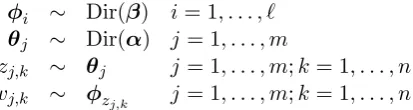
The LDA generative model can be compactly expressed as follows, where “∼” should be read as “is distributed according to”.
φi ∼ Dir(β) i= 1, . . . , ` θj ∼ Dir(α) j= 1, . . . , m
zj,k ∼ θj j= 1, . . . , m;k= 1, . . . , n wj,k ∼ φzj,k j= 1, . . . , m;k= 1, . . . , n
In inference, the parameters α and β of the Dirichlet priors are either fixed (i.e., chosen by the model designer), or else themselves inferred,
e.g., by Bayesian inference. (The adaptor gram-mar software we used in the experiments de-scribed below automatically does this kind of hyper-parameter inference).
The inference task is to find the topic probabil-ity vectorθjof each documentDjgiven the words wj,kof the documents; in general this also requires
inferring the topic to word distributionsφand the topic assigned to each wordzj,k. Blei et al. (2003)
describe a Variational Bayes inference algorithm for LDA models based on a mean-field approx-imation, while Griffiths and Steyvers (2004) de-scribe an Markov Chain Monte Carlo inference al-gorithm based on Gibbs sampling; both are quite effective in practice.
3 Probabilistic Context-Free Grammars
Context-Free Grammars are a simple model of hi-erarchical structure often used to describe natu-ral language syntax. A Context-Free Grammar (CFG) is a quadruple(N, W, R, S) whereN and W are disjoint finite sets ofnonterminaland ter-minalsymbols respectively,Ris a finite set of pro-ductions orrulesof the formA→βwhereA∈N andβ ∈(N∪W)?, andS∈Nis thestart symbol. In what follows, it will be useful to interpret a CFG as generating sets of finite, labelled, ordered treesTA for eachX ∈ N ∪W. Informally, TX
consists of all treestrooted inX where for each local tree(B, β) int (i.e., where B is a parent’s label andβ is the sequence of labels of its imme-diate children) there is a ruleB→β ∈R.
Formally, the sets TX are the smallest sets of
trees that satisfy the following equations.
IfX ∈ W (i.e., ifX is a terminal) thenTX =
{X}, i.e., TX consists of a single tree, which in
turn only consists of a single node labelledX. IfX ∈N (i.e., ifXis a nonterminal) then
TX =
[
X→B1...Bn∈RX
TREEX(TB1, . . . ,TBn)
whereRA = {A→ β :A → β ∈R}for each A∈N, and
TREEX(TB1, . . . ,TBn)
=
(
PP
X t1 . . . tn
: ti ∈ TBi,
i= 1, . . . , n )
The set of trees generated by the CFG is TS, whereSis the start symbol, and the set of strings generated by the CFG is the set of yields (i.e., ter-minal strings) of the trees inTS.
AProbabilistic Context-Free Grammar(PCFG) is a pair consisting of a CFG and set of multino-mial probability vectorsθX indexed by
nontermi-nalsX ∈ N, where θX is a distribution over the
rulesRX (i.e., the rules expandingX). Informally, θX→βis the probability ofXexpanding toβusing
the ruleX → β ∈ RX. More formally, a PCFG
associates eachX ∈ N ∪W with a distribution GX over the treesTX as follows.
If X ∈ W (i.e., if X is a terminal) then GX
is the distribution that puts probability 1 on the single-node tree labelledX.
IfX ∈N (i.e., ifXis a nonterminal) then:
GX =
X
X→B1...Bn∈RX
θX→B1...BnTDX(GB1, . . . , GBn)(1)
where:
TDA(G1, . . . , Gn) PP
X t1 . . .tn
!
=
n
Y
i=1
Gi(ti).
That is, TDA(G1, . . . , Gn) is a distribution over TA where each subtree ti is generated
indepen-dently from Gi. These equations have solutions
(i.e., the PCFG is said to be “consistent”) when the rule probabilitiesθAobey certain conditions;
see e.g., Wetherell (1980) for details.
The PCFG generates the distribution over trees GS, where S is the start symbol. The
distribu-tion over the strings it generates is obtained by marginalising over the trees.
In a Bayesian PCFG one puts Dirichlet priors
Dir(αX) on each of the multinomial rule
proba-bility vectors θX for each nonterminal X ∈ N.
This means that there is one Dirichlet parameter αX→βfor each ruleX→β ∈Rin the CFG.
In the “unsupervised” inference problem for a PCFG one is given a CFG, parametersαX for the
Dirichlet priors over the rule probabilities, and a corpus of strings. The task is to infer the cor-responding posterior distribution over rule prob-abilities θX. Recently Bayesian inference
algo-rithms for PCFGs have been described. Kurihara and Sato (2006) describe a Variational Bayes algo-rithm for inferring PCFGs using a mean-field ap-proximation, while Johnson et al. (2007a) describe a Markov Chain Monte Carlo algorithm based on Gibbs sampling.
4 LDA topic models as PCFGs
This section explains how to construct a PCFG that generates the same distribution over a collec-tion of documents as an LDA model, and where Bayesian inference for the PCFG’s rule proba-bilities yields the corresponding distributions as Bayesian inference of the corresponding LDA models. (There are several different ways of en-coding LDA models as PCFGs; the one presented here is not the most succinct — it is possible to collapse theDocandDoc0 nonterminals — but it has the advantage that the LDA distributions map straight-forwardly onto PCFG nonterminals).
The terminalsW of the CFG consist of the vo-cabularyV of the LDA model plus a set of special “document identifier” terminals “ j” for each
doc-ument j ∈ 1, . . . , m, where m is the number of documents. In the PCFG encoding strings from documentj are prefixed with “ j”; this indicates
to the grammar which document the string comes from. The nonterminals consist of the start symbol
Sentence,Docj andDoc0j for eachj ∈1, . . . , m,
andTopici for each i ∈ 1, . . . , `, where` is the number of topics in the LDA model.
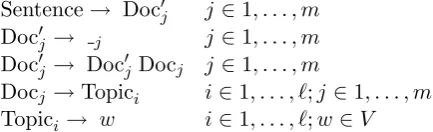
The rules of the CFG are all instances of the following schemata:
Sentence→ Doc0j j∈1, . . . , m
Doc0j → j j∈1, . . . , m
Doc0j → Doc0j Docj j∈1, . . . , m
Docj →Topici i∈1, . . . , `;j∈1, . . . , m
[image:3.595.312.529.442.508.2]Topici → w i∈1, . . . , `;w∈V
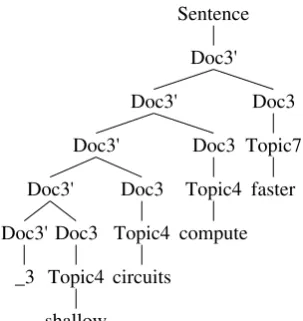
Figure 2 depicts a tree generated by such a CFG. The relationship between the LDA model and the PCFG can be understood by studying the trees generated by the CFG. In these trees the left-branching spine of nodes labelledDoc0j propagate the document identifier throughout the whole tree. The nodes labelledTopici indicate the topics as-signed to particular words, and the local trees ex-pandingDocjtoTopici(one per word in the
docu-ment) indicate the distribution of topics in the doc-ument.
The corresponding Bayesian PCFG associates probabilities with each of the rules in the CFG. The probabilitiesθTopici associated with the rules
expanding the Topici nonterminals indicate how words are distributed across topics; the θTopici
Sentence
Doc3'
Doc3'
Doc3'
Doc3'
Doc3'
_3 Doc3
Topic4
shallow Doc3
Topic4
circuits Doc3
Topic4
compute Doc3
Topic7
[image:4.595.105.257.63.224.2]faster
Figure 2: A tree generated by the CFG encoding an LDA topic model. The prefix “ 3” indicates that this string belongs to document 3. The tree also indicates the assignment of words to topics.
θDocjassociated with rules expandingDocj
spec-ify the distribution of topics in documentj; they correspond exactly to the probabilities θj of the
LDA model. (The PCFG also specifies several other distributions that are suppressed in the LDA model. For exampleθSentence specifies the
distri-bution of documents in the corpus. However, it is easy to see that these distributions do not influence the topic distributions; indeed, the expansions of the Sentence nonterminal are completely deter-mined by the document distribution in the corpus, and are not affected byθSentence).
A Bayesian PCFG places Dirichlet priors
Dir(αA) on the corresponding rule probabilities
θA for eachA ∈ N. In the PCFG encoding an
LDA model, the αTopici parameters correspond
exactly to theβparameters of the LDA model, and theαDocj parameters correspond to theα
param-eters of the LDA model.
As suggested above, each document Dj in the
LDA model is mapped to a string in the corpus used to train the corresponding PCFG by prefix-ing it with a document identifier “j”. Given this
training data, the posterior distribution over rule probabilitiesθDocj→Topici is the same as the
pos-terior distribution over topics given documentsθj,i
in the original LDA model.
As we will see below, this connection between PCFGs and LDA topic models suggests a num-ber of interesting variants of both PCFGs and topic models. Note that we are not suggesting that Bayesian inference for PCFGs is
necessar-ily a good way of estimating LDA topic models. Current Bayesian PCFG inference algorithms re-quire time proportional to the cube of the length of the longest string in the training corpus, and since these strings correspond to entire documents in our embedding, blindly applying a Bayesian PCFG in-ference algorithm is likely to be impractical.
A little reflection shows that the embedding still holds if the strings in the PCFG corpus correspond to sentences or even smaller units of the original document collection, so a single document would be mapped to multiple strings in the PCFG infer-ence task. In this way the cubic time complex-ity of PCFG inference can be mitigated. Also, the trees generated by these CFGs have a very spe-cialized left-branching structure, and it is straight-forward to modify the general-purpose CFG infer-ence procedures to avoid the cubic time complex-ity for such grammars: thus it may be practical to estimate topic models via grammatical inference.
However, we believe that the primary value of the embedding of LDA topic models into Bayesian PCFGs is theoretical: it suggests a number of novel extensions of both topic models and gram-mars that may be worth exploring. Our claim here is not that these models are the best algorithms for performing these tasks, but that the relationship we described between LDA models and PCFGs suggests a variety of interesting novel models.
We end this section with a simple example of such a modification to LDA. Inspired by the stan-dard embedding of HMMs into PCFGs, we pro-pose a “sticky topic” variant of LDA in which ad-jacent words are more likely to be assigned the same topic. Such an LDA extension is easy to describe as a PCFG (see Fox et al. (2008) for a similar model presented as an extended HMM). The nonterminals Sentence and Topici for i = 1, . . . , `have the same interpretation as before, but we introduce new nonterminals Docj,i that
indi-cate we have just generated a nonterminal in doc-umentjbelonging to topici. Given a collection of m documents and`topics, the rule schemata are as follows:
Sentence→ Docj,i i∈1, . . . , `; j∈1, . . . , m
Docj,1 → j j∈1, . . . , m
Docj,i→Docj,i0 Topici i, i0 ∈1, . . . , `;
j∈1, . . . , m
Sentence
Doc3,7
Doc3,4
Doc3,4
Doc3,4
Doc3,1
_3
Topic4
shallow Topic4
circuits
Topic4
compute Topic7
[image:5.595.100.262.63.208.2]faster
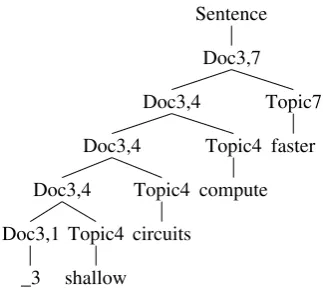
Figure 3: A tree generated by the “sticky topic” CFG. Here a nonterminal Doc3,7 indicates we have just generated a word in document 3 belong-ing to topic 7.
CFG is shown in Figure 3. The probabilities of the rules Docj,i→Docj,i0 Topici in this PCFG
encode the probability of shifting from topic ito topic i0 (this PCFG can be viewed as generating the string from right to left).
We can use non-uniform sparse Dirichlet pri-ors on the probabilities of these rules to encour-age “topic stickiness”. Specifically, by setting the Dirichlet parameters for the “topic shift” rules
Docj,i0 →Docj,iTopiciwherei0 6=imuch lower
than the parameters for the “topic preservation” rulesDocj,i →Docj,iTopici, Bayesian inference
will be biased to find distributions in which adja-cent words will tend to have the same topic.
5 Adaptor Grammars
Non-parametric Bayesian inference, where the in-ference task involves learning not just the values of a finite vector of parameters but which parame-ters are relevant, has been the focus of intense re-search in machine learning recently. In the topic-modelling community this has lead to work on Dirichlet Processes and Chinese Restaurant Pro-cesses, which can be used to estimate the number of topics as well as their distribution across docu-ments (Teh et al., 2006).
There are two obvious non-parametric exten-sions to PCFGs. In the first we regard the set of nonterminalsN as potentially unbounded, and try to learn the set of nonterminals required to de-scribe the training corpus. This approach goes un-der the name of the “infinite HMM” or “infinite PCFG” (Beal et al., 2002; Liang et al., 2007; Liang et al., 2009). Informally, we are given a set of
“ba-sic categories”, sayNP,VP, etc., and a set of rules that use these basic categories, sayS → NP VP. The inference task is to learn a set of refined cate-gories and rules (e.g.,S7 →NP2VP5) as well as
their probabilities; this approach can therefore be viewed as a Bayesian version of the “split-merge” approach to grammar induction (Petrov and Klein, 2007).
In the second approach, which we adopt here, we regard the set of rules R as potentially un-bounded, and try to learn the rules required to describe a training corpus as well as their prob-abilities. Adaptor grammars are an example of this approach (Johnson et al., 2007b), where en-tire subtrees generated by a “base grammar” can be viewed as distinct rules (in that we learn a sep-arate probability for each subtree). The inference task is non-parametric if there are an unbounded number of such subtrees.
We review the adaptor grammar generative pro-cess below; for an informal introduction see John-son (2008) and for details of the adaptor grammar inference procedure see Johnson and Goldwater (2009).
An adaptor grammar(N, W, R, S, θ, A, C) con-sists of a PCFG (N, W, R, S, θ) in which a sub-setA ⊆ N of the nonterminals areadapted, and where each adapted nonterminal X ∈ A has an associated adaptorCX. AnadaptorCX forXis a
function that maps a distribution over treesTX to
a distribution over distributions overTX (we give examples of adaptors below).
Just as for a PCFG, an adaptor grammar de-fines distributionsGX over treesTXfor eachX∈ N ∪W. IfX∈W orX6∈AthenGX is defined
just as for a PCFG above, i.e., using (1). How-ever, ifX ∈AthenGX is defined in terms of an
additional distributionHX as follows: GX ∼ CX(HX)
HX =
X
X→Y1...Ym∈RX
θX→Y1...YmTDX(GY1, . . . , GYm)
That is, the distribution GX associated with an
adapted nonterminal X ∈ A is a sample from adapting (i.e., applying CX to) its “ordinary”
PCFG distribution HX. In general adaptors are
chosen for the specific properties they have. For example, with the adaptors used hereGXtypically
concentrates mass on a smaller subset of the trees
TX thanHX does.
is the start symbol. However, whileGSin a PCFG
is a fixed distribution (given the rule probabili-tiesθ), in an adaptor grammar the distributionGS
is itself a random variable (because eachGX for X ∈Ais random), i.e., an adaptor grammar gen-erates a distribution over distributions over trees
TS. However, the posterior joint distributionPr(t)
of a sequence t = (t1, . . . , tn) of trees in TS is
well-defined:
Pr(t) =
Z
GS(t1). . . GS(tn)dG
where the integral is over all of the random distri-butionsGX, X ∈ A. The adaptors we use in this
paper are Dirichlet Processes or two-parameter Poisson-Dirichlet Processes, for which it is pos-sible to compute this integral. One way to do this uses the predictive distributions:
Pr(tn+1|t, HX) ∝
Z
GX(t1). . . GX(tn+1)CX(GX |HX)dGX
wheret= (t1, . . . , tn)and eachti ∈ TX. The
pre-dictive distribution for the Dirichlet Process is the (labeled)Chinese Restaurant Process(CRP), and the predictive distribution for the two-parameter Poisson-Dirichlet process is the (labeled) Pitman-Yor Process(PYP).
In the context of adaptor grammars, the CRP is:
CRP(t|t, αX, HX) ∝ nt(t) +αXHX(t)
wherent(t)is the number of timestappears in t
andαX > 0 is a user-settable “concentration
pa-rameter”. In order to generate the next tree tn+1
a CRP either reuses a treetwith probability pro-portional to number of timesthas been previously generated, or else it “backs off” to the “base distri-bution”HX and generates a fresh treetwith
prob-ability proportional toαXHX(t).
The PYP is a generalization of the CRP:
PYP(t|t, aX, bX, HX)
∝ max(0, nt(t)−mtaX) + (maX +bX)HX(t)
Here aX ∈ [0,1] and bX > 0 are user-settable
parameters, andmtis the number of times the PYP
has generatedtintfrom the base distributionHX,
andm = P
t∈TXmt is the number of times any
tree has been generated fromHX. (In the Chinese
Restaurant metaphor, mt is the number of tables
labeled witht, andm is the number of occupied
tables). IfaX = 0then the PYP is equivalent to
a CRP withαX = bX, while ifaX = 1then the
PYP generates samples fromHX.
Informally, the CRP has a strong preference to regenerate trees that have been generated fre-quently before, leading to a “rich-get-richer” dy-namics. The PYP can mitigate this somewhat by reducing the effective count of previously gener-ated trees and redistributing that probability mass to new trees generated from HX. As
Goldwa-ter et al. (2006) explain, Bayesian inference for HX given samples from GX is effectively
per-formed from types if aX = 0 and from tokens
if aX = 1, so varying aX smoothly interpolates
between type-based and token-based inference. Adaptor grammars have previously been used primarily to study grammatical inference in the context of language acquisition. The word seg-mentation task involves segmenting a corpus of unsegmented phonemic utterance representa-tions into words (Elman, 1990; Bernstein-Ratner, 1987). For example, the phoneme string corre-sponding to “you want to see the book” (with its correct segmentation indicated) is as follows:
yMuNwMaMnMtNtMuNsMiNDM6NbMUMk
We can represent any possible segmentation of any possible sentence as a tree generated by the fol-lowingunigram adaptor grammar.
Sentence→Word
Sentence→Word Sentence Word→Phonemes
Phonemes→Phoneme
Phonemes→Phoneme Phonemes
The trees generated by this adaptor grammar are the same as the trees generated by the CFG rules. For example, the following skeletal parse in which all but theWordnonterminals are suppressed (the others are deterministically inferrable) shows the parse that corresponds to the correct segmentation of the string above.
(Wordy u) (Wordw a n t) (Wordt u) (Words i) (Wordd 6) (Wordb u k)
6 Topic models with collocations
Here we combine ideas from the unigram word segmentation adaptor grammar above and the PCFG encoding of LDA topic models to present a novel topic model that learns topical colloca-tions. (For a non-grammar-based approach to this problem see Wang et al. (2007)). Specifically, we take the PCFG encoding of the LDA topic model described above, but modify it so that theTopici
nodes generate sequences of words rather than sin-gle words. Then we adapt each of theTopici non-terminals, which means that we learn the probabil-ity of each of the sequences of words it can expand to.
Sentence→Docj j∈1, . . . , m
Docj → j j∈1, . . . , m
Docj →Docj Topici i∈1, . . . , `; j∈1, . . . , m
Topici→Words i∈1, . . . , `
Words→Word Words→Words Word
Word→w w∈V
In order to demonstrate that this model works, we implemented this using the publically-available adaptor grammar inference software,1 and ran it on the NIPS corpus (composed of pub-lished NIPS abstracts), which has previously been used for studying collocation-based topic models (Griffiths et al., 2007). Because there is no gen-erally accepted evaluation for collocation-finding, we merely present some of the sample analyses found by our adaptor grammar. We ran our adap-tor grammar with ` = 20 topics (i.e., 20 distinct
Topicinonterminals). Adaptor grammar inference on this corpus is actually relatively efficient be-cause the corpus provided by Griffiths et al. (2007) is already segmented by punctuation, so the termi-nal strings are generally rather short. Rather than set the Dirichlet parameters by hand, we placed vague priors on them and estimated them as de-scribed in Johnson and Goldwater (2009).
The following are some examples of colloca-tions found by our adaptor grammar:
Topic0→cost function
Topic0→fixed point
Topic0→gradient descent
Topic0→learning rates
1http://web.science.mq.edu.au/ ˜mjohnson/Software.htm
Topic1→associative memory
Topic1→hamming distance
Topic1→randomly chosen
Topic1→standard deviation
Topic3→action potentials
Topic3→membrane potential
Topic3→primary visual cortex
Topic3→visual system
Topic10→nervous system
Topic10→action potential
Topic10→ocular dominance
Topic10→visual field
The following are skeletal sample parses, where we have elided all but the adapted nonterminals (i.e., all we show are theTopicnonterminals, since the other structure can be inferred deterministi-cally). Note that because Griffiths et al. (2007) segmented the NIPS abstracts at punctuation sym-bols, the training corpus contains more than one string from each abstract.
3 (Topic5 polynomial size) (Topic15threshold circuits)
4 (Topic11studied)
(Topic19pattern recognition algorithms)
4 (Topic2 feedforward neural network) (Topic1implementation)
5 (Topic11single)
(Topic10ocular dominance stripe) (Topic12low) (Topic3ocularity) (Topic12drift rate)
7 Finding the structure of proper names
Grammars offer structural and positional sensitiv-ity that is not exploited in the basic LDA topic models. Here we explore the potential for us-ing Bayesian inference for learnus-ing linear order-ing constraints that hold between elements within proper names.
names then we could infer that Bill Clinton and Hillary Clinton are likely to refer to distinct in-dividuals. On the other hand, becauseMr inMr Clinton is not a first name, it is possible thatMr ClintonandBill Clintonrefer to the same individ-ual (Elsner et al., 2009).
Here we present an adaptor grammar based on the insights of the PCFG encoding of LDA topic models that learns some of the structure of proper names. The key idea is that elements in proper names typically appear in a fixed order; we expect honorifics to appear before first names, which ap-pear before middle names, which in turn apap-pear before surnames, etc. Similarly, many company names end in fixed phrases such as Inc. Here we think of first names as a kind of topic, albeit one with a restricted positional location. One of the challenges is that some of these structural ele-ments can be filled by multiword expressions; e.g., de Grootcan be a surname. We deal with this by permitting multi-word collocations to fill the cor-responding positions, and use the adaptor gram-mar machinery to learn these collocations.
Inspired by the grammar presented in Elsner et al. (2009), our adaptor grammar is as follows, where adapted nonterminals are indicated by un-derlining as before.
NP→(A0) (A1) . . . (A6) NP→(B0) (B1) . . . (B6) NP→Unordered+ A0→Word+
. . .
A6→Word+ B0→Word+
. . .
B6→Word+
Unordered→Word+
In this grammar parentheses indicate optional-ity, and the Kleene plus indicates iteration (these were manually expanded into ordinary CFG rules in our experiments). The grammar provides three different expansions for proper names. The first expansion says that a proper name can consist of some subset of the six different collocation classes
A0throughA6in that order, while the second ex-pansion says that a proper name can consist of some subset of the collocation classesB0through
B6, again in that order. Finally, the third expan-sion says that a proper name can consist of an ar-bitrary sequence of “unordered” collocations (this
is intended as a “catch-all” expansion to provide analyses for proper names that don’t fit either of the first two expansions).
We extracted all of the proper names (i.e., phrases of category NNP and NNPS) in the Penn WSJ treebank and used them as the training cor-pora for the adaptor grammar just described. The adaptor grammar inference procedure found skele-tal sample parses such as the following:
(A0 barrett) (A3 smith)
(A0 albert) (A2 j.) (A3 smith) (A4 jr.) (A0 robert) (A2 b.) (A3 van dover) (B0 aim) (B1 prime rate) (B2 plus) (B5 fund) (B6 inc.)
(B0 balfour) (B1 maclaine) (B5 interna-tional) (B6 ltd.)
(B0 american express) (B1 information services) (B6 co)
(U abc) (U sports) (U sports illustrated) (U sports unlimited)
While a full evaluation will have to await further study, in general it seems to distinguish person names from company names reasonably reliably, and it seems to have discovered that person names consist of a first name (A0), a middle name or ini-tial (A2), a surname (A3) and an optional suffix (A4). Similarly, it seems to have uncovered that company names typically end in a phrase such as inc,ltdorco.
8 Conclusion
This paper establishes a connection between two very different kinds of probabilistic models; LDA models of the kind used for topic modelling, and PCFGs, which are a standard model of hierarchi-cal structure in language. The embedding we pre-sented shows how to express an LDA model as a PCFG, and has the property that Bayesian infer-ence of the parameters of that PCFG produces an equivalent model to that produced by Bayesian in-ference of the LDA model’s parameters.
grammars. We don’t claim that these are neces-sarily the best models for performing any particu-lar tasks; rather, we present them as examples of models inspired by a combination of PCFGs and LDA topic models. We showed how the LDA to PCFG embedding suggested a “sticky topic” model extension to LDA. We then discussed adap-tor grammars, and inspired by the LDA topic mod-els, presented a novel topic model whose prim-itive elements are multi-word collocations rather than words. We concluded with an adaptor gram-mar that learns aspects of the internal structure of proper names.
Acknowledgments
This research was funded by US NSF awards 0544127 and 0631667, as well as by a start-up award from Macquarie University. I’d like to thank the organisers and audience at the Topic Modeling workshop at NIPS 2009, my former col-leagues at Brown University (especially Eugene Charniak, Micha Elsner, Sharon Goldwater, Tom Griffiths and Erik Sudderth), my new colleagues at Macquarie University and the ACL reviewers for their excellent suggestions and comments on this work. Naturally all errors remain my own.
References
M.J. Beal, Z. Ghahramani, and C.E. Rasmussen. 2002. The infinite Hidden Markov Model. In T. Dietterich,
S. Becker, and Z. Ghahramani, editors,Advances in
Neural Information Processing Systems, volume 14, pages 577–584. The MIT Press.
N. Bernstein-Ratner. 1987. The phonology of
parent-child speech. In K. Nelson and A. van Kleeck,
editors, Children’s Language, volume 6. Erlbaum,
Hillsdale, NJ.
David M. Blei, Andrew Y. Ng, and Michael I. Jordan.
2003. Latent Dirichlet allocation. Journal of
Ma-chine Learning Research, 3:993–1022.
Jeffrey Elman. 1990. Finding structure in time.
Cog-nitive Science, 14:197–211.
Micha Elsner, Eugene Charniak, and Mark Johnson.
2009. Structured generative models for
unsuper-vised named-entity clustering. In Proceedings of
Human Language Technologies: The 2009 Annual Conference of the North American Chapter of the Association for Computational Linguistics, pages 164–172, Boulder, Colorado, June. Association for Computational Linguistics.
E. Fox, E. Sudderth, M. Jordan, and A. Willsky. 2008. An HDP-HMM for systems with state persistence.
In Andrew McCallum and Sam Roweis, editors,
Proceedings of the 25th Annual International Con-ference on Machine Learning (ICML 2008), pages 312–319. Omnipress.
Sharon Goldwater, Tom Griffiths, and Mark John-son. 2006. Interpolating between types and tokens by estimating power-law generators. In Y. Weiss, B. Sch¨olkopf, and J. Platt, editors,Advances in Neu-ral Information Processing Systems 18, pages 459– 466, Cambridge, MA. MIT Press.
Thomas L. Griffiths and Mark Steyvers. 2004.
Find-ing scientific topics. Proceedings of the National
Academy of Sciences, 101:52285235.
Thomas L. Griffiths, Mark Steyvers, and Joshua B. Tenenbaum. 2007. Topics in semantic representa-tion. Psychological Review, 114(2):211244.
Mark Johnson and Sharon Goldwater. 2009.
Im-proving nonparameteric Bayesian inference: exper-iments on unsupervised word segmentation with
adaptor grammars. InProceedings of Human
Lan-guage Technologies: The 2009 Annual Conference of the North American Chapter of the Associa-tion for ComputaAssocia-tional Linguistics, pages 317–325, Boulder, Colorado, June. Association for Computa-tional Linguistics.
Mark Johnson, Thomas Griffiths, and Sharon Gold-water. 2007a. Bayesian inference for PCFGs via
Markov chain Monte Carlo. In Human Language
Technologies 2007: The Conference of the North American Chapter of the Association for Computa-tional Linguistics; Proceedings of the Main
Confer-ence, pages 139–146, Rochester, New York, April.
Association for Computational Linguistics.
Mark Johnson, Thomas L. Griffiths, and Sharon Gold-water. 2007b. Adaptor Grammars: A framework for specifying compositional nonparametric Bayesian models. In B. Sch¨olkopf, J. Platt, and T. Hoffman,
editors,Advances in Neural Information Processing
Systems 19, pages 641–648. MIT Press, Cambridge, MA.
Mark Johnson. 2008. Using adaptor grammars to iden-tifying synergies in the unsupervised acquisition of linguistic structure. InProceedings of the 46th An-nual Meeting of the Association of Computational Linguistics, Columbus, Ohio. Association for Com-putational Linguistics.
Kenichi Kurihara and Taisuke Sato. 2006. Variational Bayesian grammar induction for natural language. In8th International Colloquium on Grammatical In-ference.
Percy Liang, Michael Jordan, and Dan Klein. 2009. Probabilistic grammars and hierarchical Dirichlet
processes. In The Oxford Handbook of Applied
Bayesian Analysis. Oxford University Press.
Michell P. Marcus, Beatrice Santorini, and Mary Ann Marcinkiewicz. 1993. Building a large annotated
corpus of English: The Penn Treebank.
Computa-tional Linguistics, 19(2):313–330.
Slav Petrov and Dan Klein. 2007. Improved
infer-ence for unlexicalized parsing. InHuman Language
Technologies 2007: The Conference of the North American Chapter of the Association for Computa-tional Linguistics; Proceedings of the Main
Confer-ence, pages 404–411, Rochester, New York.
Associ-ation for ComputAssoci-ational Linguistics.
Y. W. Teh, M. Jordan, M. Beal, and D. Blei. 2006. Hi-erarchical Dirichlet processes. Journal of the Amer-ican Statistical Association, 101:1566–1581.
Xuerui Wang, Andrew McCallum, and Xing Wei. 2007. Topical n-grams: Phrase and topic discovery, with an application to information retrieval. In Pro-ceedings of the 7th IEEE International Conference on Data Mining (ICDM), pages 697–702.
C.S. Wetherell. 1980. Probabilistic languages: A
re-view and some open questions. Computing Surveys,