Application of Jig Separation for Pre-Concentration of Low-Grade Scheelite Ore
Sang-Ho Baek
1and Ho-Seok Jeon
2,*1University of Science & Technology (UST), 217, Gajeong-ro, Yuseong-gu, Daejeon, 34113, Republic of Korea 2Mineral Resources Division, Korea Institute of Geoscience & Mineral Resources (KIGAM),
124, Gwahang-no, Yuseong-gu, Daejeon, 34132, Republic of Korea
Jig separation, one of the oldest methods of gravity separation, is commonly used to reduce the costs of subsequent processes by pre-concentrating the valuable minerals from the product following coarse particle crushing. In this study, jig separation was used to pre- concentrate scheelite prior to grinding for the next process. Experiments were carried out using 0.21 to 5 mm samples, in order to determine and evaluate optimal conditions by varying factors, including the thickness of the bed, the water flow rate and the number of scavenging. The results of the experiments show that when pre-concentration of low-grade scheelite ore (0.75% WO3) using jig separation is conducted, a con-centrate with a mass percentage of about 22.0%, a WO3 grade of about 3.1% and WO3 recovery of about 90.0% can be obtained. It is there-fore expected that when this concentrate is supplied to the next separation process, the grade, economic feasibility, and separation efficiency will be improved compared with separations that do not involve a pre-concentration. [doi:10.2320/matertrans.M2017150]
(Received November 16, 2017; Accepted December 8, 2017; Published January 19, 2018)
Keywords: pre-concentration, jig separation, low-grade scheelite, brittleness
1. Introduction
The effective separation of valuable minerals from gangue minerals often involves a crushing process, but in the case of low-grade ore, the economic value of mineral processing op-eration decreases due to excessive crushing costs. A possible solution would be to pre-concentrate the valuable minerals following coarse particle crushing.
The sample used in this study is low-grade scheelite (0.75%WO3) that is easily ground to fine particles during the
crushing process due to its brittleness.1) Finer particles tend
to be lost in the separation process used for improving grade, which makes the early recovery of scheelite crushed by coarse particles more necessary than other minerals.
Generally, gravity separation methods, such as jig separa-tion, Knelson concentrasepara-tion, multi-gravity separasepara-tion, spiral concentration and the use of a shaking table, are applied for the pre-concentration of high specific gravity minerals like scheelite (5.9–6.1 S.G.).2–6) Of these, jig separation is one of
the oldest types of gravity separation equipment in its class for treating relatively coarser particles. It also has the advan-tage of being low cost, easy to operate, and capable of han-dling large quantities of material; for these reasons, it has been used for the beneficiation of ore minerals as well as the washing of coal.7,8) However, most of the literature on jig
separation only concerns coal washing and iron ore tion. In addition, most of the literature related to the separa-tion of scheelite was in the area of flotasepara-tion for improving the grade after crushing by fine particles.9–11) No significant
literature on jig separation of scheelite was found.
In this study, jig separation was conducted for the pre-concentration of low-grade scheelite crushed by coarse particles. The jig separation was performed using a labora-tory scale plunger jig and optimal conditions parameters were identified and examined under various conditions.
2. Materials & Methods
The sample used in this study was scheelite ore collected from the Dongbo mine in Uljin, Gyeongbuk, Korea.
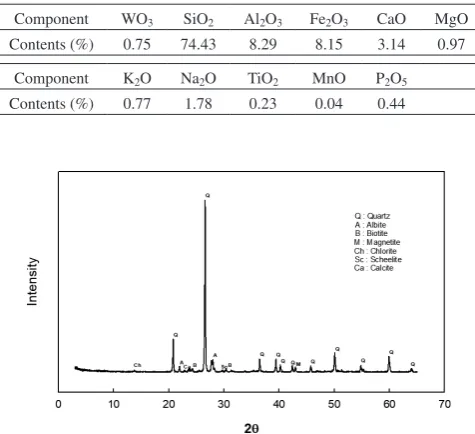
The result of chemical analysis of XRF (x-ray fluores-cence) and ICP (inductively coupled plasma) spectrometry on the ore are given in Table 1. It is comparatively low-grade
scheelite ore with a grade of 0.75% WO3. Most of the
gangue minerals are silicate minerals that contain SiO2 and
Al2O3, as high as 74.43% and 8.29%. In addition, it was
confirmed that Fe2O3 and CaO were 8.15% and 3.14%.
Figure 1 shows the XRD analysis result of the ore with the following minerals being observed: quartz, albite, biotite, magnetite, chlorite, as well as scheelite and calcite that con-tain calcium.
Particle size analysis is useful in understanding the
char-* Corresponding author, E-mail: [email protected] Fig. 1 XRD analysis of the ore. Table 1 Chemical composition of the ore.
Component WO3 SiO2 Al2O3 Fe2O3 CaO MgO
Contents (%) 0.75 74.43 8.29 8.15 3.14 0.97
Component K2O Na2O TiO2 MnO P2O5
Contents (%) 0.77 1.78 0.23 0.04 0.44
[image:1.595.307.545.554.771.2]acteristics of scheelite distribution in various size frac-tions.12) Table 2 shows the results of the particle size
analy-sis of this sample. The ore was crushed to less than 5 mm using a jaw crusher and cone crusher for particle size analy-sis. Results showed that the crushed sample is a compara-tively coarser as over 28 mesh (590 μm) particles making up
about 75% of total mass. It was confirmed that WO3 is
mostly distributed in +65 mesh products of about 85% in mass. Based on these preliminary results, however, there is a possibility that liberation could not be achieved due to the coarse nature of the particles.
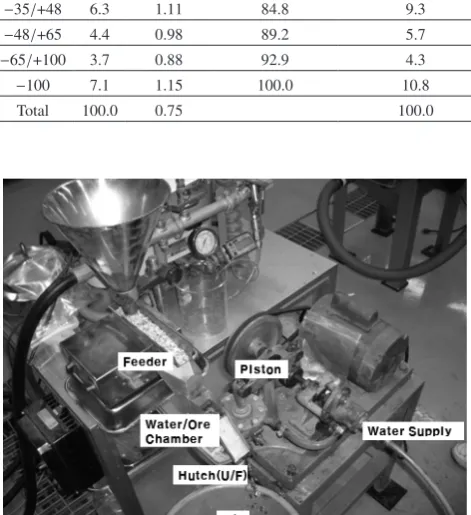
The jig separation was performed using a laboratory scale plunger jig, as shown in Fig. 2. Experiments were exclu-sively carried out with 0.21 to 5 mm samples, crushed to
−5 mm and screened through a 65 mesh sieve. A
representa-tive sample of 500 g was used for each experiment. During the experiment, water is supplied to the plunger chamber and plunger movement allows water to flow into the jig chamber and overflow out during pulsation of the bed (layer of balls). When the prepared samples are fed into the jig, particles with a higher specific gravity settle down through a porous bed, while lower specific gravity particles overflow out of the chamber with the water flow. The heavy product collected in the hutch of the jig is classified as concentrate (U/F, under flow) and the light product that overflows out of
the chamber is called tailing (O/F, over flow). Both heavy
and light products were analyzed using ICP. For this jig
sep-aration, the bed in the jig chamber was made using ceramic balls (5.8 S.G.) with a diameter of 5 mm. Optimum condi-tions were determined and examined by varying the thick-ness of the bed, the water flow rate and the number of scavenging.
3. Results & Discussion
The main purpose of jig separation is to maximize scheelite recovery, while minimizing the mass of concen-trate. Therefore, the separation efficiency was estimated by calculating the amount of recovered concentrate and recov-ery of WO3.
The formula used to calculate recovery is as follows:
R=C×c
F×f ×100
Here, C and c are the mass percentage and WO3 grade of
the concentrate, and F and f are the mass percentage and WO3 grade of feed.
3.1 Thickness of bed
The thickness of the bed formed in the jig chamber affects the separation efficiency. A thick bed in the jig allows less concentrate to pass through because of more friction during the suction stage. On the other hand, thin bed will allow easy passage for the concentrate, because of reduction of friction action during suction stage.13) A thin bed also makes
the stratification process rapid. This may be due to excessive movement of the bed, which would mean that there is a higher possibility that the particles will overflow.14) The bed
thickness was therefore investigated to determine its effects in jig separation.
The effects of bed thickness were studied using three dif-ferent thicknesses, ranging from the minimum to maximum thicknesses possible: a thin bed (0 cm), an intermediate bed (3 cm), and a thick bed (6 cm). Figure 3 shows the experi-mental results of separation using different bed thicknesses. The results confirm that the separation efficiency varies ac-cording to the thickness of bed. Specifically, the results show that an increase in bed thickness results in a decrease
in the mass percentage of the concentrate. However, WO3
[image:2.595.46.290.431.566.2]grade and recovery are found to be higher at a bed thickness
Table 2 Particle size distribution of the ore crushed to −5 mm....
Size range (mesh)
Mass (%)
WO3 grade (%)
Cumulative mass (%)
WO3 distribution (%)
+8 32.1 0.54 32.1 23.1
−8/+16 27.2 0.67 59.3 24.3 −16/+28 15.5 0.87 74.8 18.0 −28/+35 3.7 0.92 78.5 4.5 −35/+48 6.3 1.11 84.8 9.3 −48/+65 4.4 0.98 89.2 5.7 −65/+100 3.7 0.88 92.9 4.3
−100 7.1 1.15 100.0 10.8
Total 100.0 0.75 100.0
[image:2.595.51.287.507.765.2] [image:2.595.320.533.607.770.2]of 3 cm. The separation efficiency using a bed thickness of 0 cm is lower than that seen using a bed thickness of 3 cm
because WO3 grade and recovery are both low and the mass
percentage of the concentrate is high. In the case of the bed thickness of 6 cm, the mass percentage of the concentrate is
lowest at 14.9%, but WO3 recovery is about 45% lower than
that seen using a bed thickness of 3 cm. This means that the separation efficiency of the 6 cm bed is lower than that of the 3 cm bed. In the present study, it was confirmed that the most effective bed thickness is 3 cm, which is in the middle of the chamber.
3.2 Water flow rate
In jig separation, the water flow rate is related to the water pressure delivered to the chamber, which therefore affects the motion of particles in relation to the porosity of the bed filled with balls.15–17) As the water flow rate increases, the
porosity of the bed increases. Although there is an increased possibility that the particles settle down, there is also a pos-sibility that the particles overflow with the water. A low wa-ter flow rate can also affect the motion of the particles. As control of the water flow rate is an important factor in jig separation efficiency, its effects were thoroughly examined.
In this series of tests, the bed thickness was fixed at 3 cm and the water flow rate was varied, using levels of 500 ml/
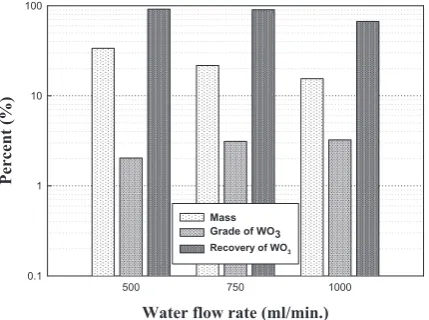
min, 750 ml/min and 1,000 ml/min. Figure 4 shows that the results varied with different water flow rates. As the water flow rate increases, the mass percentage of concentrate
de-creases, but the grade of WO3 increases; the concentrate
mass percentage and WO3 grade are 33.7% and 2.04% at the
lowest water flow rate of 500 ml/min, but 15.5% and 3.24%
at the highest 1,000 ml/min. Compared with 500 ml/min,
the recovery of WO3 at 750 ml/min is not different, but the
mass percentage of the concentrate is 12% lower. Therefore, the separation efficiency using a rate of 500 ml/min is lower
than that using 750 ml/min. In addition, the concentrate
mass percentage using a flow rate of 1,000 ml/min is lowest
at 15.5%, but the recovery of WO3 is 24.7% lower than
when using 750 ml/min. This is considered to be due to the change in water pressure and porosity. Therefore, it confirms that using a suitable water flow rate is an important factor, for improving the separation efficiency in jig separation. In this study, the effective water flow rate is 750 ml/min taking
into account the mass percentage and WO3 recovery of
concentrate.
3.3 Number of scavenging
The purpose of jig separation is to increase the concentra-tion of valuable minerals while minimizing the loss of valu-able minerals to the tailing. For this reason, a scavenging process is required to re-treat the tailing generated by the rougher process. And so, the effects of number of scaveng-ing on separation efficiency was examined.
In this section, the bed thickness and the water flow rate were fixed at 3 cm and 750 ml/min, and the effects of num-ber of scavenging were observed. The jig process has two products, concentrate and tailing. Heavy product collected in
the hutch of a jig are concentrate, marked U/F1, and the
light product overflown out of the chamber is a tailing, which are marked as O/F1. As the tailing (O/F1) may still contain valuable minerals, it was processed again using the same conditions in the jig separator as used for the rougher, a process called scavenging, this time marking the products
as U/F2 and O/F2. A secondary scavenging was performed
on O/F2 with the final concentrate, U/F3, and final tailing,
O/F3, being the end products. Figure 5 shows that a large
amount of WO3 was distributed in the U/F1 product. In the
rougher process 90.3% of WO3 was recovered, and 2.5%
and 1.5% of WO3 was recovered in the subsequent
scaveng-ing processes. It was also found that 5.8% of WO3 was
dis-carded to the final tailing (O/F3). Based on these results, if
the U/F2 and U/F3 products are mixed in with the U/F1
product, the recovery of WO3 can be increased by about 4%.
However, the mass percentage of final concentrate also rose by 15.7%, with only a slight increase in the recovery of
WO3. It is therefore not recommended that that the U/F
products recovered during the scavenging process be added to the final concentrate.
3.4 Analysis and evaluation of jig separation products
Various combinations of bed thickness, water flow rate, and number of scavenging were studied in jig separation, and the optimal conditions identified. The optimal condi-tions for jig separation in these experiments occurs when the thickness of the bed is 3 cm, the water flow rate is 750 ml/
min, and without scavenging. Using these conditions, the
[image:3.595.62.277.610.770.2] [image:3.595.321.533.612.771.2]mass percentage, grade and recovery of WO3 of the
concen-trate were 21.7%, 3.12% and 90.3% and those of the tailing were 78.3%, 0.09% and 9.7%, respectively.
In order to examine the particle size distribution and WO3
distribution of concentrate and tailing, each product was
classified in size ranges of +8 mesh, −8/+16 mesh,
−16/+35 mesh, and −65 mesh (−210 um). WO3 grade and
distribution analysis results are shown in Fig. 6. In the case
of the concentrate, 80 mass% or more of WO3 were
distrib-uted in under 1,000 μm size fractions, while in the case of the tailing, 80 mass% or more is distributed over 1,000 μm size. This means that particles with a high degree of libera-tion are moved to the concentrate, and the particles of large gangue mineral with a low degree of liberation are moved to
the tailing. The figure shows that WO3 grades tend to
in-crease as the particle size inin-creases in the concentrate, while the tailing shows opposite trends. Finally, the distribution of WO3 is consistent regardless of particle size in the
concen-trate, but in tailing, about 80% is found in particles larger than 1,000 µm. This is also inferred to be related to the liber-ation. In other words, it could be inferred that fluctuations in the contents of scheelite and gangue minerals, in accordance with the degree of liberation, may have an effect on the movement of particles.
In order to prove this hypothesis in detail, the sink and float test was performed on each product, concentrate and tailing. Tetrabromoethane (2.89 S.G.) and diiodomethane (3.32 S.G.) were used for the sink and float test. First, a cer-tain amount of tetrabromoethane was put into a beaker and the feed added for the sink and float test. Using the sink product from this step, the sink and float test was repeated
using diiodomethane. The products of −2.89 S.G.,
+2.89/−3.32 S.G, and +3.32 S.G. were recovered by the
[image:4.595.319.533.284.448.2]sink and float test and characteristics of these samples were examined.
Figure 7 shows the result of the sink and float test. In the
case of the concentrate, most WO3 (approximately 95%) is
distributed in the +3.32 S.G. product. This, as previously de-scribed, demonstrates that the particles with some degree of liberation have moved toward the concentrate. In the case of the tailing, most WO3 (approximately 68%) is distributed in
the −2.89 S.G. product. This might also be related to the
ra-tio of scheelite and gangue minerals in unliberated particles, or the fact that scheelite exists as fine particles that do not greatly affect the specific gravity of particles.
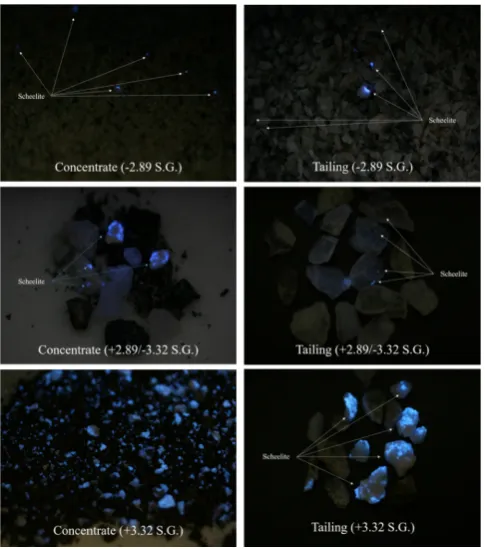
Figure 8 shows images of the products recovered by the sink and float test under UV (ultraviolet) light illumination. Blue-colored mineral particles are fluorescent particles of scheelite. As can be seen from the photographs, in the case of the concentrate, the scheelites are predominantly accumu-lated in the +3.32 S.G. product, and are distributed through-out all of the size fractions from fine particles to coarse par-ticles. Some unliberated scheelites are also observed in the
−2.89 S.G. and +2.89/−3.32 S.G. product. In the case of the tailing, a small amount of unliberated fine scheelites exists in gangue mineral, and a small amount of unliberated coarse scheelites is observed in the +3.32 S.G. product. These pho-tographic images qualitatively demonstrate the results of jig
Fig. 6 Effect of jig separation according to particle size of products ob-tained. (C: Concentrate, T: Tailing)
Fig. 7 Result of the sink and float test obtained in jig separation.
[image:4.595.306.549.487.762.2] [image:4.595.62.275.598.760.2]separation and the sink and float test.
4. Conclusion
Scheelite, due to its brittleness, is ground easily into fine particles during the crushing process. Finer scheelite parti-cles tend to be lost in the separation process for improving grade. In this study, jig separation was conducted for pre-concentration of scheelite crushed by coarse particles and the following conclusions were made.
(1) The sample is comparatively low-grade scheelite ore
with 0.75% WO3, and most of the gangue minerals are
sili-cate minerals that contain SiO2 and Al2O3, as high as
74.43% and 8.29%. Experiments were carried out using 0.21
to 5 mm samples, crushed to −5 mm and screened with a
65 mesh sieve. As a result of the particle size analysis, the sample crushed to less than 5 mm is a comparatively coarser
as over 28 mesh (590 μm) particles making up about 75% of
total mass. The majority of WO3 (approximately 85%) is
distributed in +65 mesh products.
(2) The jig separation was performed using a laboratory scale plunger jig, and optimal conditions were determined and examined by varying the thickness of the bed, the water flow rate and the number of scavenging. Optimal conditions for jig separation occurred using a bed thickness of 3 cm, a
water flow rate of 750 ml/min, and without scavenging.
Using these conditions, the mass percentage, grade and WO3
recovery of the concentrate were 21.7%, 3.12% and 90.3%, and those of the tailing were 78.3%, 0.09% and 9.7%, respectively.
(3) To examine the WO3 distribution in the recovered
con-centrate and tailing, the characteristics in different particle sizes, the result of the sink and float test, and photographs of each product under UV light illumination were used. These experiments demonstrated that particle movement during jig separation is related to liberation. In other words, it should be considered that fluctuations in contents of scheelite and gangue minerals, in accordance with the degree of libera-tion, may have an effect on the movement of particles.
(4) In conclusion, when low-grade scheelite ore (0.75% WO3) crushed by coarser particles is pre-concentrated using
jig separation, a concentrate at a mass percentage of about
22%, a WO3 grade of about 3.1% and WO3 recovery of
about 90% can be obtained. Therefore, if this concentrate were to be supplied to the next separation process, improve-ments in grade, economic feasibility, and separation effi-ciency can be expected compared with a sample that has not been pre-concentrated.
Acknowledgments
The research was supported by the Basic Research Project (GP2017-025) of the Korea Institute of Geoscience and Mineral Resources (KIGAM), funded by the Ministry of Science, ICT and Future Planning of Korea.
REFERENCES
1) W. Zhou, H. Chen, L. Ou and Q. Shi: Int. J. Miner. Process. 157
(2016) 236–240.
2) B.A. Wills: Mineral Processing Technology 6th Edition, (Pergamon Press, 1992) pp. 407–425.
3) T. Coulter and G.K.N. Subasinghe: Miner. Eng. 18 (2005) 9–17.
4) K. Udaya Bhaskar, B. Govindarajan, J.P. Barnwal, R. Venugopal, M.R. Jakhu and T.C. Rao: Int. J. Miner. Process. 67 (2002) 59–70.
5) P.O.J. Davies, R.H. Goodman and J.A. Deschamps: Miner. Eng. 4
(1991) 437–456.
6) R. Sivamohan and E. Forssberg: Int. J. Miner. Process. 15 (1985) 281–295.
7) A.K. Mukherjee, D. Bhattacharjee and B.K. Mishra: Miner. Eng. 19
(2006) 952–959.
8) K. Hori, M. Tsunekawa, N. Hiroyoshi and M. Ito: Int. J. Miner. Process. 92 (2009) 103–108.
9) W. Xia, G. Xie and Y. Peng: Powder Technol. 277 (2015) 206–221.
10) B. Das, S. Prakash and P.S.R. Reddy: J. Miner. Mater. Charact. Eng. 7 (2007) 27–37.
11) F. Bo, L. Xianping, W. Jinqing and W. Pengcheng: Miner. Eng. 80
(2015) 45–49.
12) R. Sripriya and C.V.G.K. Murty: Int. J. Miner. Process. 75 (2005) 123–134.
13) P.A. Olubambi and J.H. Potgieter: JMMCE 4 (2005) 21–30.
14) M.M. Ahmed: Int. J. Eng. Sci. 38 (2010) 807–818.
15) M. Tsunekawa, B. Naoi, S. Ogawa, K. Hori, N. Hiroyoshi, M. Ito and T. Hirajim: Int. J. Miner. Process. 76 (2005) 67–74.
16) B. Das, S. Prakash, S.K. Das and P.S.R. Reddy: JMMCE 7 (2007) 27–37.
17) L. Panda, A.K. Sahoo, A. Tripathy, S.K. Biswal and A.K. Sahu: Fuel