Munich Personal RePEc Archive
Corporate Restructuring in the Asian
electronics market: Insights from Philips
and Panasonic
Reddy, Kotapati Srinivasa
2016
Corporate Restructuring in the Asian electronics market: Insights from
Philips and Panasonic
Kotapati Srinivasa Reddy
Working version: 2016
Corporate Restructuring in the Asian electronics market: Insights from
Philips and Panasonic
Disguised Case and Teaching Note: Download from the Emerald Emerging Markets Case Studies
Reddy, K.S., Agrawal, R., & Nangia, V. K. (2012). Drop-offs in the Asian electronics market: unloading Bolipps and Canssonic. Emerald Emerging Markets Case Studies, 2(8), 1-12.
ABSTRACT
(DON’T CITE THIS WORKING VERSION)
Subject area of the Case: Business Policy and Strategy – Sell-off and Joint venture
Student level and proposed courses: Graduation and Post Graduation (BBA, MBA and other management degrees). It includes lessons on Strategic Management and Multinational Business Environment.
Brief overview of the Case: The surge in Asian electronics business becomes a global platform for international vendors and customers. Conversely, Chinese and Korean firms have become the foremost manufacturing & fabrication nucleus for electronic supplies in the world. This is also a roaring example of success from Asian developing nations. This case presents the fortune of Asian rivals in the electronics business that made Philips and Panasonic to redesign and reform their global tactics for long-term sustainable occurrence in the emerging economies market. Further, it also discusses the reasons behind their current mode of business and post deal issues.
Expected learning outcomes: This case describes a way to impart the managerial and leadership strategies from the regular business operations happening in and around the world. Exclusively, it focuses on designing inorganic choices such as self-off, joint venture, shuffle and merging strategies from theory to application.
List of supplementary materials: Asian electronics market, Philips and Panasonic group structure, financial information, data on stock and index performance, and teaching note.
ne fine morning in the cool-cool summer day with hot coffee, I was distracted from the headlines “Philips to hive off TV unit after losses” in the ‘Times of Oman’ news paper. As a customer and loyalty shareholder of the Philips, I felt miserable and thought what happened to my bright & light company and why they sold 70% of Asian electronics business to someone, who are rivals in the industry. On the very next day, I was watching the DLF - IPL match on Philips television in a sweet cool environment created by Panasonic air conditioner. My spouse asked me to go for shopping that evening and purchase ‘Panasonic oven’, but I did not answer. Then she was browsing the internet and found “Panasonic is going to sell 70 factories in Asia” on the Reuters news portal. One can imagine that how deep
the two brands existed in the heart of stakeholders, especially shareholders and customers. The present case evidences from the disaster of the two brands, whether an Asian electronics market has been affected & competed by Chinese and Korean low cost electronic manufacturers. Further it presents the reasons behind selling Asian business and what they would be doing in the future as well as how it effects on the employees, business and goodwill of their brands.
PHILIPS – CASE ISSUES
Finding a solution for our television business was our top priority and we strongly believe
that the intended joint venture with TPV will enable a return to profitability for the television
business, and an increased portfolio focus for Philips in health and well-being. The
partnership will create the scale and focus needed for our television business to return to
profitability and to be successful in the very dynamic television industry.
Frans van Houten, CEO, Philips
(Reuters, April 18, 2011)
Frans van Houten, a restructuring expert and newly appointed CEO of the Amsterdam-based company Philips has implemented a plan to hand over control of the TV business to TPV, a Hong Kong based monitor maker that controls 33% of the global computer monitor market. Because he feels that Philips can no longer compete with low-cost Chinese suppliers and it has been unable to create value out of this TV unit in the last few years (Bloomberg; Reuters, April 18, 2011).
Philips is offloading 70% of its loss-making television business and agreed 30/70 joint venture with Chinese maker TPV. It has suffered losses of almost €1 billion since 2007 (Euro news; Taipei times; Times of Oman, April 19, 2011). Currently Philips licenses its TV business to TPV in China, Funai in the US and Videocon in India. After continuing losses, Philips decided to give up a majority stake in its television business. It lost €130 million in 2010. This is not the first time Philips has done business to TPV. According to Bloomberg, it had already sold a majority stake in PC monitors to TPV for $358 million in 2004. Now, the TV division is dragging down the group’s results. The company sells fewer flat screens than its competitors and already licensed out production in the US and China.
Post Deal
Philips will retain a 30% stake in the TV division and would receive royalty payments of $70 million a year. Further, 4000 Philips employees would be moving to TPV, though there will not be any layoffs from that division. The joint venture will handle design, manufacturing, distribution, and sales of new Philips sets around the world, except in China, India, the U.S., Canada, and a few other countries. TPV Technology will have no right to do operations in the excluded countries. Under the terms of new joint venture, Philips will allow TPV to use its brand for five years. If all goes well, the deal will automatically renew for the next five years. Philips will receive the greater of €50 million or 2.2% of total sales from 2013. After six years, Philips can sell its remaining 30% share in the TV business.
PANASONIC – CASE ISSUES
Panasonic had about 350 manufacturing bases around the world and would look to merge
operations where it could.
Fumio Ohtsubo, President, Panasonic
(The Economic Times, April 29, 2011)
Company president, Fumio Ohtsubo said in a press meeting that, Panasonic had about 350 manufacturing bases around the world and would be looking to merge operations where it could. They also propose to cut the number of manufacturing bases by 10% or 20%. The recent staff cuts compare with past Panasonic restructuring including 26,000 workers shed after the information technology bubble burst and about 15,000 in the aftermath of the Lehman shock (Hindustan times; China Financial Daily, April 28 & 29, 2011).
COMPANY PROFILE
PHILIPS – THE NETHERLANDS
In 2010, we entered into a full-cycle innovative partnership with Electron, Russia’s market
leader in developing and manufacturing medical equipment. Further, we announced our
Vision 2015 strategic plan, which focuses on fueling growth, increasing brand preference
and strengthening our market leadership in the domain of health and well-being.
Gerard Kleisterlee, President, Philips
(Philips Annual report, 2010)
In 1891, Anton and Gerard Philips established Philips & Co. in Eindhoven, the Netherlands. The company began manufacturing carbon-filament lamps and by the turn of the century, it had become one of the largest producers of carbon-filament lamps in Europe. After the industrial revolution in Europe, Philips first research laboratories started introducing its first innovations in the x-ray and radio technology. Over the years, the list of inventions has been growing to include many breakthroughs that have continued to enrich people’s everyday lives.
In detail, Philips consumer division is largest by revenue for the company. At present, 38% of Philips’ lighting business comes from the emerging markets, driven by healthy growth in India and China. In 2010, lighting business contributed about 34% of the company’s overall revenue. It is Europe's second-largest maker of health care equipments after Siemens, which also competes with Philips in the lighting business. Figure 1 presents the group business of Philips.
Moving into the 21st century, Philips continued to change and grow. In 2004, Philips unveiled its new brand promise of “sense and simplicity”. Underlined by a sizeable advertising campaign, the company confirmed its dedication to offering consumer products that are advanced, easy to use and designed to meet consumer needs. Philips is a market-driven, people-centric creature with a strategy and a structure that fully reflect the needs of its customer base. With this set of businesses, Philips aims to build the leading brand in Health and Well-being (refer Annexure for History).
At the end of 2010, Philips had 118 production sites in 27 countries, sales and service outlets in approximately 100 countries, and 119,001 employees. During 2010, Philips entered into 11 acquisitions. These acquisitions involved an aggregated purchase price of €235 million and have been accounted for using the acquisition method. On March 9, 2010, Philips divested 9.4% of the shares in TPV Technology Ltd. (TPV). At present, Philips has 35% of female employees, 3 incubators, 36000 registered trademarks, 3900 domain names, 63000 design rights and 50000 patent rights. Exclusively, it has 7 research laboratories spread over Europe, North America and Asia. Figure 2 depicts the group wise sales of Philips during 2008-10.
Insert Figure 2 about here
PANASONIC – JAPAN
We will unite together to establish a ‘Panasonic Group filled with strong growth potential’ breaking away from our current business structure that leads to overconcentration on
existing fields, focus on Japan and preference for individual products. Synergies will be
captured through collaboration in businesses and by strengthen management structure. We
expect to generate synergies of ¥80 billion on an operating profit basis in fiscal 2013.
Kunio Nakamura, Chairman, Panasonic
(Panasonic Annual report, 2010)
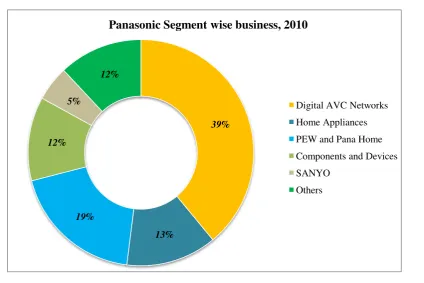
appliances, to industrial solutions and other consumer electronic products. Each company has its distinct R&D, production, and sales functions that satisfy specific consumer needs worldwide. The Panasonic brand name was created in 1955 and was first used as a brand for audio speakers. It is a combination of the words, "Pan", and "Sonic", sound and has a meaning of bringing sound that creates in the world. It was found in 1918 and incorporated in 1935. At present, it has 634 consolidate companies and 366,937 employee bases. For the year ended 2010, it generated 12% of sales from America, Europe 11%, Asia & China 23% and Japan 54%. Figure 3&4 shows Panasonic’s various segments and its turnover for 2010.
Insert Figure 3 about here
Insert Figure 4 about here
The History of Konosuke Matsushita and Panasonic
Panasonic founder Konosuke Matsushita was born on November 27, 1894 in Wasamura, a farming village that is now part of Wakayama City. His father was a small landowner and prominent member of the community, and Konosuke, the youngest of eight children, enjoyed a comfortable early childhood. But the family's fortunes turned when his father lost his property as a result of poor speculation on the commodities market, and the family was forced to leave their farm and move to a small house in the city.
GLIMPSES OF ELECTRONICS INDUSTRY
The electronics industry has been an important driver of Asian growth and development, creating millions of jobs. Since 1960s, western electronics firms began moving their operations to Asia to avail the region’s low-cost manual labor. In the decades, those initial investments have blossomed, turning Asia into an industrialized powerhouse that now produces two-thirds of the world’s electronic products (The Economist, 2011). The electronics industry in Southeast Asia has developed considerably in the second half of the twentieth century (Tilley and Williams, 1997).
In particular, 16 countries occupied around 63% of the global electronics market and 67% of production, namely Australia, Brazil, Canada, China, India, Indonesia, Israel, Japan, Malaysia, Philippines, Singapore, South Africa, South Korea, Taiwan, Thailand and USA. According to Reed Electronics Research, UK, there are 107 major companies have been identified with TV manufacturing or assembly locations in Asia. Generally, Chinese manufacturers dominate in terms of actual numbers, although only a few companies have established a major global presence, while other Asian companies outside of Japan, have remained relatively small.
Excluding Japan, China now dominates the Asian electronics industry accounting for around 48% of production in 2008, up from 30% seven years earlier. Despite rising labor costs, China is still seen as the preferred location for overseas companies, while local manufacturers ramp up production to meet global demand and the surging domestic market. Nevertheless, other Asian countries do have significant electronics industries with South Korea, Taiwan, Malaysia and Singapore all playing an important role within the global market (Reed Electronics Research). The global LED light market is estimated at over €1 billion and is expected to touch €12 billion by 2015. According to Euro news division, Samsung is the leading company in 18.7% of market share in the global flat TV market; further LG captures 13.1%, Sony 10.3% and Philips with 4.1% stands in the seventh position.
and Panasonic rounded out the top five in the fourth quarter of 2010 with 10.4%, 8.8%, and 6.6% market share respectively.
Philips was one of the mass-market European television manufacturers which is now dominated by Germany's Loewe AG and Denmark's Bang & Olufsen AS. Philips, though, struggled to compete with Asian manufacturers such as Samsung and LG Electronics. Heading for its fifth consecutive annual loss, the television subsidiary has suffered as Sony Corp and Panasonic Corp cut prices to combat local Chinese suppliers. Once unrivaled, Japan's consumer electronics firms are facing increasing competition from cheaper Korean and Chinese producers. Figure 5 portrays the market demand for household audio and video equipments in Asia.
Insert Figure 5 about here
Challenges & Opportunities
The Asia-Pacific electronics industry has been built primarily on foreign investment and many countries are finding it increasingly difficult to compete with Chinese products, exclusively in low-cost assembly. However, Greater China will also face increasing pressures including escalating wages and potentially increased competition from other low-cost locations.
Starting from a base of limited industrialization in 1945, these countries can now boast some of the largest and most advanced electronics production facilities in the world, Taiwan, Singapore, Malaysia, Mainland China, and Hong Kong. These Countries begin with labor-intensive tasks, and gradually move into making goods that are both capitals-labor-intensive and knowledge-intensive (Tilley and Williams, 1997).
In the context of marketing, consumerism in Asia is elevated because of rising income levels. While, that is positive when it comes to selling goods and services, it also means that labor costs are climbing (The Economist, 2011). On the other hand, Asia’s rapid economic growth
CONCLUSION
In the early days, Western companies dump their investment, technology and human skills in third world nations, say the Asian region for self earnings. After five decades, the inventiveness and the surge in income levels route causes the spur in the Asia region, like India, China, Korea, Singapore, Malaysia and South-East Asian countries. This could be observed at the footstep in the success of techno-electronics business. Now, Chinese and Korean companies have become the leading production hub for electronic goods in the world. This is due to the availability of cheap, hard working and most importantly skilled labor. Further, competition has intensified between Western and Asian enterprises. It has been proven by the recent announcement of Philips sell-off cum joint venture with TPV Technology and Panasonic’s restructure and merging global operations tactics. These two companies adopted analogous strategies to keep their presence in Asia. In a nutshell, both are planning to reshuffle and judicious their policies comparatively with Asian contenders.
Figure 1: Philips Group Business
Figure 2: Philips Group Business Sales, 2008-10
Philips Health Care Imaging systems Home healthcare Clinical care systems Healthcare informatics Customer serivices Consumer Life style Health & Wellness Domestic appliances Coffee Machines Personal care Audio/Video Accessories Lighting Lamps Professional Luminaires Home Luminaires Lighting electronics Automotive Solid state modules Lumileds Special Lighting Group Management
Healthcare Consumer Lifestyle
of which
Television Lighting
Group Management
& Services
Total sales
2008 7649 10889 4724 7362 485 26385
2009 7839 8467 3122 6546 337 23189
2010 8601 8906 3155 7552 360 25419
0 5000 10000 15000 20000 25000 30000 (Mil lio n s o f E u ro s)
Philips Group Business Sales, 2008-10
2008
2009
Figure 3: Panasonic Segment-wise Business
Figure 4: Panasonic Segment-wise Business Sales, 2010
Panasonic
Digital AVC Networks
AVC
Systems & Communications
Automotive Electronics
Home Appliances
Household Equipment
Lighting
Environmental Systems
PEW & PanaHome
Components & Devices
Semiconductors
Batteries
Electronic components
SANYO
39%
13% 19%
12% 5%
12%
Panasonic Segment wise business, 2010
Digital AVC Networks
Home Appliances
PEW and Pana Home
Components and Devices
SANYO
[image:13.595.93.518.376.659.2]Figure 5: Market demand for household audio and video equipment in Asia, 2000-14
Annexure I: Philips Financials (Millions of Euros)
2008 2009 2010
Sales 26,385 23,189 25,419
EBITA 744 1,050 2,552
as a % of sales 2.8 4.5 10.0
EBIT 54 614 2,065
as a % of sales 0.2 2.6 8.1
Net income (loss) (92) 424 1,452
per common share in Euros
- basic (0.09) 0.46 1.54
- diluted (0.09) 0.46 1.53
Net operating capital (NOC) 14,069 12,649 12,071
Turnover rate of NOC 1.72 1.79 1.91
Free cash flows 773 863 1,333
Shareholders' equity 15,544 14,595 15,046
Market Capitalization 12765 19170 21705
Dividend per share 0.70 0.70 0.70
P/E ratio -153.67 45.14 14.88
No of Employees 121,398 115,924 119,001
Annexure II: Panasonic Financials (Millions of Yen)
2008 2009 2010
Net sales 9,068,928 7,765,507 7,417,980
Operating profit (loss) 519,481 72,873 190,453
Operating profit (loss)/sales 5.7% 0.9% 2.6%
Income (loss) before income taxes 434,993 (382,634) (29,315)
Net income (loss) 310,514 (403,843) (170,667)
Net income (loss) attributable to Panasonic 281,877 (378,961) (103,465)
Capital investment 449,348 494,368 385,489
Depreciation 282,102 325,835 251,839
R&D expenditures 554,538 517,913 476,903
R&D expenditures/sales 6.1% 6.7% 6.4%
Panasonic corporation shareholders' equity 3,742,329 2,783,980 2,792,488
Cash dividends per share 32.50 40.00 12.50
ROE 7.4% (11.8)% (3.7)%
ROA 3.7% (5.5)% (1.4)%
Number of employees 305,828 292,250 384,586
Source: Panasonic Annual report, 2010
Annexure III: Panasonic - History
1894 From birth to the founding of the company
1918 Panasonic launched
1923 Bullet-shaped bicycle lamp developed and marketed
1927 Square bicycle lamp developed and marketed
1931 Radio production started
1933 Motor development and production launched
1935 A trading company established
1951-54 Sales and finance companies established
1956 Beginning of the home appliance era
1959 Establishment of Matsushita Electric Corporation of America (MECA)
1961 Overseas manufacturing rapidly built-up
1961 A company organized with Konosuke Matsushita as chairman and
Masaharu Matsushita as president
1960-65 Establishment of Corporate Special Equipment Sales and Corporate
Housing Equipment Sales Divisions
1963 The service Division established
1971 Panasonic shares traded on NYSE Nixon
1989 Death of company founder Konosuke Matsushita
Annexure IV: Philips - History
1891 – 1915
Philips began by making carbon-filament lamps and, by the turn of the century, was one of the largest producers in Europe. In 1914 it established a research laboratory to study physical and chemical phenomena and stimulate product innovation.
1915 – 1925
In 1918, Philips introduced a medical X-ray tube. This marked the beginning
of the diversification of the company’s product range and the moment when it
began to protect its innovations with patents in areas stretching from X-ray radiation to radio reception.
1925 – 1940
In 1925, Philips became involved in the first experiments in television and, in 1927, began producing radios. By 1932, Philips had sold one million of them
and had become the world’s largest radio producer. By 1939, when it
launched the first Philips electric shaver, the company employed 45,000 people worldwide.
1940 – 1970
Science and technology underwent tremendous development in the 1940s and laying down the basis for later ground-breaking work in transistors and integrated circuits. The company also made major contributions to the development of the recording, transmission and reproduction of television pictures. In 1963, it introduced the Compact Audio Cassette. In 1965, it produced its first integrated circuits.
1970 – 1980
These led to the inventions of the laser vision optical disc, the Compact Disc and optical telecommunication systems. In 1972, the company co-founded PolyGram, the enormously successful music recording label. In 1974, it acquired Magnavox and Signetic in 1975, both in the United States.
1980 – 1990
In 1983 Philips came with a technological landmark: the launch of the Compact Disc. Other milestones of the time included the production of Philips' 100-millionth TV set in 1984. The business expanded in the 1980s through the acquisitions of GTE Sylvania's television concern and Westinghouse's lamps business.
1990 – 2000
In 1997 Philips cooperated with Sony to introduce another innovation, DVD that became the fastest growing home electronics product in history.
21st Century
Health & Wellness
Exhibit 1: Competitor’s Financial facts and Accounting ratios
Koninklijke
Philips Electronics
Panasonic Electrolux Sony
Corporation
General Electric
Industry: Electronic Equipment Market Cap
($ billions)
22.54 25.05 13.13 26.72 194.93 113.55*
Qtrly Rev Growth (yoy)
5.50% -7.20% -6.80% -7.80% -2.90% 9.30%
Revenue 36.66 107.84 16.39 89.09 149.18 111.88*
Gross Margin 37.87% 26.50% 21.50% 23.38% 36.39% 29.18%
EBITDA ($ billions)
4.75 8.34 1.36 5.97 28.62 14.01*
Operating Margin
8.44% 3.51% 5.61% 2.99% 11.41% 7.02%
Net Income ($ billions)
2.11 918.25* 554.93* -3.22 13.43 -
EPS 2.07 0.44 1.94 -3.21 1.2 0.16
P/E 11.49 27.25 23.78 - 15.33 13.09
Employees 117,246 366,937 50,665 - 287,000 661
Exhibit 2: Share price and Index value for both cases during pre- and post-announcement period
Philips (in US $) NYSE: World Leaders Index Panasonic (in US $) NYSE: World Leaders Index
Date High Low Close High Low Close Date High Low Close High Low Close
01-04-11 32.5 32.12 32.44 5901.36 5839.82 5884.88 12-04-11 12.01 11.92 11.96 5896.62 5813.43 5835.56 04-04-11 31.83 31.58 31.71 5910.16 5880.16 5894.27 13-04-11 12.13 12.02 12.06 5877.31 5819.77 5836.29 05-04-11 31.38 31.01 31.35 5911.57 5871.27 5895.44 14-04-11 12.19 12.05 12.19 5850.82 5788.98 5841.17
06-04-11 31.46 31.33 31.4 5926.67 5895.42 5916.69 15-04-11 12.23 12.11 12.13 5863.13 5825.39 5850.97 07-04-11 31.63 31.26 31.45 5932.16 5880.84 5908.53 18-04-11 12.09 11.91 12.07 5850.97 5708.54 5762.61 08-04-11 31.84 31.42 31.51 5950.63 5895.52 5917.85 19-04-11 12.17 11.99 12.06 5802.6 5762.53 5801.52 11-04-11 31.6 31.27 31.36 5943.34 5880.91 5896.62 20-04-11 12.13 12.03 12.04 5900.11 5801.52 5889.35 12-04-11 31.02 30.67 30.91 5896.62 5813.43 5835.56 21-04-11 12.17 12.04 12.08 5925.21 5762.61 5920.41
13-04-11 31.28 30.88 31.04 5877.31 5819.77 5836.29 25-04-11 12.15 12.07 12.14 5921.9 5891.14 5906.77 14-04-11 31.04 30.49 30.98 5850.82 5788.98 5841.17 26-04-11 12.14 12.01 12.08 5962.54 5906.77 5955.66 15-04-11 30.81 30.22 30.59 5863.13 5825.39 5850.97 27-04-11 12.03 11.88 11.93 6005.19 5932.77 5996.24 18-04-11 29.98 29.39 29.89 5850.97 5708.54 5762.61 28-04-11 12.49 12.05 12.38 6019.67 5982.92 6015.77
19-04-11 29.37 29.02 29.31 5802.6 5762.53 5801.52 29-04-11 12.37 12.29 12.29 6042.45 6010.12 6037.73 20-04-11 29.88 29.47 29.62 5900.11 5801.52 5889.35 02-05-11 12.67 12.49 12.51 6074.66 6015.45 6026.87 21-04-11 29.42 29.16 29.29 5925.21 5762.61 5920.41 03-05-11 12.56 12.43 12.5 6026.87 5954.65 5986.52
25-04-11 29.38 29.13 29.27 5921.9 5891.14 5906.77 04-05-11 12.49 12.35 12.41 5986.57 5910.87 5933.77 26-04-11 29.69 29.43 29.63 5962.54 5906.77 5955.66 05-05-11 12.45 12.32 12.38 5933.77 5807.73 5837.1 27-04-11 30.01 29.47 29.99 6005.19 5932.77 5996.24 06-05-11 12.54 12.3 12.35 5925.24 5829.17 5854.85 28-04-11 29.9 29.63 29.86 6019.67 5982.92 6015.77 09-05-11 12.55 12.43 12.5 5896.22 5837.1 5885.48 29-04-11 29.69 29.49 29.49 6042.45 6010.12 6037.73 10-05-11 12.51 12.39 12.45 5939.75 5885.48 5930.23
02-05-11 30.1 29.76 29.83 6074.66 6015.45 6026.87 11-05-11 12.34 12.21 12.25 5930.23 5819.23 5841.59 03-05-11 30.61 30.28 30.53 6026.87 5954.65 5986.52 12-05-11 12.29 12.14 12.25 5875.02 5786.61 5860.84 04-05-11 30.57 30.16 30.29 5986.57 5910.87 5933.77 13-05-11 12.18 11.91 11.93 5861.49 5771.99 5800.38
SYNOPSIS OF THE CASE
To meet international business obligations and prepare students to craft combat strategies for achieving translational entity’s objectives, the present case aims to describe Asian electronics market, evidencing the reality of competitive environment between western and emerging firms and presents the profile of Philips and Panasonic as a leaflet for the case issues. Practically, the case falls in the domain of Business Strategy and Multinational Management, mainly it focuses on international environment and inorganic strategies. Further, we present additional information in regard to stock performance against market indices during announcement of news in the media and financial facts & accounting ratios. Interestingly, we portray competitor’s financials and figures for comparative analysis.
Supplementary data for case analysis
History – Philips and Panasonic (To understand historical product and business nature) Competitors Financials (Industry comparison)
Share price and Market Indices (To know the effect of announcement on stock earnings) Teaching Note (For Case instructors)
- Learning objectives of the case
- Case overview
- Teaching Pedagogy/Plan
- Discussions & Questions
- Case analysis
-
Case feedbackTEACHING NOTE
FRAMEWORK OF THE TEACHING NOTE
To understand, examine and discuss the given case, we present domain area of the case in section 1, section 2 reports instructions to the case instructors, section 3 describes case learning objectives, case overview depicts in section 4, section 5 suggest teaching pedagogy. Finally, section 6 analyzes & concludes the case. Further, we recommend faculty to take feedback from the students and ask faculty to review and evaluate themselves for an auxiliary improvement in the teaching pedagogy.
CASE DEVELOPMENT
At the outset, I wish to introduce the development of the case material. This case was developed based on archival sources rooted in the Reddy’s Test-Tube case study research design (see Reddy, 2015a, 2015d; Reddy & Agrawal, 2012). A major list of archival sources includes newspapers, company official documents, annual reports, and media highlights such as The Economist. As a case instructor, I suggest readers to read some standard textbooks on mergers and corporate restructuring activities, and also research papers related to the case problems and issues (see, for example, Reddy, 2014; 2015b).
1. DOMAIN AREA OF THE CASE
This management case is designed to explicit the implied connection between the business environment, competitive & industry forces (Porter, 1987), business strategy and leadership tactics. In a nutshell, it imparts the domain knowledge of inorganic strategies, like joint ventures, mergers, acquisitions and sell-offs against host market players by home based leaders, which, in order to keep their global presence and brand loyalty in the emerging markets (Reddy, 2014). From the marketing and general management perspective, it aims to feed the competitive and generic strategies that have been adopted by local adopters against global innovators and their post-strategies respectively. Finally, Philips-Panasonic case seems to be a half-boiled and the remaining would be filled by the following lecturer’s note.
Domain knowledge: Business Policy and Strategy
Inorganic Opportunities
Focus part:
Joint ventures; Equity acquisition; Sell-offs
For whom:
BBA; MBA (Full-time and Executive); MDP’s
Estimated time for discussion: 120 minutes
Method of lecture:
Brainstorming; Group Participation
2. INSTRUCTIONS TO THE CASE INSTRUCTORS
The case should be discussed with the suggestion of instructing the students to go through following reading material or concepts in the electives.
- International Business Environment – Internal & External factors, SWOT analysis
- International Management
- Business Policy & Strategy – Organic and Inorganic strategies
- Motives behind Inorganic strategies
It is suggested that case should be first analyzed with respect to theoretical framework as presented in the above reading material. After this, students should be given suggested assignment questions which can be submitted as written assignment or can be discussed in the lecture theatre. For fulltime MBA audiences the distinction should be on an integrated plan for the two businesses and provide the simple numerical analysis for students, so that they can focus on post diversification strategy and modeling action plans.
This case has been written to illustrate strategic issues and provoke discussion of these issues rather than as a vehicle for extensive quantitative analyses. A set of indicative questions are included at the end of teaching note. They are not necessary the only appropriate questions. It is suggestible that the questions at the end can be read before you start as a guide to the issues, while reading the case it may help you in quickly understanding the case and learning outcome. We, authors invite you to analyze the facts & issues for yourself and to come-up with your own recommendations.
The case is developed to impart knowledge of strategy and international management. Business Policy and Strategy Discipline
To know the importance of strategic choices on international operations, i.e. organic and inorganic growth opportunities
In a narrow sense, understand the differences and synergies between joint ventures, mergers and sell-offs
Similarity among industry, competitive forces by multinationals and host country firms, i.e. local players
Role of Chief Executive Officer/Top Officials in the strategic planning.
International Management/Integrative/General
Management of international business operations, such as cost cutting through layoffs and single hub locations
In a close shot, brand appearance in the host competition through sale of equity stake to the rivalry
Strategies to be kept through in the international dominance and evidence from Philips-Panasonic
To examine the competitors facts and figures
To critically analyze the impact of announcement of news in media on Philips and Panasonic stock earnings
4. GENERAL AND CASE OVERVIEW
We now know that the “World is flat” and “Knowledge is borderless”. As such, the economic changes are bound to be rapid. Complexity and disparity are likely to be major factors worrying the world leaders and global institutions. Consequently, the present cross-country and multinational strategic case is aimed to describe the application of inorganic choices (joint ventures, mergers, acquisitions and sell-offs, etc.) through Philips – Panasonic two fold tactical approach. Theoretically, an acquisition, merger or joint venture is likely to take place when an organization lacks a key success factor for a particular market (Thompson, 2001). Excluding Japan, China is dominating the Asian electronics industry and occupied around 48% of production in 2008, where it was 30% seven years earlier. In spite of rising labor costs, China is still seen as the favored spot for western companies, while local manufacturers ramp up their production to meet the universal demand and the progressing domestic market.
creating bulk employment and supporting the erection of essential infrastructure. In a nutshell, the present case discusses overview of Asian electronics industry, Philips-Panasonic swift strategies to presence themselves as brand loyalties in the business cosmos.
Amsterdam-based company Philips wants to unload 70% of its loss-making TV business and contracted 30/70 joint venture with Chinese maker TPV. It has congregated up losses of almost €1bn, since 2007. After continuing losses, Philips determined to sell a majority stake in its television division. A newly appointed CEO, Frans van Houten has implemented a plan to relinquish control of the TV business to TPV, a Hong Kong-based monitor maker that controls 33% of the global computer monitor market. Philips will retain a 30% stake in the TV division and would receive royalty payments of $70mn a year. Further, 4000 Philips employees would be moving to TPV. Japanese conglomerated and multinational firm, Panasonic Corporation had about 350 manufacturing bases around the world and would be looking to merge operations where it could. They also intend to sever the number of manufacturing bases by 10 to 20%. Consequently, it would be cutting another 17000 jobs around the world over the next two years. Philips would be receiving a benefit in the form of royalty; conversely Panasonic could re-plan their worldwide functions through lay-off for strategic cost advantage.
5.0. TEACHING PEDAGOGY
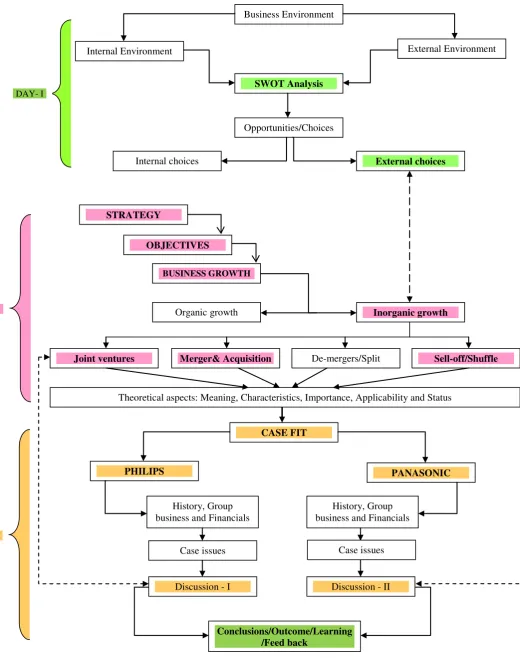
The simplest way of teaching management/business case is to avoid unwanted theory, notes and over discussion. So, it is suggested to accommodate the case while preparing teaching or session plan for the next semester. Figure TN-1 presents the flowchart to guide some valuable principles for case discussion and participation by the instructors, though these are not limited to anyone.
[image:24.595.39.560.87.754.2]
Figure TN-1: Teaching Plan
Business Environment
Internal Environment External Environment
SWOT Analysis
Internal choices
Opportunities/Choices
External choices
Inorganic growth
Theoretical aspects: Meaning, Characteristics, Importance, Applicability and Status
STRATEGY
BUSINESS GROWTH OBJECTIVES
Organic growth
Joint ventures Merger& Acquisition De-mergers/Split Sell-off/Shuffle option
CASE FIT
PHILIPS
History, Group business and Financials
PANASONIC
Case issues Case issues
Discussion - I Discussion - II
Conclusions/Outcome/Learning /Feed back
History, Group business and Financials
DAY- I
DAY- II
5.1. DISCUSSIONS AND QUESTIONS
5.1a. Are Philips and Panasonic facing similar type of reasons behind their
restructuring mechanism?
The question is molded in a broad perspective to recognize, classify, analyze and their motive behind the deals or contracts. A student can be understood why both companies have been chosen these restructuring strategy and at what stage? On the other hand, this question gives an opportunity and it show narrow gaze for broad thinking in case analysis. We suggest instructors to go through the prescribed textbook for theoretical background (Weston et al., 1998) and compare the present case reasons with any previous case(s). In addition, I also suggest readers to understand the market performance of cross-border mergers and acquisitions in the world economy around the 2007-2008 global financial crisis, both country, industry and continent patterns (see Rao & Reddy, 2015; Reddy et al., 2014b).
5.1b. How the new joint venture between Philips and TPV do helps Philips to achieve
their global vision and its impact on the brand image and financial numbers?
This creates a breaking point ‘WHY’ and ‘WHAT FOR’ in the given case. The lecturer must discuss growth opportunities of a firm in the multinational context. Because the answer for this query mainly depends upon theoretical map and it will assist in identifying most attractive motive factors in Philips strategic blueprint of joint venture with TPV. The students shall list out various motive factors behind the Philips tactic and their impact on reputation.
5.1c. How extreme the conception of “Merging manufacturing by shutting down the
assembling firms” puts Panasonic growth and what synergy benefits would be getting
through it?
This is an integrated inquiry and investigation of complete historical perspective, vision, and business growth of Panasonic Corporation. The students would be getting inputs from this query that why Panasonic wants to merge or shuffle their global manufacturing/assembling operations and what would be the strong reasons behind their surprising announcement. Further, what can be done to stimulate the things at international level?
5.1d. Differentiate leadership strategies and approaches between Philips and
Panasonic?
Philips as well as option of shuffle strategies by Panasonic. It can be explain with appropriate conjectural note on strategic leadership.
5.1e. Prepare a detailed report on the competitor analysis in the global electronics
market and comment on the present case by linking the report?
To make this analysis and do some valuation report, please refer to Nangia et al., 2011a; Reddy et al., 2013a; Reddy et al., 2013b).
6. CASE ANALYSIS
This case is articulated to focus on inorganic opportunities chosen by global transnational companies for enhancing business growth and thus to sustain in the competitive environment. The case analysis is staged in respect of theoretical, facts and figures presented in the case. Principally, we focus on central investigation and outcome of the case, further it is extended to interpret the empirical results on the stock earnings of Philips and Panasonic.
In the liberalization, privatization and globalization (LPG) era, inorganic choices become a buzzword in the corporate world. On one hand organizations trying to build customer loyalty, brand recognition and reputation value; on the other hand growing importance of shuffle, sell-offs, joint ventures and restructuring activities for long term sustainable growth. To achieve this, top level management plays a vital role in designing combat strategies in this competitive milieu. Philips CEO, Frans van Houten, a strategic restructuring expert has chosen the joint venture option against sell-off or merger to keep their brand presence in the Asian electronics market. In a nutshell, once upon a time this market has dominated by western players like Sony, GE, Thomson, Philips and Panasonic, etc. but, now the shift is transferring to domestic players in the Asian countries, China, Korea and India. This momentum is not only due to the availability of cheap labor, other factors include people motivation towards learning, achievement and inspiration by domestic corporate riders. Though, Philips does not want to leave the TV business since they are obliging themselves to remain in the existing markets through various options like technical collaboration, management contracts, acquisitions and alliance. These choices keep the organizations alive and improve financial members.
vision to achieve the synergetic cost advantage. Presently, they have 634 consolidated manufacturing and assembling firms throughout the globe. First, they have chosen to close or sell-off virtually 70 factories, and then it conversely impacts on employee layoff, i.e. they would be cutting nearly 17000 jobs in the next two years. Largely, this is due to an increase in the production & maintenance cost and employee pay and then preferred ‘shuffle strategy’ to close loss making units or sell-off some units to integrate and build international manufacturing hubs at select locations. If they could have continued, it would be largely impacts on accounting numbers. Though, they woke up early and have picked the right coined decision, on the other hand crafting Panasonic to remain in the market for continue growth and sustainable business in the long-run.
Finally, the strategies applied or would be applying by Philips and Panasonic respectively will improve their balance sheet, conversely they can maintain the current market share in the global electronics industry (refer “Exhibit 1: Competitor’s facts and figures” in the given case). We suggest faculty to go through the ‘solution for the given assignment’ in the next
section for supplementary information on the stock earnings during pre- and post- announcement of news in the media. It provides strong base for case discussion from the shareholders perspective and their reaction against market indices.
CASE FEEDBACK
In addition to this, the faculty has to thoroughly prepare and underlines some key points. These points will be discussed in the case analysis as a concrete story. After the case presentation, students asked to fill their opinion regarding learning outcome on the given feedback form in five point Likert scale. This report helps faculty member while selecting case studies for the next semester teaching plan and the progress in teaching strategy that leads to career advancement.
Case Feedback Form
S. No. Factor Likert Scale
Very poor Poor Average Good Excellent
1 Case title
2 Relevancy of the subject
3 Case learning
4 Case inputs to the students
5 Strategic perspective
7 Marketing outlook
8 Overall opinion on the case
9 Practicality and decision
10 Teaching note/style
POST-FEEDBACK
I would suggest case instructors to provide some relevant cases to the students, then ask them to do case analysis and cross-analysis across sample cases. As an example, I would suggest other two interesting cases, such as broken Bharti Airtel-MTN cross-border telecom merger deal between India and South Africa (Reddy et al., 2012), and delayed inbound cross-border acquisition between Vedanta and Cairn India (Nangia et al., 2011b). After reading these cases, students would better understand how to do single case analysis using some relevant literature, for example, Vodafone-Hutchison tax litigation deal in India (Reddy et al., 2014a), and importantly, how to do cross-case analysis using two or more cases (see Reddy, 2015c).
REFERENCES
Bloomberg (2011), “Philips Cedes Control of TV Unit after Losses Crimp Profit”, April, 18.
Available at: http://news.businessweek.com/article.asp?documentKey=1377-ah49Ii
GbbdBw-30TMRGCNP0QDO0L9N6DH8TMQ48
China Financial Daily (2011), “Panasonic layoffs: Matsushita confirmed to lay off 17,000 people or close
70 factories”, April, 29. Available at: http://www.chinafinancialdaily.com
/financial/news/2011/04/29/14114/matsushita-layoffs-matsushita-confirmed-to-lay-off-17000-people-or-close-70-factories.html
CNET (2011), “Philips to cede majority stake in TV business”. Available at:
http://news.cnet.com/8301-13506_3-20054867-17.html#ixzz1LHGZ1vMm
Euro news (2011), “Philips in Chinese TV joint venture”, April, 18. Available at: http://www.euronews.net/2011/04/18/philips-in-joint-venture-with-chinese-to-make-tvs/
Hales, S., (2011), “Philips sell off majority of TV business”, April, 21. Available at:
http://www.connectedaustralia.com/News/GlobalNews/tabid/120/ArticleId/5297/Philips-sell-off-majority-of-TV-business.aspx
HDTVHD (2011), “Philips is giving up majority control of its HDTV business”. Available at:
http://hdtvhd.com/philips-to-cede-majority-stake-in-tv-business/
Highdefdigest (2011), “Philips Sells its HDTV Business to TPV Technology”, April, 19. Available at:
http://www.highdefdigest.com/news/show/TPV_Technology/Philips /Philips_ Sells_ its_
Hindustan times (2011), “Panasonic to axe another 17,000 jobs, may close dozens of plants”, April, 28. Available at:
http://www.hindustantimes.com/Panasonic-to-axe-another-17-000-jobs-may-close-dozens-of-plants/Article1-690842.aspx
Kevin J. Tilley and David J. Williams (1997), “An Assessment of the Electronics Industry in Southeast Asia”, IEEE Transactions on Components, Packaging, and Manufacturing Technology—Part C, Vol. 20, No. 4, October, pp. 230-234.
Nangia, V. K., Agrawal, R., & Reddy, K. S. (2011a). Business valuation: modelling forecasting
hurdle rate. Asian Journal of Finance & Accounting, 3(1), 86-102.
Nangia, V. K., Agarawal, R., Sharma, V., & Reddy, K.S. (2011b). Conglomerate diversification
through cross-continent acquisition: Vedanta weds Cairn India. Emerald Emerging Markets Case Studies, 1(1), 1-15.
Panasonic profile (2011), “History and business of Panasonic”. Available at: www.panasonic.com; www.panasonic.co.in
Philips profile (2011), “History and group business of Philips”. Available at: www.philips.com; www.india.philips.com
Rao, N. V., & Reddy, K. S. (2015). The impact of the global financial crisis on cross-border mergers
and acquisitions: a continental and industry analysis. Eurasian Business Review, 5(2), 309-341.
Reddy, K. S. (2014). Extant reviews on entry-mode/internationalization, mergers & acquisitions, and
diversification: Understanding theories and establishing interdisciplinary research. Pacific Science Review, 16(4), 250-274.
Reddy, K. S. (2015a). Beating the Odds! Build theory from emerging markets phenomenon and the
emergence of case study research—A “Test-Tube” typology. Cogent Business & Management, 2(1), 1037225.
Reddy, K. S. (2015b). Determinants of Cross-border Mergers and Acquisitions: A Comprehensive Review and Future Direction. https://mpra.ub.uni-muenchen.de/63969/1/MPRA_paper_63969.pdf
Reddy, K. S. (2015c). Revisiting and reinforcing the Farmers Fox theory: A study (test) of three cases in cross-border inbound acquisitions. https://mpra.ub.uni-muenchen.de/63561/1/MPRA_paper_63561.pdf
Reddy, K. S. (2015d). The state of case study approach in mergers and acquisitions literature: A
bibliometric analysis. Future Business Journal, 1(1), 13-34.
Reddy, K. S., & Agrawal, R. (2012). Designing case studies from secondary sources–A conceptual
framework. International Management Review, 8(2), 63-70.
Reddy, K. S., Nangia, V. K., & Agrawal, R. (2012). Mysterious broken cross-country M&A deal:
Reddy, K.S., Nangia, V. K., & Agrawal, R. (2013a). Corporate mergers and financial performance: a
new assessment of Indian cases. Nankai Business Review International, 4(2), 107-129. Reddy, K.S., Agrawal, R., & Nangia, V. K. (2013b). Reengineering, crafting and comparing business
valuation models-the advisory exemplar. International Journal of Commerce and Management, 23(3), 216-241.
Reddy, K. S., Nangia, V. K., & Agrawal, R. (2014a). Farmers Fox Theory: does a country's weak
regulatory system benefit both the acquirer and the target firm? Evidence from
Vodafone-Hutchison deal. International Strategic Management Review, 2(1), 56-67.
Reddy, K. S., Nangia, V. K., & Agrawal, R. (2014b). The 2007–2008 Global Financial Crisis, and
Cross-border Mergers and Acquisitions A 26-nation Exploratory Study. Global Journal of Emerging Market Economies, 6(3), 257-281.
Reed Electronics Research, Oxon, UK, available at: http://www.rer.co.uk/emf/asia.shtml
Reuters (2011), “Philips sells majority stake of TV business”, April, 18. Available
at:http://www.thisismoney.co.uk/markets/article.html?in_article_id=530780&in_page_id=3
#ixzz1LGm46vxs
Reuters (2011), “10-Panasonic to axe thousands of jobs, close dozens of plants”, April, 28. Available at: http://uk.reuters.com/article/2011/04/28/panasonic-idUKL3E7FS03A2 0110428
Taipei times (2011), “Philips unloads its television business”, April, 19 (p. 10). Available at:
http://www.taipeitimes.com/News/biz/archives/2011/04/19/2003501 106
The Economic Times (2011), “Panasonic to cut 40,000 workers on cost-cutting drive”, April, 28. Available at: http://articles.economictimes.indiatimes.com/2011-04-28/news
/29482953_1_panasonic-corp-president-fumio-ohtsubo-panasonic-electric-works
The Economic Times (2011), “Panasonic to cut 17,000 jobs; may close 70 factories”, April, 29.
Available at: http://articles.economictimes.indiatimes.com/2011-04-29/news/ 29487203_
1_viera-tvs-fumio-ohtsubo-panasonic-electric-works
The Economist (2011), “Rising consumption, rising influence - How Asian consumerism will reshape the global electronics industry”, The Economist Intelligence Unit Limited.
The Hindu (2011), “Philips on the lookout for acquisitions in Asia-Pacific”, January, 28 (Friday).
Times of Oman (2011), “Philips to hive off TV unit after losses”, April, 19. Available at:
http://www.timesofoman.com/innercat.asp?cat=8&detail=43538
Ireland, R.D., Hoskisson, R.E. and Hitt, M.A (2008), “Strategic Management”, India edition, New Delhi: Cengage.
Thompson, J. L. (2001), “Strategic Management”, Fourth edition, London: Thomson Learning.
Trautwein, F., (1990), “Merger motives and Merger perceptions”, Strategic Management Journal, Vol. 11, No. 4, pp. 283-295.
Weston, J.F., Chung, K.S. and Hoag, S.E. (1998), “Mergers, Restructuring and Corporate control”,