Munich Personal RePEc Archive
Oligarchy and soft incompleteness
Piggins, Ashley and Duddy, Conal
NUI Galway, NUI Galway
2016
Oligarchy and soft incompleteness
∗
Conal Duddy
†and Ashley Piggins
‡May 11, 2016
Abstract
The assumption that the social preference relation is complete is
demand-ing. We distinguish between “hard” and “soft” incompleteness, and explore
the social choice implications of the latter. Under soft incompleteness,
so-cial preferences can take values in the unit interval. We motivate interest in
soft incompleteness by presenting a version of the strong Pareto rule that
is suited to the context of a [0,1]-valued social preference relation. Using a
novel approach to the quasi-transitivity of this relation we prove a general
oligarchy theorem. Our framework allows us to make a distinction between
a “strong” and a “weak” oligarchy, and our theorem identifies when the
oli-garchy must be strong and when it can be weak. Weak olioli-garchy need not be
undesirable.
∗Financial support from the Irish Research Council for the Humanities and Social Sciences
co-funding from the European Commission, and from the Spanish Ministry of Economy and Competitiveness through MEC/FEDER grant ECO2013-44483-P is gratefully acknowledged.
†J.E. Cairnes School of Business and Economics and the Whitaker Institute, National
Uni-versity of Ireland Galway, Ireland. Email: [email protected]
‡Corresponding author. J.E. Cairnes School of Business and Economics and the Whitaker
Keywords: Oligarchy; Gibbard’s theorem; Incompleteness; Max-star
tran-sitivity
JEL Classification: D71
1
Introduction
A social welfare function is a mapping from profiles of individual preference
order-ings (reflexive, transitive and complete binary relations) into a social ordering of
the alternatives. Arrow’s (1951, 1963) impossibility theorem demonstrates that the
only social welfare functions that satisfy unrestricted domain, independence of
ir-relevant alternatives, and the weak Pareto principle are dictatorial.1 One approach
that has been taken to circumvent this negative result is to weaken the requirement
that the social preference relation is an ordering. For example, research has
fo-cussed on weakening the transitivity requirement on the social preference relation
to quasi-transitivity, acyclicity or Suzumura consistency.2 Other work has retained
Arrow’s original transitivity assumption, but dropped the requirement that the
so-cial preference relation is complete. Pioneering contributions have come from Sen
(1969, 1970a), Mas-Colell and Sonnenschein (1972), Plott (1973), Brown (1975),
Blair and Pollak (1982), Weymark (1984), Banks (1995), Bossert and Suzumura
(2008, 2010) and Gibbard (2014).3
1
A thorough survey of impossibility results in the Arrovian framework is Campbell and Kelly (2002).
2
Formal definitions of these concepts can be found in Bossert and Suzumura (2010, chapter 2). Intuitively, a quasi-transitive relation is one where the strict preference relation is transitive, whereas the indifference relation need not be. An acyclic relation is one with no cycles in the strict preference relation. A Suzumura consistent relation rules out not only strict preference cycles, but all cycles that involve at least one strict preference. Acyclicity is the weakest concept of the three. Suzumura consistency and quasi-transitivity are logically independent.
One of the earliest contributions to this literature was provided by Allan
Gib-bard, who proved a celebrated theorem in a paper that remained unpublished
until recently. Gibbard was motivated by what Sen called the Pareto-extension
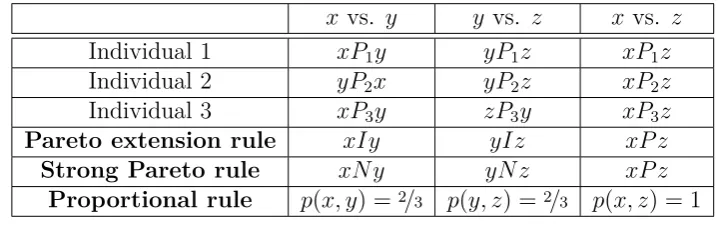
rule (Sen 1969, 1970a). To explain this rule, consider the profile in Table 1.
xvs. y y vs. z x vs. z
Individual 1 xP1y yP1z xP1z Individual 2 yP2x yP2z xP2z Individual 3 xP3y zP3y xP3z
Pareto extension rule xIy yIz xP z Strong Pareto rule xN y yN z xP z
[image:4.595.116.476.201.318.2]Proportional rule p(x, y) = 2/3 p(y, z) =2/3 p(x, z) = 1 Table 1: A profile.
The notation used is standard.4 In Table 1 and throughout this paper,
indi-vidual preferences are taken to be orderings, i.e. reflexive, complete and transitive
binary relations (Sen 1970a, p.8).5
Under both the Pareto extension rule and the strong Pareto rule (Weymark,
1984), whenever everyone strictly prefers one social state to another then so does
society (hence, xP z in the example). The two rules differ whenever there are two individuals with opposing strict preferences. Under the Pareto extension rule,
these disagreements result in social indifference. A consequence of this is that the
weak social preference relation R can be intransitive, i.e. in the example we have
yRxand zRy but not zRx. R is, however, complete. Since individual preferences
4
The primitive concept,R⊆X×X, is a binary relation on a set of social statesX. Writing xRymeans thatxis at least as good asy. Strict preference,P, is defined as∀x, y∈X :xP y↔ [xRy∧ ¬yRx] while indifference, I, is defined as∀x, y∈X : xIy↔[xRy∧yRx]. The relation of non-comparability,N, is defined as∀x, y∈X :xN y ↔[¬xRy∧ ¬yRx]. WritingxN y means thatxandy are not ranked. Subscripts are used to denote individual preference relations. The absence of a subscript denotes a social preference relation.
5Given a binary relationR, reflexivity is defined as:
∀x∈X :xRx. Completeness is defined as:
are assumed to be transitive, under this rule the strict social preference relation
P must be transitive as well.6 In contrast, under the strong Pareto rule, opposing strict preferences result in social non-comparability. This means that R need not be complete under this rule, but it is transitive nonetheless (again, because
individual preferences are assumed to be).
These rules are interesting because they can be placed on a defensible
norma-tive footing. For example, assuming that the social preference relation is reflexive,
quasi-transitive and complete, the Pareto extension rule can be shown to be the
only collective choice rule that satisfies Arrow’s conditions of unrestricted domain,
independence of irrelevant alternatives, a strengthening of Arrow’s Pareto
prin-ciple, and a reasonable anonymity requirement.7 Weymark (1984, Theorem 3)
proves something similar for the strong Pareto rule under the assumption that the
social preference relation is reflexive and transitive, but not necessarily complete
(i.e. it is a quasi-ordering). There is an intuitive sense in which these rules
repre-sent the “closest” Arrovian rules, i.e. they come as near as possible to satisfying
Arrow’s requirements without resulting in a dictatorship.
Of these two complementary approaches to Arrow’s theorem (Sen’s and
Wey-mark’s), Weymark’s is arguably more attractive. Transitivity seems a more
com-pelling assumption about R than completeness. Aumann (1962, p.446) is often quoted in discussions of completeness: “Of all the axioms of utility theory, the
completeness axiom is perhaps the most questionable. Like others of the axioms,
6
In other words,R is quasi-transitive. Quasi-transitivity is defined as: ∀x, y, z∈X : (xP y∧
yP z)→xP z.This formal definition plays a role in the argument that follows. 7
it is inaccurate as a description of real life; but unlike them, we find it hard to
accept even from the normative viewpoint”. Aumann is referring to individual
preferences in this quote, but the argument that social preferences are incomplete
is, if anything, even stronger.8
If the social preference relation is incomplete then there exists a pair of
al-ternatives, x, y ∈ X, such that xN y. As noted in footnote 4, xN y is defined as
¬xRy ∧ ¬yRx which is equivalent to ¬xP y ∧ ¬yP x∧ ¬xIy. In this paper, we call this social non-comparability, “hard” incompleteness. The strong Pareto rule,
characterized by Weymark, is a collective choice rule with hard incompleteness.
Our objective is to present an alternative approach to the social preference
rela-tion that lies in between completeness and hard incompleteness. We call it “soft”
incompleteness and we explore the logical space for collective choice rules opened
up by the possibility of soft incompleteness.9
In order to motivate the idea of soft incompleteness, let us return to the
col-lective choice rules in Table 1. Although the Pareto extension rule and the strong
Pareto rule can be given a normative justification by appealing to a certain social
choice framework, there is something unsatisfactory about them. If just one
per-son holds an opposing strict preference (i.e. there is “virtual” but not “complete”
unanimity on the ranking of a particular pair), then the result is either social
indifference or social non-comparability. Contrast this with what we call the
pro-8
Sen (1970b) himself developed a model involving “partial” comparability of welfare units. This gives rise to an aggregate quasi-ordering that may be incomplete. In philosophy, incom-pleteness is often taken to be a consequence of the “small improvement argument”. For an introduction to this literature, see Chang (1997) and Espinoza (2008).
9
portional rule.10 Letp(x, y) denote the degree to which it is true that xis socially preferred toy. Loosely speaking, under the proportional rule,p(x, y) is determined by the proportion of people who prefer x to y. In this way, we can think of the underlying social preference relation as taking numerical values weakly between 0
and 1.11 Interestingly, the proportional rule is still like the strong Pareto rule; if
everyone prefers x to y then p(x, y) = 1. However, unlike the standard version of this rule, social non-comparability does not follow when there is virtual
unanim-ity. As we see in Table 1, p(x, y) =2/3 when individual 2 holds an opposing strict preference. Moving from unanimity (if individual 2 reverses her x vs. y prefer-ence then p(x, y) = 1) to virtual unanimity still induces a transition in the social preference, but it is intuitively “softer”. In our language, the proportional rule is
a collective choice rule with soft incompleteness. We say that the incompleteness
is “soft” because while it is not true that xis socially preferred to y (p(x, y)<1), it is not false either (p(x, y)>0).12
Despite their differences, the Pareto extension rule, the strong Pareto rule and
the proportional rule share one thing in common. All of them are “oligarchic”
rules (a term that was first used, we believe, in Gibbard’s seminal paper). Under
an oligarchic rule, (i) social preferences respect the unanimous strict preferences
10A formal definition of the proportional rule appears in section 4. 11
The idea that preferences can be numerically valued (or “fuzzy”) has, of course, been con-sidered before. A sample of the literature is Orlovsky (1978), Ovchinnikov (1981), Basu (1984), Billot (1995), Dutta, Panda, Pattanaik (1986), Dutta (1987), Ponsard (1990), Dasgupta and Deb (1991, 1996, 2001), Ovchinnikov and Roubens (1991, 1992) and Banerjee (1993, 1994). Salles (1998) surveys the field. Throughout this paper, we use the words “valued” and “fuzzy” interchangeably.
12
of the oligarchs, and (ii) if any two oligarchs hold opposing strict preferences over
a pair of alternatives then neither can be overruled. Part (i) means that when
the oligarchs act in concert with one another (in terms of their strict preferences)
they can determine the social ranking irrespective of the wishes of everyone else.
In other words, they act as a collective like an Arrovian dictator. Part (ii) means
that each oligarch possesses a “veto” in that xP y is not true when an oligarch prefers y to x. Under the Pareto extension rule, the strong Pareto rule and the proportional rule, the entire society is the oligarchy.
Gibbard writes (2014, p.5), “A liberum veto oligarchy is a terrible way to govern
a large group. If the set of oligarchs is small, the system is as undemocratic as my
name for it suggests, for a small group can get its way whatever anyone outside
the group wants. If the set of oligarchs is large, the system is more democratic
but likely to be paralyzed. Numerous oligarchs will rarely be unanimous, and
when they are not, society will have no preference. In the egalitarian case when
everyone is an “oligarch”, no one’s preference can ever be over-ridden in forming
the social preference, and social decision is paralyzed by the slightest controversy.
Thus, however large or small the set of oligarchs, a liberum veto oligarchy is a
poor system”.
Despite the fact that the proportional rule is oligarchic, each person exercises
only a weak form of veto power, i.e. anyone who prefers x to y can ensure that
p(y, x)<1. However, no one can unilaterally ensure that p(y, x) = 0. The latter can be thought of as reflecting a stronger form of veto power (and this kind of
power is in the hands of all individuals under both the strong Pareto rule and
the Pareto extension rule). The proportional rule is a weakly oligarchic rule, with
a strong oligarchy is central to this paper. The example of the proportional rule
suggests that a large, weak oligarchy is not necessarily undesirable. Intuitively, it
is a less troubling kind of oligarchy than Gibbard’s quote would appear to suggest.
Gibbard’s original oligarchy theorem says that any collective choice rule that
satisfies Arrow’s conditions together with the weaker requirement of a
quasi-transitive social preference relation (in addition to it being reflexive and complete),
must be an oligarchic rule in which the opposing strict preferences of any two
oli-garchs over a pair of alternatives results in social indifference between that pair.13
Weymark (1984) calls this an α-oligarchy. Sen’s Pareto extension rule is then characterized by strengthening Arrow’s Pareto condition and introducing a
natu-ral anonymity requirement.14 Complementing Gibbard’s result, Weymark proves
that any collective choice rule that satisfies Arrow’s conditions together with the
weaker requirement that the social preference relation is a quasi-ordering must be
an oligarchic rule in which the opposing strict preferences of any two oligarchs over
a pair of alternatives results in social non-comparability between that pair.15 He
calls this aβ-oligarchy. Weymark’s characterization of the strong Pareto rule then follows from a strengthening of Arrow’s Pareto condition and the introduction of
a natural anonymity requirement.16
As a foundation for these results, Weymark first proves a general oligarchy
the-orem.17 For any collective choice rule that satisfies Arrow’s conditions along with
the requirement that the social preference relation is reflexive and quasi-transitive,
13
The Pareto extension rule is one oligarchic rule that satisfies Arrow’s axioms when transitivity is weakened to quasi-transitivity. Gibbard’s theorem tells us that all such rules must be oligarchic.
14
there exists a unique oligarchy. The veto power exercised by each oligarch takes
the following form: when an oligarch prefersxtoythen it is false thaty is socially preferred tox(i.e. p(y, x) = 0). Strengthening the social rationality requirement in this theorem leads either to α-oligarchy (when we add completeness),β-oligarchy (when we add full transitivity), or dictatorship (when we add both).
The objective of this paper is to prove a counterpart to Weymark’s general
oligarchy theorem in the framework of a [0,1]-valued social preference relation. In fact, Weymark’s original result is a special case, obtained by requiring the
social preference relation to take values in {0,1} only. At a technical level, this paper can be viewed as a contribution to the literature on social choice with fuzzy
preferences.18 However, as we will see, there are important differences (both formal
and philosophical) between the approach taken in this paper and other approaches
considered in this literature. We explain some of these differences later in this
section.
Our central result says the following. For any collective choice rule that
sat-isfies Arrow’s conditions along with the requirement that the [0,1]-valued social preference relation is reflexive and quasi-transitive, there exists an oligarchy. For
[0,1]-valued relations, our definition of reflexivity is standard but our definition of quasi-transitivity is new, and we argue in favor of it below. In our theorem,
just like in the classical case, whenever the oligarchs all strictly preferx toy then
p(x, y) > 0. Further, the veto power exercised by each oligarch in our theorem takes the following form: when an oligarch prefersxtoythen it is not true that y
18
is socially preferred tox(i.e. p(y, x)<1). On the surface, our theorem looks very similar to Weymark’s. However, our framework permits subtle differences. First,
we show that if a certain technical property (called “no zero divisor”) is satisfied
by our quasi-transitivity condition, then each oligarch in fact exercises strong veto
power (i.e. p(y, x) = 0). This is identical to the veto power exercised by oligarchs in Weymark’s theorem. This part of our theorem has a negative interpretation;
the oligarchy must be strong. A consequence of this is that the proportional rule
(which is weakly oligarchic) must fail to generate quasi-transitive social preferences
when the no zero divisor condition is in place.19
This oligarchy result is essentially what Barrett, Pattanaik and Salles (1986)
prove in their landmark paper on fuzzy social choice.20 Although they do not
mention the concept of a zero divisor in their paper, something very similar to
the no zero divisor condition holds under their formulation of quasi-transitivity.21
This seminal result by Barrett, Pattanaik and Salles has typically been given a
negative interpretation; that admitting a [0,1]-valued social preference relation still leads to an “undesirable distribution of ‘veto’ power” (page 2 of their paper) in
the Arrovian framework. Our initial result reinforces this message for Weymark’s
framework; fuzziness does not help us escape from strong oligarchy.
Despite this, our central theorem also shows that if the no zero divisor condition
does not hold (in which case there exists a zero divisor), then an oligarchy can
exist that is not strong. In this case, each oligarch can exercise weak veto power
19
The proportional rule satisfies unrestricted domain, independence of irrelevant alternatives and the weak Pareto principle.
20
This is Theorem 3.5 in that paper.
(like under the proportional rule). This part of our theorem has a more positive
interpretation; the oligarchy can be weak and weak oligarchy is less objectionable
than strong oligarchy. The proportional rule demonstrates that weak veto power
need not be troubling, and the fact that everyone can exercise it can be viewed
(arguably) as a requirement of fairness.
Our theorem also allows us to establish two corollaries, which are
generaliza-tions of Weymark’s Corollary 1 and Corollary 2.22 First, if we add the requirement
that the [0,1]-valued social preference relation is connected, then Arrow’s condi-tions jointly imply a counterpart of Weymark’sα-oligarchy.23 The opposing strict preferences of any two oligarchs over a pair of alternatives results in a social
pref-erence over the pair that cannot be “hard” incomplete, nor can there be a strict
preference for one alternative over the other (Gibbard’s original “indifference” over
the pair is a special case). Second, if we assume that the [0,1]-valued social prefer-ence relation is fully transitive (in addition to reflexive), then Arrow’s conditions
jointly imply a counterpart of Weymark’sβ-oligarchy. The opposing strict prefer-ences of any two oligarchs over a pair of alternatives results in a social preference
over the pair that cannot correspond to indifference, nor can it correspond to a
strict preference for one alternative over the other. Hard incompleteness is
possi-ble in this case (and so Weymark’s original “non-comparability” is a special case).
Our final result says that if the [0,1]-valued social preference relation is reflexive, fully transitive and connected (and the no zero divisor condition is satisfied), then
Arrow’s conditions jointly imply a dictator in the sense of Arrow. Therefore, all
of our results are consistent with (and generalize) the classical theory of Arrow,
22Weymark (1984, pp.240-241).
23We use the term connected here, as we reserve “complete” for relations where, for all x, y∈
Gibbard and Weymark. Interestingly, for this last result, if we dispense with the
assumption of no zero divisor, then anonymous rules are possible that satisfy all
of the remaining assumptions.
1.1
Literature
In terms of interpretation, we contend that fuzziness gives us a way of thinking
about the logic of “softly incomplete” relations. Although this interpretation is
new, it is compatible with other justifications for the fuzzy approach that have
appeared in the literature. The typical justification refers to the presence of
un-resolved conflict, i.e. that x can be preferred to y to some extent, with y being preferred toxto some extent.24 We contend that this reflects a kind of incomplete-ness; it is not true that one of these alternatives is preferred to the other, nor is it
true that they are equally good. However, this incompleteness is not necessarily
“hard”.
Next, a formal difference. It is common in the literature to assume that both
individual and social preferences are fuzzy. However, we take individual preferences
to be “crisp” orderings of the set of alternatives, and allow only the social preference
relation to be fuzzy. Although an argument can be made for treating individual
preferences as fuzzy, we wish to remain as close as possible to the literature on
revising Arrow’s collective rationality requirement. This literature makes the same
assumption about individual preferences as we do. Moreover, we would intuitively
expect a fuzzy social preference relation to “smooth” the aggregation of preferences
somewhat. One objective of this paper is to explore the extent to which this is
possible.
We consider next definitional differences. Let the social weak preference
rela-tion be a funcrela-tionr :X×X →[0,1], whereX is a set of three or more social states (we will retain this assumption about the cardinality ofX throughout). The value
r(x, y) can be interpreted as the degree to which it is true that x is (socially) at least as good as y. The function ris called a fuzzy weak social preference relation (FWSPR). Considerable debate has taken place as to the appropriate properties
to impose on this function if it is to be a coherent preference relation. One
reason-able requirement is that r(x, x) = 1 for allx∈X. This is the natural counterpart to the standard reflexivity condition and we adopt it in this paper. Well-known
difficulties arise when we try to determine a counterpart to the transitivity
condi-tion. These difficulties are compounded by the various ways in which it is possible
to factor out of an FWSPR an asymmetric component (corresponding to strict
preference) and a symmetric component (corresponding to indifference). Each of
these approaches is valid in the sense that the definitions adopted will collapse
into the classical ones when the range of the functionr is{0,1}.
We highlight some of these differences in Table 3 by focusing on Dutta (1987),
Banerjee (1994), Richardson (1998) and Dasgupta and Deb (1999). We exclude
Barrett, Pattanaik and Salles (1986) from this list since, as noted earlier, they
work with an asymmetric relation as a primitive and so the issue of factorization
does not arise. That said, we will discuss their transitivity condition in the next
Assumption Dutta Banerjee Richardson Dasgupta & Deb
Transitivity Max-min Max-δ Minimal Weak max-min
p(x, y) = r(x, y) ifr(x, y)> r(y, x), 1−r(y, x) Max(r(x, y)−r(y, x),0) Same as Richardson 0 otherwise.
[image:15.595.89.587.100.180.2]Connectedness r(x, y) +r(y, x)≥1 Same as Dutta Max(r(x, y), r(y, x)) = 1 Same as Dutta
Table 2: Approaches adopted in the literature.
The names of various transitivity conditions appear in Table 3 and they are defined as follows.
Max-min transitivity: for all x, y, z ∈X, r(x, z)≥min(r(x, y), r(y, z)).
Max-δ transitivity: for all x, y, z ∈X, r(x, z)≥r(x, y) +r(y, z)−1.
Minimal transitivity: for all x, y, z ∈ X, if r(x, y) = 1 and r(y, z) = 1 then
r(x, z) = 1.
Weak max-min transitivity: for allx, y, z ∈X,ifr(x, y)≥r(y, x) andr(y, z)≥
r(z, y), then r(x, z)≥min(r(x, y), r(y, z)).
Much has been written about the appropriateness of these various formulations.
In addition to the papers themselves, Barrett and Salles (2011) and Dasgupta and
Deb (1996, 2001) contain important comments.
For our central theorem, in addition to reflexivity, we assume that r is quasi-transitive and so the asymmetric component p is transitive. The form of transi-tivity we adopt is discussed thoroughly in the next section, where we provide an
argument in support of it. We should emphasize as well that our central theorem
straightforward to verify that all of the methods of factorization described in Table
2 satisfy these criteria. This approach makes our results more general than they
otherwise would have been.
1.2
Quasi-transitivity
Our central assumption about r is that it is quasi-transitive. Just as in the crisp case, this means that p is transitive (not necessarily r). However, this raises the question of how we should model the transitivity ofp. One possibility is to adopt a form of max-min transitivity: for all x, y, z ∈ X, p(x, z) ≥ min(p(x, y), p(y, z)). This formulation has the advantage of insisting thatp(x, z) = 1 wheneverp(x, y) = 1 and p(y, z) = 1. This accords with intuition.
Notice that we can generalize max-min transitivity by requiring p to be max-star transitive. That is, for all x, y, z ∈X,
p(x, z)≥p(x, y)⋆ p(y, z) (1)
where the ⋆ operator is a triangular norm,25 i.e. a function T from [0,1]2 to [0,1] such that for all a, b, c∈[0,1] the following conditions are satisfied,
(i) T(a, b) =T(b, a),
(ii) T(a, T(b, c)) =T(T(a, b), c), (iii) T(a, b)≤T(a, c) if b ≤c, (iv) T(a,1) =a.
It is easy to see that max-min transitivity is a special case of a max-star
transitive relation, as the function TM(a, b) = min (a, b) for a, b ∈ [0,1]
fies criteria (i) to (iv). Another special case is Lukasiewicz transitivity: for all
x, y, z ∈ X, p(x, z) ≥ max(p(x, y) +p(y, z)−1,0). It is easy to verify that the function TL(a, b) = max(a+b−1,0) for a, b ∈ [0,1] also satisfies criteria (i) to
(iv).
In order to justify our approach, it is worth recalling the definition of
quasi-transitivity in the crisp case:
for all x, y, z ∈X,(xP y∧yP z)→xP z. (2)
We argue that (1) is the natural “fuzzification” of (2). Under (1) it must be
the case via property (iv) of a triangular norm that we havep(x, z) = 1 whenever
p(x, y) = 1 andp(y, z) = 1. From an intuitive point of view, the fuzzy strict social preference relation ought to satisfy this; if it is true that x is socially preferred to
y, and true that y is socially preferred to z, then it should also be true that x is socially preferred to z.
Other approaches to the transitivity of p do not share this property. For ex-ample, Barrett, Pattanaik and Salles (1986) take the fuzzy strict relation pBP S
as a primitive, and do not derive it from a weak relation. They require, for all
x, y, z ∈X,
pBP S(x, y)>0 andpBP S(y, z)>0 implies pBP S(x, z)>0. (3)
However, pBP S(x, y) = 1, pBP S(y, z) = 1 and pBP S(x, z) = 0.01 is transitive
under this definition, and this is arguably problematic. It also demonstrates that
transitivity. We have p(x, y) = 0.5, p(y, z) = 0.5 and p(x, z) = 0. However, this violates (3). The same is true under Tang’s (1994) formulation of the transitivity
of p. Tang requires, for all x, y, z ∈X,
if pT A(x, y)> pT A(y, x) and pT A(y, z)> pT A(z, y) then pT A(x, z)> pT A(z, x).
(4)
Formulation (4) suffers from exactly the same intuitive difficulty as (3) and,
like (3), is logically independent of (1). Similarly, (4) and (3) are independent.
Given that these three conditions are logically independent, the choice of an
appropriate condition must be determined bya priori reasoning. We have already
noted an intuitive difficulty with (3) and (4), not shared by (1). We now give our
main argument in favor of (1). It is based on the logical form of (2).
First, note that we can takep(x, y) to be the degree of truth of the proposition “x is socially preferred to y”. The set of truth degrees is, therefore, [0,1]. Trian-gular norms (t-norms) are regarded as the natural way of modeling conjunction in
infinitely-many valued (i.e. fuzzy) logic (Hájek (1998)). In this logic, if a
propo-sition P is true to degree 0.8 and proposition Q is true to degree 0.2, then the conjunction P ∧Qis true to degree T(0.8,0.2).
Property (i) of a t-norm is a natural commutativity property, expressing the
idea that the order of propositions is immaterial in conjunction. Property (ii) is
a natural associativity property, expressing the idea that the order of performing
conjunction is immaterial. Property (iii) is a monotonicity property, expressing
the idea that increasing the truth degree of a conjunct should not decrease the
truth degree of the conjunction. Finally, property (iv) corresponds to regarding
value of the other conjunct. The conditions imply thatT(0, a) = 0 for alla∈[0,1], which corresponds to regarding the truth degree 0 as full falsity, conjunction with
which is always fully false.
Notice that T provides a generalization of classical (2-valued) conjunction, i.e. when P and Q take values in {0,1} then T(P, Q) will always be equal to the classical valuation. All of these attractive properties justify modeling the
antecedent in (2) as a triangular norm in the fuzzy context, and this seems to be
widely accepted in the literature on fuzzy logic.
An equally attractive way of modeling the consequent in (2) is provided by
the following principle: if (P ∧Q) → R then R is at least as true as (P ∧Q).
Again, if we requireP, QandRto be 2-valued then this principle holds in classical logic. Combining this and the argument above about conjunction leads us to (1).
Therefore, we hold that (1) is the natural fuzzification of (2).
Note that it is possible to partition the set of max-star transitive relations into
two parts, and this partitioning is critical to the results that we present in this
paper. This partitioning is possible because it is also the case that the set of
t-norms can be partitioned into two parts. To identify this partitioning property of
t-norms, note that the Lukasiewicz t-norm possesses a technical property that is
not shared by the min t-norm. It contains a zero divisor.
A triangular norm T contains azero divisor if there exists an element a∈]0,1[ such that for some b ∈]0,1[ we have T(a, b) = 0. The element a is called a zero divisor of T. For example, 0.4 is a zero divisor of the Lukasiewicz t-norm, TL. In
fact, for TL, the set of zero divisors is ]0,1[. If there is no a∈]0,1[ and nob ∈]0,1[
because TM(a, b) = 0 only if a= 0 orb = 0. Two further examples of t-norms will
reinforce this partitioning property. The product t-norm is defined by TP(a, b) =
a×b and so has no zero divisor. The “drastic” t-norm is defined by TD(a, b) =
b (if a= 1), a (if b = 1), and 0 otherwise. TD has a zero divisor. Like TL, the set
of zero divisors for TD is ]0,1[.26 Note that all t-norms are equal, i.e. T(a, b) =
T′(a, b), when a, b ∈ {0,1}. This paper can be viewed as an examination of the
social choice consequences of the zero divisor/no zero divisor distinction.27 As a
consequence of this partitioning of t-norms, we can also partition the set of
max-star transitive relations into two parts; those whose t-norm contains a zero divisor
and those whose t-norm does not.
Note that the formulation of transitivity adopted by Barrett, Pattanaik and
Salles (condition (3) above) can be interpreted (in the framework of this paper)
as a “no zero divisor” requirement. We cannot say that their formulation of
tran-sitivity is a special case of ours, as they do not assume that pBP S is max-star
transitive. However, it would be natural for them to do so on foot of the
ar-guments given above. An appropriate reformulation would yield pBP S(x, z)
≥
pBP S(x, y)⋆ pBP S(y, z) with the requirement that ⋆ is a t-norm with no zero
divi-sor. Their condition (3) then follows from this.
In a series of important papers, Dasgupta and Deb (1996, 1999, 2001) raise
an objection to max-min transitivity, which is a special case of the transitivity
26
The drastic t-norm is the smallest t-norm in that, for alla, b ∈ [0,1], TD(a, b) ≤ TO(a, b)
whereTO is any other t-norm.
27
condition presented here. First, we should emphasize that none of our results
require us to assume min transitivity. Second, even if we did assume
max-min transitivity (as opposed to the more general max-star transitivity) Dasgupta
and Deb’s objection would still not apply to the setting of this paper. We briefly
elaborate on this point.
Dasgupta and Deb raise the following concern.28 Suppose that r is max-min transitive and connected. Assume that r(y, z) = 1 and r(z, y) = 0 and so, in-tuitively, it is true that society prefers y to z. If r(x, y) > 0 then r(z, y) ≥ min(r(z, x), r(x, y)) and so r(z, x) = 0. Connectedness implies that r(x, z) = 1. As Dasgupta and Deb observe, if it is true thaty is preferred to z then we should not be able to deduce from this thatxis preferred toz simply because r(x, y)>0. The value ofr(x, y) may be close to zero, for instance.
Note that Dasgupta and Deb state their objection to max-min transitivity
when that condition is applied tor, and not top. For most of our results we make no assumption about the transitivity of r itself (only that the p derived from r is max-star transitive).29 Moreover, when stating their objection, they assume that
r is connected. If we construct a counterpart to their example for p, then we can show that p(x, y)>0, p(y, z) = 1 and p(z, y) = 0 implies p(z, x) = 0. However, it does not follow from this thatp(x, z) = 1 as we do not assume thatpis connected (nor do we assume that r is connected). This objection to max-min transitivity does not hold in our framework.
To outline the paper, section 2 contains the model and the description of the
28
This is Proposition 3 in Dasgupta and Deb (1996). 29Further, note that the max-star transitivity of
central axioms. Section 3 contains our results. Section 4 discusses other
aggrega-tion rules (including the proporaggrega-tional rule). Secaggrega-tion 5 concludes.
2
Model
Let X denote a finite set of at least three social alternatives. Let N ={1, ..., n}
denote the finite set of individuals with n ≥2. The individuals in N are ordered (and “labeled”) from 1 to n. Let R denote the set of all binary relations over X
that are reflexive, transitive and complete. A profile is ann-tuple (R1, . . . , Rn) in
Rn. We writeP
i for the asymmetric part of individuali’s weak preference relation
Ri.
A collective choice rule (a rule) φ is a function from the set of admissible profiles D, a subset of Rn, to a set CT,F. CT,F is the set of all FWSPRs on X
which are reflexive and quasi-transitive with respect to some specified t-norm (T) and some specified method of factorization (F). The quasi-transitivity requirement means that the p relation derived from the method of factorization F is max-star transitive with respect to the t-normT.
A function from D to CTM,Richardson is an example of a collective choice rule.
Another example is a function from D to CTL,Banerjee. In what follows, we denote
φ((R1, . . . , Rn)) byr and φ((R′1, . . . , R′n)) byr′ and so on.
For some of our results, properties of collective choice rules are derived that
are independent of the particular co-domain (e.g. they would hold for both
CTM,Richardson and CTL,Banerjee). Other results hold for particular co-domains (e.g.
when the t-norm used contains no zero divisor).
particular method of factoring pfrom r for our results. However, we assume that whichever method is used satisfies the following requirements:
(A) r(x, y) = 1 and r(y, x) = 0 impliesp(x, y) = 1 and p(y, x) = 0, (B) r(x, y)>0 and r(y, x) = 0 implies p(x, y)>0,
(C) p(x, y) = 0 implies r(x, y)≤r(y, x), (D) r(x, y)≥p(x, y) and
(E) r(x, y)≥r(z, w) and r(y, x)≤r(w, z) implies p(x, y)≥p(z, w).
It is straightforward to verify that all of the methods of factorization listed in
Table 3 satisfy these properties.30 This means that, when stating our results, the
co-domain of φ can be simply written CT where only the t-norm is specified. It
should be understood, however, that some method of factorization is being used
to derive p fromr. That method satisfies conditions (A) to (E). The assumptions we impose on φ are:
Unrestricted domain. D=Rn.
This condition says that all logically possible orderings of the elements in X are permissible as inputs into the aggregation exercise.
Weak Pareto principle. For all x, y ∈ X and all (R1, ..., Rn) ∈ D, xPiy for all
i∈N impliesr(x, y) = 1 and r(y, x) = 0.
This condition says that if everyone strictly prefersxtoy, then it is definitely true that society does as well (by virtue of factorization requirement (A)).
Independence of irrelevant alternatives. For allx, y ∈Xand all (R1, ..., Rn),(R′1, ..., R′n)∈
D, [xRiy↔xR′iy] and [yRix↔yR′ix] for alli∈N impliesr(x, y) = r′(x, y)
and r(y, x) = r′(y, x).
Given thatp(x, y) is factored out ofr(x, y) andr(y, x), this condition says that the degree to which it is true that x is (socially) preferred to y depends on (and only on) the orderings of the individuals overxandy.31 Unrestricted domain, the weak Pareto principle and independence of irrelevant alternatives are our basic axioms.
The following definitions play a role in what follows. These are definitions, not
axioms.
Veto power. An individualihas veto power if, for allx, y ∈Xand all (R1, ..., Rn)∈
D, xPiy implies p(y, x)<1.
Strong veto power. An individual i has strong veto power if, for all x, y ∈ X
and all (R1, ..., Rn)∈D,xPiy impliesp(y, x) = 0.
Decisive. A group of individualsV is decisive if, for allx, y ∈Xand all (R1, ..., Rn)∈
D, xPiy for all i∈V implies p(x, y)>0.
Oligarchy. A set of individuals V is an oligarchy if V is decisive and every indi-vidual inV has veto power.
Strong oligarchy. A set of individuals V is a strong oligarchy if V is decisive and every individual inV has strong veto power.
α-oligarchy. A set of individualsV is anα-oligarchy if V is an oligarchy and, for alli∈V, all x, y ∈X and all (R1, ..., Rn)∈D, xPiy implies r(x, y)>0.
Strong α-oligarchy. A set of individuals V is a strong α-oligarchy if V is an oligarchy and, for all i ∈ V, all x, y ∈ X and all (R1, ..., Rn) ∈ D, xPiy
impliesr(x, y)≥ 12.
31Translating the independence condition of Duddy, Perote-Peña and Piggins (2011) into the setting of this paper yields: For allx, y∈X and all (R1, ..., Rn),(R′1, ..., R′n)∈D,
β-oligarchy. A set of individuals V is a β-oligarchy if V is an oligarchy and, for alli∈V, all x, y ∈X and all (R1, ..., Rn)∈D, xPiy implies r(y, x)<1.
Strong β-oligarchy. A set of individuals V is a strong β-oligarchy if V is an oligarchy and, for all i ∈ V, all x, y ∈ X and all (R1, ..., Rn) ∈ D, xPiy
impliesr(y, x) = 0.
3
Theorems
We note the following condition that a ruleφ may satisfy.
Strict-ranking neutrality. For allw, x, y, z ∈X, and all (R1, ..., Rn),(R′1, ..., R′n)∈
D, if [wPixorxPiw] and [wPix↔yPi′z] for alli∈N thenp(w, x) =p′(y, z).
This condition says that if everyone ranks w and x at profile (R1, ..., Rn) in the
same way as they ranky and z, respectively, at profile (R′
1, ..., R′n), and no one is
indifferent between w and x at (R1, ..., Rn), then p(w, x) equals p′(y, z). We can
now state the following proposition.
Lemma 1. Irrespective of the t-norm, any rule φ that satisfies unrestricted do-main, the weak Pareto principle and independence of irrelevant alternatives
satis-fies strict-ranking neutrality.
Proof. Let φ be a collective choice rule. Case 1: If w = y and x = z then the result follows immediately from the fact thatφsatisfies independence of irrelevant alternatives.
Case 2: Assume that w = y and x 6= z. Consider (R∗
1, ..., R∗n) ∈ D. At this
individual’s ranking of w and z is the same as in (R′
1, ..., Rn′), and all
individ-uals strictly prefer x to z. By weak Pareto and factorization requirement (A),
p∗(x, z) = 1. Since r is quasi-transitive, we have p∗(w, z) ≥ p∗(w, x).
Indepen-dence of irrelevant alternatives implies that p′(w, z) ≥ p(w, x). Repeating this
argument with everyone strictly preferring z to x leads to p(w, x) ≥ p′(w, z) and
sop(w, x) =p′(w, z).
Case 3: The case where w6=y and x=z is similar to case 2. Case 4: Assume that w, x, y and z are distinct. Consider (R∗
1, ..., R∗n) ∈ D.
At this profile, each individual’s ranking of w and xis the same as in (R1, ..., Rn)
and each individual’s ranking of y and z is the same as in (R′
1, ..., R′n). Further,
each individual’s ranking of y and x is identical to their ranking of w and x
at (R1, ..., Rn). Finally, all individuals strictly prefer w to y, and x to z. A
similar argument to that in case 1 shows that p∗(w, x) ≥ p∗(y, x) and p∗(y, z) ≥
p∗(y, x). Independence of irrelevant alternatives implies that p(w, x) ≥ p∗(y, x)
and p′(y, z) ≥ p∗(y, x). Simply repeating this argument with everyone strictly
preferring y to w, and z to x (instead of w to y, and x to z) leads to p(w, x) ≤
p∗(y, x) and p′(y, z)≤p∗(y, x), and so p(w, x) =p′(y, z).
Case 5: Assume that w = z and x 6= y. Consider (R∗
1, ..., R∗n) ∈ D. At this
profile, each individual’s ranking of w and x is the same as in (R1, ..., Rn), and
each individual’s ranking ofy andxis the same as their ranking ofwandx. From case 3 we know that p∗(w, x) = p∗(y, x). Similarly, we know from case 2 that a
profile (R′′
1, ..., R′′n) in which each individual’s ranking of y and x is the same as
their ranking of y and w leads to p′′(y, x) = p′′(y, w). Independence of irrelevant
alternatives leads to p(w, x) =p′(y, w).
Case 7: Assume that w =z and x =y. Let e be an alternative distinct from
w and x. We know that such an alternative exists since #X ≥ 3. Repeatedly combining cases 2 and 3 yields the desired result that p(w, x) = p′(x, w).
Lemma 2. Irrespective of the t-norm, if a rule φ satisfies unrestricted domain, the weak Pareto principle and independence of irrelevant alternatives then there
is an oligarchy. Moreover, if the t-norm has no zero divisor then it is a strong
oligarchy.
Proof. Take any two alternatives x and y and let (R1, . . . , Rn) be a profile where
everyone strictly prefers x to y and let (R′
1, . . . , Rn′) be a profile where everyone
strictly prefers y to x. The weak Pareto principle and factorization requirement (A) implies that p(y, x) = 0 and p′(y, x) = 1. If we move from (R
1, . . . , Rn)
to (R′
1, . . . , R′n) in n steps, changing the preference of one individual i from Ri
to R′
i at each step, there must be a step at which the value of the strict social
preference relation over (y, x) rises above zero. We say that the individual whose switch of preference causes that value to rise above zero is “pivotal”.32 There are
n! possible ways to sequence the set ofnindividuals and so there aren! paths from (R1, . . . , Rn) to (R′1, . . . , R′n). For each path there must be a pivotal individual.
We will show that if an individual is pivotal for any path then that individual has
veto power. If the t-norm has no zero divisor then that individual has strong veto
power.
Without loss of generality, suppose that individual 2 is pivotal in one of the
paths from (R1, . . . , Rn) to (R′1, . . . , Rn′). There are two adjacent profiles in that
sequence where individual 2 is the only one whose preference has changed. Let
R(1) denote the earlier of these two profiles, where individual 2 still strictly prefers
x to y, and let R(2) denote the other, where individual 2 has switched to strictly preferring y to x. Let Nxy denote those individuals who strictly prefer x to y
at both R(1) and R(2) (they have yet to switch), and let Nyx denote the set of
individuals who strictly prefer y to x at both of those profiles (they have already switched).
Take any two alternatives a and b and construct a profile (R∗
1, . . . , Rn∗) where
every individual inNxy strictly prefers z to botha and b while every individual in
Nyx strictly prefers both a and b to z. Individual 2 strictly prefers a to z and z
tob. The individuals inN − {2} are free to hold any preference over aand b (i.e. they can prefer one of these alternatives to the other, or be indifferent between
them). Each individual’s preference over z and b at this profile is the same as his or her preference over x and y, respectively, at profile R(1). Hence, by strict-ranking neutrality, we have p∗(b, z) = 0. Each individual’s preference over z and
a at (R∗
1, . . . , R∗n) is the same as his or her preference over x and y, respectively,
at profile R(2). By strict-ranking neutrality, we havep∗(a, z)>0.
Since r is quasi-transitive, we have p∗(b, z) ≥ p∗(b, a)⋆ p∗(a, z). This means
that 0 ≥p∗(b, a)⋆ p∗(a, z) with p∗(a, z) >0. Recall that for any t-norm, we have
α ⋆1 =α for any α∈[0,1]. So if it were the case that p∗(b, a) = 1 then we would
have 0 ≥ p∗(a, z). Since this is not true it follows that p∗(b, a) <1. Here we see
individual 2 exerting veto power; we havep∗(b, a)<1 regardless of the preferences
has veto power in general.
What if the t-norm has no zero divisor? This means that for any numbers α
and β in ]0,1] we have α ⋆ β > 0. Hence, it follows from 0 ≥ p∗(b, a)⋆ p∗(a, z)
and p∗(a, z) > 0 that we have p∗(b, a) = 0. Individual 2 is exerting strong veto
power. Simply repeating the argument above shows that individual 2 has strong
veto power in general.
We have seen that if an individual is pivotal in a path from (R1, . . . , Rn) to
(R′
1, . . . , R′n) then that individual has veto power, with that veto power being
strong if the t-norm has no zero divisor. Let V be the set of all such individuals. We will prove that V is an oligarchy. To do this, we need to show that these individuals are jointly decisive. Consider the profile “between” (R1, . . . , Rn) and
(R′
1, . . . , R′n) with Ri′ for each i in V and Ri for each i in N − {V}. That is, the
profile where just the individuals in V have switched to preferring y to x. Let us denote this profile by R(3). We will prove that the value of the strict social preference relation over (y, x) at this profile is greater than zero.
By way of contradiction, assume that p(3)(y, x) = 0. Just as in the argument above, assume that the individuals inN− {V}switch one at a time, from strictly preferring x to y, to strictly preferring y to x. At some point the value of the strict social preference relation over (y, x) must rise above zero. From our earlier argument, the person whose switch causes this value to rise must be pivotal.
How-ever, this contradicts the assumption that all such individuals are inV. Therefore,
p(3)(y, x)>0.
To see that V is decisive in general, construct a profile (R′′
1, . . . , R′′n) where
everyone in V strictly prefers a to z and z to b, and the individuals in N − {V}
preference overaandb(i.e. they can strictly prefer one of these alternatives to the other, or be indifferent between them). Each individual’s preference overzandaat this profile is the same as his or her preference overxandy, respectively, at profile
R(3). Hence, strict-ranking neutrality implies that p′′(a, z) > 0. By the weak
Pareto principle and factorization requirement (A) we have p′′(z, b) = 1. Since r
is quasi-transitive, we have p′′(a, b) > 0. Independence of irrelevant alternatives
implies that at any profile where every individual in V strictly prefers a to b
the value of the strict social preference relation over (a, b) is greater than zero. Since a and b are just arbitrary alternatives, this argument holds for all pairs of alternatives.
The following result is useful in establishing an important property of strong
oligarchies.
Lemma 3. If an individual exists with strong veto power then every oligarchy must contain this individual.
Proof. Assume i has strong veto power. Therefore, xPiy implies p(y, x) = 0.
Assume that there exists some oligarchy V not containing i. Assume that yPjx
for all j ∈V. By definition, p(y, x)>0. This is a contradiction.
An implication of this result is that if a strong oligarchy exists then it must be
the unique oligarchy. As we will see, a weak oligarchy (i.e. one that is not strong)
need not be unique.
An interpretation of our results thus far: all rules satisfying unrestricted
do-main, independence of irrelevant alternatives, and the weak Pareto principle are
zero divisor (for example,CTM orCTP) then it must be strongly oligarchical, with
a unique strong oligarchy.33 Our next result establishes that if the collective choice
rule maps to CT′ where T′ is a t-norm containing a zero divisor, then strong
oli-garchy can be avoided (i.e. it does not logically follow from the other assumptions).
Note that in Lemma 4 we assume that there are at least three individuals.
Lemma 4. Assume that there are at least three individuals. For any t-norm with a zero divisor T′ there exists a rule φ that maps into C
T′ that is without a strong
oligarchy, and which also satisfies unrestricted domain, the weak Pareto principle
and independence of irrelevant alternatives.
Proof. We construct a particular rule as follows. For every pair (x, y), let π(x, y) denote the number of individuals at the profile who strictly prefer x to y divided by the number of individuals who are not indifferent between x and y. If every individual is indifferent between x and y then let π(x, y) be one. Also, letδ be a number in the open interval ]0,1[ such that δ ⋆ δ = 0. Such a number exists since the t-norm T′ has a zero divisor. Define
r(x, y) =
1 ifπ(x, y) = 1
δ if 12 ≤π(x, y)<1
0 ifπ(x, y)< 12.
It is obvious that this rule satisfies unrestricted domain, the weak Pareto
princi-ple and independence of irrelevant alternatives. Moreover, no individual has strong
veto power and so there is no strong oligarchy. To see this, take any individual
33
i and suppose that i strictly prefers x to y while every other individual strictly prefers y tox. It follows thatr(x, y) = 0 and r(y, x) = δ (assuming that there are at least three individuals). By property (B) of our factorization requirements it
follows that p(y, x)>0. It remains for us to prove that r is quasi-transitive. Assume, by way of contradiction, that the rule generates a relation r with asymmetric partp such that p(x, z)< p(x, y)⋆ p(y, z). In order for this to hold, it must be the case that p(x, y)⋆ p(y, z) > 0. Given that ⋆ is monotone (condition (iii) of a t-norm) and δ ⋆ δ = 0, it follows thatp(x, y)> δ orp(y, z)> δ (or both). Let us assume, without loss of generality, thatp(x, y)> δ. Since r(x, y)≥p(x, y) (property (D) of our factorization requirements), it follows thatr(x, y)> δ. From the definition of the rule we can see that this implies r(x, y) = 1. It follows, again from that definition, that every individual weakly prefers x to y (i.e. xRiy
for all i ∈N). Since individual preferences are transitive, this implies that every individual who weakly prefers y to z must also weakly prefer x to z. Similarly, everyone who weakly prefers z to x must also weakly prefer z to y. So we have
π(x, z) ≥ π(y, z) and π(z, x) ≤ π(z, y). It follows from the definition of the rule that r(x, z)≥r(y, z) and r(z, x)≤ r(z, y). This implies that p(x, z)≥p(y, z) (by property (E) of our factorization requirements). But we know, by the properties
of a t-norm, thatp(x, y)⋆ p(y, z) cannot be greater than p(y, z).34 Hence p(x, z)≥
p(x, y)⋆ p(y, z). This is a contradiction.
Of course, the rule described in Lemma 4 is actually a class of rules, as δ can vary from t-norm to t-norm (and even within a t-norm). For example, underCTD
δ could be equal to 0.8, whereas this value would not be suitable for CTL.
35 Each
34
The proof of this is straightforward. 35
rule in this class is a weakly oligarchic rule. Every subset ofN containing at least half of the individuals is a weak oligarchy. Clearly, if all members of such a subset
strictly prefer x to y then r(x, y)> 0 and r(y, x) = 0. Factorization requirement (B) implies p(x, y) > 0. If anyone in the subset reverses their x vs. y preference (and so now strictly prefersy tox) then r(x, y)<1. It follows that p(x, y)<1 by requirement (D).
This class of rules is “universal” in the sense that whichever zero divisor t-norm
we use, there exists a value of δ that allows the collective choice rule described in the lemma to work. As we will see in the next section, some rules, like the
proportional rule, work with some zero divisor t-norms, but not with others. That
rule is not, therefore, universal.
To explore the rule in Lemma 4 some more, consider the Condorcet triplet.
Sup-pose that there are three individuals,i, jand k, with preferencesxPiyPiz, yPjzPjx
and zPkxPky. Applying the rule yields r(x, z) = 0 and so p(x, z) = 0 by
factor-ization requirement (D). Similarly, δ≥p(x, y)>0 andδ ≥p(y, z)>0 by require-ments (B) and (D). Note, however, that the inequality 0 ≥ p(x, y)⋆ p(y, z) still holds and so the derivedpis max-star transitive. Suppose instead that the t-norm does not contain a zero divisor. In this case the triplet does generate a p that violates max-star transitivity. What lesson are we to draw from this? If there is
no zero divisor then p(x, y) >0 and p(y, z)>0 imply that p(x, z) >0. However, under the requirement of independence of irrelevant alternatives, the profile
condi-tion required to raisep(x, z) above zero may not be satisfied. When there is a zero divisor, then p(x, z)>0 does not logically follow from p(x, y)>0 and p(y, z)>0 and so it is not necessary for that profile condition to be satisfied. Of course,