Predicting User Reactions to System Error
Diane Litman and Julia Hirschberg
AT&T Labs–Research
Florham Park, NJ, 07932 USA
diane/julia
@research.att.com
Marc Swerts
IPO, Eindhoven, The Netherlands,
and CNTS, Antwerp, Belgium
[email protected]
Abstract
This paper focuses on the analysis and prediction of so-called aware sites, defined as turns where a user of a spoken dialogue system first becomes aware that the system has made a speech recognition error. We describe statistical comparisons of features of these aware sites in a train timetable spoken dialogue corpus, which re-veal significant prosodic differences between such turns, compared with turns that ‘correct’ speech recogni-tion errors as well as with ‘normal’ turns that are neither aware sites nor corrections. We then present machine learning results in which we show how prosodic features in combination with other automatically available features can predict whether or not a user turn was a normal turn, a correction, and/or an aware site.
1
Introduction
This paper describes new results in our continu-ing investigation of prosodic information as a po-tential resource for error recovery in interactions between a user and a spoken dialogue system. In human-human interaction, dialogue partners ap-ply sophisticated strategies to detect and correct communication failures so that errors of recog-nition and understanding rarely lead to a com-plete breakdown of the interaction (Clark and Wilkes-Gibbs, 1986). In particular, various stud-ies have shown that prosody is an important cue in avoiding such breakdown, e.g. (Shimojima et al., 1999). Human-machine interactions between
a user and a spoken dialogue system (SDS) ex-hibit more frequent communication breakdowns, due mainly to errors in the Automatic Speech Re-cognition (ASR) component of these systems. In such interactions, however, there is also evidence showing prosodic information may be used as a resource for error recovery. In previous work, we identified new procedures to detect recogni-tion errors. In particular, we found that pros-odic features, in combination with other inform-ation already available to the recognizer, can dis-tinguish user turns that are misrecognized by the system far better than traditional methods used in ASR rejection (Litman et al., 2000; Hirschberg et al., 2000). We also found that user corrections of system misrecognitions exhibit certain typical prosodic features, which can be used to identify such turns (Swerts et al., 2000; Hirschberg et al., 2001). These findings are consistent with previ-ous research showing that corrections tend to be
hyperarticulated — higher, louder, longer ...than
other turns (Wade et al., 1992; Oviatt et al., 1996; Levow, 1998; Bell and Gustafson, 1999).
In the current study, we focus on another turn category that is potentially useful in error hand-ling. In particular, we examine what we term
aware sites — turns where a user, while
interact-ing with a machine, first becomes aware that the system has misrecognized a previous user turn. Note that such aware sites may or may not also be corrections (another type of post-misrecognition turn), since a user may not immediately provide correcting information. We will refer to turns that are both aware sites and corrections as
corr-awares, to turns that are only corrections as corrs,
to turns that are only aware sites as awares, and to turns that are neither aware sites nor corrections as
We believe that it would be useful for the dialogue manager in an SDS to be able to de-tect aware sites for several reasons. First, if aware sites are detectable, they can function as backward-looking error-signaling devices, mak-ing it clear to the system that somethmak-ing has gone wrong in the preceding context, so that, for ex-ample, the system can reprompt for information. In this way, they are similar to what others have termed ‘go-back’ signals (Krahmer et al., 1999). Second, aware sites can be used as forward-looking signals, indicating upcoming corrections or more drastic changes in user behavior, such as complete restarts of the task. Given that, in current systems, both corrections and restarts of-ten lead to recognition error (Swerts et al., 2000), aware sites may be useful in preparing systems to deal with such problems.
In this paper, we investigate whether aware sites share acoustic properties that set them apart from normal turns, from corrections, and from turns which are both aware sites and corrections. We also want to test whether these different turn categories can be distinguished automatically, via their prosodic features or from other features known to or automatically detectible by a spoken dialogue system. Our domain is theTOOTspoken
dialogue corpus, which we describe in Section 2. In Section 3, we present some descriptive findings on different turn categories in TOOT. Section 4
presents results of our machine learning experi-ments on distinguishing the different turn classes. In Section 5 we summarize our conclusions.
2
Data
TheTOOTcorpus was collected using an
experi-mental SDS developed for the purpose of compar-ing differences in dialogue strategy. It provides access to train information over the phone and is implemented using an internal platform com-bining ASR, text-to-speech, a phone interface, and modules for specifying a finite-state dialogue manager, and application functions. Subjects per-formed four tasks with versions ofTOOT, which varied confirmation type and locus of initiative (system initiative with explicit system confirma-tion, user initiative with no system confirmation until the end of the task, mixed initiative with im-plicit system confirmation), as well as whether
the user could change versions at will using voice commands. Subjects were 39 students, 20 nat-ive speakers of standard American English and 19 non-native speakers; 16 subjects were female and 23 male. The exchanges were recorded and the system and user behavior logged automatic-ally. Dialogues were manually transcribed and user turns automatically compared to the corres-ponding ASR (one-best) recognized string to pro-duce a word accuracy score (WA) for each turn. Each turn’s concept accuracy (CA) was labeled by the experimenters from the dialogue recordings and the system log; if the recognizer correctly cap-tured all the task-related information given in the user’s original input (e.g. date, time, departure or arrival cities), the turn was given a CA score of 1, indicating a semantically correct recognition. Otherwise, the CA score reflected the percentage of correctly recognized task concepts in the turn. For the study described below, we examined 2328 user turns from 152 dialogues generated during these experiments. 194 of the 2320 turns were re-jected by the system.
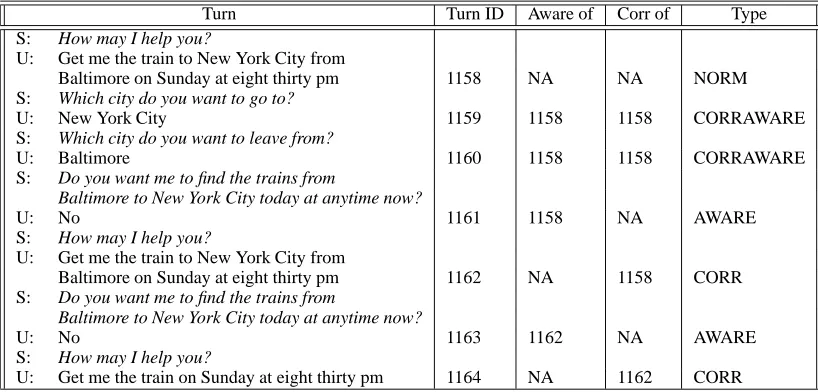
To identify the different turn categories in the corpus, two authors independently labeled each turn as to whether or not it constituted a correction of a prior system failure (a CA error or a rejection) and what turn was being corrected, and whether or not it represented an aware site for a prior fail-ure, and, if so, the turn which the system had failed on. Labeler disagreement was subsequently re-solved by consensus. The fragment in Figure 1, produced with a version of TOOT in which the
user has the initiative with no confirmation until the end of the task, illustrates these labels. This example illustrates cases of corraware, in which both the user’s awareness and correction of a mis-recognition occur in the same turn (e.g. turns 1159 and 1160, after system prompts for informa-tion already given in turn 1158). It also illustrates cases in which aware sites and corrections occur in different turns. For example, after the immedi-ate explicit system confirmation of turn 1162, the user first becomes aware of the system errors (turn 1163), then separately corrects them (turn 1164); turn 1163 is thus an aware turn and turn 1164 a
corr. When no immediate confirmation of an
Turn Turn ID Aware of Corr of Type S: How may I help you?
U: Get me the train to New York City from
Baltimore on Sunday at eight thirty pm 1158 NA NA NORM S: Which city do you want to go to?
U: New York City 1159 1158 1158 CORRAWARE
S: Which city do you want to leave from?
U: Baltimore 1160 1158 1158 CORRAWARE
S: Do you want me to find the trains from
Baltimore to New York City today at anytime now?
U: No 1161 1158 NA AWARE
S: How may I help you?
U: Get me the train to New York City from
Baltimore on Sunday at eight thirty pm 1162 NA 1158 CORR S: Do you want me to find the trains from
Baltimore to New York City today at anytime now?
U: No 1163 1162 NA AWARE
S: How may I help you?
[image:3.595.93.502.64.260.2]U: Get me the train on Sunday at eight thirty pm 1164 NA 1162 CORR
Figure 1: Dialogue Fragment with Aware and Correction Labels.
misrecognition errors. For example, it is not un-til turn 1161 that the user first becomes aware of the error in date and time from 1158; the user then corrects the error in 1162. So, 1161 is classified as an aware and 1162 as a corr. Note that corr turns represent 13% of the turns in our corpus, awares represent 14%, corrawares account for 16%, and norm turns represent 57% of the turns in the cor-pus.
3
Descriptive Analysis and Results
We examined prosodic features for each user turn which had previously been shown to be useful for predicting misrecognized turns and corrections: maximum and mean fundamental frequency val-ues (F0 Max, F0 Mean), maximum and mean en-ergy values (RMS Max, RMS Mean), total dur-ation (Dur), length of pause preceding the turn (Ppau), speaking rate (Tempo) and amount of si-lence within the turn (%Sil). F0 and RMS val-ues, representing measures of pitch excursion and loudness, were calculated from the output of En-tropic Research Laboratory’s pitch tracker, get f0, with no post-correction. Timing variation was represented by four features. Duration within and length of pause between turns was computed from the temporal labels associated with each turn’s
While the features were automatically computed, begin-nings and endings were hand segmented from recordings of the entire dialogue, as the turn-level speech files used as in-put in the original recognition process created byTOOTwere unavailable.
ginning and end. Speaking rate was approximated in terms of syllables in the recognized string per second, while %Sil was defined as the percentage of zero frames in the turn, i.e., roughly the per-centage of time within the turn that the speaker was silent.
To see whether the different turn categories were prosodically distinct from one another, we applied the following procedure. We first calcu-lated mean values for each prosodic feature for each of the four turn categories produced by each individual speaker. So, for speaker A, we divided all turns produced into four classes. For each class, we then calculated mean F0 Max, mean F0 Mean, and so on. After this step had been repeated for each speaker and for each feature, we then cre-ated four vectors of speaker means for each indi-vidual prosodic feature. Then, for each prosodic feature, we ran a one-factor within subjects anova on the means to learn whether there was an overall effect of turn category.
Turn categories
Feature Normal Correction Aware Corraware -stat
***F0 Max (Hz) 220.05 263.40 216.87 229.00 =10.477
F0 Mean (Hz) 161.78 173.43 162.61 158.24 =1.575
***RMS Max (dB) 1484.14 1833.62 1538.91 1925.38 =7.548
*RMS Mean (dB) 372.47 379.65 425.96 464.16 =3.190
***Dur (sec) 1.43 4.39 1.12 2.33 =34.418
Ppau (sec) 0.60 0.93 0.87 0.80 =1.325
**Tempo (syls/sec) 2.59 2.38 2.16 2.43 =4.206
*%Sil (sec) 0.46 0.41 0.44 0.42 =3.182
Significance level: *(p .05), **(p .01), ***(p .001)
Table 1: Mean Values of Prosodic Features for Turn Categories.
Prosodic features
Classes F0 max F0 mean RMS max RMS mean Dur Ppau Tempo %Sil
norm/corr – – – +
norm/aware +
norm/corraware – –
aware/corr – – – –
aware/corraware – – –
[image:4.595.129.472.64.185.2]corraware/corr – –
Table 2: Pairwise Comparisons of Different Turn Categories by Prosodic Feature.
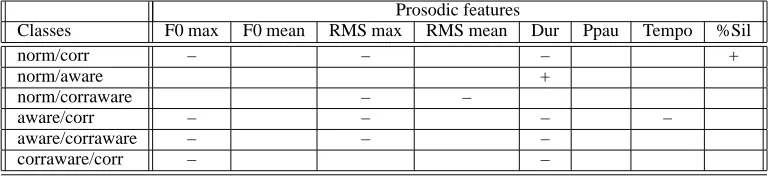
can be drawn from an array of 4 means). Res-ults are summarized in Table 2, where ‘ + ’ or ‘ – ’ indicates that the feature value of the first cat-egory is either significantly higher or lower than the second. Note that, for each of the pairs, there is at least one prosodic feature that distinguishes the categories significantly, though it is clear that some pairs, like aware vs. corr and norm vs. corr appear to have more distinguishing features than others, like norm vs. aware. It is also interesting to see that the three types of post-error turns are in-deed prosodically different: awares are less prom-inent in terms of F0 and RMS maximum than cor-rawares, which, in turn, are less prominent than corrections, for example. In fact, awares, except for duration, are prosodically similar to normal turns.
4
Predictive Results
We next wanted to determine whether the pros-odic features described above could, alone or in combination with other automatically avail-able features, be used to predict our turn categor-ies automatically. This section describes experi-ments using the machine learning program RIP
-PER (Cohen, 1996) to automatically induce pre-diction models from our data. Like many learn-ing programs, RIPPER takes as input the classes
to be learned, a set of feature names and possible values, and training data specifying the class and feature values for each training example. RIPPER
outputs a classification model for predicting the class of future examples, expressed as an ordered set of if-then rules. The main advantages ofRIP
-PERfor our experiments are thatRIPPERsupports “set-valued” features (which allows us to repres-ent the speech recognizer’s best hypothesis as a set of words), and that rule output is an intuitive way to gain insight into our data.
[image:4.595.105.490.221.309.2]Raw: f0 max, f0 mean, rms max, rms mean, dur, ppau,
tempo, %sil;
Norm1: f0 max1, f0 mean1, rms max1, rms mean1, dur1,
ppau1, tempo1, %sil1;
Norm2: f0 max2, f0 mean2, rms max2, rms mean2, dur2,
ppau2, tempo2, %sil2;
ASR: gram, str, conf, ynstr, nofeat, canc, help, wordsstr,
syls, rejbool;
System Experimental: inittype, conftype, adapt, realstrat;
Dialogue Position: diadist;
PreTurn: features for preceding turn (e.g., pref0max);
PrepreTurn: features for preceding preceding turn (e.g.,
ppref0max);
Prior: for each boolean-valued feature (ynstr, nofeat,
canc, help, rejbool), the number/percentage of prior turns exhibiting the feature (e.g., prioryn-strnum/priorynstrpct);
PMean: for each continuous-valued feature, the mean of the
feature’s value over all prior turns (e.g., pmnf0max);
Figure 2: Feature Set.
the system’s best hypothesis for the user input (str), and the acoustic confidence score produced by the recognizer for the turn (conf). As subcases of the str feature, we also included whether or not the recognized string included the strings yes or no (ynstr), some variant of no such as nope (nofeat),
cancel (canc), or help (help), as these lexical items
were often used to signal problems in our sys-tem. We also derived features to approximate the length of the user turn in words (wordsstr) and in syllables (syls) from the str features. And we ad-ded a boolean feature identifying whether or not the turn had been rejected by the system (rejbool). Next, we include a set of features representing the system’s dialogue strategy when each turn was produced. These include the system’s current ini-tiative and confirmation strategies (inittype, conf-type), whether users could adapt the system’s dia-logue strategies (adapt), and the combined initiat-ive/confirmation strategy in effect at the time of the turn (realstrat). Finally, given that our previ-ous studies showed that preceding dialogue con-text may affect correction behavior (Swerts et al., 2000; Hirschberg et al., 2001), we included a
fea-ture (diadist) reflecting the distance of the current turn from the beginning of the dialogue, and a set of features summarizing aspects of the prior dia-logue: for the latter features, we included both the number of times prior turns exhibited certain char-acteristics (e.g. priorcancnum) and the percent-age of the prior dialogue containing one of these features (e.g. priorcancpct). We also examined means for all raw and normalized prosodic fea-tures and some word-based feafea-tures over the en-tire dialogue preceding the turn to be predicted (pmn ). Finally, we examined more local con-texts, including all features of the preceding turn (pre ) and for the turn preceding that (ppre ).
We provided all of the above features to the learning algorithm first to predict the four-way classification of turns into normal, aware, corr and corraware. A baseline for this classification (al-ways predicting norm, the majority class) has a success rate of 57%. Compared to this, our fea-tures improve classification accuracy to 74.23% (+/– 0.96%). Figure 3 presents the rules learned for this classification. Of the features that appear in the ruleset, about half are features of current turn and half features of the prior context. Only once does a system feature appear, suggesting that the rules generalize beyond the experimental con-ditions of the data collection. Of the features spe-cific to the current turn, prosodic features domin-ate, and, overall, timing features (dur and tempo especially) appear most frequently in the rules. About half of the contextual features are prosodic ones and half are ASR features, with ASR confid-ence score appearing to be most useful. ASR fea-tures of the current turn which appear most often are string-based features and the grammar state the system used for recognizing the turn. There appear to be no differences in which type of fea-tures are chosen to predict the different classes.
if (gram=universal) (dur2 7.31) then CORR
if (dur2 2.19) (priornofeatpct 0.09) (tempo 1.50) (pmntempo 2.39) then CORR
if (dur2 1.53) (pmnwordsstr 2.06) (tempo1 1.07) (predur 0.80) (prenofeat=F) (presyls 4) then CORR
if (predur1 0.26) (dur 0.79) (rmsmean2 1.51) (f0mean 173.49) then CORR
if (dur2 1.41) (prenofeat=T) (str contains word ‘eight’) then CORR
if (predur1 0.18) (dur2 4.21) (dur1 0.50) (f0mean 276.43) then CORR
if (predur1 0.19) (ppregram=cityname) (rmsmax1 1.10) (pmntempo2 1.64) then CORR
if (realstrat=SystemImplicit) (gram=cityname) (pmnf0mean1 0.96) then CORR
if (preconf -2.66) (dur2 0.31) (pprenofeat=T) (tempo2 0.61) then AWARE
if (preconf -2.85) (syls 2) (predur 1.05) (pref0max 4.82) (tempo2 0.58) (pmn%sil 0.53) then AWARE
if (preconf -3.34) (syls 2) (ppau 0.57) (conf -3.07) (preppau 0.72) then AWARE
if (dur 0.74) (pmndur 2.57) (preconf -4.36) (f0mean2 0.90) then CORRAWARE
if (preconf -2.80) (pretempo 2.16) (preconf -3.95) (tempo1 4.67) then CORRAWARE
if (preconf -2.80) (dur 0.66) (rmsmean 488.56) then CORRAWARE
if (preconf -3.56) (dur2 0.64) (prerejbool=T) then CORRAWARE
if (pretempo 0.71) (tempo 3.31) then CORRAWARE
if (preconf -3.01) (tempo2 0.78) (pmndur 2.83) (pmnf0mean 199.84) then CORRAWARE
if (pmnconf -3.10) (prestr contains the word ‘help’) (pmndur2 2.01) (ppau 0.98) then CORRAWARE
if (pmnconf -3.10) (gram=universal) (pregram=universal) ( %sil 0.39) then CORRAWARE
[image:6.595.90.272.305.370.2]else NORM
Figure 3: Rules for Predicting 4 Turn Categories.
Precision (%) Recall (%)
norm 80.09 89.39
corr 72.86 61.66
aware 61.01 39.79 corraware 61.76 61.72 Accuracy: 74.23% ( 0.96%); baseline: 57%
Table 3: 4-way Classification Performance.
applying our best ruleset to the whole corpus. This
Classified as
norm corr aware corraware
norm 1263 14 11 38
corr 68 219 0 7
aware 149 1 130 47
[image:6.595.83.278.442.505.2]corraware 53 5 8 315
Table 4: Confusion Matrix, 4-way Classification.
matrix clearly shows a tendency for the minority classes, aware, corr and corraware, to be falsely classified as normal. It also shows that aware and corraware are more often confused than the other categories.
These confusability results motivated us to col-lapse the aware and corraware into one class, which we will label isaware; this class thus rep-resents all turns in which users become aware of a problem. From a system perspective, such a 3-way classification would be useful in identify-ing the existence of a prior system failure and in further identifying those turns which simply rep-resent corrections; such information might be as
useful, potentially, as the 4-way distinction, if we could achieve it with greater accuracy.
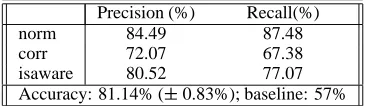
Indeed, when we predict the three classes (isaware, corr, and norm) instead of four, we do improve in predictive power — from 74.23% to 81.14% (+/– 0.83%) classification success. Again, this compares to the baseline (predicting norm, which is still the majority class) of 57%. We also get a corresponding improvement in terms of precision and recall, as shown in Table 5, with the isaware category considerably better distin-guished than either aware or corraware in Table 3. The ruleset for the 3-class predictions is given in
Precision (%) Recall(%)
norm 84.49 87.48
corr 72.07 67.38
isaware 80.52 77.07 Accuracy: 81.14% ( 0.83%); baseline: 57%
Table 5: 3-way Classification Performance.
[image:6.595.322.505.495.548.2]if (gram=universal) (dur2 7.31) then CORR
if (dur2 2.25) (priornofeatpct 0.11) (%sil 0.55) (wordsstr 4) then CORR
if (dur2 2.75) (gram=universal) (pre%sil1 1.17)
then CORR
if (predur1 0.24) (dur 0.85) (priornofeatnum 2) (pmnconf -3.11) (pmn%sil 0.45) then CORR
if (predur1 0.19) (dur 1.21) (pmnf0mean2 0.99) (predur2 0.90) (%sil 0.70) (tempo 3.25) then
CORR
if (predur1 0.20) (ynstr=F) (pregram=cityname)
(ppref0mean 171.58) then CORR
if (dur2 0.75) (gram=cityname) (pmnsyls 3.67)
(pmnconf -3.23) (%sil 0.41) then CORR
if (prenofeat=T) (preconf -0.72) then CORR
if (preconf -4.07) then ISAWARE
if (preconf -2.76) (pmntempo 2.39) (tempo2
1.56) (preynstr=F) then ISAWARE
if (preconf -2.75) (ppau 0.46) (tempo 1.20) then
ISAWARE
if (pretempo 0.23) then ISAWARE
if (pmnconf -3.10) (ppregram=universal) (ppre%sil
0.34) (tempo1 2.94) then ISAWARE
if (predur 1.27) (pretempo 2.36) (prermsmean
229.33) (tempo2 0.83) then ISAWARE
if (preconf -2.80) (nofeat=T) (f0mean 205.56) then
ISAWARE
else NORM
Figure 4: Rules for Predicting 3 Turn Categories.
once in isaware rules. Instead, these rules make considerable use of the ASR confidence score of the preceding turn; in cases where aware turns im-mediately follow a rejection or recognition error, one would expect this to be true. Isaware rules also appear distinct from correction rules in that they make frequent use of the tempo feature. It is also interesting to note that rules for predicting isaware turns make only limited use of the nofeat feature, i.e. whether or not a variant of the word
no appears in the turn. We might expect this
lex-ical item to be a more useful predictor, since in the explicit confirmation condition, users should become aware of errors while responding to a re-quest for confirmation.
Note that corrections, now the minority class, are more poorly distinguished than other classes in our 3-way classification task (Table 5). In a third set of experiments, we merged corrections with normal turns to form a 2-way distinction over all between aware turns and all others. Thus, we only distinguish turns in which a user first becomes aware of an ASR failure (our original isaware and corraware categories) from those that are not (our original corr and norm categories). Such a
dis-tinction could be useful in flagging a prior sys-tem problem, even though it fails to target the ma-terial intended to correct that problem. For this new 2-way distinction, we obtain a higher de-gree of classification accuracy than for the 3-way classification — 87.80% (+/– 0.61%) compared to 81.14%. Note, however, that the baseline (predict majority class of !isaware) for this new classifica-tion is 70%, considerably higher than the previous baseline. Table 6 shows the improvement in terms of accuracy, precision, and recall.
Precision (%) Recall (%) !isaware 91.7 91.6 isaware 80.7 81.1 Accuracy: 87.80% ( 0.61%); baseline: 70%
Table 6: 2-way Classification Performance.
The ruleset for the 2-way distinction is shown in Figure 5. The features appearing most frequently
if (preconf -4.06) (pretempo 2.65) (ppau 0.25)
then T
if (preconf -3.59) (prerejbool=T) then T
if (preconf -2.85) (predur 1.039) (tempo2 1.04) (preppau 0.57) (pretempo 2.18) then T
if (preconf -3.78) (pmnsyls 4.04) then T
if (preconf -2.75) (prestr contains the word ‘help’) then
T
if (pregram=universal) (pprewordsstr 2) then T
if (preconf -2.60) (predur 1.04) (%sil1 1.06)
(prermsmean 370.65) then T
if (pretempo 0.13) then T
if (predur 1.27) (pretempo 2.36) (prermsmean
245.36) then T
if (pretempo 0.80) (pmntempo 1.75) (ppretempo2 1.39) then T
then F
Figure 5: Rules for Predicting 2 Turn Categories: ISAWARE (T) versus the rest (F).
task, contextual features are far more important than for the more fine-grained distinctions.
5
Conclusion
Continuing our earlier research into the use of prosodic information to identify system misrecog-nitions and user corrections in a SDS, we have studied aware sites, turns in which a user first no-tices a system error. We find first that these sites have prosodic properties which distinguish them from other turns, such as corrections and normal turns. Subsequent machine learning experiments distinguishing aware sites from corrections and from normal turns show that aware sites can be classified as such automatically, with a consid-erable degree of accuracy. In particular, in a 2-way classification of aware sites vs. all other turns we achieve an estimated success rate of 87.8%. Such classification, we believe, will be especially useful in error-handling for SDS. We have pre-viously shown that misrecognitions can be clas-sified with considerable accuracy, using prosodic and other automatically available features. With our new success in identifying aware sites, we acquire another potentially powerful indicator of prior error. Using these two indicators together, we hope to target system errors considerably more accurately than current SDS can do and to hypo-thesize likely locations of user attempts to correct these errors. Our future research will focus upon combining these sources of information identify-ing system errors and user corrections, and invest-igating strategies to make use of this information, including changes in dialogue strategy (e.g. from user or mixed initiative to system initiative after errors) and the use of specially trained acoustic models to better recognize corrections.
References
L. Bell and J. Gustafson. 1999. Repetition and its phonetic realizations: Investigating a Swedish data-base of spontaneous computer-directed speech. In
Proceedings of ICPhS-99, San Francisco.
Interna-tional Congress of Phonetic Sciences.
H. H. Clark and D. Wilkes-Gibbs. 1986. Referring as a collaborative process. Cognition, 22:1–39.
W. Cohen. 1996. Learning trees and rules with set-valued features. In 14th Conference of the American
Association of Artificial Intelligence, AAAI.
J. Hirschberg, D. Litman, and M. Swerts. 2000. Generalizing prosodic prediction of speech recog-nition errors. In Proceedings of the Sixth
Interna-tional Conference on Spoken Language Processing,
Beijing.
J. Hirschberg, D. Litman, and M. Swerts. 2001. Identifying user corrections automatically in spoken dialogue systems. In Proceedings of NAACL-2001, Pittsburgh.
E. Krahmer, M. Swerts, M. Theune, and M. Weegels. 1999. Error spotting in human-machine interac-tions. In Proceedings of EUROSPEECH-99.
G. Levow. 1998. Characterizing and recognizing spoken corrections in human-computer dialogue. In Proceedings of the 36th Annual Meeting of the
Association of Computational Linguistics, COL-ING/ACL 98, pages 736–742.
D. Litman, J. Hirschberg, and M. Swerts. 2000. Pre-dicting automatic speech recognition performance using prosodic cues. In Proceedings of NAACL-00, Seattle, May.
S. L. Oviatt, G. Levow, M. MacEarchern, and K. Kuhn. 1996. Modeling hyperarticulate speech during human-computer error resolution. In Proceedings
of ICSLP-96, pages 801–804, Philadelphia.
A. Shimojima, K. Katagiri, H. Koiso, and M. Swerts. 1999. An experimental study on the informational and grounding functions of prosodic features of Ja-panese echoic responses. In Proceedings of the
ESCA Workshop on Dialogue and Prosody, pages
187–192, Veldhoven.
M. Swerts, D. Litman, and J. Hirschberg. 2000. Corrections in spoken dialogue systems. In
Pro-ceedings of the Sixth International Conference on Spoken Language Processing, Beijing.
E. Wade, E. E. Shriberg, and P. J. Price. 1992. User behaviors affecting speech recognition. In