Mechanical Properties of Harmonic Structured Composite with Pure Titanium
and Ti
48 at
%
Al Alloy by MM
/
SPS Process
Hiroshi Fujiwara
1,+, Takeshi Kawabata
2, Hiroyuki Miyamoto
1and Kei Ameyama
31Department of Mechanical and Systems Engineering, Doshisha University, Kyotanabe 610-0394, Japan 2Graduate School, Doshisha University, Kyotanabe 610-0394, Japan
3Department of Mechanical Engineering, Ritsumeikan University, Kusatsu 525-8577, Japan
TiAl alloy demonstrates high strength in high-temperature environments. Thus, the TiAl alloys are expected in an application as high temperature materials. However, the TiAl alloys demonstrate low strength and limited ductility at room temperature. Harmonic-structured materials with a network fine grain structure and a dispersed coarse grain structure show high strength and sufficient ductility at room temperature. In addition, a composite of different materials is also effective in improving both strength and ductility. Therefore, the harmonic-structured composite with pure titanium (Ti) and Ti48 at%Al alloy (Ti48Al) were fabricated by the combination of the mechanical milling (MM) and the spark plasma sintering (SPS) process. The harmonic-structured composite has afine grained network TiAl alloy and a dispersed coarse grain Ti region. The XRD result reveals that the harmonic-structured composite composes of Ti, TiAl and Ti3Al phases. The harmonic-structured composite demonstrates high strength and sufficient ductility compared with the conventional compact consisting of only Ti48Al. Advanced ductility of the harmonic-structured composite is attributed to an obstruction of the crack propagation by the dispersed coarse grain region. After heat treatment of the Ti/Ti48Al harmonic-structured composite, its hardness decreased to much lesser than that of the pure Ti compact. [doi:10.2320/matertrans.MH201317]
(Received March 6, 2013; Accepted April 8, 2013; Published May 17, 2013)
Keywords: harmonic structure, titaniumaluminum alloy, pure titanium, mechanical milling, spark plasma sintering
1. Introduction
TiAl alloys demonstrate high strength in high-temper-ature environments; thus, they are used in turbochargers and are expected to find use in other applications such as in jet engines.13)However, the range of TiAl alloy applicability
is limited, because it has low strength and a limited ductility at room temperature.4,5) It is well known that a grain
refinement is an effective method for improving both the strength and ductility of such alloys. However, ultra fi ne-grained materials (i.e., with homogeneous nano grains) demonstrate high strength but low ductility because of early plastic instability.6,7) On the other hand, a harmonic-structured material with a networked fine grain area and a dispersed coarse grain area shows high strength and sufficient ductility.811)In addition, a composite of different materials is also effective in improving both strength and ductility. A composite with TiAl and Ti2AlC phases demonstrates a
higher strength and elongation than TiAl-phase material.12)
Therefore, to improve the mechanical properties of TiAl alloys at room temperature, a harmonic-structured composite consisting of a TiAl alloy and pure titanium was fabricated by mechanical milling (MM) and spark plasma sintering (SPS) process and its mechanical properties were evaluated in detail.
2. Experimental Procedure
Powders of titanium alloyed with 48 at%Al (Ti48Al) and commercially pure titanium (Ti; 99.9 mass% purity) were used in this study. The initial particle sizes of the Ti48Al and the pure Ti powders were about 260 and 200 µm, respectively. These powders were mechanically milled using
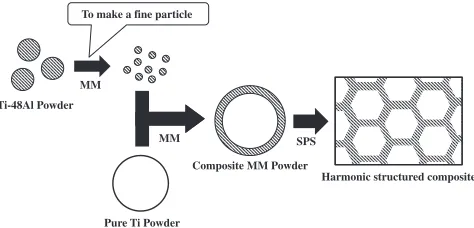
planetary ball mill equipment (P-6; Fritch Co., Ltd.) with an SKD11 vial and SUJ2 steel balls in Ar atmosphere at room temperature. First, to obtain a fine Ti48Al powder, mechanical milling was performed at a ball-to-powder weight ratio of 3 : 1 and an MM time of 54 ks. Next, a mixture of pure Ti powder and Ti48Al (11.1 to 20.0 mass%) MM powder was mechanically milled at a ball-to-powder weight ratio of 2 : 1 and an MM time of 36 ks. The composite MM powder containing Ti48Al and pure Ti was sintered using SPS apparatus (SPS-510L; Sumitomo Coal Mining Co., Ltd.) at 1073 K and 50 MPa for 1.8 ks. Figure 1 shows a schematic of the process to fabricate the composite MM compact by MM and SPS. Scanning electron microscopy (SEM)/energy dispersive X-ray spectroscopy (EDS) and X-ray diffraction (XRD) were employed to observe the microstructure of the composite SPS compact with Ti48Al and pure Ti. The mechanical properties of the composite SPS compacts were evaluated by the Vickers hardness test (VMT-7; Matsuzawa Co., Ltd.) and a tensile test (AGS-10kND; Shimadzu Corporation) with an initial strain rate of 5.5©10¹4s¹1.
MM
MM SPS
Ti-48Al Powder
Pure Ti Powder
Harmonic structured composite To make a fine particle
Composite MM Powder
Fig. 1 Schematic of the process to fabricate the harmonic-structured composite by MM/SPS process.
+Corresponding author, E-mail: hifujiwa@mail.doshisha.ac.jp
Special Issue on Advanced Materials Science in Bulk Nanostructured Metals II
[image:1.595.309.546.376.490.2]3. Results and Discussions
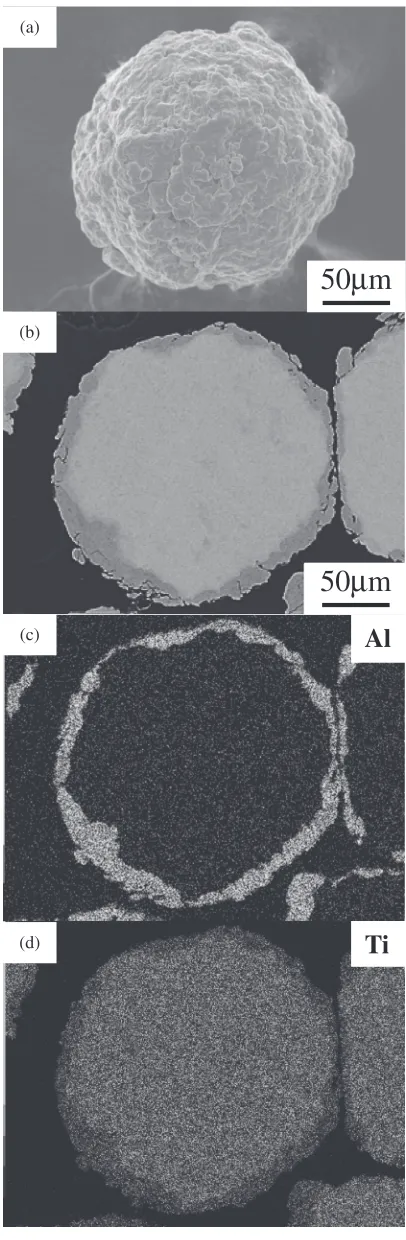
The Ti48Al powder was refined to about 80.5 µm by MM for 54 ks. The composite MM powder in which pure Ti and Ti48Al fine powders were combined by MM for 36 ks is shown in Fig. 2. Figures 2(a) and 2(b) show SEM micro-graphs of the appearance and the cross section of the composite MM powder with Ti48Al (20.0 mass%), respec-tively. Figures 2(c) and 2(d) indicate EDS results for the Al and Ti concentrations shown in Fig. 2(b), respectively. The composite MM powder shown in Fig. 2(b) exhibits a different contrast in the surface and middle regions, and Figs. 2(c) and 2(d) demonstrate that the surface region has high Al concentration. Figure 3 shows the XRD result for the composite MM powder with Ti48Al (20.0 mass%). The composite MM powder consists of Ti, TiAl and Ti3Al phases.
Therefore, the surface region in Fig. 2(b) corresponds to a TiAl alloy with the TiAl and Ti3Al phases and the middle
region corresponds to the Ti phase.
The composite MM powder as shown in Fig. 2 was sintered using an SPS apparatus, and an interesting micro-structure was obtained. Figure 4 shows this micromicro-structure in an SEM micrograph of a Ti/Ti48Al composite compact with 14.3 mass% Ti48Al sintered at 1073 K for 1.8 ks. This micrograph has a network structure, and its network region corresponds to the surface region of the composite MM powder shown in Fig. 2; that is, the network structure is composed of a TiAl alloy. The dispersed region surrounding the network corresponds to pure Ti material. A micro-structure having network and dispersed regions is referred to as a“harmonic structure”. Figure 5 shows the XRD result for the harmonic-structured composite shown in Fig. 4. This harmonic-structured composite consists of Ti, TiAl and Ti3Al
phases, and the network TiAl alloy region consists of TiAl and Ti3Al phases. Figures 6(a) and 6(b) show SEM
micro-graphs of the network and dispersed regions of the harmonic-structured composite, respectively. As shown in Fig. 6(a), a lamellar structure with a width of several tens of nanometers is observed in the network TiAl alloy region and consists of TiAl and Ti3Al phases.13)The network TiAl alloy region
has an average grain size of 840 nm, as shown in Fig. 6(a), and the dispersed pure Ti region has an average grain size of 21 µm. The Ti/Ti48Al harmonic-structured composite consists of a nano grain network region and a coarse-grain dispersed region, same as the harmonic-structured material reported in previous research.811) Such a
harmonic-struc-tured composite is expected to exhibit good mechanical properties.
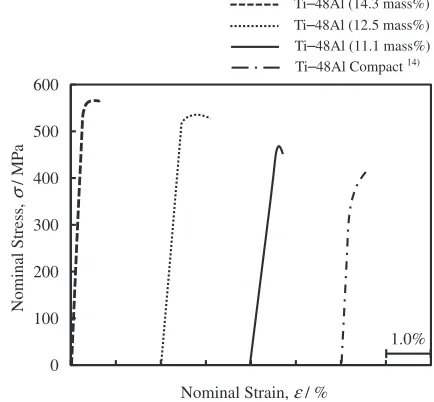
Figure 7 demonstrates nominal stressstrain curves from the tensile test of the Ti/Ti48Al harmonic-structured composite with various weight ratios; the compact consisting of only Ti48Al is also shown.14) The 0.2% proof stresses of the harmonic-structured composite with 11.1, 12.5 and 14.3 mass%Ti48Al are 450, 520 and 560 MPa, respectively. The total elongation values for the harmonic-structured composite with 11.1, 12.5 and 14.3 mass% Ti48Al are 0.18, 0.58 and 0.35%, respectively. On the other hand, the 0.2%stress and the total elongation of the compact consisting of only Ti48Al are 350 MPa and 0.25%, respectively.14)The
averages of 0.2% proof stress for the harmonic-structured
composite with 11.1, 12.5 and 14.3 mass%Ti48Al are 506, 440 and 549 MPa, respectively. The averages of total elongation for the harmonic-structured composite with 11.1,
Al
Ti
50
μ
m
50
μ
m
(a)
(b)
(c)
(d)
[image:2.595.325.528.68.688.2]12.5 and 14.3 mass% Ti48Al are 0.22, 0.47 and 0.34%, respectively. The standard deviations are 0.040, 0.090 and 0.015, respectively. As a result, the harmonic- structured composites with Ti48Al (12.5 and 14.3 mass%) indicate high strength and high elongation compared with the conventional Ti48Al compact. The harmonic-structured composite having the middle weight ratio of Ti48Al
demonstrates the best elongation but low 0.2% proof stress, suggesting the existence of an optimal microstructure design.8) Such a result indicates that a harmonic-structured
composite of Ti and a TiAl alloy could effectively improve the mechanical properties of a TiAl alloy at room
temper-100
μ
m
Fig. 4 SEM micrograph of the Ti/Ti48Al harmonic structured composite with the weight ratio of Ti48Al (14.3 mass%), sintered by SPS at 1073 K for 1.8 ks.
30 40 50 60 70 80 90 Ti TiAl Ti3Al
Diffraction Angle, 2θ / deg.
Intensity
,
I
/ arb
. unit
Fig. 5 XRD result for the Ti/Ti48Al harmonic-structured composite with Ti48Al (14.3 mass%) shown in Fig. 4.
0 100 200 300 400 500 600
Ti–48Al (14.3 mass%) Ti–48Al (12.5 mass%) Ti–48Al (11.1 mass%) Ti–48Al Compact 14)
1.0%
Nominal Strain, ε/ %
Nominal Stress,
σ
/M
P
a
Fig. 7 Nominal stressnominal strain curves of the Ti/Ti48Al harmonic-structured composite with Ti48Al (11.1 to 14.3 mass%). Alternate long and short dash lines curve also shows the compact consisting of only Ti 48Al alloy.14)
30 40 50 60 70 80 90
Diffraction Angle, 2θ / deg.
Intensity
,
I
/ arb
. unit
Ti TiAl Ti3Al
Fig. 3 XRD result for the composite MM powder with Ti48Al (20.0 mass%).
20
μ
m
(b)
1
μ
m
(a)
[image:3.595.64.280.70.217.2] [image:3.595.312.541.71.401.2] [image:3.595.55.285.267.444.2] [image:3.595.317.534.462.663.2] [image:3.595.62.280.504.654.2]ature. Figure 8 shows an SEM micrograph in the vicinity of the fracture surface after the tensile test. Some cracking is observed at the network region; thus, the fracture initiated at the network region and propagated there. However, some crack propagation was prevented by the dispersed region, as indicated by the arrows in Fig. 8. Therefore, the harmonic-structured composite can deform without a rapid fracture. Advanced ductility of the harmonic-structured materials is attributed to the obstruction of crack propagation by the dispersed region.11)
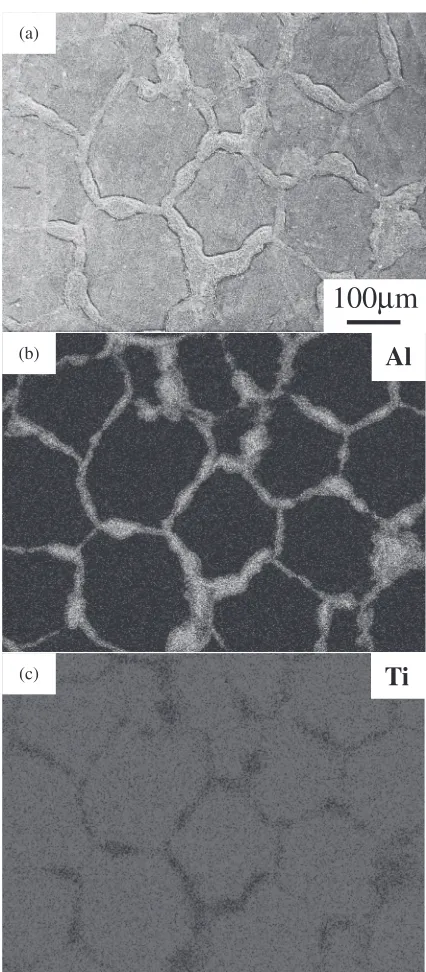
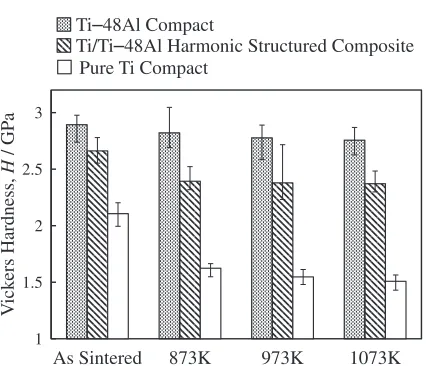
As mentioned above, the Ti/Ti48Al harmonic-structured composite demonstrates advanced mechanical properties at room temperature. To investigate its thermal stability, the harmonic-structured composite with 14.3 mass% Ti48Al was annealed at 873, 973 and 1073 K for 3.6 ks. The SEM micrograph and EDS results for the annealed harmonic-structured composite are shown in Fig. 9. As shown in the figure, the heat treatment leads to the stabilization of the harmonic-structured composite at high temperature. Figure 9(a) shows the harmonic structure in spite of the heat treatment at 1073 K. Figures 9(b) and 9(c) indicate that the Al element is concentrated at the network region and that the Ti element is comparatively highly concentrated at the dispersed region. The XRD result for this material indicates that the phase composition is the same as that in the result shown in Fig. 5. Figure 10 shows the Vickers hardness test results for the Ti48Al compact, the pure Ti compact, and the harmonic-structured composite before and after heat treatment. As the temperature increases, the hardness of the Ti48Al compact and the pure Ti compact decreases to a lesser and to a greater extent, respectively. In contrast, the hardness of the harmonic-structured composite remains high hardness after the heat treatment in spite of the addition of 14.3 mass% of Ti48Al. This result suggests that the Ti/Ti 48Al harmonic-structured composite would exhibit good properties at high temperature.
4. Conclusion
A harmonic-structured composite with a network region of a TiAl alloy and a dispersed region of pure titanium was
fabricated by a mechanical milling and spark plasma sintering. The microstructure and mechanical properties of the harmonic-structured composite were evaluated. The composite powder with a surface of the Ti48 at%Al alloy and a middle region of pure titanium was produced by the mechanical milling. As this composite powder underwent spark plasma sintering, the harmonic-structured composite with a network region of a TiAl alloy and a dispersed region of pure titanium was created. At room temperature, the harmonic-structured composite demonstrated high strength and advanced ductility as compared with the compact consisting of only Ti48 at%Al. After heat treatment at 1073 K, its hardness decreased to much lesser than of the pure Ti compact.
100
μ
m
T
ensile direction
Fig. 8 SEM micrograph in the vicinity of the fracture surface after tensile test of Ti/Ti48Al harmonic-structured composite with Ti48Al (14.3 mass%).
(a)
(b)
(c)
Al
Ti
100
μ
m
[image:4.595.320.533.65.551.2] [image:4.595.54.283.69.236.2]Acknowledgments
This work was supported by grant-in-aid from Iketani Science and Technology Foundation and the support is gratefully appreciated.
REFERENCES
1) H. Jabbar, J.-P. Monchoux, M. Thomas and A. Couret:Acta Mater.59 (2011) 75747585.
2) A. Couret, G. Molenat, J. Galy and M. Thomas: Intermatallics16 (2008) 11341141.
3) X. Lu, X. B. He, B. Zhang, L. Zhang, X. H. Qu and Z. X. Guo: Intermatallics17(2009) 840846.
4) H. A. Lipsitt, D. Shechtman and R. E. Schafrik: Metall. Trans. A6A
(1975) 19911996.
5) Y. Liu, H. Li, S. Wang and H. Ye: J. Mater. Res.24(2009) 3165 3173.
6) E. Ma:Scr. Mater.49(2003) 663668.
7) N. Tsuji, N. Kamikawa, R. Ueji, N. Takata, H. Koyama and D. Terada: ISIJ Int.48(2008) 11141121.
8) T. Sekiguchi, K. Ono, H. Fujiwara and K. Ameyama:Mater. Trans.51 (2010) 3945.
9) H. Fujiwara, R. Akada, A. Noro, Y. Yoshita and K. Ameyama:Mater. Trans.49(2008) 9096.
10) H. Fujiwara, T. Sekiguchi and K. Ameyama:Int. J. Mater. Res.100 (2009) 796799.
11) A. Ueno, H. Fujiwara, M. Rifai, Z. Zhang and K. Ameyama:J. Soc. Mater. Sci. Jpn.61(2012) 686691.
12) H. Mabuchi, N. Kiji, H. Tsuda and Y. Nakayama:J. Jpn. Soc. Powder Powder Met.42(1995) 12891294.
13) S. C. Huang and E. L. Hall: Metall. Trans. A22A(1991) 427439. 14) K. Kato, A. Matsumoto, Y. Nozaki and T. Ieki:J. Jpn. Soc. Powder
Powder Met.42(1995) 10681072.
1 1.5 2 2.5 3
V
ick
ers Hardness,
H
/ GP
a
As Sintered 873K 973K 1073K
Ti–48Al Compact
[image:5.595.64.277.64.247.2]Ti/Ti–48Al Harmonic Structured Composite Pure Ti Compact