Characterization of the Microstructure Evolution and Microsegregation
in a Ni-Based Superalloy under Super-High Thermal
Gradient Directional Solidi
fi
cation
Yongjun Zhang
+and Jianguo Li
School of Materials Science and Engineering, Shanghai Jiao Tong University, Shanghai 200240, P. R. China
The microstructure evolution and microsegregation behavior of alloying elements in a Ni-based superalloy at a series of growth rates under super-high thermal gradient directional solidification were quantitatively characterized. Both microstructure and dendritic segregation are functions of growth rate. The high growth rate solidification leads to refinement in primary (1) and secondary (2) dendrite arm, decreased size
of£/£Aeutectics and £A phase, as well as reduced microsegregation degree of alloying elements. Also with the growth rate increased, the morphology of£Aprecipitates changes from irregular shape to a cuboidal one. The electron probe microanalysis (EPMA) reveals that Cr, Mo and
£Aforming elements (Al, Ta and Nb) all partition to interdendritic region, while W and Re both preferably segregate to dendrite core. Thus at fast growth rates (or high cooling rates),finer dendrites, uniformly coherently cuboidal£Aprecipitates and decreased segregation favorable to the performance of superalloys are obtained. These quantitative results provide a basis for the establishment of cast and heat treatment process.
[doi:10.2320/matertrans.M2012173]
(Received May 8, 2012; Accepted August 20, 2012; Published October 25, 2012)
Keywords: nickel-based superalloy, directional solidification, microstructure evolution, microsegregation
1. Introduction
Nickel-based superalloys have been used extensively in the aerospace industry due to their exceptional properties at elevated temperatures.1,2) The primary fabrication process of
superalloy components including turbine blades and vanes is investment casting that is essential for introduction of different cooling models and for control of grain growth. Thus those cast superalloys can be grouped into three categories: conventionally casting (CC), directionally
solidi-fied (DS) and single crystal (SC) superalloys. Although CC Ni-based superalloys have inherently good high-temperature properties to begin with, creep failures experienced in blades and vanes have revealed that the transverse grain boundaries is the easy fracture path. Therefore, elimination of transverse or all grain boundaries will lead to further improvement of the high-temperature capability. And these requirements can be satisfied by directional solidification technique. Bridgman high rate solidification (HRS) is the typical manufacture process for the fabrication of directionally solidified and single crystal blades. But its limited temperature gradient, resulting in coarse dendritic structure, serious dendritic segregation and defects, confines its application in the production of large size components (Industrial gas turbine blade). Accordingly, Giamei et al. developed a new casting technique with high thermal gradient and high cooling rating-liquid metal cooling (LMC).3)A large number of literatures reported thatfiner dendrite, decreased microsegregation and improved properties can be achieved in Ni-based superalloys fabricated through LMC which is greatly superior to HRS in cooling effect.46)Even so, the thermal gradient can also be further improved upon through processing. Based on LMC, J.G. Li et al.7) developed a super-high gradient directional
solidification technique-Zone Melting Liquid Metal Cooling (ZMLMC), which could reach 1300 K/cm at the front of the
S/L interface in the experimental scale. L. Liu et al.8,9)
discussed the design principles of elevated thermal gradient in detail and established the relationship between micro-structure feature/microsegregation and solidification param-eters of 1st single crystal superalloy CMSX-2 (without Re) under high thermal gradient directional solidification. But there is not enough data accumulation about ZMLMC and for its practical application.
This study is to quantify the microstructure features and microsegregation of a Ni-based superalloy under super-high temperature gradient directional solidification. In addition, the experimental alloy represents a model of 2nd single crystal superalloy (containing Re) about which there is no detailed quantification characterization of microstructure and microsegregation. The present workfills the gap, which can provide support for the establishment of cast and subsequent heat treatment process for the experimental alloy.
2. Experimental Procedures
The nominal chemical compositions (mass%) of exper-imental Ni-based superalloy are listed in Table 1. The experimental alloy contains about 19.5 mass% refractory contents (W+Mo+Ta+Re). The directionally solidified alloys with the dimension of ¯7©100 mm were produced by zone melting liquid metal cooling (ZMLMC) technique10)
with the mould withdrawal rates (V) from 20 to 700 µm/s. Herein, crystal growth rate (growth rate) is advancing rate of solid/liquid (S/L) interface, which is equal to withdrawal rate in steady state. The specimens were etched in a solution
Table 1 Nominal compositions (mass%) of experimental Ni-based super-alloy.
Ni Cr Co W Mo Al Nb Re Ta Hf C Bal. 4.43 9.08 7.62 2.02 5.72 1.00 2.02 6.74 0.10 0.012
+Graduate Student, Shanghai Jiao Tong University
composed of 20 ml HCl, 5 g CuSO4·5H2O and 80 ml H2O.
The microstructures of all specimens were characterized by means of optical microscopy (OLMPUS PME3) and SEM (JSM7600F). The Primary dendrite arm spacing (1) and
secondary dendrite arm spacing (2) are key scale for
characterizing dendritic features, which were quantitatively analyzed by triangulation and truncation method, respec-tively, which the literature11) referred to. The £/£A eutectic
volume fraction was calculated by using point grids overlaid on transverse micrographs at magnifications in the range of 50500©on the as-cast samples for each growth rate. At least threefields of view were used and the average taken. The size of £A particles was determined by a¼pffiffiffiffiffiffiffiffiffiffiffiffiffiffiS£0=n£0, where S£0
and n£0 are the total£A area of micrograph (in dendrite core or interdendritic region) and the number of £A particles, respectively. The concentrations of alloying elements in dendrite core and interdendritic region, as well as £/£A eutectic, were measured on a JXA-8100 electron probe microanalysis (EPMA).
3. Results and Discussion
3.1 Microstructure of the alloy
Cross-shaped dendrite morphology and interdendritic region can be observed obviously in the transverse micro-structure. In the longitudinal section, the dendrite array shows directional growth and the direction is parallel to that of the heat flow. The dendrite morphology of three-dimensional graphics can be seen in Fig. 1. The dendrites are fined with increasing growth rate, which can be represented as shortened primary and secondary dendrite arm spacing. The primary and secondary dendrite arm spacing decrease linearly with increased G·V in the diagram of log³ log (G·V) (Fig. 2) and by linear regression analysis can be expressed as follows: 1¼5220:1ðGVÞ0:35191 and 2¼
5309:8ðGVÞ0:42944, whereGis the thermal gradient ahead
of Solid/Liquid (S/L) interface, V is growth rate, andG·V
is defined as cooling rate in directional solidification. The
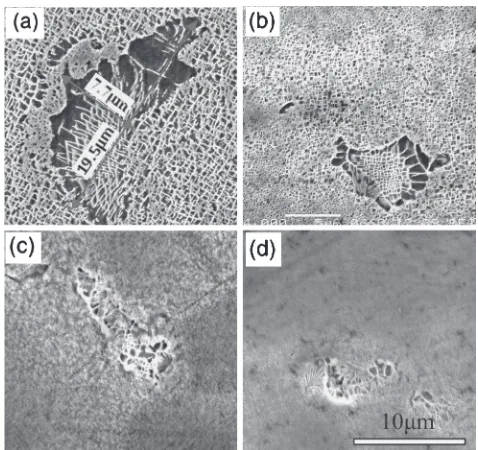
£/£A eutectics in the interdendritic region at different rates
are shown in Fig. 3. The eutectic was characterized by
ðl£=£0
max þw£max=£0Þ=2 as reported in Ref. 12), where l£max=£0 and
w£=£0
max were the biggest length and width, respectively. The
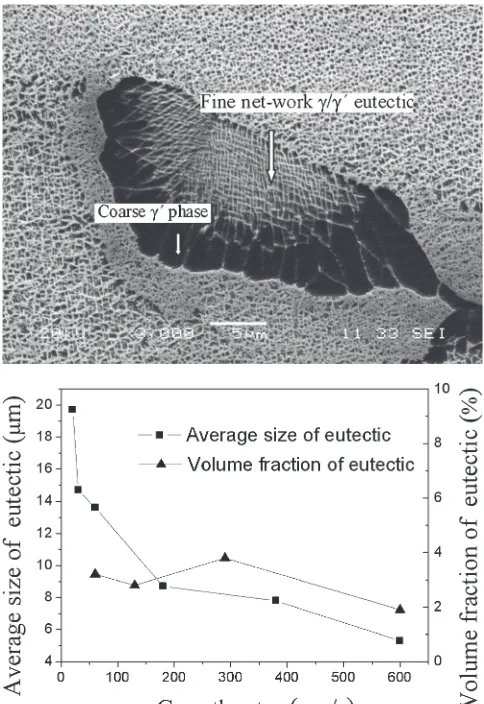
average size of the eutectics decreases with increasing growth rate and the volume fraction is not a function of growth rate (Fig. 4). Figure 5 shows the average size of £A particles in dendrite core and interdendritic region of directionally
Fig. 1 Dendrite morphology of three-dimensional graphics in the direc-tionally solidified Ni-based superalloy.
Fig. 2 Diagram of log1(2)³log (G·V).
[image:2.595.74.269.69.266.2] [image:2.595.318.535.72.386.2] [image:2.595.307.546.429.654.2]solidified samples. With increasing growth rate, the average size of£Aparticles decreases and the morphology is changing from irregular shape to cuboidal structure both in dendrite core and interdendritic region. At identical growth rate, the average size of £A particles in interdendritic region is larger than that in dendrite core, but the morphology of the latter is more regular than the former.
For complicated multi-component superalloys, the solid-ification process itself essentially involves the formation of
a single phase (£-nickel) constituting ³99% by volume.13)
The £A largely precipitates from the solid state at a lower temperature, which has little effect on solidification. Consequently, the general solidification behaviour of super-alloys appears to be described reasonably well by the formalism that has been development for single phase freezing.13) KurzFisher (KF) and MaSahm (MS) models described the evolution law of primary dendrite arm spacing (1), expressed as 1/G1=2V1=4. The common ground
of these models is that1is mainly affected by cooling rate.
The general formula can be written as1=NG¹aV¹b(0<a,
b<1,N-material physical parameter).11)The current
exper-imental results are in accordance with the general formula. In addition, during cell and dendrite solidification, primary £ phase forms first when the temperature of melt reaches the liquidus temperature or below it. Toward the end of solidification, eutectic islands or eutectic structure as is called in Ref. 14) will be formed. That is because during the solidification,£Aforming elements segregate in the liquid, in the late solidification the remaining liquid in the interden-dritic region attains eutectic composition, and eutectic reaction L¼£+£A takes place. The size and distribution of £/£A eutectic are associated with growth rate. Due to refining of dendrite with increasing growth rate, remaining liquid was more refined and scattered, so eutectic of smaller size is formed after solidification, while the eutectic maintains a relatively stable volume fraction and did not appear to be a strong function of the growth rate, which is in agreement with the study of B. C. Wilson.15)
£Aphase is a L12structure and an important strengthening
phase in superalloys. The morphologies, size and quantity of £A phase greatly affecting the performance of alloys1618) are closely bound up with solidification parameters. The evolution of £A with the growth rates can be explained by nucleation and growth theories. The decreasing average size of £A particles with increasing growth rate suggests that the nucleation of £A phase is under large undercooling and the driving force is expected to increase rapidly. Consequently, the nucleation rate of the£A precipitate per unit volume will increase and the average size will decrease. On the other hand, due to the existence of microsegregation, the concen-tration of Al, Ta and Nb (£A-forming elements) in interden-dritic region is higher than that in dendrite core. The increased supersaturation of £A-forming elements in interdendritic region results in a decrease in the critical crystal nucleus size of precipitate and an increase in the precipitating velocity, which leads to the£Aparticles in interdendritic region coarser than those in dendrite core at identical growth rate.
3.2 The microsegregation behavior of alloying elements
The microsegregation degree of alloying elements can be evaluated by the segregation ratio (SR) which can be calculated using the following formula:
SR¼Ci;IR=Ci;DC ð1Þ
where Ci,IR is the maximum concentration of element i in
interdendritic region, andCi,DCis the minimum concentration
of elementiin dendrite core.
The different SR values represent the discrepancy of elemental segregation behavior. ForSR<1, solute elements
Fig. 4 The morphology, average size and volume fraction of£/£Aeutectic.
[image:3.595.48.290.69.421.2] [image:3.595.63.273.476.632.2]tend to segregate to dendrite core during solidification and the extent of segregation is aggravated with decreasingSRvalue. In contrary, when SR > 1, the alloying elements partition towards the interdendritic region and the greater segregation ratio can lead to the greater segregation degree. IfSRvalues are close to 1, the corresponding elements do not favorably segregate to either phase. In addition, it is worth noticing that
SR is proportional to 1/k0, with k0 being the equilibrium
partitioning coefficient, which is defined as k0¼CiL=CiS,
whereCiL andCiSare the concentration of elementiin liquid and solid, respectively.
The composition of different microstructures and the segregation ratio (SR) of each element at the rate of 60 µm/s are listed in Table 2. This table shows that the SR
values of W and Re are less than 1 (SR <1) and they both tend to segregate toward the dendrite core. On the contrary, elements with correspondingSR>1, such as Al, Nb, Ta, Mo and Cr, all preferentially segregate to interdendritic region. These elements partitioned in greater quantity into the last liquid phase to solidify result in large eutectic£/£Aphases to form within the interdendritic regions. The eutectic £/£A phases are enriched in Al, Nb and Ta, and depleted in W and Re. In addition, Ni and Co withSRvalues close to 1 do not favorably segregate to either phase. The SR values of all elements above at various growth rates are shown in Fig. 6 from which it is obviously observed that all elements exhibit similar segregation tendency based on their segregation ratios at those growth rates. But with increasing growth rate (Fig. 6) the microsegregation degree of all above elements decreases. The reduced microsegregation is favorable to the homoge-nization of alloys. These would be expected to reduce the heat-treatment requirements of the alloy.
It is known that microsegregation in solidification has been recognized to arise from the partitioning of solute between solid and liquid, which is expressed by the partition ratio:
ki¼Ci
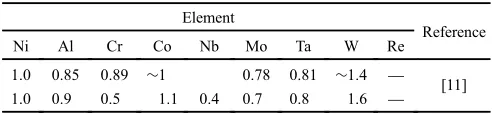
S=CiL, whereCiSandCiLare the concentration of solute i in solid and liquid, respectively. Literature11) reported the partition ratio of NiX binary alloys listed in Table 3 showing that Al, Cr, Nb, Mo and Ta partition to interdendritic region and W segregates to dendrite core, which is in agreement with the experimental results in this study. Importantly, the correlation of elemental segregation is found between NiX binary alloys and the multi-composition system. The elements segregating to interdendritic region in NiX binary alloys are the same ones that segregate to
interdendritic region in this multi-composition alloy (Al, Cr, Nb, Mo and Ta), while those segregating to dendrite core in NiX binary alloys are the same ones that segregate to dendrite core in this multi-composition alloy (W and Re). The agreement of segregation behavior suggests that the segre-gation tendency of solute elements is not affected by the interaction among elements presented in this multi-compo-sition Ni-based superalloy and the segregation behavior can be qualitatively analyzed by the partition ratio of NiX binary alloys to some extent.
The segregation behavior of elements, such as Al, Ta, W and Re, follows the segregation trends of reported model Ni-based superalloys.19)And Mo partitions to the interdendritic region, which is in agreement with the previous research.20) It is worth mentioning that Cr preferentially segregates to interdendritic region, which disagrees with other re-searches.19) E. C. Caldwell et al.21) found that the Mo
additions (1.6 mass%) appeared to decrease the segregation of Cr and actually appeared to change the direction of segregation of Cr. In this study, the content of Mo as high as 2.02 mass% can be responsible for the segregation behavior of Cr.
[image:4.595.316.534.71.235.2]It has been reported that the cooling rate has great influence on the segregation degree.9) In directional solid-ification, the cooling rate is equals to the product of temperature gradient and growth rate, namely (G·V). Provided that the variation of thermal gradient or its effect on solidification can be neglected, the primary and secondary dendrite arm spacings decrease and the dendrite is refined with increasing growth rate. Thus the local solidification time is shortened and diffusion rate/time decrease, which makes the degree of microsegregation reduced. Furthermore, the degree of microsegregation can be evaluated with effective partitioning coefficient22)given by:
Table 2 EPMA composition (mass%) of different microstructures and the segregation ration (SR) of each element at a growth rate of 60 µm/s.
Microstructure Element
Ni Al Cr Co Nb Mo Ta W Re Dendrite core 60.86 4.21 4.41 9.06 0.83 1.65 4.96 10.69 3.22 Interdendritic
region 56.99 4.93 5.53 9.27 2.31 3.82 8.00 7.21 1.83 Fine net-work
£/£Aeutectic 63.39 5.88 3.53 7.21 1.95 1.80 10.14 5.89 0.10 Coarse£Aphase 6.53 2.65 6.60 1.76 1.55 12.18 4.59 ® Segregation
ratio (SR) 0.94 1.17 1.25 1.02 2.78 2.32 1.61 0.67 0.57
Fig. 6 Segregation ratios (SR) at various growth rates.
Table 3 The partition ratios of NiX binary alloys. Element
Reference Ni Al Cr Co Nb Mo Ta W Re
[image:4.595.47.290.93.218.2] [image:4.595.304.550.292.349.2]ke¼k0=½k0þ ð1k0ÞexpðR¤=DLÞ ð2Þ
whereDLis solute diffusion coefficient in liquid,Ris growth
rate, k0 is the equilibrium partitioning coefficient, and ¤
is the boundary layer thickness ahead of L/S interface, respectively.
For k0 > 1 (SR < 1), with increasing growth rate, the
values of exp¹R·/Ddecrease, which makeskedecrease, so the
degree of microsegregation decreases; On the contrary, for
k0<1 (SR>1), with increasing growth rate, the values of
exp¹R·/D decrease, which makes ke increase, so eventually
the degree of microsegregation decreases. With increasing growth rate, the degree of microsegregation decreases no matter SR<1 orSR>1.
4. Conclusions
Quantitative characterization of microstructure evolution as well as dendrite segregation at a series of growth rates has been presented in a Ni-based superalloy under super-high thermal gradient directional solidification. The conclusions can be drawn as follows:
(1) The observed finer dendrites and decreasing size of
£A precipitates with increasing growth rate are found, which can be interpreted through nucleation and growth theory. With the growth rate increased, the morphology of the£Aprecipitates changes from irregular shape to a cuboidal one.
(2) Cr, Mo and £A forming elements (Al, Ta and Nb) all partition to interdendritic region. On the contrary, W and Re both preferably segregate to dendrite core. And the£/£Aeutectic are enriched in Nb, Ta and Al, and depleted in W and Re. With increasing growth rate the microsegregation degree decreases.
(3) In general, at fast growth rates (or high cooling rates), both finer dendrites and uniformly coherently cuboidal
£A precipitates favorable to the performance of super-alloys are obtained. In addition, decreased segregation at high growth rate is easy to homogenize in subsequent heat-treatment which helps reduce cost in the sub-sequent heat-treatment process. And also this study provides a support for the establishment of cast and heat treatment process.
Acknowledgements
The authors gratefully acknowledge thefinancial support of the Project of the Shanghai Science & Technology Commission.
REFERENCES
1) T. M. Pollock and S. Tin:J. Propul. Power22(2006) 361374.
2) H. Zhuangqi, L. Lirong, J. Tao and S. Xiaofeng: Aviation Engine31
(2005) 17.
3) A. F. Giamei and J. G. Tschinkel:Metall. Mater. Trans. A7(1976) 14271434.
4) C. L. Brundidge, J. D. Miller and T. M. Pollock:Metall. Mater. Trans. A42(2011) 27232732.
5) C. L. Brundidge, J. D. Miller and T. M. Pollock:Metall. Mater. Trans. A43(2012) 965976.
6) K. Zhao, Y. H. Ma and L. H. Lou:J. Alloy. Compd.475(2009) 648 651.
7) J. G. Li, X. M. Mao, H. Z. Fu and Z. X. Shi: Mater. Sci. Progr.5(1991) 461466.
8) L. Liu, T. Huang, M. Qu, G. Liu, J. Zhang and H. Fu:J. Mater. Process. Technol.210(2010) 159165.
9) L. Liu, T. W. Huang, J. Zhang and H. Z. Fu:Mater. Lett.61(2007) 227230.
10) X. J. Tang, Y. J. Zhang and J. G. Li: Rare Metal Mater. Eng.41(2012) 738742.
11) H. Z. Fu, J. J. Guo, L. Liu and J. S. Li:Directional Solidification and Processing of Advanced Materials, (Science Press, Beijing, 2008) pp. 519521.
12) Y. Z. Zhou and A. Volek:Scr. Mater.56(2007) 537540.
13) M. McLean:Directionally Solidified Materials for High Temperature Service, (The Metals Society, London, 1983) p. 11.
14) N. Warnken, D. Ma, M. Mathes and I. Steinbach:Mater. Sci. Eng. A
413414(2005) 267271.
15) B. C. Wilson, E. R. Cutler and G. E. Fuchs:Mater. Sci. Eng. A479
(2008) 356364.
16) T. Murakumo, T. Kobayashi, Y. Koizumi and H. Harada:Acta Mater.
52(2004) 37373744.
17) M. V. Nathal, R. A. MacKay and R. V. Miner:Metall. Mater. Trans. A
20(1989) 133141.
18) P. C. Xia, J. J. Yu, X. F. Sun, H. R. Guan and Z. Q. Hu:Mater. Sci. Eng. A476(2008) 3945.
19) R. M. Kearsey, J. C. Beddoes, P. Jones and P. Au:Intermetallics12
(2004) 903910.
20) E. C. Caldwell, F. J. Fela and G. E. Fuchs:JOM56(2004) 4448.
21) E. C. Caldwell, F. J. Fela and G. E. Fuchs:Superalloys, TMS (The Minerals, Metals & Materials Society) (2004) 811818.