Copyright ©2010 chromatic
Editor:Shane Warden
Logo design:Devin Muldoon
Cover design:Allison Randal and chromatic
ISBN-10:0-9779201-5-1
ISBN-13:978-0-9779201-5-0
Published by Onyx Neon Press,http://www.onyxneon.com/. The Onyx Neon logo is a trademark of Onyx Neon, Inc.
This book was typeset on Ubuntu GNU/Linux using Perl 5,Pod::PseudoPod::LaTeX, and LaTeX. Many thanks to the free software contributors who make these and other projects possible.
Please report any errors athttp://github.com/chromatic/modern_perl_book/.
We give this book away in the hope that it is useful. We encourage you to share this unmodified PDF with others, for free. If you do find this book useful, please seehttp://onyxneon.com/books/modern_perl/#why_freeto help us produce more such books in the future.
Preface i
Running Modern Perl . . . ii
Perl 5 and Perl 6 . . . iii
Credits . . . iii
The Perl Philosophy 1 Perldoc . . . 1
Expressivity . . . 2
Context . . . 3
Implicit Ideas . . . 6
Perl and Its Community 9 Community Sites . . . 9
Development Sites . . . 9
Events . . . 10
IRC . . . 10
The CPAN . . . 10
The Perl Language 13 Names . . . 13
Variables . . . 14
Values . . . 15
Control Flow . . . 23
Scalars . . . 35
Arrays . . . 36
Hashes . . . 40
Coercion . . . 47
Operators 59
Operator Characteristics . . . 59
Operator Types . . . 60
Functions 63 Declaring Functions . . . 63
Invoking Functions . . . 63
Function Parameters . . . 64
Functions and Namespaces . . . 66
Reporting Errors . . . 67
Advanced Functions . . . 68
Pitfalls and Misfeatures . . . 71
Scope . . . 72
Anonymous Functions . . . 75
Closures . . . 79
State versus Closures . . . 82
State versus Pseudo-State . . . 83
Attributes . . . 83
AUTOLOAD . . . 85
Regular Expressions and Matching 89 Literals . . . 89
The qr// Operator and Regex Combinations . . . 89
Quantifiers . . . 90
Greediness . . . 91
Regex Anchors . . . 92
Metacharacters . . . 92
Character Classes . . . 93
Capturing . . . 93
Grouping and Alternation . . . 95
Other Escape Sequences . . . 96
Assertions . . . 96
Regex Modifiers . . . 97
Smart Matching . . . 98
Objects 100 Moose . . . 100
Reflection . . . 113
Advanced OO Perl . . . 115
Style and Efficacy 117 Writing Maintainable Perl . . . 117
Writing Idiomatic Perl . . . 118
Writing Effective Perl . . . 118
Exceptions . . . 119
Pragmas . . . 121
Managing Real Programs 123 Testing . . . 123
Handling Warnings . . . 126
Files . . . 129
Modules . . . 134
Distributions . . . 137
The UNIVERSAL Package . . . 139
Code Generation . . . 141
Overloading . . . 145
Taint . . . 146
Perl Beyond Syntax 148 Idioms . . . 148
Global Variables . . . 153
What to Avoid 156 Barewords . . . 156
Indirect Objects . . . 158
Prototypes . . . 159
Method-Function Equivalence . . . 162
Tie . . . 163
Perl turns 23 years old later this year. The language has gone from a simple tool for system administration somewhere between shell scripting and C programming (Perl 1) to a powerful, general-purpose language steeped in a rich heritage (Perl 5) and a consistent, coherent, rethinking of programming in general intended to last for another 25 years (Perl 6).
Even so, most Perl 5 programs in the world take far too little advantage of the language. Youcanwrite Perl 5 programs as if they were Perl 4 programs (or Perl 3 or 2 or 1), but programs written to take advantage of everything amazing the worldwide Perl 5 community has invented, polished, and discovered are shorter, faster, more powerful, and easier to maintain than their alternatives.
Modern Perlis a loose description of how experienced and effective Perl 5 programmers work. They use language idioms. They take advantage of the CPAN. They’re recognizably Perlish, and they show good taste and craftsmanship and a full understanding of Perl.
You can learn this too.
Running Modern Perl
The Modern::Perl module is available from the CPAN. Install it yourself or replace it with: use 5.010;
use strict; use warnings;
With these lines in every example program, Perl will warn you of dubious constructs and typos and will enable new features of Perl 5.10 through thefeaturepragma (see Pragmas, page 121). For now, assume these lines are always present. You will understand them soon.
Unless otherwise mentioned, code snippets always assume the basic skeleton of a program:
#!/usr/bin/perl
use Modern::Perl;
# example code here ...
Other code snippets use testing functions such asok(),like(), andis()(see Testing, page 123). That skeleton program is:
#!/usr/bin/perl
use Modern::Perl; use Test::More;
# example code here ...
The examples in this book work best with Perl 5.10.0 or newer; ideally at least Perl 5.10.1. Many examples will work on older versions of Perl 5 with modest changes, but you will have more difficulty with anything older than 5.10.0. This book also describes (but does notrequirethe use of) features found in Perl 5.12.
You can often install a new version of Perl yourself. Windows users, download Strawberry Perl fromhttp://www.strawberryperl.
com/. Users of other operating systems with Perl 5 already installed (and a C compiler and the other development tools), start by installing the CPAN moduleApp::perlbrew1.
perlbrew allows you to install and to manage multiple versions of Perl 5. By default, it installs them to your own home directory. Not only can you have multiple versions of Perl 5 installed without affecting the system Perl but you can also install any module you like into these directories without asking your system administrator for specific permission.
Perl 5 and Perl 6
Should you learn Perl 5 or Perl 6? They share philosophy and syntax and libraries and community; they fill different niches. Learn Perl 5 if:
• You have existing Perl 5 code to maintain
• You need to take advantage of CPAN modules
• Your deployment strategy requires rigorous stability
Learn Perl 6 if:
• You’re comfortable managing frequent upgrades
• You can afford to experiment with new syntax and features
• You need new features only available in Perl 6
• You can contribute to its development (whether patches, bug reports, documentation, sponsorship, or other resources)
In general, Perl 5 development is conservative with regard to the core language. For good or for ill, change occurs slowly. Perl 6 is more experimental, as it considers finding the best possible design more important than keeping old code working. Fortunately, you can learn and use both languages (and they interoperate to an ever-improving degree).
This book discusses Perl 5. To learn more about Perl 6, seehttp://perl6.org/, try Rakudo (http://www.rakudo.org/), and refer to the bookUsing Perl 6, also published by Onyx Neon Press.
Credits
This book would not have been possible in its current form without questions, comments, suggestions, advice, wisdom, and encouragement from many, many people. In particular, the author and editor would like to thank:
John SJ Anderson, Peter Aronoff, Lee Aylward, Alex Balhatchet, Ævar Arnfjörð Bjarmason, Matthias Bloch, John Bokma, Vasily Chekalkin, Dmitry Chestnykh, E. Choroba, Paulo Custodio, Felipe, Shlomi Fish, Jeremiah Foster, Mark Fowler, John Gabriele, Andrew Grangaard, Bruce Gray, Ask Bjørn Hansen, Tim Heaney, Robert Hicks, Michael Hind, Mark Hindess, Yary Hluchan, Mike Huffman, Curtis Jewell, Mohammed Arafat Kamaal, James E Keenan, Yuval Kogman, Jan Krynicky, Jeff Lavallee, Moritz Lenz, Jean-Baptiste Mazon, Josh McAdams, Gareth McCaughan, John McNamara, Shawn M Moore, Alex Muntada, Carl Mäsak, Chris Niswander, Nelo Onyiah, Chas. Owens, ww from PerlMonks, Jess Robinson, Dave Rolsky, Gabrielle Roth, Andrew Savige, Lorne Schachter, Dan Scott, Alexander Scott-Johns, Phillip Smith, Christopher E. Stith, Mark A. Stratman, Bryan Summersett, Audrey Tang, Scott Thomson, Ben Tilly, Sam Vilain, Larry Wall, Colin Wetherbee, Frank Wiegand, Doug Wilson, Sawyer X, David Yingling, Marko Zagozen, harleypig, hbm, and sunnavy.
Any errors are the fault of the author’s own stubbornness.
Perl is a language for getting things done. It’s flexible, forgiving, and malleable. In the hands of a capable programmer, it can accomplish almost any task, from one-liner calculations and automations to multi-programmer, multi-year projects and everything in between.
Perl is powerful, and modern Perl—Perl which takes advantage of the best knowledge, deepest experience, and reusable idioms of the global Perl community—is maintainable, fast, and easy to use. Perhaps most importantly, it can help you do what you need to do with little frustration and no ceremony.
Perl is a pragmatic language. You, the programmer, are in charge. Rather than manipulating your mind and your problems to fit how the language designer thinks you should write programs, Perl allows you to solve your problems as you see fit.
Perl is a language which can grow with you. You can write useful programs with the knowledge that you can learn in an hour of reading this book. Yet if you take the time to understand the philosophies behind the syntax, semantics, and design of the language, you can be far more productive.
First, you need to know how to learn more.
Perldoc
One of Perl’s most useful and least appreciated features is theperldocutility. This program is part of every complete Perl 5 in-stallation2. It displays the documentation of every Perl module installed on the system—whether a core module or one installed
from the Comprehensive Perl Archive Network (CPAN)—as well as thousands of pages of Perl’s copious core documentation.
If you prefer an online version, http://perldoc.perl.org/hosts recent versions of the Perl documentation.
http://search.cpan.org/ displays the documentation of every module on the CPAN. Windows users, both ActivePerl and Strawberry Perl provide a link in your Start menu to the documentation.
The default behavior ofperldocis to display the documentation for a named module or a specific section of the core docu-mentation:
$ perldoc List::Util $ perldoc perltoc $ perldoc Moose::Manual
The first example extracts documentation written for theList::Utilmodule and displays it in a form appropriate for your screen. Community standards for CPAN modules (see The CPAN, page 10) suggest that additional libraries use the same documentation format and form as core modules, so there’s no distinction between reading the documentation for a core library such asData::Dumperor one installed from the CPAN. The standard documentation template includes a description of the module, demonstrates sample uses, and then contains a detailed explanation of the module and its interface. While the amount of documentation varies by author, the form of the documentation is remarkably consistent.
The second example displays a pure documentation file, in this case the table of contents of the core documentation itself. This file describes each individual piece of the core documentation; browse it for a good understanding of Perl’s breadth.
The third example resembles the second;Moose::Manualis part of the Moose CPAN distribution (see Moose, page 100). It is also purely documentation; it contains no code.
Similarly, perldoc perlfaq will display the table of contents for Frequently Asked Questions about Perl 5. Skimming these questions is invaluable.
Theperldocutility has many more abilities (seeperldoc perldoc). Two of the most useful are the-qand the-fflags. The
-qflag takes a keyword or keywords and searches only the Perl FAQ, displaying all results. Thusperldoc -q sortreturns three questions:How do I sort an array by (anything)?,How do I sort a hash (optionally by value instead of key)?, andHow can I always keep my hash sorted?.
The-fflag displays the core documentation for a builtin Perl function.perldoc -f sortexplains the behavior of thesort operator. If you don’t know the name of the function you want, useperldoc perlfuncto see a list of functions.
perldoc perlopandperldoc perlsyndocument Perl’s symbolic operators and syntactic constructs;perldoc
perldiagexplains the meanings of Perl’s warning messages.
Perl 5’s documentation system is POD, or Plain Old Documentation.perldoc perlpod describes how POD works. The
perldocutility will display the POD in any Perl module you create and install for your project, and other POD tools such as
podchecker, which validates the form of your POD, andPod::Webserver, which displays local POD as HTML through a minimal web server, will handle valid POD correctly.
perldochas other uses. With the-lcommand-line flag, it displays thepathto the documentation file rather than the contents of the documentation3. With the-mflag, it displays the entirecontentsof the module, code and all, without processing any POD instructions.
Expressivity
Before Larry Wall created Perl, he studied linguistics and human languages. His experiences continue to influence Perl’s design. There are many ways to write a Perl program depending on your project’s style, the available time to create the program, the expected maintenance burden, or even your own personal sense of expression. You may write in a straightforward, top-to-bottom style. You may write many small and independent functions. You may model your problem with classes and objects. You may eschew or embrace advanced features.
Perl hackers have a slogan for this:TIMTOWTDI, pronounced “Tim Toady”, or “There’s more than one way to do it!”
Where this expressivity can provide a large palette with which master craftsman can create amazing and powerful edifices, unwise conglomerations of various techniques can impede maintainability and comprehensibility. You can write good code or you can make a mess. The choice is yours4.
Where other languages might suggest that one enforced way to write any operation is the right solution, Perl allows you to optimize for your most important criteria. Within the realm of your own problems, you can choose from several good approaches—but be mindful of readability and future maintainability.
As a novice to Perl, you may find certain constructs difficult to understand. The greater Perl community has discovered and promoted several idioms (see Idioms, page 148) which offer great power. Don’t expect to understand them immediately. Some of Perl’s features interact in subtle ways.
Another design goal of Perl is to surprise experienced (Perl) programmers very little. For example, adding two scalars together with a numeric operator ($first_num + $second_num) is obviously a numeric operation; the operator must treat both scalars
3Be aware that a module may have a separate.podfile in addition to its.pmfile.
Learning Perl is like learning a second or third spoken language. You’ll learn a few words, then string together some sentences, and eventually will be able to have small, simple conversations. Mastery comes with practice, both reading and writing. You don’t have to understand all of the details of this chapter immediately to be productive with Perl. Keep these principles in mind as you read the rest of this book.
as numeric values to produce a numeric result. No matter what the contents of$first_numand$second_num, Perl will coerce them to numeric values (see Numeric Coercion, page 47) without requiring the user or programmer to specify this conversion manually. You’ve expressed your intent to treat them as numbers by choosing a numeric operator (see Numeric Operators, page 60), so Perl happily handles the rest.
In general, Perl programmers can expect Perl to do what you mean; this is the notion of DWIM—do what I mean. You may also see this mentioned as theprinciple of least astonishment. Given a cursory understanding of Perl (especially context; see Context, page 3), it should be possible to read a single unfamiliar Perl expression and understand its intent.
If you’re new to Perl, you will develop this skill over time. The flip side of Perl’s expressivity is that Perl novices can write useful programs before they learn all of Perl’s powerful features. The Perl community often refers to this asbaby Perl. Though it may sound dismissive, please don’t take offense; everyone is a novice once. Take the opportunity to learn from more experienced programmers and ask for explanations of idioms and constructs you don’t yet understand.
A Perl novice might multiply a list of numbers by three by writing: my @tripled;
my $count = @numbers;
for (my $i = 0; $i < $count; $i++) {
$tripled[$i] = $numbers[$i] * 3; }
A Perl adept might write:
my @tripled;
for my $num (@numbers) {
push @tripled, $num * 3; }
An experienced Perl hacker might write:
my @tripled = map { $_ * 3 } @numbers;
Experience writing Perl will help you to focus on what you want to do rather than how to do it.
Perl is a language intended to grow with your understanding of programming. It won’t punish you for writing simple pro-grams. It allows you to refine and expand programs for clarity, expressivity, reuse, and maintainability. Take advantage of this philosophy. It’s more important to accomplish your task well than to write a conceptually pure and beautiful program.
The rest of this book demonstrates how to use Perl to your advantage.
Context
Spoken languages have a notion ofcontextwhere the correct usage or meaning of a word or phrase depends on its surroundings. You may understand this in a spoken language, where the inappropriate pluralization of “Please give me one hamburgers!”5
sounds wrong or the incorrect gender of “la gato”6makes native speakers chuckle. Consider also the pronoun “you” or the noun
“sheep” which can be singular or plural depending on the remainder of the sentence.
Context in Perl is similar; the language understands expectations of the amount of data to provide as well as what kind of data to provide. Perl will happily attempt to provide exactly what you ask for—and you ask by choosing one operator over another.
One type of context in Perl means that certain operators have different behavior if you want zero, one, or many results. It’s possible that a specific construct in Perl will do something different if you say “Fetch me zero results; I don’t care about any” than if you say “Fetch me one result” or “Fetch me many results.”
Likewise, certain contexts make it clear that you expect a numeric value, a string value, or a value that’s either true or false.
Context can be tricky if you try to write or read Perl code as a series of single expressions which stand apart from their environments. You may find yourself slapping your forehead after a long debugging session when you discover that your assumptions about context were incorrect. However, if you’re cognizant of contexts, they can make your code clearer, more concise, and more flexible.
Void, Scalar, and List Context
One of the aspects of context governshow manyitems you expect. This isamount context. Compare this context to subject-verb number agreement in English. Even if you haven’t learned the formal description of the rule, you probably understand the error in the sentence “Perl are a fun language”. The rule in Perl is that the number of items you request determines how many you get.
Suppose you have a function (see Declaring Functions, page 63) calledfind_chores()which sorts all of your chores in order of their priority. The means by which you call this function determines what it will produce. You may have no time to do chores, in which case calling the function is an attempt to look industrious. You may have enough time to do one task, or you could have a burst of energy and a free weekend and the desire to do as much of the list as possible.
If you call the function on its own and never use its return value, you’ve called the function invoid context:
find_chores();
Assigning the function’s return value to a single element evaluates the function inscalar context:
my $single_result = find_chores();
Assigning the results of calling the function to an array (see Arrays, page 36) or a list, or using it in a list, evaluates the function inlist context:
my @all_results = find_chores(); my ($single_element) = find_chores(); process_list_of_results( find_chores() );
The second line of the previous example may look confusing; the parentheses there give a hint to the compiler that although there’s only a scalar, this assignment should occur in list context. It’s semantically equivalent to assigning the first item in the list to a scalar and assigning the rest of the list to a temporary array, and then throwing away the array—except that no assignment to the array actually occurs:
my ($single_element, @rest) = find_chores();
Evaluating a function or expression—except for assignment—in list context can produce confusion. Lists propagate list context to the expressions they contain. Both calls tofind_chores()occur in list context:
process_list_of_results( find_chores() );
my %results = (
cheap_operation => $cheap_operation_results, expensive_operation => find_chores(), # OOPS! );
The latter example often surprises novice programmers who expect scalar context for the call.expensive_operationoccurs is in list context, because its results are assigned to a hash. Hash assignments take a list of key/value pairs, which causes any the evaluation of any expressions in that list to occur in list context.
Use thescalaroperator to impose scalar context:
my %results = (
cheap_operation => $cheap_operation_results, expensive_operation => scalar find_chores(), );
Why does context matter? The function can examine its calling context and decide how much work it needs to do before returning its results. In void context,find_chores()can do nothing. In scalar context, it can find only the most important task. In list context, it has to sort and return the entire list.
Numeric, String, and Boolean Context
Another type of context determines how Perl understands a piece of data—nothow manypieces of data you want, but what the data means. You’ve probably already noticed that Perl’s flexible about figuring out if you have a number or a string and converting between the two as you want them. Thisvalue contexthelps to explain how it does so. In exchange for not having to declare (or at least track) explicitly what typeof data a variable contains or a function produces, Perl offers specific type contexts that tell the compiler how to treat a given value during an operation.
Suppose you want to compare the contents of two strings. Theeqoperator tells you if the strings contain the same information:
say "Catastrophic crypto fail!" if $alice eq $bob;
You may have had a baffling experience where youknowthat the strings are different, but they still compare the same:
my $alice = 'alice';
say "Catastrophic crypto fail!" if $alice == 'Bob'; # OOPS
Theeqoperator treats its operands as strings by enforcingstring contexton them. The==operator imposesnumeric context. The example code fails because the value of both strings when treated as numbers is0(see Numeric Coercion, page 47).
Boolean contextoccurs when you use a value in a conditional statement. In the previous examples, theifstatement evaluated the results of theeqand==operators in boolean context.
Perl will do its best to coerce values to the proper type (see Coercion, page 47), depending on the operators you use. Be sure to use the proper operator for the type of context you want.
In rare circumstances, you may need to force an explicit context where no appropriately typed operator exists. To force a numeric context, add zero to a variable. To force a string context, concatenate a variable with the empty string. To force a boolean context, double the negation operator:
my $numeric_x = 0 + $x; # forces numeric context my $stringy_x = '' . $x; # forces string context my $boolean_x = !!$x; # forces boolean context
Implicit Ideas
Like many spoken languages, Perl provides linguistic shortcuts. Context is one such feature: both the compiler and a program-mer reading the code can understand the expected number of results or the type of an operation from existing information without requiring additional information to disambiguate.
Other linguistic features include default variables—essentially pronouns.
The Default Scalar Variable
Thedefault scalar variable(also called thetopic variable),$_, is the best example of a linguistic shortcut in Perl. It’s most notable in itsabsence: many of Perl’s builtin operations work on the contents of$_in the absence of an explicit variable. You can still use$_as the variable, but it’s often unnecessary.
For example, thechompoperator removes any trailing newline sequence from the given string:
my $uncle = "Bob\n"; say "'$uncle'"; chomp $uncle; say "'$uncle'";
Without an explicit variable,chompremoves the trailing newline sequence from$_. These two lines of code are equivalent:
chomp $_; chomp;
$_has the same function in Perl as the pronounitin English. Read the first line as “chompit” and the second as “chomp”. Perl understands what you mean when you don’t explain what to chomp; Perl will always chompit.
Similarly, thesayandprintbuiltins operate on$_in the absence of other arguments:
print; # prints $_ to the currently selected filehandle say; # prints $_ to the currently selected filehandle
# with a trailing newline
Perl’s regular expression facilities (see Regular Expressions and Matching, page 89) can also operate on$_to match, substitute, and transliterate:
$_ = 'My name is Paquito'; say if /My name is/;
s/Paquito/Paquita/;
tr/A-Z/a-z/; say;
Many of Perl’s scalar operators (includingchr,ord,lc,length,reverse, anduc) work on the default scalar variable if you do not provide an alternative.
Perl’s looping directives (see Looping Directives, page 27) also set$_, such asforiterating over a list:
say "#$_" for 1 .. 10;
for (1 .. 10) {
say "#$_"; }
while (<STDIN>) {
chomp;
say scalar reverse; }
. . . ormaptransforming a list:
my @squares = map { $_ * $_ } 1 .. 10; say for @squares;
. . . orgrepfiltering a list:
say 'Brunch time!' if grep { /pancake mix/ } @pantry;
If you call functions within code that uses$_whether implicitly or explicitly, they may overwrite the value of$_. Similarly, if you write a function which uses$_, you may clobber a caller function’s use of$_. Perl 5.10 allows you to usemyto declare
$_as a lexical variable, which prevents this clobbering behavior. Be wise.
while (<STDIN>) {
chomp;
# BAD EXAMPLE
my $munged = calculate_value( $_ ); say "Original: $_";
say "Munged : $munged"; }
In this example, if calculate_value() or any other function it happened to call changed $_, it would remain changed throughout thewhileloop. Adding amydeclaration prevents that behavior:
while (my $_ = <STDIN>) {
... }
Of course, using a named lexical can be just as clear:
while (my $line = <STDIN>) {
... }
Use$_as you would the word “it” in formal writing: sparingly, in small and well-defined scopes.
The Default Array Variables
While Perl has a single implicit scalar variable, it has two implicit array variables. Perl passes arguments to functions in an array named@_. Array manipulation operations (see Arrays, page 36) inside functions affect this array by default. Thus, these two snippets of code are equivalent:
sub foo {
my $arg = shift; ...
}
sub foo_explicit {
my $arg = shift @_; ...
Just as$_corresponds to the pronounit,@_corresponds to the pronountheyorthem.Unlike$_, Perl automatically localizes
@_for you when you call other functions. The array operatorsshiftandpopoperate on@_with no other operands provided. Outside of all functions, the default array variable@ARGVcontains the command-line arguments to the program. The same array operators which use @_implicitlywithin functions use@ARGV implicitly outside of functions. You cannot use@_when you mean@ARGV.
ARGVhas one special case. If you read from the null filehandle<>, Perl will treat every element in@ARGVas thenameof a file to open for reading. (If@ARGVis empty, Perl will read from standard input.) This implicit@ARGVbehavior is useful for writing short programs, such as this command-line filter which reverses its input:
while (<>) {
chomp;
say scalar reverse; }
Whyscalar?sayimposes list context on its operands.reversepasses its context on to its operands, treating them as a list in list context and a concatenated string in scalar context. This sounds confusing, because it is. Perl 5 arguably should have had different operators for these different operations.
If you run it with a list of files:
$ perl reverse_lines.pl encrypted/*.txt
One of Larry’s main goals for Perl 5 was to encourage Perl development and evolution outside the core distribution. Perl 4 had several forks, because there was no easy way to connect it to a relational database, for example. Larry wanted people to create and maintain their own extensions without fragmenting Perl into thousands of incompatible pidgins.
You can add technical mechanisms for extensions, but you must also consider community aspects as well. Extensions and enhancements that no one shares are extensions and enhancements that everyone has to build and test and debug and maintain themselves. Yet shared extensions and libraries are worthless if you can’t find them, or you can’t enhance them, or you don’t have permission to use them.
Fortunately, the Perl community exists. It’s strong and healthy. It welcomes willing participants at all levels—and not just for people who produce and share code. Consider taking advantage of the knowledge and experience of countless other Perl programmers, and sharing your abilities as well.
Community Sites
Perl’s homepage athttp://www.perl.org/hosts documentation, source code, tutorials, mailing lists, and several important community projects. If you’re new to Perl, the Perl beginners mailing list is a friendly place to ask novice questions and get accurate and helpful answers. Seehttp://beginners.perl.org/.
An important domain of note ishttp://dev.perl.org/, a central site for core development of Perl 5, Perl 67, and even Perl 1.
Perl.com publishes several articles and tutorials about Perl programming every month. Its archives reach back into the 20th century. Seehttp://www.perl.com/.
The CPAN’s (see The CPAN, page 10) central location ishttp://www.cpan.org/, though experienced users spend more time onhttp://search.cpan.org/. This central software distribution hub of reusable, free Perl code is an essential part of the Perl community.
PerlMonks, athttp://perlmonks.org/, is a venerable community site devoted to questions and answers and other discus-sions about Perl programming. It celebrated its tenth anniversary in December 2009, making it one of the longest- lasting web communities dedicated to any programming language.
Several community sites offer news and commentary.http://blogs.perl.org/is a community site where many well known developers post.
Other sites aggregate the musings of Perl hackers, includinghttp://perlsphere.net/,http://planet.perl.org/, and
http://ironman.enlightenedperl.org/. The latter is part of an initiative from the Enlightened Perl Organization (http:
//enlightenedperl.org/) to increase the amount and improve the quality of Perl publishing on the web.
Perl Buzz (http://perlbuzz.com/) collects and republishes some of the most interesting and useful Perl news on a regular basis.
Development Sites
Best Practical Solutions (http://bestpractical.com/) maintains an installation of their popular request tracking system, RT, for CPAN authors as well as Perl 5 and Perl 6 development. Every CPAN distribution has its own RT queue, linked
fromsearch.cpan.organd available onhttp://rt.cpan.org/. Perl 5 and Perl 6 have separate RT queues available on
http://rt.perl.org/.
The Perl 5 Porters (orp5p) mailing list is the focal point of the development of Perl 5 itself. Seehttp://lists.cpan.org/
showlist.cgi?name=perl5-porters.
The Perl Foundation (http://www.perlfoundation.org/) hosts a wiki for all things Perl 5. Seehttp://www.perlfoundation.
org/perl5.
Many Perl hackers use Github (http://github.com/) to host their projects8. See especially Gitpan (http://github.com/
gitpan/), which hosts Git repositories chronicling the complete history of every distribution on the CPAN.
Events
There are plenty of events in the physical world as well. The Perl community holds a lot of conferences, workshops, and seminars. In particular, the community-run YAPC—Yet Another Perl Conference—is a successful, local, low-cost conference model held on multiple continents. Seehttp://yapc.org/.
The Perl Foundation wiki lists other events athttp://www.perlfoundation.org/perl5/index.cgi?perl_events.
There are also hundreds of local Perl Mongers groups which get together frequently for technical talks and social interaction. Seehttp://www.pm.org/.
IRC
When Perl mongers aren’t at local meetings or conferences or workshops, many collaborate and chat online through IRC, a textual group chat system from the early days of the Internet. Many of the most popular and useful Perl projects have their own IRC channels, such as#mooseor#catalyst.
The main server for Perl community isirc://irc.perl.org/. Other notable channels include#perl-help, for general assis-tance on Perl programming, and#perl-qa, devoted to testing and other quality issues. Be aware that the channel#perlisnotfor general help—instead, it’s a general purpose room for discussing whatever its participants want to discuss9.
The CPAN
Perl 5 is a pragmatic language. It’ll help you get your work done. Yet the ever-pragmatic Perl community has extended that language and made their work available to the world. If you have a problem to solve, chances are someone’s already uploaded code to the CPAN for it.
The line between a modern language and its libraries is fuzzy. Is a language only syntax? Is it the core libraries? Is it the availability of external libraries and the ease at which you can use them within your own projects?
Regardless of how you answer those questions for any other language, modern Perl programming makes heavy use of the CPAN (http://www.cpan.org/). The CPAN, or Comprehensive Perl Archive Network, is an uploading and mirroring system for redistributable, reusable Perl code. It’s one of—if notthe—largest archives of libraries of code in the world.
CPAN mirrorsdistributions, which tend to be collections of reusable Perl code. A single distribution can contain one or more
modules, or self-contained libraries of Perl code. Each distribution lives in its own namespace on the CPAN and contains its own metadata. You can build, install, test, and update each distribution. Distributions may depend on other distributions. For this reason, installing distributions through a CPAN client is often simpler than doing so manually.
The CPAN itself is merely a mirroring service. Authors upload distributions containing modules, and the CPAN sends them to mirror sites, from which users and CPAN clients download, configure, build, test, and install distributions. Yet the CPAN has succeeded because of this simplicity, and because of the contributions of thousands of volunteers who’ve built on this
8. . . including the sources of this book athttp://github.com/chromatic/modern_perl_book/
The CPANaddshundreds of registered contributors and thousands of indexed modules in hundreds of distributions every month. Those numbers do not take into account updates. At printing time in October 2010, search.cpan.org reported 8465 uploaders, 86470 modules, and 21116 distributions.
distribution system to produce something greater. In particular, community standards have evolved to identify the attributes and characteristics of well-formed CPAN distributions. These include:
Standards for installation to work with automated CPAN installers.
Standards for metadata to describe what each distribution includes and any dependencies of the distribution.
Standards for documentation and licensing to describe what the distribution does and how you may use it.
Additional CPAN services provide comprehensive automated testing and reporting of every CPAN distribution for adherence to packaging and distribution guidelines and correctness of behavior on various platforms and versions of Perl. Every CPAN distribution has its own ticket queue on http://rt.cpan.org/for reporting bugs and working with authors. Distributions also have historical versions available on the CPAN, ratings, annotations for the documentation, and other useful information. All of this is available fromhttp://search.cpan.org/.
Modern Perl installations include two clients to connect to, search, download, build, test, and install CPAN distributions, CPAN.pm and CPANPLUS. They behave equivalently; their use is a matter of taste. This book recommends the use of CPAN.pm solely due to its ubiquity.
If you use a recent version of CPAN.pm (as of this writing, 1.9402 is the latest stable release), CPAN.pm configuration is largely decision-free. For any complete installation of Perl, you may start the client with:
$ cpan
To install a distribution:
$ cpan Modern::Perl
Eric Wilhelm’s tutorial on configuring CPAN.pm10includes a great troubleshooting section.
Even though the CPAN client is a core module for the Perl 5 distribution, you may also have to install standard development tools such as amakeutility and possibly a C compiler to install all of the distributions you want. Windows users, see Strawberry Perl (http://strawberryperl.com/) and Strawberry Perl Professional. Mac OS X users need their developer tools installed. Unix and Unix-like users, consult your local system administrator.
For your work setting up a CPAN client and an environment to build and install distributions, you get access to libraries for everything from database access to profiling tools to protocols for almost every network device ever created to sound and graphics libraries and wrappers for shared libraries on your system.
Modern Perl without the CPAN is just another language. Modern Perl with the CPAN is amazing.
CPAN Management Tools
Serious Perl developers often manage their own Perl library paths or even full installations. Several projects help to make this possible.
App::cpanminusis a new CPAN client with goals of speed, simplicity, and zero configuration. Installation is as easy as:
$ curl -LO http://xrl.us/cpanm $ chmod +x cpanm
App::perlbrewis a system to manage and to switch between your own installations of multiple versions and configurations of Perl. Installation is as easy as:
$ curl -LO http://xrl.us/perlbrew $ chmod +x perlbrew
$ ./perlbrew install $ perldoc App::perlbrew
Thelocal::libCPAN distribution allows you to install and to manage distributions in your own user directory, rather than for the system as a whole. This is an effective way to maintain CPAN distributions without affecting other users. Installation is somewhat more involved than the previous two distributions. Seehttp://search.cpan.org/perldoc?local::libfor more details.
The Perl language has several smaller parts which combine to form its syntax. Unlike spoken language, where nuance and tone of voice and intuition allow people to communicate despite slight misunderstandings and fuzzy concepts, computers and source code require precision. You can write effective Perl code without knowing every detail of every language feature, but you must understand how they work together to write Perl code well.
Names
Names (or identifiers) are everywhere in Perl programs: variables, functions, packages, classes, and even filehandles have names. These names all start with a letter or an underscore. They may optionally include any combination of letters, num-bers, and underscores. When theutf8pragma (see Unicode and Strings, page 17) is in effect, you may use any valid UTF-8 characters in identifiers. These are all valid Perl identifiers:
my $name;
my @_private_names; my %Names_to_Addresses;
sub anAwkwardName3;
# with use utf8; enabled package Ingy::Döt::Net;
These are invalid Perl identifiers:
my $invalid name; my @3;
my %~flags;
package a-lisp-style-name;
These rules only apply to names which appear in literal form in source code; that is, if you’ve typed it directly like sub
fetch_pieormy $waffleiron.
Perl’s dynamic nature makes it possible to refer to entities with names generated at runtime or provided as input to a program. These aresymbolic lookups. You get more flexibility this way at the expense of some safety. In particular, invoking functions or methods indirectly or looking up symbols in a namespace lets you bypass Perl’s parser, which is the only part of Perl that enforces these grammatical rules. Be aware that doing so can produce confusing code; a hash (see Hashes, page 40) or nested data structure (see Nested Data Structures, page 55) is often clearer.
Variable Names and Sigils
Variable namesalways have a leading sigil which indicates the type of the variable’s value.Scalar variables(see Scalars, page 35) have a leading dollar sign ($) character.Array variables(see Arrays, page 36) have a leading at sign (@) character.Hash variables(see Hashes, page 40) have a leading percent sign (%) character:
my $scalar; my @array; my %hash;
my ($bad_name, @bad_name, %bad_name);
Perl won’t get confused, but people reading the code might.
Perl 5 usesvariant sigils, where the sigil on a variable may change depending on what you do with it. For example, to access an element of an array or a hash, the sigil changes to the scalar sigil ($):
my $hash_element = $hash{ $key }; my $array_element = $array[ $index ]
$hash{ $key } = 'value'; $array[ $index ] = 'item';
In the latter two lines, using a scalar element of an aggregate as anlvalue(the target of an assignment, on the left side of the= character) imposes scalar context (see Context, page 3) on thervalue(the value assigned, on the right side of the=character). Similarly, accessing multiple elements of a hash or an array—an operation known asslicing—uses the at symbol (@) as the leading sigil and imposes list context:
my @hash_elements = @hash{ @keys }; my @array_elements = @array[ @indexes ];
my %hash;
@hash{ @keys } = @values;
The most reliable way to determine the type of a variable—scalar, array, or hash—is to look at the operations performed on it. Scalars support all basic operations, such as string, numeric, and boolean manipulations. Arrays support indexed access through square brackets. Hashes support keyed access through curly brackets.
Package-Qualified Names
Occasionally you may need to refer to functions or variables in a separate namespace. Often you will need to refer to a class by itsfully-qualified name. These names are collections of package names joined by double colons (::). That is,
My::Fine::-Packagerefers to a logical collection of variables and functions.
While the standard naming rules apply to package names, by convention user-defined packages all start with uppercase letters. The Perl core reserves lowercase package names for core pragmas (see Pragmas, page 121), such asstrictandwarnings. This is a policy enforced by community guidelines instead of Perl itself.
Namespaces do not nest in Perl 5. The relationship between Some::Package andSome::Package::Refinementis only a storage mechanism, with no further implications on the relationships between parent and child or sibling packages. When Perl looks up a symbol in Some::Package::Refinement, it looks in the main::symbol table for a symbol representing theSome::namespace, then in there for thePackage::namespace, and so on. It’s your responsibility to make anylogical
relationships between entities obvious when you choose names and organize your code.
Variables
Avariablein Perl is a storage location for a value (see Values, page 15). You can work with values directly, but all but the most trivial code works with variables. A variable is a level of indirection; it’s easier to explain the Pythagorean theorem in terms of the variablesa,b, andcthan with the side lengths of every right triangle you can imagine. This may seem basic and obvious, but to write robust, well-designed, testable, and composable programs, you must identify and exploit points of genericity wherever possible.
Variable Scopes
package Store::Toy;
our $discount = 0.10;
package Store::Music;
# $Store::Toy::discount still visible as $discount say "Our current discount is $discount!";
Variable Sigils
In Perl 5, the sigil of the variable in a declaration determines the type of the variable, whether scalar, array, or hash. The sigil of the variable used to access the variable determines the type of access to its value. Sigils on variables vary depending on what you do to the variable. For example, declare an array as@values. Access the first element—a single value—of the array with
$values[0]. Access a list of values from the array with@values[ @indices ].
Anonymous Variables
Perl 5 variables do notneed names; Perl manages variables just fine without caring about how you refer to them. Variables created without literal names in your source code (such as$apple,@boys,%cheeseburgers) areanonymousvariables. The only way to access anonymous variables is by reference (see References, page 50).
Variables, Types, and Coercion
A variable in Perl 5 represents two things: the value (a dollar value, a list of pizza toppings, a group of guitar shops and their phone numbers) and the container which stores that value. Perl 5’s type system deals withvalue typesandcontainer types. A variable’s value type—whether a value is a string or a number, for example—can change. You may store a string in a variable in one line, append to that variable a number on the next, and reassign a reference to a function (see Function References, page 53) on the third. A variable’scontainer type—whether it’s a scalar, an array, or a hash—cannot change.
Assigning to a variable may cause coercion (see Coercion, page 47). The documented way to determine the number of entries in an array is to evaluate that array in scalar context (see Context, page 3). Because a scalar variable can only ever contain a scalar, assigning an array to a scalar imposes scalar context on the operation and produces the number of elements in the array:
my $count = @items;
The relationship between variable types, sigils, and context is vital to a proper understanding of Perl.
Values
Effective Perl programs depend on the accurate representation and manipulation of values.
Computer programs containvariables: containers which holdvalues. Values are the actual data the programs manipulate. While it’s easy to explain what that data might be—your aunt’s name and address, the distance between your office and a golf course on the moon, or the weight of all cookies you’ve eaten in the past year—the rules regarding the format of that data are often strict. Writing an effective program often means understanding the best (simplest, fastest, most compact, or easiest) way of representing that data.
While the structure of a program depends heavily on the means by which you model your data with appropriate variables, these variables would be meaningless if they couldn’t accurately contain the data itself—the values.
Strings
Astringis a piece of textual or binary data with no particular formatting, no particular contents, and no other meaning to the program. It could be your name. It could be the contents of an image file read from your hard drive. It could be the Perl program itself. A string has no meaning to the program until you give it meaning.
To represent a string in your program, you must surround it with a pair of quoting characters. The most commonstring delimiters
my $name = 'Donner Odinson, Bringer of Despair'; my $address = "Room 539, Bilskirnir, Valhalla";
Perl strings do not have a fixed length after you declare them. Perl allows you to manipulate and modify strings as necessary and will handle all relevant memory management for you.
Characters in asingle-quoted stringrepresent themselves literally, with two exceptions. You may embed a single quote inside a single-quoted string by escaping the quote with a leading backlash:
my $reminder = 'Don\'t forget to escape the single quote!';
You must also escape any backslash at the end of the string to avoid escaping the closing delimiter and producing a syntax error:
my $exception = 'This string ends with a backslash, not a quote: \\';
Any other backslash appears literally in the string, but given two adjacent backslashes, the first will escape the second:
is('Modern \ Perl', 'Modern \\ Perl', 'single quotes backslash escaping');
A double-quoted stringhas more complex (and often, more useful) behavior. For example, you may encode non-printable characters in the string:
my $tab = "\t"; my $newline = "\n"; my $carriage = "\r"; my $formfeed = "\f"; my $backspace = "\b";
This demonstrates a useful principle: the syntax used to declare a string may vary. You can represent a tab within a string with the\tescape or by typing a tab directly. As Perl runs, both strings behave the same way, even though the specific representation of the string may differ in the source code.
A string declaration may cross logical newlines, such that these two strings are equivalent:
my $escaped = "two\nlines"; my $literal = "two
lines";
is( $escaped, $literal, '\n and newline are equivalent' );
Youcanenter these characters directly in the strings, but it’s often difficult to see the visual distinction between one tab character and four (or two or eight) spaces.
You may alsointerpolatethe value of a scalar variable or the values of an array within a double-quoted string, such that the contents of the variable become part of the string as if you’d written a concatenation operation directly:
my $factoid = "Did you know that $name lives at $address?";
# equivalent to
my $factoid = 'Did you know that ' . $name . ' lives at ' . $address . '?';
my $quote = "\"Ouch,\", he cried. \"That hurt!\"";
If you find that hideously ugly, you may use an alternatequoting operator. Theqoperator indicates single quoting, while the
qqoperator provides double quoting behavior. In each case, you may choose your own delimiter for the string. The character immediately following the operator determines the beginning and end of the string. If the character is the opening character of a balanced pair—such as opening and closing braces—the closing character will be the final delimiter. Otherwise, the character itself will be both the starting and ending delimiter.
my $quote = qq{"Ouch", he said. "That hurt!"}; my $reminder = q^Didn't need to escape the single quote!^; my $complaint = q{It's too early to be awake.};
Even though you can declare a complex string with a series of embedded escape characters, sometimes it’s easier to declare a multi-line string on multiple lines. Theheredocsyntax lets you assign one or more lines of a string with a different syntax:
my $blurb =<<'END_BLURB';
He looked up. "Time is never on our side, my child. Do you see the irony? All they know is change. Change is the constant on which they all can agree. Whereas we, born out of time to remain perfect and perfectly self-aware, can only suffer change if we pursue it. It is against our nature. We rebel against that change. Shall we consider them greater for it?"
END_BLURB
The<<'END_BLURB'syntax has three parts. The double angle-brackets introduce the heredoc. The quotes determine whether the heredoc obeys single-quoted or double-quoted behavior with regard to variable and escape character interpolation. They’re optional; the default behavior is double-quoted interpolation. TheEND_BLURBitself is an arbitrary identifier which the Perl 5 parser uses as the ending delimiter.
Be careful; regardless of the indentation of the heredoc declaration itself, the ending delimitermuststart at the beginning of the line:
sub some_function {
my $ingredients =<<'END_INGREDIENTS'; Two eggs
One cup flour Two ounces butter One-quarter teaspoon salt One cup milk
One drop vanilla Season to taste END_INGREDIENTS }
If the identifier begins with whitespace, that same whitespace must be present exactly in the ending delimiter. Even if you do indent the identifier, Perl 5 willnotremove equivalent whitespace from the start of each line of the heredoc.
You may use a string in other contexts, such as boolean or numeric; its contents will determine the resulting value (see Coercion, page 47).
Unicode and Strings
Unicodeis a system for representing characters in the world’s written languages. While most English text uses a character set of only 127 characters (which requires seven bits of storage and fits nicely into eight-bit bytes), it’s naïve to believe that you won’t someday need an umlaut, for example.
Sequences of Unicode characters
The Unicode character set contains characters from the scripts of most languages, and various other symbols. Each character has acodepoint, a unique number which identifies it in the Unicode character set.
Sequences of octets
Binary data is a sequence ofoctets—8 bit numbers, each of which can represent a number between 0 and 255.
Whyoctetand notbyte? Think of Unicode as characters without thinking of any particular size of the representation of those characters in memory. Assuming that one character fits in one byte will cause you no end of Unicode grief.
Unicode strings and binary strings look very similar. They each have alength(), and they support standard string operations such as concatenation, splicing, and regular expression processing. Any string which is not purely binary data is textual data, and should be a sequence of Unicode characters.
However, because of how your operating system represents data on disk or from users or over the network—as sequences of octets—Perl can’t know if the data you read is an image file or a text document or anything else. By default, Perl treats all incoming data as sequences of octets. Any additional meaning of the string’s contents are your responsibility.
Character Encodings
A Unicode string is a sequence of octets which represent a sequence of characters. AUnicode encodingmaps octet sequences to characters. Some encodings, such as UTF-8, can encode all of the characters in the Unicode character set. Others represent a subset of Unicode characters. For example, ASCII encodes plain English text with no accented characters and Latin-1 can represent text in most languages which use the Latin alphabet.
If you always decode to and from the appropriate encoding at the inputs and outputs of your program, you will avoid many problems.
Unicode in Your Filehandles
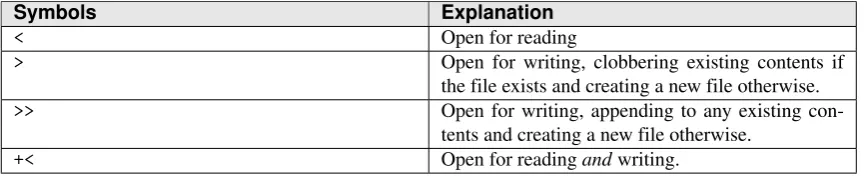
One source of Unicode input is filehandles (see Files, page 129). If you tell Perl that a specific filehandle works with encoded text, Perl can convert the data to Unicode strings automatically. To do this, add a IO layer to the mode of theopenbuiltin. An
IO layerwraps around input or output and converts the data. In this case, the:utf8layer decodes UTF-8 data:
use autodie;
open my $fh, '<:utf8', $textfile;
my $unicode_string = <$fh>;
You may also modify an existing filehandle withbinmode, whether for input or output:
binmode $fh, ':utf8'; my $unicode_string = <$fh>;
binmode STDOUT, ':utf8'; say $unicode_string;
Without theutf8mode, printing Unicode strings to a filehandle will result in a warning (Wide character in %s), because files contain octets, not Unicode characters.
Unicode in Your Data
The core module Encodeprovides a function nameddecode()to convert a scalar containing data in a known format to a Unicode string. For example, if you have UTF-8 data:
The correspondingencode()function converts from Perl’s internal encoding to the desired output encoding:
my $latin1 = encode('iso-8859-1', $string);
Unicode in Your Programs
You may include Unicode characters in your programs in three ways. The easiest is to use theutf8pragma (see Pragmas, page 121), which tells the Perl parser to interpret the rest of the source code file with the UTF-8 encoding This allows you to use Unicode characters in strings as well in identifiers:
use utf8;
sub £_to_¥ { ... }
my $pounds = £_to_¥('1000£');
Towritethis code, your text editor must understand UTF-8 and you must save the file with the appropriate encoding.
Within double-quoted strings you may also use the Unicode escape sequence to represent character encodings. The syntax\x{}
represents a single character; place the hex form of the character’s Unicode number within the curly brackets:
my $escaped_thorn = "\x{00FE}";
Some Unicode characters have names. Though these are more verbose, they can be clearer to read than Unicode numbers. You must use thecharnamespragma to enable them. Use the\N{}escape to refer to them:
use charnames ':full'; use Test::More tests => 1;
my $escaped_thorn = "\x{00FE}";
my $named_thorn = "\N{LATIN SMALL LETTER THORN}";
is( $escaped_thorn, $named_thorn, 'Thorn equivalence check' );
You may use the\x{}and\N{}forms within regular expressions as well as anywhere else you may legitimately use a string or a character.
Implicit Conversion
Most Unicode problems in Perl arise from the fact that a string could be either a sequence of octets or a sequence of characters. Perl allows you to combine these types through the use of implicit conversions. When these conversions are wrong, they’re rarelyobviouslywrong.
When Perl concatenates a sequences of octets with a sequence of Unicode characters, it implicitly decodes the octet sequence using the Latin-1 encoding. The resulting string contains Unicode characters. When you print Unicode characters, Perl encodes the string using UTF-8, because Latin-1 cannot represent the entire set of Unicode characters.
This asymmetry can lead to Unicode strings encoded as UTF-8 for output and decoded as Latin-1 when input.
Worse yet, when the text contains only English characters with no accents, the bug hides—because both encodings have the same representation for every such character.
my $hello = "Hello, "; my $greeting = $hello . $name;
If$namecontains an English name such asAliceyou will never notice any problem, because the Latin-1 representation is the same as the UTF-8 representation.
If, on the other hand,$namecontains a name likeJosé,$namecan contain several possible values:
• $namecontains four Latin-1 octets representing four Unicode characters.
• $namecontains five UTF-8 octets representing four Unicode characters.
The string literal has several possible scenarios:
• It is an ASCII string literal and contains octets.
my $hello = "Hello, ";
• It is a Latin-1 string literal with no explicit encoding and contains octets.
my $hello = "¡Hola, ";
The string literal contains octets.
• It is a non-ASCII string literal with theutf8orencodingpragma in effect and contains Unicode characters.
use utf8;
my $hello = "Kuirabá, ";
If both$helloand$nameare Unicode strings, the concatenation will produce another Unicode string.
If both strings are octet streams, Perl will concatenate them into a new octet string. If both values are octets of the same encoding—both Latin-1, for example, the concatenation will work correctly. If the octets do not share an encoding, the concate-nation append UTF-8 data to Latin-1 data, producing a sequence of octets which makes sense inneitherencoding. This could happen if the user entered a name as UTF-8 data and the greeting were a Latin-1 string literal, but the program decoded neither.
If only one of the values is a Unicode string, Perl will decode the other as Latin-1 data. If this is not the correct encoding, the resulting Unicode characters will be wrong. For example, if the user input were UTF-8 data and the string literal were a Unicode string, the name will be incorrectly decoded into five Unicode characters to formJosé(sic) instead ofJosébecause the UTF-8 data means something else when decoded as Latin-1 data.
Seeperldoc perluniintrofor a far more detailed explanation of Unicode, encodings, and how to manage incoming and outgoing data in a Unicode world.
Numbers
Perl also supports numbers, both integers and floating-point values. You may write them in scientific notation as well as binary, octal, and hexadecimal representations:
my $integer = 42; my $float = 0.007; my $sci_float = 1.02e14; my $binary = 0b101010; my $octal = 052; my $hex = 0x20;
The emboldened characters are the numeric prefixes for binary, octal, and hex notation respectively. Be aware that the leading zero always indicates octal mode; this can occasionally produce unanticipated confusion.
Even though you can write floating-point values explicitly in Perl 5 with perfect accuracy, Perl 5 stores them internally in a binary format. Comparing floating-point values is sometimes imprecise in specific ways; consult
perldoc perlnumberfor more details.
my $billion = 1000000000; my $billion = 1_000_000_000; my $billion = 10_0_00_00_0_0_0;
Consider the most readable alternative, however.
Because of coercion (see Coercion, page 47), Perl programmers rarely have to worry about converting text read from outside the program to numbers. Perl will treat anything which looks like a number as a number in numeric contexts. Even though it almost always does so correctly, occasionally it’s useful to know if something really does look like a number. The core module
Scalar::Util contains a function namedlooks_like_number which returns a true value if Perl will consider the given argument numeric.
The Regexp::Commonmodule from the CPAN also provides several well-tested regular expressions to identify valid types
(whole number, integer, floating-point value) of numeric values.
Undef
Perl 5 has a value which represents an unassigned, undefined, and unknown value: undef. Declared but undefined scalar variables containundef:
my $name = undef; # unnecessary assignment my $rank; # also contains undef
undefevaluates to false in boolean context. Interpolatingundefinto a string—or evaluating it in a string context—produces anuninitialized valuewarning:
my $undefined;
my $defined = $undefined . '... and so forth';
. . . produces:
Use of uninitialized value $undefined in concatenation (.) or string...
Thedefinedbuiltin returns a true value if its operand is a defined value (anything other thanundef):
my $status = 'suffering from a cold';
say defined $status; say defined undef;
The Empty List
When used on the right-hand side of an assignment, the()construct represents an empty list. When evaluated in scalar context, this evaluates toundef. In list context, it is effectively an empty list.
When used on the left-hand side of an assignment, the ()construct imposes list context. To count the number of elements returned from an expression in list context without using a temporary variable, you use the idiom (see Idioms, page 148):
my $count = () = get_all_clown_hats();
Because of the right associativity (see Associativity, page 59) of the assignment operator, Perl first evaluates the second assign-ment by callingget_all_clown_hats()in list context. This produces a list.
Assignment to the empty list throws away all of the values of the list, but that assignment takes place in scalar context, which evaluates to the number of items on the right hand side of the assignment. As a result,$countcontains the number of elements in the list returned fromget_all_clown_hats().
Lists
A list is a comma-separated group of one or more expressions.
Lists may occur verbatim in source code as values:
my @first_fibs = (1, 1, 2, 3, 5, 8, 13, 21);
. . . as targets of assignments:
my ($package, $filename, $line) = caller();
. . . or as lists of expressions:
say name(), ' => ', age();
You do not need parentheses tocreatelists; the comma operator creates lists. Where present, the parentheses in these examples group expressions to change theprecedenceof those expressions (see Precedence, page 59).
You may use the range operator to create lists of literals in a compact form:
my @chars = 'a' .. 'z'; my @count = 13 .. 27;
. . . and you may use theqw()operator to split a literal string on whitespace to produce a list of strings:
my @stooges = qw( Larry Curly Moe Shemp Joey Kenny );
Perl will produce a warning if aqw()contains a comma or the comment character (#), because not only are such characters rarely included in aqw(), their presence usually indicates an oversight.
Lists can (and often do) occur as the results of expressions, but these lists do not appear literally in source code.
Lists and arrays are not interchangeable in Perl. Lists are values and arrays are containers. You may store a list in an array and you may coerce an array to a list, but they are separate entities. For example, indexing into a list always occurs in list context. Indexing into an array can occur in scalar context (for a single element) or list context (for a slice):
# enable say and other features (see preface) use Modern::Perl;
# you do not need to understand this sub context
{
my $context = wantarray();
say defined $context ? $context
? 'list' : 'scalar' : 'void'; return 0; }
my @list_slice = (1, 2, 3)[context()]; my @array_slice = @list_slice[context()]; my $array_index = $array_slice[context()];
# say imposes list context say context();
Control Flow
Perl’s basic control flowis straightforward. Program execution starts at the beginning (the first line of the file executed) and continues to the end:
say 'At start'; say 'In middle'; say 'At end';
Most programs need more complex control flow. Perl’scontrol flow directiveschange the order of execution—what happens next in the program—depending on the values of arbitrarily complex expressions.
Branching Directives
Theifdirective evaluates a conditional expression and performs the associated action only when the conditional expression evaluates to atruevalue:
say 'Hello, Bob!' if $name eq 'Bob';
This postfix form is useful for simple expressions. A block form groups multiple expressions into a single unit:
if ($name eq 'Bob') {
say 'Hello, Bob!'; found_bob(); }
While the block form requires parentheses around its condition, the postfix form does not. The conditional expression may also be complex:
if ($name eq 'Bob' && not greeted_bob()) {
say 'Hello, Bob!'; found_bob(); }
. . . though in this case, adding parentheses to the postfix conditional expression may add clarity, though theneedto add paren-theses may argue against using the postfix form.
greet_bob() if ($name eq 'Bob' && not greeted_bob());
The unless directive is a negated form of if. Perl will evaluate the following statement when the conditional expression evaluates tofalse:
say "You're no Bob!" unless $name eq 'Bob';
Likeif,unlessalso has a block form. Unlikeif, the block form ofunlessis much rarer than its postfix form:
unless (is_leap_year() and is_full_moon()) {
frolic(); gambol(); }
sub frolic {
return unless @_;
for my $chant (@_) {
... } }
unlesscan be difficult to read with multiple conditions; this is one reason it appears rarely in its block form.
The block forms of ifand unlessboth work with the else directive, which provides code to run when the conditional expression does not evaluate to true (forif) or false (forunless):
if ($name eq 'Bob') {
say 'Hi, Bob!'; greet_user(); }
else {
say "I don't know you."; shun_user();
}
elseblocks allow you to rewriteifandunlessconditionals in terms of each other:
unless ($name eq 'Bob') {
say "I don't know you."; shun_user();
} else {
say 'Hi, Bob!'; greet_user(); }
If you read the previous example out loud, you may notice the awkward pseudocode phrasing: “Unless this name is Bob, do this. Otherwise, do something else.” The implied double negative can be confusing. Perl provides bothifandunlessto allow you to phrase your conditionals in the most natural and readable way. Likewise, you can choose between positive and negative assertions with regard to the comparison operators you use:
if ($name ne 'Bob') {
say "I don't know you."; shun_user();
} else {
say 'Hi, Bob!'; greet_user(); }
The double negative implied by the presence of theelseblock argues against this particular phrasing.
One or moreelsifdirectives may follow anifblock form and may precede any singleelse. You may use as manyelsif blocks as you like, but you may not change the order in which the block types appear:
if ($name eq 'Bob') {
say 'Hi, Bob!'; greet_user(); }
say 'Hi, Jim!'; greet_user(); }
else {
say "You're not my uncle."; shun_user();
}
You may also use theelsifblock with anunlesschain, but the resulting code may be unclear. There is noelseunless.
There is noelse ifconstruct11, so this code contains a syntax error:
if ($name eq 'Rick') {
say 'Hi, cousin!'; }
# warning; syntax error else if ($name eq 'Kristen') {
say 'Hi, cousin-in-law!'; }
The Ternary Conditional Operator
Theternary conditionaloperator offers an alternate approach to control flow. It evaluates a conditional expression and evaluates to one of two different results:
my $time_suffix = after_noon($time) ? 'morning' : 'afternoon';
The conditional expression precedes the question mark character (?) and the colon character (:) separates the alternatives. The alternatives are literals or (parenthesized) expressions of arbitrary complexity, including other ternary conditional expressions, though readability may suffer.
An interesting, though obscure, idiom is to use the ternary conditional to select between alternativevariables, not only values:
push @{ rand() > 0.5 ? \@red_team : \@blue_team }, Player->new();
Again, weigh the benefits of clarity versus the benefits of conciseness.
Short Circuiting
Perl exhibitsshort-circuitingbehavior when it encounters complex expressions—expressions composed of multiple evaluated expressions. If Perl can determine that a complex expression would succeed or fail as a whole without evaluating every subex-pression, it will not evaluate subsequent subexpressions. This is most obvious with an example:
# see preface
use Test::More 'no_plan';
say "Both true!" if ok(1, 'first subexpression') && ok(1, 'second subexpression');
done_testing();
This example prints:
The return value ofok()(see Testing, page 123) is the boolean value obtained by evaluating the first argument.
ok 1 - first subexpression ok 2 - second subexpression Both true!
When the first subexpression—the first call to ok—evaluates to true, Perl must evaluate the second subexpression. When the first subexpression evaluates to false, the entire expression cannot succeed, and there is no need to check subsequent subexpressions:
say "Both true!" if ok(0, 'first subexpression') && ok(1, 'second subexpression');
This example prints:
not ok 1 - first subexpression
Even though the second subexpression would obviously succeed, Perl never evaluates it. The logic is similar for a complex conditional expres