Evolving individualised consumer products
DEAN, Lionel, T, ATKINSON, Paul <http://orcid.org/0000-0002-6633-7242>
and UNVER, Ertu
Available from Sheffield Hallam University Research Archive (SHURA) at:
http://shura.shu.ac.uk/8660/
This document is the author deposited version. You are advised to consult the
publisher's version if you wish to cite from it.
Published version
DEAN, Lionel, T, ATKINSON, Paul and UNVER, Ertu (2005). Evolving individualised
consumer products. In: JONAS, Wolfgang, (ed.) Design system evolution : the
application of systemic and evolutionary approaches to design theory, design
practice, design research and design education. Proceedings of the 6th European
Academy of Design Conference. Bremen, Germany, Hochschule für Künste Bremen
(University of the Arts, Bremen), 1-19.
Copyright and re-use policy
See
http://shura.shu.ac.uk/information.html
Sheffield Hallam University Research Archive
Dean, L. Atkinson, P and Unver, E.
Evolving individualised consumer
products
Abstract
The origins of this project began in 2002 with experimentation into the application of computer generated random form to 3D product design. Advances in the Rapid Prototyping industry were offering the possibility of mss-produced one-off consumer products. Computer based 3D solid models were created that would randomly mutate within parameter envelopes set by the designer. At any given point the mutation could be halted and a real-world product generated via digital manufacture (Rapid Prototyping). This first stage of the work has already been reported on (Atkinson and Dean, 2003).
The next phase of the program has been to introduce evolutionary development so that, via the computer generated random mutation, the model develops generation by generation in a desired direction (though not necessarily to a predictable outcome). This requires an element of selection. There are several examples of computer based evolutionary design experiments that use human by-eye selection methods, notably Richard Dawkins’ ‘Biomorph’ system (Dawkins 1993). The aim of this project is an automated system that selects on some measure of desirability and rejects outright any functional failures.
Introduction
Future Factories is a digital design and manufacturing concept for the mass-individualisation of products. The project began as a one year Design Residency in School of Art and Design at the University of Huddersfield. The project has now been expanded into a practice-based PhD study. Instead of creating a single discreet design solution (or indeed a finite range of options), the designer creates a template. This template defines not only the functional requirements of the form but also embodies the character of the design. Through the design template, the designer establishes a series of rules and relationships which maintain a desired aesthetic over a potentially infinite range of outcomes. The design becomes a ‘living’ entity, continuously morphing within its template envelope (Atkinson and Dean, 2003). In a development of the project we have looked at coupling random mutation with selection and the introduction of evolutionary pressure. This application of computer based evolutionary design is the subject of this paper.
Technological context
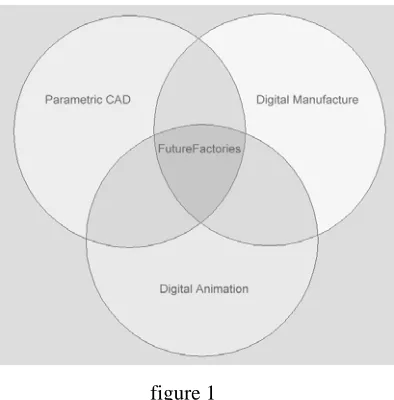
[image:3.612.225.422.335.535.2]Computer generated artwork has become commonplace, the creation of three dimensional artifacts from this artwork imposes considerable limitations and is consequently rare. Advances in digital technologies have made the creation of one-off products from computer generated models, a realistic, affordable possibility. There are three principle technologies exploited in the FutureFactories model (fig. 1).
figure 1
Three core digital technologies exploited by FutureFactories
Parametric computer aided design
up-date to maintain specified proportional relationships. Individual variables in the computer based 3D model can be modified and the whole form will up-date to maintain specified relationships.
Digital Manufacture (Rapid Manufacture, Direct Manufacture)
Now that Rapid Prototyping (RP) is well established – the new frontier for the digital manufacturing industry is Direct Manufacture. Direct or Rapid Manufacture is essentially the adaptation of RP technologies to the manufacture of end-use products. “A number of compelling examples of RM suggest that it will span across many industries in the future. Among these are hearing instruments, dentistry, medicine, aerospace, military, oil exploration, motor-sports, and consumer products” (Wohlers 2003). Rapid Prototyping (RP) is a catch-all term that applies to the digital manufacture of prototypes directly from CAD data. Essentially RP allows on-screen models to ‘printed out’ in 3D. Most of the recently developed processes are layer additive. Software ‘slices’ the CAD model into thin layers (down to 0.05mm). The model then ‘grows’ one thin layer at a time as each data ‘slice’ is replicated in 3D from the bottom up. The layers are built on a moving platform, each built on its predecessor as the platform steps down in layer thicknesses. There is no tooling or cutting away of material. This allows unlimited geometry. Forms may be produced that would be almost impossible to mould or machine. The relatively slow layer-by-layer building means that digital manufacturing is unlikely to ever match production capacity of die casting and injection moulding. Manufacturing parts without the need for moulds or dies does however makes the volume production of individualised forms an economic possibility.
Graphics
In FutureFactories the product forms are not fixed. The designs exist in a constant state of metamorphosis. To appreciate this, customers should be able to see the designs continuously ‘morphing’ in real time. The concept lends itself to some form of ‘virtual’ web-based merchandising (Unver, Dean and Atkinson, 2003). A system is envisaged in which the consumer is presented with a 3D animated model via a website. The consumer may access the website directly or via a sales outlet within, for example, a gallery or a department store. Advances in the graphics capabilities of home PC’s and the speed of internet connections allow the display of rendered forms mutating in real time on the customer’s home computer. Memory hungry three-dimensional rendering now exploits graphics processors on the video cards instead of consuming valuable CPU resources when drawing 3D images. These advances in video cards and the software that manage them, driven hard by the video game industry, enable the smooth real time display of animated forms complete with realistic scene lighting and material finishes.
The introduction of selection into the FutureFactories model
develop generic systems of commercial potential. For commercial viability it should be possible to introduce new designs with reasonable ease. Ideally one would be able to apply mutation rules to a conventional 3D model via an intuitive on-screen process (the system is seen as a plug-in addition to high-end parametric CAD systems). The complexity of specifying a parameter envelope could be reduced by severe restriction of the permissible parameter ranges and by isolating their effects where possible. But this would lead to uninspiring, predictable, movement in the form, repeated oscillations for example. A way of simplifying the rules for mutation had to be found. Evolutionary design principles offered a potential solution. Genetic algorithms permit virtual entities to be created without requiring an understanding of the procedures or parameters used to generate them. Instead of incorporating expert systems of technical knowledge into the programming, evolutionary design systems rely on utilitarian assessments of feasibility and functionality (Sims 1999, Funes and Pollack 1997). Our parameter envelope was designed to perform two functions; to ensure that manufacturability be maintained and that the mutated form retains the ‘designers intent’. If these factors can be assessed and scored then mutation, coupled with selection, can be used to drive and control changes in form.
A model for mutation and selection
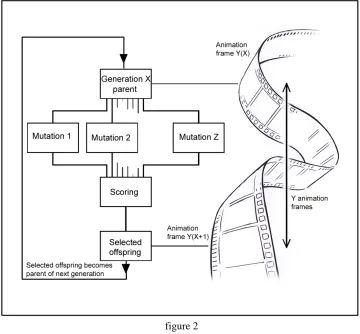
figure 2
The mutation, selection and animation process
The introduction of an evolutionary pressure
Given the use of random mutation and selection, the introduction of an evolutionary pressure was a logical step. Indeed it would be hard to avoid creating such pressure by virtue of the ‘fitness’ scoring. Public reaction to the early stages of the project also pointed to the inclusion of an evolutionary element.
Public reaction
The mutating image proved initially extremely seductive, with visitors drawn to the image and captivated by it. The selection process proved less of an attraction; users were often just as happy for the choice to be made for them. To some extent this is understandable, as no actual purchases were being made and no 3D objects would be generated. But it was nevertheless apparent that as the mutation was completely random there was little intrigue in ‘what happens next’. Creating this type of intrigue is obviously important from a marketing point of view. A level of evolutionary development is seen as a way of stimulating this type of interest. The idea is that designs would be available and evolve for a limited period. Different periods of the evolution process may achieve different levels of desirability. The value of an artifact would vary according to its position in the evolution. There may be ‘good’ and ‘bad’ generations as there are good and bad vine harvests.
Aesthetic Evolutionary Design
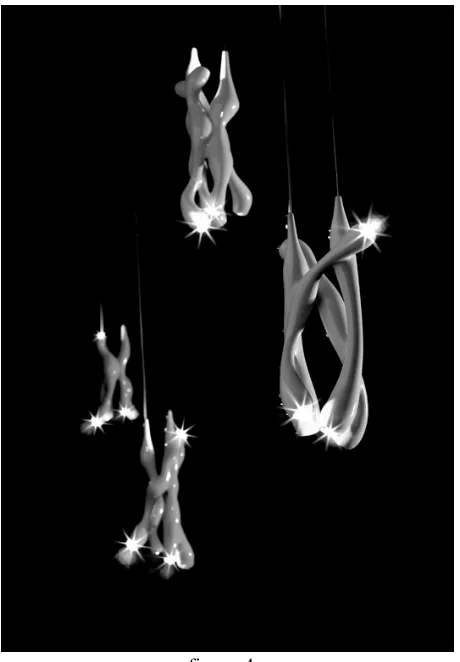
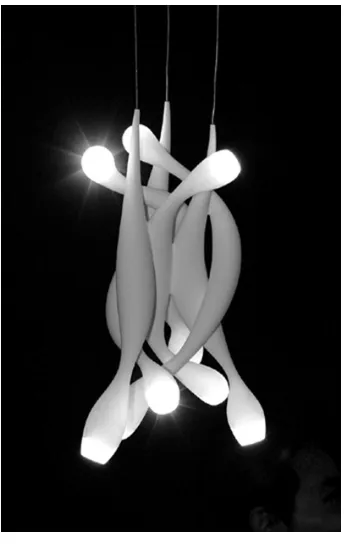
figure 4
‘Tuber’ pendant lamp produced by 3D printing
Failure criteria - feasibility, functionality and manufacturability
Scoring the aesthetic
Maintaining the designer’s intent requires a more relativist approach. Selecting designs based on a scoring of ‘fitness’ allows the designer to express general ideas for the design rather than absolute limits. For example the notion, “some rotation is fine but not too much,” might translate to an exponential decrease in the probability of further rotation being selected as the angle increases. This less rigid form of definition simplifies the set up of the model and also allows the possibility of new unexpected forms (although the possibility of surprising turns has to be balanced against maintaining a coherent, identifiable design). The effects of the rules are ‘softened’ by the use of probability: a high fitness score can be allocated a higher probability of selection rather than assured selection. This again broadens the possibilities allowing from time to time the success of a less fit parent.
Step size – micro-mutation, macro-mutation and the balance between
different transformations
Evolution is the result of accumulated small change. If the geometry of the model were to be re-arranged at random there would be infinitely more ways of creating a failure than a success. As Dawkins points out of the natural world, “Even a small random jump in genetic space is likely to end in death. But the smaller the jump the less likely death is, and the more likely is it that the jump will be in improvement……….The chance of improvement resulting from a transformation tends to zero with increasing step size and to 50% as it decreases” (Dawkins 1986). Also the more transformations that are occurring simultaneously, the lower the probability that they will all be successful. For this reason each offspring ‘bred’ from the parent form has only one parameter adjusted at random +/- one ‘small’ step. The step size is an absolute value arrived at through experimentation. A step size is set for rotation, transformation and scaling. The values of these different steps must be balanced so that they each achieve a comparable degree of change to the form. If particular transformations have disproportionate effects, they will inevitably exclude milder transformations from the evolutionary process. A diagnostics screen has been incorporated into the system to guide the setting up process. Amongst other information this screen is shows the percentage breakdown between the three transformation types that have acted on the model up to the current point in the evolution. It is possible to see the balance between the operation types as the evolution progresses.
Evolution – what are the aims?
The designer creates both the initial form of the design and the evolutionary pressure that will govern changes in that form over its evolutionary lifespan. The aim is to evolve increasingly visually interesting designs along the path set by the designer. The use of digital manufacturing favours more complex forms. If the forms are simple or regular, then the options increase for manufacture via faster, cheaper, conventional methods. So whilst simplicity may have elegance, FutureFactories evolutions will necessarily tend toward the more complex.
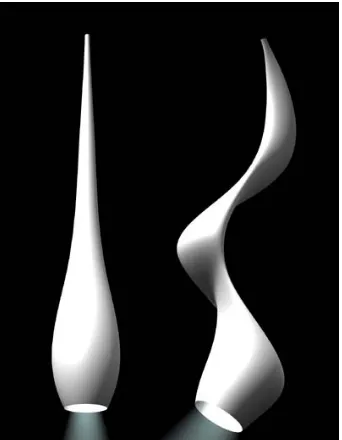
model, the resulting forms, after 200 generations, are clearly related, more intricate, and yet still manufacturable (machine build area is used as a failure criteria).
figure 5, the initial form and the form after 200 generations
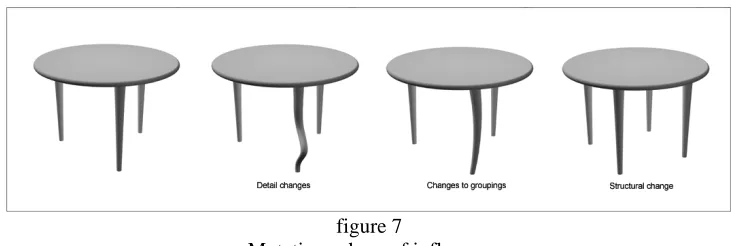
etail, grouped, and structural changes
ls are made up of surfaces defined by
D
The product forms of the FutureFactories mode
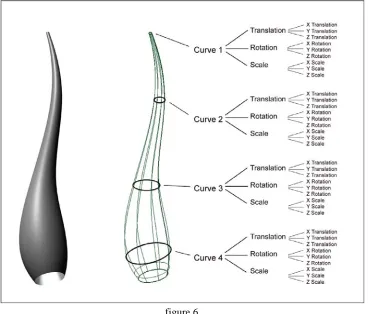
control curves. It is these control curves that are manipulated during the evolutionary process. Each 3D iteration (in evolutionary terminology phenotype), is defined by a list of parameter values (the genotype). Parametric CAD generates the 3D form from this list or genotype. The evolutionary algorithm modifies the list generating mutated
figure 6
The CAD model phenotype and its Parameter genotype
figure 7
Mutation sphere of influence
Figure 8
Tuber9 produced in Laser sintered nylon
figure 9
changes in model structure
FutureFactories vs. Evolutionary art
FutureFactories employs many of the principles seen in evolutionary art. There are also major differences. Evolutionary art and FutureFactories are similar in that they have no fixed target solution. The design is not homing in on an ideal generation by generation (Although in evolutionary art, with manual selection a user might focus on his/her preference). What is important, is the level of development: this usually means complexity. The number of generations “progress” from the start point. The importance is the distance from the starting point in solution space rather than a particular region of it.
Organic art often starts with simple geometric primitives; effectively a blank canvas. FutureFactories starts with well developed, non random, seeded solutions, a viable design that must be maintained throughout the evolutionary process.
Evolutionary art often allows a user, or ‘artist’, to guide the evolution. The FutureFactories selection process is automated: there is no human input during the evolutionary process.
One of the ‘drawbacks’ for Evolutionary art is that the images generated often have very distinct styles. “Often the style of the form generated using a particular representation is more identifiable than the style of the artist used to guide the evolution” (Bentley, 1999). The representations used are often limited to particular types of structure and generate forms with common, readily identifiable elements. In FutureFactories this is an aim - to produce designs that remain identifiable in spite of mutation.
The nature of the FutureFactories designs
From the project’s inception, communication of the FutureFactories concept was an important factor. The example designs created had a strong flavour of organic growth in the aesthetic. The name Tuber and Tuber’s colour – vivid green, were seen as factors in selling the concept. A frequent question raised is, given that the designs to date have such a strong organic flavor – could the system be applied to other aesthetics, to something more geometric?
Beyond the ‘marketing’ of the concept, there are other reasons for the preference of organic forms. Firstly, the example products produced to date are the work of one designer; inevitably the work reflects his tastes and ideas. Secondly, the virtual models are literally growing: natural organic forms are the result of growth and so the connection is hardly surprising. Thirdly, one of the transformation types employed is a twisting motion. Twisting a form is almost certain to result in the generation of curves. Where surfaces are formed between control curves, they are geometrically constrained to flow smoothly one curve to the next.
Geometric aesthetics are not being overlooked however. One of the areas for future work is an evolution that favors the creation of flat surfaces, straight edges, and angular relationships between faces. The evolution would start from a simple organic base and evolve into something geometric and faceted.
Conclusions
narrow, as required. This gives the possibility of running the evolution on the customer’s home computer, rather than on the host server. Computationally, this is a much more attractive solution than the customer accessing an evolution on a host server: however, conceptually the main benefit is in the flexibility. Running the evolution on the customer’s home computer means that the evolution can be started on-demand. The customer can run the evolution at will, stopping, starting and resetting as desired.
FutureFactories focuses on a single mutating solution. Evolutionary algorithms are usually much more sophisticated. They often feature populations of solutions, and two parents, both of whom contribute to the offspring’s ‘genetic’ make up. This ‘crossover’ contributes to the evolution as well as mutation. So far FutureFactories has been very broad in its aims for evolution. As the complexity of the models, and the degree of evolutionary control required increase, it is likely that the models will become susceptible to ‘noise’ and ‘local optima’ (solutions that score high on ‘fitness’ but are not ultimately the ‘target’).
The scope of the evolution possible within FutureFactories is restricted. It is limited by the use of standard components, by the geometry of the model, and by the requirement that the iterations remain recognisable designs, true to the designer’s intent. Trials have shown us that customer demand is for significant change in the forms. It is also seen as desirable that, whilst conforming to a design idea, the evolved form contains some unexpected twists.
The potential for evolution is restricted by the internal components in the sense that, whist in principle the skin of the design might be allowed to mutate, significant areas of the form will be dictated by standard functional components. Ideally the entire product should be allowed to evolve including any functional components. It is possible that such components could be built digitally along with the body. This already happens with some simple mechanical devices for example, springs, bearings, clips and hinges. There are also machines capable of building in more than one material simultaneously. There are research machines capable of ‘growing’ circuitry on electronic substrates (de Garis 1999). It is safe to assume that technology will make components ever smaller and easier to package. New materials and possibilities for digital manufacturing are emerging all the time, with ever increasing performance. It will become possible to achieve more and more functionality from digital builds.
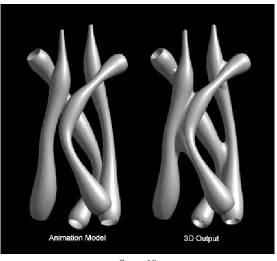
the mapping operations must be computed for each generation. The latter approach is impractical, requiring too much computation. Presenting the customer with a simplified version is open to misinterpretation. If the mapping operation makes significant changes to the model, then too much is left to the imagination. In the FutureFactories multiple body model, the animated evolution shows the separate bodies simply intersecting. Outputting a 3D model gives the intersection between the forms a fillet radius. An integrated form is made from overlaid separate entities. Visually the product becomes more realistic and ‘believable’ after this ‘mapping’ (fig 10): however, a reasonable impression can be gained from the simplified animation model. From a computational point of view leaving complex modelling operations to a mapping stage, completed only if a 3D outcome is required is highly desirable. But visually the animation needs to be close to the final outcome. A square block representation of a soft sculptural form, for example, would not be acceptable.
figure 10
Animation model vs. 3D output
Scoring surface area/volume represents a crude beginning. Other assessment methodologies are under consideration. Consideration is also being given to the number of polygons required to idealise a surface, average surface curvature, and the spread of surface-normals as fitness criteria: the results to-date are promising.
definitions of design practice (Atkinson & Hales 2004).
Clearly 'Future Factories' is an example of emerging and converging technologies and new practices which are forming a new position for the maker and author as the creative source of finished pieces. In fact, the designer may not even be aware of products selected and produced in his or her name. The combination of mathematical algorithmic processes and autonomous production potentially act to isolate the author of the work from the outcome, and raises questions of responsibility and ownership.
Finally, the use of software processes and real-time networks as generative tools questions existing, transient boundaries of practice, and also exposes the relevance or irrelevance of conventional definitions and accepted nature of the roles, practices, techniques and processes involved. It is clear that the outcomes of such a new model of creative production cannot be thought of as traditionally conceived pieces. They are, without question, art. Outside of that, existing definitions convey little of the reality of their production, as they lie in some new, as yet unspecified arena of production.
References
Atkinson, P (2003) Future Factories: Design work by Lionel Theodore Dean, University of Huddersfield. ISBN 1862180474
Atkinson, P. and Dean, L. (2003).Teaching Techné.5th European Academy of Design Conference, Barcelona. http://www.ub.es/5ead/PDF/10/Atkinson.pdf
Atkinson, P & Hales, D (2004) Chance would be a fine thing: Digitally Driven Practice-based Research at Huddersfield, published in the proceedings of the pixelraiders2 conference, Sheffield Hallam University, ISBN 1843870606
Bentley, P. (1999). Evolutionary Design by Computers. Morgan Kaufmann Publishers, Inc.
Dawkins, R. (1986) The Blind Watchmaker, Penguin Science pp.70-74; pp.77-85; pp.231-235
de Garis, H. (1999) Artificial Embryology and Cellular Differentiation. Evolutionary Design by Computers. Morgan Kaufmann Publishers, Inc. P282
Sims, K (1999) Evolving Three-Dimensional Morphology and Behavior. Evolutionary Design by Computers. Morgan Kaufmann Publishers, Inc.
Todd, S. and Latham, W. (1992). Evolutionary Art and Computers. Academic Press.
Unver, E. Dean, L. and Atkinson, P (2003). ‘Future Factories’: developing individualised production methods.International conference on Advanced Engineering Design, Prague
Wohlers, T. (2003) The Wohlers Report
Lionel Theodore Dean – Biography
Lionel is a graduate mechanical engineer and has a Master’s Degree in Automotive Design from the Royal College of Art. He worked as an automotive designer, for Pininfarina in Italy before setting up his own design consultancy business in 1990. Initially focusing, on small cars and motorcycles Lionel’s work spread from the mid-nineties into interior products in particular lighting. Lionel’s products are very much design led: through his work he seeks to explore the boundaries between Art and Design. Lionel was appointed Designer in Residence in the school of Art and Design, University of Huddersfield for the academic year 2002/2003 when he began the development of FutureFactories. The project proved extremely successful and has now been expanded into a practice based PhD study supported by the school. Lionel collaborates with Huddersfield academic staff on cultural and technical aspects of the project (one of the aims of the Residency program). FutureFactories was exhibited in London and Milan 2004 and in New York in 2005. Tuber9 (pendant lamp in laser sintered nylon) was acquired by MoMA The Museum of Modern Art, New York, 2005.
Lionel T Dean FutureFactories 52 Rauceby Drove South Rauceby United Kingdom
Tel +44 1529 488436 Fax +44 1529 488437 www.futurefactories.com
Email [email protected]
Paul Atkinson – Biography
working in a variety of jobs in industry as a designer, design manager and director of a design consultancy for 10 years.
On moving into education as a career, Paul led Product Design and Industrial Design degrees before undertaking an MA in Design History and becoming a Principal Lecturer and the Coordinator for Historical and Contextual Studies. He is now responsible for organising and planning all staff research activity within the School. Paul has had an active role in the Design History Society for a number of years, acting as Editor of the Society’s Newsletter for three years before taking up a position on the Editorial Board of the Journal of Design History. He has spoken at a number of conferences around the world, and published articles on the design history, visual culture and material culture of the computer.
Paul Atkinson
Head of Professional Development Subject Leader, 3D Design
School of Art & Design, University of Huddersfield, Queensgate, Huddersfield, West Yorkshire
HD1 3DH, United Kingdom