2015–
2016
Contents
01 01.0 Introduction from the Provost 02
02 02.0 Trinity at a Glance 06
03 03.0 Trinity’s Global Relations 14
04 04.0 Research Case Studies 18
04.1 Peter Gallagher 20
04.2 Cecily Begley 22
04.3 Neville Cox 24
04.4 Carol Newman 26
04.5 Eoin O’Sullivan 28
04.6 Lorna Carson 30
04.7 David Coleman 32
04.8 Naomi Harte 34
04.9 Seamus Martin 36
04.10 Sinéad Ryan 38
04.11 Nicola Marples 40
04.12 Carmel O’Sullivan 42
05 05.0 Innovation and Enterprise 44
06 06.0 Public Engagement 48
07 07.0 The Student Experience 52
08 08.0 The Trinity Education Project 56
09 09.0 Raising Our Game, a Review of Sport in 2015/16 60
10 10.0 New Professor Interviews 64
10.1 Caitríona Lally 66
10.2 Brendan Kelly 69
10.3 Michael Morris 72
10.4 Luiz DaSilva 75
10.5 Ursula Fearon 78
10.6 Mary Cosgrove 81
11 11.0 Philanthropy and Alumni Engagement 84
12 12.0 Visitors 88
13 13.0 Creative Arts Catalyst 92
Introduction
from the Provost
01
This was a key commemorative year for Ireland, and for Trinity. The 1916 Easter Rising was a pivotal moment in modern Irish history and Trinity was one of the principal locations – during Easter Week the College was turned into a hospital for the wounded, a temporary burial ground, and a barracks stationed with 4,000 troops. The Centenary gave us the opportunity to explore what happened within Trinity’s walls a hundred years ago and to fulfil our responsibility, as a centre of scholarship and learning, to critically examine the legacy of the Rising.
Public events on campus were greatly dominated by the Rising, especially around March and April. The chap-ters, Public Engagement and Creative Arts Catalyst, detail the lectures, symposia, exhibitions, plays and readings held in commemoration. Our commitment ran to translating the Proclamation into the 17 languages taught at Trinity, includ-ing Hebrew, Japanese, Korean, Russian and Turkish; and to holding events off-campus, including when we joined with the University of Liverpool to co-host a debate with their Institute of Irish Studies on their London campus – featuring historians from Ireland, the UK and the USA.
The academic year got off to a tremendous start with the news that Trinity is receiving the largest charitable donation in Irish history to tackle dementia. A landmark donation of €138.4 million from The Atlantic Philanthropies is helping us fulfil our ambition to become a world leader in ageing research. Co-led
by Trinity College Dublin and the University of California, San Francisco, the Global Brain Health Institute (GBHI) will train 600 global leaders over 15 years in the US, Ireland and across the world to carry out dementia research, deliver health care, and influence policies and practices.
Our chapter, Philanthropy and Alumni Engagement, details other significant philanthropic gifts. Philanthropy makes an ever more important contribution helping Trinity achieve its ambitions, and a feasibility study, carried out in 2015/16, estab-lished that alumni and friends feel a strong connection to Trinity and would like to be involved with fund-raising. In consequence in 2016/17 we are launching a Philanthropic Campaign, the very first comprehensive campaign in the College’s 425 year history. I look forward to bringing you news of this next year.
≥ The academic year got
off to a tremendous start
with the news that Trinity
is receiving the largest
Ensuring access to students from backgrounds under-represented at third-level is fundamental to strength-ening Trinity’s reputation for excellence. This was a key year for the Trinity Access Programme (TAP), now in its 23rd year. The Foundation Year, which prepares promising students for college life, is a lynchpin of TAP, and today more than 90% of young people who complete the TAP Foundation Year go on to take a degree at Trinity, where they perform as well as any other student. In a ground-breaking initiative, TAP is collabo-rating with Lady Margaret Hall, an Oxford college, to bring this Foundation Year to Oxford. The four-year pilot scheme starts in Lady Margaret Hall this coming academic year. I look forward to bringing you news of it.
Outreach is an important part of Trinity’s mission. Through Science Gallery Dublin we help drive young people’s enthusiasm for studying science and technology. We further extended our activities in this area with the inaugural year of the Trinity Walton Club. Named for our Nobel Laureate, Ernest Walton, the Walton Club is a not-for-profit STEM Education programme subsidised by Trinity and supporters, including the Bank of Ireland. The Club invites secondary school students to
attend STEM learning environments in Trinity labs on Saturdays. In May, 71 ‘Walton Clubbers’ showcased their STEM projects and prototype solutions at an exhibition and graduation cer-emony on campus.
Our mission to be a global university offering a global education received further boost this year with the addition of eight new agreements, to bring our number of non-EU exchanges with high ranking universities globally to 35. And after four years of successful collaboration with the Singapore Institute of Technology (SIT), we are now embarking on our first joint degree programme with SIT in Physiotherapy: 100 students will be enrolled from September 2016. You can read about these initiatives and more in our chapter, Trinity’s Global Relations.
For the second year running, in September 2016, we received corroboration that our initiatives to encourage innova-tion and entrepreneurship are working: over the past ten years our graduates have founded more venture-backed companies than graduates from any other European university, according to private equity and venture capital-focused research firm, PitchBook. Trinity is the only European university in PitchBook’s global Top 50 which ranks graduate entrepreneurship.
01
The pipeline for next year’s PitchBook report is already strong, and Trinity and UCD have collaborated to help launch a new €60 million fund to invest in early stage compa-nies emerging from third-level research. The fund, which will provide capital and expertise for scaling campus companies, was announced in June by Atlantic Bridge, one of Europe’s top performing growth technology funds. It’s aimed at early stage companies, built from world class research in all Irish third-level institutions, and focusing on software, hardware, engineering, physical sciences, life sciences and agri-food.
You can read about our initiatives to encourage innovation and entrepreneurship at staff and student level in the chapter, Innovation and Enterprise. These include initiatives in the SFI research centres led out of Trinity – ADAPT, AMBER, and CONNECT – to train highly skilled postgrads and support research in strategically important areas such as advanced materials, telecommunications, and digital content technol-ogy; as well as undergraduate initiatives like the start-up accelerator, LaunchBox. Now in its fourth year, LaunchBox has incubated over 150 students-entrepreneurs, created 40 jobs through start-ups, and raised over €3.5 million in investment.
Finally, research is, of course, the cornerstone of what we do. Here we interview six new professors – in Molecular Rheumatology, German, Bioengineering, Psychiatry, Telecommunications and Chemistry – and we hear about their exciting research. And 12 of our researchers across our three faculties detail some of their research projects – from urban multilingualism to reducing rates of caesarean section; from solar storms to developing anti-inflammatory therapies.
In December I had the great pleasure of being in Sweden for the Nobel ceremony where our graduate William C. Campbell was awarded for his work in helping to eradicate river blindness. His great breakthrough came after decades of research starting as an undergraduate in Trinity where he first developed his interest in the parasitic worms that cause river blindness. He is a symbol, for Trinity and the world, of the schol-ar’s dedication. We salute him and all our scholars for their work in myriad fields which enhance our way of being in the world.
My great thanks to the whole community – staff, students and alumni – for another great Trinity year.
Dr Patrick Prendergast Provost & President BELOW LEFT – Recipients of the 2016 Provost’s Teaching
Awards, Prof Michelle D’Arcy, Dr Shane Bergin, Prof Kevin Kelly with the Provost, Dr Patrick Prendergast.
Trinity at
a Glance
Trinity is Ireland’s
No. 1 University
QS World University Ranking, Academic Ranking of World Universities (Shanghai)
≥
A 424 year old
CLUBS AND SOCIETIES
48
| 48 |49| 49 SPORTS CLUBS120
| 119|118| 112 STUDENT SOCIETIESStudent Statistics
2016
|
2015
|
2014
|
2013
(4 year comparisons)
THE LARGEST SOCIETIES ARE:
THE VINCENT DE PAUL SOCIETY
THE PHILOSOPHICAL SOCIETY (THE PHIL)
DU PLAYERS
THE COLLEGE HISTORICAL SOCIETY (THE HIST)
02
12,742
12,633 |12,420 | 12,174
UNDERGRADUATES
17,511
17,080 |16,729| 16,646
15,433
15,254 |15,014| 14,871
FULL-TIME *
42%
42% |42%| 42%
MALE
58%
58% |58%| 58%
FEMALE
1,800
1,789 |1,715 | 1,775
PART-TIME *
4,769
4,447 |4,309| 4,472
POSTGRADUATES
88
|
37
ONLINE
REGISTERED STUDENTS
ALUMNI
111,272
| 107,353 |103,518| 100,277REPUBLIC OF IRELAND 82,816| 79,728 |76,720| 74,170
GREAT BRITAIN 10,084| 10,001 |9,754| 9,616
NORTHERN IRELAND 4,789| 4,696 |4,662| 4,621
USA 3,960| 3,838 |3,670| 3,557
CANADA 1,259| 1,226 |1,195| 1,162
REST OF WORLD 8,364| 7,864 |7,517| 7,151
ARTS, HUMANITIES AND SOCIAL SCIENCES
ENGINEERING, MATHEMATICS AND SCIENCE FACULTIES
ACADEMIC STAFF
Student / Staff Statistics
167
173 |180| 189
TECHNICAL
890
870 |850| 819
ADMINISTRATIVE
369
353 |321| 346
SUPPORT
754
730 |606| 655
RESEARCH
130
127 |134| 143
LIBRARY
773
758 |777| 785
ACADEMIC
3,083
*
3,011 |2,868| 2,937
37%
39% |39%| 40%
INTERNATIONAL
63%
61% |61%| 60%
IRISH
* Full-time Equivalent
Staff Statistics
2016
|
2015
|
2014
|
2013
IRELAND13,760
MONTENEGRO01
MOROCCO05
SERBIA03 CZECHREPUBLIC09
ICELAND02
UNITEDKINGDOM514 BELGIUM68 THENETHERLANDS49 NORWAY10 DENMARK09
UKRAINE09 SWEDEN32
RUSSIANFEDERATION40
KAZAKHSTAN06
ARMENIA01
IRAN, ISLAMICREPUBLICOF18 BAHRAIN02
QATAR02 OMAN09 UNITED ARABEMIRATES08
SAUDIARABIA31 KUWAIT12 JORDAN09 GERMANY206 AUSTRALIA40 INDONESIA03 PHILIPPINES10 TAIWANREPUBLICOFCHINA04
BRUNEIDARUSSALAM03 INDIA158
PAKISTAN14 BANGLADESH06 BHUTAN01
NEPAL05 CHINA159
HONGKONG20 MACAU01
SRILANKA01
VENEZUELA03
BRAZIL135
PARAGUAY01 CAYMANISLANDS04
BERMUDA01 ARGENTINA02 AUSTRIA33 POLAND28 HUNGARY07 SLOVAKIA06 BULGARIA07 SWITZERLAND18 GIBRALTER01 GREECE22 SLOVENIA03 MALTA08 MADAGASCAR01 SINGAPORE184 IRAQ08 LEBANON01
NEWZEALAND01 JAPAN27
REPOFKOREA15
MOZAMBIQUE01 KENYA02 MAURITIUS12 ZAMBIA06 BURUNDI01 ZIMBABWE03 UGANDA06 SUDAN04 LATVIA01 ESTONIA01 MOLDOVA05 BELARUS02 LITHUANIA03 TURKEY21 PORTUGAL19 SPAIN94 CANADA183 USA704 MEXICO12 ISRAEL02 EGYPT14
SOUTHAFRICA15 BOTSWANA01 FRANCE252 LUXEMBOURG19 MALAYSIA122 VIETNAM03 THAILAND03 CHILE02 COLOMBIA02 COSTARICA02
ECUADOR02
TRINIDADANDTOBAGO05 FINLAND28
PUERTORICO01
GUYANA01 ROMANIA15
ITALY125
BOSNIAANDHERZEGOVINA02
CROATIA06
MONACO01
REPOFKOSOVO01
MALAWI03 GUINEA01
GHANA02 ALGERIA01
NIGERIA22
LIBYANARABJAMAHIRIYA13
CYPRUS08
International Students
2016
|
2015
|
2014
|
2013
(4 year comparisons)
114
| 95 | 97 | 109AFRICA
842
| 728 | 615 | 567ASIA
41
| 33 | 37 | 33AUSTRALASIA
≥
A look at the diverse
group of international
students here at Trinity,
and where they come from.
02
ALGERIA 1| 2|1|1
BOTSWANA 1| 1|5
BURUNDI 1| 1|1
CAMEROON 1|1
EGYPT 14| 8| 4|3
ETHIOPIA 1| 2|3
GHANA 2| 2|3
GUINEA 1|1
KENYA 2|3|5|4
LESOTHO 1|1
LIBYA 13 |14 |5|6
MADAGASCAR 1|1 MALAWI 3| 1| 5|4
MAURITIUS 12|9|9|7
MOROCCO 5|2
MOZAMBIQUE 1|1|1|1
NIGER 1|1
NIGERIA 22|17|23|33
REP OF EQUATORIAL GUINEA 1
RWANDA 1|1
SOUTH AFRICA 15|18|15|18
SUDAN 4|6|6|6
TANZANIA 1|1|1
TUNISIA 1 UGANDA 6| 3|5|3
ZAMBIA 6| 1|3|3
ZIMBABWE 3|3|3|5
TOTAL 114| 95|97|109
AFGHANISTAN 1
ARMENIA 1| 1|1|1
AZERBAIJAN 1|1|2
BAHRAIN 2| 4|3|2
BANGLADESH 6|4|5|7
BHUTAN 1
BRUNEI DARUSSALAM 3|1|1|1
CHINA 159| 143|122|99
HONG KONG 20|10|4|1
INDIA 158|112|91|90
INDONESIA 3|2|2|1
ISLAMIC REP OF IRAN 18|14|14|12
IRAQ 8| 10|7|7
ISRAEL 2| 1|2|1
JAPAN 27| 19|22|16
JORDAN 9|9|3|6
KUWAIT 12| 10| 8|8
LEBANON 1| 2|1
MACAO 1| 2
MALAYSIA 122|108|108|107
NEPAL 5|3|3
OMAN 9|6|5|3
PAKISTAN 14|18|16|17
PALESTINE 1|1
PHILIPPINES 10|12|10|10
QATAR 2| 2|1
REP OF KOREA 15| 7|13|14
SAUDI ARABIA 31|26|28|24
SINGAPORE 184|187|131|120
SRI LANKA 1|3|4|2
SYRIAN ARAB REPUBLIC 1|1 TAIWAN REP OF CHINA 4 | 3| 1| 1
THAILAND 3 | 1
UNITED ARAB EMIRATES 8|6|5|6
VIETNAM 3| 4| 1|3
TOTAL 842| 728|615|567
AUSTRALIA 40|30|31|26
NEW ZEALAND 1| 3|6|7
International Students
IRELAND13,760
MONTENEGRO01
MOROCCO05
SERBIA03 CZECHREPUBLIC09
ICELAND02
UNITEDKINGDOM514 BELGIUM68 THENETHERLANDS49 NORWAY10 DENMARK09
UKRAINE09 SWEDEN32
RUSSIANFEDERATION40
KAZAKHSTAN06
ARMENIA01
IRAN, ISLAMICREPUBLICOF18 BAHRAIN02
QATAR02 OMAN09 UNITED ARABEMIRATES08
SAUDIARABIA31 KUWAIT12 JORDAN09 GERMANY206 AUSTRALIA40 INDONESIA03 PHILIPPINES10 TAIWANREPUBLICOFCHINA04
BRUNEIDARUSSALAM03 INDIA158
PAKISTAN14 BANGLADESH06 BHUTAN01
NEPAL05 CHINA159
HONGKONG20 MACAU01
SRILANKA01
VENEZUELA03
BRAZIL135
PARAGUAY01 CAYMANISLANDS04
BERMUDA01 ARGENTINA02 AUSTRIA33 POLAND28 HUNGARY07 SLOVAKIA06 BULGARIA07 SWITZERLAND18 GIBRALTER01 GREECE22 SLOVENIA03 MALTA08 MADAGASCAR01 SINGAPORE184 IRAQ08 LEBANON01
NEWZEALAND01 JAPAN27
REPOFKOREA15
MOZAMBIQUE01 KENYA02 MAURITIUS12 ZAMBIA06 BURUNDI01 ZIMBABWE03 UGANDA06 SUDAN04 LATVIA01 ESTONIA01 MOLDOVA05 BELARUS02 LITHUANIA03 TURKEY21 PORTUGAL19 SPAIN94 CANADA183 USA704 MEXICO12 ISRAEL02 EGYPT14
SOUTHAFRICA15 BOTSWANA01 FRANCE252 LUXEMBOURG19 MALAYSIA122 VIETNAM03 THAILAND03 CHILE02 COLOMBIA02 COSTARICA02
ECUADOR02
TRINIDADANDTOBAGO05 FINLAND28
PUERTORICO01
GUYANA01 ROMANIA15
ITALY125
BOSNIAANDHERZEGOVINA02
CROATIA06
MONACO01
REPOFKOSOVO01
MALAWI03 GUINEA01
GHANA02 ALGERIA01
NIGERIA22
LIBYANARABJAMAHIRIYA13
CYPRUS08
15,326
| 15,125 | 14,954 | 15,062EUROPE EU
128
| 146 | 112 | 106EUROPE NON EU
912
| 821 | 836 | 718NORTH/CENTRAL AMERICA
148
| 132 | 78 | 19SOUTH AMERICA
AUSTRIA 33| 30|24|20
BELGIUM 68|70|71|61
BULGARIA 7|3|4|3
CYPRUS 8|7|8|8
CZECH REPUBLIC 9| 8|8|7
DENMARK 9|9|10|11
ESTONIA 1| 1
FINLAND 28|22|15|18
FRANCE 252|236|238|205
GERMANY 206|205|211|190
GREAT BRITAIN 514| 550|572|637
GREECE 22| 21|19|22
HUNGARY 7| 8|5|5
IRELAND 13,760|13,593 13,434|13,600
ITALY 125| 112|91|74
LATVIA 1|3|3|3
LITHUANIA 3|5|9|11
LUXEMBOURG 19 | 17 |14 |12
MALTA 8 |8 |5|4
POLAND 28|29|41|40
PORTUGAL 19| 22|13|10
ROMANIA 15|13|10|11
SLOVAKIA 6|7|2|6
SLOVENIA 3| 3|3|1
SPAIN 94| 80|69|70
SWEDEN 32|27|35|28
THE NETHERLANDS 49| 37|40|35
TOTAL 15,326|15,125 14,954|15,062
ALBANIA 4|1|2
BELARUS 2|1|2|1
BOSNIA & HERZEGOVINA 2|3|2|1
CANARY ISLANDS 2 CROATIA 6| 4|2 GEORGIA 1 GIBRALTAR 1| 1|1|1
ICELAND 2 |2|2|1
KAZAKHSTAN 6|9|12|16
MACEDONIA 1 MOLDOVA 5|5|4|3
MONACO 1|1
MONTENEGRO 1
NORWAY 10|14|9|14
REPUBLIC OF KOSOVO 1| 1
RUSSIA 40|47|41|36
SAN MARINO 1
SERBIA 3|3|2|1
BAHAMAS 2|1|1
BARBADOS 1|1
BERMUDA 1 |1|2|1
CANADA 183 |162|164|158
CAYMAN ISLANDS 4|2|1|1
COSTA RICA 2|1 CUBA 1
HAITI 1 JAMAICA 1
MEXICO 12 |8|10|10
PUERTO RICO 1 |2|1 ST VINCENT & GRENADINES 1 TRINIDAD & TOBAGO 5 |4|7|5
USA 704|637|648|540
TOTAL 912 |821|836|718
ARGENTINA 2|3|2 BRAZIL 135|118|70|12
CHILE 2|3|1|4
COLOMBIA 2|3|2|2
ECUADOR 2|2|1
GUYANA 1
PARAGUAY 1|1|1
PERU 1|1
VENEZUELA 3|2
—AGEING
—CANCER
—CREATIVE ARTS PRACTICE
—CREATIVE TECHNOLOGIES
—DIGITAL ENGAGEMENT
—DIGITAL HUMANITIES
—GENES AND SOCIETY
—IDENTITIES IN TRANSFORMATION
—IMMUNOLOGY, INFLAMMATION & INFECTION
—INCLUSIVE SOCIETY
—INTERNATIONAL DEVELOPMENT
—INTERNATIONAL INTEGRATION
—MAKING IRELAND
—MANUSCRIPT, BOOK & PRINT CULTURES
—NANOSCIENCE
—NEUROSCIENCE
—NEXT GENERATION MEDICAL DEVICES
— SMART AND SUSTAINABLE PLANET
—TELECOMMUNICATIONS
—TRINITY BIOMEDICAL SCIENCES INSTITUTE
—CENTRE FOR RESEARCH ON ADAPTIVE NANOSTRUCTURES AND NANODEVICES (CRANN)
—TRINITY COLLEGE INSTITUTE OF NEUROSCIENCE (NATIONAL NEUROSCIENCE NETWORK)
—TRINITY LONG ROOM HUB, ARTS AND HUMANITIES RESEARCH INSTITUTE
—TRINITY TRANSLATIONAL MEDICINE INSTITUTE
TRINITY’S RESEARCH THEMES
LEADING FLAGSHIP RESEARCH INSTITUTES
6,000,000
PRINTED ITEMS
500,000
MAPS
LIBRARY COLLECTION HAS
350,000
ELECTRONIC BOOKS
80,000
ELECTRONIC JOURNALS
01
BOOK
OF KELLS
05
Library
Commercialisation of Research
2016
|
2015
|
2014
(3 year comparisons)
CONSOLIDATED FINANCIAL STATEMENTS
€314.5
m
TOTAL INCOME FOR YEAR ENDED 2014 (EXCLUDING GRANT AMORTISATION)
€321.2
m
TOTAL INCOME FOR YEAR ENDED 2015 (EXCLUDING GRANT AMORTISATION)
€305.2
m
TOTAL INCOME FOR YEAR ENDED 2013 (EXCLUDING GRANT AMORTISATION)
€308.9
m
TOTAL INCOME FOR YEAR ENDED 2012 (EXCLUDING GRANT AMORTISATION)
Library / Commercialisation of Research
IN THE PERIOD 2011–2016
(2010–2015) (2009–2014)
04
|
03
|
04
TRINITY CAMPUS COMPANIES
60
|
53
|
58
DISCLOSURES OF NOVEL INTELLECTUAL PROPERTY RECEIVED
34
|
23
|
28
COMMERCIALISATION LICENCES TO INDUSTRY
15
|
18
|
23
NEW PATENT APPLICATIONS FILED
58
|
59
|
32
COLLABORATIVE RESEARCH
AGREEMENTS WITH INDUSTRY EACH <€25K
69
|
55
|
51
COLLABORATIVE RESEARCH
AGREEMENTS WITH INDUSTRY EACH >€25K IN THE YEAR ENDED SEPTEMBER 2016
(2015) (2014)
329
|
314
|
308
DISCLOSURES OF NOVEL INVENTIONS
125
|
102
|
81
LICENCES TO INDUSTRY GRANTED
28
|
36
|
37
TRINITY CAMPUS COMPANIES APPROVED
€m €m €m €m
FINANCIAL YEAR 2015 2014 2013 2012
STATE GRANTS €44.5 €47.3 €54.5 €58.7
ACADEMIC FEES €128.9 €124.2 €116.1 €113.8
RESEARCH GRANTS AND CONTRACTS €85.2 €78.0 €74.7 €75.9
COMMERCIAL REVENUE UNIT INCOME €29.1 €25.2 €23.3 €23.3
OTHER INCOME €23.3 €24.0 €27.3 €26.2
Trinity’s vision, as set out in our current Strategic Plan 2014–2019, is to be ‘a university of global consequence, known for realising student potential and for research and scholarship that benefits Ireland and the world’. Growing glob-ally is central to our mission in education, research and inno-vation – we pursue policies and actions to increase student mobility, deepen collaborations with peer institutions round the world, and to ensure a welcoming, international campus that celebrates diversity.
Student Mobility
‘Geographical diversity in our student community is critical in developing an educational milieu which fosters cross-cultural understanding and prepares all students for a life of global citizenship’, Strategic Plan 2014–2019.
In 2015/16, Trinity welcomed over 4,500 students from outside of Ireland, with 1,800 of these from outside of Europe, representing 26% and 11% respectively of the total student body, and a 54% increase since 2011/12 in non-EU students. During the academic year, 433 Trinity students stud-ied overseas as part of mobility programmes, representing a 28% increase in the number of students engaging in student exchanges since 2011/12. Trinity currently has almost 200 Erasmus partner universities across Europe.
We continue to expand our college-wide student exchange programme and in 2015/16, added eight new agreements to bring the number of non-EU exchanges with high rank-ing universities globally to 35. There are many opportunities for students to study abroad in leading Asian universities (including mainland China and Hong Kong, Singapore, Japan and Korea) and students are supported by the Provost’s Asian Travel Bursary which defrays some of the costs encountered. During 2016, Trinity became a member of the Consortium for Advanced Studies Abroad (CASA) and hosted the CASA 2016 Board meeting in Dublin on 20th June 2016. CASA, a non-profit consortium of nine leading research uni-versities in the United States including Harvard, Brown and Columbia, was established to provide a framework to facilitate student mobility internationally, through the establishment of study-centres around the world. Trinity is the tenth CASA member and the first from outside the United States.
Membership of CASA will allow Trinity students to study alongside their counterparts from other CASA members in locations around the world, in partnership with leading local universities. The first Trinity CASA students are expected to be among the CASA cohort in Havana in January 2017.
Trinity’s Global
Relations
≥ We continue to expand
our college-wide student
exchange programme and
in 2015/16, added eight
new agreements to bring
the number of non-EU
Partnerships and Global Collaborations
Trinity continues to build strategic partnerships and joint and degree programmes with peer institutions worldwide... After four years of successful collaboration with the Singapore Institute of Technology (SIT), and 421 graduates from pro-grammes in Physiotherapy, Occupational Therapy, Diagnostic Radiography and Radiation Therapy, we are now embarking on our first joint degree programme with SIT in Physiotherapy – 100 students will be enrolled from September 2016. SIT is set to be a leader in innovative university education by integrating learning, industry and community.
Trinity and Thapar University in the Punjab, India have agreed a significant partnership which involves collaboration in undergraduate programmes and research in Engineering and Computer Science. As part of the overall partnership, Thapar University will align its curriculum with that of Trinity and this will enable the articulation programme which will see 40 students from Thapar entering year 3 in Trinity to complete their degrees in Engineering and Computer Science.
A key component of the partnership will be the appointment of two professors who will develop collaborative research across the two institutions.
2016 has also seen Trinity expand its international access and participation initiative through the development of
a new International Foundation Programme delivered through
a strategic partnership with Marino Institute of Education, an associated college of Trinity. The Foundation Programme was developed by Trinity academics as a preparatory foundation year for students coming from abroad to enable progression to undergraduate courses across the three faculties. Twenty students from China, South Korea, Malaysia, Nigeria, Bahrain, Saudi Arabia, and Kuwait are enrolled on the first year of the programme.
In addition to core modules in English and Maths, the programme aims to equip students to think critically, express viewpoints, and to debate and problem-solve effectively within the learning environment. It encourages students to become independent in their learning and prepares them for under-graduate study in Trinity.
Internationalizing the University
The Global Relations Office provides support services for inter-national students to help them embrace college life at Trinity. This includes managing the Trinity Global Room, an innovative space designed to link the University to the world. Acting as a platform to celebrate cultural diversity within Trinity, the Global Room is an area where students and staff can relax, converse
03
BELOW – Non-EU student exchange universities.REGION UNIVERSITY
AUSTRALIA AUSTRALIAN NATIONAL UNIVERSITY UNIVERSITY OF MELBOURNE UNIVERSITY OF NEW SOUTH WALES UNIVERSITY OF QUEENSLAND UNIVERSITY OF SYDNEY
CANADA MCGILL UNIVERSITY UNIVERSITY OF TORONTO UNIVERSITY OF WATERLOO
CHINA BEIHANG UNIVERSITY FUDAN UNIVERSITY PEKING UNIVERSITY TSINGHUA UNIVERSITY
UNIVERSITY OF NOTTINGHAM NINGBO, CHINA WUHAN UNIVERSITY
XI’AN JIAOTONG-LIVERPOOL UNIVERSITY
HONG KONG CHINESE UNIVERSITY OF HONG KONG HONG KONG UNIVERSITY
HONG KONG UNIVERSITY OF SCIENCE AND TECHNOLOGY
JAPAN UNIVERSITY OF TOKYO
RUSSIA MOSCOW STATE UNIVERSITY
SINGAPORE NATIONAL UNIVERSITY OF SINGAPORE SINGAPORE MANAGEMENT UNIVERSITY
SOUTH PUC RIO AMERICA
US BARNARD COLLEGE
BOSTON COLLEGE GEORGETOWN UNIVERSITY NEW YORK UNIVERSITY UNIVERSITY OF CALIFORNIA UNIVERSITY OF CHICAGO
UNIVERSITY OF MASSACHUSETTS AMHERST UNIVERSITY OF NORTH CAROLINA, CHAPEL HILL UNIVERSITY OF NOTRE DAME
This year the Global Relations Office organised hundreds of events, including celebrations for a range of inter-national festivals such as Thanksgiving, Diwali and Chinese New Year, as well as film screenings, international dance, music and art showcases, and seminars and talks.
In addition to the programmes run during term, Trinity has also embarked on a range of international summer school programmes. For example:
The Brown Summer Programme in Contemporary Global Politics was developed as a collaborative initiative between Brown University, the Global Relations Office and the Department of Political Science, with the aim of welcoming Brown University students for summer study at Trinity. The inaugural programme welcomed 16 students from Brown University and one student from Princeton University.
In July 2016 we welcomed 200 students from 18 countries to the Riverdance Trinity College International Summer School where students participated in a week long programme of dance at the Lir Academy of Dramatic Art.
Global Engagement Awards
The Global Engagement Awards is an annual event in recogni-tion of Trinity’s global engagement activities. This year’s three recipients were: Professor Mauro Ferreira, School of Physics; Professor Kevin Kelly, School of Engineering; and Professor Daniel Faas, School of Social Sciences and Philosophy.
Professor Ferreira was key in advising Trinity on the Science without Borders programme as well as playing a
Linking Universities of Science and Technology for Education and Research), Professor Kelly was instrumental in setting up a global network for design innovation in undergraduate Engineering programmes in leading universities. As well as collaborating in research across three continents Professor Faas has been a longstanding champion for student and staff mobility programmes. He led on coordinating the academic content for the social sciences modules on the recently launched International Foundation Programme.
Alumni Networks
The Global Alumni Network continues to provide valuable support to Trinity in a number of key areas abroad, with alumni around the globe proud and eager to support the University. With over 75 regional branches, hundreds of alumni volunteers have been involved in numerous programmes, from supporting student recruitment and visiting students, as well as visiting staff. In the area of student recruitment, 36 alumni formally volunteered to support specific recruitment fairs and events in 2015/16. Their role and the role of many more, informally, is a valuable resource for students, with 24% of incoming students in 2015/16 referencing alumni as a source of infor-mation about Trinity.
Another global initiative proving successful is the International Welcome Programme, which pairs students travelling abroad with local alumni. In 2015/16, the programme ran in 29 cities/states in seven non-EU countries (Australia, Canada, China, Japan, Russia, Singapore and USA), matching
BELOW – Provost Dr Patrick Prendergast and Vice-President for Global Relations, Prof Juliette Hussey with Trinity Global Engagement Award recipients Prof Daniel Faas and Prof Mauro Ferreira and Certificate of Excellence winners to mark
their significant contribution to Trinity’s Global Engagement activities, Prof Rosemary Byrne, School of Law, Prof Fabio Boylan, School of Pharmacy and Pharmaceutical Sciences and Prof Nigel Stevenson, School of Biochemistry and Immunology.
THAPARUNIVERSITY
Research
Case Studies
01
Peter Gallagher
02
Cecily Begley
03
Neville Cox
04
Carol Newman
05
Eoin O’Sullivan
06
Lorna Carson
07
David Coleman
08
Naomi Harte
09
Seamus Martin
10
Sinéad Ryan
11
Nicola Marples
12
Carmel O’Sullivan
BACK (L–R) –Prof David Coleman, Dr Nicola Marples, Prof Sinéad Ryan, Prof Peter Gallagher.
Living with a Star: Understanding Solar Activity
and its Terrestrial Effects
Peter Gallagher
The Sun, the source of light and heat for Earth, is a far from quiet star. From time to time it launches ejections of hot gas called solar storms, which can produce beautiful auroral displays on Earth and have more sinister effects on navigation and communications systems, satellite electronics, and power grids.
Due to an intense solar storm in November 2015, aircraft were not allowed to take off from airports in Sweden for over an hour, while in March 1989, a solar storm triggered a sequence of events that caused a nine-hour outage of the Hydro-Quebec power grid in Canada. A solar storm later that year caused a halt in all trading on Toronto’s stock market. This is nothing new. In 1859, the largest solar storm on record occurred. The aurora that it produced was visi-ble as far south as Italy in Europe and Jamaica in the Caribbean. Here in Ireland, the Irish Times of the day reported “the whole sky from the horizon to the zenith being irradiated with a rich purple tint [and] telegraph communications with all quarters were disturbed owing to some mysterious atmospheric influence”.
Trinity’s tradition in solar-terrestrial research – In Trinity, there is a long tra-dition of research in geomagnetism. Humphrey Lloyd, Professor of Natural
and Experimental Philosophy, and Provost 1867–1881, built a magnetic observatory in the Provost’s Garden in the 1830s, and together with fellow Dubliner, Sir Edward Sabine, developed a global network of magnetic observatories. They became the first to confirm the link between solar activity and magnetic disturbances here on Earth. Later, the great Trinity physicist George Francis Fitzgerald (1851–1901) used a magnetometer located near the transatlantic telegraph cable in Valentia, Co. Kerry to show that variations in the Earth’s magnetic field could cause current surges in the telegraph cable – early proof of the damaging effects of solar storms on communications links.
The Rosse Solar-Terrestrial Observatory
– To investigate these enigmatic Sun-Terrestrial connections, I have established a large and active research group in the School of Physics to understand the causes and consequences of solar storms, using data from European Space Agency (ESA) and NASA satellites. In addition, I have developed Trinity’s Rosse Observatory at Birr Castle, Co. Offaly to continuously monitor bursts of radiation from the Sun and their effects on Earth’s ionosphere and magnetic field. The data processing techniques my team is developing are used to characterize the ever-changing
magnetic field of sunspots and track the dynamics of solar storms as they are launched, while their forecasting tech-niques are used to predict when solar storms will occur and when they might impact the Earth.
2016 is a particularly exciting year for the group as we begin building a large radio telescope called the Low Frequency Array (LOFAR) at Birr. This pro-ject, supported by Dermot Desmond, Denis O’Brien, Joe Hogan and Science Foundation Ireland, will connect Ireland to the largest network of radio telescope in the world and enable my team to study solar activity with better detail than ever before.
Space exploration– The Solar Physics Group also works closely with ESA and NASA teams exploring solar activity using their fleets of spacecraft. I am a Co-Investigator for the Solar Telescope Imaging X-rays (STIX) instrument which will be launched on ESA’s Solar Orbiter spacecraft in 2018. This ambitious mis-sion will fly inside the orbit of Mercury giving solar physicists a closer view of the enigmatic Sun than ever before, keeping Trinity scientists at the frontiers of space exploration and solar-terrestrial physics.
Peter Gallagherreceived his BSc from UCD and MSc and PhD from Queen’s University Belfast. He spent six years in the US
as a Postdoc at Owens Valley Radio Observatory and Big Bear Solar Observatory in California and Senior Scientist at NASA Goddard Space Flight Centre. He joined Trinity in 2006 and is a Professor in Astrophysics, Director of the Rosse Observatory, and Associate Dean of Research. Published in over 100 papers in leading journals, he is supported by the IRC, SFI, AXA, ESA, and Horizon 2020. He is a Senior Advisor to ESA’s Director of Science.
Contact: [email protected]
Living with a Star: Understanding Solar Activity and its Terrestrial Effects – Peter Gallagher
BELOW –Image courtesy of European Space Agency at www.sci.esa.int
≥ The Solar Physics Group also
works closely with ESA and NASA
teams exploring solar activity
Normalising Childbirth
Cecily Begley
Childbirth is a normal, physio-logical process that has a profound impact on every couple’s life. For the majority of women it remains normal, with 56% of all women in Ireland having a spontaneous vaginal birth. Many interventions are used, however, in even so-called “normal” births. For over thirty years, my research has focussed on decreasing unnecessary inter-ventions in childbirth. My early research included a randomised trial comparing giving a drug routinely to contract the uterus immediately after birth (active management), and giving no drug unless it was necessary (physiological care). This showed that both methods had benefits and harms, but that routine drugs were not essential for normal, healthy, low-risk women.
I also studied episiotomies in normal birth in one Dublin hospital. An episiotomy is a cut made in the soft tissue just below the vagina, and my study con-cluded that it should only be done when absolutely necessary. Following this study, episiotomy rates in this hospital, in 1986, were halved in first-time mothers, from 54% to 25%, and reduced from 25% to 7% in women having their second baby. The “MidU” study followed, which compared midwife-led with con-sultant-led care in Ireland’s first two midwife-led units, and was commis-sioned by the HSE, and conducted by the School of Nursing & Midwifery in Trinity. Published in December 2009, this
showed that midwife-led care was as safe as consultant-led, used less intervention, was viewed with greater satisfaction by women, and cost €182 less per woman.
Promoting maternal wellbeing and increasing vaginal births – Our present research programme has two strands: pre-venting maternal morbidity and decreasing caesarean section. The MAMMI study (Maternal health And Maternal Morbidity in Ireland) is a longitudinal cohort study involving 3,000 first-time mothers, funded by the Health Research Board (four grants), Science Without Borders, and Rotunda and Coombe maternity hospitals (www.mammi.ie).
Initial results in 2015 show startling levels of physical and mental problems experienced by first-time mothers, the majority of whom do not tell healthcare professionals about their difficulties. This is a major source of anx-iety to a substantial minority of women, at a time when they should be free to enjoy their baby. Future work will evaluate interventions to decrease key morbidities. I also lead the OptiBIRTH FP7-funded project, with a consortium of eleven partners from eight European countries (www.optibirth.eu/optibirth). The stim-ulus for this work was the “widespread concern” noted in the 2008 European Perinatal Health Report over rising cae-sarean section (CS) rates, varying from 15% in the Netherlands to 38% in Italy.
Much of the rise is due to routine CS following previous CS, despite calls for increased vaginal birth after caesarean (VBAC), which results in less mortality and morbidity and is the preferred option for the majority of women.
Cecily Begley received her MSc and PhD from Trinity College Dublin and joined the university in 1996 to open and
develop the School of Nursing and Midwifery. She is now Professor of Nursing and Midwifery and leads the Maternity Care Research Group. She is visiting professor in the University of Gothenburg, section editor of BMC Pregnancy and Childbirth, and has published almost 160 papers in peer-reviewed journals. Her research focuses on decreasing unnecessary interventions and promoting normality in childbirth.
Contact: [email protected]
≥ The aim of OptiBIRTH is to increase VBAC
rates through enhanced women-centred
maternity care. We are conducting a cluster
randomised trial in Ireland, Germany and Italy,
involving 1,800 consenting women in fifteen
maternity hospitals.
Normalising Childbirth – Cecily Begley
The aim of OptiBIRTH is to increase VBAC rates through enhanced women-centred maternity care. We are conducting a cluster randomised trial in Ireland, Germany and Italy, involving 1,800 consenting women in fifteen maternity hospitals. The intervention we are testing involves evidence-based education of women, information for clinicians, opinion
leaders, audit and peer review of cae-sarean sections in each site, and joint decision-making by women and clinicians. Results, which will be published next year, following the five-year study, will influence EU health policymaking and have the potential to avoid 160,000 unnecessary caesarean sections per annum in Europe, with savings of €156 million.
TOP LEFT – Rachel and Mark Singleton, with baby William, born at home, a normal vaginal birth following a previous caesarean section. Rachel had to travel to the UK to obtain the birth she wanted, which was not available here in Ireland.
Exploring Tensions in the Relationship
between Islamic and Western Worldviews
Neville Cox
In 2005 Denmark’s Jyllands
Posten newspaper published 12 cartoons depicting the Prophet Muhammad, the central and most sacred human figure in the Islamic faith. Two things about these publications, and the controversy that followed, are of particular note for my research. First, they trivialised the sacred and implied that there was some inherent connection between the Prophet (and presumably, thus, the religion which he formed) and global terrorism. Secondly, they emphasised the ‘otherness’ of Islam in so far as western society was con-cerned, through the proposition that one should be free, as a matter of right, to publish whatever one wants about religion, God or sacred things. Inherent within the response from many western commentators to both the cartoons and the perceived Islamic intolerance of them, was the view that western free speech values were inherently and universally right and that any value system which stood against them (such as Islam) must be universally wrong.
Challenging Western misconceptions
– In my research I seek to explore the tensions that are inherent in the rela-tionship between Islamic and western worldviews. In a recently published article in the Australian Law Journal I argue that there can be no genuine or inherent con-nection between Shari’a law and terrorism.
More generally, I seek to locate the princi-ples behind certain controversial aspects of Shari’a law within, rather than outside, liberal theory, and thus to characterise what are often seen as conflicts of prin-ciple between two purportedly universal world views as simply different applica-tions of the same principles, resulting from the fact that religion is an express element of the public morality of most Islamic states, but not of their western, secular counterparts. It is my hope that this will serve to counter some of the mis-conceptions about Islamic law – including fundamentalist interpretations thereof – that abound in western discourse.
I have focused on the concept of blasphemy laws (something which gained an obvious traction in the wake of the 2015 Charlie Hebdo attacks). My conclusion, published in 2015–16 in the
Human Rights Law Review and Oxford
Journal of Law and Religion, is that, in prin-ciple, Islamic blasphemy laws are indis-tinguishable from western laws against hate speech or holocaust denial. Both seek to prohibit the saying of the morally unacceptable (something permitted as a matter of international human rights law) – with the only difference being the (unprovable) verdict of each worldview as to what is morally unacceptable.
In addition I am currently researching into laws which either require or prohibit the wearing of certain forms of
Islamic head or face coverings. Again my argument is that there is nothing unusual in principle about a law or indeed a cultural or societal norm which tells women (or men) what to wear, nor is there any reason to characterise Islamic rules of this kind as inherently misogynistic. Rather they reflect cultural conclusions as to what parts of the body are sexualised which are neither empirically right nor wrong, oppressive or empowering, but simply different to the equivalent standards in the West.
Applications of my research – My research plans for the coming years centre around these broad themes. I am currently writing a monograph on the issue of laws pertaining to what can broadly be termed ‘Islamic veiling’ linking such laws (and the various societal pressures on some Islamic women to veil) with equivalent laws and pressures which impact on the sartorial choices of women in western society. I am also planning to organise a symposium on the topic in 2017. Beyond this I am working on an essay on the roots of attitudes to blasphemy laws for a European wide publication on European Religious Illiteracy in a Pluralistic Society published by the European Foundation for Religious Sciences.
Neville Cox received his LLB and PhD degrees from Trinity College Dublin and his BL degree from the Honourable Society of
King’s Inns. He has lectured in Trinity since 1996 and, since July 2016 is the Dean of Graduate Studies. He has also lectured widely in the United States and was a visiting scholar in residence at Washington and Lee Law School in Virginia. He is the author of five books and numerous law review articles. He researches in the area of Islamic law with a particular focus on its relationship to International Human Rights law.
Contact: [email protected]
≥ In my research I seek to
explore the tensions that are
inherent in the relationship
between Islamic and western
worldviews.
Understanding the Micro-foundations of Development
Carol Newman
Over the past two decades, significant progress has been made in addressing issues of the developing world, but this progress has been unevenly dis-tributed. With increasing challenges on the horizon, such as rapid population growth, climate change and security issues, the fate of the poorest will continue to be a shared global challenge.
For policymakers, addressing emerging challenges is complex, particu-larly given that the majority of the poor live in remote and often fragile contexts. Poor governance, a lack of leadership, and corruption add further constraints to the development process.
Understanding these com-plexities requires significant academic research input. My research aims to uncover why significant disparities in income and welfare continue to exist and what policies can be put in place to address them. I aim to ensure that policy advice arising from research is built on sound identification strategies that are generalizable to other settings and con-texts. Through working closely with local partners and governments, I ensure that my work addresses the relevant research questions and has real impact.
Trinity IMpact Evaluation Unit (TIME)
– The first strand of my research is concerned with evaluating the impact
of development projects. TIME was estab-lished by researchers in the Department of Economics in 2015 with the aim of understanding which investments in devel-oping countries work, which do not, and why. Understanding the effectiveness of these investments requires the use of rigorous research methodologies. I am currently involved in three large-scale randomized controlled trials examining: the impact of nutrition interventions in HIV treatment; the impact of empowering women through the use of role models; and the effectiveness of community engagement interventions in flood risk prevention. The results of these trials will be finalized by the end of 2016 and will be disseminated through publication in academic papers and a set of more accessible policy briefs to ensure that the findings reach a wide audience. These will be made available through the TIME website (www.tcd.ie/economics/time). The large scale and geographical scope of the studies make the results highly relevant to other researchers but also to development practitioners and policy makers throughout the developing world.
Structural transformation– The sec-ond strand of my research is concerned with the process of structural transfor-mation (the shift of resources towards more productive sectors of the economy)
in developing countries. This body of work is the product of a 10-year collabora-tion with researchers at the University of Copenhagen and UNU-WIDER.
A key focus of our research is on understanding the industrialization process in low income settings, using detailed micro data on firms. Our research in Vietnam analyses the evolution of the Vietnamese industrial sector focusing on globalization and international inte-gration. We have published a number of academic papers on the basis of this research in journals such as the European Economic Review, World Bank Economic Review, Journal of Economic Geography and the Review of Finance. Lessons drawn from this work have been used to under-stand the industrialization process in Africa, the findings from which we have published in two books in 2016, Made in Africa: Learning to Compete in Industry, published by Brookings Institution Press
and Manufacturing Transformation:
Comparative Studies of Industrial Development in Africa and Emerging Asia, published by Oxford University Press. In a related project, we work closely with various government institutions in South Africa, to understand the impact of gov-ernment policies aimed at increasing the productivity of firms.
Carol Newman received her BA and PhD from Trinity and in 2002 joined the Department of Economics, where she is now
Associate Professor. She is Chair of the Trinity International Development Initiative and co-founder of the Trinity Impact Evaluation Unit. Her research is in the field of development economics, in particular the micro-foundations of development – she has published 24 internationally peer-reviewed journal articles, 7 books, and 14 book chapters and is involved in a number of major development projects in South East Asia and Africa.
Understanding the Micro-foundations of Development – Carol Newman
Understanding the constraints to structural transformation requires knowledge of how households behave and make decisions. Our work in Vietnam involves the collection of an extensive dataset of 3,000 rural households, tracked over a 10-year period. This is a rich and unique source of data that has facili-tated the analysis of a range of impor-tant academic and policy-issues, such as household savings and investment behaviour, property rights, child labour, political connections and micro-credit, which we have published in a number of academic papers and policy briefs. In addition, an edited volume bringing together all of our findings from this body of work entitled Growth, structural, trans-formation and rural change in Viet Nam: A rising dragon on the move, to which I contribute a number of chapters, will be published by Oxford University press early in 2017. Given the remarkable success story of the Vietnamese economy over the last decade, our findings will be of interest to researchers and policy makers around the globe.
≥
My research
aims to uncover why
significant disparities
in income and welfare
continue to exist
Tackling Homelessness – a Housing-led Approach
Eoin O’Sullivan
Homelessness has increased in virtually all European Union member states over the past decade. Politicians and policy makers have increasingly sought to devise solutions to homelessness based on research evidence rather than on tra-dition and instinct, and this research is demonstrating that a large part of the problem is the manner in which services are delivered, rather than the problem being homeless people themselves.
The primary traditional response to homelessness was the provision of communal or congregate accommodation in ‘shelters’. Shelters have their origins in the mid-19th century and their emergence came in parallel with a range of other institutions to manage the poor, including workhouses, prisons and a vast array of asylums and peniten-tiaries. The failure of these institutions to reform or rehabilitate, to desist or to deter was clearly evident by the end of the 19th century, but it was to take several decades before the majority of these massive mausoleums of misery gradually fell into disuse and disgrace. However, two institutions survived and indeed have thrived into the 21st century – prisons and shelters for the homeless.
Homeless people – a heterogeneous population – Research increasingly demonstrates the limited efficacy of providing shelters as a response to home-lessness. We have robust evidence that
those who experience homelessness are not just those depicted by the media – the stereotypical rough sleeper – but are a heterogeneous population, with rough sleepers in a minority. It would seem to be an erroneous policy to cluster this heterogeneous population in congregate settings and expect this policy and prac-tice response to aid their exiting from homelessness.
The housing-led approach– Methodolog-ically sophisticated research clearly demonstrates the vastly superior housing retention rates when housing
is made available first to homeless
people, rather than after a series of interventions designed to make them ready for housing. Popularly known as the housing-led approach, this evidence based policy is transforming how policy makers at a local and national level are devising responses to homelessness. This approach was adopted by the Irish government in 2013 with the
publication of a Homelessness Policy
Statement which drew on a review of
existing policies and practices – entitled Ending Homelessness – A Housing-Led
Approach – that I was commissioned
to produce by the Department of the Environment, Community and Local Government.
At a European level, I pub-lished, with colleagues from other insti-tutions, the first comprehensive overview
of responses to homelessness in mem-ber states in 2010, commissioned by the Belgian Presidency of the Council of the European Union. This has led the shift towards housing-led responses in an increasing number of member states.
As editor of the European Journal of
Homelessness, published twice a year since 2008 and celebrating its 10th anni-versary in 2016, I aim to provide a forum where a rigorous and critical analysis of policy and practice on both the nature of and responses to homelessness in Europe and further afield can take place. The Journal deliberately aims to inform not only academics, but also policy makers and practitioners, and it has made a sig-nificant contribution to providing evidence based responses to homelessness by publishing methodologically sophisti-cated papers that are contributing to re-orientating policy responses to reflect the research evidence.
Eoin O’Sullivan received his BA from NUIG, his MA from UL and his PhD from Trinity College Dublin and joined the School
of Social Work and Social Policy as a lecturer in 1999. He is now Professor in Social Policy and Head of the School of Social Work and Social Policy. His research focuses on both comparative dimensions of homelessness, and the history of the institutionalisation of marginal populations in the 19th and 20th century.
Contact: [email protected]
≥ Research increasingly
demonstrates the limited
efficacy of providing shelters
as a response to homelessness.
Tackling Homelessness – a Housing-led Approach – Eoin O’Sullivan
LEFT – European Journal of
We live in an increasingly urbanised world, with more than half of the global population living in cities. Much of the research on contemporary city life tends to overlook multilingualism and there is a lack of serious and sustained research on the many languages spoken within neighbourhoods and communities. My research on multilingualism focuses on language and diversity, especially in city life. The extent and composition of mul-tilingualism in urban contacts is directly impacted by serious global challenges: migration, the economic crisis, the rise of the far right and growing intolerance of diversity.
A ‘two-tier’ multilingualism– The con-temporary multilingual city (including Dublin, where some 200 languages are spoken) provides a living laboratory for the study of language use. Whilst rural areas are also affected by immigration and mobility, the city is a particularly concen-trated example of both the co-existence of different language communities (societal multilingualism) as well as multilingual citizens (individual multilingualism).
We clearly see a growing and dynamic multilingualism in the city where different languages are celebrated and seen as an enriching resource. But there is also evidence of a ‘two-tier’ multilin-gualism: an elite version which includes the larger European languages, sought after by employers, and a less prestig-ious version which tends to include the languages of immigrants.
In the elite version, multi-lingualism is viewed from a narrow competence per-spective that tends to see language capital uniquely in terms of employability. In the less prestigious version, where the profi-ciency of migrants in multiple languages may be ignored because of a lack of English language competence, multilingualism is seen an obstacle to integration, or as an unwelcome burden on public spending because of the need for translation and interpretation.
Through systematically ana-lysing attitudes, behaviours and practices, applied linguistic research gives us a deeper understanding of the language needs of individuals and groups and suggests how instruments and policies can be created and adapted, especially in relation to language learning, teaching
and assessment. I investigate how foster-ing language learnfoster-ing can contribute to individual wellbeing and social cohesion, specifically how languages are learned, supported or indeed lost throughout the lifespan.
Using a variety of methods (interviews, surveys, ethnographic, pho-tographic and archival), my research has resulted in academic publications includ-ing, most recently, The Multilingual City: Vitality, Conflict and Change (Multilingual Matters, 2016), as well as in the pub-lication of online toolkits to help sup-port community groups involved in language teaching in volunteer schools, in compiling records of good practice in language support across Europe, and developing language curricula and materials.
Understanding Diversity Through Urban Multilingualism
Lorna Carson
Lorna Carson joined the School of Linguistic, Speech and Communication Sciences in 2006, where she is assistant professor
in Applied Linguistics and Director of the Trinity Centre for Asian Studies. She holds a BA (Mod.), MPhil and PhD from Trinity College Dublin, and an MA from the College of Europe, Bruges. In 2015 she was elected a Fellow of Trinity College Dublin. She has been awarded three European Commission grants for projects researching multilingualism and language learning. She is currently President of the Irish Association for Applied Linguistics.
Multilingualism and European identity formation – Having led the 60-strong research team across 18 cities in the European Commission-funded LUCIDE project (‘Languages in Urban Communities: Integration and Diversity for Europe’, 2011–2014, www.urbanlanguages.eu), which conducted an extensive compara-tive study of multilingualism in different spheres of city life (economic, educa-tion, etc.), I am now tracking the linguistic aspects of European identity formation specifically among young city-dwellers from all sorts of backgrounds, examining whether linguistic diversity is supported, tolerated, hidden, or indeed actively dis-couraged (www.euromec.eu). This project, funded by the European Commission’s Jean Monnet programme (2014–2017),
focuses on diversity in three European cities (Krakow, Sofia and Dublin), each with very different experiences of immigration. Immigration is one of the most pressing political and social issues of contemporary life, and many consensual views about multilingualism – for instance the benefits of allowing for multiple lin-guistic and cultural practices and for overlapping identities – are now being called into question. Our research suggests that governments are leaning towards policies which assume that diversity is a threat to social cohesion, rather than a way of allowing citizens to flourish in their private and public lives. In addition to a forthcoming publication on multilin-gualism and migration in a global context, Euromec will host a summer school next
summer in Trinity for postgraduate stu-dents from a variety of disciplines whose work focuses on diversity and inclusion.
Understanding Diversity Through Urban Multilingualism – Lorna Carson
≥
The contemporary
multilingual city (including
Dublin, where some 200
languages are spoken)
provides a living laboratory
for the study of language use.
LEFT – Graffiti in Oslo. RIGHT TOP – The Multilingual City: Vitality, Conflict and Change, co-edited by Lorna Carson.
Patients in healthcare facilities are often more susceptible to infection than are healthy individuals. Despite an extraordinary range of prevention and control measures, many acquire health-care-associated infections. My research group in Trinity’s School of Dental Science Microbiology Unit works at an interna-tional level to develop effective practical solutions to minimise these infection risks.
Microbial biofilm build-up in water networks and dental systems – Water delivered to taps, washbasins and medi-cal devices acts as a source of microbial contamination due to the build-up of microbial biofilms, which are produced by microorganisms to aid their survival. Slimy in texture, biofilms protect resident microbes from disinfectants and antibi-otics and are difficult to remove using conventional approaches. In addition to harbouring harmful microorganisms, they may interfere with equipment.
Examples of commonly used water networks which are prone to biofilms, and represent a considerable infection risk to patients and clinical staff, include hospital taps, U-bends from clinical wash-basins, and dental chair unit waterlines which provide water to irrigate tooth sur-faces and to cool dental drills.
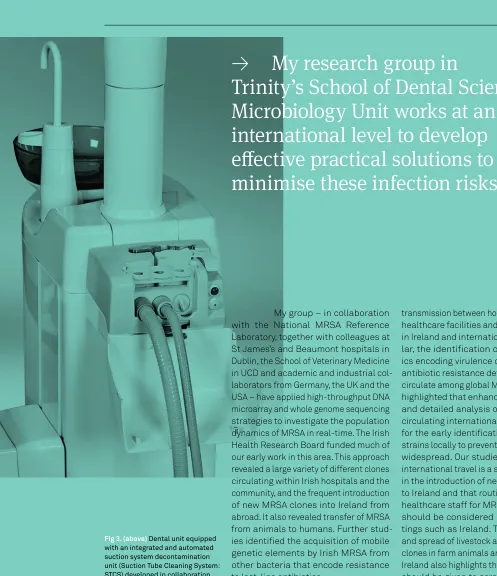
We have developed automated systems for disinfecting such water net-works by harnessing the cleaning and disinfection properties of metastable electrochemically-activated solutions
generated from dilute salt solutions. This negates the need for toxic chemical dis-infectants, reduces costs, and results in biofilm-free systems, providing water virtually free from microorganisms and very substantially reducing infection risk. Dental suction systems remove fluids (e.g. blood and saliva) and debris from the mouth during dental treatment; they can become heavily contaminated with biofilm, which damage the equipment and present multiple infection risks. In a long-term study carried out between 2010–2015, we established that universally used decontamination methods were ineffective due to design problems. In co-operation with industrial partners, we simplified the design and automated the disinfection process, solving the problem. Several of our systems for den-tal and waterline treatment and denden-tal suction decontamination technology were successfully commercialised between 2006–2015 in collaboration with our long-term industrial partners Planmeca Oy
(Helsinki, Finland). These include the Waterline Cleaning System, the Water Management System, the Centralised Water Quality System and the Suction Tube Cleaning System.
New and re-equipping dental hospitals and clinics worldwide have now adopted our disinfection technology and this has benefitted millions of patients every day. In addition to greatly reducing infection risks, our technology provides reduced environmental impact.
MRSA – Our research has applications
beyond combating biofilms. Methicillin-resistant Staphylococcus aureus (often called ‘superbugs’) are a group of path-ogenic bacteria responsible for severe healthcare – and community-associated infections worldwide. MRSA have been endemic in Irish hospitals for 40 years and place a significant burden on patients and healthcare resources.
Combating MRSA, Biofilms and Reservoirs
of Healthcare-associated Infections
David C. Coleman
David Coleman received his BA (Mod), PhD and ScD from Trinity. Joining the School of Dental Science in 1989, he is now
Professor of Oral and Applied Microbiology and head of the division of Oral Biosciences. He is a Fellow of Trinity and the Royal College of Pathologists, London, member of the RIA and winner of the RIA silver medal for microbiology. Published in 170+ articles in peer-reviewed journals, his research interests include minimising infection risks from water networks and medical devices, and the population biology of methicillin resistant Staphylococcus aureus (MRSA) and pathogenic Candida species.
Contact: [email protected]
Combating MRSA, Biofilms and Reservoirs of Healthcare-associated Infections – David C. Coleman
Fig 1. Electron micrograph showing heterogenous bacterial biofilm on the internal surface of a dental waterline.
Fig 2. Electron micrograph showing two-day old biofilm in a dental waterline.
My group – in collaboration with the National MRSA Reference Laboratory, together with colleagues at St James’s and Beaumont hospitals in Dublin, the School of Veterinary Medicine in UCD and academic and industrial col-laborators from Germany, the UK and the USA – have applied high-throughput DNA microarray and whole genome sequencing strategies to investigate the population dynamics of MRSA in real-time. The Irish Health Research Board funded much of our early work in this area. This approach revealed a large variety of different clones circulating within Irish hospitals and the community, and the frequent introduction of new MRSA clones into Ireland from abroad. It also revealed transfer of MRSA from animals to humans. Further stud-ies identified the acquisition of mobile genetic elements by Irish MRSA from other bacteria that encode resistance to last-line antibiotics.
transmission between hospitals and other healthcare facilities and the community in Ireland and internationally. In particu-lar, the identification of mobile genet-ics encoding virulence determinants or antibiotic resistance determinants that circulate among global MRSA strains has highlighted that enhanced surveillance and detailed analysis of MRSA strains circulating internationally is imperative for the early identification of emerging strains locally to prevent them becoming widespread. Our studies revealed that international travel is a significant factor in the introduction of new MRSA strains to Ireland and that routine screening of healthcare staff for MRSA colonisation should be considered in endemic set-tings such as Ireland. The importation and spread of livestock associated MRSA clones in farm animals and their carers in Ireland also highlights that consideration should be given to screening imported
≥ My research group in
Trinity’s School of Dental Science
Microbiology Unit works at an
international level to develop
effective practical solutions to
minimise these infection risks.
[image:35.612.9.506.104.680.2]The Engineering Behind Understanding Speech
Naomi Harte
Humans love to talk and for the lucky majority speech is a natural and easy form of communication. So why is it so hard for computers to understand what we say? The challenge of speech recognition has seen tremendous progress in the past decade, with applications like Apple’s Siri now widely used. But there is much more to speech that the words we say. A decade ago, engineers were happy to correctly detect a sequence of spo-ken words. Now I, and my research team in the ADAPT Centre, are going beyond those words to automatically achieve a fuller understanding of speech. This has applications for audio-visual speech recognition, online surfing, and in animal vocalisation and species delimitation.
Watch my lips– A major obstacle to speech recognition by machine is noise: other people talking, traffic going by, or the radio in the background. When talking to a person in a noisy situation, you sub-consciously start to lip-read to augment the information your brain receives. My ongoing research in ADAPT seeks to estab-lish what visual features are the most useful to augment the speech informa-tion we extract, and how to cleverly fuse these two sources. My group has recently published the TCD-TIMIT database, an audio-visual database of high-resolution continuous speech, which has the poten-tial to become the de facto standard for evaluating audio visual speech recogni-tion systems. T