ADVERTISING.
By J. C. M. EASON.
{Read on 20th November, 1942.)
In submitting this paper on the subject of Advertising I would make
it clear that although I have certain contacts which provide me with
some knowledge as regards the use of advertising, there are many
specialised activities of the practitioner in advertising of which I have
no practical experience, and on the economic side I depend upon higher
authority than my own experience. It is not in any sense a technical
paper on Advertising, but it purports to summarise certain aspects
of this business activity, and to furnish some comments upon criticisms,
which have been rather frequent recently, of its utility. Whatever may
be the reason advertising is attracting more attention than formerly ;
people who do not like it are becoming more prominent, and their
dislikes are being advertised. When the Economic Journal includes a
special article on thesubject ; when the B.B.C. allows Mr. Max Beerbohm
to ventilate his views which, while couched in humorous vein, undoubtedly
disturbed the minds of a number of persons interested in advertising
(both the users and the sellers of space) ; and when Mr. Samuel
Courtauld in his article on the " Relations of Government and Industry "
devotes quite a number of paragraphs to depreciating its value, I think
there is no great excuse needed for bringing the subject under the notice
of this learned Society.
Advertising is simply a part of a selling process. It cannot be isolated
as some separate business activity and taxed or regulated apart from
general economic considerations which would primarily concern the
question of production. I shall deal later on with some of the specific
oriticisms which have been directed against the obvious faults of
advertising. Their importance and their volume is somewhat exaggerated.
There is naturally a tendency in almost all activities whether of business
or of sport to overdo things. Nature, indeed, runs to excess, but a certain
amount of toleration is usually necessary, the tares must be allowed
to grow up amongst the wheat, and nobody needs to make his garden
a desert because the weeds have to be constantly cleared away. There
is evidence that the extravagances and absurdities of advertising are
fully known to those mainly concerned. What follows will clarify the
position and, perhaps, lead to a better understanding of the issues
involved.
seller discloses the specific article he has for sale, gives it a price or
invites inquiries and, in many oases, enters into elaborate arguments •
as to why he believes the consumer should be interested. The primary
object of advertising is to carry out a function which in the
earlier days of commerce occupied the attention of the middleman.
The old definition of the middleman was—" a trader who bought from
the man who did not know where to sell and sold to the man who did
not know where to buy." It has been one of the principal
accomplish-ments of advertising through the medium of printed matter to make
this function less necessary and the wholesaler now is part
of the network of distribution which connects the producer with the
consumer through retail channels, but the producer can, if he wishes,
trade direct with the consumer and he often uses both methods of selling.
When advertising is mentioned the majority of people at once
picture in their mind the Press advertising in papers and magazines
and also poster advertising. It will be helpful, therefore, to give an
indication of the relative importance of the media used by quoting
what is termed the " appropriation" made by typical advertisers.
The statistics in Tables I to V which follow relate to Great Britain,
this type of information not being available for this country.
. TABLE I
Main Forms of Media used by Advertisers
Actual appropria-tion of 24 firms for
one £ Press Media:
National dailies . . 363,714 Sundays . . . . 134,693 London evenings 43,856 Provincials . . 143,912 Periodicals . . 151,696 Trade and Technical
Journals . . 38,228 Other Publications 4,602 Direct Mail
Outdoor Publicity:
Posters . . . . 61,135 Signs . . . . 13,860 Coupon gift schemes Films and slides Radio
Sales promotion : (Displays, dealer
aids, joint adver-tising with dealers, exhibitions, Air a d v e r t i s i n g , sampling and miscellaneous).. Overseas Advertising
Total . . . . £ year
, £
880,701 32,362
74 995 165*725 66,632 38,759
331,826 9,090 1,600,080
Comparison years' aggregate
of two expenditure Percentages 1936-37
55 2
5 10 4
21
i
1001935-36
55 1
10 3 1
25 1 100 Source : Advertiser's Weekly, 10th Sept., 1936.
news-By J> G; M. Eason
43
papers. This sample is quoted here for the purpose of showing
the variety of media used.
Statistics regarding the cost of advertising as a whole are not
avail-able, but there is valuable information on the expenditure in all important
dailies and weeklies on what is called Display Advertising. I give in
Table No. II two columns, one showing the classification as regards
commodities advertised and the other the distribution of the expenditure
between Morning papers, Weekly papers, etc.
TABLE II
Analysis of Total " Display " Advertising Expenditure for 1938.
Commodities
Food and Drink Medicinal Motoring Household Equipment ... Toilet Household Stores Smoking Wearing Apparel Radio and Music
Total Expen-diture £ 000's 5,174 3,337 2,104 2,569 2,285 1,743 1,747 1,177 625 20,761 Total 24-91 16-06 10-13 12-36 11-07 8-38 8-41 5-67 3-01 100-00 Percent-age Incr. or deer, on 1937 + 1-36 + 0-57 — 5-59 — 5-23 + 4-84 + 6-75 — 6-60 — 6-02 — 24-33 — 1-71 Media London Morn. Evg. Nat. Sundays ... Prov. Dailies ... „ Weeklies Magazines Technical Trade Expen-diture £ 000's 7,590 1,008 2,334 3,658 1,141 4,083 529 418 20,761 Total 36-56 4-85 11-25 17-62 5-50 19-66 2-55 2-01 100-00 Percent-age Incr. or deer, on 1937 — 1-74 — 11-85 — 3-81 — 3-03 4- 11-30 -1- 0-49 — 4-59 — 2-62 — 1-71 Source : Statistical Review, April, 1939.
The available figures regarding the use of total newspaper space
refer to Dai]y papers, and below is given an analysis of
one-week showing that advertisers use from 25 per cent, to 38 per cent,
of available space, and that in the lower priced group of papers the
proportion used for display is about 50 per cent, as against 23 per cent,
in such papers as the Times.
TABLE I I I
Dailies Total Space Sq. ins.
Total Advts.
Sq. ins. Display Advts.Sq. ins. Sq. ins.News 2d. group . .
6 papers ljd. and Id.
29 papers Evening 15 papers 000's 252 857 456 000's 65 25-8% 233 27-2% 173 38% 000's 15 126 "87 "000's 187 74*4% $24 72-8% 283 62% Source : Newspaper World, Sept., 1931.
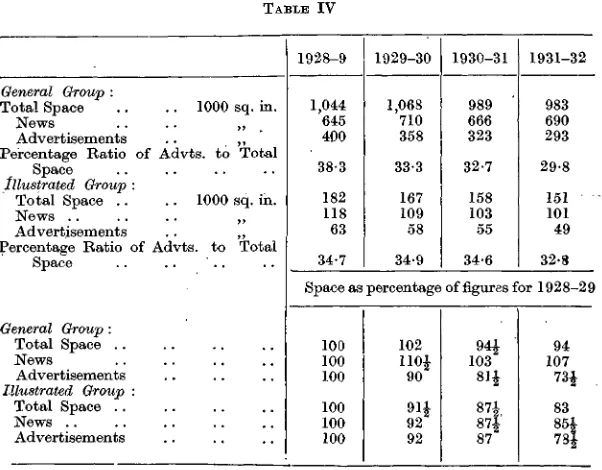
figures printed in the Economist, 4th June, 1932, showing the results
of a " sample " inquiry based on data given in the " Space Barometer "
of the " Newspaper World." The figures relate, in the case of each winter,
to the aggregate of the first weeks of the months of October, January,
February and March. The " General Group " comprises three " national "
and five provincial penny dailies ; the " Illustrated Group " consists
of two " national " dailies.
TABLE IV
General Group :
Total Space . . . . 1000 sq. in. News . . . . ,, Advertisements . . ,, ' Percentage Ratio of Advts. to Total
Space
illustrated Group :
Total Space . . . . 1000 sq. in. News . . . . . . ,, Advertisements . . „ Percentage Ratio of Advts. to Total
Space . . . .
General Group :
Total Space News
Advertisements
Illustrated Group :
Total Space News Advertisements 1928-9 1,044 645 400 38-3 182 118 63 34-7 1929-30 1,068 710 358 33-3 167 109 58 34-9 1930-31 989 666 323 32-7 158 103 55 34-6 1931-32 983 690 293 29-8 151 101 49 32-3 Space as percentage of figures for 1928-29
100 100 100 100 100 100 102 110} 90
9 1 * 92 92
9 4 1 103
8 1 *
87J 8 7 1 87 94 107 73} 83 854 73}
As indicating the importance of advertising in the finance of a
news-paper, figures published by P.E.P., in 1925, show a Sales
Revenue of £1,600,000 and an Advertising Revenue of £1,800,000,
making up the total gross receipts. This calculation is for a morning
newspaper with a 2,000,000 circulation and 20 pages in size. For a
newspaper with 1,000,000 circulation and 16 pages in size the relevant
figures are £800,000 Sales, and £750,000 Advertising.
By J. C. M. Eason 45
advertising. In recent years the means of contact with the public have
been expanded by the use of Radio and Pictures. With Sponsored
Programmes we are all familiar and Documentary films, Screen displays
and other devices have been, and no doubt will be, exploited. The
wider field of propaganda and personal publicity is outside the scope
of this paper?
While there are not any published figures to indicate by statistical
measurement the value or volume of advertising as a whole, there exists
a large accumulation of statistical data produced by the sellers of
advertising space for the purpose of bringing under the notice of
advertisers the facts which are deemed most convincing when putting
forward the claims of their respective publication or publications.
Individual publishers, individual publishing groups and publishers'
associations produce these details in large quantity. Moreover, this
market research and readership survey is also carried out by independent
bodies making investigations, etc. The introduction of the Research
Bureau is largely due to the fact " that the imaginative enterprising
type of mind needed in the advertising world is probably not well
adapted to the carrying out of investigations for which accuracy and
patience are the chief requisites " (Taylor, p. 175) ; a judgment which
is fully borne out by experience. As evidence of the type of information
which is provided by newspapers for the guidance of their clients,
I would refer to an elaborate publication entitled Advertisers' Aid,
issued by the Newspaper Society on behalf of the provincial newspapers.
In this the general industrial development is shown and the preliminary
summaries of the 1935 Census of Production ; gross output is given
for all classified trades, also for building and coal-mining ; the number
of men employed and the location of the businesses are quoted, and a
further paragraph indicates the developments which are known to be
in hands indicating, for instance in Scotland, the development of blast
ovens, aircraft factories, munition factories, etc., also a note of the
orders which have been placed for battleships : details which are vital
to any advertiser or advertising agency are also given for over 1,000
publications, the rates charged and the number and width of columns.
The County figures are separately set out showing the list of publications
in its area, the rural valuation, the occupation of the population as
given in the 1931 Census ; an Income Tax classification as in the middle
of 1936 is also given of families (a) considered likely to afford a
considerable range of luxuries and to be responsive to the appeal of
quality ; (b) may be expected to buy with discrimination, but their
means strictly limit their range of luxuries ; (c) those in poorer
circum-stances, to whom the price factor is of supreme importance and whose
range of purchase is comparatively narrow. For each County the male
and female occupied population is given as distributed between industry,
agriculture, transport, distribution, professional, clerical, etc. The
number of motor vehicles in use is also quoted, both private and
commercial: the number of motor cycles, and the number of insured
persons as in July 1937, and an estimated average number in employment
in 1937 is also shown.
of the circulation, whereas in 1939 it covered only 62 per cent., and the
15 mile radius was also some 4 per cent, lower in 1939 than in 1935,
showing the outward trend of population. Much of the information
is given diagrammatically ; full information as regards the number of
houses, and the families living in the various sized houses, from 3 or
more living rooms upwards ; the occupations are given in detail; there
is a long list of classified shops, and a list of all the multiple shops, and
the number of branches. The consumption of gas and electricity is noted
for 6 selected years over a period of 10 years, as also are the number
of Wireless Licences given for the Bristol Postal area, and the number
of telephone subscribers. A duplicated statement towards the end
gives a comparison of " X " with the rest of England and Wales. This
procedure is repeated for other cities.
Market research, as it is called, is not confined to individual publishers,
or to publishing groups. There are independent bodies carrying out
investigation which purports to be an impartial examination of the
field, and to correct errors of exaggerations or emphasis which may
have been discovered in the claims put forward by the individual
publications. The general result is to provide some defence for the
inexpert or credulous advertiser against the claims which may be put
before him by those who are selling space. The approach to the matter
is indicated by the following extracts from a journal published by one
of these organizations :—
" To be of practical value to a manufacturer a report of an investigation
must among other things truthfully represent the opinions of his
existing or potential customers. If the truth has not been recorded
by the investigator, if a proper cross-section of the public has not been
taken, then the entire work is not only valueless but extremely dangerous
and may easily result in great loss from misguided efforts. For two
years we have never hesitated to criticise space selling propaganda
put out by newspapers and journals where our own work has conclusively
proved the statements to be ill-founded." This particular publication
claims to have " debunked " pseudo-statistical reports published under
the banner of " market research." In one of the issues there is a
complete analysis for the month of September, 1936, of 9 Daily papers
and 12 Sunday papers giving precise-information as to the number of
inches of space occupied by the proprietors of 63 groups of commodities,
beer, jam, cigarettes, furnishers, motor cars, etc. This kind of information
ip given to enable advertisers to follow the extent of current advertising
in a manner which will enable them to measure their own advertising,
newspaper by newspaper, against the total volume for the group, and
the volume used by leading advertisers (for in each group the figures
for two leading advertisers are given).
By J. CM. Edson 47
with an enquiry even when made by an experienced team of investigators.
Full use is made of all these facts by the expert advertiser to any
manufacturer or merchant. A marketing programme must embrace a
selection of suitable media according to the price of the article and
the area to be covered. The design of the package or container has to
be carefully chosen, the channels of trade—wholesale and retail—
have to be studied, and the work of each salesman examined, possibly
samples have to be distributed. The whole has to be very carefully
correlated as to the time of appearance. It is not suggested that every
advertisement implies all these processes, but it is claimed that they
are essential to advertising as a whole, and at some time or another
must receive consideration from the advertiser. It is surely a mistake
to write off such work as unnecessary and parasitical as is done by Mr.
Samuel Courtauld. There is a determined effort to base selling policy
on relevant facts and to economise selling expenses.
The development of the use of statistics has been gradual. In the
early days of advertising there was a recognition of the qualitative
aspect, and publishers' rates indicated what users of space considered
to be the value of a particular medium. With the remarkable rise that
took place in the publishing world, starting about 40 years ago, and
showing continuous development ever since, the quantitative factor
began to enter into the minds of both the seller and the buyer. It
became clear that as between any two publications in a somewhat
similar group of papers, as, for instance, the national dailies or the
periodicals, the one with the greatest number of readers occupied a
superior place, and could charge a higher rate ; this, for instance, leads
to claims such as the following :—" The cost of a page in . . .
per thousand of its 2,800,000 guaranteed circulation will vary from
3s. 5d. to 5s. 8d., according to the position required. No paper with
this class of circulation can claim so low a cost per page per thousand
of circulation " ; it will be noted that a qualitative factor is claimed
in the reference to the type of reader.
methods of gifts, free insurance and canvassing, merely chasing their
own tails. And the people for whom the chasing was being done—
i.e., the advertiser—began to show a new interest in where his money
was going." (Extract from " Newspaper Reading in the Third Year
of the War," by P. Kimble.) It would be of interest to speculate upon
the course of events had the proposal of a leading newspaper proprietor
to produce a f d. paper been persisted in and proved successful. One
of the obstacles was the magnitude of the change, which was greater
than the distributors could accept. Does the absence of flexibility in
our coinage system tend to prevent a change which would secure to
the consumer a price advantage rather than non-price coupon or other
benefits ? Is there any evidence on the point elsewhere ?
Having described as best I could, though imperfectly, the scope of
advertising and given some idea of its value and volume, it becomes
necessary to consider its place in the business structure.
In February, 1937, Lord Stamp, in addressing the Advertising
Association in London, maintained, without qualification, that advertising
that is informative and not merely assertive adds to mutual exchange
and so increases the national income ; that rival advertising is not
wholly uneconomic, because by it trial is made, and that advertising
is the great agent of the principle of substitution which works unceasingly
towards the reduction of costs, the introduction of new methods, and.
the maintenance of quality : the wider the range the wider the exchange^
and advertising is an essential complement to the division and stablization
of labour. Intrinsically advertising need not be apologised for.
(He had some comments to make upon other aspects of advertising
to which I shall refer later.)
Advertising, however, has been a subject of comment and criticism
in several journals. I have referred to Mr. Rothschild's article in the
"Economic Journal," (April 1942). In addition to that I have been
fortunate in having my attention called to reviews of a book by an
American, Professor N. H. Borden, entitled, " Economic Effects of
Advertising," and published under the auspices of the Harvard University.
I have not had an opportunity of reading the book itself, but there are
reviews in the " Times Trade and Engineering Supplement " of October
1942 and the August 1942 issue of " Economica " (by Mrs..Robinson).
The first-mentioned article is chiefly concerned with the relation of
advertising to the trade cycle, and its utility in encouraging an
employ-ment of resources when productive activities are slack. Mr. Rothschild
comments upon the absence of reliable statistics ( a point which is very
noticeable) ; points out that the precise results of an advertisement
or series of advertisements cannot be easily—if at all—ascertained by
the firm using such ; considers that even " combative " advertising as
distinct from " constructive " advertising is of value in maintaining
employment, and that the alternative to advertising may not be
increased production and consumption of capital goods, but
idleness-of the resources involved.
By J. C. M. Eason
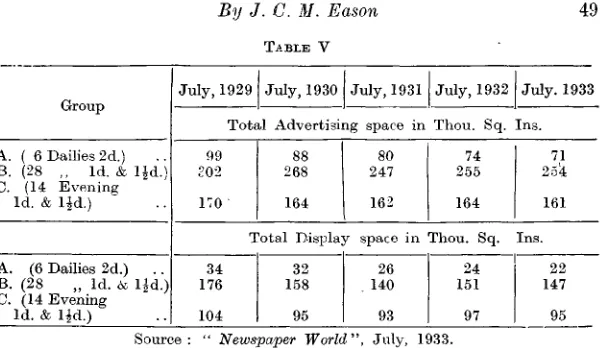
TABLE V
49
Group
A. ( 6 Dailies 2d.) B. (28 ,, Id. & lid.) C. (14 Evening
Id. & lid.)
A. (6 Dailies 2d.) B. (28 „ Id. & l i d . ) C. (14 Evening
Id. & l^d.)
July, 1929 July,1930 July,1931 July, 1932 July. 1933 Total Advertising space in Thou. Sq. Ins. 99
202 170
88 268 164
80 247 162
74 255 164
71 2oi 161 Total Display space in Thou. Sq. Ins. 34
176 104
32 158 95
26 , 140 93
24 151 97
22 147 95 Source: " Newspaper World", July, 1933.
It will be noted that the lowest figures occurred in the year
1931-and that the two-penny group suffered most. Not only that but whereas
the other groups show a recovery from the lowest figure in 1931 the fall
continued in this group ; the evening papers show the greatest
resist-ance ; the percentages for 1933 on 1929 are 28, 16 and 6J respectively
for each group. The figures for display advertising alone were also taken
out for the same month ; they show similar movements as regards the
volume of space used, that is to say, 1931 is the lowest figure ; the
per-centages for 1933 compared with 1929 are 35, 16| and 8^ respectively
for each group.
The " Economist," referring to the article by Mr. Rothschild, comments
upon what he describes as the economic " lack-logic " of the advertising
habits of the business world. I wonder how far readers will agree that
this criticism is pertinent. Why should firms as a whole employ their
resources in doing something which they believe is unproductive ?
Why challenge their decision ? He admits, indeed, that advertising
expenditure is le?s elastic than other kinds of expenditure, and in that
I think he is referring more particularly to those manufacturing firms
with large resources and widespread interests who can maintain general
publicity so that the public may not forget about their products, but
how can the majority of firms continue a selling policy under
cir-cumstances where it is clear there are not buyers ? It would seem
to be an anomalous position. If, under the circumstances of
depres-sion, publicity and advertising is to continue, it can only be as part
of a programme which is directed to create purchasing power.
Advertising cannot operate in a vacuum. The wisdom of such a
pro-gramme in any particular set of circumstances becomes a matter of
wide economic significance, but cannot be discussed here. If
adopted it must be advertised.
The conclusions reached by Professor Borden are summarised in
the " Times Trade Review " at considerable length. The real importance
of his book consists in its being a factual study, and it is likely—I should
think—that in the near future similar studies will be made as the result
of the various criticisms now appearing upon this interesting subject.
It is not easy to summarise a summary, and, while I quote some of the
findings as given in the source mentioned, these cannot convey the
full results of Professor Borden's book :—
from its part in promoting a dynamic, expanding economy.
Adver-tising's chief task from a social standpoint is that of encouraging the
development of new products. It offers a means whereby the enterpriser
may hope to build a profitable demand for his new and differentiated
merchandise which will justify investment. From growing investment
has come the increasing now of income which has raised man's material
welfare to a level unknown in previous centuries. In a dynamic economy,
however, advertising plays a different role. It is an integral part of a
business system in which entrepreneurs are striving constantly to find
new products and new product differentiations which consumers will
want. Without opportunity to profit relatively quickly from the new
products which they develop, entrepreneurs would not be inclined
either to search for them or to risk investment in putting them on the
market. Advertising and aggressive selling provide tools wiiich give
prospect of profitable demand. Since advertising has in large part
been associated with the promotion of new and differentiated
merchandise, a substantial part of advertising costs should be looked
upon economically as growth costs. They are the costs incurred in
raising the economy from one level to another. From the standpoint
of social welfare these costs have been far more than offset by the rise
in national income which they have made possible. Such costs should
not be prevented or decried. In the future if man's material welfare
is to be raised to higher levels in our free economy, the spark of
enterprise must be kept glowing brightly ; the chance to profit from
the new should continue to exist. So long as individual enterprise
flourishes and a dynamic economy continues, advertising and aggressive
selling will play a significant social role." (T. T. and E. S. Oct. 1942.)
Mr. Samuel Courtauld primarily objects to the use of public money
for teaching advertising salesmanship ; but his criticism is based upon
his views as to the place advertising plays in business. Summarised
briefly, they are as follows : It is used to sell things to people who
cannot afford them, competition advertising is a costly national
extravagance, it causes economic waste, production power is wrongly
employed, fraudulent sales and dishonest prospectuses bear hardly upon
honest and useful competitors, transfers business from one manufacturer
to another without increasing total volume ; ultimate consumer who
has to pay gets less or inferior products for his money ; the judgment
could hardly be more severe—there is one helpful admission, however,
in the sentence : " Advertising, of course, has a legitimate function :
to let people know where they can get what they want. Moreover,
an advertising campaign to introduce a really valuable commodity,
hitherto unknown, to the public, is wholly justifiable, and is a legitimate
business expense."
It would really appear that the indictment should be framed against
human nature than against advertising. Human fallibility or gullibility
is no new feature of social life. " Passing off " was known of long ago ;
"sanding the sugar " is not a new device ; waste in production is no
novelty. I was interested to note that Mrs. Robinson, in reviewing
Professor Borden's book, states," it is impossible to separate advertising
from other forms of ' aggressive selling ' or to separate ' aggressive
selling ' from the economic system of which it is an integral part."
By J. C. M. Eason 51
types of wrapping and branding prevents substitution, and in connection
with certain classes of goods it ensures a certain degree of service.
From the manufacturers' point of view these things can only be
accomplished with the assistance of advertising, and on the assumption
that manufacturers, as a whole, know their business best, and that in
the long run the manufacturer must sell his goods at a price to attract
the consumer, little question need be raised. Price maintenance,
un-doubtedly, at one and the same time prevents large scale retail trading
based upon quantity because prices cannot be cut, and facilitates wide
distribution and sale at numerous points where the shopkeeper can
trade within the allowed margins. This particularly applies to articles
sold in small quantities over a wide area. In the case of dearer articles,
as, for instance, motors, photographic apparatus, etc., price maintenance
is more concerned to secure service, and the structure of distribution
is maintained to achieve that end. I do not regard this economic process
as being determined mainly by advertising. The fixed price, cheap price,
and non-price competitive struggle may be facilitated but is not induced
by advertising. It may be that this system is developing its own faults.
There probably is a history of action and reaction in the forms of retail
selling and distribution just as in other human affairs. The present
generation sees the drawbacks of the price maintenance system and is not
conscious of some of the disadvantages which led to its adoption. From
a knowledge of the Book trade, where the Net Book system, under which
a publisher fixed the price of his article and then secured the co-operation
of other publishers to maintain the fixed price in the book shops, it is
certain that the publishers adopted a policy which suited themselves.
It is probable also that they acted in what has turned out to be the
best interests of the consumer, and so secured the maximum sale of
their goods. To illustrate my point I quote from a letter dated 13th
March, 1890, written by the late Charles Eason, Senior, to Mr. Frederick
MacMillan :—" I have been 25 years in the trade. In my several positions
as assistant and master I have had a fair opportunity of following all
the aspects of this question. The varying allowances made to the public
in the conflict between buyers and sellers have been a great injury to
the morals of the Book selling trade. I have known 5 copies of a
21/-book sold to the public on the same day in the same shop at 5 different
prices: full price, 5% off, 10% off, 15% off, and 2d. in the shilling. It
was not what was the true price of the book, but how much can I get,
and what is the state of the buyer's mind ? Is he ignorant or learned
in the ways of Booksellers ? The moral sense of both buyer and seller
is blunted and in the higgling that goes on statements are often made
by both parties which are not true, and all because of the fiction of
published price which an unwise system of trade terms has originated
and now supports."
the conditions of sale, including all the lavish shop-fittings and publicity
devices for which the consumer and nobody else has got to pay." I
do not accept the statements as conclusive, and certainly not as
self-evident. There are other points of interest in connection with price
maintenance which one would like to discuss, but which would be quite
inappropriate here. I think I have not gone outside the boundaries
of my subject in the comments made.
By J. C. M. Eason 53
human problem not in any way confined to these Islands. I find in a
Trade paper, under the heading " Better Keep on the Safe Side/' some
notes as to the position in the U.S.A. :—" Mr. Roosevelt's Government
is standing no nonsense from over-imaginative advertisers these days.
While this applies to everybody it is a matter of very special importance
to all those concerned with food, drug and cosmetic advertising. Make
a statement which you can't back up with proof and you are lucky
if you only get a prompt demand to ' cease and desist.' Then if you
try to be a show-off and think you can out-smart Uncle Sam, any one
of a number of things might happen—in fact, will most certainly happen.
You may be presented with a very hefty fine or you may have your
stock of goods confiscated ; you may find yourself in behind bars, or
out on bail. And it makes no difference who or how prominent you
and your business may be. . . . Even the most correct statements,
according to the old standard, have now to be edited, pruned and
sterilized of all misleading words of praise and/or claim. ' Cure ' is
practically eliminated from the advertising dictionary of the States.
The same applies to a considerable extent to 'Best,' 'Finest/
' Cheapest.' It's even dangerous to say such a thing as ' Doe's Doses
relieve a cold.' Instead you must say 'Doe's Doses help to relieve
the discomfort (or pain, unpleasantness, or similar qualifying word)
resulting from a cold.' In fact, this situation has resulted in the
publication by the National Better Business Bureau of ' A Guide to
National Advertising/ which it would be well for every British advertiser
in, or interested in, the market in the States, to have on hand. . . .
But both the advertiser and the publisher, in the vast majority of
instances, recognise to-day that protecting public confidence is their
only hope of protection for themselves. ' A Guide to National Advertising '
will be a friend as well as a guide, and may well become the constant
companion of every advertising agency as well as of publishers."
In Great Britain the Official Journal of the Pharmaceutical Society
has drawn up a series of conditions which will, in future, govern the
acceptance of advertisements by them. The principal points dealt
with are (a) an advertisement cannot be accepted for a product which
is advertised elsewhere in terms which are objectionable or grossly
exaggerated, and (b) that an advertisement will not be accepted if
elsewhere than in the Journal the product is advertised in terms implying
that it is a benefit in certain illnesses and a cure for certain others.
Another paragraph deals with a statement regarding vitamin content.
This action is complementary to that of the special Proprietary
Medi-cines Committee of the Advertising Association whose recommendations
on the type of advertising to be accepted have been adopted by all
the principal Trade Associations interested in publishing printing
and advertising.
serve a useful public service " ; it is suggested that developments
should be subject to a licence ; exceptions must be made to meet
legitimate claims in country areas. In the broadcast made by Mr. Max
Beerbohm which has received so much attention, he ranks advertisers
as the Fifth Estate, and hopes that if they are strong they will be
merciful. He waxes strong on the " loathsome red-hot coal illuminations
5Jappearing on buildings in London—" If such things must be allowed,
let them be done with some semblance of taste and fancy." This
sentiment would be re-echoed by all the principal users, but, of course,
"de gustibus non est disputandum." For instance, he shows his
personal dislike (which I share) to the current practice of printing
the letterpress of a magazine in " disjected fragments " between the
pages of advertisements. This practice has been followed by a large
number of journals over a long period during which their circulations
have increased sometimes in a spectacular manner. A publisher
evidently knows his advertisers and readers and success is the acid
test of the accuracy of his judgment, and those who dislike the habit
must console themselves with the thought that they possess some
unusual and distinguishing characteristics not those of the man in the
.street.
It must always be remembered in connection with judgments on
advertising that the intellectual, refined, cultured and highly aesthetic
appeal may not, in fact, effectively advertise the produce with which
it is associated. If the only recollection it leaves is the cleverness of
the sentence or slogan, the humour of picture or cartoon, it has failed
in its mission. That this is frequently the case can be testified to by
those who have participated in a competition to identify well-known
slogans with the goods advertised. Sometimes even the class of goods
cannot be recognised : often the precise product is not recalled to
memory. On the other hand, some advertising which is deemed crude
and, perhaps, even vulgar, rivets the attention and fixes itself on the
memory.
By J. C. M. Eason 55
What is the impression conveyed by this survey of advertising ?
To some extent that will, no doubt, be revealed by the comments which
it evokes at this meetiEg. For my part I can see a very useful business
activity promoting more immediate and direct contact between the
producer and the consumer, enabling life to become more varied
and providing the consumer with a knowledge as to how he can escape
from the tyranny of routine and price control. On the whole, it
brightens life for us all, and as far as Press advertising is concerned
it secures a circulation of news and opinion which would not otherwise
be possible, since it enables papers and magazines to be sold cheaper
than they otherwise would be. In facilitating movement it may tend
to accelerate the pace of change by reducing the time it takes for an
invention to pass from the laboratory through the factory to the
consumer, and it also may make change more intelligible and acceptable.
Its exuberance may lead to its downfall. Do not the poets warn us
that " goodness " may grow to a " plurisy " and " die of his own too
much " and that nature may become " strangled with her waste fertility
v?
This end, however, is not inevitable. Advertising one may hope will
never earn such an epitaph.
DISCUSSION.
Mr. Lyon: It gives me very great pleasure to propose a vote of
thanks to our ex-President, Mr. Eason, for the paper which he has
just read to us this evening on the subject of Advertising. As he has
told us the subject is one of very great importance nowadays and
one which it is very well worth while to have brought forward for
discussion before Members of this Society. It would be rash for me
to offer any criticisms on the observation of a man who is an expert
on the subject, and a part of whose successful publishing and
book-selling business is concerned with the business of advertising, but
I feel sure he will forgive me if I just refer briefly to some thoughts
on advertising which his paper has inspired.
Advertising is sometimes spoken of as a sort of conspiracy between
the producer and seller of goods at the expense of the buyer, perhaps
even Mr. Courtauld has that opinion, but I think that modern
adver-tising is a great help to the buyer in most cases and is greatly
appre-ciated by him; advertising aims to inform as well as to persuade and
generally is in the interests of the public.
Mr. Eason deals in his paper mostly with Press advertising and
with the advertising of branded articles. The Press is used to keep
the name of an article, or a trade mark distinguishing the article,
before the public and thus to establish " goodwill " which is sometimes
described as the probability that the old customer will resort to the
old place.
Mr. Courtauld, whose opinion was quoted by Mr. Eason, would
appear to be obsessed with the notion that a factory manager who has
to undertake 100 per cent, of responsibility for production and
quality of goods is frequently paid a salary of the range of £700 per
annum, whereas the sales manager for that firm is paid a salary of as
much as £5,000 per annum. He should be reminded of the recent case
of fruit advertising where an expenditure of £100,000 on Press
adver-tising repaid within twelve months an increased return of £2 millions
worth in sales.
Mr. Eason makes a passing reference in Table I of his paper to the
fact that poster advertising accounts for only 4 or 5 per cent, of the
total gross annual expenditure on advertising. Some of those engaged
on designing for this class of work are eminent artists who are
doubt-less paid very big fees. We all remember one of the early posters of
Pears Soap " Bubbles " by Sir John Millais, and recently the London,
Midland and Scottish Eailway Company engaged Sir William Orpen
to design some of their big posters of holiday resorts, of railway
stations, and of means of transport.
The publication Advertisers' Aid serves to bring together much
statistical information of use to advertisers. We have in this country
corresponding information available for the business community in
the many Government statistical publications, such as the Reports on
the Census of Population, The Census of Production, The Census of
Distribution, 1933, and in the Statistical Abstract, which is published
annually. I often think business-people do not make sufficient use of
all the information that is put at their disposal in Government Reports
which are authoritative and have been compiled often at great expense.
There is no doubt that in recent years the Association of Advertising
Agencies has helped a great deal in keeping out of the public Press
advertisements which are fradulent or undesirable and not fit to put
before the public, and it is gratifying to note that when they make
recommendations of this kind the recommendations are submitted to
the Newspaper Associations, who always endorse them and act on
them.
I am sure all the Members and visitors present have had great
pleasure in listening to the paper, and I have much pleasure in
pro-posing that the thanks of the Society be given to Mr. Eason for his
most interesting paper.
57
interestingly presented and it must create confidence. Vast sums are
spent to-day on drawings and production work, often several times
greater than the cost of the space in which the advertisements
appeared. Many famous artists contributed to make advertisement
pictures real works of art.
This great advance in the technique of advertising must be credited
primarily to the work of the modern advertising service agencies
which, with their highly skilled staffs, their market research specialists,
idea men and artists, were constantly striving for new and higher
standards. Their work had undoubtedly changed the whole course of
advertising, and turned it into the vital electrifying force it is to-day.
An interesting point brought out by Mr. 0'Kennedy was that some
years ago, when the Government was endeavouring to ascertain the
amount of the invisible export of this country he had pointed out that
at that time advertising formed a not unsubstantial " invisible
export " which was apparently not included in the Government
figures. He had ascertained that probably about £200,000 came into
this country in payment for advertising space in the newspapers, on
the hoardings, railway stations, trams, etc. This figure was*now
sub-stantially reduced—happily, he thought—because many of the firms
whose advertising formerly reached Irish media from outside the
country were now established here, and though their advertising had
increased rather than diminished it w
ras now an internal affair and
therefore could no longer be classed as an invisible export.
Turning to the future of advertising, Mr. O'Kennedy said it was
not easy to foretell what may happen when peace breaks out again,
but unless there was a complete cataclysm, upsetting the whole
struc-ture of business as we knew it to-day, he predicted that the
advertis-ing of to-morrow would be somethadvertis-ing vastly greater, vastly more
powerful, vastly more interesting than anything we had known. It
would compete with the editorial columns in interest and
attention-compelling values. It would reach out into the air, not in the crude
way in which many American commercial broadcasts have done, but
in a way which by sheer interest will hold the attention of millions
of listeners. It would reach out into the streets, making of the
hoard-ings in very truth the poor man's picture gallery. Advertising was
still in its infancy when the war began. This war had brought home
to us the amazing power of mass propaganda. Advertising was in all
essentials mass propaganda adapted to the needs of business. In the
world of the future advertising would assuredly play a tremendous
part.
He had very great pleasure in seconding the vote of thanks to Mr.
Eason which had been so ably proposed by Mr. Stanley Lyon.
of the cornucopia of £60,000 per annum paid for years by this firm
on advertising. The second instance was perhaps the most striking
of the two. It related to his old friend the late Viscount Wakefield,.
who was founder and head of the well-known firm of Messrs. C. E .
Wakefield & Co., London. When he (Mr. Shanahan) first met Mr.
Charles Wakefield (as he was then) over forty years ago, he was,
the travelling representative of an American oil company. A few
years later, having—largely due to a marvellous
personality—estab-lished an extensive business for the American company, he was
suc-cessful in forming a British oil company which he advertised
exten-sively and continuously in Great Britain and Ireland. As a result^
the American firm was largely eliminated and the new British firm
prospered to such a wonderful extent that during his lifetime Charlie
Wakefield—who meantime, as his well-known philanthropy became
established, had received a knighthood, then a baronetcy, and
subse-quently, to crown all, a peerage—gave away for charitable and
national purposes over a million of money, and when he died two<
years ago he left £800,000. He was Lord Mayor of London in
1915-1916. He (Mr. Shanahan) enjoyed his hospitality at the Mansion
House at that period. There had been in the past a good deal of
objectionable advertising calculated to lower the moral tone of the
people who lent a willing ear to such improprieties, but fortunately
this unpleasant phase had diminished very largely in recent years,,
and need not now be regarded as a regrettable feature of the
adver-tising system.
There was one other point worth mentioning, namely, propaganda,,
which Mr. Eason had advisedly ignored. In his (Mr. Shanahan's)
opinion, propaganda could not be dissociated from advertising when
they had the experience of broadcasting over the air of
announce-ments relative not only to current news but also to charitable and!
national purposes. In the long run, only truth prevails. Finally,,
with all its admitted blemishes, advertising exercised a marvellous
and beneficial power in the land.
He would conclude by mis-quoting Shakespeare :
11 Sweet are the uses of advertisementWhich, like the toad, ugly and venomous,
Wears yet a precious jewel in its head."
Mr. 0. E. MoConnell, F.I.P.A., Chairman of the Publicity Club of
Ireland, complimented Mr. Eason on the very excellent and
compre-hensive paper he read. He said he would make his remarks as brief
as possible owing to the shortage of time, and said he would refer
to-one point which was touched on in the paper, viz., wastage in
adver-tising. He also said he would try, in the time at his disposal, to go
behind the scenes of an advertising agency and give an idea of some
of the difficulties that professional advertising men had to contend
with in conducting the advertising of any Irish product on the British
market, which should, of course, be of great interest to those present.
He referred to Irish eggs which bore the official Government mark
tDire-Irish.
First of all, he said wastage in advertising was the same as in any
other commercial activity, such as manufacture, distribution and
selling; in no other selling activity was it harder to compute wastage
than in advertising.
59
in 1940, the title being, " Wastage in Advertising and Selling ", and
after referring in a brief manner to the different types of wastage,
he concluded his remarks by stating that " in no other selling activity
is it so difficult to compute the value of results as in advertising. The
sound method to adopt, therefore, is to place a certain value on the
results aimed at, and to measure the advertising by this standard ".
He then went on to refer to advertising Irish eggs in Great Britain,
and said that when he was asked by the Department of Agriculture
to conduct this scheme, he was faced with a great difficulty, and that
was, to make popular an article bearing a brand against an article
without a brand. He explained that all English-produced eggs
fetched a higher price than imported eggs, and that the British egg
had no mark; therefore, his principal aim was to make the Irish egg,
which was looked upon as foreign with a trade mark, equal in value
to the British-produced egg without a mark.
In consultation with the Government Department concerned, he
took advantage of the methods of distribution to enclose a number of
leaflets, suitably printed, which contained a number of recipes for'
the cooking of eggs. These leaflets, in addition, told the story very
clearly of the Government control and methods of grading, sorting
and exporting the eggs.
The slogan used in the leaflets, and subsequently in the Press
advertisements, was " yesterday's egg on your table to-morrow ", and
upwards of 5,000,000 leaflets were printed and distributed to the
shops where the eggs were sold; thus a very large expense was saved.
Each case also contained a price card giving to-day's price, and
the experience gained was that all these leaflets were distributed to
the consumers in the shops, which had a very decided effect on the
public mind.
To support this, a scheme of Press advertising was linked up with
it, and this had the effect of drawing the trade away from the markets,
where they had a good distribution, and therefore the larger demands
had the effect of bringing the price almost to the British level.
Un-fortunately, war conditions prevented the continuance of this scheme,
which was highly successful in its inception.
Mr. McConnell concluded by stating that this is a very good
example of one of the many problems that face a modern advertising
agency, and the success is some small justification for their existence.
He also referred to his starting his business career in the firm of
Messrs. Eason & Son, and again thanked the speaker for an excellent'
pa'per.
Mr. E. K. Eason: Advertising is one of the means by which the
ground is prepared in the mind of the buyer so that he discovers and
buys the things he needs. Without advertising, goods produced in
one place could not be sold to consumers distributed over a million
other places.
The Government Stationery Office could take lessons from
adver-tisers regarding the lay-out of their publications, including forms,
so as to attract readers and secure the maximum attention to their
contents.
Professor B. F. Shields: Mr. Eason deserves our best thanks for
what some regard as the many-headed monster of publicity. It is a
subject that most economists avoid, probably because little or no
information is available on the costs of advertising as a part of the
prices of articles advertised; yet it is possible to deduce certain
pro-visional conclusions on the general economic effects of advertising on
production, consumption and prices. The late Professor Marshall
appears to consider most forms of advertising, except those which he
calls constructive, as purely social waste. In his Industry and Trade
he defines constructive advertisements as all measures designed to
draw the attention of people to opportunities for buying or selling,
of which they may be willing to avail themselves. In fact, the
adver-tisement of almost every article offered for sale would come under
this definition.
Some advertisements have their special uses. They make known
to consumers certain articles and their properties. For instance,
well-directed publicity may -be given to new inventions and useful
pro-ducts, which may result in an immense addition to the public welfare.
This does not imply that all advertisements present a truthful or
reasoned statement of the goods advertised. They are not written to
persuade people to make a careful selection of articles required. They
appeal not to reason, but to the emotions of the public by constant
suggestion, iteration and attractive illustrations.
61
I
to be charged by retailer^. By doing so, they prevent mark-down
prices and quick turnover which are features of successful
mer-chandising. Without price maintenance, the inefficient retailer tends
to be eliminated, and the burden of waste that he saddles on society
is kept at a minimum. Under this system, in lines where there is
little or no competition between manufacturers, undue profits may
be secured by those handling their products.