METHOD DEVELOPMENT AND VALIDATION FOR
SIMULTANEOUS ESTIMATION OF ESOMEPRAZOLE AND
DOMPERIDONE BY RP-HPLC IN BULK AND COMBINED DOSAGE
FORMS
R. Suthakaran*
Professor and Principal, Department of Pharmaceutical Chemistry and Drug Regulatory
Affairs, Teegala Ramreddy College of Pharmacy, Meer pet, Hyderabad, Telangana, INDIA.
ABSTRACT
A new HPLC method was developed and validated for the
determination of Esomeprazole and Domperidone in tablet dosage
form. The chromatographic separation was achieved on an Intersil C18
methanol: water (50:50 V/V) at a flow rate of 1.0 mL/min, and the
detection was carried out by using UV detector at 260 nm. The total
run time was 10 minutes. The retention time of Esomeprazole and
Domperidone were found to be 2.869 min. and 3.942 min.
respectively. The performance of the method was validated according
to the present ICH guidelines.
KEYWORDS: Esomeprazole and Domperidone in tablet dosage form.
INTRODUCTION Esomeprazole
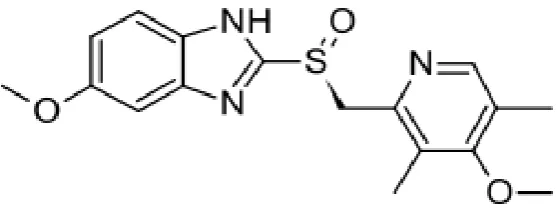
Esomeprazole is a Proton Pump Inhibitors and Histamine Antagonist,
chemically (S)-5-Methoxy-2-[(4-methoxy-3,5-dimethyl pyridine-2yl) methylsulfinyl}-3H
benzimidazole. A highly effective inhibitor of gastric acid secretion used in the therapy of
stomach ulcers and Zollinger-Ellison syndrome. The drug inhibits the H+-K+-ATP ase (H+-K+
exchanging ATP ase) in the proton pump of gastric parietal cells. Esomeprazole is a
compound that inhibits gastric acid secretion and is indicated in the treatment of
Volume 5, Issue 01, 656-676. Research Article ISSN 2277– 7105
Article Received on 18 Oct 2015,
Revised on 10 Nov 2015, Accepted on 02 Dec 2015
*Correspondence for
Author
R. Suthakaran
Professor and Principal,
Department of
Pharmaceutical Chemistry
and Drug Regulatory
Affairs, Teegala
Ramreddy College of
Pharmacy, Meer pet,
Hyderabad, Telangana,
pylori eradication to reduce the risk of duodenal ulcer recurrence. Esomeprazole belongs to a
new class of antisecretory compounds, the substituted benzimidazoles, that do not exhibit
anticholinergic or H2 histamine antagonistic properties, but that suppress gastric acid
secretion by specific inhibition of the H+/K+ ATPase at the secretory surface of the gastric parietal cell. By doing so, it inhibits acid secretion into the gastric lumen. This effect is
dose-related and leads to inhibition of both basal and stimulated acid secretion irrespective of the
stimulus.
Mechanism of Action: Esomeprazole is a proton pump inhibitor that suppresses gastric acid secretion by specific inhibition of the H+/K+-ATPase in the gastric parietal cell. By acting specifically on the proton pump, Esomeprazole blocks the final step in acid production, thus
[image:2.595.159.438.323.430.2]reducing gastric acidity.
Fig. 1. Structure of Esomeprazole Domperidone
A specific blocker of dopamine receptors. It speeds gastrointestinal peristalsis, causes
prolactin release, and is used as antiemetic and tool in the study of dopaminergic
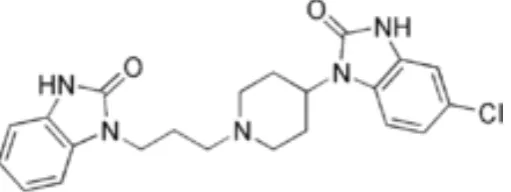
mechanisms. Chemically 5-chloro-1-(1-[3-(2-oxo-2,3-dihydro-1H-benzo[d] imidazol-1-yl)
propyl piperidin-4-yl)-1H- benzo[d]imidazol-2(3H)-one, in Pharmacodynamically, It is a
specific blocker of dopamine receptors. It speeds gastrointestinal peristalsis, causes prolactin
release, and is used as antiemetic and tool in the study of dopaminergic mechanisms.
Mechanism of Action: Domperidone acts as a gastrointestinal emptying (delayed) adjunct and peristaltic stimulant. The gastroprokinetic properties of Domperidone are related to its
peripheral dopamine receptor blocking properties. Domperidone facilitates gastric emptying
and decreases small bowel transit time by increasing esophageal and gastric peristalsis and by
lowering esophageal sphincter pressure. Antiemetic: The antiemetic properties of
Domperidone are related to its dopamine receptor blocking activity at both the chemoreceptor
receptors, which are found in the chemoreceptor trigger zone, located just outside the blood
[image:3.595.173.429.128.224.2]brain barrier, which - among others - regulates nausea and vomiting.
Fig. 1. Structure of Domperidone
METHODS AND MATERIALS Chemicals
Esomeprazole and Domperidone were obtained as a gift sample, from Casca. HPLC grade
methanol, water and acetonitrile and other solvents were obtained from Merck Limited.
Waters 2690 pump, Detector 996 PDA, Inertsil-C18 ODS column with Empower-2
chromatogra- phic system. HPLC grade water was obtained by distilling deionizer water
produced by a Milli-Q Millipore water system (Milford, MA, USA).
Chromatographic conditions
The HPLC system (LC Waters, Milford, MA, USA) consisted of quaternary gradient system
(600 Controller), in-line degasser (Waters, model AF), photodiode array detector (Water,
2998 model) and auto sampler (Waters). Data was processed using Empower2 software
(Waters, Milford, MA, USA).
Integration of the detector output was performed using the Waters Empower software to
determine the peak area. The contents of the mobile phase were filtered through a 0.45μm
membrane filter and degassed by sonication before use. Mobile phase was used as diluents.
The flow rate of the mobile phase was optimized to 1 ml/min which yields a column back
pressure of 110–112 kg/cm The run time was set at 6 min and a column temperature was
maintained at 30°C. The volume of injection was 5μl, prior to injection of the analyte, the
column was equilibrated for 30 with the mobile phase. The eluent was detected at 235 nm.
The developed method was validated in terms of specificity, linearity, accuracy, limit of
detection (LOD), limit of quantification(LOQ), intra-day and inter-day precision and
OPTIMIZED CHROMATOGRAPHIC METHOD Mobile Phase
Degassed Methanol and Water in the ratio of 50:50 V/V.
Preparation of stock solution
Reference solution: The solution was prepared by dissolving 20.0 mg of accurately weighed
Esomeprazole and 25.0 mg Domperidone in Mobile phase, in two 100.0 mL volumetric
flasks separately and sonicate for 20 min. From the above solutions take 10.0 mL from each
solution into a 50.0 mL volumetric flask and then makeup with mobile phase and sonicate for
10min.
Preparation of working standard solution
The stock solutions equivalent to 20 ppm to 80 ppm with respect to both drugs were prepared
in combination of Esomeprazole and Domperidone above, sonicated, and filtered through
0.45µ membrane.
Preparation of sample drug solution for pharmaceutical formulations
Twenty tablets were weighed accurately and a quantity of tablet powder equivalent to 25 mg
Esomeprazole and 50 mg Domperidone was weighed and dissolved in the 70 mL mobile
phase with the aid of ultrasonication for 20 min. The content was diluted to 100 mL with
mobile phase to furnish a stock test solution. The stock solution was filtered through a 0.45
µm Nylon syringe filter and 10.0 mL of the filtrate was diluted into a 50.0 mL volumetric
flask to give a test solution containing 25 µg/mL Esomeprazole and 50 µg/mL Piperaquine
Phosphate.
RESULTS AND DISCUSSION
The present research work was designed at developing a rapid, sensitive, precise and accurate
HPLC method for the simultaneous estimation of Esomeprazole and Domperidone in
pharmaceutical dosage forms. In order to affect analysis of the component peaks under
isocratic conditions, mixtures of water and methanol in different combinations with different
pH were tested as mobile phase on a Waters C8 stationary phase. A binary mixture of water:
methanol in the ratio of 50:50 v/v was proved to be the most suitable of all the combinations
since the chromatographic peaks obtained were better defined and resolved and free from
Optimized chromatographic conditions
After various trials, the following chromatographic conditions were finally optimized for the
simultaneous estimation of Esomeprazole and domperidone in a capsule dosage form. Mobile
phase constitutes of Methanol: Water in the ratio of 50:50 v/v. Detection wave length 260 nm
flow rate 1.0 ml/min, after a steady baseline the standard solution were injected and
chromatograms were recorded until the reproducibility of the peak areas were found and
finally 120 μg/ml of the standard solution of the individual samples of and domperidone and
Esomeprazole mixed standard solutions were injected and the chromatograms were recorded.
Table1: Optimized Chromatographic Conditions
Calculation
The amount of drugs present in each pharmaceutical formulation was calculated by using the
standard calibration curves (concentration in ppm was taken on x-axis and peak area on
y-axis).
Optimized method
The separation of Esomeprazole and Domperidone with retention time 2.008 min for and
3.912 min respectively for standard. The typical chromatograms of the standard were
recorded for the repeatability and were given in Figure No.3.
Parameters Method
Stationary phase (column) Inertsil -ODS C18 (250 x 4.6 mm, 5 µ)
Mobile Phase Methanol : Water (50:50)
Flow rate (ml/min) 1.0 mL/min
Run time (minutes) 10 min
Column temperature (°C) Ambient
Volume of injection loop (l) 20
Detection wavelength (nm) 260 nm
E s o m e p ra z o le 2 .8 6 9 D o m p e ri d o n e 3 .9 4 2 AU 0.00 0.02 0.04 0.06 0.08 Minutes
[image:6.595.148.459.73.229.2]1.00 2.00 3.00 4.00 5.00 6.00 7.00 8.00 9.00 10.00
Fig. 3: Chromatogram of standard
The separation of Esomeprazole and Domperidone with retention time 2.007 min and 3.942
min respectively for sample. The typical chromatograms of the standard and sample were
recorded for the repeatability and the respective chromatograms were given in Figure No. 4.
E s o m e p ra z o le 2 .8 6 7 D o m p e ri d o n e 3 .9 4 2 AU 0.00 0.02 0.04 0.06 0.08 Minutes
1.00 2.00 3.00 4.00 5.00 6.00 7.00 8.00 9.00 10.00
Fig. 4: Chromatogram of sample
Observation: Got chromatogram at RT’s of 2.007 min to Esomeprazole and 3.942 min to
Domperidone.
Acceptance Criteria: The assay limits for Esomeprazole and Domperidone was 98-102.0% and the results obtained for Esomeprazole and Domperidone was found to be within the
limits.
DISCUSSION: In this trail Methanol and water in 50:50 ratio are allowed to pass through
Inertsil - C18 ODS column at a flow rate of 1.0 mL/min for 10 min and detection is done at
[image:6.595.140.458.364.519.2]METHOD VALIDATION 1) System suitability
A Standard solution was prepared by using Esomeprazole and Domperidone working
standards as per test method and was injected Five times into the HPLC system.
The system suitability parameters were evaluated from standard chromatograms by
calculating the % RSD from five replicate injections for Esomeprazole and Domperidone,
retention times and peak areas.
1. The % RSD for the retention times of principal peak from 5 replicate injections of each
standard solution should be not more than 2.0 %
2. The % RSD for the peak area responses of principal peak from 5 replicate injections of
each standard solution should be not more than 2.0%.
3. The number of theoretical plates (N) for the Esomeprazole and Domperidone peaks is NLT
3000.
4. The Tailing factor (T) for the Esomeprazole and Domperidone peaks is NMT 2.0.
RESULT
The system suitability for Esomeprazole with parameters of mean RT, Peak area, USP Plate
count, USP Tailing are 2.8745, 678433.8, 10768.34, and 1.155774 respectively . The SD
(Standard deviation) for RT and Peak RT are 0.001817 and 6031.131 respectively. The %
RSD for RT and Peak area is 0.05221 and 0.888979.
The system suitability for Domperidone with parameters of mean RT, Peak area, USP Plate
count, USP Tailing are 3.9432, 1228593, 9573.997, and 0.892407 respectively . The SD
(Standard deviation) for RT and Peak RT are 0.00707and 122124.07 respectively. The %
RSD for RT and Peak area is 0.025353 and 1.800764.
Acceptance criteria
Resolution between two drugs must be not less than 2.
Theoretical plates must be not less than 2000.
Tailing factor must be not less than 0.9 and not more than 2.
2) Specificity
―Specificity is the ability to assess unequivocally the analyte in the presence of components
which may be expected to be present. Typically these might include impurities, degradants,
matrix, etc. Lack of specificity of an individual procedure may be compensated by other
supporting analytical procedure(s).‖
With respect to identification, discrimination between closely related compounds likely to be
present should be demonstrated by positive and negative samples. In the case of
chromatographic assay and impurity tests, available impurities / degradants can be spiked at
appropriate levels to the corresponding matrix or else degraded samples can be used. For
assay, it can be demonstrated that the result is unaffected by the spiked material. Impurities
should be separated individually and/or from other matrix components. Specificity can also
be demonstrated by verification of the result with an independent In the case of
chromatographic separation, resolution factors should be obtained for critical separation.
Tests for peak homogeneity, for example, by diode array detection (DAD) or mass
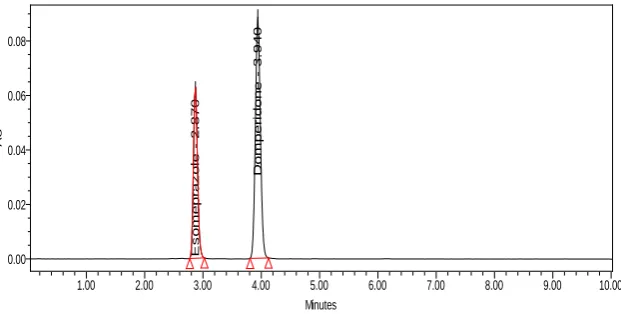
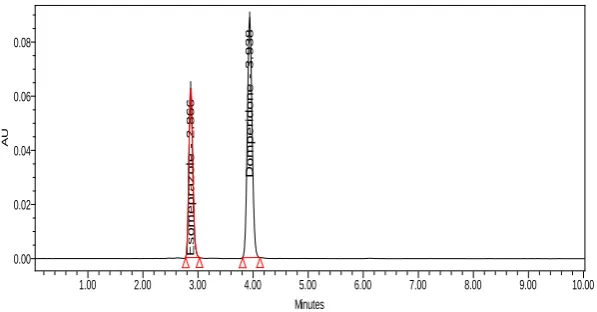
spectrometry (MS) are recommended. The chromatogram of standard is in Fig. 5 and
sample in Fig. 6.
E s o m e p ra z o le 2 .8 7 0 D o m p e ri d o n e 3 .9 4 0 AU 0.00 0.02 0.04 0.06 0.08 Minutes
[image:8.595.149.460.433.590.2]1.00 2.00 3.00 4.00 5.00 6.00 7.00 8.00 9.00 10.00
Fig 5: Chromatogram of standard
E s o m e p r a z o le -2 .8 6 6 D o m p e r id o n e -3 .9 3 8 AU 0.00 0.02 0.04 0.06 0.08 Minutes
[image:9.595.154.453.74.230.2]1.00 2.00 3.00 4.00 5.00 6.00 7.00 8.00 9.00 10.00
Fig 6: Chromatogram of sample
Observation: Got a peak for sample at an Rt of 2.866 min for Esomeprazole and 3.938 min for Domperidone.
Discussion: The chromatograms for specificity of Esomeprazole and Domperidone were identical with nearly same retention time; specificity was confirmed by peak purity.
3) Precision
―The precision of an analytical procedure expresses the closeness of agreement (degree of
scatter) between a series of measurements obtained from multiple sampling of the same
homogeneous sample under the prescribed conditions. Precision may be considered at three
levels; repeatability, intermediate precision and reproducibility.‖
Precision should be obtained preferably using authentic samples. As parameters, the standard
deviation (SD), the relative standard deviation (coefficient of variation) and the confidence
interval should be calculated for each level of precision.
Repeatability expresses the analytical variability under the same operating conditions over a
short interval of time (within-assay, intra-assay). At least nine determinations covering the
specified range or six determinations at 100 % test concentration should be performed.
Intermediate precision includes the influence of additional random effects within laboratories,
according to the intended use of the procedure, for example, different days, analysts or
Reproducibility, i.e., the precision between laboratories (collaborative or interlaboratory
Studies), is not required for submission, but can be taken into account for standardization of
analytical procedures.
Calculation
The precision of an analytical method is a measure of the random error and is defined as the
agreement between replicate measurements of the same sample. It is expressed as the
percentage coefficient of variation (% CV) or relative standard deviation (RSD) of the
replicate measurements.
% RSD = Standard deviation x 100 Mean
Acceptance Criteria
Chromatograms of standard and sample should be identical with near Retention time.
a) Repeatability
Data of Repeatability (System precision) for Esomeprazole
System precision: Standard solution prepared as per test method and injected five times with
concentration of 40 ppm , the Peak area and its % assay is 674753(98.66), 674261(99.30),
675298(101.53), 679221(100.53), 688636(99.98), respectively ,the mean value of this
precision was 678433.8 (100.00) and SD 6031.135, 1.107678 and % RSD 0.888979 (1.10).
Data of Repeatability (System precision) for Domperidone
System precision: Standard solution prepared as per test method and injected five times with
concentration of 40ppm, the Peak area and its % assay is 1218805 (99.95), 1214014 (100.24),
1215474 (100.06), 1227655 (99.30), 1267019 (100.00), respectively, the mean value of this
precision was 1228593 (99.91) and SD 22124.07(0.35819) and % RSD 1.800764(0.35).
Acceptance criteria
The %RSD for sample should be NMT 2.
The %RSD, which is within the limits hence method, is precise.
Discussion: The proposed RP-HPLC method was also validated for system precision and method precision. When the solution of Esomeprazole and Domperidone was repeatedly
injected on the same day, the % RSD of the Esomeprazole and Domperidone was found to be
4)Accuracy
―The accuracy of an analytical procedure expresses the closeness of agreement between the
value which is accepted either as a conventional true value or an accepted reference value and
the value found‖.
Accuracy can be demonstrated by the following approaches:
Inferred from precision, linearity and specificity
Comparison of the results with those of a well characterized, independent procedure.
Application to a reference material (for drug substance)
Recovery of drug substance spiked to placebo or drug product (for drug product)
Recovery of the impurity spiked to drug substance or drug product (for impurities)
The closeness of agreement between the true value which is accepted either conventional new
value or an accepted reference value and the value found.
A study of Accuracy was conducted. Drug Assay was performed in triplicate as per test
method with equivalent amount of Esomeprazole and Domperidone into each volumetric
flask for each spike level to get the concentration of Esomeprazole and Domperidone
equivalent to 50%, 100%, and 150% of the labeled amount as per the test method. The
average % recovery of Esomeprazole and Domperidone were calculated.
Acceptance Criteria:
The mean % recovery of the Esomeprazole and Domperidone at each spike level should be
not less than 98.0% and not more than 102.0% for both the drugs separately.
Observation
Amount found
% Recovery = --- × 100
Amount added
The recovery results indicating that the test method has an acceptable level of accuracy.
The mean % recovery and % RSD for 50% concentration of three injections for
Esomeprazole are 100.06 and 0.18. For 100%, 100.04 and 0.0191 and for 150%, 100.02 and
The mean % recovery and % RSD for 50% concentration of three injections for
Domiperitone are 99.69333 and 0.92 For 100%, 99.83333 and 0.41 and for 150% 99.97333
and 0.31 respectively.
Acceptance Criteria: The mean recoveries of both the drugs were found to be 100.04%, 99.83%. Under the acceptance criteria within the limit of 98 to 102 %. So the results obtained
for recovery at 50%, 100%, 150% are within the limits. Hence method is accurate.
Discussion: The % recovery studies are performed by spiking known amount of analyte at three different concentrations (50%, 100%, and 150%). There was a high % recovery of
Esomeprazole and Domperidone indicating the proposed method is accurate.
5) Linearity
―The linearity of an analytical procedure is its ability (within a given range) to obtain test
results which are directly proportional to the concentration (amount) of analyte in the
sample‖.
It may be demonstrated directly on the analyte, or on spiked samples using at least five
concentrations over the whole working range. Besides a visual evaluation of the analyte
signal as a function of the concentration, appropriate statistical calculations are
recommended, such as a linear regression. The parameters slope and intercept, residual sum
of squares and the coefficient of correlation should reported. A graphical presentation of the
data and the residuals is recommended.
Linearity of test method
It is an analytical procedure is its ability within a given range to obtain test results which are
directly proportional to the concentration of analyte in the sample.
A Series of solutions are prepared using Esomeprazole and Domperidone working standards
at concentration levels from 20 ppm to 80 ppm of target concentration .Measure the peak area
response of solution at Level 1 and Level 6 six times and Level 2 to Level 5 two times.
Acceptance Criteria
Correlation Coefficient should be not less than 0.9990.
% of y- Intercept should be ±2.0.
The concentrations from 0 to 80 ppm with increment of 10 , the respective average area were
0, 632546, 658296, 694400, 730308, 916282, 9402046, 9788277 and its slope value 18600,
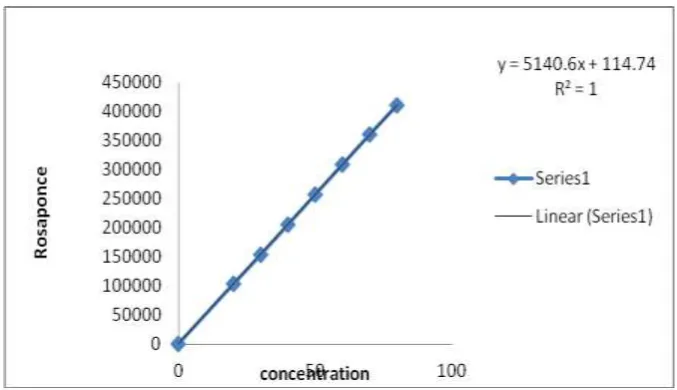
Y-intercept 276.2 and correlation coefficient is 1 for Esomeprazole. For Domperitone 0,
1202965, 1254371, 1295856, 1297167, 1308577, 1359903, 1411306 and its slope value
[image:13.595.125.473.188.362.2]5140, Y-intercept 114.7 and correlation coefficient is 1.
Fig 7: Linearity Plot (Concentration Vs Response) of Esomeprazole.
Fig 8: Linearity Plot (Concentration Vs Response) of Domperidone.
Acceptance criteria: Correlation coefficient (R2) should not be less than 0.998. The correlation coefficient obtained was 0.998, which is in the acceptance limit.
Discussion: The method was linear in theconcentration ranges 20-80 μg mL-1 and 20-80 μg
[image:13.595.127.466.405.600.2]6) Ruggedness
―The ruggedness of an analytical method is the degree of reproducibility of test results
obtained by the analysis of the same samples under a variety of conditions, such as different
laboratories, different analysts, different instruments, different days, etc. Ruggedness is
normally expressed as the lack of influence on test results of operational and environmental
variables of the analytical method. Ruggedness is a measure of reproducibility of test results
under the variation in conditions normally expected from laboratory to laboratory and from
analyst to analyst‖. The degree of reproducibility is then evaluated by comparison of the
results obtained under varied conditions with those under standard conditions.
a) System to system variability
System to system variability study was conducted on different HPLC systems, under similar
conditions at different times. Six samples were prepared and each was analyzed as per test
method. Comparison of both the results obtained on two different HPLC systems, shows that
the assay test method are rugged for System to system variability.
Acceptance Criteria
The % relative standard deviation of Esomeprazole and Domperidone from the six sample
preparations should be not more than 2.0%
The % assay of Esomeprazole and Domperidone should be between 98.0%-102.0%.
Observation
The % RSD was found within the limit. Ref tables:
Result
The system variability of Esomeprazole of peak area and its % assay of six samples were
634360 (98.65), 634098(98.63), 635696(96.86), 633289(98.52), 634147(98.63),
633495(98.55) and its mean value is 634180.8(98.64) as well as % RSD 0.019(0.12).
The system variability of domperitone of peak area and its % assay of six samples were
1203625 (99.98), 1202225 (99.30), 1202840 (98.60), 1204283 (99.30), 1202735 (98.55),
7) Robustness
According to ICH Q2A ―the robustness of an analytical procedure is a measure of its capacity
to remain unaffected by small, but deliberate variations in method parameters and provides an
indication of its reliability during normal usage‖.
Furthermore, it is stated in ICH Q2B ―The evaluation of robustness should be considered
during the development phase and depends on the type of procedure under study. It should
show the reliability of an analysis with respect to deliberate variations in method parameters.
If measurements are susceptible to variations in analytical conditions, the analytical
conditions should be suitably controlled or a precautionary statement should be included in
the procedure. One consequence of the evaluation of robustness should be that a series of
system suitability parameters (e.g., resolution test) is established to ensure that the validity of
the analytical procedure is maintained whenever used.‖
As part of the Robustness, deliberate change in the Flow rate, Mobile Phase composition,
Temperature Variation were made to evaluate the impact on the method.
a) Effect of variation of flow rate
A study was conducted to determine the effect of variation in flow rate. Standard solution
prepared as per the test method was injected into the HPLC system using flow rates, 1.0
mL/min and 1.2 mL/min. The system suitability parameters were evaluated and found to be
within the limits for 1.0 mL/min and 1.2mL/min flow.
Esomeprazole and Domperidone and was resolved from all other peaks and the retention
times were comparable with those obtained for mobile phase having flow rates 1.0mL/min.
Acceptance Criteria
The Tailing Factor of Esomeprazole and Domperidone standards should be NMT 2.0 for
Variation in Flow.
Observation: The tailing factor for Esomeprazole and Domperidone was found to be within the limits. As shown in table.
b) Effect of variation of temperature
system suitability parameters were evaluated and found to be within the limits for a
temperature change of 20ºC.
Similarly sample solution was chromatographed at 25ºC temperature. Esomeprazole and
Domperidone were resolved from all other peaks and the retention times were comparable
with those.
Acceptance Criteria: The Tailing Factor of Esomeprazole and Domperidone standard and sample solutions should be NMT 2.0 for Variation in temperature.
Observation: The tailing factor for Esomeprazole and Domperidone is found to be within the limits.
Table 3: Data for Effect of variation in flow rate (Esomeprazole)
Flow 0.8 ml
Std Area Tailing factor
Flow 1.0 ml
Std Area Tailing factor
Flow 1.2 ml
Std Area Tailing factor
620286 1.322089 634322 1.604878 602077 1.285372
619282 1.331920 635792 1.584354 601854 1.319385
621337 1.296438 634360 1.543805 602403 1.292055
620456 1.315454 635696 1.568590 603421 1.304561
620765 1.326551 633147 1.559986 602465 1.294621
Avg 620425 1.31849 Avg 634663.4 1.572323 Avg 602444 1.299199
SD 754.0018 0.013728 SD 1100.917 0.023367 SD 599.8833 0.013223
%RSD 0.086 1.04 %RSD 0.184 1.48 %RSD 0.09 1.01
TABLE 4: Data for Effect of variation in flow rate (Domperidone)
Flow 0.8 ml
Std Area Tailing factor
Flow 1.0 ml
Std Area Tailing factor Flow 1.2 ml Std Area Tailing factor
1273707 1.362089 1206349 1.280574 1266195 1.285372
1273211 1.352617 1205267 1.279932 1265885 1.299385
1273948 1.376926 1205625 1.261721 1266303 1.308063
1273465 1.345752 1205840 1.276089 1267243 1.274662
1273862 1.374925 1205735 1.250640 1265762 1.267630
Avg 1273638.6 1.362462 Avg 1205763.2 1.269791 Avg 166277.6 1.287022
SD 3301.369 0.013609 SD 392.1635 0.01314 SD 582.9758 0.016786
%RSD 1.041 0.99 %RSD 0.19 1.03 %RSD 0.35 1.3
Acceptance criteria
The %RSD obtained for change of flow rate, variation in mobile phase was found to be
below 1, which is within the acceptance criteria. Hence the method is robust.
Discussion: The results of robustness for effect of variation in flow rate and organic phase
are presented in Table: 3 and 4.
8) Limit of detection and limit of quantification (LOD and LOQ)
―The detection limit of an individual analytical procedure is the lowest amount of analyte in a
sample which can be detected but not necessarily quantitated as an exact value. The
quantitation limit of an individual analytical procedure is the lowest concentration of analyte
in a sample which can be quantitatively determined with suitable precision and accuracy.‖
Various approaches can be applied
Visual definition
Calculation from the signal-to-noise ratio (LOD and LOQ correspond to 3 or 2 and 10 times
the noise level, respectively)
Calculation from the standard deviation of the blank
Calculation from the calibration line at low concentrations
LOD; LOQ ¼ F_SD b (2.6-1)
F: factor of 3.3 and 10 for LOD and LOQ, respectively
SD: standard deviation of the blank, standard deviation of the ordinate intercept, or
residual standard deviation of the linear regression.
b: slope of the regression line
The estimated limits should be verified by analyzing a suitable number of samples containing
the analyte at the corresponding concentrations. The LOD or LOQ and the procedure used for
determination, as well as relevant chromatograms, should be reported.
The quantification limit is the lowest level of analyte that can be accurately and precisely
measured. This limit is required only for impurity methods and is determined by reducing the
analyte concentration until a level is reached where the precision of the method is
unacceptable. If not determined experimentally, the quantification limit is often calculated as
the analyte concentration that gives S / N = 10. An example of quantification limit criteria is
Esomeprazole
From the linearity plot the LOD and LOQ are calcula ted
LOD = 3.3 σ S
3.3×5988.87
= --- = 1.06 18600
LOQ = 10 σ S
10×5988.87
= --- = 3.21 18600
Domperidone
From the linearity plot the LOD and LOQ are calculated:
LOD = 3.3 σ S
3.3×771.5483
= --- = 0.49 5140
LOQ = 10 σ S
10×771.5483
= --- = 1.50 5140
Acceptance criteria
Resolution between two drugs must be not less than 2.
It was found from above data that all the system suitability parameters were within the limit.
Discussion: The Limit of detection (LOD) was 1.06 and 0.49 μg mL-1 and Limit of Quantization (LOQ) was 3.21 μg mL-1 and 1.50 μg mL-1 for Esomeprazole and
SUMMARY AND CONCLUSION Summary
The analytical method was developed by studying different parameters. First of all, maximum
absorbance was found to be at 260 nm for Esomeprazole and 238 nm for Domperidone.
Common wavelength will be 260 nm and the peaks purity was excellent. Injection volume
was selected to be 20 µL which gave a good peak area. The column used for study was
Inertsil C18, ODS chosen good peak shape. Ambient temperature was found to be suitable for
the nature of drug solution. The flow rate was fixed at 1.0 mL/min because of good peak area,
satisfactory retention time and good resolution. Different ratios of mobile phase were studied,
mobile phase with ratio of 50:50 Methanol : Water was fixed due to good symmetrical peaks
and for good resolution. So this mobile phase was used for the proposed study.
The present recovery was found to be 98.0-102 was linear and precise over the same range.
Both system and method precision was found to be accurate and well within range. Limit of
Detection was found to be 1.06 µg/mL for Esomeprazole and 0.49 µg/mL for Domperidone.
Linearity study was, correlation coefficient and curve fitting was found to be 0.999. The
analytical method was found linearity over the range of 20-80 ppm of the target concentration
for both the drugs. The analytical passed both robustness and ruggedness tests. On both cases,
[image:19.595.43.557.492.770.2]relative standard deviation was well satisfactory.
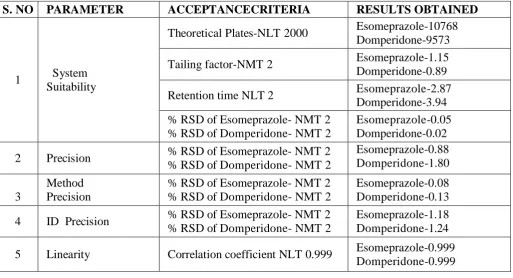
Table 5: Summary for RP-HPLC Method
S. NO PARAMETER ACCEPTANCECRITERIA RESULTS OBTAINED
1 System Suitability
Theoretical Plates-NLT 2000 Esomeprazole-10768
Domperidone-9573
Tailing factor-NMT 2 Esomeprazole-1.15
Domperidone-0.89
Retention time NLT 2 Esomeprazole-2.87
Domperidone-3.94 % RSD of Esomeprazole- NMT 2
% RSD of Domperidone- NMT 2
Esomeprazole-0.05 Domperidone-0.02
2 Precision % RSD of Esomeprazole- NMT 2
% RSD of Domperidone- NMT 2
Esomeprazole-0.88 Domperidone-1.80
3
Method Precision
% RSD of Esomeprazole- NMT 2 % RSD of Domperidone- NMT 2
Esomeprazole-0.08 Domperidone-0.13
4 ID Precision % RSD of Esomeprazole- NMT 2
% RSD of Domperidone- NMT 2
6 Accuracy Percentage Recovery 98-102%
Esomeprazole-100.4 Domperidone-99.7
7 Limit of detection Esomeprazole-1.06 µg/mL
Domperidone-0.49 µg/mL
8 Limit of quantitation Esomeprazole-3.21 µg/mL
Domperidone-1.50 µg/mL
CONCLUSION
The proposed HPLC method was found to be precise, specific, accurate, rapid and
economical for simultaneous estimation of Esomeprazole and Domperidone in tablet dosage
form. The sample recoveries in all formulations were in good agreement with their respective
Label Claims and this method can be used for routine analysis. It can be applied for routine
analysis in laboratories and is suitable for the quality control of the raw materials,
formulations, dissolution studies and can be employed for bioequivalence studies for the
same formulation.
REFERENCES
1. Gerber, F. Krummen, M. Potgeter, H. Roth, A. Siffrin, C. Spoendlin, C. (2004). "Practical
aspects of fast reversed-phase high-performance liquid chromatography using 3μm
particle packed columns and monolithic columns in pharmaceutical development and
production working under current good manufacturing practice". Journal of
Chromatography. Displacement Chromatography. Sacheminc.com. Retrieved
2011-06-07.
2. Lloyd R. and Dolan, John W. (2006). High-Performance Gradient Elution: The Practical
Application of the Linear-Solvent-Strength Model. Wiley Interscience. ISBN
0470055510.
3. Majors, Ronald E.. (2010-09-07) Fast and Ultrafast HPLC on sub-2 μm Porous Particles
— Where Do We Go From Here? – LC-GC Europe. Lcgceurope.com.
4. Xiang, Y.; Liu Y.; Lee M.L. (2006). "Ultrahigh pressure liquid chromatography using
elevated temperature". Journal of Chromatography.
5. Horváth, Cs.; Preiss B.A.; Lipsky S.R. (1967). "Fast liquid chromatography. Investigation
of operating parameters and the separation of nucleotides on pellicular ion exchangers".
6.
http://www.agilent.com/en-us/products/liquid-chromatography/lc-pumps-vacuum-degassers/1290-infinity-quaternary-pump#specifications Saccar CL: The pharmacology
7. McKeage K, Blick SK, Croxtall JD, Lyseng-Williamson KA, Keating GM:
Esomeprazole: a review of its use in the management of gastric acid-related diseases in
adults. Drugs., 2008; 68(11): 1571-607.
8. Vachhani R, Olds G, Velanovich V: Esomeprazole: a proton pump inhibitor. Expert Rev
Gastroenterol Hepatol., 2009 Feb; 3(1): 15-27.
9. Chen X, Ji ZL, Chen YZ: TTD: Therapeutic Target Database. Nucleic Acids Res., 2002
Jan 1; 30(1): 412-5.
10.Argekar AP, Shah SJ. Simultaneous determination of cinnarizine and domperidone
maleate from tablet dosage form by reverse phase ion pair high performance liquid
chromatography. J Pharm Biomed Anal., 1999; 19: 813–7.
11.Kobylinska M, Kobylinska K. High-performance liquid chromatographic analysis for the
determination of domperidone in human plasma. J Chromatogr B Biomed Sci Appl. 2000;
744: 207–12.
12.Zarapkar SS, Salunkhe BB. Determination of domperidone by high performance thinlayer