Abstract—Dynamic task allocation is among the most difficult issues in multi-robot coordination, although it is imperative for a multitude of applications. Auction-based approaches are popular methods that allocate tasks to robots by assembling team information at a single location to make practicable decisions. However, a main deficiency of auction-based methods is that robots generally do not have sufficient information to estimate reliable bids to perform tasks, particularly in dynamic environments. While some techniques have been developed to improve bidding, they are mostly open-looped without feed-back adjustments to tune the bid prices for subsequent tasks of the same type. Robots’ bids, if not assessed and adjusted accordingly, may not be trustworthy and would indeed impede team performance. To address this issue, we propose a closed-loop bid adjustment mechanism for auction-based multi-robot task allocation, with an aim to evaluate and improve robots’ bids, and hence enhance the overall team performance.
Each robot in a team maintains and uses its own track record as closed-loop feedback information to adjust and improve its bid prices. After a robot has completed a task, it assesses and records its performance to reflect the discrepancy between the bid price and the actual cost of the task. Such performance records, with time-discounting factors, are taken into account to damp out fluctuations of bid prices. Adopting this adjustment mechanism, a task would be more likely allocated to a competent robot that submits a more accurate bid price, and hence improve the overall team performance. Simulation of task allocation of free-range automated guided vehicles serving at a container terminal is presented to demonstrate the effectiveness of the adjustment mechanism.
Index Terms—Multi-robot, task allocation, auction, bid adjustment, dynamic environments
I. INTRODUCTION
Multi-robot task allocation addresses the problem of how to assign tasks to the corresponding robots while achieving the
Manuscript received March 06, 2011; revised April 07, 2011.
W. K. Zhu is with The Department of Industrial and Manufacturing Systems Engineering, The University of Hong Kong, Hong Kong, (e-mail: [email protected]).
S. H. Choi is with The Department of Industrial and Manufacturing Systems Engineering, The University of Hong Kong, Hong Kong, (e-mail: [email protected]).
specific objectives of team performance. Research in this field dates back to the late 1980s. Task allocation of multiple autonomous robots in dynamic environments is core to multi-robot control for a number of real world applications, such as military [1], transport services [2], search and rescue [3], etc.
The working environments of task allocation can be static or dynamic [4]. Static task allocation assumes completely known information about the environment, such as the number of tasks and robots, the arrival time of tasks, and the process of task execution. Traditionally, applications in multi-robot domains have largely remained in static scenarios, with an aim to minimise a cost function, such as total path length, or execution time of the team. Obviously, static approaches cannot adapt to changes in a dynamic and uncertain working environment. Dynamic task allocation, on the other hand, makes decisions based on real-time information and is therefore more adaptive to changes. This paper assumes a set of dynamically released tasks to be completed by a team of robots, and the conditions of the work process keep changing during task execution. This kind of dynamic working environment is ubiquitous in real-life applications, such as exploring and mapping by robots in an unknown environment, unexpected adversarial targets in a combat, stochastic pickup and delivery transport services, etc. [5].
According to the taxonomy of Gerkey and Mataric [6], multi-robot task allocation problems can be classified along three dimensions. In the dimension of robot, it can be a single-task robot or a multi-task one. A single-task robot is capable of executing exactly one task at a time, while a multi-task robot can handle more than one task simultaneously. In the dimension of task, it can be a single-robot task or a multi-robot task. A single-robot task requires only one robot to execute it, while a multi-robot task requires more than one robot to work on it at the same time. In terms of planning horizon, task allocation can be instantaneous assignment and time-extended assignment. Instantaneous assignment only considers the tasks currently available. Time-extended assignment elaborates the effect of current assignment on future assignment, involving task dependency and schedule. Instantaneous assignment is commonly used since it needs less computation on task sequencing algorithms, and is particularly practicable in dynamic situations where tasks are randomly released [7].
An Auction-based Approach with Closed-loop
Bid Adjustment to Dynamic Task Allocation in
Robot Teams
The task allocation problem in this paper is restricted as a single-task robot, single-robot task, and instantaneous assignment.
The problem of multi-robot task allocation is typically NP-hard. The challenges become even more complicated when considering operations in dynamic and uncertain environments, such as unexpected interference between robots, stochastic task requests, inconsistent information, and various component failures [4]. In these cases, it is not worth spending time and resources to secure an optimal solution, if that solution keeps changing as operations go on. Also, if there are time-window constraints, there may not be enough time to compute an exact and global solution. The basic objective of a multi-robot task allocation problem is to have tractable planning that produces efficient and practicable solutions. Auction-based, or market-based, approaches manage this by assembling team information at a single location to make decisions about assigning tasks over the team to produce practicable solutions quickly and concisely [5].
In an auction, a set of tasks are offered by an auctioneer in the announcement phase, and the robot bidders submit offers to the auctioneer. Once all bids are received or a pre-specified deadline has passed, the auction is cleared. In the winner determination phase, the auctioneer decides which robot wins which task. This paper considers the case of cost minimisation in that an auctioned task is awarded to a robot offering the lowest bid price. A simple yet commonly used kind of auction is single-item auction in which only one task is offered at a time [8]. On the other hand, combinatorial auctions are more complex in that multiple tasks are offered and each participant can bid on any combination of these tasks. Since there are an exponential number of combinations to consider, auction administration such as bid valuation, communication, and auction clearing would soon become intractable [5]. Sequential single-item auction is a practicable approach when tasks are dynamically released, and is adopted in this paper.
The earliest example of auction-based multi-robot coordination appeared about thirty years ago, called contract net protocol [9]. Auction-based multi-robot coordination approaches have been growing in popularity in recent years. They have been successfully implemented in a variety of domains, such as robotic transport [10], mapping and exploration [11], house cleaning [12], and reconnaissance [13]. Auction-based approaches are preferable in on-line applications, in that they can quickly and concisely assemble team information at a single location to make decisions, significantly reducing the combinatorial nature of task assignment problems. The solution quality, although not optimal, is guaranteed in most cases. Auction-based approaches are suitable for dynamic and uncertain applications since they can accommodate new information through frequent auction of tasks [4].
However, some issues of auction-based task allocation have yet to be further investigated [5]. Firstly, a clear conceptual understanding of auction-based coordination approaches is needed. Further works should be devoted to studying how components, such as performance assessment mechanism,
bidding strategy, and auction clearing mechanism, can be implemented effectively in different multi-robot applications. Secondly, the fundamental premise of success in an auction relies on the ability of individual robots to make reasonable cost estimation and submit acceptably accurate bid prices. However, robots generally do not have sufficient information for reliable cost calculation, which requires an accurate model of the environment and computation-expensive operations. Thus, heuristics and approximation algorithms are commonly used, such as the first-come-first-served and the shortest-distance-first. Some progress has been made to improve the accuracy of bid price. In the work of [14], two physical robots executed distributed sensing tasks in a cell-based map. Path costs were estimated using the D* path planning algorithm with optimistic cost of unknown map-cells. It was demonstrated that auction-based approaches could improve team efficiency if cost estimation considered the environmental and mission characteristics. Duvallet and Stentz [15] applied an imitation learning technique to bias the bid prices in auctions to make better solutions. Two simulated scenarios were presented to demonstrate applicability of this technique, including three fire-fighting agents putting out fires in buildings, and eight players in an adversarial game trying to score more points than their opponents. This approach needed a considerable amount of training samples and time to reach a reasonable solution, and the learning rate should be skilfully tuned. Nevertheless, the above-mentioned approaches to improving cost estimation, like most of the current auction-based methods, are open-looped. They cannot assess whether a bidder has kept its commitment to a task or not, because they do not have a mechanism to evaluate the bidder’s performance after winning the task. Human bidders are self-interested in auctions, and would sometimes deliberately offer over-optimistic bid prices. Robots, on the other hand, are assumed to be honest in estimating the costs before offering the bid prices. However, there are often discrepancies between the bid prices and the actual costs in real-life applications, particularly in dynamic working environments. Discrepancies between the bid prices and the actual costs are usually caused by the uncertainties of a dynamic environment, such as unexpected task requests, changing traffic conditions, communication delay, inconsistent information, and stochastic component failures [4]. Unfortunately, these uncertainties are difficult to explicitly model in advance. By submitting either over-estimated or under-estimated bids, robots may not be able to deliver on their task promises. As a result, the overall team performance would be significantly hampered.
resulting in significant improvement in the overall team performance.
Section 2 introduces the details of the proposed bid adjustment mechanism in auctions. Section 3 presents its implementation in a task allocation algorithm for simulation of free-range automated guided vehicles serving at a container terminal to demonstrate the effectiveness of the adjustment mechanism. Section 4 draws conclusion and discusses some future work.
II.THE CLOSED-LOOP BID ADJUSTMENT MECHANISM
[image:3.595.46.289.354.534.2]This paper restricts task allocation to a single-task robot, single-robot task, and instantaneous assignment problem. Hence, we adopt sequential single-item auction for situations where tasks are dynamically released and not known in advance.
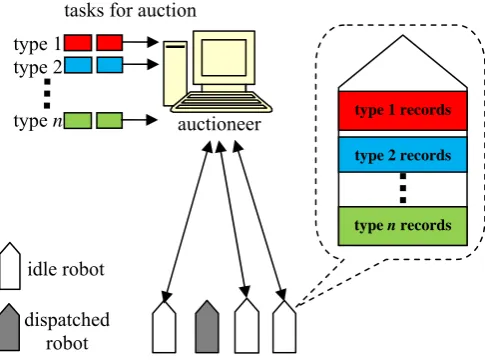
Fig. 1 shows the task auction architecture. During operation, different types of stochastic tasks may appear for auction. A central processor is the auctioneer that auctions the tasks one by one. Idle robots bid for a task being auctioned, and the one that submitted the lowest bid price wins the task.
Each of the robots maintains an array of records of different types of tasks it has ever executed. After a robot has completed a specific type of task, it evaluates its own performance and records a reward or a penalty accordingly. This track record facilitates adjustment of the bid price that the robot in question will subsequently submit for another task of the same type. Fig. 2 shows a block diagram of this bid adjustment mechanism.
[image:3.595.49.293.682.756.2]
Fig. 2. The closed-loop bid adjustment mechanism
The algorithm of the adjustment mechanism is presented as follows. For a specific type of tasks, we denote Actualk as
the k th record of actual cost, and Bidkas the k
th record of bid
price. Adjustments are in the form of either rewards or penalties:
k k k
Adjust Actual Bid ………..(1)
k
Adjust is a penalty when positive, and a reward when
negative. When a robot bids for a next task of the same type, it first estimates the cost, and then tunes the bid price based on the previous adjustment:
1 1
k k k
Bid Cost Adjust ……….(2)
where Costk1 is the (k+1)
th estimated cost, which can be
acquired by other heuristics or approximation methods.
To damp out huge fluctuations and to reflect more reliable estimations, a series of previous adjustments should be taken into account. Moreover, since the working environment is dynamically changing, older track records are deemed relatively obsolete as time elapses. Hence, a time-discounting factor , where 0<<1, is introduced to weigh the track records. The averaged bid adjustment is:
1
0 1
0
k j
k j j
k j
j
Adjust
In practice, the latest three terms are sufficient for adjustment of the bid price. The complete form of the proposed bid adjustment mechanism is given in equation (3).
1
0
1 1 1
0
k j
k j j
k k k
j
j
Adjust Bid Cost
……….…(3)The task being auctioned is therefore assigned to the robot that submitted the lowest adjusted bid price, based on equation (3). As such, this closed-loop adjustment mechanism can improve bidding accuracy, considerably enhancing the overall team performance.
III. IMPLEMENTATION AND CASE STUDY
The adjustment mechanism is incorporated with a multi-robot task allocation algorithm in a simulator developed to validate dynamic motion planning of a fleet of range free-range automated guided vehicles serving at a container terminal. For the approach to motion planning, readers are referred to [16].
This simulator is developed in the Player/Stage [17] and C++ programming language. The Player/Stage is an open-source auctioneer
idle robot
Fig. 1. Task auction architecture dispatched
robot type 1 type 2 type n
tasks for auction
type 1 records
type 2 records
type n records
Task
Evaluation Estimated cost
Adjustment
package widely used for multi-robot control and simulation. It runs in a Linux-based operating system called Fedora 13, and consists of two sub-packages, namely Player, and Stage. Player provides a network interface to a variety of physical robots and sensors. Player's client/server model allows robot control programs to be written in a number of programming languages and to run on any computer with a network connection to physical robots. Control program communicates with Player over TCP sockets, reads data from sensors, and writes commands to actuators. Stage is a Player plug-in simulation package which simulates a population of mobile robots moving and sensing in a 2D bitmapped environment. Various sensor models are provided, including sonars, laser rangefinders, pan-tilt-zoom cameras and odometers. Virtual devices of Stage present a standard Player interface, and hence few or no changes are required to move between simulation and hardware. Controllers designed in Stage have been demonstrated to work on various physical robots.
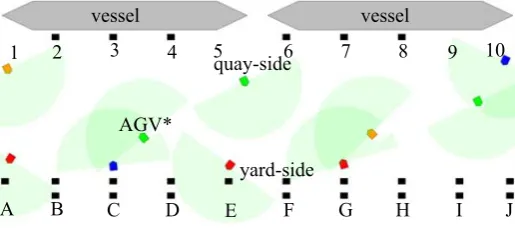
[image:4.595.306.548.422.520.2]An automated guided vehicle (AGV), with autonomous control and sensing devices, can be regarded as an autonomous robot. A team of AGVs at a container terminal transporting containers from the quay-side to the yard-side is used to verify the practicability of the proposed task allocation approach, as shown in Fig. 3. There are two vessels berthed at the quay-side. Each vessel is served by five quay cranes which unload the containers from the vessels. Small rectangles in black represent containers. Containers beside the vessel are ready to be picked up, while those being handled by the quay cranes are not shown in the figure. Racks at the quay-side are labelled as 1, 2, …, 10, while racks at the yard-side are labelled as A, B, …, J. The AGVs are transporting containers from the quay-side to the yard-side.
Fig. 3. Simulated working environment of free-range AGVs at a container terminal
There are two possibilities for the transfer of a container from a quay crane to an AGV. The first possibility is that the quay crane places a container directly onto the AGV. The second one, which we adopt in this paper, is that the quay crane places a container onto a buffer rack, from which an AGV will later picks up the container and transports it to the yard side [18].
Traditionally, most AGVs use fixed guide-paths, such as loops, and networks. The fixed routing approaches allow for reliable automation of vehicles. Such AGVs are however less manoeuvrable. Routes are unnecessarily long, incurring considerable transportation time and low system throughput. Route segments are shared for multiple vehicles, leading to
potential congestion and deadlocks. With the advent of more powerful onboard processors and advanced sensors, it is now possible for AGVs to navigate without physical guide-paths. Some experimental systems have indeed been developed [19]. Preliminary simulation results showed that free-range routing was on average 19% shorter than traditional mesh-based routing, and 53% shorter than loop-based routing. Huge potentials are therefore seen for free-range routing to improve transport capacities of AGV systems at container terminals.
The AGVs work in an area of 600m × 150m. Each AGV measures 12m × 4.5m × 1.5m and weighs 25 tonnes. The maximum velocity and the maximum acceleration of an AGV
are 1
max 7
V = m s- and 2
max 1
a = m s- , respectively. Inertial measurement units (IMU) and sonars are used in this paper. An IMU is a device that utilises measurement systems such as gyroscopes and accelerometers to estimate the relative position, velocity, and acceleration of a vehicle in motion [20]. Sonars are common range sensors in mobile robotics. The general principle is that the system emits sound pulses and picks up the echoes bounced off from objects in range, if any. Knowing the transmission speed of sound in the medium and the time of flight, it is possible to compute the distance. This method is widely used due to the low cost of sensors with adequate performance [21]. The sensing field of view is 180°, and the range of sonar scan R is derived as
follows. Consider an extreme case where two AGVs, heading directly towards each other without yaw steering, are braking from the maximum velocity Vmax with the maximum acceleration amax . According to kinematic
equations: 2
max max
1
2 2
R
V t a t
= - , and max
max
V t
a
= , R is
derived as:
2 max
max
V R
a =
that is, R=49m, approximately four times the length of an
AGV. With a proper yawing angle, this sensing range can sufficiently safeguard motion safety.
There are two major operational uncertainties for AGVs at container terminals, namely, dynamic task requirements, and uncertain traffic conditions. Dynamic task requirements are mainly due to the variation of vessel arrival time, and the handling time of quay cranes. Uncertain traffic conditions are mainly due to stochastic interferences between AGVs [22]. It is assumed that each AGV can only carry one container at a time, and obviously a container should only be transported by one AGV. Whenever a container is put onto a rack from a quay crane, it is ready for auction. This is a single-task robot, single-robot task, and instantaneous assignment problem. Hence, this scenario of a team of decentralised free-range AGVs working at a dynamic container terminal is a good test-bed to validate the proposed bid adjustment mechanism for dynamic multi-robot task allocation.
A specific type of tasks is described by the pick-up location and the destination of delivery, as T(n, x), where n specifies vessel vessel
quay-side
1 2 3 4 5 6 7 8 9 10
A
AGV*
B C D E F G H I J
[image:4.595.40.298.476.590.2]the label of the pick-up location at quay-side (n=1, 2, …, 10), and x specifies the label of the destination at yard-side (x= A, B, …, J). For example, T(3, F) is a type of tasks requiring to transport containers from rack 3 at quay-side to rack F at yard-side. The cost of a task in the simulation is the time consumed to travel and handle a container, which is in the unit of minutes. When a container is up for auction, all idle AGVs bid for it.
[image:5.595.306.548.65.221.2]A simulation of ten AGVs to transport 300 containers was carried out. Fig. 4 shows the track records of fifteen tasks of type T(3, F) ever performed by AGV*, which is at the left side of Fig. 3. The time-discounting factor, α, was set to be 0.5. For the first time after AGV* executed a T(3, F) type of task, the adjustment was a penalty of about two minutes. It meant that AGV* under-estimated the cost of the task and submitted a bid price which turned out to be much lower than the actual cost incurred afterwards. With this penalty, AGV* adjusted the bid price for task type T(3, F). It can be observed that the subsequent 2nd to 9th adjustments of this task type were within the accuracy of ±1 minute band. This verifies that, with the closed-loop bid adjustment mechanism in auctions, the discrepancies between the actual costs and the bid prices were effectively minimised.
Fig. 4. Adjustment records of task type T(3, F) performed by AGV*
To verify the robustness of the proposed bid adjustment mechanism, the characteristic of task type T(3, F) was modified, for example, to transport lighter containers. In this case, the actual cost of task fulfilment should be lower than before. Nevertheless, the bidding AGVs still offered the previously adjusted bid prices. Hence, a winning and dispatched AGV, like AGV*, was able to complete the task earlier than expected, and got a reward of about 2.3 minutes. With this reward, the AGV* adjusted the bidding price for task type T(3, F). It can be noted that the subsequent 11th to 15th adjustments were within the accuracy of ±1 minute band again. It shows that the closed-loop bid adjustment mechanism can minimise the discrepancies between the bidding prices and the actual costs in a dynamic environment. Fig. 5 shows a comparison of the overall team performances of ten AGVs for transportation of 300 containers, with and without the bid adjustment mechanism. It can be seen the total operational time with bid adjustment is considerably shorter than without. With the proposed bid adjustment mechanism, the bidding accuracy was improved, and containers were allocated to competent AGVs that submitted more reliable bidding prices. As a result, a significant improvement of 31% in overall team performance was achieved.
Fig. 5. Comparison of team performances, with and without
bid adjustment
IV. CONCLUSION AND FUTURE WORK
This paper has presented an auction-based approach with closed-loop bid adjustment to dynamic task allocation in robot teams. The bid adjustment mechanism tunes bid prices based on the performance track records of each robot in the team. Simulation results show that the bid adjustment mechanism can effectively minimise the discrepancy between the bid price and the actual cost of a task. This enhances the likelihood of allocating tasks to competent robots that are able to submit more accurate bids, and as a result, improves the overall team performance substantially. Despite the advance above, some issues of the auction-based task allocation approach are worthy of further study. In particular, an allocated-but-not-yet-executed task cannot be re-auctioned even if the dispatched robot is locked in a heavy congestion or even fails. Future work will be devoted to incorporating some other market-based mechanisms, like task trading between robots. For example, it would be preferable if the locked robot can negotiate and trade its task to another robot which is more likely to fulfil the task, according to real-time working conditions. Nevertheless, adopting such a trade-based approach would cost more local communication overheads between robots. Moreover, the overall performance of the team would need further investigation, in comparison with the proposed auction-based approach.
REFERENCES
[1] A. Richards, J. Bellingham, M. Tillerson, and J. How, “Co-ordination and control of multiple UAVs,” in: Proceedings of AIAA Conference on Guidance, Navigation, and Control. California, pp.251-256, 2002.
[2] R. M. Murray, “Recent research in cooperative control of multivehicle systems”, Journal of Dynamic Systems, Measurement and Control,
vol.129, no.5, pp. 571-583, 2007.
[3] L. E. Parker, “Path planning and motion coordination in multiple mobile robot teams”. Encyclopedia of Complexity and Systems Science 2009, pp.5783-5800, 2009.
[4] L. E. Parker, Chapter 40: Multiple mobile robot systems. in: S. Bruno, and K. Oussama, editors. Springer Handbook of Robotics. Springer, pp.
[image:5.595.48.290.349.449.2][5] M. B. Dias, R. Zlot, N. Kalra, and A. Stentz, “Market-based multi-robot coordination: a survey and analysis”. Proceedings of the IEEE, vol.94,
no.7, pp.1257-1270, 2006.
[6] B. P. Gerkey, and M. J. Mataric, “A formal analysis and taxonomy of task allocation in multi-robot systems”. The International Journal of Robotics Research, vol.23, no.9, pp.939-954, 2004.
[7] K. Lerman, C. Jones, A. Galstyan, and M. J. Mataric, “Analysis of dynamic task allocation in multi-robot systems”. The International Journal of Robotics Research, vol.25, no.3, pp.225-241, 2006.
[8] A. Schoenig, and M. Pagnucco, “Evaluating sequential single-item auctions for dynamic task allocation”, in: Lecture Notes in Computer Science, Vol.6464, pp.506-515, 2010.
[9] R. G. Smith, “The contract net protocol: high-level communication and control in a distributed problem solver”, IEEE Transactions on Computing, vol.29, no.12, pp.1104-1113, 1980.
[10]E. G. Jones, M. B. Dias, and A. Stentz, “Time-extended multi-robot coordination for domains with intra-path constraints”, Autonomous Robots, vol.30, no.4, pp. 41–56, 2011.
[11]J. Schneider, D. Apfelbaum, D. Bagnell, and R. Simmons, “Learning opportunity costs in multi-robot market based planners”, in:
Proceedings of the 2005 IEEE International Conference on Robotics and Automation, Spain, pp.1151-1156, 2005.
[12]N. Kalra, D. Ferguson, and A. Stentz, “Hoplites: a market-based framework for planned tight coordination in multirobot teams”. in:
Proceedings of IEEE International Conference on Robotics and Automation, Spain, pp.1170-1177, 2005.
[13]L. F. Bertuccelli, H.-L. Choi, P. Cho, and J. P. How, “Real-time multi-UAV task assignment in dynamic and uncertain environments”. in: Proceedings of The American Institute of Aeronautics and Astronautics Conference on Guidance, Navigation, and Control 2009,
Chicago, USA. pp. 389-395, 2009.
[14]M. B. Dias, B. Ghanem, and A. Stentz, “Improving cost estimation in market-based coordination of a distributed sensing task”, in:
Proceedings of IEEE/RSJ International Conference on Intelligent Robots and Systems (IROS), Alberta, Canada, pp.3972–3977, 2005. [15]F. Duvallet, and A. Stentz, “Imitation learning for task allocation”, in:
Proceedings of The 2010 IEEE/RSJ International Conference on Intelligent Robots and Systems, Taipei, Taiwan, pp.3568-3573, 2010.
[16]S.H. Choi, and W.K. Zhu, “A bio-inspired intelligent approach to motion planning of mobile robots”, Accepted in Proceedings of the Computer-Aided Design and Exhibition Conference 2011, Taipei, Taiwan.
[17]Player/Stage Project, http://playerstage.sourceforge.net/ [18] Gottwald Port Technology.
http://www.gottwald.com/gottwald/site/gottwald/en/products/agv.html [19]M. B. Duinkerken, M. van der Zee, and G. Lodewijks, “Dynamic free
range routing for automated guided vehicles”, in: Proceedings of IEEE International Conference on Networking, Sensing, and Control, pp.
312-317, 2006.
[20] G. Dudek, M. Jenkin, Chapter 20: Inertial Sensors, GPS, and Odometry. In: S. Bruno, K. Oussama, editors: Springer Handbook of Robotics,
Springer, The Netherlands, pp.477-490, 2008.
[21] L. Kleeman, and R. Kuc, Chapter 21 Sonar Sensing. In: S. Bruno, K. Oussama, editors: Springer Handbook of Robotics, Springer, The
Netherlands, pp.491-519, 2008.
[22] I. F. A. Vis, “Survey of research in the design and control of automated guided vehicle systems”. European Journal of Operational Research,