A Study on the Blended Wax Patterns in Investment
Casting Process
Omkar Bemblage and D. Benny Karunakar
Abstract:- Investment casting is known for its ability to produce components of excellent surface finish, dimensional accuracy and complex shapes. Inadequate surface finish, hardness and excessive shrinkage of the wax pattern often result in poor quality of the finished casting. Hence, in the present study, an attempt has been made to produce a wax blend which could offer better surface finish, minimum shrinkage and moderate hardness. Experiments were conducted with different types of waxes namely Paraffin wax, Bees wax, Montan wax and Carnabua wax, varying their proportions and stirring time. In each case, properties of wax pattern like surface finish, percentage shrinkage and hardness were determined. An attempt was made to find out the set of input parameters, which could offer a set of ideal properties of the wax blend, using Taguchi method. The set of input parameters suggested by Taguchi method was experimentally verified and found to offer the set of desired optimal properties of the wax blend pattern.
Index Terms: Investment Casting, Wax blends, Pattern
properties, Optimization, Taguchi method
I. INTRODUCTION
Investment casting (also known as ‘lost wax casting’ or ‘precision casting’) has been the most widely used process for several centuries. In this casting technique, a pattern, usually made of wax, is utilized in forming the inside cavity of a refractory mold. The pattern is formed by injecting the molten wax into a permanent mold of the desired shape and there by cooling it until solidification. In the ceramic shell method, the pattern or a cluster of such patterns is yare gated to a wax sprue. Then the sprued pattern or patterns are invested with ceramic slurry which is then solidified forming a mold around the wax pattern. The wax pattern is then removed from the mold by melting or burning.
---
Manuscript received March 18, 2010. This work was supported by Indian Institute of Technology Roorkee, India.
Omkar Bemblage is a student of M.Tech programme in the Mechanical & Industrial Engineering Department, Indian Institute of Technology Roorkee, Roorkee – 247 667, India.
D. Benny Karunakar is with the Mechanical & Industrial Engineering Department, Indian Institute of Technology Roorkee, Roorkee – 247 667, India (Corresponding author, E-mail: [email protected])
The resulting refractory shell is further hardened by heating and then filled with molten metal to produce the finished part. The working efficiency of investment casting depends largely upon the quality of the disposable pattern since its surface and dimensional characteristics are transferred to the ceramic shell and so to the final casting. Wax is the most widely used pattern material but blends containing different types of waxes need to be modified in terms of their properties through the addition of some materials called additives and fillers. Continuing efforts are always underway to improve the properties of pattern waxes though numerous additives and fillers. A pattern wax must have the following characteristics:
a) It should have lowest possible thermal expansion so that it can form a pattern with the highest dimensional accuracy.
b) Its melting point is not much higher than the ambient temperature so that the expansion during the injection and the energy consumption can be minimized.
c) After the injection, it should solidify in the mold in a short while. This improves the cycle time in the die and minimizes the solidification shrinkage which leads to the distortion of the patterns on thick sections and to the surface cavitation.
d) It should be resistant to breakage, i.e. it is of sufficient strength and hard enough at room temperature such that the patterns can be self supporting and handled without damage.
e) It should have a smooth and wettable surface so that a finished part with a smooth surface can be obtained and that the ceramic slurry can adhere to its surface.
f) It should have a low viscosity when melted to simplify its injection and, flow into and fill the thinnest sections of the die.
g) It should be released from the mold easily after formation.
h) It should have very low ash content so that it does not leave any ash inside the ceramic shell.
Costs, availability, easy of recycling, toxicity, resistance to binders or solvents are the other important factors in selecting the ingredients of pattern wax compositions. The working efficiency of investment casting can be increased by improving one or more characteristics of the pattern wax, mentioned above, without spoiling the others. In the present study, an attempt is made to produce a wax blend that would offer optimum properties.
II. LITERATURE REVIEW
Tascyogylu et al [1] found that waxes are the complex mixtures of many compounds including natural or synthetic wax, solid fillers and even water. They made tests like penetration, specific gravity, viscosity to determine quality of the wax mixture.
Sabau and Viswanathan [2] investigated the effect of addition of the additives to the wax. Additives used for making investment casting waxes included a variety of materials such as resins, plastics, fillers, oils and plasticizers. They concluded that dimensional changes between the pattern tooling and its corresponding cast part occur as a result of thermal expansion, shrinkage, hot deformation, and creep of the pattern material (wax), mold material (shell), and solidifying alloy during the processing. Okhuysen et al [3] found that shrinkage of the wax is
largest components of the overall dimensional changes between the pattern and its corresponding cast part. He used the computer model to predict the wax dimensions and concluded that, one of the main difficulties in using computer models for the prediction of wax dimensions is the lack of constitutive equations and material properties of the wax. He reported the results of a survey of 18 investment casting companies to determine the tooling allowance practices. It appears that there is no consistency in the way investment casters decide on the application of their tooling shrinkage allowances.
Gebelin and Jolly [4] explained that the accuracy of the wax patterns used has a direct bearing on the accuracy achievable in the final cast part. They also concluded that, it is usual for the investment caster to use precision-machined full –metal dies for producing wax patterns when large numbers of highly accurate components are required. Bonilla et al [5] found that the injection parameters play an important role in the accuracy of the wax patterns. These parameters include: the injection flowrate; the injection cycle time; the injection temperature; the injection pressure; and the die temperature. Singh et al [6] also carried out similar investigations.
Liu et al [7] explained a new investment casting
technology, 'freeze cast process' with ice as pattern material. There is an advantage of ice pattern as it prevents shell cracking during pattern removal.
Liu et al [8] found that most production wax patterns
exhibit an abrupt expansion as the crystalline portion of the
microstructure melts during de-waxing. In contrast, the ice pattern will shrink, thus relieving the stress on the shell during pattern removal. The cracking of the shell can be eliminated by making ice patterns with the rapid freeze prototyping (RFP) process.
Rezavand and Behravesh [9] made an experimental study on dimensional stability of simplified wax models. The dimensional accuracy of wax pattern can be determined during injection step which introduces a great influence on the final dimension and thus on finishing process. The focus of this experimental work was on the injection stage, investigating the effects of processing parameters and the shrinkage of critical dimensions. They had chosen injection temperature and holding time as variable processing parameters and concluded that, the final dimensions of wax pattern are affected by: (i) type of wax; (ii) geometry of part and (iii) process parameters.
Horacek and Lubos[10] studied the influence of injection parameters on the dimensional stability of wax patterns produced by injection molding process. They found an interrelationship between injection parameters like injection temperature, die temperature, injection force, holding time and their dependency on dimensional parameters.
Yarlagadda and Hock [11] determined the accuracy of wax patterns produced by hard (polyurethane mold) and soft (RTV mold) tooling and optimized the injection parameters used in a low-pressure injection molding. Tascroglu and Akar [12] carried out investigations on different additives used in making wax patterns and found that the addition of soybean flours of different varieties to the pattern wax material could improve surface roughness, shrinkage, hardness and tensile strength.
From the above mentioned literature review, it is clear that lot of work has done in investment casting by using pattern materials like plastics, ice, mercury and wax, mostly paraffin wax. Plastic pattern gives the better dimensional accuracy but it may expand enough to crack ceramic shell mould while removing from the ceramic shell. The ice pattern gives the better dimensional accuracy and there are less chances of cracking of shell, but the investigation of surface finish of ice pattern is very difficult to measure directly. Frozen mercury can be used as a pattern material because it does not expand in changing from the solid (frozen) to the liquid state. A major disadvantage of mercury pattern is the requirement for making and keeping them at extremely low temperature and the other disadvantage is its high cost.
finish while carnauba wax and montan wax give better
dimensional accuracy. By mixing these four waxes in different proportions, we will determine the wax blend which gives better dimensional accuracy as well as better surface finish. The investigation also aims in determining the optimal set of process parameters like injection temperature, injection pressure, die temperature, holding time that would minimize the shrinkage and expansion of wax blends.
III. PRESENT PROBLEM
In the present study, an attempt has been made to produce a wax blend which could offer better surface finish, minimum shrinkage and moderate hardness. Experiments were conducted with different types of waxes namely Paraffin wax, Bees wax, Montan wax and Carnabua wax, varying their proportions and stirring time. In each case properties of wax pattern like surface roughness and percentage shrinkage (linear/volumetric) were determined. Using the data obtained from the experiments an attempt is made to find out the set of input parameters, which could offer a set of ideal properties of the wax blend. Taguchi method was used to optimize the process parameters.
Steps of the problem:
a) Selection of different wax blends for pattern making.
b) Experimental determination of the wax blends behavior under different process parameters.
c) Experimental determination of shrinkage
(linear/volumetric) and surface roughness of wax blend patterns produced.
d) Selection of best wax blend.
e) Optimization of process parameters by Taguchi method.
In the present study, thermal analyses like differential thermal analysis, thermo-mechanical analyses are used as a quality control check of wax blends. Shrinkage characteristics of waxes and their influences on the final dimensions of the wax patterns and castings are considered. The typical compositions and properties of the waxes used in the present study are briefly described below.
A. Bees wax
This wax is a secretion of bees. Its main components are palmitate, palmitoleate, hydroxypalmitate and oleate esters of long chain alcohols (C30-32) (about 70 to 80% of the total weight). One of the properties of bees wax is that, it gives better surface finish.
B. Paraffin wax
Paraffin is a class of aliphatic hydrocarbons characterized by straight or branched carbon chains, generic formula C
nH2n+2. Their physical properties vary with increasing molecular weight from gases to waxy solids. Paraffin waxes are white, translucent, tasteless and odorless solids consisting of a mixture of solid hydrocarbons of high molecular weight. They are soluble in benzene ligroin and warm alcohol. One of the properties of paraffin wax is that, it gives better surface finish.
C. Carnauba wax
This wax (known as "queen of waxes") is secreted by leaves of a Brasilian palm tree (Copernicia prunifera cerifera), about 100 g for one tree in a year. It contains mainly fatty esters (80-85%), free alcohols (10-15%), acids (3-6%) and hydrocarbons (1-3%). One of the properties of carnauba wax is that, it gives better dimensional accuracy.
D. Montan wax
This wax is derived by solvent extraction of lignite or brown coal (sub-bituminous coal). The wax component of Montan is a mixture of long chain (C24-C30) esters (62-68 wt %), long-chain acids (22-26 wt %), and long chain alcohols, ketones, and hydrocarbons (7-15 wt %). Montan wax is hard and is most resistant to oxidation. Carbon papers were the largest consumer of crude Montan wax. The highest present part (30%) of Montan wax is used in car polishes. Additional applications are shoe polishes, electrical insulators, and lubricant in plastics and in paper industry. Table 1 gives the properties of the waxes used in the present study.
Table 1: Properties of the waxes used
Sr. No.
Name of wax
Density (gm/cc)
Melting point
(oC)
Volumetric shrinkage
(%)
1 Bees wax 0.97 65 7.25
2 Paraffin wax
0.78 64 6.20
3 Carnauba
wax 0.99 87 4.20
4 Montan wax
1.02 82 2.45
IV. EXPERIMENTAL WORK
Four types of waxes namely paraffin wax, bees wax, montan wax and carnauba wax with different melting temperatures between 64 0C to 87 0C are selected for the
Table 2: Wax blends and their proportions (by % weight)
Blend No.
Paraffin wax (%)
Bees wax (%)
Montan wax (%)
Carnauba wax (%)
1 50 30 0 20
2 50 30 20 0
3 50 30 10 10 4 60 20 10 10 5 70 10 10 10
The ingredients of each wax blend are mixed and melted at 120 oC in a metal container with constant agitation in order
to get homogeneous melt.
A. Thermal analysis of waxes
[image:4.595.311.552.96.188.2]The thermal analysis techniques used for measuring the effect of temperature on the blend sample are Gravimetric Analysis (TGA), Differential Thermo-Gravimetric (DTG) and Differential Thermal Analysis (DTA). DTA is a technique which measures the difference in heat gained or lost by the sample, in comparison to a reference temperature during a temperature ramp. Temperature changes in the sample are due to endothermic or exothermic enthalpy transition or reaction such as those caused by phase changes, fusion, sublimation etc. DTG measures the loss in weight of a sample as it is heated. TGA is widely used to separate and quantify the components in a mixture. The thermal technique provides information concerning the thermal stability and composition of the sample and of any intermediate compound. The results obtained from DTA are summarized in Table 3.
Table 3: Differential Thermal Analysis results
Wax type Heating
rate
oC/min
Loss of material
(%)
Melting temperature
oC
Bees wax 5 0.00 65
Paraffin wax 5 0.00 64
Montan wax 5 0.20 82
Carnauba wax 5 0.30 87
B. Pattern production
The four types of waxes are mixed together to produce different wax blends (as shown in Table 2). The molten wax is then injected into the die. The die is heated up to 48
oC before injecting the wax and the wax injection
temperature was raised up to 70 oC. After injecting the wax
into the die, it is cooled down to the room temperature. Then the pattern is removed from the die. The parameters customarily controlled include wax temperature, injection temperature and injection pressure, die temperature, holding time. The selected range of the process parameters is shown in the Table 4.
Table 4: Range of process parameters
Process Parameters Range
Injection temperature (A) 66 oC – 70 oC
Die temperature (B) 44 oC – 48 oC
Injection force ( C ) 440 N – 540 N
Holding time (D) 9 min – 11 min
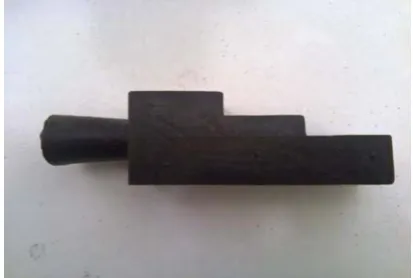
There are two main shrinkage allowances to be considered: the die-to-wax shrinkage and the casting solidification shrinkage. If these allowances are not correct and the final cast-part tolerances are not met, then additional cost and time are incurred because the tooling must be reworked. It is, therefore, very important to ensure that all the appropriate factors are considered when applying the shrinkage allowances. Wax patterns are generally injected at relatively low temperatures and pressures in split dies, using equipment specifically designed for this purpose. Figure 1 shows the typical wax pattern that is chosen for the present study. Figure 2 shows the wax pattern with shrinkage.
C. Measurement of properties
[image:4.595.328.535.360.499.2]After the pattern production the following properties are measured.
Figure 1 Wax pattern without shrinkage
[image:4.595.329.539.537.679.2]a] Linear shrinkage (LS)
b] Volumetric shrinkage (VS) c] Surface roughness (SR)
The measurement of the properties is explained briefly as follows.
a] Linear shrinkage
Linear shrinkage can be calculated by measuring the difference between die dimensions and pattern dimensions produced.
b] Volumetric shrinkage
The Volumetric shrinkage is calculated as follows:
i.
Apply a coating of grease on two halves of die to make it leak-proof from water and align the two-halves of die together.ii.
Fill the die cavity with water and measure its volume with the help of a measuring flask. (VD)iii.
Fill water in a measuring flask and note the initialreading. (Vi)
iv.
Place the wax patterns made inside the measuring flask, volume rises and take the final reading. (Vf)v.
The difference between the two readings (Vf - Vi)gives the volume of pattern.
vi.
The percentage of volumetric contraction of thepattern is given by
{
(
)}
x 100
D f i
D
V
V
V
V
Volumetric coefficient of thermal expansion is calculated by the relationship as shown.
ΔV = β Vi (Ti – Tf)
Where, ΔV = change in volume
β = volumetric coefficient of thermal expansion Vi = initial volume,
Ti = initial temperature.
Tf = final temperature
c] Surface roughness
Surface roughness of the each pattern is measured by using Optical Profiling System device which is of the type Veeco WYKO NTI 100.
V. TAGUCHI DESIGN OF EXPERIMENTS
From the experiments conducted, each wax blend under different set of process parameters exhibited different properties. Yet, there exists a set of process parameters which could offer a set of ideal properties. Hence, an attempt is made to determine the optimum set of process parameters using Taguchi method. It is one of the most important tool for studying the effect of various input process parameters. For a particular defect in a wax pattern production, the number of causes contributing to the defect
is large. In such a case the traditional experimental design methods are too complex and difficult to use. Moreover, a large number of experiments are to be conducted that are too time consuming and expensive.
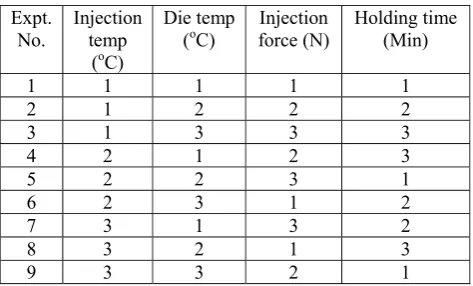
Taguchi designed certain standard orthogonal arrays using which simultaneous and independent evaluation of two or more parameters for their ability to affect the variability of particular process characteristics could be done in a minimum number of tests. The range and levels of selected factors (input process parameters) are shown in the Table 5.
Table 5: Range and levels of input process parameters
Factors Levels L1 L2 L3
Injection temperature (A) 66 68 70
Die temperature (B) 44 46 48
Injection force ( C ) 45 50 55
Holding time (D) 9 10 11
The selection of a particular orthogonal array is based on the number of levels of various factors. Here, to conduct the Taguchi procedure we selected 4 factors and each at 3 levels. Now the Degree of Freedom (DOF) can be calculated by the formula as
(DOF)R = P(L – 1)
Where, (DOF)R = degree’s of freedom
P = number of factors L = number of levels
(DOF)R = 4(3 – 1) = 8
However, total DOF of the orthogonal array (OA) should be greater than or equal to the total DOF required for the experiment. Thus, we selected the L9 orthogonal array to
make the further experiment. This array specifies 9 experiments. The L9 OA with 4 factors, 3 levels and its
[image:5.595.315.552.560.703.2]responses are shown in the Table 6.
Table 6: L9 orthogonal array
Expt. No.
Injection temp
(oC)
Die temp
(oC) force (N) Injection Holding time (Min)
1 1 1 1 1
2 1 2 2 2
3 1 3 3 3
4 2 1 2 3
5 2 2 3 1
6 2 3 1 2
7 3 1 3 2
8 3 2 1 3
9 3 3 2 1
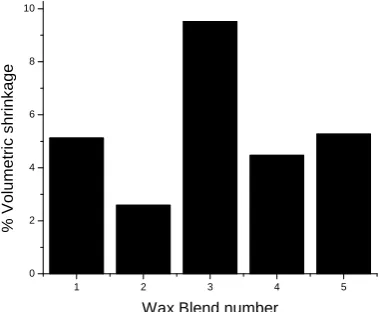
volumetric shrinkage and better surface roughness as shown in Figures 3, 4 and 5 respectively.
1 2 3 4 5
0.0 0.5 1.0 1.5 2.0 2.5
% Li
ne
ar s
hri
nk
ag
e
Wax Blend number
1 2 3 4 5
0 2 4 6 8 10
% V
o
lumetric shrinkage
Wax Blend number
1 2 3 4 5
0.0 0.2 0.4 0.6 0.8 1.0 1.2 1.4 1.6 1.8
Surface roughness (um)
Wax Blend number
VI. OPTIMIZATION OF PROCESS PARAMETERS USING TAGUCHI METHOD
After conducting the experiments it is observed that wax blend 2 is giving minimum shrinkage and better surface roughness. Taguchi optimization technique was applied to wax blend 2, using Minitab software. The results of the investigation are shown in Figure 6.
From the graph of injection temperature (A), it is observed that, as injection temperature increases at 68 oC it gives
better results but further increase in injection temperature increases the linear shrinkage, volumetric shrinkage and surface roughness. For graph of die temperature (B), it is observed that at 48 oC it is giving better results. Similarly
for graph of injection force (C) and holding time (D), it is observed that these graphs give better results at 490 N and 10 minutes respectively.
From the graph it is observed that the optimum process parameters to be used are:
a) Injection temperature: 68 0C
b) Die temperature: 46 0C
c) Injection force: 490 N d) Holding time: 9 minutes
VII. DISCUSSION
[image:6.595.59.241.129.278.2] [image:6.595.322.545.309.461.2]If the conventional method is used to carry out the experiments then for the selected process parameter we have to do the experiment for their selected ranges. Thus, we need to conduct more experiments which are time consuming.
So, it better to use the technique which reduces the number of experiments to be carried out and optimizes the process parameters. Taguchi method is used for optimization. Then the numbers of experiments to be carried out are 9. The software used to carry out the Taguchi experimental analysis is MINITAB solutions. Figure 3 Linear shrinkage of wax blends
Figure 4 Volumetric shrinkage of wax blends
[image:6.595.59.249.319.475.2]Figure 5 Surface roughness (Ra) of wax blends
[image:6.595.60.248.541.708.2]VIII. CONCLUSION
The following conclusions are drawn out of the experiments conducted on wax blend selection and selection of optimum process parameters by Taguchi method.
1. The wax blend 2 with proportion of 50% paraffin wax, 30% bees wax, 20% montan wax and 0% carnauba wax gives the better results of linear shrinkage, volumetric shrinkage and surface roughness.
2. The optimized process parameters (using Taguchi method) are: 68 oC (injection temperature), 48 oC
(die temperature), 490 N (injection force) and 10 minutes (holding time).
3. Taguchi method cab successfully used to optimize the process parameters.
REFERENCES
1. S. Tascyoglu, B. Inem, and N. Akar, “Conversion of an investment casting sprue wax to a pattern wax by the modification of its properties”, Materials and Design, vol. 25, 2004, pp 499 – 505.
2. A.S. Sabau and S. Viswanathan, “Material
properties for predicting wax pattern dimensions in investment casting”, Material Science and Engineering A, vol. 362, 2003, pp 125–134.
3. V.F. Okhuysen, K. Padmanabhan, and R.C. Voigt, “Tooling allowance practices in investment casting industry”, Proceedings of the 46th Annual Technical Meeting of the Investment Casting Institute, Orlando, USA, 1998, Paper no. 1.
4. J.C. Gebelin and M.R. Jolly, “Modeling of the investment casting process”, Journal of Material Processing Technology, vol. 135, 2003, pp 291 – 300.
5. W. Bonilla, S. H. Masood and P. Iovenitti, “An investigation of wax patterns for accuracy improvement in investment casting parts”, Bulletin of Industrial Research Institute of Swineburne, Melbourne, Australia, vol. 18, 2001, pp 348 – 356.
6. B. Singh, P. Kumar, and B.K. Mishra,
“Optimization of injection parameters for making wax patterns to be used in ceramic shell investment casting”, Proceedings of Asian
Symposium on Materials and Processing, 2006,
Thailand.
7. Q. Liu, G. Sui and M.C. Leu, “Experimental Study on the ice pattern fabrication for the investment casting by rapid freeze prototyping (RFP)”,
Computers in Industry, vol. 48, 2002, pp 181 –
197.
8. Q. Liu, V.L. Richards, M.C. Leu, and S.M. Schmitt, “Dimensional accuracy and surface roughness of rapid freeze prototyping ice patterns
and investment casting metal parts”, International
Journal of Advanced Manufacturing Technology,
vol. 24, 2004, pp 485–495.
9. S.A.M. Rezavand and A.H. Behravesh, “An experimental investigation on dimensional stability of injected wax patterns of gas turbine blades”, Journal of Materials Processing Technology, vol. 182, 2007, pp 580–587.
10. M. Horacek and S. Lubos, “Influence of injection parameters to the dimensional stability of wax patterns”, Proceedings of the Ninth World Conference on Investment Casting, San Francisco, California, USA, 1996, pp. 1–20.
11. P.K.D.V. Yarlagadda and T.S. Hock, “Statistical analysis on accuracy of wax patterns used in investment casting process”, Journal of Materials Processing Technology, vol. 138, 2003, pp 75–81. 12. S. Tascroglu and N. Akar, “A novel alternative to