Predicting IPTV usage:
An SEM Approach
Running head: PREDICTING IPTV USAGE
Predicting IPTV usage: An SEM Approach Matthias W. Kampmann
University of Twente
Bachelor Thesis Psychology: Cognition, Media and Ergonomics Instructors: Dr. A. Heuvelman & Dr. O. Peters
Abstract
Introduction
In the last two decades the media landscape has undergone some drastic changes. In 1980 the average number of TV sets per household, in the U.S., was 1.7 (U.S. Census, 2008). In 2005 there was an average of 2.6 TV sets per household. 66% were digital TV sets. Today’s households often do not only include TV sets, but increasing amounts of PCs, gaming consoles, MP3 Players and mobile phones. Children now even spend more time on the Internet than watching TV (Mindlin, 2008). To be competitive in this fast moving media landscape, companies try out new technologies or merge existing technologies (Liu, Gill & Berendt, 2008). The most prominent example might be the iPhone, a device not only
demand. IPTV moves the focus away from push mechanisms (content supplied by media companies) towards more user centered pull mechanisms (what does the user want). This study tries to determine how this more active role of the user might influence his evaluations and acceptance of new technologies. The knowledge which processes underlie the adoption of new technologies is not only interesting from a theoretical point of view, but offers direct implications for IPTV providers or other technical innovators. This is especially true as a more pull oriented perspective on media distribution makes it even more important to know what a user wants or expects from new technologies.
Theoretical background
predict user’s general opinions about expected use” (p. 138) but has it weakness in explaining the users motivations to adopt a new technology in the first place. This is where the model of media attendance has its strengths. In this study both models will be used to complement each other in order to get a better understanding of the factors underlying IPTV usage.
As IPTV has a very low market penetration of approximately 2 percent in Europe
(European Commission, 2006) the models will be used to predict future behavior rather than explaining existent behavior. Until now most research was done on well diffused
technologies such as online newspapers (Schoneville, 2007), mobile services (Koivumak, 2008) or IPTV usage in Korea where the market penetration of IPTV and broadband internet is much higher in comparison to Europe (Shin, 2007).
Model of Media Attendance
La Rose’s & Eastin’s (2004) Model of Media Attendance was designed to explain usage from a social-cognitive point of view. The authors stated that previous uses and gratifications models only accounted for little variance in Internet behavior and that they had to be
extended to achieve greater explanatory power. However, the basic assumption that users actively use media to gratify their needs (Palmgreen, Wenner & Rosengren, 1985) still holds true in the new model. As Palmgreen stated in an earlier research (Palmgreen, Wenner & Rayburn, 1981) the underlying process is thought to be an iterative comparison of
gratifications sought and gratifications obtained. This process is very similar to Bandura’s (1986) concept of enactive learning, where interaction with the (media) environment leads to a steady update and alteration of expectations.
sensations), activity incentives (enjoyableness) and self reactive incentives (comparison of own behavior with standards for behavior) (Bandura, 1986). In the Model of Media
Attendance:
H1: Expected outcomes are positively related to intention to use IPTV. H2: Expected outcomes are positively related to habit.
Habit is not to be mistaken as past behavior or experience. As Limayem, Hirt & Cheung (2003) noted; past behavior and experience are only preconditions to develop a habit. Habit is defined as an automatic response of using a technology in certain situations (Limayem et al., 2003). In addition actual use can not be measured in this study as most participants are unlikely to have experience with IPTV. As noted by Shin (2007) people who are early adopters of new technologies or who habitually use digital media broadcasting (DMB) are more likely to adopt IPTV. Therefore the habit to use new media in general will be used as a measure of habit in this study.
H3: Habit is positively related to intention to use IPTV.
La Rose proposed (2001) that within social-cognitive theory habit is a cause of deficient self regulation. Deficient self regulation is a failure to engage in self-monitoring, judgmental process, and self-reaction (Bandura, 1986). But Peters (2007) noted that deficient self
regulation does imply that participants already have experience with the technique at hand. This is not expected to be the case with IPTV. Therefore the concept of deficient self regulation is dropped for this study.
Ferguson’s and Perse’s original research was on the use of the Internet as an alternative for television:
H4: Experience with new media is positively related to habit.
H5: Experience with new media is positively related to self-efficacy.
Self-efficacy, defined as belief in one’s capability to organize and execute a particular course of action (Bandura, 1997), is another important predictor of media use in the model of media attendance. Self-efficacy does not only relate to usage in a direct manner, but is
mediated through expected outcomes and habit (La Rose & Eastin, 2004): H6: Self-efficacy is positively related to intention to use IPTV. H7: Self-efficacy is positively related to expected outcomes. H8: Self-efficacy is positively related to habit.
Polites (2005) noted that habit to use one technology can also have a negative impact on the adoption of a new technology. It is possible that users feel self confident, have the appropriate knowledge and see the advantage of the new technology, but nonetheless they might not have the intention to adopt the new technology. In this case it is likely that they formed a counter intentional habit. While the habit to use new media (internet, DMB) is expected to have a positive effect on the intention to use IPTV, the habit of using standard television is hypothesized to have a negative impact on the intention to use IPTV. This is in line with findings of Ouellette and Wood (1998) who stated “Given the lack of immediate evidence that the new responses will yield positive outcomes, many people will not persist” (p. 70).
Figure 1: Model of Media Attendance
Unified Model of Acceptance and Use of Technology
The unified Model of Acceptance and Use of Technology (UTAUT) was first proposed by Venkatesh, Morris, Davis & Davis in 2003. Venkatesh et al. stated that there are several different research perspectives on how individuals choose and adapt to new information technologies. While one research tradition is focused on individual intention and usage (Davis et al. 1989) another tradition is more concerned with implementations in
organizational settings (Leonard-Barton & Deschamps, 1988). To integrate the different points of view Venkatesh et al. reviewed eight theoretical models to come to a unified model with greater statistical and theoretical power. The UTAUT was able to account for 70 percent of explained variance, compared to 40 percent of explained variance in most other social cognitive models (Venkatesh et al., 2003).
interest in this study is behavioral intention. As the concept “facilitating conditions” is only theorized to be positively related to usage (Venkatesh et al., 2003), but not to intention, it is dropped for this study.
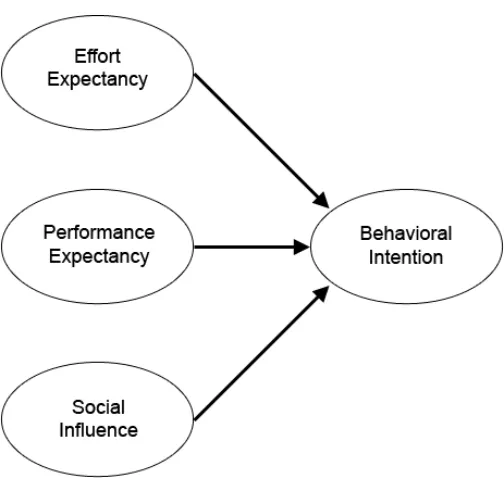
Behavioral intention is predicted by three factors: Effort expectancy, performance
expectancy and social influence. Effort expectancy is defined as the perceived ease of use of a system (Venkatesh et al., 2003). Effort expectancy is usually higher for new systems with unknown procedures. As IPTV meets this criteria it can be considered to be a new
technology:
H1: Effort expectancy is positively related to behavioral intention.
Performance expectancy is the degree of expected gains by using the new technology (Venkatesh et al., 2003). In other models it is known as outcome expectation or usefulness and relative advantage (Davis et al., 1989). In most models performance expectancy is one of the best predictors of behavioral intention (Venkatesh et al., 2003):
H2: Performance expectancy is positively related to behavioral intention.
The third factor influencing behavioral intention in the UTAUT is social influence. Social influence is defined as the degree to which peers or important persons influence a user’s decision to use IPTV:
H3: Social influence is positively related to behavioral intention.
moderating factor in this study. The remaining moderators are gender and previous experience:
H4: The influence of performance expectancy on behavioral intention will be moderated by gender.
H5: The influence of effort expectancy on behavioral intention will be moderated by gender and experience.
H6: The influence of social influence on behavioral intention will be moderated by gender and experience.
For the full conceptual model see Figure 2.
Figure 2: Unified Model of Acceptance and Use of Technology
The UTAUT and the Model of Media Attendance clearly have some factors in common to predict media behavior. The concepts of effort- and performance expectancy in the UTAUT are conceptualized as expected outcomes in the Model of Media Attendance. This concept has its theoretical roots in the expectancy-value theory (e.g. Ajzen & Madden, 1985). The factor social influence in the UTAUT and the social incentive in the Model of Media
[image:11.595.72.324.313.552.2]UTAUT the influence of effort expectancy on behavioral intention is moderated by experience (H5). Experience is also moderating the influence of social influence on
behavioral intention (H6). In the Model of Media Attendance experience is positively related to self-efficacy (H5) and habit (H4).
While the Model of Media Attendance is mostly based on social cognitive theory the UTAUT is stronger related to the theory of reasoned action (Peters, 2007). Habit and attitude are therefore central parameters in the Model of Media Attendance, but not in the UTAUT. This might in part be explained by the fact that the UTAUT was developed for organizational settings and the Model of Media Attendance is more concerned with individual media
behavior. Nevertheless the UTAUT has shown to be valid outside its original area of application (e.g. Koivumaki et al., 2008, Schoneville, 2007, Kwong et al., 2002). It is expected that there is no single best model to explain and predict media usage. Combining the insights from different models might help to get a better understanding of the factors underlying media adoption. This is in line with Peters’ (2007) advice to not hold “statistical horse races” but to pay close attention to theoretical implications. The Model of Media Attendance might help to understand how personal factors like self efficacy and habit influence IPTV usage, while the UTAUT adds insight into the influence of moderating factors (gender and experience) and the role of expectancies. In addition to the main hypotheses of the two models this study will try to answer the questions:
Method
Questionnaire development
The online survey for this study was created using items from the original questionnaires where possible. The questions were assessed using a 5-point Likert scale, ranging from 1 (fully disagree) to 5 (fully agree). To measure previous experience with new media, open questions were used for both models (e.g. “How many hours do you use the internet on a typical weekday?”). Age and gender were asked for, although only gender was expected to be a moderating factor in this study.
For the Model of Media Attendance the original items of LaRose and Eastin’s (2004) study were rephrased to fit the theme of IPTV usage. The six incentives (social, activity, monetary, novelty, status and self-reactive) were measured with items similar to “I would use IPTV to find something to talk about” (social incentive) or “To be directly involved in
program decisions” (novel incentive). Media use habit was operationalized as the habit to use new media: “The use of new media is part of my daily routine”, while counterintentional habit was operationalized as the habitual use of TV. For counterintentional habit questions by Verplanken and Orbell (2006) were used as advised by Polites (2005): “I frequently use the TV”, “I Would find it hard to not watch TV”, “Using the TV belongs to my daily routine”. Behavioral intention was measured with items requiring the forethought of the participant “I plan to use IPTV within the next 6 months”. The whole questionnaire for the model of media attendance can be found in appendix A.
example of a question concerned with social influence. For the whole questionnaire see appendix B.
It was expected that knowledge about IPTV varies greatly among participants as the market penetration was below two percent in Europe (European Commission, 2006). To make sure that all participants have a common baseline of knowledge of what IPTV is, a short, brochure style introduction with technical details was given before the questionnaire started.
Pretest
To make sure that the rephrased items still have a high reliability and internal consistency a pretest was conducted (n = 15). On the basis of feedback only one question of “counter intentional habit” had to be revised as the meaning seemed to be unclear. It was replaced with a more appropriate item from Verplanken and Orbell’s (2006) SRH index (See appendix A). The items were tested for reliability and internal consistency. While most subscales had a Cronbach’s α above aspiration level (α > .70) the scales for “activity incentive” and “performance expectancy” showed a low reliability (α = .41 and α = .44) and had to be revised. The item “I would use IPTV to play in a game show” was not recognized as a desired activity incentive. It was therefore replaced with a more general item used by Peters (2007) “I would use IPTV because it's a pleasant activity”.
Sample
160 psychology students of the University of Twente took part in the online survey to receive course credits. There were more female participants (75.6%) than male participants (24.4%). All participants were in the age range from 18 to 28 with a mean age of 20.26 years and a standard deviation of 1.81 years.
Data analysis
The 5-point Likert scale questions were recoded ranging from 1 (fully disagree) to 5 (fully agree). Gender was recoded as a 0 (male) 1 (female) variable.
As first step of the data analysis internal consistency reliabilities were tested using the Cronbach’s Alpha coefficient with a critical value of 0.7 as advised by Nunnally & Bernstein (1994).
Structural Equation Modeling (SEM) was used to test the two models. Garson (2008) stated that the use of ordinal data with maximum likelihood estimation (MLE) requires at least 5 Likert scale categories, a reasonably large sample size and skew and kurtosis within normal limits. While the assumptions of a reasonably large sample size and 5 Likert scale categories were met the assumption of normal skew and kurtosis (values between-2 and 2) showed to be problematic when screening the data for normality. As a result polychoric correlations were used as input matrix (e.g. Jöreskog & Sörbom, 1997). Garson (2008) advised to use weighted least squares (WLS) estimates in conjunction with polychoric
correlations. In this study neither WLS nor GLS (generalized least squares) methods could be used as these methods require substantially larger sample sizes (n > 2500). Therefore the less optimal MLE approach had to be used.
Results
Model of Media Attendance
Prior to the analyses, data were checked for normality. To correct skewness to the upper end, square root transformation was used (Garson, 2008).
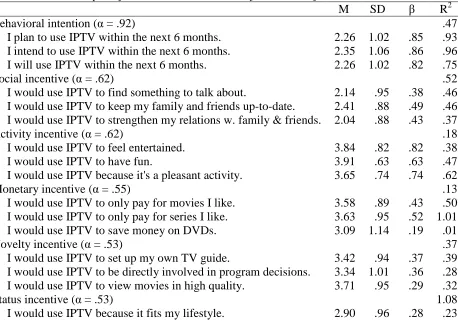
Following the analysis of normality Cronbach’s Alpha was investigated. Results can be found in Table 1. It became evident that the measure of experience was extremely unreliable (α = .33) and it had to be dropped for this study. Six of the other ten scales showed a
[image:16.595.80.538.443.773.2]reliability below aspiration level (α > .70). By deleting indicators of the latent variables monetary incentive, self-reactive incentive and social influence a better Cronbach’s Alpha could be reached (.75, .71 and .75 respectively). Following Garson’s (2008) advice each latent variable has to be defined by at least three indicators, therefore no indicators could be deleted without the violation of SEM assumptions.
Table 1
Descriptive Statistics, Factor Loadings, Squared Multiple Correlation, and Cronbach’s Alpha of the Observed Indicators of the Model of Media Attendance.
M SD β R2
Behavioral intention (α = .92) .47
I plan to use IPTV within the next 6 months. 2.26 1.02 .85 .93 I intend to use IPTV within the next 6 months. 2.35 1.06 .86 .96 I will use IPTV within the next 6 months. 2.26 1.02 .82 .75
Social incentive (α = .62) .52
I would use IPTV to find something to talk about. 2.14 .95 .38 .46 I would use IPTV to keep my family and friends up-to-date. 2.41 .88 .49 .46 I would use IPTV to strengthen my relations w. family & friends. 2.04 .88 .43 .37
Activity incentive (α = .62) .18
I would use IPTV to feel entertained. 3.84 .82 .82 .38
I would use IPTV to have fun. 3.91 .63 .63 .47
I would use IPTV because it's a pleasant activity. 3.65 .74 .74 .62
Monetary incentive (α = .55) .13
I would use IPTV to only pay for movies I like. 3.58 .89 .43 .50 I would use IPTV to only pay for series I like. 3.63 .95 .52 1.01 I would use IPTV to save money on DVDs. 3.09 1.14 .19 .01
Novelty incentive (α = .53) .37
I would use IPTV to set up my own TV guide. 3.42 .94 .37 .39 I would use IPTV to be directly involved in program decisions. 3.34 1.01 .36 .28 I would use IPTV to view movies in high quality. 3.71 .95 .29 .32
Status incentive (α = .53) 1.08
I would use IPTV because it is a modern way to watch TV. 3.13 .93 .39 .33 I would use IPTV to get up to date with a new technology. 2.89 .94 .36 .42
Selfreactive incentive (α = .62) .21
I would use IPTV to forget my problems. 2.13 .99 .31 .20 I would use IPTV to find a way to pass the time. 3.12 1.08 .53 .66 I would use IPTV to relieve boredom. 3.29 1.05 .52 .53
Self efficacy (α = .81) .43
I would handle IPTV without the help from others. 3.49 1.00 .67 .68 It would be no problem for me to operate IPTV. 3.56 .87 .65 .63 I have the knowledge and skills to operate IPTV. 3.24 1.02 .66 .67
Habit (α = .74) .68
The use of new media is part of my daily routine. 3.43 1.11 .61 .69 I use as many new media as possible. 2.64 .95 .55 .54 I would miss new media if they were not available. 3.10 1.16 .55 .41
Counter intentional habit (α = .76) .09
I frequently use the TV. 3.61 1.11 .61 .63
I would find it hard to not watch TV. 2.83 1.23 .52 .39 Using the TV belongs to my daily routine. 3.40 1.13 .67 .88
As the scales have shown to be reliable in other studies (LaRose and Eastin, 2004, Peters, 2007, Verplanken and Orbell, 2006) it was decided to take a look at the SEM output despite the low reliabilities.
As advised by Kline (1998) the measurement model was tested before testing the
structural model to prevent model misspecifications. The measurement model of the model of media attendance had an adequate fit χ2(243) = 284.04, χ2/df = 1.17, SRMR = .094, TLI = .98, RMSEA = .033 (CI: .0091, .047).
residuals can be found in Appendix C. As only strong theoretical arguments justify alterations in the model no correlated measurement errors were added to the SEM.
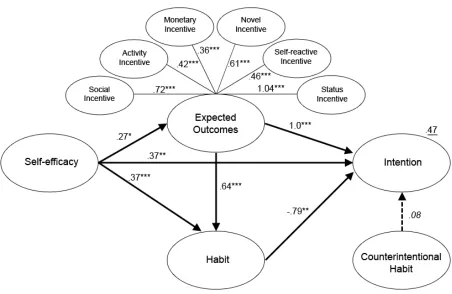
Figure 3 shows the path model with standardized path coefficients. The direct effects of expected outcomes and self-efficacy on intention to use IPTV were significant. Habit had a significant negative direct effect on intention. The direct effect of counterintentional habit did not reach the level of significance. Self-efficacy had a positive direct effect on expected outcomes and habit. Expected outcomes had a positive direct effect on habit. Status and social incentives were the strongest contributors to the construct “expected outcomes”, followed by novel, self-reactive, activity and monetary incentives. The complete set of variables accounted for 47% of variance of intention to use IPTV.
Figure 3: Standardized path coefficients of the model of media attendance
Note. *p < .05, **p < .01, ***p < .001. Dotted lines are non-significant paths (non-significant factor loadings in Italic). Squared multiple correlations are underlined
[image:18.595.72.524.341.635.2]3
0
-
2
9 - .58
2
8
- .49 .75
2
7
- .15 .23 .17
2
6
- .49 .01 .14 .14
2
5
- .58 .57 .04 .22 .06
2
4
- .41 .40 .24 -.0
6 -. 1 3 -. 0 4 2 3
- .65 .44 .39 .17 -.0
6 -. 1 9 -. 1 2 2 2
- .66 .68 .33 .35 .10 -.1
8 -. 1 8 -. 0 7 2 1
- .08 .07 .15 .25 .09 .18 .09 .16 .13
2
0 - .60 .01 -.09
.0 8 .1 6 .1 7 .2 3 .2 5 .3 3 .3 2 1 9
- .35 .32 .22 .04 .19 .35 .22 .22 .23 .35 .26
1
8
- .23 .17 .22 .11 6.1 .14 .39 .43 .38 -.0
1 .1 9 .0 6 1 7
- .41 .03 .22 .16 .09 .00 .14 .30 .36 .30 -.0
4 .0 3 .1 1 1 6
- .29 .26 .29 .21 .10 .15 7.1 .23 .32 .29 .13 .19 .20 .24
1
5
- .25 .36 .21 .14 .14 .09 .32 .30 .27 .28 .33 .12 .04 .13 .10
1
4
- .30 .28 .22 .10 .11 .20 .17 0.1 .18 .23 .15 6.1 .14 .04 .07 .18
1
3
- .38 .31 .32 5.1 .18 .11 .18 .22 .16 .33 .26 .33 9.1 .23 .08 .13 .13
1
2
- .10 .18 .16 .01 2.2 .08 .09 .09 .23 -.0
3 .0 7 .0 7 .1 2 .1 2 .1 0 -. 1 6 .0 2 -. 0 2 1
1 - .25 .35 .09 .22 .17 .19 .23 .17 .10 .20 .14 .18 .12 .21 .18 .18 .09 .01 .05
1
0
- .71 .13 .28 3.1 .31 .18 .10 .13 7.2 .00 .11 .21 .22 .10 .23 .24 .22 -.0
2 -. 0 7 -. 0 8
9 - .03 .16 .10 .09 5.1 .33 .17 .18 .13 .08 .24 .15 .06 .04 .09 2.2 .18 .14 .13 .04 .07
6
8 - .54 .28 .34 .05 2.2 .08 .28 .07 .12 .12 0.1 .33 .27 .28 .28 .11 .33 .35 .23 .18 .17 .21
7 - .41 .50 .10 .09 .09 .01 .13 .31 .14 .23 .08 .21 .39 .28 .17 .14 .21 .31 .18 .23 .01 .02 .05
6 - -.1
2 -. 0 7 .0 4 -. 1 3 -. 0 8 .1 4 .0 6 .0 2 -. 0 3 .2 4 .3 1 .3 1 .1 3 .1 0 .0 4 -. 1 5 -. 0 9 .0 4 .0 3 .2 5 .1 1 .1 0 .1 7 .2 0
5 - .49 .06 -.0
1 .0 4 .1 7 .2 7 .1 9 .2 3 .0 9 .1 1 .1 7 .1 9 .4 0 .2 9 .1 9 .1 6 -. 1 0 .0 0 4 .0 3 .2 0 .2 2 .1 9 .0 7 .0 9 .1 1
4 - .42 .38 .02 5.0 .13 .08 .16 .15 7.1 .10 .11 .33 .26 .51 .34 .24 .13 -.0
3 .0 6 .0 2 .3 2 .3 4 .3 1 .1 1 .3 2 .2 5
3 - .26 .24 .35 -.0
6 .1 9 .2 1 -. 0 5 .1 7 .2 1 .1 4 .1 3 .1 2 .3 6 .3 5 .3 3 -. 1 2 .1 4 .0 1 .1 5 .0 3 .1 0 .0 4 .2 1 .1 3 .0 4 .1 3 .1 7
2 - .85 .26 .26 .40 -.0
3 .1 8 .2 0 .0 5 .1 6 .2 4 .1 7 .0 8 .1 6 .2 5 .3 3 .3 1 -. 0 8 .1 8 .0 6 .2 5 .0 4 .1 6 .0 3 .2 2 .1 4 .0 4 .0 6 .1 6
1 - .94 .83 .23 6.3 .38 .05 .15 .19 7.0 .23 .24 .16 .08 .21 .27 .33 .34 -.0
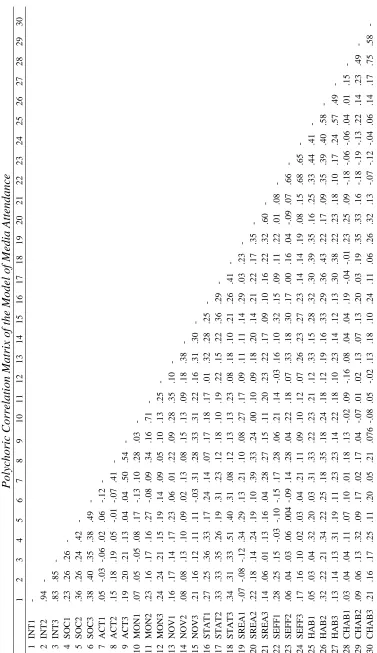
7 .2 2 .1 4 .2 8 .0 6 .1 7 .0 5 .3 2 .1 3 .0 3 .0 9 .2 1 IN T 1 IN T 2 IN T 3 S O C1 S O C2 S O C3 A CT 1 A CT 2 A CT 3 M O N 1 M O N 2 M O N 3 N O V 1 N O V 2 N O V 3 S T A T 1 S T A T 2 S T A T 3 S RE A 1 S RE A 2 S RE A 3 S E F F 1 S E F F 2 S E F F 3 H A B1 H A B2 H A B3 CH A B1 CH A B2 CH A B3 T ab le 2 P o ly ch o ri c C o rr el a ti o n M a tr ix o f th e M o d el o f M ed ia A tt en d a n ce
1 2 3 4 5 6 7 8 9
[image:20.595.88.465.93.746.2]Unified Model of Acceptance and Use of Technology
Prior to the analyses, data was checked for normality. Skewness and kurtosis were within normal bounds and no outliers were detected.
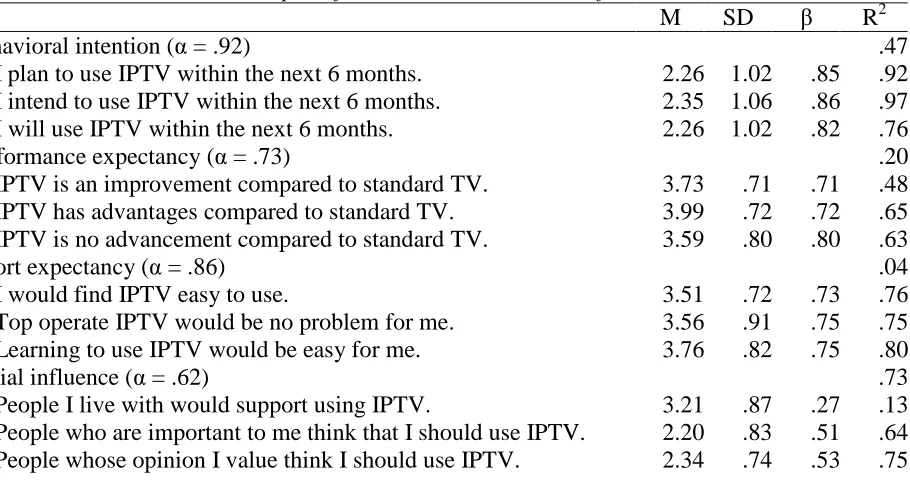
Cronbach’s Alpha for behavioral intention, performance expectancy and effort expectancy was above aspiration level (α >.70). Cronbach’s Alpha for social influence was below
aspiration level (α = .62). Cronbach’s Alpha of experience was low (α = .33), therefore the variable had to be dropped for this study. See Table 3 for descriptive statistics and
[image:21.595.90.545.333.578.2]Cronbach’s Alphas.
Table 3
Descriptive Statistics, Factor Loadings Squared Multiple Correlation, and Cronbach’s Alpha of the Observed Indicators of the UTAUT.
M SD β R2
Behavioral intention (α = .92) .47
I plan to use IPTV within the next 6 months. 2.26 1.02 .85 .92 I intend to use IPTV within the next 6 months. 2.35 1.06 .86 .97 I will use IPTV within the next 6 months. 2.26 1.02 .82 .76
Performance expectancy (α = .73) .20
IPTV is an improvement compared to standard TV. 3.73 .71 .71 .48 IPTV has advantages compared to standard TV. 3.99 .72 .72 .65 IPTV is no advancement compared to standard TV. 3.59 .80 .80 .63
Effort expectancy (α = .86) .04
I would find IPTV easy to use. 3.51 .72 .73 .76
Top operate IPTV would be no problem for me. 3.56 .91 .75 .75 Learning to use IPTV would be easy for me. 3.76 .82 .75 .80
Social influence (α = .62) .73
People I live with would support using IPTV. 3.21 .87 .27 .13 People who are important to me think that I should use IPTV. 2.20 .83 .51 .64 People whose opinion I value think I should use IPTV. 2.34 .74 .53 .75
As advised by Kline (1998) the measurement model was tested before testing the
structural model to prevent model misspecifications. The measurement model of the UTAUT had an adequate fit χ2(24) = 34.67 χ2/df = 1.44, SRMR = .081, TLI = .98, RMSEA = .053 (CI: .0, .089).
= 1.00 and RMSEA = .00 would indicate a perfect fit, but perfect model fits can also be obtained with totally uncorrelated variables (Garson, 2008) and the model is considered to be over identified. The error term of the indicator “social influence 1” was correlated to the error terms of “behavioral intention 1”, “performance expectancy 1” and “performance expectancy 2” (standardized residuals of 2.92, 2.72, 4.94 respectively) suggesting that the assumption of conditional independence of the indicator is not met.
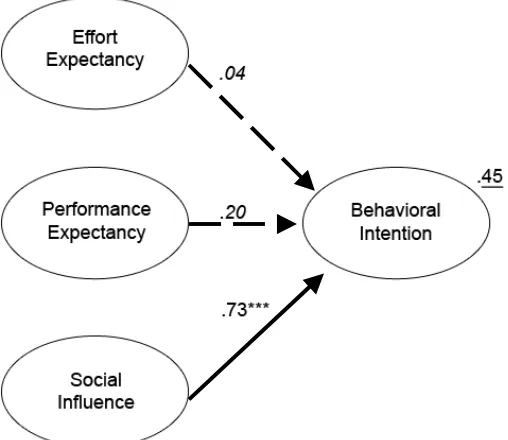
The path model of the UTAUT is shown in Figure 4. The direct effect of social influence on behavioral intention was significant. The direct effects of effort expectancy and
performance expectancy on behavioral intention were not significant. The complete set of variable accounted for 45% of variance for intention to use IPTV. To reproduce the findings the polychoric correlation matrix is supplied in Table 4.
Figure 4: Standardized path coefficients of the UTAUT
Note. *p < .05, **p < .01, ***p < .001. Dotted lines are non-significant paths (non-significant factor loadings in Italic). Squared multiple correlations are underlined.
Moderation
[image:22.595.72.326.377.597.2]moderator was gender. Moderation can not be modeled with LISREL and advanced methods as suggested by Jaccard & Wan (1996) were considered to be outside the scope of this study. Therefore the analysis of possible moderators was not conducted.
Table 4
Polychoric Correlation Matrix of the UTAUT
1 2 3 4 5 6 7 8 9 10 11 12 1 INT1 -
2 INT2 .94 - 3 INT3 .83 .85 - 4 PERF1 .09 .06 .08 - 5 PERF2 .13 .13 .09 .58 - 6 PERF3 .07 .03 .01 .53 .64 - 7 EFF1 .20 .14 .11 .19 .14 .28 - 8 EFF2 .12 .10 .07 .21 .32 .28 .76 - 9 EFF3 .18 .12 .06 .24 .32 .37 .78 .77 - 10 SOCIAL1 .36 .32 .34 .19 .32 .11 .07 .18 -.04 - 11 SOCIAL2 .49 .50 .53 -.08 .02 -.10 .06 .05 .01 .29 - 12 SOCIAL3 .48 .55 .54 -.13 -.03 -.20 .06 .05 .05 .30 .70 -
Model comparison
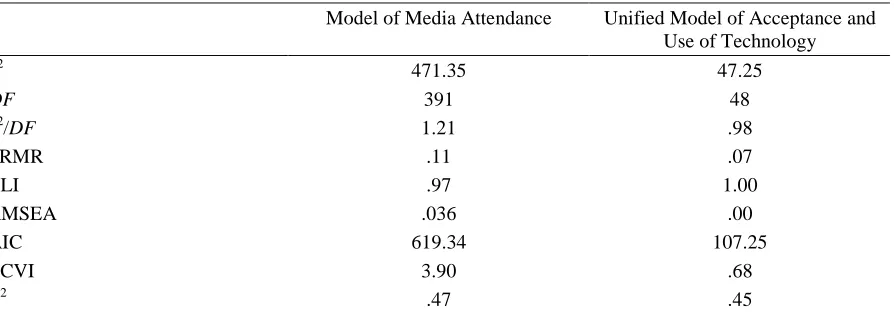
On the basis of low reliabilities, high multicollinearity and correlated error variances the comparison of the two models should be interpreted with great caution. Fit indices of the model of media attendance and the UTAUT are summarized in Table 5.
Table 5
Fit indices of the Model of Media Attendance and the UTAUT
Model of Media Attendance Unified Model of Acceptance and Use of Technology
χ2 471.35 47.25
DF 391 48
χ2/DF 1.21 .98
SRMR .11 .07
TLI .97 1.00
RMSEA .036 .00
AIC 619.34 107.25
ECVI 3.90 .68
R2 .47 .45
[image:23.595.78.525.500.663.2]The Tucker-Lewis Index (TLI) penalizes for model complexity and is very good for the Model of Media Attendance (.97) and perfect for the UTAUT (1.0). The root mean square error of approximation (RMSEA) had a good fit for the Model of Media Attendance (.04) the UTAUT had a perfect fit of .00. As mentioned in the results section of the UTAUT this is most likely a sign of an over identified model caused by multicollinearity in the dataset (Garson, 2008).
On the basis of comparative fit indices like the Akaike Information Criterion (AIC) and the expected cross-validation index (ECVI) the UTAUT has a better fit than the Model of Media Attendance. These measures compare non nested models and while the AIC penalizes for model complexity the ECVI penalizes for the number of free parameters. The UTAUT, in this study, does only consist of three direct effects and four variables and is therefore favored by most of the mentioned fit indices. As noted by Garson (2008) the model might in fact be so simple that it fits all data.
Discussion
The findings of this study do suggest that scales and indicators that are reliable in the setting of explaining media use may be less reliable in a predictive setting. Low reliability of the measurement scales and high multicollinearity within the dataset call for great caution when interpreting the results.
Model of Media Attendance
An unexpected effect is found in the relation between the habit to use new media and the intention to use IPTV. It was hypothesized that people who habitually use new media are more likely to adopt the new technology, as suggested by Shin (2007). The results suggest that the opposite is the case. A strong habit to use new media has a negative effect on the intention to use IPTV. It can be argued that the habit of using new media is a
counterintentional habit in this setting. A possible explanation for this finding is that internet television, streams and the download of movies offer most, but not all, of the features of IPTV. Users might not see the advantage of using IPTV over their current media use habits. Hinduja (2003) noted that students who are frequent internet users are also more likely to conduct internet piracy and services they have to pay for might simply not be considered. As the sample of this study consisted solely of students it might not be representative for the media use habits of the whole population.
Watching TV was hypothesized to be a counterintentional habit in this study but it had no effect on the intention to use IPTV. Future research should consider integrating the habit to use other new media as counterintentional habit and watching TV, visiting movies or buying DVDs as habits that are positively related to the intention of using IPTV.
Unified Model of Acceptance and Use of Technology
The possible implications of the UTAUT are severely limited in this study as the model had to be reduced to only three factors (effort expectancy, performance expectancy and social influence) linked to behavioral intention. Possible moderating effects of age, gender and experience were not taken into account. While parsimony is considered to be important a model that is too simple will most likely exclude important variables and will not help to get a better insight into the underlying processes.
of this study. The results suggest that the users have relatively high performance expectancies and expect the efforts to use IPTV to be low. In contrast to earlier studies (e.g. Venkatesh, 2003, Welmers, 2005, Schoneville, 2007) these factors have no positive effect on intention in this study. It can be argued that the unique features of IPTV are not easy to evaluate without actual experience and testing of the product. In this case the brochure like introduction of this study can be seen as a limited source of information leading to higher uncertainty in the product evaluation. This is in line with findings from marketing research where the evaluation of a product is influenced by the product category (search, experience and credence) and by the amount of product relevant information given (e.g. Klein, 1998). It is also possible that behavioral factors and habits that are not included in the UTAUT outweigh the positive expectations. This is supported by Limayem et al. (2003) who stated that habit plays a vital role in the use and adoption of new technologies. Without the
inclusion of these factors the UTAUT might not be able to explain how users come to adopt a new technology.
It can be argued that the UTAUT might not be useful in a highly voluntary setting with an unknown technology, but more studies that incorporate all theoretical meaningful factors have to be conducted to come to a conclusion. As noted by Venkatesh (2003) the scales of the UTAUT are also open for discussion and should be validated and tested in more non
organizational settings.
Limitations
reliabilities of the indicator items, even though they have proven to be reliable in other settings and in the pretest of this study. Low reliabilities and high multicollinearity of the predictor variables increase bias in the standardized and unstandardized regression weights reducing the interpretability of the data (Pedhazur, 1982). Skew and kurtosis in the ordinal dataset called for the use of a polychoric correlation matrix. The appropriate statistical procedures of weighted least squares or generalized least squares could not be used as the sample size was relatively small in this study. The small sample size is also problematic when interpreting the standardized residuals, as the standard error of the residual is only stable when the sample is large enough.
References
Ajzen, I., & Madden, T.J. (1985). Prediction of Goal-Directed Behavior: Attitudes,
Intentions, and Perceived Behavioral Control. Journal of Experimental Social Psychology, 22, 453-474.
Bandura, A. (1986). Social foundations of thought and action: A social cognitive theory. Englewood Cliffs, NJ: Prentice Hall.
Bandura, A. (1997). Self-efficacy: The exercise of control. New York: Freeman.
Davis, F. D. (1989). Perceived Usefulness, Perceived Ease of Use, and User Acceptance of Information Technology. MIS Quarterly, 13(3), 319-339.
European Commission, Information Society and Media Directorate. (2006, November). General Digital television data - EU market for digital television. Retrieved September 9, 2008. from http://ec.europa.eu/information_society/policy/ecomm/doc/info_centre/studies _ext_consult/digital_tv_final_report_cec.pdf
Ferguson, D. A., & Perse, E. M. (2000). The World Wide Web as a functional alternative to television. Journal of Broadcasting and Electronic Media, 44, 155-174.
Fishbein, M., & Ajzen, I. (1975). Belief, attitude, intention, and behavior: An introduction to
theory and research. Reading, MA: Addison-Wesley. Retrieved September 20, 2008. from
http://www.people.umass.edu/aizen/f&a1975.html
Garson, G. D. (2008). Statnotes: Topics in Multivariate Analysis. Retrieved December 16, 2008, from http://www2.chass.ncsu.edu/garson/pa765/structur.htm
Hinduja, S. (2003). Trends and patterns among online software pirates. Ethics and
Information Technology, 5, 49–61.
Huang, S., & Mangs, J. (2008). Pervasive computing: Migrating to mobile devices: A case study. Systems Conference, 2008 2nd Annual IEEE, 7(10), 1-8.
consultancy.com/publications/internet-stats-compendium/
Jaccard, J., & Wan, C. K. (1996). LISREL approaches to interaction effects in multiple
regression. Thousand Oaks, CA: Sage.
Jöreskog, K. G., & Sörbom, D. (1997). LISREL 8: A guide to the program and applications. Chicago, IL: SPSS Inc.
Jöreskog, K.G. (1999). How Large can a Standardized Coefficient be? Retrieved December 18, 2008 from http://www.ssicentral.com/lisrel/techdocs/HowLargeCanaStandardized Coefficientbe.pdf
Klein, L.R. (1998). Evaluating the potential of interactive media through a new lens: Search versus experience goods. Journal of Business Research, 41, 195–203.
Kline, R. B. (1998). Principles and practice of structural equation modelling. New York: Guilford Press.
Koivumak, T., Ristola, A., & Kesti, M. (2008). The perceptions towards mobile services: an empirical analysis of the role of use facilitators. Personal and Ubiquitous Computing,
12(1), 67-75.
Kwong, T., Cheung, C., Zhu, L., Limayem, M., & Viehland, D. (2002). Online consumer behavior: an overview and analysis of the literature. Proceedings of the 2002 Southern
Association of Information Systems Conference. Retrieved September 20, 2008 from
http://www.pacis-net.org/file/2002/166.PDF
LaRose, R. (2001). On the negative effects of e-commerce: A sociocognitive exploration of unregulated on-line buying. Journal of Computer Mediated Communication [Online serial], 6(3). Retrieved September 17, 2008 from:http://www3.interscience.wiley.com/cgi- bin/fulltext/120837815/HTMLSTART
Electronic Media, 48 (3), 358 – 377.
Leonard-Barton, D., & Deschamps, I. (1988). Managerial Influence in the Implementation of New Technology. Management Science, 34(10), 1252-1265.
Limayem, M., Hirt, S.G., & Chueng, C.M. (2003). Habit in the context of IS continuance: theory extension and scale development. In Proceedings of the 11th European Conference on Information Systems (ECIS 2001).
Liu, K., Gill, A., & Berendt, A. (2008). IPTV: The entertainment game has changed. IEEE
Communications Magazine, 46(8), 88-89.
Mindlin, S. (2008, August 25). Drilling Down - Preferring the Web Over Watching TV. The
New York Times, p C3.
Nunally, J.C., & Bernstein, I.H. (1994). Psychometric theory (3rd edition), New York,
McGraw-Hill.
Ouellette, J.A., & Wood, W. (1998). Habit and intention in everyday life: the multiple
processes by which past behavior predicts future behavior. Psychological Bulletin, 124(1), 54-74.
Palmgreen, P.,Wenner, L. A., & Rayburn, J. D. (1981). Gratification discrepancies and news program choice. Communication Research, 8, 451-478.
Palmgreen, P.,Wenner, L., & Rosengren, K. (1985). Uses and gratifications research: The past ten years. In K. Rosengren, L.Wenner,&P. Palmgreen (Eds.), Media gratifications
research (pp. 11-37). Beverly Hills, CA: Sage.
Pedhazur, E.J. (1982). Multiple regression in behavioral research: Explanation and
prediction (2nd ed.). Fort Worth, TX: Harcourt Brace Jovanovich.
Peters, O. (2007). Social psychological determinants of mobile communication technology
use and adoption. A comparison of three models to explain and predict mobile
Polites, G.L. (2005). Counterintentional habit as an inhibitor of technology acceptance.
Proceedings of the 2005 Southern Association for Information Systems Conference.
Retrieved on October 10th, 2008 from http://sais.aisnet.org/SAIS2005/Polites.pdf. Scherer, F.M. (1982). Demand-pull and technological opportunity: Schmookler Revisited. The Journal of Industrial Economics, 30 (3), 225-237.
Schoneville, S. (2007). This just in: Analysis of factors influencing online newspaper reading
behaviour. Master thesis of the University Twente.
Schramm, W. (1954). How communication Works. In W. Schramm (Ed.), The Process and
Effects of Mass Communication (pp. 3-26). Urbana, IL: University of Illinois Press.
Shin, D.H. (2007). Potential user factors driving adoption of IPTV. What are customers expecting from IPTV? Technological Forecasting & Social Change, 74, 1446–1464. Straub, D., Limayem, M., & Karahanna-Evaristo, E. (1995). Measuring System usage: Implications for IS Theory Testing. Management Science, 41, 1328-1342.
Thompson, R. L., Higgins, C. A., & Howell, J. M. (1991). Personal Computing: Toward a Conceptual Model of Utilization. MIS Quarterly, 15(1), 124-143.
United States Department of Commerce, Census Bureau. (2008, May). Conversion from
Analog to Digital-TV. Retrieved September 15, 2008. from http://www.census.gov/Press-
Release/www/releases/archives/cb08ffse-03.pdf
Venkatesh, V., Morris, M. G., Davis, G. B., & Davis, F. D. (2003). User Acceptance of Information Technology: Toward a Unified View. MIS Quarterly, 27 (3), 425-478. Verplanken, B., & Orbell, S. (2006). Reflections on Past Behavior: A Self-Report Index of Habit Strength. Journal of Applied Social Psychology, 33 (6), 1313-1330.
Welmers, A. (2005). Op zoek naar helderheid: een aangepast UTAUT model voor digitale
Appendix A
Survey Questions “Model of media attendance”
Behavioral intention:
I plan to use IPTV within the next 6 months. I intend to use IPTV within the next 6 months. I will use IPTV within the next 6 months. Social incentive:
I would use IPTV to find something to talk about.
I would use IPTV to keep my family and friends up-to-date.
I would use IPTV to strengthen my relations with family and friends. Activity incentive:
I would use IPTV to feel entertained. I would use IPTV to have fun.
I would use IPTV because it's a pleasant activity. Monetary incentive:
I would use IPTV to only pay for movies I like. I would use IPTV to only pay for series I like. I would use IPTV to save money on DVDs. Novel incentives:
I would use IPTV to set up my own TV guide.
I would use IPTV to be directly involved in program decisions. I would use IPTV to view movies in high quality.
Status incentives:
I would use IPTV because it fits my lifestyle.
I would use IPTV because it is a modern way to watch TV. I would use IPTV to get up to date with a new technology. Self-reactive incentives:
I would use IPTV to forget my problems. I would use IPTV to find a way to pass the time. I would use IPTV to relieve boredom.
Self-efficacy
I would handle IPTV without the help from others. It would be no problem for me to operate IPTV. I have the knowledge and skills to operate IPTV. Media use habit
The use of new media is part of my daily routine. I use as many new media as possible.
Counterintentional habit: I frequently use the TV
I would find it hard to not watch TV Using the TV belongs to my daily routine Experience:
How many hours do you use the internet on a typical weekday? How often have you used a pay per view service in the last month?
Appendix B
Survey Questions UTAUT
Behavioral intention:
I plan to use IPTV within the next 6 months. I intend to use IPTV within the next 6 months. I will use IPTV within the next 6 months. Performance expectancy:
IPTV is an improvement compared to standard TV. IPTV has advantages compared to standard TV.
IPTV is no advancement compared to standard TV. (Reverse Coded) Effort expectancy:
I would find IPTV easy to use.
To operate IPTV would be no problem for me. Learning to use IPTV would be easy for me. Social influence:
People I live with would support using IPTV.
People who are important to me think that I should use IPTV. People whose opinion I value think I should use IPTV. Experience:
How many hours do you use the internet on a typical weekday? How often have you used a pay per view service in the last month?
Appendix C
Standardized Residuals for the Model of Media Attendance:
Largest Negative Standardized Residuals between
MON1 and SOC3 -2.89 MON2 and SOC3 -2.98 HABIT1 and SOC3 -3.28 SEFF1 and SOC3 -2.65 SEFF1 and HABIT3 -2.70
Largest Positive Standardized Residuals between