Proceedings of the CoNLL 2018 Shared Task: Multilingual Parsing from Raw Text to Universal Dependencies, pages 45–54 45
Semi-Supervised Neural System for Tagging, Parsing and Lemmatization
Piotr Rybak
Institute of Computer Science, Polish Academy of Sciences [email protected]
Alina Wr´oblewska
Institute of Computer Science, Polish Academy of Sciences [email protected]
Abstract
This paper describes the ICS PAS system which took part in CoNLL 2018 shared task on Multilingual Parsing from Raw Text to Universal Dependencies. The sys-tem consists of jointly trained tagger, lem-matizer, and dependency parser which are based on features extracted by a biL-STM network. The system uses both fully connected and dilated convolutional neu-ral architectures. The novelty of our ap-proach is the use of an additional loss function, which reduces the number of cy-cles in the predicted dependency graphs, and the use of self-training to increase the system performance. The proposed system, i.e. ICS PAS (Warszawa), ranked 3th/4th in the official evaluation1 obtain-ing the followobtain-ing overall results: 73.02 (LAS), 60.25 (MLAS) and 64.44 (BLEX).
1 Introduction
Most of contemporary NLP systems for machine translation, question answering, sentiment analy-sis, etc. operate on preprocessed texts, i.e. texts with tokenised, part-of-speech tagged, and pos-sibly syntactically parsed sentences. Therefore, the development of high-quality pipelines of NLP tools or entire systems for language preprocessing is still an important issue. The vast majority of language preprocessing frameworks take advan-tage of the statistical methods, especially the su-pervised or semi-susu-pervised statistical methods. Based on training data, language preprocessing tools learn to analyse sentences and to predict mor-phosyntactic annotations of these sentences.
1http://universaldependencies.org/
conll18/results.html
The supervised methods require gold-standard training data whose creation is a time-consuming and expensive process. Nevertheless, the mor-phosyntactically annotated data sets are pub-licly available for many languages, in particu-lar within Universal Dependencies initiative (UD,
Nivre et al.,2016). The initiators of UD aim at de-veloping a cross-linguistically consistent annota-tion schema and at building a large multilingual collection of sentences annotated according to this schema with the universal part-of-speech tags and the universal dependency trees.
UD treebanks are nowadays used for multi-lingual system development (Nivre et al., 2018). The history of developing multilingual systems dates back to 2006 and 2007, when two shared tasks on multilingual dependency parsing were or-ganised at the Conference on Computational Nat-ural Language Learning (CoNLL, Buchholz and Marsi, 2006;Nivre et al., 2007). After 10 years, the shared task was organised again in 2017 ( Ze-man et al.,2017), and currently there is its fourth edition (Zeman et al.,2018).
In this paper we describe our solution submit-ted to the CoNLL 2018 Universal Dependency shared task. The system and the trained models for participating treebanks are publicly available.2 Our system takes a tokenised sentence as input. The sentence tokenisation is predicted by the base-line model (Straka and Strakov´a,2017).
Each word is represented both as an external word embedding and as a character-based word embedding estimated by a dilated convolutional neural network encoder (CNN, Yu and Koltun,
2016). The concatenation of these embeddings is fed to a bidirectional long short-term memory net-work (biLSTM, Graves and Schmidhuber, 2005;
Hochreiter and Schmidhuber, 1997) which
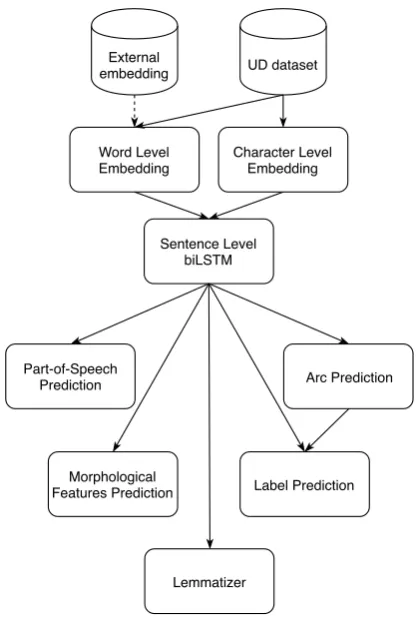
tracts the final features (see Section2.1). The tag-ger takes extracted features and predicts univer-sal part-of-speech tags, language-specific tags and morphological features using three separate fully connected neural networks with one hidden layer (see Section 2.2). The lemmatizer uses a dilated CNN to predict lemmas based on characters of corresponding words and features previously ex-tracted by a biLSTM encoder (see Section 2.3). As a scoring function, the graph-based depen-dency parser uses simple dot product of the vec-tor representations of a dependent and its gover-nor. These representations are output by two single fully connected layers which take feature vectors extracted by a biLSTM encoder as input. A novel loss function penalizes cycles, in order to reduce their number in the predicted dependency graphs (see Section 2.4.2). Chu-Liu-Edmonds algorithm (Chu and Liu, 1965; Edmonds, 1967) constructs the final dependency tree. The dependency labels are predicted with a fully connected neural net-work based on the dependent and its governor em-beddings as well (see Section2.4for more details on the parser’s architecture). The system architec-ture is schematised in Figure1.
The whole system is end-to-end trained, sepa-rately for each treebank provided for the purposes of the shared task. The technical details of the im-plemented system are given in Section 3. Ad-ditionally, for 20 selected treebanks self-training is used to increase the performance of the mod-els (see Section 3.4). The proposed technique of self-training has an impact on the quality of tag-ging, lemmatisation and parsing (see Section4.3). The article ends with the presentation of the results achieved by our system (see Section4) and some conclusions (see Section5).
2 Architecture Overview
2.1 Feature Extraction
The system accepts an input in the form of to-kenised sentences that can be annotated with addi-tional morphosyntactic information: lemmas, part-of-speech tags, and morphological features. How-ever, as the goal of the shared task is to predict not only dependency trees but also parts of speech, lemmas and morphological features,3we decide to use words as the only input.
3Not all treebanks are annotated with lemmas and mor-phological features.
Character Level Embedding Word Level
Embedding External
embedding UD dataset
Sentence Level biLSTM
Lemmatizer
Label Prediction Morphological
Features Prediction
Arc Prediction Part-of-Speech
[image:2.595.312.521.69.379.2]Prediction
Figure 1: The schema of the system architecture.
2.1.1 Word Level Embedding
Each input word is represented as a vector us-ing the external pre-trained embeddus-ing. Words not present in the external embedding are re-placed with the “unknown” word and represented as a random vector drawn from the normal dis-tribution with the mean and the variance calcu-lated based on other word embedding vectors. Both the external embedding itself and the vec-tor representing “unknown” word are fixed during the training, but they are transformed by a single fully connected layer. This transformation serves similar purpose as a trainable embedding, but helps with generalization, since it will also trans-form vectors for words available in the external embedding, but not in the training set.
2.1.2 Character Level Embedding
First, each word is transformed to a sequence of the trainable character embeddings. More-over, the special symbols “beginning-of-word” and “end-of-word” are added to the sequence to represent the beginning and the end of the word. Then the dilated CNN encoder is used. Since the encoder also outputs a sequence, we use the global max-pooling operation to obtain the fi-nal word embedding. This procedure is reasonable for estimating embeddings of out-of-vocabulary words, especially in languages with rich morphol-ogy.
2.1.3 Sentence Level biLSTM
Both word representations are concatenated to-gether and fed into the sentence level biLSTM net-work. The network learns contexts for each word and extracts the final features for each of these words.
2.2 Tagger
2.2.1 Part-of-Speech Tags
The tagger is implemented as a fully connected network with one hidden layer and soft-max ac-tivation function. The tagger takes the features ex-tracted by the biLSTM as input and predicts a uni-versal part-of-speech tag and a language-specific tag for each word.
2.2.2 Morphological Features
Similar approach is used to predict morphologi-cal features. Each morphologimorphologi-cal feature is rep-resented as an attribute-value pair (e.g. Num-ber=Sing) and each word is annotated with a set of appropriate attribute-value pairs in training data. We therefore decide to treat the problem of mor-phological features prediction as several classifi-cation problems (see Figure2).
biLSTM representation
Hidden layers
Probabilities
Case=Nom Gender=Fem Tense=NA Individual predictions
[image:3.595.329.506.452.693.2]Case=Nom|Gender=Fem Final prediction
Figure 2: The morphological features prediction.
For each attribute its value is predicted with a fully connected network with one hidden layer and soft-max activation function. Various words are defined by the sets of various morphological features. Since for each word only some attributes are present in the set of morphological features, the possible values are extended with “not applica-ble” label. It allows the model to learn that an at-tribute is not present in the set of morphological features of a particular word.
2.3 Lemmatizer
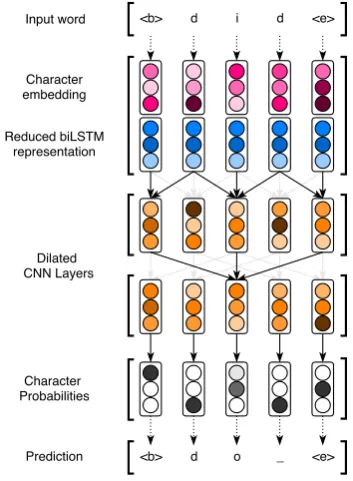
Lemmatizer takes two different inputs. First, fea-tures extracted by the biLSTM encoder are used, however their dimensionality is reduced with a single fully connected layer. Next, the word, for which we want to predict a lemma, is con-verted to a sequence of characters. The special symbols “beginning-of-word” and “end-of-word” are added to the sequence to represent the begin-ning and the end of the word. Each character in the sequence is represented as a trainable embed-ding vector. The final input to the lemmatizer is a sequence of character embeddings concatenated with the reduced version of features extracted by the biLSTM encoder. Note that each character em-bedding is concatenated with exactly the same ex-tracted feature vector.
Input word
<b> d o _ <e> <b> d i d <e>
Character embedding
Reduced biLSTM representation
Dilated CNN Layers
Character Probabilities
Prediction
Figure 3: The lemmas prediction.
[image:3.595.79.280.604.713.2]in-put to the sequence of probabilities of one-hot en-coded characters of the predicted lemma (see Fig-ure3).
2.4 Parser
2.4.1 Arc Prediction
Two single fully connected layers transform fea-tures extracted by the biLSTM encoder into head and dependent vector representations. A fully con-nected dependency graph is defined with an ad-jacency matrix. The columns of the matrix cor-respond to heads represented with heads’ vector representations and the rows correspond to depen-dents represented with dependepen-dents’ vector repre-sentations. The elements of the adjacency matrix, in turn, are dot products of all pairs of the head and dependent vector representations. Soft-max func-tion is then applied to each row of the matrix to predict the adjacent head-dependent pairs (see Figure4).
Adjacency matrix Dot product
Dependent
representation
Head representation
ROOT The car is red cop det
nsubj root
Figure 4: The adjacency matrix and the extracted dependency tree of the sentenceThe car is red.
2.4.2 Loss Function
In order to force the network to predict the correct head for each dependent and thus a correct depen-dency tree, the cross-entropy loss function is used for each row in the adjacency matrix. Note how-ever that such formulation of the problem can lead the network to predict an adjacency matrix with cycles.
We aim to get an adjacency matrix for which a simple greedy algorithm would suffice to
con-struct the correct tree. Therefore, we propose an additional ‘cycle-penalty’ loss function which reduces the number of cycles in the predicted ad-jacency matrix:
loss(A) = K
X
k=1
tr(Ak)
The non-zero trace of Ak indicates that there
are the paths of the length k in the graph repre-sented by the adjacency matrixA(Norman,1965). Therefore, by minimizing the sum of the traces of the subsequent powers ofAwe reduce the number of cycles in the predicted graph. In an ideal sce-narioK should be equal to the length of the sen-tence, but in practice evenK = 3helps to reduce the number of cycles. The final loss used to train the arc prediction model is a sum of cross-entropy loss and ‘cycle-penalty’ loss.
If the smoothed adjacent matrix still contains cycles, Chu-Liu-Edmonds algorithm (Chu and Liu, 1965;Edmonds, 1967) is applied to extract the properly built dependency tree in the final step of the prediction procedure.
2.4.3 Label Prediction
In order to predict the label for each arc of the pre-dicted dependency tree, the vector representations of the arc’s head and its dependent are calculated. These representations do not correspond to those used during the arc prediction, but they are ob-tained in a similar way. The estimated vector of the dependent is concatenated with the weighted average of its predicted head vector. The weights correspond to probabilities of a word being the pendent’s head predicted by the arc model de-scribed in the previous section. It is not possible to take just the vector of a single predicted head, because it would prevent the model to be trained together with the rest of the system, as argmax op-eration is not differentiable. The concatenated vec-tor representations are then fed to a single fully connected layer with soft-max activation function.
3 Implementation Details
3.1 Network Hyperparameters
Word Embedding We use 300-dimensional fastText word embeddings (Grave et al., 2018),4
4https://github.com/facebookresearch/
[image:4.595.77.278.353.563.2]which are then converted to 100-dimensional vec-tors by a single fully connected layer. The em-bedding is not available for some languages, i.e. for Old Church Slavonic (‘cu proiel’), Old French (‘fro srcmf’), Gothic (‘got proiel’), Kur-manji (‘kmr mg’), North S´ami (‘sme giella’) or it seems incorrect, i.e. in Slovak (‘sk snk’). There-fore, we estimate the embedding for these lan-guages during the training of the whole system.
Character Embedding The character level em-bedding is calculated with three convolutional lay-ers with 512, 128 and 64 filtlay-ers with dilation rates equal to 1, 2 and 4. All of the filters have the ker-nel of size 3. The input character embedding has the size of 64.
Final Word Embedding The final word embed-ding is the concatenation of the 100-dimensional
word embedding and the 64-dimensional
character-based word embedding. It has thus 164 dimensions.
Feature Extraction Two biLSTM layers with 512 hidden units are used to extract the final fea-tures.
Tagger The tagger uses a fully connected net-work with the hidden layer of the size 64. The model to predict morphological features uses the hidden layer of 128 neurons.
Lemmatizer The lemmatizer uses three convo-lutional layers with 256 filters and dilation rates equal to 1, 2 and 4. All of the filters have the kernel of size 3. Then the final convolutional layer with the kernel size equal to 1 is used to predict lmas. The input characters, represented as the em-beddings with 256 dimensions, are concatenated with the features extracted with the biLSTM en-coder and reduced to 32 dimensions with a single fully connected layer.
Parser The arc model uses heads’ and depen-dents’ vector representations with 512 dimen-sions. The labelling model uses 128-dimensional vectors.
All fully connected layers use tanh activation function and all convolutional layers use rectified linear unit (ReLU,Nair and Hinton,2010).
3.2 Regularization
We apply both Gaussian Dropout (with
the dropout rate of 0.25) and Gaussian Noise
(with the standard deviation on 0.2) to the final word embedding5 and after processing each biLSTM layer. All fully connected layers use the standard dropout (Srivastava et al., 2014) with the dropout rate of 0.25. The biLSTM layers use both the standard and recurrent dropout with the rate of 0.25. Moreover, the biLSTM and convolutional layers use L2 regularization with the rate of1×10−6and the trainable embeddings use L2 regularization with the rate of1×10−5.
3.3 Training
We use cross-entropy loss for all parts of the sys-tem. The loss for the arc prediction model is a sum of cross-entropy loss and novel loss (see Section
2.4.2). The final loss is the weighted sum of losses with the following weights for each task:
• 0.05 for part-of-speech tagging,
• 0.2 for morphological features prediction,
• 0.05 for lemmatization,
• 0.2 for arc prediction,
• 0.8 for label prediction.
The whole system is optimized with ADAM (Kingma and Ba, 2014) with the learning rate equal to 0.002 and β1 = β2 = 0.9. Typically, the batch size of approximately 2500 words is used, however for a few of the smallest tree-banks the batch size is reduced to 1000 or even 75 words. Each batch consists of sentences with a similar length, but the ordering of batches is randomized within each epoch. Each observa-tion (i.e. sentence) is weighted with the log of the sentence length that forces the model to focus on longer (and usually more difficult) sentences. The model is trained for maximum of 400 epochs and the learning rate is reduced twice by the factor of two when the validation score reaches plateau. For languages with multiple treebanks, first a gen-eral model is trained on all sentences from these treebanks and then the model is fine-tuned for each treebank.
3.4 Self-training
For 20 arbitrarily selected treebanks, mostly the smallest ones, self-training method (Triguero et al.,2015) is used to increase the performance of
the system. First the model is trained in a stan-dard way, as described in the previous sections. Then the ‘semi-supervised’ training set is built. It contains sentences with the total of approxi-mately 25M words taken from raw data6provided by CoNLL 2018 organizers. For Uyghur language only 3M words are available. The provided data sets come either from Wikipedia or Commom Crawl. Where it is possible we choose the sen-tences from Common Crawl, due to longer (on average) sentence sizes. The pre-trained model is then used to predict dependency trees, lemmas and part-of-speech tags for all sentences in the ‘semi-supervised’ training set. Finally, the new model is trained on this ‘semi-supervised’ training set for only one epoch and fine-tuned on the gold-standard training data, using the gold-standard training procedure.
3.5 Languages with No Resources
Our solution for processing treebanks with no training data is very simple. We choose another language for which training data is available and train the model on this data. The estimated model is used for predictions in the language with no training data. We use the following treebank pairs:
• ‘br keb’ (Breton)7– ‘ga idt’ (Irish),
• ‘fo oft’ (Faroese) – ‘no nynorsk’ (Norwe-gian),
• ‘pcm nsc’ (Naija) – ‘en ewt’ (English),
• ‘th pud’ (Thai) – ‘vi vtb’ (Vietnamese).
The parallel UD treebanks for Czech, English, Finish, and Swedish, and the treebank for modern Japanese are processed with the models estimated on other treebanks for the respective languages:
• ‘cs pud’ – ‘cs pdt’ (Czech),
• ‘en pud’ – ‘en ewt’ (English),
• ‘fi pud’ – ‘fi tdt’ (Finish),
• ‘sv pud’ – ‘sv talbanken’ (Swedish),
• ‘ja modern’ – ‘ja gsd’ (Japanese).
6https://lindat.mff.cuni.cz/
repository/xmlui/handle/11234/1-1989
7The first language in each row has no training data and is parsed with the model estimated for the second language in the pair.
4 Results
4.1 Overview
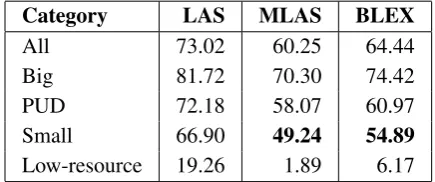
In the official evaluation8(Zeman et al.,2018) our system ranks 3th/4th for all three main metrics (ex aequo with LATTICE and UDPipe Future for LAS). It performs particularly well on small tree-banks with no development data, but a reasonable size of the training set. For example, the system ranks 1st in terms of all three measures on Russian ‘ru taiga’ treebank, 1st (MLAS and BLEX) and 2nd (LAS) on Latin ‘la perseus’ treebank and spo-ken Slovenian ‘sl sst’ treebank, and 1st (MLAS and BLEX) and 3rd (LAS) on spoken Norwegian ‘no nynorsklia’ treebank. It is worth noting that overall MLAS and BLEX scores obtained by our system trained on small treebanks are currently the state of the art (see Table 1). With respect to LAS score, our system ranks 3rd.
Category LAS MLAS BLEX
All 73.02 60.25 64.44
Big 81.72 70.30 74.42
PUD 72.18 58.07 60.97
Small 66.90 49.24 54.89
Low-resource 19.26 1.89 6.17
Table 1: Official results of our system in CoNLL shared task. State-of-the-art results are in bold.
Regarding to processing big treebanks, our sys-tem performs very well on Czech ‘cs fictree’ tree-bank and English ‘en gum’ treetree-bank (1st place in MLAS and BLEX, and 2nd place in LAS), and Latin ‘la ittb’ treebank (1st place in MLAS and BLEX, and 3rd place in LAS). It is very important to note that most of the mentioned languages, i.e. Russian, Latin, Slovenian, Norwegian, and Czech, are Indo-European languages (fusional). Further-more, for other fusional languages, e.g. Gali-cian, Ancient Greek, Polish, Ukrainian, Dutch, Swedish, French, Italian, Spanish, Basque, our system provides quite satisfying results as well. It follows that our system is especially appropriate for processing fusional languages.
Our last observation concerns the usefulness of external word embeddings for NLP system with a neural architecture. The languages without ex-ternal word embeddings (see Section3.1) are
pro-8http://universaldependencies.org/
[image:6.595.307.525.333.424.2]cessed by our system significantly below its over-all performance. Hence, the external word embed-dings are crucial for a neural NLP system.
4.2 Impact of Loss Function
For 15 arbitrarily selected treebanks we train the models without the additional loss function and we compare UAS scores of these models with UAS scores obtained by the models estimated with the additional loss function (withK = 3, see Sec-tion2.4.2). Moreover for each treebank we calcu-late what would be the fraction of trees with cycles if we use the greedy algorithm to construct the pre-dicted trees.
Note that the following results cannot be di-rectly compared to the official test results. First we report the scores on the validation set. Second we use the gold-standard segmentation instead of the segmentation predicted by the baseline model.
Treebank UAS % Cycles without with without with
ar padt 86.23 86.39 7.70 4.51
bg btb 92.32 92.45 1.26 1.52
cu proiel 86.94 86.49 4.19 3.91
da ddt 86.61 86.24 5.14 4.61
de gsd 87.74 87.64 3.50 2.63
es ancora 92.39 92.49 3.08 3.39
fa seraji 90.30 90.44 5.18 4.51
got proiel 83.88 83.57 5.48 4.57
hr set 90.34 90.50 6.71 4.95
hu szeged 81.99 82.48 11.34 9.75
id gsd 84.33 84.47 6.98 6.98
lv lvtb 85.69 85.58 6.28 4.66
pt bosque 92.65 92.63 1.25 1.43
ro rrt 91.04 90.89 2.39 2.53
vi vtb 68.92 69.02 15.00 12.63
Average 86.76 86.75 5.70 4.84
Table 2: Comparison of the models trained with and without the additional loss function.
The additional loss only slightly decreases UAS (see the second and the third column in Table
2). However, it also has only a small impact on the cycles reduction (see the fourth and the fifth column in Table 2). If there is a lot of cycles in the graphs predicted without the additional loss, e.g. 7.7% cycles in ‘ar padt’ (Arabic), the num-ber of cycles is significantly reduced with the
addi-tional loss function, i.e. the reduction by 3.2 p.p. If the rate of cycles is lower, e.g. 4.19% in ‘cu proiel’ (Old Church Slavonic), fewer cycles are corrected, i.e. the reduction by 0.28 p.p. Finally, there are four treebanks – ‘bg btb’ (Bulgarian), ‘es ancora’ (Spanish), ‘pt bosque’ (Portuguese), and ‘ro rrt’ (Romanian), for which the additional loss function slightly increases the number of cycles.
4.3 Impact of Self-training
We test the impact of self-training method on the performance of the system trained on 20 se-lected treebanks. Again the models are tested on the validation set with the gold-standard segmen-tation.
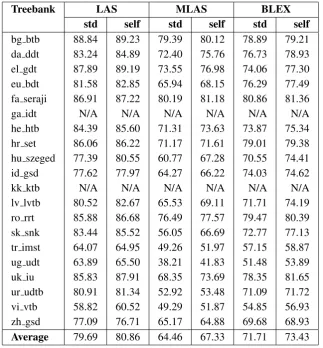
Comparing the results of the models estimated on training data with the results of the models estimated with the self-training method (see Ta-ble3), we notice that self-training significantly in-creases the performance of the system. There is an increase for all metrics for all treebanks except for ‘zh gsd’ (Chinese). On average there is an in-crease of 1.2 p.p. for LAS, 2.9 p.p. for MLAS and 1.7 p.p. for BLEX.
5 Conclusion
We described the ICS PAS system which took part in CoNLL 2018 shared task. Our goal was to build one system for preprocessing natural lan-guages, i.e. for part-of-speech tagging, lemmatisa-tion and dependency parsing. The three system’s modules – tagger, lemmatizer and parser – are jointly trained. The proposed neural system ranks 3th/4th in the official evaluation of the shared task. It is worth nothing that the system is especially useful for estimating the models on relative sparse data (small treebanks), as it overcame other sys-tems in terms of MLAS and BLEX. Furthermore, our system is especially appropriate for processing Indo-European fusional languages.
Treebank LAS MLAS BLEX std self std self std self
bg btb 88.84 89.23 79.39 80.12 78.89 79.21
da ddt 83.24 84.89 72.40 75.76 76.73 78.93
el gdt 87.89 89.19 73.55 76.98 74.06 77.30
eu bdt 81.58 82.85 65.94 68.15 76.29 77.49
fa seraji 86.91 87.22 80.19 81.18 80.86 81.36
ga idt N/A N/A N/A N/A N/A N/A
he htb 84.39 85.60 71.31 73.63 73.87 75.34
hr set 86.06 86.22 71.17 71.61 79.01 79.38
hu szeged 77.39 80.55 60.77 67.28 70.55 74.41
id gsd 77.62 77.97 64.27 66.22 74.03 74.62
kk ktb N/A N/A N/A N/A N/A N/A
lv lvtb 80.52 82.67 65.53 69.11 71.71 74.19
ro rrt 85.88 86.68 76.49 77.57 79.47 80.39
sk snk 83.44 85.52 56.05 66.69 72.77 77.13
tr imst 64.07 64.95 49.26 51.97 57.15 58.87
ug udt 63.89 65.50 38.21 41.83 51.48 53.89
uk iu 85.83 87.91 68.35 73.69 78.35 81.65
ur udtb 80.91 81.34 52.92 53.48 71.09 71.72
vi vtb 58.82 60.52 49.29 51.87 54.85 56.93
zh gsd 77.09 76.71 65.17 64.88 69.68 68.93
[image:8.595.138.462.61.410.2]Average 79.69 80.86 64.46 67.33 71.71 73.43
Table 3: Comparison of the standard (std) and self-training (self) models on the validation set using the gold-standard segmentation. Note that ‘kk ktb’ (Kazakh) and ‘ga idt’ (modern Irish) treebanks do not have validation sets, so we are unable to report any results.
Acknowledgements
The research presented in this paper was founded by SONATA 8 grant no 2014/15/D/HS2/03486 from the National Science Centre Poland and by the Polish Ministry of Science and Higher Educa-tion as part of the investment in the CLARIN-PL research infrastructure.
References
Sabine Buchholz and Erwin Marsi. 2006. CoNLL-X shared task on Multilingual Dependency Parsing. In
Proceedings of the Tenth Conference on Computa-tional Natural Language Learning. pages 149–164.
Yoeng Jin Chu and Tseng Hong Liu. 1965. On the Shortest Arborescence of a Directed Graph. Science Sinica14:1396–1400.
Jack Edmonds. 1967. Optimum Branchings. Jour-nal of Research of the NatioJour-nal Bureau of Standards
71B(4):233–240.
Edouard Grave, Piotr Bojanowski, Prakhar Gupta, Ar-mand Joulin, and Tomas Mikolov. 2018. Learning word vectors for 157 languages. In Proceedings of the International Conference on Language Re-sources and Evaluation (LREC 2018).
Alex Graves and J¨urgen Schmidhuber. 2005. Frame-wise Phoneme Classification with Bidirectional LSTM and Other Neural Network Architectures.
Neural Networks18(5):602–610.
Sepp Hochreiter and J¨urgen Schmidhuber. 1997. Long short-term memory. Neural Computation
9(8):1735–1780.
Diederik P. Kingma and Jimmy Ba. 2014. Adam:
A Method for Stochastic Optimization. CoRR
abs/1412.6980. http://arxiv.org/abs/1412.6980.
Vinod Nair and Geoffrey E. Hinton. 2010. Rectified Linear Units Improve Restricted Boltzmann Ma-chines. InProceedings of ICML’10, pages 807–814.
Mohammed Attia, Aitziber Atutxa, Liesbeth Augustinus, Elena Badmaeva, Miguel Balles-teros, Esha Banerjee, Sebastian Bank, Verginica Barbu Mititelu, John Bauer, Sandra Bellato, Kepa Bengoetxea, Riyaz Ahmad Bhat, Erica Biagetti, Eckhard Bick, Rogier Blokland, Victoria Bobicev, Carl B¨orstell, Cristina Bosco, Gosse Bouma, Sam Bowman, Adriane Boyd, Aljoscha Burchardt, Marie Candito, Bernard Caron, Gauthier Caron, G¨uls¸en Cebiro˘glu Eryi˘git, Giuseppe G. A. Celano, Savas Cetin, Fabricio Chalub, Jinho Choi, Yongseok Cho, Jayeol Chun, Silvie Cinkov´a, Aur´elie Collomb, C¸ a˘grı C¸ ¨oltekin, Miriam Connor, Marine Courtin, Elizabeth Davidson, Marie-Catherine de Marn-effe, Valeria de Paiva, Arantza Diaz de Ilarraza, Carly Dickerson, Peter Dirix, Kaja Dobrovoljc, Timothy Dozat, Kira Droganova, Puneet Dwivedi, Marhaba Eli, Ali Elkahky, Binyam Ephrem, Tomaˇz Erjavec, Aline Etienne, Rich´ard Farkas, Hector Fernandez Alcalde, Jennifer Foster, Cl´audia Freitas, Katar´ına Gajdoˇsov´a, Daniel Galbraith, Marcos Garcia, Moa G¨ardenfors, Kim Gerdes, Filip Gin-ter, Iakes Goenaga, Koldo Gojenola, Memduh G¨okırmak, Yoav Goldberg, Xavier G´omez Guino-vart, Berta Gonz´ales Saavedra, Matias Grioni, Normunds Gr¯uz¯itis, Bruno Guillaume, C´eline Guillot-Barbance, Nizar Habash, Jan Hajiˇc, Jan Hajiˇc jr., Linh H`a M˜y, Na-Rae Han, Kim Harris, Dag Haug, Barbora Hladk´a, Jaroslava Hlav´aˇcov´a, Florinel Hociung, Petter Hohle, Jena Hwang, Radu Ion, Elena Irimia, Tom´aˇs Jel´ınek, Anders Johannsen, Fredrik Jørgensen, H¨uner Kas¸ıkara, Sylvain Kahane, Hiroshi Kanayama, Jenna Kanerva, Tolga Kayade-len, V´aclava Kettnerov´a, Jesse Kirchner, Natalia Kotsyba, Simon Krek, Sookyoung Kwak, Veronika Laippala, Lorenzo Lambertino, Tatiana Lando, Septina Dian Larasati, Alexei Lavrentiev, John Lee, Phuong Lˆe Hˆong, Alessandro Lenci, Saran Lertpradit, Herman Leung, Cheuk Ying Li, Josie Li, Keying Li, KyungTae Lim, Nikola Ljubeˇsi´c, Olga Loginova, Olga Lyashevskaya, Teresa Lynn, Vivien Macketanz, Aibek Makazhanov, Michael Mandl, Christopher Manning, Ruli Manurung, C˘at˘alina M˘ar˘anduc, David Mareˇcek, Katrin Marheinecke, H´ector Mart´ınez Alonso, Andr´e Martins, Jan Maˇsek, Yuji Matsumoto, Ryan McDonald, Gustavo Mendonc¸a, Niko Miekka, Anna Missil¨a, C˘at˘alin Mititelu, Yusuke Miyao, Simonetta Montemagni, Amir More, Laura Moreno Romero, Shinsuke Mori, Bjartur Mortensen, Bohdan Moskalevskyi, Kadri Muischnek, Yugo Murawaki, Kaili M¨u¨urisep, Pinkey Nainwani, Juan Ignacio Navarro Hor˜niacek, Anna Nedoluzhko, Gunta Neˇspore-B¯erzkalne, Luong Nguyˆen Thi., Huyˆen Nguyˆen Thi. Minh, Vitaly Nikolaev, Rattima Nitisaroj, Hanna Nurmi, Stina Ojala, Ad´eday`o. Ol´u`okun, Mai Omura, Petya Osenova, Robert Ostling, Lilja Øvrelid,¨ Niko Partanen, Elena Pascual, Marco Passarotti, Agnieszka Patejuk, Siyao Peng, Cenel-Augusto Perez, Guy Perrier, Slav Petrov, Jussi Piitulainen, Emily Pitler, Barbara Plank, Thierry Poibeau, Martin Popel, Lauma Pretkalnin¸a, Sophie Pr´evost, Prokopis Prokopidis, Adam Przepi´orkowski, Tiina
Puolakainen, Sampo Pyysalo, Andriela R¨a¨abis, Alexandre Rademaker, Loganathan Ramasamy, Taraka Rama, Carlos Ramisch, Vinit Ravishankar, Livy Real, Siva Reddy, Georg Rehm, Michael Rießler, Larissa Rinaldi, Laura Rituma, Luisa Rocha, Mykhailo Romanenko, Rudolf Rosa, Da-vide Rovati, Valentin Ros,ca, Olga Rudina, Shoval Sadde, Shadi Saleh, Tanja Samardˇzi´c, Stephanie Samson, Manuela Sanguinetti, Baiba Saul¯ıte, Yanin Sawanakunanon, Nathan Schneider, Sebas-tian Schuster, Djam´e Seddah, Wolfgang Seeker, Mojgan Seraji, Mo Shen, Atsuko Shimada, Muh Shohibussirri, Dmitry Sichinava, Natalia Silveira, Maria Simi, Radu Simionescu, Katalin Simk´o, M´aria ˇSimkov´a, Kiril Simov, Aaron Smith, Is-abela Soares-Bastos, Antonio Stella, Milan Straka, Jana Strnadov´a, Alane Suhr, Umut Sulubacak, Zsolt Sz´ant´o, Dima Taji, Yuta Takahashi, Takaaki Tanaka, Isabelle Tellier, Trond Trosterud, Anna Trukhina, Reut Tsarfaty, Francis Tyers, Sumire Uematsu, Zdeˇnka Ureˇsov´a, Larraitz Uria, Hans Uszkoreit, Sowmya Vajjala, Daniel van Niekerk, Gertjan van Noord, Viktor Varga, Veronika Vincze, Lars Wallin, Jonathan North Washington, Seyi Williams, Mats Wir´en, Tsegay Woldemariam, Tak-sum Wong, Chunxiao Yan, Marat M. Yavrumyan, Zhuoran Yu, Zdenˇek ˇZabokrtsk´y, Amir Zeldes, Daniel Zeman, Manying Zhang, and Hanzhi Zhu. 2018. Universal Dependencies 2.2. LIN-DAT/CLARIN digital library at the Institute of Formal and Applied Linguistics ( ´UFAL), Faculty of Mathematics and Physics, Charles University.
http://hdl.handle.net/11234/1-2837.
Joakim Nivre, Marie-Catherine de Marneffe, Filip Ginter, Yoav Goldberg, Jan Hajiˇc, Christopher D. Manning, Ryan T. McDonald, Slav Petrov, Sampo Pyysalo, Natalia Silveira, Reut Tsarfaty, and Daniel Zeman. 2016. Universal Dependencies v1: A Mul-tilingual Treebank Collection. In Proceedings of the Tenth International Conference on Language Re-sources and Evaluation LREC 2016. pages 1659– 1666.
Joakim Nivre, Johan Hall, Sandra K¨ubler, Ryan Mc-Donald, Jens Nilsson, Sebastian Riedel, and Deniz Yuret. 2007. The CoNLL 2007 Shared Task on De-pendency Parsing. In Proceedings of the CoNLL Shared Task Session of EMNLP-CoNLL 2007. pages 915–932.
R. L. Norman. 1965. A matrix method
for location of cycles of a directed
graph. AIChE Journal 11(3):450–452.
https://doi.org/10.1002/aic.690110316.
Nitish Srivastava, Geoffrey Hinton, Alex Krizhevsky, Ilya Sutskever, and Ruslan Salakhutdinov. 2014. Dropout: A simple way to prevent
neural networks from overfitting. Journal of
Machine Learning Research 15:1929–1958.
http://jmlr.org/papers/v15/srivastava14a.html.
with UDPipe. InProceedings of the CoNLL 2017 Shared Task: Multilingual Parsing from Raw Text to Universal Dependencies. Association for Compu-tational Linguistics, Vancouver, Canada, pages 88–
99.
http://www.aclweb.org/anthology/K/K17/K17-3009.pdf.
Isaac Triguero, Salvador Garc´ıa, and Fran-cisco Herrera. 2015. Self-labeled
tech-niques for semi-supervised learning:
taxon-omy, software and empirical study.
Knowl-edge and Information Systems 42:245–284.
https://doi.org/https://doi.org/10.1007/s10115-013-0706-y.
Fisher Yu and Vladlen Koltun. 2016. Multi-Scale
Con-text Aggregation by Dilated Convolutions. CoRR
abs/1511.07122. http://arxiv.org/abs/1511.07122.
Daniel Zeman, Jan Hajiˇc, Martin Popel, Martin Pot-thast, Milan Straka, Filip Ginter, Joakim Nivre, and Slav Petrov. 2018. CoNLL 2018 Shared Task: Mul-tilingual Parsing from Raw Text to Universal De-pendencies. In Proceedings of the CoNLL 2018 Shared Task: Multilingual Parsing from Raw Text to Universal Dependencies. Association for Computa-tional Linguistics, Brussels, Belgium, pages 1–20.
Daniel Zeman, Martin Popel, Milan Straka, Jan Hajiˇc, Joakim Nivre, Filip Ginter, Juhani Luotolahti, Sampo Pyysalo, Slav Petrov, Martin Potthast, Fran-cis Tyers, Elena Badmaeva, Memduh G¨okırmak, Anna Nedoluzhko, Silvie Cinkov´a, Jan Hajiˇc jr., Jaroslava Hlav´aˇcov´a, V´aclava Kettnerov´a, Zdenka Ureˇsov´a, Jenna Kanerva, Stina Ojala, Anna Mis-sil¨a, Christopher D. Manning, Sebastian Schuster, Siva Reddy, Dima Taji, Nizar Habash, Herman Le-ung, Marie-Catherine de Marneffe, Manuela San-guinetti, Maria Simi, Hiroshi Kanayama, Valeria de-Paiva, Kira Droganova, H´ector Mart´ınez Alonso, C¸ a˘grı C¸ ¨oltekin, Umut Sulubacak, Hans Uszkor-eit, Vivien Macketanz, Aljoscha Burchardt, Kim Harris, Katrin Marheinecke, Georg Rehm, Tolga Kayadelen, Mohammed Attia, Ali Elkahky, Zhuo-ran Yu, Emily Pitler, SaZhuo-ran Lertpradit, Michael Mandl, Jesse Kirchner, Hector Fernandez Alcalde, Jana Strnadov´a, Esha Banerjee, Ruli Manurung, An-tonio Stella, Atsuko Shimada, Sookyoung Kwak, Gustavo Mendonc¸a, Tatiana Lando, Rattima Niti-saroj, and Josie Li. 2017. CoNLL 2017 Shared Task: Multilingual Parsing from Raw Text to
Uni-versal Dependencies. In Proceedings of the
CoNLL 2017 Shared Task: Multilingual Parsing from Raw Text to Universal Dependencies. As-sociation for Computational Linguistics, pages 1–
19.