349
EQUATE : A Benchmark Evaluation Framework for Quantitative
Reasoning in Natural Language Inference
Abhilasha Ravichander∗, Aakanksha Naik∗, Carolyn Rose,Eduard Hovy
Language Technologies Institute, Carnegie Mellon University {aravicha, anaik, cprose, hovy}@cs.cmu.edu
Abstract
Quantitative reasoning is a higher-order reaso-ning skill that any intelligent natural language understanding system can reasonably be ex-pected to handle. We presentEQUATE1 (Eva-luating Quantitative Understanding Aptitude in Textual Entailment), a new framework for quantitative reasoning in textual entailment. We benchmark the performance of 9 published NLI models onEQUATE, and find that on ave-rage, state-of-the-art methods do not achieve an absolute improvement over a majority-class baseline, suggesting that they do not implicitly learn to reason with quantities. We establish a new baseline Q-REASthat manipulates quan-tities symbolically. In comparison to the best performing NLI model, it achieves success on numerical reasoning tests (+24.2%), but has limited verbal reasoning capabilities (-8.1%). We hope our evaluation framework will sup-port the development of models of quantitative reasoning in language understanding.
1 Introduction
Numbers play a vital role in our lives. We re-ason with numbers in day-to-day tasks ranging from handling currency to reading news articles to understanding sports results, elections and stock markets. As numbers are used to communicate in-formation accurately, reasoning with them is an essential core competence in understanding natu-ral language (Levinson,2001;Frank et al.,2008;
Dehaene,2011). A benchmark task in natural lan-guage understanding is natural lanlan-guage inference (NLI)(or recognizing textual entailment (RTE)) (Cooper et al.,1996;Condoravdi et al.,2003;Bos and Markert,2005;Dagan et al.,2006), wherein a model determines if a natural language hypothesis
∗
*The first two authors contributed equally to this work.
1Code and data available athttps://github.com/
AbhilashaRavichander/EQUATE.
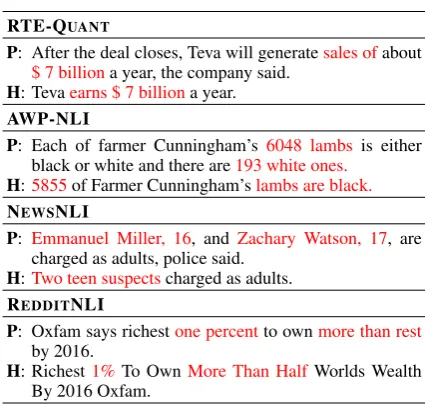
RTE-QUANT
P: After the deal closes, Teva will generatesales ofabout
$ 7 billiona year, the company said.
H: Tevaearns $ 7 billiona year.
AWP-NLI
P: Each of farmer Cunningham’s 6048 lambs is either black or white and there are193 white ones.
H:5855of Farmer Cunningham’slambs are black. NEWSNLI
P: Emmanuel Miller, 16, andZachary Watson, 17, are charged as adults, police said.
H:Two teen suspectscharged as adults.
REDDITNLI
P: Oxfam says richestone percentto ownmore than rest
by 2016.
[image:1.595.306.519.217.419.2]H: Richest1%To OwnMore Than HalfWorlds Wealth By 2016 Oxfam.
Table 1: Examples from evaluation sets in EQUATE
can be justifiably inferred from a given premise2. Making such inferences often necessitates reaso-ning about quantities.
Consider the following example from Table1,
P: With 99.6% of precincts counted , Dewhurst held 48% of the vote to 30% for Cruz .
H: Lt. Gov. David Dewhurst fails to get 50% of primary vote.
To conclude the hypothesis is inferable, a model must reason that since 99.6% precincts are coun-ted, even if all remaining precincts vote for De-whurst, he would fail to get 50% of the primary vote. Scant attention has been paid to building da-tasets to evaluate this reasoning ability. To address this gap, we present EQUATE (Evaluating Quanti-ty Understanding Aptitude in Textual Entailment) (§3), which consists of five evaluation sets, each
2Often, this is posed as a three-way decision where the
featuring different facets of quantitative reasoning in textual entailment (Table 1) (including verbal reasoning with quantities, basic arithmetic com-putation, dealing with approximations and range comparisons.).
We evaluate the ability of existing state-of-the-art NLI models to perform quantitative reasoning (§4.1), by benchmarking 9 published models on EQUATE. Our results show that most models are incapable of quantitative reasoning, instead rely-ing on lexical cues for prediction. Additionally, we build Q-REAS , a shallow semantic reasoning baseline for quantitative reasoning in NLI (§4.2). Q-REAS is effective on synthetic test sets which contain more quantity-based inference, but shows limited success on natural test sets which require deeper linguistic reasoning. However, the hardest cases require a complex interplay between lingui-stic and numerical reasoning. The EQUATE eva-luation framework makes it clear where this new challenge area for textual entailment stands.
2 Related Work
NLI has attracted community-wide interest as a stringent test for natural language understanding (Cooper et al., 1996; Fyodorov; Glickman et al.,
2005;Haghighi et al.,2005;Harabagiu and Hickl,
2006; Romano et al., 2006; Dagan et al., 2006;
Giampiccolo et al., 2007; Zanzotto et al., 2006;
Malakasiotis and Androutsopoulos, 2007; Mac-Cartney, 2009; de2; Dagan et al., 2010; Angeli and Manning,2014;Marelli et al.,2014). Recent-ly, the creation of large-scale datasets (Bowman et al.,2015;wil;Khot et al.,2018) spurred the de-velopment of many neural models (Parikh et al.,
2016;Nie and Bansal,2017;Conneau et al.,2017;
Balazs et al., 2017; Chen et al., 2017a; Radford et al.,2018;Devlin et al.,2018).
However, state-of-the-art models for NLI treat the task like a matching problem, which appears to work in many cases, but breaks down in others. As the field moves past current models of the mat-ching variety to ones that embody more of the reasoning we know is part of the task, we need benchmarks that will enable us to mark progress in the field. Prior work on challenge tasks has al-ready made headway in defining tasks for subpro-blems such as lexical inference with hypernymy, co-hyponymy, antonymy (Glockner et al., 2018;
Naik et al., 2018). In this work, we specifically probe into quantitative reasoning.
De Marneffe et al.(2008) find that in a corpus of real-life contradiction pairs collected from Wi-kipedia and Google News,29%contradictions ari-se from numeric discrepancies, and in the RTE-3 (Recognizing Textual Entailment) development set, numeric contradictions make up 8.8% of con-tradictory pairs.Naik et al.(2018) find that model inability to do numerical reasoning causes 4% of errors made by state-of-the-art models.Sammons et al. (2010); Clark (2018) argue for a systema-tic knowledge-oriented approach in NLI by eva-luating specific semantic analysis tasks, identify-ing quantitative reasonidentify-ing in particular as a focus area.Bentivogli et al.(2010) propose creating spe-cialized datasets, but feature only 6 examples with quantitative reasoning. Our work bridges this gap by providing a more comprehensive examination of quantitative reasoning in NLI.
While to the best of our knowledge, prior work has not studied quantitative reasoning in NLI,Roy
(2017) propose a model for a related subtask cal-ledquantity entailment, which aims to determine if a given quantity can be inferred from a sen-tence. In contrast, our work is concerned with general-purpose textual entailment which consi-ders if a givensentencecan be inferred from ano-ther. Our work also relates to solving arithme-tic word problems (Hosseini et al., 2014; Mitra and Baral, 2016; Zhou et al., 2015; Upadhyay et al., 2016;Huang et al., 2017; Kushman et al.,
2014a;Koncel-Kedziorski et al., 2015;roy;Roy,
2017; Ling et al., 2017a). A key difference is that word problems focus on arithmetic reasoning, while the requirement for linguistic reasoning and world knowledge is limited as the text is conci-se, straightforward, and self-contained (Hosseini et al., 2014; Kushman et al., 2014b). Our work provides a testbed that evaluates basic arithmetic reasoning while incorporating the complexity of natural language.
Ad-ditionally, through EQUATE we suggest the in-clusion of controlled synthetic tests in evaluation benchmarks. Controlled tests act as basic validati-on of model behaviour, isolating model ability to reason about a property of interest.
3 Quantitative Reasoning in NLI
Our interpretation of “quantitative reasoning” draws from cognitive testing and education ( Staf-ford,1972;Ekstrom et al.,1976), which considers it “verbal problem-solving ability”. While inextri-cably linked to mathematics, it is an inclusive skill involving everyday language rather than a specia-lized lexicon. To excel at quantitative reasoning, one must interpret quantities expressed in langua-ge, perform basic calculations, judge their accura-cy, and justify quantitative claims using verbal and numeric reasoning. These requirements show a re-ciprocity: NLI lends itself as a test bed for quan-titative reasoning, which conversely, is important for NLI (Sammons et al.,2010;Clark,2018). Mo-tivated by this, we present the EQUATE (Evalua-ting Quantity Understanding Aptitude in Textual Entailment) framework.
3.1 The EQUATE Dataset
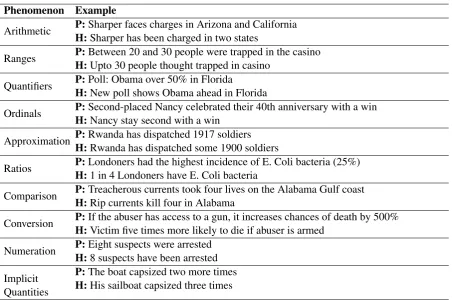
EQUATE consists of five NLI test sets featuring quantities. Three of these tests for quantitative re-asoning feature language from real-world sources such as news articles and social media (§3.2;§3.3; §3.4). We focus on sentences containing quantities with numerical values, and consider an entailment pair to feature quantitative reasoning if it is at least one component of the reasoning required to de-termine the entailment label (but not necessarily the only reasoning component). Quantitative rea-soning features quantity matching, quantity com-parison, quantity conversion, arithmetic, qualitati-ve processes, ordinality and quantifiers, quantity noun and adverb resolution3 as well as verbal re-asoning with the quantity’s textual context4. Ap-pendix B gives some examples for these quanti-tative phenomena. We further filter sentence pairs which require only temporal reasoning, since spe-cialized knowledge is needed to reason about time. These three test sets contain pairs which conflate multiple lexical and quantitative reasoning pheno-mena. In order to study aspects of quantitative
rea-3
Such as the quantities represented indozen,twice, teena-gers.
4For example,hObama cuts tax rate to 28%, Obama wants
to cut tax rate to 28% as part of overhauli.
soning in isolation, EQUATE further features two controlled synthetic tests (§3.5;§3.6).
3.2 RTE-Quant
This test set is constructed from the RTE sub-corpus for quantity entailment (Roy, 2017), ori-ginally drawn from the RTE2-RTE4 datasets ( Da-gan et al.,2006). The original sub-corpus conflates temporal and quantitative reasoning. We discarded pairs requiring temporal reasoning, obtaining a set of 166 entailment pairs.
3.3 NewsNLI
This test set is created from the CNN corpus ( Her-mann et al.,2015) of news articles with abstrac-tive summaries. We identify summary points with quantities, filtering out temporal expressions. For a summary point, the two most similar sentences5 from the article are chosen, flipping pairs whe-re the pwhe-remise begins with a first-person pronoun (eg:h“He had nine pears”, “Bob had nine pears”i becomes h“Bob had nine pears”, “He had nine pears”i). The top 50% of similar pairs are retai-ned to avoid lexical overlap bias. We crowdsource annotations for a subset of this data from Ama-zon Mechanical Turk. Crowdworkers6 are shown two sentences and asked to determine whether the second sentence is definitely true, definitely fal-se, or not inferable given the first. We collect 5 annotations per pair, and consider pairs with lo-west token overlap between premise and hypo-thesis and least difference in premise-hypohypo-thesis lengths when stratified by entailment label. Top 1000 samples meeting these criteria form our fi-nal set. To validate crowdsourced labels, experts are asked to annotate 100 pairs. Crowdsourced gold labels match expert gold labels in 85% cases, while individual crowdworker labels match expert gold labels in 75.8%. Disagreements are manual-ly resolved by experts and examples not featuring quantitiative reasoning are filtered, leaving a set of 968 samples.
3.4 RedditNLI
This test set is sourced from the popular soci-al forum \reddit7. Since reasoning about
quanti-5
According to Jaccard similarity.
6We require crowdworkers to have an approval rate of
95% on at least 100 tasks and pass a qualification test.
7According to the Reddit User Agreement, users grant
Source Test Set Size Classes Data Source Annotation Source
Quantitative Phenomena
RTE-Quant 166 2 RTE2-RTE4 Experts Arithmetic, Ranges,
Quan-tifiers
Natural NewsNLI 968 2 CNN Crowdworkers Ordinals, Quantifiers,
Arithmetic, Approximati-on, Magnitude, Ratios
RedditNLI 250 3 Reddit Experts Range, Arithmetic,
Appro-ximation, Verbal
Stress Test 7500 3 AQuA-RAT Automatic Quantifiers
Synthetic AwpNLI 722 2 Arithmetic Word
Problems
[image:4.595.76.526.62.185.2]Automatic Arithmetic
Table 2: An overview of test sets included in EQUATE. RedditNLI and Stress Test are framed as 3-class (entail-ment, neutral, contradiction) while RTE-Quant, NewsNLI and AwpNLI are 2-class (entails=yes/no). RTE 2-4 for-mulate entailment as a 2-way decision. We find that few news article headlines are contradictory, thus NewsNLI is similarly framed as a 2-way decision. For algebra word problems, substituting the wrong answer in the hypothesis necessarily creates a contradiction under the event coreference assumption (De Marneffe et al.,2008), thus it is framed as a 2-way decision as well.
ties is important in domains like finance or eco-nomics, we scrape all headlines from the posts on \r\economics, considering titles that contain quantities and do not have meta-forum informa-tion. Titles appearing within three days of each other are clustered by Jaccard similarity, and the top 300 pairs are extracted. After filtering out nonsensical titles, such as concatenated stock pri-ces, we are left with 250 sentence pairs. Similar to RTE, two expert annotators label these pairs, achieving a Cohen’s kappa of 0.82. Disagreements are discussed to resolve final labels.
3.5 Stress Test
We include the numerical reasoning stress test from (Naik et al., 2018) as a synthetic sanity check. The stress test consists of 7500 entail-ment pairs constructed from sentences in algebra word problems (Ling et al., 2017b). Focusing on quantifiers, it requires models to compare entities from hypothesis to the premise while incorpora-ting quantifiers, but does not require them to per-form the computation from the original algebra word problem (eg: h“NHAI employs 100 men to build a highway of 2 km in 50 days working 8 hours a day”,“NHAI employs less than 700 men to build a highway of 2 km in 50 days working 8 hours a day”i).
3.6 AwpNLI
To evaluate arithmetic ability of NLI models, we repurpose data from arithmetic word problems (roy). They have the following characteristic struc-ture. First, they establish a world and optional-ly update its state. Then, a question is posed
about the world. This structure forms the basis of our pair creation procedure. World building and update statements form the premise. A hy-pothesis template is generated by identifying mo-dal/auxiliary verbs in the question, and subsequent verbs, which we call secondary verbs. We iden-tify the agent and conjugate the secondary verb in present tense followed by the identified unit to form the final template (for example, the al-gebra word problem ‘Gary had 73.0 dollars. He spent 55.0 dollars on a pet snake. How many dol-lars did Gary have left?’ would generate the hy-pothesis template ‘Agent(Gary) Verb(Has) Ans-wer(18.0) Unit(dollars) left’). For every templa-te, the correct guess is used to create an entailed hypothesis. Contradictory hypotheses are created by randomly sampling a wrong guess (x ∈ Z+if correct guess is an integer, andx ∈ R+ if it is a real number)8. We check for grammaticality, fin-ding only 2% ungrammatical hypotheses, which are manually corrected leaving a set of 722 pairs.
4 Models
We describe the 9 NLI models9used in this study, as well as our new baseline. The interested reader is invited to refer to the corresponding publicati-ons for further details.
4.1 NLI Models
1)Majority Class (MAJ): Simple baseline that
always predicts the majority class in test set.
8From a uniform distribution over an interval of 10 around
the correct guess (or 5 for numbers less than 5), to identify plausible wrong guesses.
9Accuracy of all models on MultiNLI closely matches
Figure 1: Overview of Q-REAS baseline.
2) Hypothesis-Only (HYP): FastText classifier
(Mikolov et al.,2018) trained on only hypotheses (Gururangan et al.,2018).
3)ALIGN: A bag-of-words alignment model
in-spired byMacCartney(2009).10
4)CBOW: A simple bag-of-embeddings sentence
representation model (wil).
5)BiLSTM: The simple BiLSTM model
descri-bed bywil.
6) Chen (CH): Stacked BiLSTM-RNNs with
shortcut connections and character word embed-dings (Chen et al.,2017b).
7)InferSent: A single-layer BiLSTM-RNN
mo-del with max-pooling (Conneau et al.,2017).
8)SSEN: Stacked BiLSTM-RNNs with shortcut
connections (Nie and Bansal,2017).
9) ESIM: Sequential inference model proposed
byChen et al.(2017a) which uses BiLSTMs with an attention mechanism.
10) OpenAI GPT: Transformer-based language
model (Vaswani et al., 2017), with finetuning on NLI (Radford et al.,2018).
11) BERT: Transformer-based language model
(Vaswani et al.,2017), with a cloze-style and next-sentence prediction objective, and finetuning on NLI (Devlin et al.,2018).
4.2 Q-REAS Baseline System
Figure 1 describes the Q-REAS baseline for quantitative reasoning in NLI. The model manipu-lates quantity representations symbolically to ma-ke entailment decisions, and is intended to serve as a strong heuristic baseline for numerical reaso-ning on the EQUATE benchmark. This model has
10Model accuracy on RTE-3 test is 61.12%, comparable to
the reported average model performance in the RTE compe-tition of 62.4% .
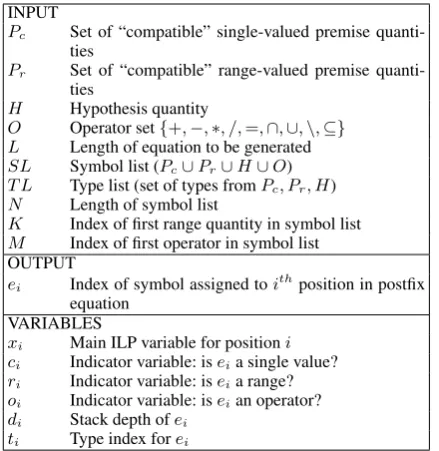
INPUT
Pc Set of “compatible” single-valued premise quanti-ties
Pr Set of “compatible” range-valued premise quanti-ties
H Hypothesis quantity
O Operator set{+,−,∗, /,=,∩,∪,\,⊆} L Length of equation to be generated
SL Symbol list (Pc∪Pr∪H∪O)
T L Type list (set of types fromPc, Pr, H)
N Length of symbol list
K Index of first range quantity in symbol list
M Index of first operator in symbol list OUTPUT
ei Index of symbol assigned toithposition in postfix equation
VARIABLES
xi Main ILP variable for positioni
ci Indicator variable: iseia single value?
ri Indicator variable: iseia range?
oi Indicator variable: iseian operator?
di Stack depth ofei
ti Type index forei
Table 3: Input, output and variable definitions for the Integer Linear Programming (ILP) framework used for quantity composition
four stages: Quantity mentions are extracted and parsed into semantic representations called NUM -SETS (§4.2.1, §4.2.2); compatible NUMSETS are extracted (§4.2.3) and composed (§4.2.4) to form justifications; Justifications are analyzed to deter-mine entailment labels (§4.2.5).
4.2.1 Quantity Segmenter
We followBarwise and Cooper(1981) in defining quantities as having a number, unit, and an optio-nal approximator. Quantity mentions are identified as least ancestor noun phrases from the constituen-cy parse of the sentence containing cardinal num-bers.
4.2.2 Quantity Parser
The quantity parser constructs a grounded repre-sentation for each quantity mention in the premise or hypothesis, henceforth known as a NUMSET11. A NUMSETis a tuple (val, unit, ent, adj, loc, verb, freq, flux)12with:
1. val ∈ [R,R]: quantity value represented as a range
2. unit∈S: unit noun associated with quantity 3. ent∈Sφ: entity noun associated with unit (e.g., donationsworth 100$)
11
A NUMSETmay be a composition of other NUMSETS.
12As in (Koncel-Kedziorski et al.,2015) S denotes all
pos-sible spans in the sentence,φrepresents the empty span, and
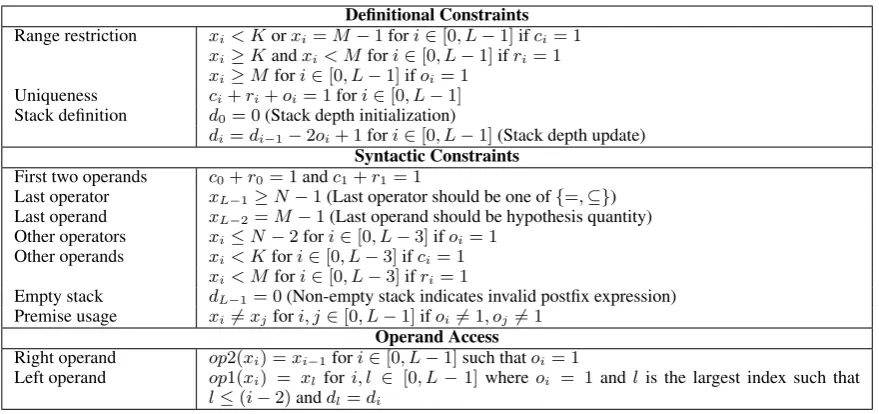
[image:5.595.77.288.66.219.2]Definitional Constraints
Range restriction xi< Korxi=M−1fori∈[0, L−1]ifci= 1
xi≥Kandxi< Mfori∈[0, L−1]ifri= 1
xi≥Mfori∈[0, L−1]ifoi= 1 Uniqueness ci+ri+oi= 1fori∈[0, L−1] Stack definition d0= 0(Stack depth initialization)
di=di−1−2oi+ 1fori∈[0, L−1](Stack depth update)
Syntactic Constraints
First two operands c0+r0= 1andc1+r1= 1
Last operator xL−1≥N−1(Last operator should be one of{=,⊆})
Last operand xL−2=M−1(Last operand should be hypothesis quantity)
Other operators xi≤N−2fori∈[0, L−3]ifoi= 1 Other operands xi< Kfori∈[0, L−3]ifci= 1
xi< Mfori∈[0, L−3]ifri= 1
Empty stack dL−1= 0(Non-empty stack indicates invalid postfix expression)
Premise usage xi6=xjfori, j∈[0, L−1]ifoi6= 1, oj6= 1
Operand Access
Right operand op2(xi) =xi−1fori∈[0, L−1]such thatoi= 1
Left operand op1(xi) = xl fori, l ∈ [0, L−1]whereoi = 1andl is the largest index such that
[image:6.595.80.520.60.267.2]l≤(i−2)anddl=di
Table 4: Mathematical validity constraint definitions for the ILP framework. Functionsop1()andop2()return the left and right operands for an operator respectively. Variables defined in table3.
Type Consistency Constraints
Type assignment ti=T L[k]fori∈[0, L−1]ifci+ri= 1andtype(SLi) =k
Two type match ti =ta =tbfori∈[0, L−1]such thatoi = 1, xi ∈ {+,−,∗, /,=,∩,∪,\,⊆}, a =
op1(xi), b=op2(xi)
One type match ti ∈ {ta, tb}, ta 6= tbfori ∈ [0, L−1]such thatoi = 1, xi = ∗, a = op1(xi), b =
op2(xi)
ti=ta6=tbfori∈[0, L−1]such thatoi= 1, xi=/, a=op1(xi), b=op2(xi)
Operator Consistency Constraints
Arithmetic operators ca=cb= 1fori∈[0, L−1]such thatoi = 1, xi∈ {+,−,∗, /,=}, a=op1(xi), b=
op2(xi)
Range operators ra=rb= 1fori∈[0, L−1]such thatoi= 1, xi∈ {∩,∪,\}, a=op1(xi), b=op2(xi)
rb= 1fori∈[0, L−1]such thatoi= 1, xi=⊆, b=op2(xi)
Table 5: Linguistic consistency constraint definitions for the ILP framework. Functionsop1()andop2()return the left and right operands for an operator respectively. Variables defined in table3.
4. adj ∈ Sφ: adjective associated with unit if any13,
5. loc⊆Sφ: location of unit (e.g.,’in the bag’)14 6. verb∈ Sφ: action verb associated with quanti-ty15.
7. freq⊆Sφ: if quantity recurs16(e.g, ’per hour’), 8. flux∈ {increase to, increase from, decrease to, decrease from}φ: if quantity is in a state of flux17.
To extractvaluesfor a quantity, we extract car-dinal numbers, recording contiguity. We norma-lize the number18. We also handle simple ratios
13
Extracted as governing verb linked to entity by anamod
relation.
14Extracted as prepositional phrase attached to the quantity
and containing noun phrase.
15
Extracted as governing verb linked to entity bydobjor
nsubjrelation.
16
extracted using keywordsperandevery
17
using gazetteer:increasing,rising,rose,decreasing, fal-ling,fell,drop
18(remove “,”s, convert written numbers to float, decide the
such as quarter, half etc, and extract bounds (eg: fewer than 10 apples is parsed to [−∞,10] app-les.)
To extract units, we examine tokens adjacent to cardinal numbers in the quantity mention and identify known units. If no known units are found, we assign the token in a numerical modifier re-lationship with the cardinal number, else we as-sign the nearest noun to the cardinal number as the unit. A quantity is determined to be approxi-mateif the word in anadverbial modifierrelation with the cardinal number appears in a gazetteer19. If approximate, range is extended to (+/-)2% of the
numerical value, for example hundred fifty eight thousand is 158000, two fifty eight is 258, 374m is 3740000 etc.). If cardinal numbers are non-adjacent, we look for an explicitly mentioned range such as ‘to’ and ‘between’.
19
[image:6.595.77.519.310.436.2]M D
RTE-Q ∆ NewsNLI ∆ RedditNLI∆ NR ST ∆ AWPNLI ∆ Nat.
Avg.∆
Synth. Avg.∆
All Avg.∆
MAJ 57.8 0.0 50.7 0.0 58.4 0.0 33.3 0.0 50.0 0.0 +0.0 +0.0 +0.0
HYP 49.4 -8.4 52.5 +1.8 40.8 -17.6 31.2 -2.1 50.1 +0.1 -8.1 -1.0 -5.2
ALIGN 62.1 +4.3 56.0 +5.3 34.8 -23.6 22.6 -10.7 47.2 -2.8 -4.7 -6.8 -5.5
CBOW 47.0 -10.8 61.8 +11.1 42.4 -16.0 30.2 -3.1 50.7 +0.7 -5.2 -1.2 -3.6
BiLSTM 51.2 -6.6 63.3 +12.6 50.8 -7.6 31.2 -2.1 50.7 +0.7 -0.5 -0.7 -0.6
CH 54.2 -3.6 64.0 +13.3 55.2 -3.2 30.3 -3.0 50.7 +0.7 +2.2 -1.2 +0.9
InferSent 66.3 +8.5 65.3 +14.6 29.6 -28.8 28.8 -4.5 50.7 +0.7 -1.9 -1.9 -1.9
SSEN 58.4 +0.6 65.1 +14.4 49.2 -9.2 28.4 -4.9 50.7 +0.7 +1.9 -2.1 +0.3
ESIM 54.8 -3.0 62.0 +11.3 45.6 -12.8 21.8 -11.5 50.1 +0.1 -1.5 -5.7 -3.2
GPT 68.1 +10.3 72.2 +21.5 52.4 -6.0 36.4 +3.1 50.0 +0.0 +8.6 +1.6 +5.8
BERT 57.2 -0.6 72.8 +22.1 49.6 -8.8 36.9 +3.6 42.2 -7.8 +4.2 -2.1 +1.7
Q-REAS 56.6 -1.2 61.1 +10.4 50.8 -7.6 63.3 +30 71.5 +21.5 +0.5 +25.8 +10.6
Table 6: Accuracies(%) of 9 NLI Models on five tests for quantitiative reasoning in entailment. M and D repre-sentmodelsanddatasetsrespectively.∆captures improvement over majority-class baseline for a dataset. Column Nat.Avg. reports the average accuracy(%) of each model across 3 evaluation sets constructed from natural sources (RTE-Quant, NewsNLI, RedditNLI), whereas Synth.Avg. reports the average accuracy(%) on 2 synthetic evalua-tion sets (Stress Test, AwpNLI). Column Avg. represents the average accuracy(%) of each model across all 5 evaluation sets inEQUATE.
current value.
4.2.3 Quantity Pruner
The pruner constructs “compatible” premise-hypothesis NUMSETpairs. Consider the pair “In-surgents killed7 U.S. soldiers, set off a car bomb that killed four Iraqi policemen” and “7 US sol-dierswere killed, andat least 10 Iraqisdied”. Our parser extracts NUMSETScorresponding to“four Iraqi policemen” and“7 US soldiers” from pre-mise and hypothesis respectively. But these NUM
-SETSshould not be compared as they involve dif-ferent units. The pruner discards such incompa-tible pairs. Heuristics to identify unit-compaincompa-tible NUMSETpairs include three cases- 1) direct string match, 2) synonymy/hypernymy relations from WordNet, 3) one unit is a nationality/ job20and the
other unit is synonymous with person (Roy,2017).
4.2.4 Quantity Composition
The composition module detects whether a hypo-thesis NUMSETis justified by composing “compa-tible” premise NUMSETS. For example, consider the pair “I had3 apples but gave oneto my bro-ther” and “I have two apples”. Here, the premise
NUMSETS P1 (“3 apples”) andP2 (“one apple”)
must be composed to deduce that the hypothesis
NUMSET H1 (“2 apples”) is justified. Our
fra-mework accomplishes this by generating postfix arithmetic equations21 from premise NUMSETS ,
20
Lists of jobs, nationalities scraped from Wikipedia.
21Note that arithmetic equations differ from algebraic
equations in that they donotcontain unknown variables
that justify the hypothesis NUMSET22. In this ex-ample, the expression < P1, P2,−, H1,=> will be generated.
The set of possible equations is exponential in number of NUMSETS, making exhaustive genera-tion intractable. But a large number of equagenera-tions are invalid as they violate constraints such as unit consistency. Thus, our framework uses integer li-near programming (ILP) to constrain the equation space. It is inspired by prior work on algebra word problems (Koncel-Kedziorski et al., 2015), with some key differences:
1. Arithmetic equations:We focus on arithmetic
equations instead of algebraic ones.
2. Range arithmetic: Quantitative reasoning
in-volves ranges, which are handled by representing then as endpoint-inclusive intervals and adding the four operators (∪,∩,\,⊆)
3. Hypothesis quantity-driven: We optimize an
ILP model for each hypothesis NUMSETbecause a sentence pair is marked “entailment” iff every hypothesis quantity is justified.
Table3describes ILP variables. We impose the following types of constraints:
1. Definitional Constraints: Ensure that ILP
variables take on valid values by constraining initialization, range, and update.
2. Syntactic Constraints: Assure syntactic
vali-dity of generated postfix expressions by limiting
22Direct comparisons are incorporated by adding “=” as an
operator-operand ordering.
3. Operand Access: Simulate stack-based
evaluation correctly by choosing correct operator-operand assignments.
4. Type Consistency: Ensure that all operations
are type-compatible.
5. Operator Consistency: Force range operators
to have range operands and mathematical opera-tors to have single-valued operands.
Definitional, syntactic, and operand access constraints ensure mathematical validity while ty-pe and oty-perator consistency constraints add lingui-stic consistency. Constraint formulations are pro-vided in Tables4 and5. We limit tree depth to 3 and retrieve a maximum of 50 solutions per hypo-thesis NUMSET, then solve to determine whether the equation is mathematically correct. We discard equations that use invalid operations (division by 0) or add unnecessary complexity (multiplication/ division by 1). The remaining equations are consi-dered plausible justifications .
4.2.5 Global Reasoner
The global reasoner predicts the final entailment label as shown in Algorithm 123, on the assumpti-on that every NUMSETin the hypothesishasto be justified24for entailment.
5 Results and Discussion
Table6presents results on EQUATE. All models, except REAS are trained on MultiNLI. Q-REAS utilizes WordNet and lists from Wikipedia. We observe that neural models, particularly OpenAI GPT excel at verbal aspects of quantita-tive reasoning (RTE-Quant, NewsNLI), whereas Q-REAS excels at numerical aspects (Stress Test, AwpNLI).
5.1 Neural Models on NewsNLI:
To tease apart contributory effects of numerical and verbal reasoning in natural data, we expe-riment with NewsNLI. We extract all entailed pairs where a quantity appears in both premise
23MaxSimilarityClass() takes two quantities and returns a
probability distribution over entailment labels based on unit match. Similarly, ValueMatch() detects whether two quanti-ties match in value (this function can also handle ranges).
24This is a necessary but not sufficient condition for
entail-ment. Consider the example,h‘Sam believed Joan had 5 app-les’, ‘Joan had 5 apples’i. The hypothesis quantities of 5 app-les is justified but is not a sufficient condition for entailment.
Algorithm 1PredictEntailmentLabel(P, H, C, E)
Input: Premise quantitiesP, Hypothesis
quanti-tiesH, Compatible pairsC, EquationsE
Output: Entailment labell∈ {e, c, n}
1: ifC=∅then returnn
2: J ← ∅
3: L←[]
4: forqh∈Hdo
5: Jh ← {qp |qp ∈P,(qp, qh)∈C} 6: J ←J ∪ {(qh, Jh)}
7: L←L+ [f alse]
8: for(qh, Jh)∈J do
9: ifJh =∅then returnn
10: forqp ∈Jh do
11: s←MaxSimilarityClass(qp, qh)
12: ifs=ethen
13: ifValueMatch(qp, qh)then
14: L[qh] =true
15: if!ValueMatch(qp, qh)then
16: L[qh] =f alse
17: ifs=cthen
18: ifValueMatch(qp, qh)then
19: L[qh] =c
20: forqh∈Hdo
21: Eq ← {ei ∈E|hyp(ei) =qh}
22: ifEq 6=∅then
23: L[qh] =true
24: ifc∈Lthen returnc
25: ifcount(L, true) = len(L)then returne
26: returnn
and hypothesis, and perturb the quantity in the hypothesis generating contradictory pairs. For example, the pair h‘In addition to 79 fatalities , some 170 passengers were injured.’i ‘The crash took the lives of 79 people and injured some 170’, ‘entailment’ is changed to h‘In addition to 79 fatalities , some 170 passengers were injured.’, ‘The crash took the lives of 80 people and injured some 170’, ‘contradiction’i, assuming scalar implicature and event coreference. Our perturbed test set contains 218 pairs. On this set, GPT25 achieves an accuracy of 51.18%, as compared to 72.04% on the unperturbed set, suggesting the model relies on verbal cues rather than numerical reasoning. In comparison, Q-REAS achieves an accuracy of 98.1% on the perturbed set, compared to 75.36% on the unperturbed set, highlighting
reliance on quantities rather than verbal infor-mation. Closer examination reveals that OpenAI switches to predicting the ‘neutral’ category for perturbed samples instead of entailment, accoun-ting for 42.7% of its errors, possibly symptomatic of lexical bias issues (Naik et al.,2018).
5.2 What Quantitative Phenomena Are
Hard?
We sample 100 errors made by Q-REAS on each test in EQUATE, to identify phenomena not addressed by simple quantity comparison. Our analysis of causes for error suggest avenues for future research:
1. Multi-step numerical-verbal reasoning:
Models do not perform well on examples requiring interleaved verbal and quantitative reasoning, especially multi-step deduction. Con-sider the pair h“Two people were injured in the attack”, “Two people perpetrated the attack”i. Quantities “two people” and “two people” are unit-compatible, but must not be compared. Another example is the NewsNLI entailment pair in Table 1. This pair requires us to identify that 16 and 17 refer to Emmanuel and Zachary’s ages (quantitative), deduce that this implies they are teenagers (verbal) and finally count them (quantitative) to get the hypothesis quantity “two teens”. Numbers and language are intricately interleaved and developing a reasoner capable of handling such complex interplay is challenging.
2. Lexical inference: Lack of real world
know-ledge causes errors in identifying quantities and valid comparisons. Errors include mapping abbreviations to correct units (“m” to “meters”), detecting part-whole coreference (“seats” can be used to refer to “buses”), and resolving hyperny-my/hyponymy (“young men” to “boys”).
3.Inferring underspecified quantities:Quantity
attributes can be implicitly specified, requiring inference to generate a complete representation. Consider “A mortar attack killed four people and injured 80”. A system must infer that the quantity “80” refers to people. On RTE-Quant, 20% of such cases stem from zero anaphora, a hard problem in coreference resolution.
4.Arithmetic comparison limitations:These
ex-amples require composition between incompatible quantities. For example, considerh“There were 3 birds and 6 nests”, “There were 3 more nests than birds”i. To correctly label this pair “3 birds” and “6 nests” must be composed.
6 Conclusion
In this work, we present EQUATE, an evaluation framework to estimate the ability of models to re-ason quantitatively in textual entailment. We ob-serve that existing neural approaches rely heavily on the lexical matching aspect of the task to suc-ceed rather than reasoning about quantities. We implement a strong symbolic baseline Q-REAS that achieves success at numerical reasoning, but lacks sophisticated verbal reasoning capabilities. The EQUATE resource presents an opportuni-ty for the communiopportuni-ty to develop powerful hy-brid neuro-symbolic architectures, combining the strengths of neural models with specialized rea-soners such as Q-REAS . We hope our insights lead to the development of models that can more precisely reason about the important, frequent, but understudied, phenomena of quantities in natural language.
Acknowledgments
References
Gabor Angeli and Christopher D Manning. 2014. Na-turalli: Natural logic inference for common sense re-asoning. InProceedings of the 2014 conference on empirical methods in natural language processing (EMNLP), pages 534–545.
Jorge Balazs, Edison Marrese-Taylor, Pablo Loyola, and Yutaka Matsuo. 2017.Refining raw sentence re-presentations for textual entailment recognition via attention. InProceedings of the 2nd Workshop on Evaluating Vector Space Representations for NLP, pages 51–55, Copenhagen, Denmark. Association for Computational Linguistics.
Jon Barwise and Robin Cooper. 1981. Generalized quantifiers and natural language. In Philosophy, Language, and Artificial Intelligence, pages 241– 301. Springer.
Luisa Bentivogli, Elena Cabrio, Ido Dagan, Danilo Giampiccolo, Medea Lo Leggio, and Bernardo Ma-gnini. 2010. Building textual entailment specialized data sets: a methodology for isolating linguistic phe-nomena relevant to inference. InProceedings of the Seventh conference on International Language Re-sources and Evaluation (LREC’10), Valletta, Mal-ta. European Languages Resources Association (EL-RA).
Johan Bos and Katja Markert. 2005. Recognising tex-tual entailment with logical inference. In Procee-dings of the conference on Human Language Tech-nology and Empirical Methods in Natural Language Processing, pages 628–635. Association for Compu-tational Linguistics.
Samuel R. Bowman, Gabor Angeli, Christopher Potts, and Christopher D. Manning. 2015. A large anno-tated corpus for learning natural language inference. In Proceedings of the 2015 Conference on Empiri-cal Methods in Natural Language Processing, pages 632–642, Lisbon, Portugal. Association for Compu-tational Linguistics.
Qian Chen, Xiaodan Zhu, Zhen-Hua Ling, Si Wei, Hui Jiang, and Diana Inkpen. 2017a. Enhanced lstm for natural language inference. InProceedings of the 55th Annual Meeting of the Association for Com-putational Linguistics (Volume 1: Long Papers), pa-ges 1657–1668, Vancouver, Canada. Association for Computational Linguistics.
Qian Chen, Xiaodan Zhu, Zhen-Hua Ling, Si Wei, Hui Jiang, and Diana Inkpen. 2017b. Recurrent neural network-based sentence encoder with gated attenti-on for natural language inference. InProceedings of the 2nd Workshop on Evaluating Vector Space
Representations for NLP, pages 36–40, Copenha-gen, Denmark. Association for Computational Lin-guistics.
Peter Clark. 2018. What knowledge is needed to solve the rte5 textual entailment challenge? arXiv preprint arXiv:1806.03561.
Cleo Condoravdi, Dick Crouch, Valeria De Paiva, Reinhard Stolle, and Daniel G Bobrow. 2003. Entailment, intensionality and text understanding. In Proceedings of the HLT-NAACL 2003 workshop on Text meaning-Volume 9, pages 38–45. Associati-on for ComputatiAssociati-onal Linguistics.
Alexis Conneau, Douwe Kiela, Holger Schwenk, Lo¨ıc Barrault, and Antoine Bordes. 2017. Supervised learning of universal sentence representations from natural language inference data. InProceedings of the 2017 Conference on Empirical Methods in Natu-ral Language Processing, pages 670–680, Copenha-gen, Denmark. Association for Computational Lin-guistics.
Robin Cooper, Dick Crouch, Jan Van Eijck, Chris Fox, Johan Van Genabith, Jan Jaspars, Hans Kamp, Da-vid Milward, Manfred Pinkal, Massimo Poesio, et al. 1996. Using the framework. Technical report.
Ido Dagan, Bill Dolan, Bernardo Magnini, and Dan Roth. 2010. The fourth pascal recognizing textual entailment challenge. Journal of Natural Language Engineering.
Ido Dagan, Oren Glickman, and Bernardo Magnini. 2006. The pascal recognising textual entailment challenge. InMachine learning challenges. evalua-ting predictive uncertainty, visual object classificati-on, and recognising tectual entailment, pages 177– 190. Springer.
Marie-Catherine De Marneffe, Anna N. Rafferty, and Christopher D. Manning. 2008.Finding contradicti-ons in text. InProceedings of ACL-08: HLT, pages 1039–1047, Columbus, Ohio. Association for Com-putational Linguistics.
Stanislas Dehaene. 2011. The number sense: How the mind creates mathematics. OUP USA.
Jacob Devlin, Ming-Wei Chang, Kenton Lee, and Kris-tina Toutanova. 2018. Bert: Pre-training of deep bi-directional transformers for language understanding.
arXiv preprint arXiv:1810.04805.
Dheeru Dua, Yizhong Wang, Pradeep Dasigi, Gabriel Stanovsky, Sameer Singh, and Matt Gardner. 2019. Drop: A reading comprehension benchmark requi-ring discrete reasoning over paragraphs. CoRR, abs/1903.00161.
Michael C Frank, Daniel L Everett, Evelina Fedoren-ko, and Edward Gibson. 2008. Number as a cogni-tive technology: Evidence from pirah˜a language and cognition. Cognition, 108(3):819–824.
Yaroslav Fyodorov. A natural logic inference system. Citeseer.
Danilo Giampiccolo, Bernardo Magnini, Ido Dagan, and Bill Dolan. 2007. The third pascal recognizing textual entailment challenge. InProceedings of the ACL-PASCAL workshop on textual entailment and paraphrasing, pages 1–9. Association for Computa-tional Linguistics.
Oren Glickman, Ido Dagan, and Moshe Koppel. 2005. Web based probabilistic textual entailment.
Max Glockner, Vered Shwartz, and Yoav Goldberg. 2018. Breaking nli systems with sentences that re-quire simple lexical inferences. InProceedings of the 56th Annual Meeting of the Association for Com-putational Linguistics (Volume 2: Short Papers), pa-ges 650–655, Melbourne, Australia. Association for Computational Linguistics.
Suchin Gururangan, Swabha Swayamdipta, Omer Le-vy, Roy Schwartz, Samuel R Bowman, and Noah A Smith. 2018. Annotation artifacts in natural langua-ge inference data. arXiv preprint arXiv:1803.02324.
Aria Haghighi, Andrew Ng, and Christopher Man-ning. 2005. Robust textual inference via graph mat-ching. InProceedings of Human Language Techno-logy Conference and Conference on Empirical Me-thods in Natural Language Processing.
Sanda Harabagiu and Andrew Hickl. 2006. Methods for using textual entailment in open-domain ques-tion answering. InProceedings of the 21st Interna-tional Conference on ComputaInterna-tional Linguistics and the 44th annual meeting of the Association for Com-putational Linguistics, pages 905–912. Association for Computational Linguistics.
Karl Moritz Hermann, Tomas Kocisky, Edward Gre-fenstette, Lasse Espeholt, Will Kay, Mustafa Suley-man, and Phil Blunsom. 2015. Teaching machines to read and comprehend. InAdvances in Neural In-formation Processing Systems, pages 1693–1701.
Mohammad Javad Hosseini, Hannaneh Hajishirzi, Oren Etzioni, and Nate Kushman. 2014. Learning to solve arithmetic word problems with verb catego-rization. InProceedings of the 2014 Conference on Empirical Methods in Natural Language Processing (EMNLP), pages 523–533.
Danqing Huang, Shuming Shi, Chin-Yew Lin, and Ji-an Yin. 2017. Learning fine-grained expressions to solve math word problems. In Proceedings of the 2017 Conference on Empirical Methods in Natural Language Processing, pages 805–814.
Tushar Khot, Ashish Sabharwal, and Peter Clark. 2018. Scitail: A textual entailment dataset from science question answering.
Rik Koncel-Kedziorski, Hannaneh Hajishirzi, Ashish Sabharwal, Oren Etzioni, and Siena Dumas Ang. 2015. Parsing algebraic word problems into equa-tions. Transactions of the Association for Computa-tional Linguistics, 3:585–597.
Nate Kushman, Yoav Artzi, Luke Zettlemoyer, and Re-gina Barzilay. 2014a. Learning to automatically sol-ve algebra word problems. In Proceedings of the 52nd Annual Meeting of the Association for Compu-tational Linguistics (Volume 1: Long Papers), volu-me 1, pages 271–281.
Nate Kushman, Luke S. Zettlemoyer, Regina Barzilay, and Yoav Artzi. 2014b. Learning to automatically solve algebra word problems. InACL.
Stephen C Levinson. 2001. Pragmatics. In Inter-national Encyclopedia of Social and Behavioral Sciences: Vol. 17, pages 11948–11954. Pergamon.
Wang Ling, Dani Yogatama, Chris Dyer, and Phil Blun-som. 2017a. Program induction by rationale genera-tion: Learning to solve and explain algebraic word problems. arXiv preprint arXiv:1705.04146.
Wang Ling, Dani Yogatama, Chris Dyer, and Phil Blun-som. 2017b. Program induction by rationale gene-ration: Learning to solve and explain algebraic word problems. InProceedings of the 55th Annual Mee-ting of the Association for Computational Lingui-stics (Volume 1: Long Papers), pages 158–167, Van-couver, Canada. Association for Computational Lin-guistics.
Bill MacCartney. 2009. Natural language inference. Stanford University.
Prodromos Malakasiotis and Ion Androutsopoulos. 2007. Learning textual entailment using svms and string similarity measures. In Proceedings of the ACL-PASCAL Workshop on Textual Entailment and Paraphrasing, pages 42–47. Association for Com-putational Linguistics.
Marco Marelli, Stefano Menini, Marco Baroni, Luisa Bentivogli, Raffaella Bernardi, Roberto Zamparelli, et al. 2014. A sick cure for the evaluation of compo-sitional distributional semantic models.
Tomas Mikolov, Edouard Grave, Piotr Bojanowski, Christian Puhrsch, and Armand Joulin. 2018. Ad-vances in pre-training distributed word representa-tions. In Proceedings of the International Con-ference on Language Resources and Evaluation (LREC 2018).
Arindam Mitra and Chitta Baral. 2016. Learning to use formulas to solve simple arithmetic problems. In Proceedings of the 54th Annual Meeting of the Association for Computational Linguistics (Volume 1: Long Papers), volume 1, pages 2144–2153.
InProceedings of the 27th International Conference on Computational Linguistics, pages 2340–2353, Santa Fe, New Mexico, USA. Association for Com-putational Linguistics.
Yixin Nie and Mohit Bansal. 2017. Shortcut-stacked sentence encoders for multi-domain inference. In
Proceedings of the 2nd Workshop on Evaluating Vector Space Representations for NLP, pages 41– 45, Copenhagen, Denmark. Association for Compu-tational Linguistics.
Ankur P Parikh, Oscar T¨ackstr¨om, Dipanjan Das, and Jakob Uszkoreit. 2016. A decomposable attention model for natural language inference. arXiv preprint arXiv:1606.01933.
Alec Radford, Karthik Narasimhan, Tim Salimans, and Ilya Sutskever. 2018. Improving language under-standing by generative pre-training.
Lorenza Romano, Milen Kouylekov, Idan Szpektor, Ido Dagan, and Alberto Lavelli. 2006. Investigating a generic paraphrase-based approach for relation ex-traction.
Subhro Roy. 2017. Reasoning about quantities in na-tural language. Ph.D. thesis, University of Illinois at Urbana-Champaign.
Mark Sammons, VG Vydiswaran, and Dan Roth. 2010. Ask not what textual entailment can do for you... In
Proceedings of the 48th Annual Meeting of the Asso-ciation for Computational Linguistics, pages 1199– 1208. Association for Computational Linguistics.
Richard E Stafford. 1972. Hereditary and environmen-tal components of quantitative reasoning. Review of Educational Research, 42(2):183–201.
Shyam Upadhyay, Ming-Wei Chang, Kai-Wei Chang, and Wen-tau Yih. 2016. Learning from explicit and implicit supervision jointly for algebra word pro-blems. In Proceedings of the 2016 Conference on Empirical Methods in Natural Language Proces-sing, pages 297–306.
Ashish Vaswani, Noam Shazeer, Niki Parmar, Jakob Uszkoreit, Llion Jones, Aidan N Gomez, Lukasz Kaiser, and Illia Polosukhin. 2017. Attention is all you need. arXiv preprint arXiv:1706.03762.
F Zanzotto, Alessandro Moschitti, Marco Pennacchiot-ti, and M Pazienza. 2006. Learning textual entail-ment from examples. InSecond PASCAL recogni-zing textual entailment challenge, page 50. PAS-CAL.
Lipu Zhou, Shuaixiang Dai, and Liwei Chen. 2015. Learn to solve algebra word problems using quadra-tic programming. InProceedings of the 2015 Con-ference on Empirical Methods in Natural Language Processing, pages 817–822.
Appendix
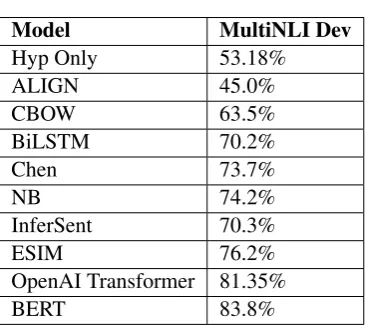
A Baseline performance on MultiNLI-Dev Matched
Model MultiNLI Dev
Hyp Only 53.18%
ALIGN 45.0%
CBOW 63.5%
BiLSTM 70.2%
Chen 73.7%
NB 74.2%
InferSent 70.3%
ESIM 76.2%
OpenAI Transformer 81.35%
[image:12.595.308.492.120.283.2]BERT 83.8%
Table 7: Performance of all baseline models used in the paper on the matched subset of MultiNLI-Dev
Table7presents classification accuracies of all baseline models used in this work on the matched subset of MultiNLI-Dev. These scores are very close to the numbers reported by the original pu-blications, affirming the correctness of our baseli-ne setup.
B Examples of quantitative phenomena present in EQUATE
Phenomenon Example
Arithmetic P:Sharper faces charges in Arizona and California
H:Sharper has been charged in two states
Ranges P:Between 20 and 30 people were trapped in the casino
H:Upto 30 people thought trapped in casino
Quantifiers P:Poll: Obama over 50% in Florida
H:New poll shows Obama ahead in Florida
Ordinals P:Second-placed Nancy celebrated their 40th anniversary with a win
H:Nancy stay second with a win
Approximation P:Rwanda has dispatched 1917 soldiers
H:Rwanda has dispatched some 1900 soldiers
Ratios P:Londoners had the highest incidence of E. Coli bacteria (25%)
H:1 in 4 Londoners have E. Coli bacteria
Comparison P:Treacherous currents took four lives on the Alabama Gulf coast
H:Rip currents kill four in Alabama
Conversion P:If the abuser has access to a gun, it increases chances of death by 500%
H:Victim five times more likely to die if abuser is armed
Numeration P:Eight suspects were arrested
H:8 suspects have been arrested
Implicit Quantities
P:The boat capsized two more times
[image:13.595.75.528.250.550.2]H:His sailboat capsized three times