1
Embedded-State Latent Conditional Random Fields
for Sequence Labeling
Dung Thai Sree Harsha Ramesh Shikhar Murty Luke Vilnis Andrew McCallum College of Information and Computer Sciences
University of Massachusetts Amherst
{dthai, shramesh, smurty, luke, mccallum}@cs.umass.edu
Abstract
Complex textual information extraction tasks are often posed as sequence labeling or shal-low parsing, where fields are extracted using local labels made consistent through proba-bilistic inference in a graphical model with constrained transitions. Recently, it has be-come common to locally parametrize these models using rich features extracted by recur-rent neural networks (such as LSTM), while enforcing consistent outputs through a sim-ple linear-chain model, representing Marko-vian dependencies between successive labels. However, the simple graphical model struc-ture belies the often complex non-local con-straints between output labels. For example, many fields, such as a first name, can only oc-cur a fixed number of times, or in the pres-ence of other fields. While RNNs have pro-vided increasingly powerful context-aware lo-cal features for sequence tagging, they have yet to be integrated with a global graphical model of similar expressivity in the output dis-tribution. Our model goes beyond the lin-ear chain CRF to incorporate multiple hidden states per output label, but parametrizes their transitions parsimoniously with low-rank log-potential scoring matrices, effectively learning an embedding space for hidden states. This augmented latent space of inference variables complements the rich feature representation of the RNN, and allows exact global infer-ence obeying complex, learned non-local out-put constraints. We experiment with several datasets and show that the model outperforms baseline CRF+RNN models when global out-put constraints are necessary at inference-time, and explore the interpretable latent structure. 1 Introduction
As with many other prediction tasks involving complex structured outputs, such as image seg-mentation (Chen et al., 2018), machine
transla-tion (Bahdanau et al.,2015), and speech recogni-tion (Hinton et al., 2012), deep neural networks (DNNs) for sequence labeling and shallow pars-ing have become standard tools for for information extraction (Collobert et al., 2011; Lample et al.,
2016). In the language of structured prediction, DNNs process the input sequence to produce a richlocalparametrization for the output prediction model. However, output variables obey a variety of hard and soft constraints — for example, in se-quence tagging tasks such as named entity recog-nition, I-PER cannot follow B-ORG.
Interestingly, even with such powerful local fea-turization, the DNN model does not automatically capture a mode of the output distribution through local decisions alone, and can violate these con-straints. Successful applications of DNNs to se-quence tagging gain from incorporating a sim-ple linear chain probabilistic graphical model to enforce consistent output predictions (Collobert et al.,2011;Lample et al., 2016), and more gerally the addition of a graphical model to en-force output label consistency is common practice for other tasks such as image segmentation (Chen et al.,2018).
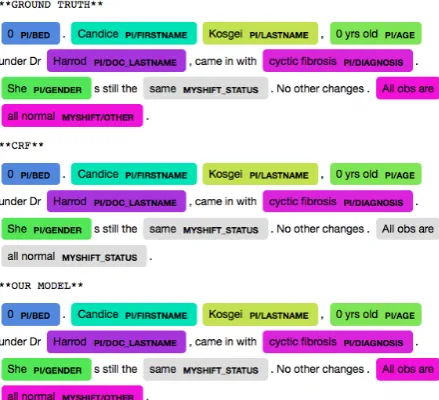
Figure 1: An example result from the CLEF eHealth dataset. The soft output constraint sug-gests tagging patient status as Myshift/Others if there already is aMyshift Statustag. Note that we have the same phrase tagged as Myshift Statusin the training dataset.
constraints on the overall prediction, without sac-rificing efficient exact inference.
While soft and hard global constraints have a rich history in sequence tagging (Koo et al.,2010;
Rush and Collins, 2012; Anzaroot et al., 2014), they have been underexplored in the context of neural-network based feature extraction models. In response, we present a latent-variable CRF model with a novel mechanism for learning la-tent constraints without overfitting, using low-rank embeddings of large-cardinality latent variables. For example, these non-local constraints appear in fine-grained nested field extraction, which re-quires hierarchical consistency between the sub-tags of an entity. Further, information extraction and slot filling tasks often require domain specific constraints — for example, we must avoid extract-ing the same field multiple times. A good combi-nation of input featurization and output modeling is needed to capture these structural dependencies. In this work we present a method for sequence labeling in which representation learning is ap-plied not only to inputs, but also to output space, in the form of a lightly parameterized transition function between a large number of latent states. We introduce a hidden state variable and learn the model dynamics in the hidden state space rather than the label state space. This relaxes the Markov
assumption between output labels and allows the model to learn global constraints. To avoid the quadratic blowup in parameters with the size of the latent state space, we factorize the transition log-potentials into a low-rank matrix, avoiding over-fitting by effectively learning parsimonious em-bedded representations of the latent states. While the low rank log-potential matrix does not im-prove test-time inference speed, we can perform exact Viterbi inference to compute the labeling se-quence. Figure 1 shows an example where our model finds the correct labeling sequence while a standard DNN+CRF model fails, by obeying a global constraint learned from the training data.
We examine the performance of the Embedded-State Latent CRF on two datasets: citation ex-traction on the UMass Citations dataset and med-ical record field extraction on the CLEF dataset. We observe improved performance in both tasks, whose outputs obey complex structural dependen-cies that are not able to be captured by RNN fea-turization. Our biggest improvement comes in the medical domain, where the small training set gives our parsimonious approach to output representa-tion learning an extra advantage.
2 Proposed Model
2.1 Problem Formulation
We consider the sequence labeling task, defined as follows. Given an input text sequence withT to-kens x = {x1, x2, ..., xT}, find a corresponding output sequencey = {y1, y2, ..., yT}where each output symbol yi is one of N possible output la-bels. There are structural dependencies between the output labels, and resolving such dependencies is necessary for good performance.
2.2 Background
The input featurization in our model is similar to previously mentioned existing methods for tag-ging with DNNs (Collobert et al.,2011). We rep-resent each input token xt with a word embed-ding wt. We then feed the embedded sequence
w ={w1, w2, ..., wT}into a bidirectional LSTM (Graves and Schmidhuber, 2005). As a result, each input xt is associated with a contextualized feature vectorft= [
− → ft;
←−
ft]∈Rdwhere − → ft and
←− ft represent the left and right context at time steptof the sequence.
over output label sequences.
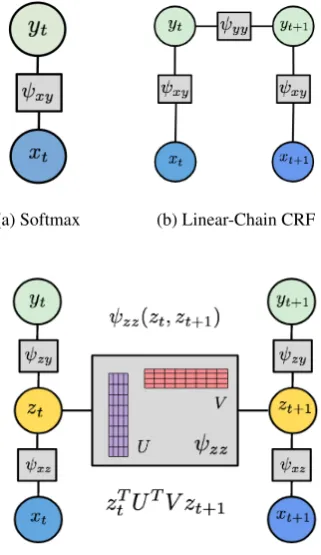
(a) Softmax (b) Linear-Chain CRF
[image:3.595.101.262.92.370.2](c) Embedded-State Latent CRF
Figure 2: Comparing PGMs for tag prediction. A straightforward solution is to use a feed-forward network to map the feature vector to the corresponding label. From a probabilistic perspec-tive, this method is equivalent to the probabilistic graphical model in Fig.2a. Here, the goal is to es-timate the posterior distribution:
P(y|x) =
T
Y
i=1
P(yt|xt) = T
Y
i=1
ψ(yt;xt) (1)
where the joint distribution over the sequence is fully factorized, i.e. there is no structural de-pendency betweenyt and the distribution P(yt |
xt) is parameterized by a deep neural network
ψ(yt;xt) = f eed f orward(ft, yt). This model ignores all the structural dependencies between the output labels during prediction, though not fea-turization, and has been found unsuitable for struc-tured prediction tasks on sequences (Collobert et al.,2011).
In order to enforce some local output consis-tency, Collobert et al. (2011) introduce a linear chain Conditional Random Field (CRF) layer to the model (Fig.2b). They define the energy
func-tion for a particular configurafunc-tion as follows
E(y|x) =
T
X
t=1
ψxy(xt, yt) +ψyy(yt, yt+1) (2)
where the local log-potentialsψxy are parameter-ized by a DNN, and (for their application) the edge log-potentialsψyy are parameterized by an input-independent parameter matrix, modeling the intra-state dependencies under a Markovian assump-tion, giving the data log-likelihood as
logP(y|x) =E(y|x)−log X
y0
exp(E(y0 |x))
(3)
Collobert et al.(2011) show a+1.71performance gain in Named-Entity Recognition (NER) by ex-plicitly enforcing these local structural dependen-cies. However, the Markov assumption is limiting, and much of the gain comes from enforcing deter-ministic hard constraints of the segmentation en-coding (e.g.I-ORGcannot go afterB-PER). Simi-lar types of local gains come from hierarchical tag-ging schemes (e.g. I-DATEshould be tagged as I-VENUE/DATEif it appears inside theI-VENUE/* segment). We would like to model, and learn, global, semantically meaningful soft constraints, e.g. BOOKTITLE should become TITLE if an-otherTITLEdoes not appear in the same citation (Anzaroot et al., 2014). The state transition dy-namics of the linear-chain CRF model are limited by a restriction to interaction betweenNoutput la-bels. The information-rich featuresft ∈Rdinput
to the local potential are restricted to a local pref-erence over theN labels in output space, failing to exploit the full power of the underlying feature space.
2.3 Embedded-State Latent CRF
Our proposed model, the embedded-state latent CRF, is shown in Figure 2c. We introduce a se-quence of hidden statesz={z1, z2, ..., zT}where
ztis one ofM possible discrete hidden states and
M >> N. Similarly, the corresponding energy for a particular joint configuration overyandzis
E(y,z|x) =
T
X
t=1
ψxz(xt, zt) +ψyz(yt, zt)
+ψzz(zt, zt+1) (4)
and hidden states, and the hidden states and out-put states, respectively. The hidden state dynamics come from the log-scoresψzz(zt, zt+1)for
transi-tioning between hidden statezttozt+1. The
pos-terior distribution over output labels can be com-puted by summing over all possible configurations ofz
P(y|x) = 1 Z
X
z
exp (E(y,z|x)) (5)
where Z = P
y0Pz0exp (E(y0,z0 |x)) is the partition function. The local log-potentials
ψxz(xt, zt) are produced by an affine transform from the RNN feature extractor, and the output potentials ψzy(zt, yt) are many-to-one mappings from the hidden state, with learned potentials but pre-allocated numbers of states for each output la-bel.
Factorized transition log-potentials We em-pirically observe that introducing a large number of hidden states can lead to overfitting, due to over-parameterization of the output dependencies. For example,JOURNALoften co-occurs withPAGES but JOURNAL is not strictly accompanied by PAGES (Anzaroot et al., 2014). Therefore, we regularize the state transition log-potential with a low-rank constraint, forming an embedding matrix wherein state transition interaction scores are me-diated through low-dimensionalstate embeddings rather than a fully unconstrained parameter matrix. Instead of learningA ∈ RM×M, a full-rank
hid-den state transition potential, we learn a low-rank modelA =UTV whereU andV are tworank-k matrices. This reduces the number of parameters from M2 to 2M k (where k << M) and shares statistical strength when learning transitions be-tween similar states.
Inference. The brute-force computation of the posterior distribution using (5) is intractable, espe-cially with the large number of hidden states. For-tunately, both the energy and the partition func-tion can be computed efficiently using tree be-lief propagation. Due to the deterministic map-ping from hidden states to outputs, we can sim-ply fold the local input and output potentials
ψxz(xt, zt) and ψyz(yt, zt) into the edge poten-tials and perform the forward-backward algorithm as in a standard linear-chain CRF. This determin-istic mapping also lets us enforce hard transition constraints while retaining exact inference. Fur-thermore, since our implementation is in PyTorch
(Paszke et al., 2017), we only need to imple-ment the forward pass, as automatic differentiation (back-propagation) is equivalent to the backward pass (Eisner,2016).
MAP inference.At test time, we run the Viterbi algorithm to search for the best configuration over
z rather than over y. Mapping from the hidden stateztto the output labelytis deterministic given the output state embedding.
3 Related Work
Much deep learning research concerns itself with learning to represent the structure of input space in a way that is highly predictive of the output. In this work, while using state-of-the-art sequence tagging baselines for input representation learn-ing, we concern ourselves with learning the global structure of the output space of label sequences, as well as fine-grained local distinctions in output space. While representation learning in the form of fine-grained, discrete, latent state transitions in the output space has been explored in this context (e.g. various latent-variable conditional random fields (Quattoni et al., 2007;Sutton et al., 2007;
Morency et al.,2007) and latent structured support vector machines (Yu and Joachims,2009)), we en-able the use of many more hidden states without overfitting by factorizing the log-potential transi-tion matrices and modeling the log-scores of latent state interactions as products of low-dimensional embeddings, effectively performing feature learn-ing in output space.
A simple linear-chain CRF over the labels was used in early applications of deep learning to se-quence tagging (Collobert et al., 2011), as well as the most recent high-performing segmenta-tion models for named entity recognisegmenta-tion (Lample et al.,2016). Outside of NLP, in tasks such as com-puter vision, certain classes of fully-connected graphical models over the output pixels have been used for multi-dimensional smoothing (Adams et al., 2010;Kr¨ahenb¨uhl and Koltun,2011), bor-rowing techniques for the graphics literature.
However, none of these models performs rep-resentation learning in the output space, as in the case of our proposed embedded latent-state model.
gains are to be found by marrying representation learning techniques with latent variable methods.
In the graphical models literature, the most sim-ilar work to ours is the Latent-Dynamic CRF of
Morency et al. (2007), who propose the same graphical model structure, without the deep input featurization, or more importantly, the learned em-bedded factorization of transition scores. Addi-tionally, that work uses a deterministic mapping of equal numbers of hidden states to output la-bels, while we have a hard-constrained (hidden states to output variables are always many-to-one), but learned, potential with different outputs pre-allocated different numbers of states based on cor-pus frequency.
Many graphical models have been proposed for natural language processing under hard and soft global constraints, e.g. (Koo et al., 2010; Anza-root et al.,2014;Vilnis et al.,2015), many based on dual decomposition (Rush and Collins,2012). However, the constraints are often fixed, and even when learned (Anzaroot et al.,2014;Vilnis et al.,
2015), the learning is done simply on constraint weights generated from pre-made templates, the construction of which requires domain knowledge.
Finally, Structured Prediction Energy Networks (Belanger and McCallum, 2016; Belanger et al.,
2017) have been used for NLP tasks such as se-mantic role labeling, but they perform approx-imate inference through gradient descent on a learned energy function over labelings, effec-tively a fully-connected graphical model, while our model sits more clearly within the frame-work of graphical models, permitting exact infer-ence with only nonconvex learning, common to all latent-variable models.
4 Experiments
We experiment on two datasets with a rich output label space, the UMass Citations dataset ( Anza-root and McCallum,2013) and the CLEF eHealth dataset (Suominen et al., 2015). Both of the datasets have a hierarchical label space, enforced by hard transition constraints, making this a form of shallow parsing (Anzaroot et al., 2014), with additional soft constraints in the label space due to the interdependent nature of the fields being ex-tracted.
4.1 Datasets
4.1.1 UMass Citations
We experiment with citation field extraction on the UMass Citations dataset (Anzaroot and Mc-Callum, 2013), a collection of 2476 richly la-beled citation strings, each tagged in a hierar-chical manner, across a set of 38 entities de-marcating both coarse-grained labeled segments, such as title, date, authors and venue, as well as fine-grained inner segments where applica-ble. The data follows a train/dev/test split of 1454, 655 and 367 citations, with 231085 to-tal tokens. For example, a person’s last name could be tagged as AUTHORS/PERSON/PERSON
-LASTorVENUE/EDITOR/PERSON/PERSON-LAST
depending on whether the person is the author of the cited TITLE or an editor of the publication
VENUE. Similarly, year could be tagged as either
DATE/YEARorVENUE/DATE/YEARdepending on whether it is the cited work’s publication date or the publication date of the venue of the cited work.
4.1.2 CLEF eHealth
We perform our second set of sequence label-ing experiments on the NICTA Synthetic Nurslabel-ing Handover dataset (Suominen et al.,2015) for clin-ical information extraction, consisting of 101 doc-uments totaling 32122 tokens.
It is a synthetic dataset of handover records, which contain patient profiles as written by a registered nurse (RN) working in the medical ward and delivering verbal handovers to another nurse at a shift change by the patients bedside. A document is typically 100-300 words long, and the included handover information contains five coarse entities i.e, PATIENTINTRODUCTION,
MYSHIFT, APPOINTMENTS, MEDICATION
and FUTURECARE. Similar to the setup of the citation field extraction task described in Section 4.1.1, each of these coarse categories has a further level of nested finer labels and the entities to be identified are all hierarchical in nature. For example, the PATIENTINTRO
-DUCTION section contains entities such as PATIENTINTRODUCTION/LASTNAME and PA -TIENTINTRODUCTION/UNDERDR LASTNAME, the APPOINTMENTS section contains APPOINT
-MENT/PROCEDURE CLINICIANLASTNAME, and
MEDICATION contains MEDICATION/DOSAGE
the hard-constrained hierarchical structure of the labels, the task also exhibits interesting global constraints, such as only tagging the first occur-rence of the patient’s gender, or the convention of labeling the most brief description of a nurse’s shift status as MYSHIFT/STATUS, while the de-tails of the shift are tagged as MYSHIFT/OTHER.
In such cases, information extraction benefits from modeling output label dependencies, as we show in the results section.
4.2 Training Details
Our baseline is the BiLSTM+CRF model from
Lample et al. (2016), employing a bidirectional LSTM with 500 hidden units for input featuriza-tion to capture long-range dependencies in the in-put space. Since we do not focus on inin-put featur-ization, we do not use character-level embeddings in the baseline model.
Both the baseline model and our EL-CRF model were implemented in PyTorch. For training our models, we use the hyper-parameter settings from the LSTM+CRF model of Lample et al. (2016). Although, we did explore different optimizer tech-niques to enhance SGD such as Adam (Kingma and Ba,2015), Averaged SGD (Polyak and Judit-sky, 1992) and YellowFin (Zhang et al., 2017), none of them performed as well as mini-batch SGD with a batch-size of 1. We also employed gradient clipping to a norm of 5.0, a learning rate of 0.01, learning rate decay of0.05, dropout with p = 0.5, and early stopping, tuned on the citation development data. We initialized our word level embeddings using pre-trained 100 di-mensional Glove embeddings (Pennington et al.,
2014), which gave better performance on our tasks than the skip-n-gram embeddings (Ling et al.,
2015) used in the original work ofLample et al.
(2016). The datasets were pre-processed to zero-replace all occurrences of numbers. Finally, we experimented with both IOBES and IOB tagging schemes, with IOB demonstrating higher perfor-mance on our tasks.
Embedding size We tune the embedding size (rank constraint) for the hidden state matrix A, varying from 10 to 40, alongside the neural net-work parameters, and report results when fixing the other hyperparameters and varying embedding size, similar to ablation analysis. Table 4 shows the impact of different embedding sizes on the per-formance of the model. We found that a size of
20 works best for both datasets, confirming the importance of the rank-constrained log-potential when using large-cardinality hidden variables.
Mapping tags to hidden statesWe find that the mapping between tags and hidden states greatly influences the performance of the model. We ex-perimented with several heuristics (e.g., individual IOB tag count ratio and entity count ratio), and found that allocating a number of hidden states proportional to the entity count gives us the best performance.
4.2.1 Evaluation
We report field-level F1 scores as computed using
theconlleval.plscript.
Since the train/validation/test splits were clearly defined for the UMass Citation dataset, we trained the models on the training split, tuned the hyper-parameters on the validation split and report the scores on the test dataset. However, as there were only 101 documents in the CLEF eHealth dataset, we report the Leave-One-Out (LOO) cross-validation F1 scores for this dataset i.e., we trained 101 models each with a different held-out document, merged the respective test outputs, and computed the F1 score on this merged output.
4.3 Results
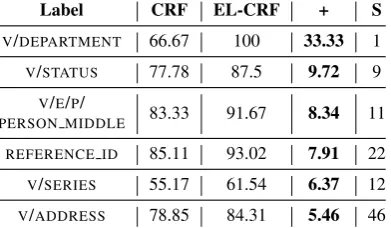
Table 1 shows that overall performance on the UMass Citation dataset using the embedded-state latent CRF (95.18) is marginally better than the baseline BiLSTM+CRF model (95.07). However, examining the entities with the largest F1 score improvement in Table 2, we see that they are mostly within theVENUEsection, which has long-range constraints with other sections, giving ev-idence of the model’s ability to learn constraints from the citation dataset.
Dataset CRF EL-CRF +
UMASSCITATION 95.07 95.18 0.11
CLEFEHEALTH 68.66 70.32 1.66
Table 1: Entity-level F1 scores of the embedded-state latent CRF and BiLSTM+CRF baseline.
Table1demonstrates that EL-CRF outperforms the BiLSTM+CRF on both datasets, with larger gains on the much smaller CLEF data. Table
3 shows the top-gaining entities include MEDI
Label CRF EL-CRF + S
V/DEPARTMENT 66.67 100 33.33 1
V/STATUS 77.78 87.5 9.72 9
V/E/P/
PERSON MIDDLE 83.33 91.67 8.34 11
REFERENCE ID 85.11 93.02 7.91 22
V/SERIES 55.17 61.54 6.37 12
[image:7.595.85.281.62.176.2]V/ADDRESS 78.85 84.31 5.46 46
Table 2: Top 5 entities in terms of F1 improve-ment on the UMass Citation Dataset. The col-umnSshows the support for a given entity in the test dataset. Key for contracted entity names: V:
VENUE,E:EDITOR,P:PERSON
Label CRF EL-CRF + S
P/DR/GIVENNAMES/
INITIALS 33.33 64.29 30.96 15
A/PROCEDURE/
TIME 34.78 53.66 18.88 28
M/MEDICINE 55.28 71.1 15.82 157
FA/WARNING/
ABNORMALRESULT 0 11.43 11.43 59
[image:7.595.322.508.73.152.2]M/DOSAGE 9.09 18.75 9.66 37
Table 3: Top 5 entities in terms of F1 im-provement on the CLEF eHealth dataset. Key for contracted entity names: P/DR:
PATIENT INTRODUCTION/UNDER DR, A:
APPOINTMENT, M: MEDICATION, FA: FU
-TURE ALERT
due to the global constraint that those entities al-ways co-occur.
5 Qualitative Analysis
In this section, we provide qualitative evidence that the embedded-state latent CRF learns con-straints which are not captured by the standard CRF.
First, we pick a few representative examples from the UMass Citations dataset and discuss when our model is able to correctly determine the label sequence based on the output constraints. In addition to the the hard constraints arising from hi-erarchical segmentation, this dataset also exhibits empirical pairwise constraints between fields e.g. two different authors’ first names cannot be placed next to each other. Figure3demonstrates that the CRF model fails to enforce such constraints. Another constraint we observe in the citation data
Factor Size UMass Citation CLEF eHealth
10 94.92 70.06
20 95.18 71.51
30 94.91 69.92
40 94.88 70.33
[image:7.595.308.522.235.349.2]Full Rank 95.13 71.11
Table 4: Comparison of F1 scores obtained by varying thefactor sizeparameter, and setting the other model and neural network parameters from the model with the best cross validation.
Figure 3: Authors name constraint violation
is that theVenue/Seriestag only appears once per citation if Venue/Booktitle is also present. Our model obeys this constraint and marks the whole span as Titleinstead of breaking it into Title and Venue/Series, even though the input text for that segment in isolation could represent a valid series (Figure4).
[image:7.595.308.524.510.661.2]Figure 5: There is at most one series per citation.
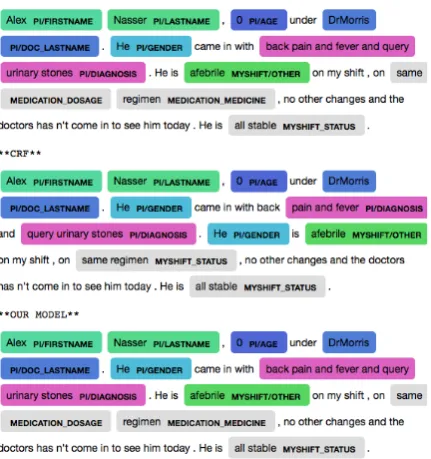
The CLEF eHealth dataset holds a different set of constraints than the citation data, and its input sequences are not strong local indicators of the labeling sequence. Therefore, our model shows stronger performance over the Markovian baseline for this dataset. Some of the constraints concern the number of entities per document. For exam-ple, we only tag the first occurrence of a gender indicator e.g. he, she, her, etc., or the most gen-eral status of a nurse’s shift.
Figure 6: The gender indicator constraint and nurse’s shift status constraint in the CLEF eHealth dataset.
Finally, a T-SNE (Maaten and Hinton, 2008) clustering on the embedding vectors of the output tags, shown in Figure7, demonstrates that output
[image:8.595.324.511.110.233.2]structural dependencies can be reflected in tag em-bedding space.
Figure 7: A part of the T-SNE clustering of the tag embedding from the CLEF eHealth dataset. The two tag PATIENTINTRODUCTION GENDER
and MYSHIFT STATUSare under the similar con-straint of being tagged only once per document.
6 Conclusion & Future Work
We present a latent variable model which not only parametrizes local potentials with the learned features from a deep neural network, but learns embedded representations in a large hidden state space, leveraging feature learning in both the in-put and outin-put representations. Experimental re-sults demonstrate that our model can learn global structural dependencies in the presence of ambigu-ities that cannot be resolved by local featurization of the input sequence. We find interpretable struc-ture in the output state embeddings.
Future work will apply our model to larger datasets with more complex dependencies, and in-troduce multiple latent states per time-step, en-abling exponentially more expressivity in output states at the cost of exact inference. We will also explore approximate inference methods, such as expectation propagation, to speed up message passing in the regime of low-rank log-potentials.
References
Andrew Adams, Jongmin Baek, and Myers Abraham Davis. 2010. Fast high-dimensional filtering using the permutohedral lattice. In Computer Graphics Forum, volume 29, pages 753–762. Wiley Online Li-brary.
[image:8.595.74.290.425.655.2]Sam Anzaroot, Alexandre Passos, David Belanger, and Andrew McCallum. 2014. Learning soft linear con-straints with application to citation field extraction.
arXiv preprint arXiv:1403.1349.
Dzmitry Bahdanau, Kyunghyun Cho, and Yoshua Ben-gio. 2015. Neural machine translation by jointly learning to align and translate. ICLR.
David Belanger and Andrew McCallum. 2016. Struc-tured prediction energy networks. In International Conference on Machine Learning, pages 983–992. David Belanger, Bishan Yang, and Andrew McCallum.
2017. End-to-end learning for structured prediction energy networks.ICML.
Liang-Chieh Chen, George Papandreou, Iasonas Kokkinos, Kevin Murphy, and Alan L Yuille. 2018. Deeplab: Semantic image segmentation with deep convolutional nets, atrous convolution, and fully connected crfs. PAMI.
Ronan Collobert, Jason Weston, L´eon Bottou, Michael Karlen, Koray Kavukcuoglu, and Pavel Kuksa. 2011. Natural language processing (almost) from scratch. Journal of Machine Learning Research, 12(Aug):2493–2537.
Jason Eisner. 2016. Inside-outside and forward-backward algorithms are just backprop (tutorial pa-per). InProceedings of the Workshop on Structured Prediction for NLP, pages 1–17.
Alex Graves and J¨urgen Schmidhuber. 2005. Frame-wise phoneme classification with bidirectional lstm networks. In Neural Networks, 2005. IJCNN’05. Proceedings. 2005 IEEE International Joint Confer-ence on, volume 4, pages 2047–2052. IEEE. Geoffrey Hinton, Li Deng, Dong Yu, George E Dahl,
Abdel-rahman Mohamed, Navdeep Jaitly, Andrew Senior, Vincent Vanhoucke, Patrick Nguyen, Tara N Sainath, et al. 2012. Deep neural networks for acoustic modeling in speech recognition: The shared views of four research groups.IEEE Signal Process-ing Magazine, 29(6):82–97.
Diederik P Kingma and Jimmy Ba. 2015. Adam: A method for stochastic optimization.ICLR.
Terry Koo, Alexander M Rush, Michael Collins, Tommi Jaakkola, and David Sontag. 2010. Dual decomposition for parsing with non-projective head automata. InEMNLP.
Philipp Kr¨ahenb¨uhl and Vladlen Koltun. 2011. Effi-cient inference in fully connected crfs with gaussian edge potentials. InAdvances in neural information processing systems, pages 109–117.
Guillaume Lample, Miguel Ballesteros, Sandeep Sub-ramanian, Kazuya Kawakami, and Chris Dyer. 2016. Neural architectures for named entity recognition.
ACL.
Wang Ling, Yulia Tsvetkov, Silvio Amir, Ramon Fer-mandez, Chris Dyer, Alan W Black, Isabel Tran-coso, and Chu-Cheng Lin. 2015. Not all contexts are created equal: Better word representations with variable attention. InProceedings of the 2015 Con-ference on Empirical Methods in Natural Language Processing, pages 1367–1372.
Laurens van der Maaten and Geoffrey Hinton. 2008. Visualizing data using t-sne. Journal of machine learning research, 9(Nov):2579–2605.
Louis-Philippe Morency, Ariadna Quattoni, and Trevor Darrell. 2007. Latent-dynamic discriminative mod-els for continuous gesture recognition. InComputer Vision and Pattern Recognition, 2007. CVPR’07. IEEE Conference on, pages 1–8. IEEE.
Adam Paszke, Sam Gross, Soumith Chintala, Gre-gory Chanan, Edward Yang, Zachary DeVito, Zem-ing Lin, Alban Desmaison, Luca Antiga, and Adam Lerer. 2017. Automatic differentiation in pytorch. InNIPS-W.
Jeffrey Pennington, Richard Socher, and Christopher Manning. 2014. Glove: Global vectors for word representation. InProceedings of the 2014 confer-ence on empirical methods in natural language pro-cessing (EMNLP), pages 1532–1543.
Boris T Polyak and Anatoli B Juditsky. 1992. Ac-celeration of stochastic approximation by averag-ing. SIAM Journal on Control and Optimization, 30(4):838–855.
Ariadna Quattoni, Sybor Wang, Louis-Philippe Morency, Morency Collins, and Trevor Darrell. 2007. Hidden conditional random fields. IEEE transactions on pattern analysis and machine intelligence, 29(10).
Alexander M Rush and MJ Collins. 2012. A tutorial on dual decomposition and lagrangian relaxation for inference in natural language processing. Journal of Artificial Intelligence Research, 45:305–362. Vivek Srikumar and Christopher D Manning. 2014.
Learning distributed representations for structured output prediction. InAdvances in Neural Informa-tion Processing Systems, pages 3266–3274.
Hanna Suominen, Liyuan Zhou, Leif Hanlen, and Gabriela Ferraro. 2015. Benchmarking clinical speech recognition and information extraction: new data, methods, and evaluations. JMIR medical in-formatics, 3(2).
Charles Sutton, Andrew McCallum, and Khashayar Rohanimanesh. 2007. Dynamic conditional random fields: Factorized probabilistic models for labeling and segmenting sequence data. Journal of Machine Learning Research, 8(Mar):693–723.
Chun-Nam John Yu and Thorsten Joachims. 2009. Learning structural svms with latent variables. In
Proceedings of the 26th annual international confer-ence on machine learning, pages 1169–1176. ACM. Jian Zhang, Ioannis Mitliagkas, and Christopher R´e. 2017. Yellowfin and the art of momentum tuning.