718
Incorporating Interlocutor-Aware Context
into Response Generation on Multi-Party Chatbots
Cao Liu1,2, Kang Liu1,2, Shizhu He1,2, Zaiqing Nie3, Jun Zhao1,2 1 National Laboratory of Pattern Recognition, Institute of Automation,
Chinese Academy of Sciences, Beijing, 100190, China
2 University of Chinese Academy of Sciences, Beijing, 100049, China 3Alibaba AI Labs, Beijing, 100029, China
{cao.liu, kliu, shizhu.he, jzhao}@nlpr.ia.ac.cn [email protected]
Abstract
Conventional chatbots focus on two-party sponse generation, which simplifies the re-al dire-alogue scene. In this paper, we strive toward a novel task of Response Generation on Multi-Party Chatbot (RGMPC), where the generated responses heavily rely on the inter-locutors’ roles (e.g., speaker and addressee) and their utterances. Unfortunately, complex interactions among the interlocutors’ roles make it challenging to precisely capture con-versational contexts and interlocutors’ infor-mation. Facing this challenge, we present a response generation model which incorpo-rates Interlocutor-aware Contexts into Recur-rent Encoder-Decoder frameworks (ICRED) for RGMPC. Specifically, we employ interac-tive representations to capture dialogue con-texts for different interlocutors. Moreover, we leverage an addressee memory to enhance contextual interlocutor information for the tar-get addressee. Finally, we construct a corpus for RGMPC based on an existing open-access dataset. Automatic and manual evaluations demonstrate that the ICRED remarkably out-performs strong baselines.
1 Introduction
Human computer conversation has been an impor-tant and challenging task in NLP and AI since the Turing Test was proposed in 1950 (Turing,1950). Recently, with the rapid growth of social conver-sation data available on the Internet, data-driven chatbots are able to learn to generate responses di-rectly and have attracted much more attention than before (Li et al.,2016a;Tian et al.,2017).
Researches in this area mostly focus on the dia-log with two interlocutors (Ma´ıra Gatti de Bayser et al.,2017). However, the real-life interaction in-volves a substantial part of Multi-Party Chatbot-s (MPC, Chatbot-such aChatbot-s internet forum and chat group), which is a form of conversation with multiple
in-t Speaker Addressee Utterance
1 Alan ( ) Bert ( ) the main ubuntu
2 Carl ( ) - i
n-1 Carl ( ) Jack ( ) i
n Carl ( )
n+1 Jack ( ) Carl ( ) mate is a recent reincarnation i
(Generated) Response Responding
[image:1.595.309.525.221.300.2]Speaker Target Addressee Context
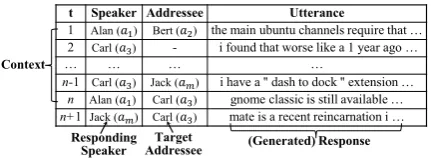
Figure 1: An example of Multi-Party Chatbots (MPC). At each turn, a speaker said one utterance to an ad-dressee. There are many interlocutors (e.g., Alan, Bert and so on) in a conversation, whereairepresents
inter-locutor’s ID.
terlocutors (Ouchi and Tsuboi, 2016). For ex-ample, there are more than three interlocutors (a1, a2, a3...am) involved in the conversation in
Figure 1, and their roles (e.g., speaker and ad-dressee) may change across different dialog turns. As shown in Figure1, at each turn, the core is-sue of MPC is to capture who (speaker) talks to
whom(addressee) aboutwhat(utterance). In order to obtain responses in MPC, in our best knowl-edge, previous approaches usually employ a re-sponse selection paradigm, which simply select-s one reselect-sponselect-se from a select-set of exiselect-sting utteranceselect-s as the final response according to the contexts. Obviously, this paradigm, which could not gen-erate new responses, is not so flexible. In this s-tudy, to build a more broadly applicable system, we concentrate on producing new responses word by word, named as Response Generation on Multi-Party Chatbots (RGMPC).
ut-terances from different speakers may be differen-t because each speaker has personal background knowledge and style of speaking. Moreover, the roles of the same interlocutor may vary across d-ifferent dialog turns. For instance, in Figure1,a3 plays different roles in different dialog turns: s-peaker in the turn 2 andn-1, addressee in the turn
nandn+1.
Therefore, it is very important for RGMPC to capture interlocutor information. Currently, most response generation methods consider only the contextual utterance information (Serban et al., 2016,2017) but neglect the interlocutor informa-tion. Although some researches have exploited the interlocutor information for response generation, they are still suffering from certain critical limita-tions.Li et al.(2016b) learn a fixed vector for each person from all conversational texts in the training corpus. However, as a global representation, the fixed person vector needs to be trained from large-scale dialogue turns for each interlocutor, and it may have a sparsity issue since some interlocu-tors have very few dialogue turns.
To address the aforementioned problems of RGMPC, this paper incorporates Interlocutor-aware Contexts into a Recurrent Encoder-Decoder model (ICRED) for RGMPC, which is also an end-to-end framework. Specifically, in order to capture interlocutor information, we exploit in-teractive interlocutor representations learned from current dialog context rather than the fixed person vectors (Li et al.,2016b) obtained from all dialogs in the training corpus. We expect that the learned contextual interlocutor representation could be a good alternative to the fixed person vectors (Li et al., 2016b) due to its ability of alleviating the sparsity issue. Furthermore, from the view of con-versation analysis, responses are usually used for answering the addressee’s question or expanding the addressee’s utterances. Therefore, we original-ly introduce an addressee memory mechanism to enhance contextual information for the target ad-dressee especially. Finally, both of the interactive interlocutor representation and addressee memory are utilized for decoding response utterances. In particular, the addressee memory is leveraged to capture the addressee information for each gener-ated word dynamically.
In order to prove the effectiveness of the pro-posed model, we construct a dataset for RGMPC
based on an open dataset1. Experimental results show that the proposed model is fairly competitive on both automatic and manual evaluations com-pared with state-of-the-arts.
In brief, the main contributions of the paper are as follows:
(1) We propose an end-to-end response gen-eration model called ICRED which incorpo-rates Interlocutor-aware Contexts into Recurrent Encoder-Decoder framework for RGMPC.
(2) We leverage an addressee memory mecha-nism to enhance contextual interlocutor informa-tion for the addressee.
(3) We construct an open-access dataset for RGMPC. Both automatic and manual evaluation-s demonevaluation-strate that our model ievaluation-s remarkably better than strong baselines in this dataset.
2 Task Formulation
Data Notation
Input
Context C= [(atspk, atadr,ut)]nt=1
Responding Speaker anspk+1(orares)
Target Addressee anadr+1(oratgt)
[image:2.595.309.524.333.399.2]Output Response un+1(or{rj}Lj=1r )
Table 1: Notations for RGMPC.
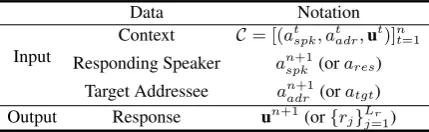
On multi-party chatbots, lots of interlocutors talk about one or more topics. At each dialogue turn (or time step) t, there is a speaker (atspk), who may talk something (ut) to a specific ad-dressee (at
adr), while the others are observers. As
shown in Table 1, given the context C of previ-ous n dialog turns, the responding speaker ares
and the target addressee atgt at time step n+1,
the task of RGMPC aims to automatically gener-ate the next utteranceun+1 as the final response. Here, C is a list ordered by the time stept: C = [Ct]n
t=1 = [(atspk, atadr,ut)]nt=1, where Ct means
atspksaysuttoatadr at time stept,nis the maxi-mum number of previous dialog turns in a context.
ut = (wt
1, wt2...wtLu)is the input utterance (word sequence) at time stept, whereLu is the number
of maximum words in utterances.
3 Methodology
The overview of the proposed ICRED for RGMPC is shown in Figure2 along with its caption. The details are as follows.
1The dataset is available at
Utterance Encoder Layer Speaker Interaction
Layer Addressee Memory
Layer Decoder layer
Contextual Addressee Vector
Attentional Addressee Vector Contextual Speaker Vector Response:
Bi-GRU
Decoder
Bi-GRU Bi-GRU Bi-GRU
[image:3.595.79.523.65.224.2]: SpeakerGRU : AddresseeGRU : ObserverGRU
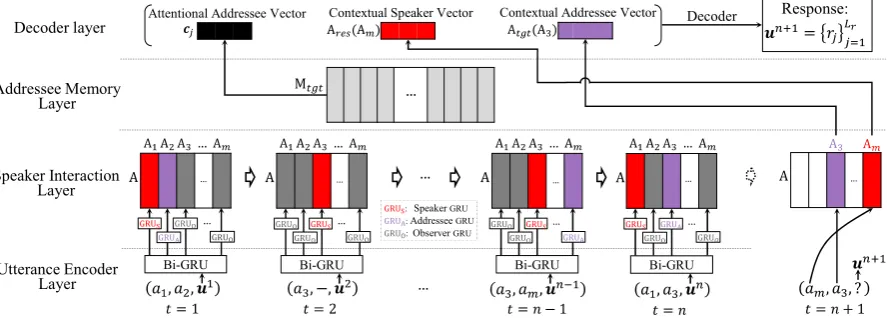
Figure 2: Overall structure of the proposed ICRED for RGMPC. At each time stept, (ai, aj,ut) means that
a speakerai said an utteranceutto an addresseeaj, where the time stept is denoted on the bottom, and the
superscriptt may be omitted for brevity. Our ICRED includes: 1 Utterance Encoder Layer: encoding each utterance (ut) into distributed vectors; 2Speaker Interaction Layer: capturing interactive interlocutor information from contexts, and it updates all interlocutors’ representation by different GRUs according to their roles at each time step, where the embedding for an interlocutorai is obtained by extracting the i-th column (Ai) from the
interlocutor embedding matrixA; 3Addressee Memory Layer: enhancing contextual information for the target addressee (a3); 4Decoder Layer: generating responses.
3.1 Utterance Encoder Layer
The utterance encoder layer transforms input ut-terance into distributional representations. We leverage the bi-directional Gated Recurrent U-nits (GRU) (Cho et al., 2014) to capture the long-term dependency. For an utterance ut =
(w1t, w2t...wtLu) at time step t, the concatenated representation for hidden states in bi-directions is denoted ashti = [−→hti,←−htL
u−i+1], whereh
t iis
con-sidered as the contextual word representation of the input wordwit. The state (htLu) of the last word is treated as the representation of the utterance at time stept, which is denoted asht, and it could be sent to the speaker interaction layer for updating contextual representation.
3.2 Speaker Interaction Layer
The speaker interaction layer is leveraged to obtain the interlocutor information in the context. Simi-lar to the Speaker Interaction RNNs (Zhang et al., 2018), we utilize the interactive speaker encoder for RGMPC.
As shown in Figure 2, an interlocutor embed-ding matrix Ais used to record all interlocutors’ representation, andAis initiated with a zero ma-trix. Each column of A corresponds to an inter-locutor’s embedding: Ai = A[∗, ai], whereAi is
the embedding for the interlocutorai. The speaker
interaction layer updates the entire interlocutors’ embeddings at each time step based on their roles
(speaker, addressee or observer). Embeddings for the speaker, addressee and observer are updated by following role-differentiated GRUs: GRUS,
GRUAandGRUO, respectively.
Atspk= GRUS(Atspk−1,ht) (1)
Atadr = GRUA(Atadr−1,ht) (2)
Atobv= GRUO(Atobv−1,h
t) (3)
whereAtspk(Atadr/Atobv) is the embedding for the speaker (addressee / observer) at time stept, and
ht is the utterance representation obtained from the utterance encoder layer. Take the first time step “(a1, a2,u1)” in Figure 2 as an example, when
a1 says u1 toa2, the speaker’s (a1’s) embedding
A1 is updated by the speaker GRU—GRUS, and
the addressee’s (a2’s) embedding A2 is updated by the addressee GRU—GRUA, while other
inter-locutors’ embeddings are updated by the observer GRU—GRUO. Note that the addressee may be
missing (such as “(a3,−,u2)” at time step 2 in Figure2), where embeddings for all interlocutors except for the speaker are updated by the observ-er GRU. The intobserv-erlocutor embedding matrix (A) is updated up to the maximum time stepn. The final interlocutor embedding matrix is used in de-coding.
3.3 Addressee Memory Layer
so it captures interlocutor’s context on the utter-ance level. In fact, contextual word representation is important for response generation, too. A con-text contains consecutive utterances, and each ut-terance is a word sequence. Therefore, memoriz-ing all contextual word representations in the en-tire context is complex, and it is difficult to work on large-scale utterances in one context.
Intuitively, from the view of conversational analysis, responses are usually used for answer-ing the addressee’s question or expandanswer-ing the dressee’s utterances. Therefore, we design an ad-dressee memory layer, which only memorizes the contextual word representations (noted as Mtgt)
in the last utterance said by the target addressee, and the contextual representation for each word is obtained from the utterance encoder layer. Take “(am, a3,?)” at time stepn+1 in Figure 2 as an example, un−1 is the last utterance said by the target addressee a3 because of “(a3, am,un−1)”
at time step n-1, so the addressee memory layer merely memorizes contextual word representation
Mtgt = [hn1−1,h n−1 2 , ...,h
n−1
Lu ]from the utterance
un−1, wherehni−1is obtained from Section3.1.
3.4 Decoder Layer
The decoder is responsible for generating target sequences. Different from a single contextual rep-resentation in previous work (Serban et al.,2017), the speaker interaction layer is able to capture dif-ferent interlocutor information from contexts (e.g., personal background knowledge and style of s-peaking for the responding speaker, special infor-mation demands for the target addressee). More-over, the addressee memory layer records contex-tual word representation for the target addressee. Therefore, we extract contextual speaker vec-tor Ares for the responding speaker ares from
the final interlocutor embedding matrix A (e.g., the responding speaker’s embedding obtained by
Am =A[∗, am]for the responding speakeram in
Figure 2). Similarly, contextual addressee vec-tor Atgt for the target addressee is also
extract-ed from A. However, Ares andAtgt keep same
for each generated word. In order to capture dy-namic information for different generated words, we leverage an attention mechanism to selective-ly reads different contextual word representations from the addressee memory. For each target word, the decoder attentively reads the contextual word
representation as follows:
cj =
XLu
k=1αjkMtgt[∗, k]; (4)
αjk =
eρ(sj−1,Mtgt[∗,k])
P
k0eρ(sj−1,Mtgt[∗,k
0]) (5)
where cj is the attentional addressee vector,
Mtgt[∗, k] is the contextual word representation
for the k-th word in the addressee memory, and
sj represents the hidden state in decoding GRU. A functionρis leveraged to compute the attentive strength, which is calculated by a projected matrix to connectsTj−1 andMtgt[∗, k]. Finally, the
atten-tional addressee vectorcj, contextual speaker
vec-torAres and contextual addressee vectorAtgtare
concatenated to estimate the probability for pre-dicted words:
p(rj|r<j, aspk, atgt,C) =
p(rj|rj−1,cj, Ares, Atgt,sj)
(6)
sj = GRUdec(sj−1,[cj, Ares, Atgt,xj−1]) (7)
where sj is the hidden state of the decoding GRU—GRUdec. xj is the word vector of the predicted target wordrj, and rj is typically
per-formed by asof tmaxclassifier over a settled vo-cabulary based on word embedding similarity.
3.5 Learning
The proposed ICRED for RGMPC is totally differ-entiable, and it can be optimized in an end-to-end manner using back-propagation. Given the con-text C, responding speaker ares, target addressee
atgtand target word sequence{rj}Lj=1r , the
objec-tive function is to minimize the loss function:
L= −1
Lr Lr
X
j=1
log[p(rj|r<j,C, ares, atgt] +λL2
(8)
It contains a negative log-likelihood for gener-ated responses and L2 regularization (L2), where
λis a hyperparameter forL2.
4 Experiment
4.1 Dataset
Our dataset is constructed based on the Ubuntu multi-party chatbot corpus2, which has been wide-ly used as the evaluation dataset for the response selection task (Ouchi and Tsuboi, 2016; Zhang
Total Train Dev Test
# Contexts 423.5K 338.9K 42.3K 42.3K
# Speaker 35.3K 33.5K 15.6K 15.6K
# Addressee 23.4K 22.4K 10.8K 10.8K
# Vocab 276.1K 254.8K 82.2K 82.0K
# Tokens 26.3M 21.0M 2.62M 2.62M
Avg. Tok/Ctx 51.4 51.5 51.4 51.3
[image:5.595.86.278.63.153.2]Avg. Tok/Res 10.6 10.6 10.7 10.6
Table 2: Data statistics. “#” means number, and “Avg. Tok/Ctx (or Res)” is the number of tokens per context (or response).
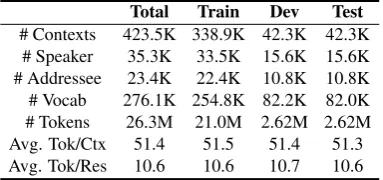
et al., 2018). The original data comes from the Ubuntu IRC chat log, where each line consists of (Time, Speaker, Utterance). If the addressee is ex-plicitly mentioned in the utterance, it is extracted as the addressee. Otherwise, all interlocutors ex-cept the speaker are observers. Considering that generating new responses in this paper is more complicated than retrieving responses, the genera-tive task requires higher-quality data. We suppose that the responding speaker and target addressee have appeared in the context, where the contextual window is set to 5. Moreover, the words are tok-enized by NLTK, and some general responses are removed by human rules3. Finally, we randomly split the dataset into Train/Dev/Test (8:1:1), and it is publicly available1. The detailed statistics of the dataset are shown in Table2.
4.2 Implement Details
In order to keep our model comparable to other typical existing methods, we keep the same param-eters and experimental environments for ICRED and the comparative models. We take a maxi-mum of 20 words for the utterance. The word vec-tor dimension is 300 and it is initialized with the public released fasttext4 pre-trained on Wikipedi-a. The utterance and interlocutor are encoded by 512-dimensional and 1024-dimensional vectors, respectively. The joint loss function with 0.0001 L2 weight is minimized by an Adam optimizer. We implemented all the models with Tensorflow on an NVIDIA TITAN X GPU.
4.3 Automatic Evaluation Metrics
Automatic evaluations (AEs) for Natural Lan-guage Generation (NLG) is a challenging and under-researched problem (Novikova et al.,2017).
3
We list some general responses, such as containing “i
don’t know”, “you are welcome”.
4https://github.com/facebookresearch/fastText
Following (Liu et al.,2018), we leverage two ref-erenced measurements (BLEU (Papineni et al., 2002) and ROUGE (Lin,2004)5) for automatic e-valuations. Considering that current data-driven approaches tend to generate short and generic (meaningless) responses, two unreferenced (“in-trinsic”) metrics are also leveraged to the evalu-ation. The first one is the average length of re-sponses, which is an objective and surfaced metric reflected the substance of responses (Mou et al., 2016; He et al., 2017a). The other one is the number of nouns6per response (Liu et al.,2018), which shows the richness of responses since nouns are usually content words. Note that the unrefer-enced metrics could enrich the evaluations, though they are weak metrics. The detailed results and analyses are shown as follows.
4.4 The Effectiveness of ICRED for RGMPC
Model Referenced Unreferenced BLEU ROUGE Length #Noun
Seq2Seq 8.86 7.62 9.48 1.24
Persona Model 9.12 7.38 11.04 1.29
VHRED 9.38 7.65 10.25 1.55
[image:5.595.307.529.332.401.2]ICRED(ours) 10.63 8.73 11.34 1.68
Table 3: Overall comparisons of ICRED.
Comparison Methods. We compared ICRED with the following methods:
(1) Seq2Seq (Sutskever et al.,2014): Seq2Seq is one of the mainstream methods for text gener-ation. In order to capture as much information as possible, the input sequence is all utterances con-catenated in order in a context.
(2) Persona Model (Li et al., 2016b): The persona-based model modified a Seq2Seq to en-code a global vector for each interlocutor that ap-pears in the training data, and it could alleviate the issue of speaker consistency for response genera-tion.
(3) VHRED (Serban et al., 2017): VHRED is essentially a conditional variational auto-encoder with hierarchical encoders, and it extends HRED (Serban et al.,2016) by adding a high-dimensional latent variable for utterances.
Comparative Results. Table 3 demonstrates overall comparisons of ICRED. We can clearly ob-tain the following observations:
5
Implemented by https://github.com/Maluuba-/nlg-eval. BLEU and ROUGE are transformed into percentages (%).
Interlocutor’s Persona Model ICRED (ours) Dialogue Turns BLEU ROUGE BLEU ROUGE
[0, 100] 8.47 6.72 10.63 8.60
(100, 1000] 8.87 7.14 10.50 8.61
(1000, 5000] 9.48 7.74 10.77 8.90
(5000, +∞) 9.51 7.80 10.60 8.79
Table 4: Performances on sparse and plentiful learn-ing data with different numbers of interlocutor’s dia-logue turns, where the test data is divided into different intervals according to the number of dialogue turns in training dataset said by target addressee (named as in-terlocutor’s dialogue turns).
(1) ICRED obtains the highest performance on all metrics (marked as bold), and it indicates that incorporating interlocutor-aware context into RGMPC contributes to generating better respons-es.
(2) Although the persona-based model utilizes interlocutor information, it performs poorly. The average dialogue turn for the interlocutor is more than 5000 in (Li et al.,2016a), while there is less than 100 dialogue turns per interlocutor in our dataset. Therefore, it is hard to learn a global vec-tor for each interlocuvec-tor from the sparse corpus. In contrast, our ICRED performs well on such a sparse corpus (details in Section4.5).
(3) VHRED brings slight improvements over the Seq2Seq and persona-base model. Even that VHRED enhances the contextual information by a high-dimensional latent variable, VHRED is still remarkably worse than ICRED because VHRED neglects the interlocutor information.
4.5 The Effect of Sparse Data on ICRED
Comparison Settings. Persona model (Li et al., 2016b) may have a sparsity issue since some terlocutors have very few dialogue turns. To in-vestigate whether ICRED has the sparsity issue or not, we divide the test data into four intervals ac-cording to the number of training dialogue turn-s turn-said by the target addreturn-sturn-see (called interlocu-tor dialogue turns), where small turns represen-t sparse learning darepresen-ta (e.g., “[0, 100]”) and large turns mean plentiful learning data (e.g., “(5000, +∞)”).
Comparative Results. Table4reports the per-formances of persona model and ICRED on differ-ent interlocutor’s dialogue turns for learning. We can clearly see that the persona model has a spar-sity issue: it performs very poorly on sparse learn-ing data (e.g., BLEU score = 8.47 on “[0, 100]”)
while it achieves good performances on plentiful learning data (e.g., BLEU score = 9.51 on “(5000, +∞)”), which demonstrates that the fixed person vectors in the persona model need to be learned from large-scale training data for each interlocu-tor. In contrast, ICRED exploits interactive inter-locutor representation learned from current dialog context rather than the fixed person vectors ob-tained from all training dialog utterances. There-fore, ICRED has no sparsity issues and it performs closely on sparse and plentiful learning data.
4.6 Ablation Study for Model Components
Model Referenced Unreferenced BLEU ROUGE Length #Noun ICRED 10.63 8.73 11.34 1.68
w/o Adr Mem 10.25 8.23 10.73 1.27
w/o Ctx Spk Vec 10.13 8.22 10.86 1.59
w/o Ctx Adr Vec 9.95 8.18 10.93 1.26
Table 5: Ablation Experiments by removing the main components.
Comparison Settings. In order to validate the effectiveness of model components, we have tried to remove some main components in decoding as follows. (1) w/o Adr Mem: without the addressee memory, such as removingcj in Equation6-7; (2)
w/o Ctx Spk Vec: without the contextual speak-er vector, such as removingAresin Equation6-7;
(3) w/o Ctx Adr Vec: without the contextual ad-dressee vector, such as removingAtgtin Equation
6-7.
Comparative Results. Results of the abla-tion study are shown in Table 5. We can see that removing any component causes obvious per-formance degradation. In particular, “w/o C-tx Adr Vec” performs the worst on almost all of the metrics, which demonstrates the importance of contextual information for the target addressee.
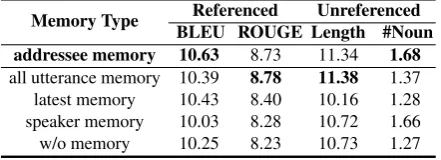
4.7 The Effectiveness of Addressee Memory
Memory Type Referenced Unreferenced BLEU ROUGE Length #Noun addressee memory 10.63 8.73 11.34 1.68
all utterance memory 10.39 8.78 11.38 1.37
latest memory 10.43 8.40 10.16 1.28
speaker memory 10.03 8.28 10.72 1.66
w/o memory 10.25 8.23 10.73 1.27
Table 6: Performances over different memory types.
umount -f does n't even work
@Pricey i have right now 12.04 ubuntu i do not want to update any of the other packages other than btrfs
@Hanumaan the quantal kernel is out of life
@k1li have right now this kernel `` 3.2.0-53-generic # 81-ubu-ntu smp thu aug 22 21:01:03 utc 2013 x86_64 x86_64 x86_64 @Hanumaanyou can update the original precise kernel with sudo apt-get update & & sudo apt-get install linux-generic
carter
Hanu maan
k1l_
Hanu maan
k1l_
Dialogue Context
@Hanumaanif you want a more recent kernel you can install a enablement stack backports kernel
k1l_
i 'm not using the OOV
you can not use the OOV of OOV ?
if you want a new kernel , you can installthe kernel from the kernel repo
Seq2Seq
ICRED
Persona Model
Model Response Gold Response
i 'm not going to try to install the ubuntu version
[image:7.595.76.525.64.154.2]VHRED
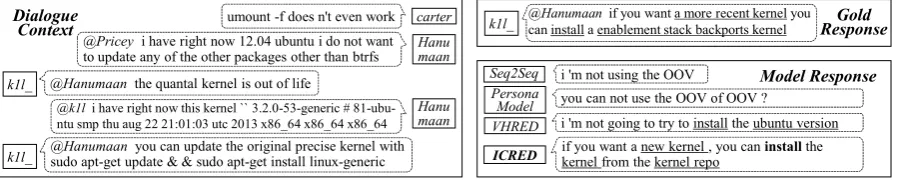
Figure 3: An example of different model responses for the same dialogue context. The input dialogue context is on the left. The gold (referenced) response and model responses are on the top right and bottom right, respectively. The rounded rectangle is the message box, where theitalicbehind “@” is the addressee, and the solid-line box near to the message box represents the speaker or model.
change the memory type, and then the attention model in Equation5is based on the new memory. The comparison settings are shown as follows. (1) addressee memory: memorizing contextual word representations in the last utterance said by the tar-get addressee(e.g.,un−1in Figure2); (2) all utter-ance memory: memorizing contextual word repre-sentations inallutterances of the context (e.g.,u1
tounin Figure2); (3) latest memory: memorizing contextual word representations of thelatest utter-ance in the context (e.g., the latest utterutter-anceunin
Figure2); (4) speaker memory: memorizing con-textual word representations in the last utterance said by theresponding speaker; (5) w/o memory: without any memory.
Comparative Results. We report the results of different memory types as shown in Table 6. It can see that our method, the addressee memory, achieves the best or near-best performances on al-l metrics. Aal-lthough memorizing aal-lal-l utterances is competitive, the complexity of all utterance mem-ory isn times compared with the one in the ad-dressee memory, where nis the number of utter-ances in a context. The speaker memory performs closely to without memory, which indicates that not all memories can improve the performance.
4.8 Manual Evaluations
Besides automatic evaluations, we employ manu-al evmanu-aluations (MEs), which is important for re-sponse generation. Similar to (He et al., 2017b; Zhou et al.,2018), and we select three metrics for MEs, which measure the following aspects. (1) Fluency: measuring whether responses are gram-matically correct or wrong. (2) Consistency: mea-suring whether responses are coherent to the con-text or not. (3) Informativeness: measuring how much informational (knowledgeable) content ob-tained from the responses.
Model Flu. Con. Inf.
ICRED vs. Seq2Seq 77.25 83.69 84.35
ICRED vs. Persona. 78.44 80.41 82.35
ICRED vs. VHRED 73.20 81.29 79.47
Table 7: Manual evaluations (%) with fluency (Flu.), consistency (Con.) and informativeness (Inf.). The S-core is the percentage that ICRED wins baselines after removing the “tie” pairs.
We conduct a pair-wise comparison between the response generated by ICRED and the one for the same input by three typical baselines. We sample 100 responses from each compared methods. Two curators judge (win, tie and lose) between these t-wo methods. The Cohen Kappa of inter-annotator statistics is 0.750, 0.658 and 0.580 for the fluen-cy, consistency and informativeness, respective-ly. As shown in Table7, the score is the percent-age that ICRED wins baselines after removing the “tie” pairs, and we can obtain that ICRED is sig-nificantly (sign test, p-value<0.005) superior to all baselines on any metric. It demonstrates our model is able to deliver more fluent, consistent and informative responses.
4.9 Case Study
4.10 Discussion
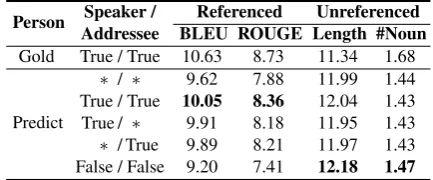
Interlocutor Prediction and RGMPC. The above methods assume that the responding speak-er and target addressee are given for RGMPC. Though the speaker and the addressee could be obtained in some situations (e.g., extracted from chat logs), it is still a researchable task to in-terlocutor prediction. There have been some re-searches to predict either the responding speaker or the target addressee based on the given textual contexts or multimodal information (Akhtiamov et al.,2017a;Meng et al.,2017;Akhtiamov et al., 2017b). Nevertheless, in order to obtain the inter-action between interlocutor prediction and RGM-PC, we further design a joint model for RGMPC and interlocutor prediction. Note that both the s-peaker and the addressee are predicted based on textual contexts, simultaneously. Firstly, the re-sponding speaker is predicted from contexts:
p(ares|C) =σ([hC;hnLu]·W·Ares) (9)
where hC is a summary contextual vector, which
is max-pooled by the final interlocutor embedding matrix (A), andhnLu is the hidden state of the last utterance. Wis a projected matrix. aresandAres
are the ID and the embedding of the responding speaker, respectively. The responding speaker is predicted by asoftmaxclassifier based on the em-bedding similarity, and the target addressee is ob-tained in the same way. Secondly, the predicted in-terlocutors replace the gold ones for the addressee memory and extracting interlocutor’s embeddings from A. Finally, the interlocutor prediction loss is added to the response generation loss for train-ing. Table8shows the response generation perfor-mance on the situation that responding interlocu-tors are given and predicted. We can observe that: (1) The overall performance on predicted inter-locutors (“* / *” in Table8) is slightly worse than the one with gold interlocutors (the first line in Ta-ble8). Nevertheless, “* / *” still outperforms the strongest baseline (VHRED in Table3).
(2) The correctness of interlocutor prediction has a significant impact on response generation performance. It performs the best when the re-sponding speaker and the target addressee are pre-dicted correctly. “False / False” (both are mispre-dicted) obtains the worst performance on the ref-erenced metrics. These results demonstrate that both responding speaker and target addressee con-tribute to generating better responses.
Person Speaker / Referenced Unreferenced Addressee BLEU ROUGE Length #Noun
Gold True / True 10.63 8.73 11.34 1.68
Predict
∗ / ∗ 9.62 7.88 11.99 1.44
True / True 10.05 8.36 12.04 1.43
True / ∗ 9.91 8.18 11.95 1.43
∗ / True 9.89 8.21 11.97 1.43
[image:8.595.307.524.63.153.2]False / False 9.20 7.41 12.18 1.47
Table 8: Performance on learning interlocutor predic-tion and RGMPC. “True” and “False” means right and wrong interlocutor, respectively. “*” represents both “True” and “False”. The correctness of the responding speaker and target addressee is segmented by “/”. For example, “True / *” means that the responding speaker is right, and the target addressee is right or wrong.
(3) Surprisingly, the unreferenced metrics per-form well on “False / False”. One possible reason is that the wrong interlocutors also capture rich contexts, and it generates long and meaningful re-sponses but with a weak correlation to the gold in-terlocutors. Therefore, it achieves very poor per-formance on the referenced metrics.
5 Related Work
Our work is inspired by a large number of appli-cations utilizing recurrent encoder-decoder frame-works (Cho et al., 2014) on NLP tasks such as machine translation (Bahdanau et al., 2015) and text summarization (Chopra et al.,2016). Recent-ly, many researches extend the encoder-decoder framework on response generation. HRED ( Ser-ban et al., 2016) utilizes hierarchical encoder to capture the context. VHRED (Serban et al.,2017) extends HRED by adding a high-dimensional la-tent variable for utterances. These researches demonstrate the importance of contexts on re-sponse generation.
this problem. Li et al. (2016b) learn fixed per-son vector for response generation. Unfortunately, it needs to be obtained from large-scale dialogue turns, which has a sparsity issue: some interlocu-tors have very little dialog data. Differently, our model has no such restrictions.
6 Conclusion
In this study, we formalize a novel task of Response Generation for Multi-Party Chatbot-s (RGMPC) and propoChatbot-se an end-to-end model which incorporates Interlocutor-aware Contexts into Recurrent Encoder-Decoder frameworks (I-CRED) for RGMPC. Specifically, we employ teractive speaker models to capture contextual in-terlocutor information. Moreover, we leverage an addressee memory mechanism to enrich contextu-al information. Furthermore, we propose to pre-dict both the speaker and the addressee when gen-erating responses. Finally, we construct a corpus for RGMPC. Experimental results demonstrate the ICRED remarkably outperforms strong baselines on automatic and manual evaluation metrics.
Acknowledgments
This work is supported by the National Natu-ral Science Foundation of China (No.61533018), the Natural Key R&D Program of China (No.2017YFB1002101), the National Natural Sci-ence Foundation of China (No.61702512) and the independent research project of National Labora-tory of Pattern Recognition. This work was also supported by CCF-DiDi BigData Joint Lab.
References
Oleg Akhtiamov, Maxim Sidorov, Alexey A. Karpov, and Wolfgang Minker. 2017a. Speech and text anal-ysis for multimodal addressee detection in human-human-computer interaction. InProceedings of IN-TERSPEECH, pages 2521–2525.
Oleg Akhtiamov, Dmitrii Ubskii, Evgeniia Feld-ina, Alexey Pugachev, Alexey Karpov, and Wolf-gang Minker. 2017b. Are you addressing me? multimodal addressee detection in human-human-computer conversations.
Dzmitry Bahdanau, Kyunghyun Cho, and Yoshua Ben-gio. 2015. Neural machine translation by jointly learning to align and translate. Proceedings of ICLR.
Paulo Rodrigo Cavalin Ma´ıra Gatti de Bayser, Renan Souza, Alan Braz, Heloisa Candello, Claudio S. Pinhanez, and Jean-Pierre Briot. 2017. A hybrid
architecture for multi-party conversational systems. CoRR, abs/1705.01214.
Kyunghyun Cho, Bart van Merrienboer, Caglar Gul-cehre, Dzmitry Bahdanau, Fethi Bougares, Holger Schwenk, and Yoshua Bengio. 2014. Learning phrase representations using rnn encoder–decoder for statistical machine translation. In Proceedings of EMNLP, pages 1724–1734.
Sumit Chopra, Michael Auli, and Alexander M. Rush. 2016. Abstractive sentence summarization with at-tentive recurrent neural networks. InProceedings of NAACL, pages 93–98.
Alfred Dielmann and Steve Renals. 2008. Recogni-tion of dialogue acts in multiparty meetings using a switching dbn. IEEE transactions on audio, speech, and language processing, pages 1303–1314.
He He, Anusha Balakrishnan, Mihail Eric, and Per-cy Liang. 2017a. Learning symmetric collabora-tive dialogue agents with dynamic knowledge graph embeddings. InProceedings of ACL, pages 1766– 1776.
Shizhu He, Cao Liu, Kang Liu, and Jun Zhao. 2017b. Generating natural answers by incorporating copying and retrieving mechanisms in sequence-to-sequence learning. In Proceedings of ACL, pages 199–208.
Jiwei Li, Michel Galley, Chris Brockett, Jianfeng Gao, and Bill Dolan. 2016a. A diversity-promoting ob-jective function for neural conversation models. In Proceedings of NAACL, pages 110–119.
Jiwei Li, Michel Galley, Chris Brockett, Georgios Sp-ithourakis, Jianfeng Gao, and Bill Dolan. 2016b. A persona-based neural conversation model. In Pro-ceedings of ACL, pages 994–1003.
Chin-Yew Lin. 2004. Rouge: A package for automat-ic evaluation of summaries. InProceedings of ACL workshop, page 10.
Cao Liu, Shizhu He, Kang Liu, and Jun Zhao. 2018. Curriculum learning for natural answer generation. InProceedings of IJCAI, pages 4223–4229.
Zhao Meng, Lili Mou, and Zhi Jin. 2017. Hierarchical rnn with static sentence-level attention for text-based speaker change detection. InProceedings of CIKM, pages 2203–2206.
Lili Mou, Yiping Song, Rui Yan, Ge Li, Lu Zhang, and Zhi Jin. 2016. Sequence to backward and for-ward sequences: A content-introducing approach to generative short-text conversation. InProceedings of COLING, pages 3349–3358.
Hiroki Ouchi and Yuta Tsuboi. 2016. Addressee and response selection for multi-party conversation. In Proceedings of EMNLP, pages 2133–2143.
Kishore Papineni, Salim Roukos, Todd Ward, and Wei-Jing Zhu. 2002. Bleu: a method for automatic e-valuation of machine translation. InProceedings of ACL, pages 311–318.
Iulian V. Serban, Alessandro Sordoni, Yoshua Bengio, Aaron Courville, and Joelle Pineau. 2016. Building end-to-end dialogue systems using generative hier-archical neural network models. InProceedings of AAAI, pages 3776–3783.
Iulian Vlad Serban, Alessandro Sordoni, Ryan Lowe, Laurent Charlin, Joelle Pineau, Aaron C. Courville, and Yoshua Bengio. 2017. A hierarchical laten-t variable encoder-decoder model for generalaten-ting di-alogues. InProceedings of AAAI.
Ilya Sutskever, Oriol Vinyals, and Quoc V Le. 2014. Sequence to sequence learning with neural network-s. InProceedings of NIPS, pages 3104–3112.
Zhiliang Tian, Rui Yan, Lili Mou, Yiping Song, Yan-song Feng, and Dongyan Zhao. 2017. How to make context more useful? an empirical study on context-aware neural conversational models. InProceedings of ACL, pages 231–236.
Turing. 1950. Computing machinery and intelligence. Mind, pages 433–460.
Rui Zhang, Honglak Lee, Lazaros Polymenakos, and Dragomir Radev. 2018. Addressee and response se-lection in multi-party conversations with speaker in-teraction rnns. InProceedings of AAAI.