On Parity based Divide and Conquer Recursive
Functions
Sung-Hyuk Cha
∗†Abstract—The parity based divide and conquer re-cursion trees are introduced where the sizes of the tree do not grow monotonically as n grows. These non-monotonic recursive functions called f ogk(n) and
˜
f ogk(n) are strictly less than linear, o(n) but greater
than logarithm,Ω(logn). Properties off ogk(n)such as
non-monotonicity, upper and lower bounds, etc. are examined and proven. These functions are useful to analyze computational complexities of certain algo-rithms, especially problems of finding various proper-ties ofk-ary divide and conquer trees or size balanced k-ary trees. Several integer sequences based on the divide and conquer recursive relations are newly dis-covered as well. Keywords: divide and conquer, Non-monotonic growth function, Analysis of Algorithms
1
Introduction
In the analysis of algorithms, the computational time complexity functions, T(n), are often limited to mono-tonically increasing [1] or eventually non-decreasing [2] growth functions, i.e., T(n1) ≤ T(n2) if there exist n0 such that n0< n1< n2. Linearand logarithmfunctions are examples of monotonically increasing functions where their asymptotic relationships can be discussed. Here some non-monotonic functions are introduced to analyze computational complexities of certain algorithms.
Thedivide and conquertechnique, which solves problems by breaking them into two or more smaller subproblems, is one of most popular algorithm design techniques [1]. This technique produces the implicitsize balanced k-ary tree [3] whose sizes of its children trees are the same or differ by only one. This divide and conquer k-ary tree gives intriguing integer sequences with regard to its input size n [3]. Neil Sloane’s Online Encyclopedia of Integer Sequences[4] contains a zoo ofdivide and conquer integer sequences. Yet, several new divide and conquer integer sequences generated from the non-monotonic recursive functions are discovered in this article.
Most classical recursive divide and conquer algorithms have their computational time complexities in a standard
∗Manuscript received June 25, 2012; revised Auguest 1, 2012. †S.-H. Cha is with the Computer Science Department, Pace
Uni-versity, New York, NY, 10038 USA Tel/Fax: 212-346-1253/1863 e-mail: [email protected] (see http://csis.pace.edu/∼scha).
recursive form given in (1) whereais the number of sub-problems andn/bis the size of the sub-problems.
T(n) =aT(n
b) +f(n) (1) These typical recursive divide and conquer algorithms form a full a-ary recursion tree and the asymptotically equivalent growth function can be determined by the Master theorem[1].
For example, consider the problem of finding the value of thenth power ofc,cnwherenis a positive integer. Two different divide and conquer recursive algorithms given in (2) and (3) can solve the problem.
pow(c, n) = {
c, ifn= 1
pow(c,⌈n2⌉)×pow(c,⌊n2⌋), ifn >1 (2)
pow(c, n) =
c, ifn= 1 pow(c,n2)2, ifnis even pow(c,⌊n2⌋)2×c, ifnis odd
(3)
The former algorithm in (2) always call two half sized subproblems which result in the full binary divide and conquer recursion tree as shown in Figure 1 (a). The latter algorithm in (3) always call only one subproblem of the half size which results in the unary divide and conquer recursion tree as shown in Figure 1 (b). The algorithm in (3) is called the “binary method” which appeared before 200 B.C. [5, 6]. Assuming that mul-tiplication operation takes a constant time, the compu-tational time complexities for algorithms in (2) and (3) have the standard recursive forms, T(n) = 2T(n/2) + 1 and T(n) =T(n/2) + 1, respectively. They are asymp-totically linear Θ(n) and logarithm Θ(logn), respectively, which can be trivially shown by theMaster Theorem[1].
Consider an algorithm in (4) which calls one subproblem ifnis even but calls twice ifnis odd.
pow(c, n) =
c, ifn= 1
pow(c, n/2)2, if even pow(c,⌈n2⌉)×pow(c,⌊n2⌋), if odd
(4)
(a) full binary (b) Unary (c) Binary Θ(n) Θ(log(n)) Θ(fog(n))
Figure 1: Three kinds of divide and conquer recursion tree.
exact asymptotic closed formula for this recursive relation in (4). Even more general divide and conquer recurrence solving theorem, such as theAkra-Bazzimethod [7], can-not handle this simple and rather elementary divide and conquer relation, either.
Albeit the algorithms in (2) and (4) should not be used for the problem of evaluating integer powers, it is a good example to realize that there exists a recursive func-tion that is strictly less than linear and greater than or equals to the logarithm as figuratively explained in Fig 1. This mysterious parity based divide and conquer recur-sive function shall be calledf ogk(n). In [3], the problem of finding the sum of heights of asize balanced k-ary tree or a divide and conquer recursion tree was considered. This article shall prove that the computational complex-ity of solving this problem in [3] is Θ(f og(n)) and investi-gate other problems whose computation complexities are Θ(f og(n)).
The subsequent sections are constructed as follows. The section 2 formally defines thef ogk(n) and its properties are examined and proven. Another similar leave-one-out divide and conquer recursive function called ˜f ogk(n) is introduced as well. In section 3, various problem exam-ples whose computational running time complexities are either Θ(f ogk(n)) or Θ( ˜f ogk(n)) are given. Finally, the section 4 concludes this work.
2
Divide and conquer recursive function
2.1
Definition
f og
k(
n
)
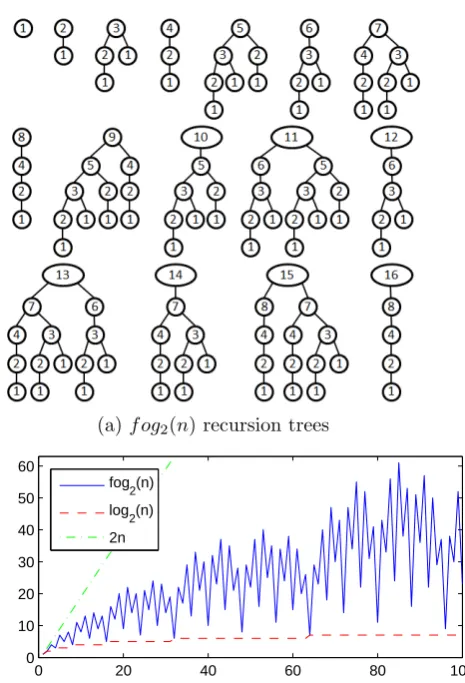
Computational running time complexity of the algo-rithm (4) can be represented as a recursion tree where the node has one or two children depending on its parity Fig. 2 (a) enumerates the first 16 recursion trees. Let the size of this binary recursion tree be f og2(n) as defined in (5).
f og2(n) =
1, ifn= 1
f og2(n2) + 1, ifn%2 = 0 f og2(⌈n2⌉) +f og2(⌊n2⌋) + 1, ifn%2̸= 0 (5) f og2(n) is not monotonically growing function but fluc-tuates as shown in Fig 2 (b).
(a)f og2(n) recursion trees
0 20 40 60 80 100
0 10 20 30 40 50 60
fog
2(n)
log
2(n)
2n
[image:2.595.64.274.67.160.2](b)f og2(n) graph in comparison tonand logn.
Figure 2: f og2(n)recursion trees and graph.
The concept in (5) can be generalized for thek-ary divide and conquer cases where each node has up tokchildren. The sizes of k-sub trees follow the integer partition into kbalanced parts defined in (6).
BIP(n, k) =
(z⌈n }|k {
k ⌉
, . . . , ⌈n
k ⌉
| {z }
˜
k=n%k
, ⌊n
k ⌋
, . . . , ⌊n
k ⌋ )
(6)
For examples, BIP(17,3) = (6,6,5) and BIP(22,4) = (6,6,5,5) . If n is divisible by k, all children have the unique size n
k. Ifnis not divisible byk, there are exactly two kinds of children, i.e.,⌈nk⌉and⌊nk⌋as defined in (6).
[image:2.595.323.552.542.595.2](a) first 21f og3(n)
[image:3.595.59.297.68.325.2](b) best (c) typical (d) worst case - unary - binary - full binary
Figure 3: f og3(n)recursion trees.
complexity of this algorithm can be defined as in (7).
f ogk(n) =
1, ifn= 1
2, ifn≤k
f ogk(nk) + 1, ifn%k= 0
f ogk(⌈nk⌉) +f ogk(⌊nk⌋) + 1, ifn%k̸= 0 (7) For the example of ternary (k= 3) case, Fig 3 (a) shows the first 21 recursion trees. In the worst case, it has a full binary tree as shown in Fig 3 (d) while it has a unary tree in the base case as given in Fig 3 (b). The Table 1 lists first 100 integer sequences forf og2(n),f og3(n), and f og4(n).
2.2
Properties of
f og
k(
n
)
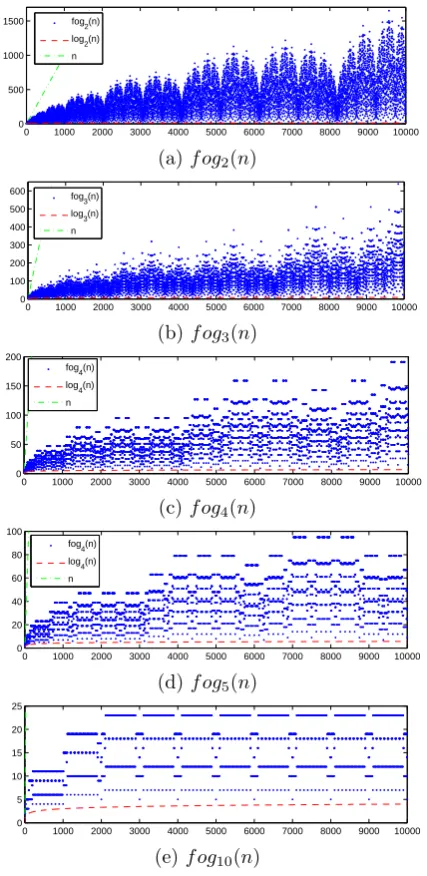
[image:3.595.331.545.145.584.2]The function in (7) is named asf ogfor two reasons. The first one is to be consistant with logarithm function in-troduced by Napier and the second reason is depicted in Fig 4 wheref ogk(n) integer values are ploted as dots in-stead of lines. This non-monotonic function looks like fogs.
Property 1 Non-monotonicity: f ogk(n1)̸≤f ogk(n2)if
n1< n2.
The first property off ogk(n) is straightforward as shown in Figs 2∼4.
Another obvious property off ogk(n) is its lower bound.
Property 2 The lower bound: f ogk(n) = Ω(logk(n)).
In the best case, the input size n is divisible by k and its sub-problem’s size is also divisible by k all the way to the base case. This case is Θ(logkn). This best case scenario occurs atn=km wherem is a positive integer as depicted in Fig. 4.
0 1000 2000 3000 4000 5000 6000 7000 8000 9000 10000 0
500 1000
1500 fog2(n)
log2(n)
n
(a)f og2(n)
0 1000 2000 3000 4000 5000 6000 7000 8000 9000 10000 0
100 200 300 400 500 600 fog
3(n)
log
3(n)
n
(b)f og3(n)
0 1000 2000 3000 4000 5000 6000 7000 8000 9000 10000 0
50 100 150 200
fog4(n)
log4(n) n
(c)f og4(n)
0 1000 2000 3000 4000 5000 6000 7000 8000 9000 10000 0
20 40 60 80 100
fog4(n) log4(n)
n
(d)f og5(n)
0 1000 2000 3000 4000 5000 6000 7000 8000 9000 10000 0
5 10 15 20 25
(e)f og10(n)
Figure 4: various f ogk(n) plots.
The worst case or the upper bound of f ogk(n) can be derived using theMaster theorem.
Theorem 1 The upper bound: f ogk(n) =O(Nlogk2).
Proof: In the worst case, the input size n and its all
Table 1: Θ(f ogk(n)) Integer Sequences.
k Integer sequence forn= 1,· · ·,100
2 1, 2, 4, 3, 7, 5, 8, 4, 11, 8, 13, 6, 14, 9, 13, 5, 16, 12, 20, 9, 22, 14, 20, 7, 21, 15, 24, 10, 23, 14, 19, 6, 22, 17, 29, 13, 33, 21, 30, 10, 32, 23, 37, 15, 35, 21, 28, 8, 29, 22, 37, 16, 40, 25, 35, 11, 34, 24, 38, 15, 34, 20, 26, 7, 29, 23, 40, 18, 47, 30, 43, 14, 47, 34, 55, 22, 52, 31, 41, 11, 43, 33, 56, 24, 61, 38, 53, 16, 51, 36, 57, 22, 50, 29, 37, 9, 38, 30, 52, 23,· · · 3 1, 2, 2, 4, 4, 3, 5, 5, 3, 7, 7, 5, 9, 9, 5, 8, 8, 4, 9, 9, 6, 11, 11, 6, 9, 9, 4, 11, 11, 8, 15, 15, 8, 13, 13, 6, 15, 15, 10, 19, 19,
10, 15, 15, 6, 14, 14, 9, 17, 17, 9, 13, 13, 5, 14, 14, 10, 19, 19, 10, 16, 16, 7, 18, 18, 12, 23, 23, 12, 18, 18, 7, 16, 16, 10, 19, 19, 10, 14, 14, 5, 16, 16, 12, 23, 23, 12, 20, 20, 9, 24, 24, 16, 31, 31, 16, 24, 24, 9, 22,· · ·
4 1 ,2 ,2 ,2 ,4 ,4 ,4 ,3 ,5 ,5 ,5 ,3 ,5 ,5 ,5 ,3 ,7 ,7 ,7 ,5 ,9 ,9 ,9 ,5 ,9 ,9 ,9 ,5 ,8 ,8 ,8 ,4 ,9 ,9 ,9 ,6 ,11 ,11 ,11 ,6 ,11 ,11 ,11 ,6 ,9 ,9 ,9 ,4 ,9 ,9 ,9 ,6 ,11 ,11 ,11 ,6 ,11 ,11 ,11 ,6 ,9 ,9 ,9 ,4 ,11 ,11 ,11 ,8 ,15 ,15 ,15 ,8 ,15 ,15 ,15 ,8 ,13 ,13 ,13 ,6 ,15 ,15 ,15 ,10 ,19 ,19 ,19 ,10 ,19 ,19 ,19 ,10 ,15 ,15 ,15 ,6 ,15 ,15 ,15 ,10,· · ·
Fork= 3 andk= 4,nlog32=n0.6309 andnlog42=n0.5,
respectively. The tigher upper bound for the binary case is given as follows.
Theorem 2 The upper bound for k = 2: f og2(n) =
O(Nlog2(φ)).
Proof: An odd numbernis always divided into odd and
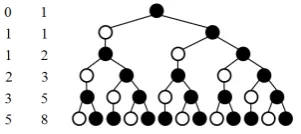
even parts. An even number n is either a sum of two smaller even numbers in the best case or two smaller odd numbers in the worst case. In the worst case, we have a Fibonaccitree as shown in Fig 5. In the standard divide and conquer form,a=1fh+2fh+1
fh+fh+1 = 1+
fh+1
fh+2 = 1+
1
φ =φ. Since T(n) = φT(n/2) + 1 belongs to the case 1 in the Master Theorem,T(n) = Θ(Nlog2(φ))≈Θ(N0.6942)
Figure 5: Worst case Fibonacci tree.
The following obvious inequality for the logarithm func-tion, i.e., logk
1(n)≤logk2(n) fork1> k2, does not apply
to the fog functions.
Fallacy 1 f ogk1(n)≤f ogk2(n)fork1> k2.
Proof: While there are cases that the claim is true, e.g.,
(f og3(64) = 18)<(f og2(64) = 7), there are also numer-ous counter examples like (f og3(96) = 16)̸≤(f og2(96) = 9), (f og4(63) = 9) ̸≤ (f og3(63) = 7), etc. Hence, f ogk1(n)̸≤f ogk2(n) fork1> k2.
Despite the Fallacy 1, fog is getting lower and fading as kincreases, i.e., the lower and upper bounds off ogk1(n)
are lower than those off ogk2(n) fork1> k2as shown in
Fig 4. The following corollary 1 is an exceptional case of Fallacy 1.
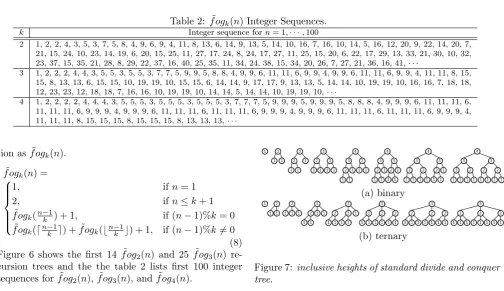
(a) ˜f og2(n) recursion trees.
(b) ˜f og3(n) recursion trees.
Figure 6: ˜f ogk(n)recursion trees.
Corollary 1 f ogkp(n)≤f ogk(n) for a positive integer,
p.
Proof omitted.
2.3
Leave-one-out
divide
and
conquer,
˜
f og
k(
n
)
There are two kinds of divide and conquer recursion trees. One is the standard one where n is the number of leaf nodes. The other is theleave-one-out divide and conquer where n is the total number of both internal and leaf nodes. In the leave-one-out divide and conquer tree, k number of subtrees have their sizes of either⌈(n−1)/k⌉ or⌊(n−1)/k⌋. Themedian split tree[8] is an example of the binary leave-one-out divide and conquertree. In [3], k-aryleave-one-out divide and conquerare categorized as simplyk-ary size-balanced tree.
[image:4.595.97.248.429.496.2]func-Table 2: ˜f ogk(n) Integer Sequences.
k Integer sequence forn= 1,· · ·,100
2 1, 2, 2, 4, 3, 5, 3, 7, 5, 8, 4, 9, 6, 9, 4, 11, 8, 13, 6, 14, 9, 13, 5, 14, 10, 16, 7, 16, 10, 14, 5, 16, 12, 20, 9, 22, 14, 20, 7, 21, 15, 24, 10, 23, 14, 19, 6, 20, 15, 25, 11, 27, 17, 24, 8, 24, 17, 27, 11, 25, 15, 20, 6, 22, 17, 29, 13, 33, 21, 30, 10, 32, 23, 37, 15, 35, 21, 28, 8, 29, 22, 37, 16, 40, 25, 35, 11, 34, 24, 38, 15, 34, 20, 26, 7, 27, 21, 36, 16, 41,· · ·
3 1, 2, 2, 2, 4, 4, 3, 5, 5, 3, 5, 5, 3, 7, 7, 5, 9, 9, 5, 8, 8, 4, 9, 9, 6, 11, 11, 6, 9, 9, 4, 9, 9, 6, 11, 11, 6, 9, 9, 4, 11, 11, 8, 15, 15, 8, 13, 13, 6, 15, 15, 10, 19, 19, 10, 15, 15, 6, 14, 14, 9, 17, 17, 9, 13, 13, 5, 14, 14, 10, 19, 19, 10, 16, 16, 7, 18, 18, 12, 23, 23, 12, 18, 18, 7, 16, 16, 10, 19, 19, 10, 14, 14, 5, 14, 14, 10, 19, 19, 10,· · ·
4 1, 2, 2, 2, 2, 4, 4, 4, 3, 5, 5, 5, 3, 5, 5, 5, 3, 5, 5, 5, 3, 7, 7, 7, 5, 9, 9, 9, 5, 9, 9, 9, 5, 8, 8, 8, 4, 9, 9, 9, 6, 11, 11, 11, 6, 11, 11, 11, 6, 9, 9, 9, 4, 9, 9, 9, 6, 11, 11, 11, 6, 11, 11, 11, 6, 9, 9, 9, 4, 9, 9, 9, 6, 11, 11, 11, 6, 11, 11, 11, 6, 9, 9, 9, 4, 11, 11, 11, 8, 15, 15, 15, 8, 15, 15, 15, 8, 13, 13, 13,· · ·
tion as ˜f ogk(n). ˜
f ogk(n) =
1, ifn= 1
2, ifn≤k+ 1
˜
f ogk(n−k1) + 1, if (n−1)%k= 0 ˜
f ogk(⌈n−k1⌉) + ˜f ogk(⌊n−k1⌋) + 1, if (n−1)%k̸= 0 (8) Figure 6 shows the first 14 ˜f og2(n) and 25 ˜f og3(n) re-cursion trees and the the table 2 lists first 100 integer sequences for ˜f og2(n), ˜f og3(n), and ˜f og4(n).
3
Applications
In [3], the problem of finding the sum of heights of a size balanced k-ary tree, Zk′(n) or a leave-one-out divide and conquer recursion tree was considered. Although the value can be computed in linear time by traversing the tree in the depth first order manner, it can be com-puted faster in Θ( ˜f ogk(n)) because we need to traverse only one sub-tree if all ksub-trees’ sizes are the same or only two sub-trees otherwise. Here some other problems whose computational complexities are either Θ(f ogk(n)) or Θ( ˜f ogk(n)) are examined.
Let Zk(n) be a standard divide and conquer recursion
tree. Let H(Zk(n)) be the sum of each node’s height in
Zk(n) and it is defined recursively as in (9).
H(Zk(n)) =
0, ifn≤1
⌈logkn⌉+ ˜k×H(Zk(
⌈n k ⌉
)) +(k−k˜)×H(Zk(
⌊n k ⌋
)) otherwise (9) Note that ˜k=n%k as defined in (6). Table 3 shows the first 100 integer sequences of H(Z2(n)) and H(Z3(n)). The direct definition based recursive algorthm in (9) would take Θ(nlogk2). However, if the following condi-tion in (10) is added to (9), the value can be computed in Θ(f ogk(n)).
H(Zk(n)) =⌈logkn⌉+k×H (
Zk(
n k)
)
ifn%k= 0 (10)
In Neil Sloane’s Online Encyclopedia of Integer Se-quences[4], the sum ofinclusive heights[3] of various
ex-(a) binary
(b) ternary
Figure 7: inclusive heights of standard divide and conquer tree.
plicit tree data structures are more popular than the sum ofexclusive heights or simply heights. Hence, Fig 7 enu-merates the first eight standard binary and ternary divide and conquer trees with each node containing the inclusive height. With a little modification to (9) and (10), the sum of the inclusive heights can be computed in Θ(f ogk(n)) as well. Table 4 shows the first one hundred integer se-quences of the sum of inclusive heights of binary and ternary trees.
Similarly, computing the several other properties of stan-dard or leave-one-out divide and conquer trees would have their computational complexities of Θ(f ogk(n)) or Θ( ˜f ogk(n)) naturally. For example, the path length of a rooted tree [9], P(T) is another important property and P(Zk(n)) andP(Zk′(n)) can be computed in Θ(f og2(n)) and Θ( ˜f og2(n)), respectively.
Strahler numbering of a binary tree, T, S(T) is another important property of a binary tree. S(T) in (11) can be computed in linear time if one uses thepostorder traver-sal[10].
S(T) =
0, ifT is empty
max(S(TL), S(TR)), ifS(TL)̸=S(TR)
S(TL) + 1, ifS(TL) =S(TR) (11)
[image:5.595.50.555.67.358.2]Table 3: Sum of heights of standard divide and conquer tree integer sequences.
k Integer sequence forn= 1,· · ·,100
2 0, 1, 3, 4, 7, 9, 10, 11, 15, 18, 20, 22, 23, 24, 25, 26, 31, 35, 38, 41, 43, 45, 47, 49, 50, 51, 52, 53, 54, 55, 56, 57, 63, 68, 72, 76, 79, 82, 85, 88, 90, 92, 94, 96, 98, 100, 102, 104, 105, 106, 107, 108, 109, 110, 111, 112, 113, 114, 115, 116, 117, 118, 119, 120, 127, 133, 138, 143, 147, 151, 155, 159, 162, 165, 168, 171, 174, 177, 180, 183, 185, 187, 189, 191, 193, 195, 197, 199, 201, 203, 205, 207, 209, 211, 213, 215, 216, 217, 218, 219,· · ·
3 0, 1, 1, 3, 4, 5, 5, 5, 5, 8, 10, 12, 13, 14, 15, 16, 17, 18, 18, 18, 18, 18, 18, 18, 18, 18, 18, 22, 25, 28, 30, 32, 34, 36, 38, 40, 41, 42, 43, 44, 45, 46, 47, 48, 49, 50, 51, 52, 53, 54, 55, 56, 57, 58, 58, 58, 58, 58, 58, 58, 58, 58, 58, 58, 58, 58, 58, 58, 58, 58, 58, 58, 58, 58, 58, 58, 58, 58, 58, 58, 58, 63, 67, 71, 74, 77, 80, 83, 86, 89, 91, 93, 95, 97, 99, 101, 103, 105, 107, 109,· · ·
Table 4: Sum of inclusive heights of standard divide and conquer tree integer sequences.
k Integer sequence forn= 1,· · ·,100
2 1, 4, 8, 11, 16, 20, 23, 26, 32, 37, 41, 45, 48, 51, 54, 57, 64, 70, 75, 80, 84, 88, 92, 96, 99, 102, 105, 108, 111, 114, 117, 120, 128, 135, 141, 147, 152, 157, 162, 167, 171, 175, 179, 183, 187, 191, 195, 199, 202, 205, 208, 211, 214, 217, 220, 223, 226, 229, 232, 235, 238, 241, 244, 247, 256, 264, 271, 278, 284, 290, 296, 302, 307, 312, 317, 322, 327, 332, 337, 342, 346, 350, 354, 358, 362, 366, 370, 374, 378, 382, 386, 390, 394, 398, 402, 406, 409, 412, 415, 418,· · ·
3 1, 4, 5, 9, 12, 15, 16, 17, 18, 23, 27, 31, 34, 37, 40, 43, 46, 49, 50, 51, 52, 53, 54, 55, 56, 57, 58, 64, 69, 74, 78, 82, 86, 90, 94, 98, 101, 104, 107, 110, 113, 116, 119, 122, 125, 128, 131, 134, 137, 140, 143, 146, 149, 152, 153, 154, 155, 156, 157, 158, 159, 160, 161, 162, 163, 164, 165, 166, 167, 168, 169, 170, 171, 172, 173, 174, 175, 176, 177, 178, 179, 186, 192, 198, 203, 208, 213, 218, 223, 228, 232, 236, 240, 244, 248, 252, 256, 260, 264, 268,· · ·
using (12) in Θ(f og2(n)) and Θ( ˜f og2(n)), respectively.
S(Z(n)) =
0, ifZ(n) is empty
max(S(Z(⌈n2⌉)), S(Z(⌊n2⌋))), ifn%2̸= 0 S(Z(n2)) + 1, ifn%2 = 0 (12)
4
Conclusions
Both standard and leave-one-out divide-and-conquer re-cursion trees are pervasive in computer science. This arti-cle introduced the parity based divide and conquer recur-sion trees. The functions of sizes of standard and leave-one-out divide and conquer trees were denoted asf ogk(n) and ˜f ogk(n), respectively. Properties and some applica-tions of these funcapplica-tions were discussed. We strongly be-lieve that there are a plethora of applications of these functions in various problems which use the divide and conquer algorithms.
Another contribution of this article is discovering new in-teger sequences. All inin-teger sequences in Tables 1∼4 are surprisingly not currently in Neil Sloane’s Online Ency-clopedia of Integer Sequences [4]. These are important and pervasive integer sequences which involve divide and conquer algorithms.
The divide and conquer recursion is one of the widely studied areas and Master theorem and Akra-Bazzi method attempt to generalize these recursive formulae. However, they cannot handlef ogk(n) and ˜f ogk(n) func-tions. Studying the more generalized parity based recur-sive forms is one of the future works.
References
[1] T.–H. Cormen, C.–E. Leiserson, and R.–L. Rivest, Algorithm, MIT Press, Cambridge, Massachusetts, 1993
[2] D.–S. Malik and M.–K. Sen, Discrete Mathematic Structures: Theory and Applications, Thomson Course Technology, 2004
[3] S.-H. Cha, “On Integer Sequences Derived from Bal-ancedk-ary trees,” inProceedings of American Con-ference on Applied Mathematics, Cambridge, MA, pp. 377-381, Jan 2012.
[4] N. J. A. Sloane. The On-Line Encyclopedia of Inte-ger Sequences. http://oeis.org/
[5] D.–E. Knuth, The Art of Computer Programming, vol 2: Seminumerical Algorithms,2nd ed. Addison-Wesley, 1981
[6] B. Datta and A.–N. Singh,History of Hindu Math-ematics,vol 1, Bombay, 1935
[7] M. Akra and L. Bazzi,“On the solution of linear recurrence equations,” Computational Optimization and Applications, vol. 10(2), pp. 195–210, 1998.
[8] B.–A. Sheil, “Median Split Trees: A Fast Lookup Technique for Frequently Occurring Keys,” Comm. ACM, vol. 21, n. 11, pp. 947–958, 1978.
[9] T.–C. Hu and K.–C. Tan, “Path Length of Binary Search Trees,”SIAM Journal on Applied Mathemat-ics, vol. 22, n. 2, pp. 225234, 1972.