Abstract— Kinetic and thermodynamic calculations were
performed on some low and high carbon steels in order to study the oxidation behaviour of the alloying elements, manganese, Mn, and silicon, Si, during annealing in H2-N2 atmospheres. In these calculations external and internal oxidation of the alloying elements were predicted where conditions of annealing were specified. The bulk external and internal oxidation as well as grain boundary oxidation of these alloying elements were predicted at a constant annealing temperature of 600oC and in H2-N2 gas mixtures containing up to 5 vol.%H2. The calculations showed that oxidation of Si and Mn in all annealing conditions is possible and that annealing in gas mixtures containing (1 vol.%H2), (3 vol.%H2) and (5 vol.%H2) will prevent the oxidation of iron. In high carbon steel both external and grain boundary oxidation of Si may take place.
Index Terms— Annealing, oxidation, kinetics, alloying elements, internal oxidation, external oxidation.
I. INTRODUCTION
OR a steel sheet to be galvanizable its surface must exhibit certain properties. Of these properties, the surface must be clean of any oxides that may develop during annealing. During the annealing treatment, however, it is inevitable that some of the elements will be subjected to oxidation by the furnace atmosphere. Despite how large the reducing power of the furnace atmosphere may be, it is still oxidizing for some of the elements present in the steel. Furnace gas mixtures employed during the annealing process normally comprise H2 and N2 with varying proportions. At equilibrium conditions, there always exists an oxygen partial pressure balanced by an H2-H2O reaction at a specific temperature. In highly reducing atmospheres, low H2O/H2 ratios, this equilibrium oxygen partial pressure is very small, however, is still enough to oxidize some elements. Therefore, to avoid the oxidation of an element at a certain temperature is to select an H2O/H2 ratio that results in an oxygen partial pressure that is less than the equilibrium
oxygen partial pressure for that reaction. Considering the kinetics of reactions, however, a deviation from the
Manuscript received September 5, 2011; revised January 1, 2012. H. T. Abuluwefa is with the University of Misurata, Libya. (phone:
behaviour predicted from thermodynamic calculations may exist. In this case, the diffusion rates of the oxidizing and/or oxidizable species through the metal matrix or the oxide layer control the oxidation process. Considering the selective oxidation of a solute in an alloy, at the beginning of metal/gas interactions, oxidation may take place internally or externally. If the inward diffusion of oxygen ions in the alloy exceeds that of the outward diffusion of solute ions oxidation will take place internally in the alloy matrix. This process will continue until a critical mole fraction of the formed oxide in the alloy is reached so to obstruct any further oxygen diffusion into the matrix. From this point on oxidation will take place externally. However, if on the other hand, the outward diffusion of solute ions exceeds that of the inward diffusion of oxygen ions, external oxidation will take place from the start of the oxidation process. In the subsequent sections, the thermodynamics and kinetics of the reactions of Fe, Mn and Si in various H2-N2 mixtures in the temperature range 100oC to 800oC is considered. The aspect of internal/external oxidation of Mn and Si of the steel alloys under consideration will be analyzed at 600oC in the gas mixtures of different dew points
II. TERMODYNAMICSOFREACTIONS
Considering the chemistry of the steels under investigation, Table I, the elements Fe, Mn and Si will be considered in the thermodynamic calculations. The Gibbs free energy of a reaction is a measure of its spontaneity. For any oxidation reaction;
(1)
where M denotes a metal, the equilibrium oxygen partial pressure, PO2, at a given temperature is evaluated from the
Gibbs free energy as follows:
(2)
where R is the gas constant, T is the temperature (Kelvin) and K is the equilibrium constant of the reaction. The
Thermodynamics and Kinetics of Surface
Oxidation of Steels during Annealing in H
2
-N
2
Atmospheres
H. T. Abuluwefa
F
MO
O
M
2
2
2
K
RT
G
o
ln
partial pressure of oxygen in (1), and since the other elements are in the solid state, can be expressed as :
(3)
This oxygen partial pressure is used to calculate the solution of oxygen in iron, i.e.,
O2 = 2 O [1 wt.%]bcc iron (4)
and subsequently, the H2O/H2 ratio from the reaction:
H2 + O [1 wt.%]bcc iron = H2O (5)
TABLE1
PROPOSEDSTEELCMPOSITIONS(WT.% X 10-2).
Grade No.
C Mn Si Nb V Ti Cu
1 5 70 5 1.5
2 5 140 25 5 10 2
3 6 120 5 120 2 150
4 15 150 150
5 4 160 2
The dew point of the H2-H2O gas mixture can be calculated using the following expression [2] :
(6)
Free energies of formation for the various reactions used in the calculations are given in Table II.
TABLE II
REACTIONS USED IN THE THERMODYNAMIC CALCULATIONS [3]. (DATA WITHIN THE STEEL ANNEALING
TEMPERATURE RANGE).
Reaction ΔGo (Joules)
3/2 Fe + O2 = ½ Fe3O4, -545,530 + 156.375 T
2 Fe + O2 = FeO -519,200 + 125.1 T
6 FeO + O2 = 2 Fe3O4 -624,520 + 250.2 T
Si + O2 = SiO2 -209,000 + 174.0 T
2Mn + O2 = 2MnO -769,400 + 145.6 T
O2 = 2O [1wt.%]bcc iron [3] -311,220 + 85.38 T
2H2 + O2= 2H2O(g) -479,000 + 16.28
TlnT-18.5T H2 [1 atm]+ O [1 wt.%]bcc iron = H2O[1
atm],
-83,889 + 8.14 T ln T – 51.93T
III. KINETICSOFREACTIONS
As mentioned earlier, the phenomenon of internal and external oxidation of a solute element in an alloy is determined by the relative diffusion rates of its atoms and that of oxygen atoms in the alloy matrix. Wagner [2] has developed a quantitative mathematical model describing the process of internal oxidation of the less noble element in ideal single crystal binary alloys. In the development of this model certain assumptions were made. It is important at this stage to point out some of these assumptions and compare them with the conditions of an actual metal annealing process. The assumptions of the model include: - The alloy microstructure is an ideal single crystal
system. In reality , the microstructure is far from being of a single crystal but consist of multiple grains of various sizes.
- Diffusion of species takes place through a single crystal. In reality, many structural defects exist through which diffusion can take place. These include grain boundaries, dislocations, micro-channels, etc. It is to bear in mind that use of this mathematical model on actual steels would only give an approximate estimation of the internal/external processes of the steels under investigation.
A. Internal Oxidation Depths
Assuming that no oxide has formed on the surface of the alloy, the thickness of the internally oxidized layer,
(cm), may be expressed as :
(7)
where is a dimensionless parameter which is defined below, t is time in seconds, and Do is the oxygen mass
transfer coefficient (cm2/s) defined as:
(8) where A is the oxygen diffusion frequency factor, Qo is the
activation energy for oxygen diffusion in the alloy. Equation (7) assumes an isothermal diffusion controlled type of internal oxidation mechanism. In the evaluation of the dimensionless parameter , an establishment of concentration gradients of the diffusing species at the alloy surface is assumed where the flux of oxygen and solute atoms obey Ficks’s second law of diffusion. Hence for oxygen diffusion in the alloy:
(9)
where No is the mole fraction of oxygen in the alloy and x is
the distance from the alloy surface (cm). Equation (9) can be solved analytically using the error function technique for semi-infinite systems [5] combined with the boundary conditions given in Fig. 1.
RT Go
O
e
P
2
15
.
273
6245
.
3
]
ln[
9
.
6151
)
(
2
ppm o
dew
O
H
C
T
RT Q
o
o
Ae
D
t
N
D
x
N
oo o
1
2 2
2 1
)
(
2
D
ot
Fig. 1. Steady state concentration gradients of oxygen and solute element during internal oxidation.
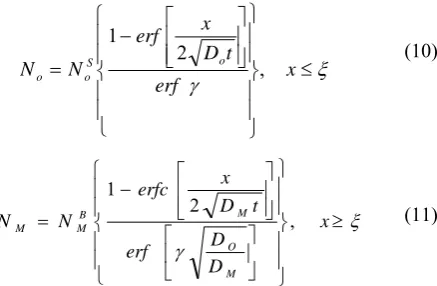
The solution yields the following relationships for the mole fraction of oxygen, No, and the alloy element, NM:
(10)
(11)
where the subscripts S and B denote the surface and bulk of the alloy, respectively, and DM is the diffusion coefficient of
the solute element in the alloy (cm2/s). The inward flux of oxygen atoms and outward flux of solute atoms at the interface between oxidized and un-oxidized layer (x = ), is equal. That is:
(12)
where n is the number of oxygen atoms per solute element atom of the formed oxide. Using (7), (10), (11) and (12), the following relationship is obtained:
(13)
The dimensionless parameter can be evaluated from (13) under the conditions that the ratio of the diffusion coefficient of oxygen to that of the solute element is greater than or equal to unity (i.e., internal oxidation process) and that is less than or equal to unity. Hence:
(14)
and (7) becomes:
(15)
Equation (15) can be used to predict the depth from metal surface of internally oxidized layer in a single crystal binary alloy.
B. Transition from Internal to External Oxidation According Wagner’s theory, internal oxidation of the less noble element in the binary alloy occurs during isothermal heat treatment where the oxygen partial pressure at the alloy surface is fixed. The internal oxidation will continue until a critical value of oxygen mole fraction in the alloy is reached. At this stage the oxygen inward flow is blocked by the formed oxide. Under the same conditions, external oxidation of the solute element will take place if its mole fraction in the alloy exceeds a critical value. It can be shown that this critical mole fraction is [4], [5] :
(16)
where V and VXO are the molar volume on the alloy and
oxide respectively (cm3/mol), and D
X is the diffusion
coefficient of the solute element in the alloy (cm2/s). Equation (16) predicts the transition from internal to external oxidation in the case where diffusion of atoms takes place through the alloy crystal. However, transition from internal to external oxidation where the diffusion process is along grain boundaries can be approximated by assuming larger diffusion coefficients [6]. If the grain boundary diffusion activation energies are assumed to be half their values for bulk diffusion, the following expression is obtained: (17) x erf t D x erf N
No oS o ,
2 1 x D D erf t D x erfc N N M O M B M M , 2 1
x M M x O Ox
N
nD
x
N
D
M O D D M O erf B M S OD
D
erfc
e
D
D
e
N
n
N
M O
2 2 ) ( 2 12
B M O S OnN
t
D
N
2 12
B M S OnN
N
2 1 * ,2
X XO O S O B crit XD
nV
D
VN
g
N
2 1 2 2 * , ,2
where QM is the activation energy of solute element in the
alloy. The atmospheres oxidizing power is controlled by controlling its PH2O/PH2 ratio. This ratio is used to determine
the mole fraction of adsorbed oxygen at the alloy surface using (5) as follows:
(18)
where MW denotes molecular weight. Equations (16) and (17) are used to discuss aspects of internal and external oxidation for the systems Fe-Mn and Fe-Si. The variables used in these expressions are given in Table III.
TABLE III
VARIABLES USED IN EQUATIONS (16) AND (17).
Eleme nt
n g V
(cm3/mol)
VXO
(cm3/mol) (cmAX 2/s) (J/atm.K) QX
Alloy 7.09
O 3.7 x 10⁻² 96,446
Mn 1 0.3 13.22 1.49 23,347
Si 2 0.3 26.12 8.0 24,895
.
IV. RESULTSANDDISCUSSION OF RESULTS
A Thermodynamics of Reactions
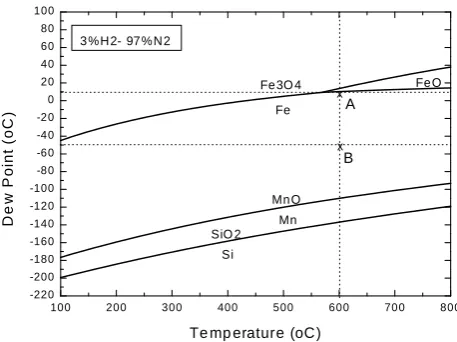
Expressing these results in terms of the oxidizing potential of the H2-N2 gas mixture used in the annealing process, the plot is reconstructed using different H2O/H2 ratios. The hydrogen content of the gas was varied from 1 to 5vol.%. Fig. 2 gives the oxidation curves for Fe, Mn and Si at different temperatures in a gas mixture of (1 vol.%H2) with different dew points. Points A and B on the graph represent annealing at 600oC in gas mixtures with dew points 10oC (H2O/H2 = 0.275) and –50 oC (H2O/H2 = 7.8 x 10⁻⁴), respectively. It can be seen that annealing in conditions corresponding to point B (dew point –50 oC) only Si and Mn will form oxides. However, annealing at conditions corresponding to point A will result in total oxidation of all elements including Fe.
Fig. 2. Equilibrium oxidation curves for selected element in a gas mixture of (1vol.% H2 – 99 vol.% N2 ) at different temperatures and gas dew points.
[image:4.595.311.540.381.552.2]Figure 3 gives the same curves but for annealing in (3 vol.% H2 - 97 vol.% N2). Again, annealing at point B is still under the iron oxidation curves but at point A will likely result in the formation of FeO.
Fig. 3. Equilibrium oxidation curves for selected element in a gas mixture Of ( 3 vol.% H2 – 97 vol.% N2 ) at different temperatures and gas dew
points.
RT G
H O H
O Fe S
O
e
P
P
MW
MW
N
0
2 2
100
1
100 200 300 400 500 600 700 800
-220 -200 -180 -160 -140 -120 -100 -80 -60 -40 -20 0 20 40 60 80 100
x x
B A
SiO2
Si Mn M nO
F eO
Fe F e3O4 1% H2- 9 9%N2
De
w P
o
in
t
(o
C)
Tem peratu re (o C)
100 200 300 400 500 600 700 800
-220 -200 -180 -160 -140 -120 -100 -80 -60 -40 -20 0 20 40 60 80 100
x x
B A
SiO 2 Si
Mn Mn O
Fe O
Fe Fe 3O 4 3 % H 2- 97 % N 2
D
e
w P
o
in
t (
o
C)
As can be seen from Fig. 4, annealing in a gas mixture containing (5 vol.% H2 will not results in the oxidation of iron.
Fig. 4. Equilibrium oxidation curves for selected element in a gas mixture of (5 vol.% H2 – 95 vol.% N2 ) at 600oC.
B Kinetics of Reactions
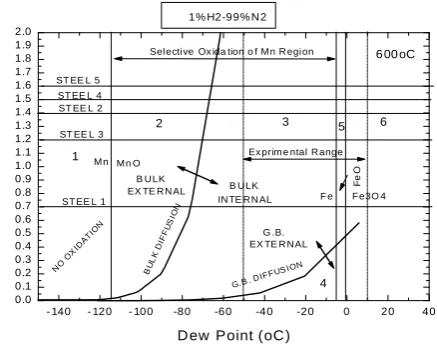
[image:5.595.316.545.183.354.2]Using equations (16) and (17) the internal/external oxidation domains due to bulk and grain boundary diffusion processes are plotted in Figs. 5 through 8 for the elements Mn and Si at 600oC. An explanation of the different regions in these graphs follows. Region 1 in Fig. 5 is where no oxidation is expected for the elements Mn and Fe. In region 2, external oxidation of Mn is expected. In region 3 an internal oxidation due to bulk diffusion is expected while in region 4 an external oxidation due to grain boundary diffusion is expected. Regions 5, and 6 are the stability regions for FeO and Fe3O4, respectively. The experimental range lies between dew points –50oC to 10oC.
Fig. 5. Domains for internal/external oxidation of Fe-Mn binary alloys in (1 vol.%H2-N2) atmosphere at 600oC (bulk and grain boundary diffusion
processes).
The steels under investigation are represented by the horizontal lines shown in the graphs. Considering the oxidation of Mn in 1 vol.% H2 shown in Fig. 5, it can be
[image:5.595.322.548.426.598.2]seen that annealing in gas mixtures with dew points between –50oC and 10oC at 600oC will result in the internal oxidation of Mn for all the steels. However, some external oxidation may take place as a result of grain boundary diffusion. As shown in Figs. 6 and 7, the above discussion applies to annealing in gas mixtures containing 3 and 5 vol.% H2 at the same conditions. As can be seen from these graphs, increasing the H2 content of the H2-N2 gas mixtures decreases the regions where internal oxidation is predicted.
Fig. 6. Domains for internal/external oxidation of Fe-Mn binary alloys in (3 vol.%H2-N2 ) atmosphere at 600oC (bulk and grain boundary diffusion
processes).
Fig. 7. Domains for internal/external oxidation of Fe-Mn binary alloys in (5 vol.% H2-N2) atmosphere at 600oC (bulk and grain boundary
diffusion processes).
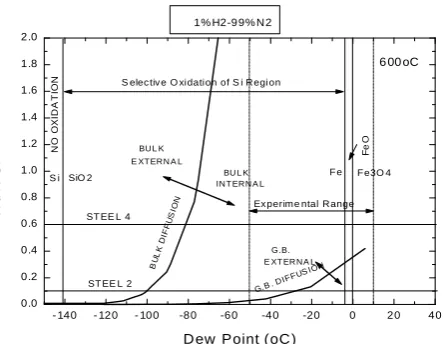
For the oxidation of Si during annealing in a gas mixture containing (1 vol.% H2 ) with dew point –50oC, shown in Fig. 8, an internal oxidation is expected for all the steels under investigation, again with the possibility of some external oxidation due to grain boundary diffusion. However, annealing in the gas mixture with dew point of 10oC, Steel 2 should not develop any grain boundary external oxidation. This observation applies to annealing in gas mixtures of (3 and 5vol.% H2) under the same conditions discussed above.
100 200 300 400 500 600 700 800
-220 -200 -180 -160 -140 -120 -100 -80 -60 -40 -20 0 20 40 60 80 100
x x
B A
SiO 2 Si
Mn Mn O
Fe O
Fe Fe 3O 4 5 %H 2 - 9 5%N 2
De
w P
o
in
t (
o
C)
Te mp erature (oC)
- 140 - 120 - 100 -80 -60 -40 -20 0 20 40 0.0
0.1 0.2 0.3 0.4 0.5 0.6 0.7 0.8 0.9 1.0 1.1 1.2 1.3 1.4 1.5 1.6 1.7 1.8 1.9 2.0
6 5
4 3 2
1
6 00 oC
EX TE R NAL G .B.
G.B. DI FFUS IO
N
BU LK
DIF FU
SIO N
B ULK ST EE L 5 ST EE L 4 ST EE L 2
Mn O Mn
Ex prim e ntal Range
B ULK
NO OX
IDAT ION
Sel ective Ox ida tion o f Mn R egi on
ST EE L 3
ST EE L 1 F e3O 4
1% H2-99% N 2
EX TE R NAL
IN TE RN AL
Fe
O
F e
Wt
.%
M
n
D ew Point (oC )
- 140 - 120 - 100 -80 -60 -40 -20 0 20 40 0.0
0.1 0.2 0.3 0.4 0.5 0.6 0.7 0.8 0.9 1.0 1.1 1.2 1.3 1.4 1.5 1.6 1.7 1.8 1.9 2.0
6 00 oC
EX TE R NAL G .B.
G.B. DI F FUS IO
N
BU LK
D IFF
US IO
N
B U LK ST EE L 5 ST EE L 4 ST EE L 2
Mn O M n
Ex prim e ntal Range B ULK
NO OX ID ATION
Sel ective Ox ida tion o f Mn R egi on
ST EE L 3
ST EE L 1 F e3O 4
3% H2-97% N 2
EX TE RN AL INTE R NAL
Fe
O
F e
Wt
.%
M
n
D ew Point (oC )
- 140 - 120 - 100 -80 -60 -40 -20 0 20 40 0.0
0.1 0.2 0.3 0.4 0.5 0.6 0.7 0.8 0.9 1.0 1.1 1.2 1.3 1.4 1.5 1.6 1.7 1.8 1.9 2.0
EX TE R NAL G .B.
G.B. DI FFUS IO
N
BU LK
D IFF
US ION
B ULK ST EE L 5
ST EE L 4 ST EE L 2
Mn O M n
Ex prim e ntal Range B ULK
N O OX ID AT ION
Sel ective Ox ida tion o f Mn R egi on
ST EE L 3
ST EE L 1
F e3O 4 5% H2-95% N 2
EX TE RN AL
IN TE RN AL
Fe
O
F e
Wt
.%
M
n
[image:5.595.50.269.514.686.2]
Fig. 8. Domains for internal/external oxidation of Fe-Si binary alloys in 1 vol.%H2-N2 atmosphere at 600oC (bulk and grain boundary diffusion
processes).
V. CONCLUSIONS
Based on thermodynamic and kinetic considerations of the process of annealing at 600 oC of the steels under consideration in H2-N2 gas mixtures containing up to 5 vol.%H2 with different dew points, the following conclusions are drawn:
1 - Oxidation of Si and Mn in all annealing conditions under study is possible.
2 - Annealing in gas mixtures with dew points less than 2oC in (1 vol.%H2), 10oC in (3 vol.%H2), and 20oC in (5 vol.%H2) will prevent the oxidation of iron.
3 - Internal oxidation of Mn of all the steels in the experimental range is predicted. However, some external oxidation may take place due to grain boundary diffusion,
4 - Internal oxidation of Si of is predicted. However, some external oxidation may take place due to grain boundary diffusion,
5 - Total internal oxidation of steel grade 2 when annealed in gas mixtures with dew points greater that –20oC in (1vol.%H2), -15oC in (3vol.%H2), and –10oC in (5vol.%H2) are predicted.
REFERENCES
[1] D. R. Gaskell,” Introduction to Metallurgical Thermodynamics”, McRaw-Hill Book Company, 2nd Ed.,1981, pgs. 242, 585, 586.
[2] C. Wagner, “Reaktionstypen bei der Oxydation von Legierungen”, Zeitschrift fur Elektrochemie, 63 (7) (1959), 772-782.
[3] J. Szekely and N. J. Themelis, “Rate Phenomena in Process Metallurgy”, John Wiley $ Sons, Inc, 1971, pp. 177-179.
[4] J. M. Mataigne, M. Lamberigts, V. Leroy, “Selective Oxidation of Cold-Rolled Steel during Recrystalization Annealing”, Developments in the Annealing of Sheet Steels, The Minerals, Metals & Materials Society, 1992, pp. 511-528.
[5] R. C. Weast, “Handbook of Chemistry and Physics”, CCR Press, Inc, Boca Raton, Florida, 1986-1986.
[6] J. M. Mataigne, M. Lamberigts, V. Leroy, “Selective Oxidation of Cold-Rolled Steel during Recrystalization Annealing”, Develpments in the Annealing of Sheet Steels, The Minerals, Metals & Materials Society, 1992, pp. 511-528.
[7] R. C. Weast, “Handbook of Chemistry and Physics”, CCR Press, Inc, Boca Raton, Florida, 1986-1986.
- 140 - 120 - 100 -80 -60 -40 -20 0 20 40
0.0 0.2 0.4 0.6 0.8 1.0 1.2 1.4 1.6 1.8 2.0
6 00 oC
Ex perime ntal Range
BU LK DIF
FU SIO
N
G.B. D IFFUS
ION G.B. E XT ER N A L BU L K
BU L K
N
O
O
X
ID
A
T
ION S elec tiv e O xidation of S i Regi on
ST EE L 4
ST EE L 2
F e3O 4 1% H2-9 9% N 2
S i SiO 2
E XTERN A L
IN T ERN A L
Fe
O
F e
W
t.%
Si