THE FUNCTIONS OF THE OCELLI OF CALLIPHORA
(DIPTERA) AND LOCUSTA (ORTHOPTERA)
BY P. B. CORNWELL*
Department of Zoology and Applied Entomology, Imperial College, London
{Received I May 1954)
INTRODUCTION
Investigations into the visual capacities of the ocelli have been made by many previous workers, and various functions have been attributed to these organs. In the present work Calliphora erythrocephala Meigen and Locusta imgratoria L. were employed to investigate the functions of the ocelli in form perception and as adjuncts to phototaxis. The optical powers of the ocellus were considered, and behaviour experiments were performed under critically controlled experimental conditions.
REARING OF MATERIAL
The culture of Calliphora was developed from a single batch of eggs in order as far as possible to obtain standardized insects. The locusts were offspring of gregarious parents and the methods of rearing were also standardized.
STRUCTURE OF THE OCELLUS
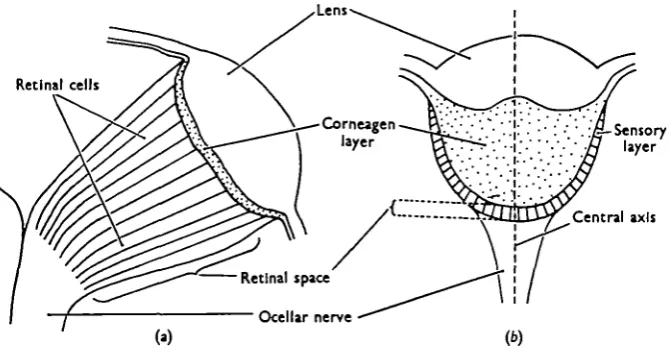
The biconvex lens of Calliphora is supported by a thin layer of corneagen cells containing minute pale brown pigment granules. The sensory layer lies immediately below the corneagen cells and is composed of elongate retinal cells. Rhabdoms were not identified with certainty, and it is therefore assumed that the retinal cells are sensitive to light along their entire length. The volume occupied by the sensory layer, 0-06 mm. deep, constitutes the retinal space (Fig. 1).
The lens of Locusta is also biconvex with a slight depression at the centre of the inner surface. The corneagen cells are extremely elongate and collectively they form a hemispherical body below the lens. Ovoid dark brown pigment granules are confined to the peripheral corneagen cells which curve inwards radially below the lens to form a pigment iris. The sensory cells are pear-shaped and aggregated in groups of four forming a distinct cup-shaped layer. Rhabdoms are again apparently absent, and the length of the sensory cells constituting the retinal space does not exceed 0-05 mm.
FORM PERCEPTION AND LIGHT-COLLECTING POWERS
The possibility of form perception by the ocellus depends on the ability of the lens to form an image, the location of the image plane relative to the retinal space and the ability of the sensory layer to receive and utilize the image so formed.
If an ocellar lens of either the blowfly or the adult locust is removed and a drop of water placed on the inner surface of the lens is allowed to evaporate almost to dryness, well-defined inverted images may be seen through the microscope. Such images may be obtained of objects placed between 2 cm. and 5 m. from the lens of
Calliphora, and less well-defined images obtained of objects placed as far as 1 m.
from the lens of Locusta. If, however, the inner surface of the lens is perfectly dry it is impossible to obtain these images because the roughness of the inner surface of the lens scatters the light in all directions. It is reasonable to assume that the inner surface of the lens in situ is in contact with body fluid and that light rays passing through the lens are converged to a focus as in the isolated lens.
Lens*
Retinal cells
Sensory layer
Central axis
7
"Retinal space
' Ocellar nerve •
[image:2.451.60.395.219.395.2]W (*)
Fig. 1. Vertical section of the ocellus (diagrammatic), (a) Calliphora, (6) Locusta.
Parry (1947) showed that the principal focus of the ocellar lens of Locusta occurs 5 times as far behind the lens as the retina, and Homann (1924), working on a number of insects, showed that in no case were the focal and retinal planes co-incident. Both these workers conclude that form perception by the ocellus is impossible.
The radius of curvature of the outer surface of the lateral and frontal ocellar lenses of Calliphora was measured by a modification of Homann's method (1924). From six-determinations a mean value of 0-07 mm. (± 0-004) was obtained. Using the same method for the adult locust, nineteen determinations provided the mean value of 0-47 mm. ( + 0-024). The radius of curvature for Locusta was also obtained graphically from medianly cut hand sections of lenses placed in a micro-projector. By this second method, twenty-five determinations provided the mean value of 0-44 mm. (±0-016). The mean obtained by these two methods in Locusta was therefore 0-46 mm. The refractive index of the ocellar lens was determined by Dethier's method (1942) and the values of 1-55 and 1-48 were obtained for
Calli-phora and Locusta respectively. The lenses were observed to be of uniform
Assuming that light refraction does not occur at the inner surface of the lens in contact with the comeagen layer the physical constants determined above provide focal length values of 012 mm. for CaUiphora and 0-96 mm. for Locusta.
The distance of the outer limit of the retinal space from the outer surface of the lens of CaUiphora, 004 mm., was ascertained by focusing the microscope first on to the outer surface of the lens, and secondly, focusing through the lens to the distal ends of the retinal cells. The measurements obtained from a vernier scale were then corrected for the difference in the refractive indices of air and the lens. Parry (1947), using this method for Locusta, apparently without the refractive index correction, said that 'the distance between the front of the lens and the retina was never found to reach the value of 0-09 mm.' In the present work, the mean thickness of the lateral and frontal ocellar lenses of the adult locust, ascertained from forty-six medianly cut sections, was found to be 0-18 mm. (± 0-008). From sixteen determi-nations of the distance of the distal ends of the sensory cells from the inner surface of the lens, measured along the central axis, a mean of 0-27 mm. (± 0-003) was obtained. The mean distance of the outer limit of the retinal space from the front of the lens of the locust was therefore 0-45 mm. The physical constants determined above provide means of o-10 and 0-50 mm. for the distance of the inner limit of the retinal space from the outer surface of the ocellar lenses of CaUiphora and Locusta respectively.
These investigations have shown that the plane of the principal focus of the ocelli of CaUiphora and Locusta is located deeper in the ocellus than the limits of the retinal space. Light rays impinging upon the ocellar lens from objects close to the insect will converge to a focus even further outside the retinal space than parallel rays entering the lens from objects at infinity. Therefore, as the positions of the image space and retinal space are not coincident, the possibility of form perception of any degree of accuracy by the ocelli of these species must be excluded, and the ability of the sensory cells to receive and utilize the images formed need not be considered. It may be noted, however, that in both species, the centre of curvature of the outer surface of the lens occurs within the retinal space, but the implications of this are not clear.
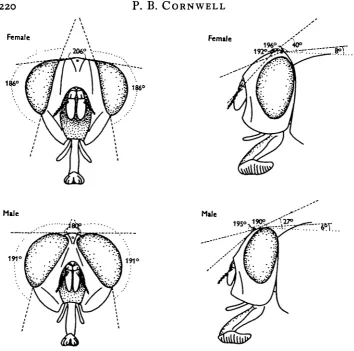
The visual fields of the ocelli were investigated by observing the reflexion on the ocellar lens of a moving light source. When this reflexion was not obtained the source was known to be outside the visual field. This method provides the maximum possible field limited by the position of the ocelli on the head, and assumes that the sensory cells are stimulated by light incident anywhere on the lens. The presence of a cup-shaped sensory layer in Locusta and of retinal cells in CaUiphora of which the distal ends are very close to, and have the same curvature as the hind surface of the lens, suggests that even oblique rays will be received. The wide visual fields of the ocelli (Figs. 2, 3) afforded by their positions on the head, and the structural arrangement of these organs support the suggestions of previous workers that the ocellus is essentially a light-gathering and not an image-forming organ.
Female
186°
Ferrule
206? \
[image:4.451.53.408.65.416.2]Mile Male
Fig. 2. Fields of view of the compound eyes and ocelli of CalUphora.
[image:4.451.77.393.440.617.2]BEHAVIOUR EXPERIMENTS
Experimental conditions
Behaviour experiments with Calliphora were carried out at a constant temperature of 21° C. and relative humidity of 70%, and experiments with Locusta at a constant temperature of 27-5° C. and relative humidity of 75 %. The room used was without windows and the four walls and ceiling were papered with a non-reflecting black paper. The bench was also covered with this paper, and as a further precaution the edges of the bench were boarded to a height of 6 in. with cardboard covered with black velvet. No electric light sources were permitted except those essential for the experiments, and in all cases these were screened by 2I in. thick water niters to obviate temperature effects. To remove reflexions, the glass niters were covered with black paper and all other apparatus was also blackened. The aper-tures of the light sources in experiments with Calliphora were 3-8 cm. with the centre at 5 cm. above the bench surface, and those in experiments with Locusta were 10 cm., with the centre 6-5 cm. above the bench surface. When recording tracks of walking insects, gloves and a coat of black material were worn to reduce reflexions from the hands and clothes.
Techniques
The part played by the ocelli in the phototactic reactions of Calliphora and
Locusta was investigated by a series of experiments in which the effect of the
occlusion of either the ocelli or compound eyes on the directional response was obtained. The eyes were occluded with an almost odourless and extremely quick-drying lacquer* which was applied to unetherized insects under a binocular micro-scope. In Calliphora there was no significant difference in the intensity of reaction between the sexes and as in the males the ocelli and compound eyes are very close together, only females were used in experiments where ocellar occlusion was required. A period of 30 min. was allowed after occlusion before starting an experiment, during which time the extra cleaning movements induced by handling and occlusion were effected. At the end of an experiment all insects were examined under a binocular dissecting microscope to check the complete occlusion of the sense organs. Results for insects with incomplete occlusion were discarded. In experiments made with walking flies the wing apices were removed and again a 30 min. period was allowed for the completion of cleaning activity. Locust hoppers were used to investigate walking reactions because adults showed a strong tendency to fly even with the wings severely clipped.
Phototactic reactions of Calliphora
It was first shown that Calliphora does not exhibit telotaxis. Two light sources of equal illumination and screened by water filters were placed 35 cm. apart, and paths made by intact flies released about 1 m. from the lights were seen to approxi-mate to a line drawn symmetrically between the sources. Twenty intact insects
were then released at the same distance from a single light source and in every case movement was made towards the source. On blackening one compound eye, repeated circus movements were made and from these observations it was con-cluded that Calliphora exhibits positive photo-tropotaxis.
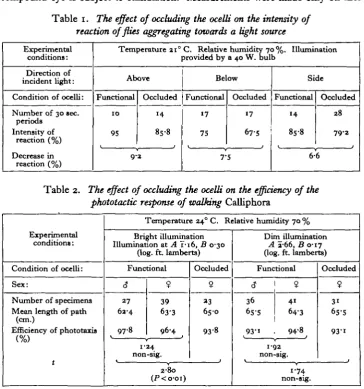
To investigate the phototactic reaction of Calliphora, twelve normal flies were introduced into a 15 cm. Perspex cube on which a line was drawn dividing the cube into two equal halves. Random distribution of the flies was allowed and with incident light from above, the number of flies in the upper half was noted at intervals of 30 sec. The ocelli were occluded and the experiment was repeated. The procedure was again repeated subjecting specimens with ocelli functional and occluded to incident light from below and also from one side. The intensity of reaction was calculated as a percentage of the flies present in that half of the cube nearer to the light source. The results shown in Table 1 indicate that when the ocelli are occluded there is a small decrease in the intensity of reaction for all directions of incident light. The difference between the intensities of reaction to incident light from above and below is attributed to the association of the positive phototactic response with a negative geotactic response. To investigate more critically the effect of occluding the ocelli on the phototactic response, the following experiment was conducted in which the length of path made by walking flies was recorded.
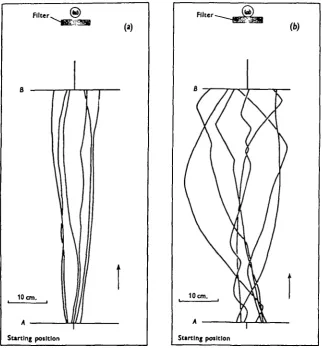
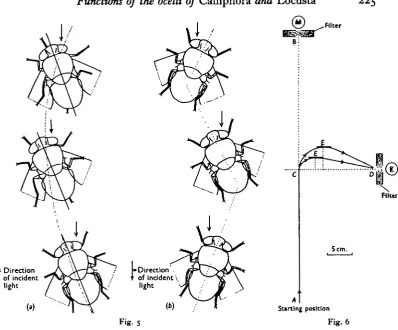
An insect which exhibited a completely efficient phototactic response would move in a straight line towards a light source. By measuring with an opisometer the actual distance travelled along a curved path (Fig. 4), and comparing this with the length of the straight line, a measure of the 'efficiency' of response is obtained. Paths of males and females with functional ocelli were measured, and the results shown in Table 2 indicate that there was no significant difference between the efficiency of movement of the sexes. Females only were used when path measure-ments were made of flies with occluded ocelli. Using a bright light source occlusion of the ocelli produced a significant decrease in the efficiency of response. Paths made by females with functional and occluded ocelli are represented to scale in Fig. 4. The angular paths made with occluded ocelli resulted from the two modes of progression shown in Fig. 5. When a less luminous source was used no significant difference between the efficiency of response of normal and anocellate insects was obtained. With this source the paths and modes of progression made with functional and occluded ocelli resembled those made by flies with occluded ocelli when subjected to bright illumination.
on females, first with functional ocelli, and secondly with ocelli occluded. The light source B orientates the fly at C so that on the illumination of source D only one compound eye is subject to stimulation. Measurements were made only on flies
Table 1. The effect of occluding the ocelli on the intensity of
reaction of flies aggregating towards a light source
Experimental conditions:
Direction of incident light:
Condition of ocelli:
Number of 30 sec. periods
Intensity of reaction (%)
Decrease in reaction (%)
Temperature 210 C. Relative humidity 70 %. Illumination provided by a 40 W. bulb
Above Functional 10 95 Occluded 14 85-8 9-3 Below Functional 17 75 Occluded 17 675 7-5 Side Functional 14 85-8 l Occluded 28 79-2 6-6
Table 2. The effect of occluding the ocelli on the efficiency of the
phototactic response of walking Calliphora
Experimental conditions:
Condition of ocelli:
Sex:
Number of specimens Mean length of path
(cm.)
Efficiency of phototaxis
t
Temperature 24° C. Relative humidity 70 %
Bright illumination Illumination at A 1-16, B 0-30
(log. ft lamberts)
Functional i 27 62-4 97-8 0 39 63-3 964 t 1-24 non-sig. Occluded -t o 65-0 93-8 t 2-8o (P<o-oi) Dim illumination A a-66, B 0-17 (log. ft. lamberts)
Functional <J 36 65-5 931 •t o 41 64-3
94-8 1 1-92 non-sig. Occluded 0 31 65-5 93-1 1-74 non-sig.
Positions A and B refer to the starting and finishing positions, respectively, of the paths shown in Fig. 4.
224
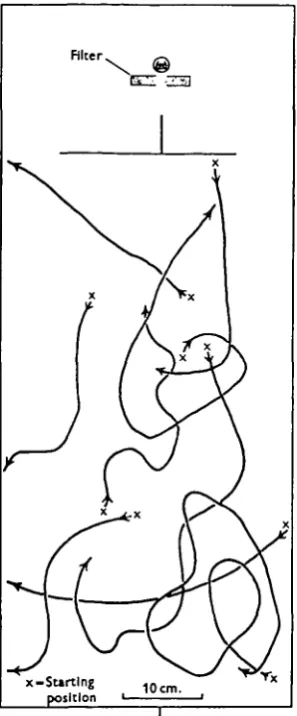
Finally, the role played by the ocelli in the phototactic response was investigated by occluding both compound eyes and subjecting flies with only the ocelli functional to a single light source. The erratic paths made by walking flies released facing in varied directions and at varied distances from the light source are shown in Fig. 7. From this experiment it may be concluded that phototactic orientation by means of the ocelli alone is impossible.
Fig. 4. (a) Paths made by walking Calliphora with the compound eyes and ocelli functional. (6) Paths made by walking Calliphora with the compound eyes functional and the ocelli occluded.
These experiments have shown that under laboratory conditions the ocelli of
Calliphora are incapable of mediating a directional response and that with the
[image:8.451.65.388.170.518.2]225
= Direction I of incident
light
^Direction . T of Incident\
light
Rlter
(b)
5 cm.
Suiting poiltlon
Fig. 5 Fig. 6
Fig. 5. (a) Mode of progression of walking Calliphora with the ocelli occluded, (b) Mode of progression of walking CaUiphora with the ocelli occluded.
[image:9.451.29.428.71.401.2]Fig. 6. The phototactic response of Calliphora to a change in direction of incident light.
Table 3. The effect of occluding the ocelli of Calliphora on the phototactic response to a change in direction of incident light
Experimental conditions:
Condition of ocelli:
Number of specimens Mean distance of tangent
at E from line CD (mm.)
t
Temperature 21° C. Relative humidity 70 %. Illumination at C produced by
source £ = 0-27. Illumination at C produced by
source D = 0-70. (log. ft. lamberts)
Functional
19 250
Occluded
14 426
4*14 (P<o-ooi)
[image:9.451.98.355.454.623.2]226
Bozler (1926), with bees by'Muller (1931) and with ants by Homann (1924). Wellington (1953), however, showed that with low light intensity in the laboratory,
Sarcophaga with the ocelli alone functional exhibited undirectional movement, but
[image:10.451.152.301.152.511.2]outdoors under conditions of high light intensity such insects produced movements as directed as any made by flies with the compound eyes functioning. Further, he
Fig. 7. Paths made by walking Calliphora with the compound eyes occluded and the ocelli functional.
showed that the ocelli of adult Sarcophagid flies are sensitive to changes in polarized light from the sky. Von Buddenbrock (1937) and Kalmus (1945) sug-gested that the ocelli aid in orientation during flight, and that they assist in the phototactic orientation of bees and ants has been suggested by Muller (1931). At low light intensities Bozler (1926) established that ocellar occlusion resulted in a slight reduction of the 'normal phototactic orientation potential'.
of Calliphora with occluded ocelli suggests that there is a correlation of function between the ocelli and compound eyes. In dim illumination there was no marked decrease in the efficiency of response which suggests that in Calliphora there is a threshold of light intensity below which the ocelli are not sensitive. In bright illumination, the progression of normal flies was such that the longitudinal axis of the insect was alined with the steepest light gradient and corresponding parts of both compound eyes were equally stimulated. With the ocelli occluded, two types of progression were exhibited during which the axis of the insect was not alined with the steepest light gradient, but at an angle to it, and there was a failure for the corresponding parts of the two eyes to be stimulated. The curved path shown in Fig. 5 (a) appears to be the result of a turning reflex evoked by stimulation of the antero-lateral region of one compound eye. In Fig. 5(6) it appears that as the result of too great a turn the antero-lateral region of the other eye becomes stimu-lated and this eye continues to mediate turning reflexes. Continued progression of this type results in the formation of a zigzag path, and movement towards the light source may result from either one or both these modes of progression. When a fly is subjected to a change in direction of incident light and the lateral region of one compound eye is stimulated, a turning movement is mediated by the lateral ommatidia followed by a direct path to the source resulting from equal stimulation of the anterior regions of both compound eyes. When the ocelli are occluded, however, orientation appears to be the result only of a reflex turning movement mediated by the lateral ommatidia, producing a less efficient path to the source.
Phototactic reactions of Locusta
First-instar nymphs were subjected to a single light source and paths made by walking hoppers are represented in Fig. 8. There appears to be no uniformity in the direction of walking, and from these observations it was impossible to define the normal phototactic response of Locusta. As similar results were obtained with all nymphal stages the following experiment was designed.
A grid of ninety-six 2 in. squares was drawn on a piece of black paper (Fig. 9), and a light source and filter placed at one end provided the light intensities as shown. One hundred and fifty hoppers (seventy-five first-instar and seventy-five second-instar nymphs) were released one at a time at the opposite end of the grid directly facing the source, and paths were recorded by noting the squares through which the hoppers walked. The table of frequency obtained has been represented as a density diagram which shows that there is a tendency for the hoppers to walk either towards the source or at right angles to it. The latter type of orientation is a 'light compass reaction' as was observed by Kennedy (1945).
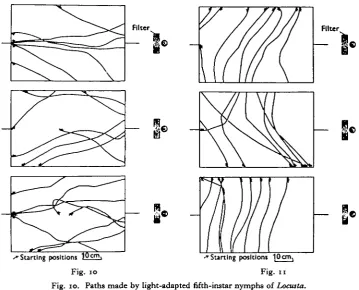
many cases the paths are at a constant acute angle with the direction of incident light, and in repeated trials with the same specimen this angle is approximately preserved. The same three specimens were then placed in complete darkness for half an hour at the same temperature, and repeated trials were again made. The
Filter © m 1-25 12! h-53 l « 1-5! \ri 72 23S Filter B Sorting position 10 n 22 82 68 7 7 3 6 15 25 59 45 24 13 10 12 19 22 39 32 18 10 7 15 14 20 28 28 11 12 8 9 9 16 24 22 10 6 11 11 12 15 22 21 e 7 7 10 10 12 20 21 6 5 4 6 6 11 17 21 9 3 2 5 5 5 18 19 13 7 4 4 5 6 17 11 9 4 3 5 6 5 15 13 7 6 4 4 5 3 12 14 5 } 2 t© 1©
Starting position, 10cm.
[image:12.451.45.409.161.478.2]Fig. 8
Fig. 8. The phototactic response of first-instar nymphs of Locusta.
Fig. 9. Locutta first- and sccond-instar nymphs. See text. (A) Light intensities recorded in log. ft. lamberts. (B) Frequency with which squares were entered by hoppers. (C) Figures of (B) grouped.
paths shown in Fig. 11 indicate that under these conditions hoppers exhibit a light compass reaction. Locusts released facing the source progress slightly towards it, turn, and continue at right angles to it. Those released facing at right angles to the light continue to walk approximately in this direction.
hoppers progressed towards the illuminating source with fixation of the stimulus in the anterior regions of both eyes.
The next experiment was designed to ascertain the effect of occluding the ocelli on the directional response. Two sources (with water filters) emitting light of the same intensity were placed at opposite sides of a circle. The circumference was divided into seventy-two equal portions each corresponding to an angle of five degrees (see Fig. 12). Four fifth-stage nymphs were dark-adapted for a period of 1 hr. and each was subjected to the illumination of the two light sources in the following manner. With one source illuminated and the other extinguished, a hopper was placed at the centre of the circle, first facing the source (i.e. at o degrees),
Rlter
I©
•••Starting posltloni 1 0 " " ' -*• Starting positions 10cm,
[image:13.451.47.407.217.507.2]Fig. 10 Fig. I I
Fig. 10. Paths made by light-adapted fifth-instar nymphs of Locusta. Fig. 11. Paths made by dark-adapted fifth-instar nymphs of Locusta.
230
40 W. bulbs situated so as to ensure equal adaptation of both eyes, and they were then subjected to the procedure described above for the dark-adapted state. Following this, the ocelli were occluded, the insects were again dark-adapted for
[image:14.451.100.356.128.265.2]Left Right I
Fig. 12. Design of experiments to investigate the phototactic reactions of Locutta hoppers.
Table 4. The effect of occluding the ocelli on the directional response of
fifth-instar Locusta nymphs after dark- and light-adaptation
Condition of ocelli: Presentation angle: Mean Specimen 1 2 3 .4 Mean Mean 1 2 3 4 Mean angle of' Source Right Left Right Left Right Left Right Left angle of' Right Left Right Left Right Left Right Left 0 ° Normal 0 0
deviation from ] 80 33 75 67 42 57 61 30 68 41 79 49 55 5° 78 5°
deviation from j
23 18 6 27 29 7 21 17 2 4 11 1 2 1 2 6 0 2 2 18 41
' 1800
Darallelism 39 58 5 2 2 8 25 35 53 56
5 3 7 Darallelism 2 2 35 3 i 2 1 67 2 9 48 35 27-1 270° ' after 58 78 46 43 67 69 6 0 36 ' after 18 33 23 4 2 5° 13 3 4 18 o° Occluded 9O° 1800
dark-adaptation 66 53 77 8 2 6z 65 81 59 59 2 8 85 57 4 3 67 56-4 2 48 63 45 37 5 i 23 82 3 light-adaptation 19 25 33 41 64 4 3 5° 49 2 6 17 55 46 63 35 7 2 3 4 4 6-47 33 8 0 39 50 7 0 6 2 50 2 270° 5O 58 41 46 56 5° 29 72 28 25 53 4 0 77 57 53 4 2
[image:14.451.62.392.282.571.2]influences (a) the 'positiveness of phototaxis' and (b) 'deviation from parallelism'. The values of 'positiveness of phototaxis' were obtained by ascribing a value of 1 to each positive observation and a value of ^ to each observation of 90 or 270 degrees. The mean angle of 'deviation from parallelism' was calculated after converting the observed angles to their equivalents lying between the limits of o and 90 degrees. Paths towards the source at angles of 30 or 330 degrees, or away from the source at 150 or 210 degrees are thus both equivalent to 30 degrees when considering 'deviation from parallelism'.
Table 5. The effect of occluding the ocelli on the directional response of
fifth-instar Locusta nymphs after dark- and light-adaptation
Condition of ocelli:
Presentation angle: Specimen 1 2 3 4 Mean 1 2 3 4 Mean ' Positiveness Source Right Left Right Left Right Left Right Left ' Positiveness Right Left Right Left Right Left Right Left o° Normal 9O° of phototaxis 2-5 5 0
i - o 0 - 5 i - o
3-o 4-o 5-o o-S S-o o-o o-o o-S 2-O 2-5 4 - 0
1 of phototaxis S-o S-o S-o 5-o 5-o
5 - 0
S-o 5-o
5'O 5 0
5 - 0 5'O 3 0 S'O S-o S-o 4 1800 ' after o-o 2-O o-o o-o o-o o-o
i - o i - o
S3
' after
4 - 0 5 - 0
S-o S-o
i - o 5 - 0
5-o
5 - 0
69
27o° 0 °
dark-adaptation
i - o 4 - 0
o-o o-o o-o o-S
2-O i - o 1 o-o 3-5 5-o 2'O I-O 2-O 2-S 5-o light-adaptation S-o
5 - 0
5 - 0
5*o
2 - 0 5 0
S-o S-o
S-o S-o
5 - 0
5-o
I-O 4 0 S-o
4 - 0
Occluded
0 0 °
o-o 3 0
4-5
i - o
o-o
i - S i - o
S-o
5-o S-o 5-o
4 - 0
3-S 4-5
i - o 5 - 0
1800
o-o
i - o
o-o
i - o
o-o
o-o o-o 5-o
1 7 2
3 0 5-o
i - o 2-O
I-O 3 0
I-O 4 - 0
3-So
270°
i - S 4 - 0
i - o
o-o
o-o o-o
o-s
4 - 0
S-o
5 - 0
4 0 i - o
o-o
4 - 0 2 - 0
4-o 1
The analyses of variance showed that there was a significant effect of adaptation (P<o-ooi) on the 'positiveness of phototaxis' and angular direction of path. Furthermore, the significance of the interaction between the state of adaptation and condition of ocelli ( P < o o o i for 'positiveness of phototaxis', P<o-oi for 'deviation from parallelism') showed that hoppers with their ocelli normal or occluded behaved differently in the two states of adaptation. Separate analyses of variance for each state of adaptation showed that occlusion of the ocelli produced a significant effect only in the state of light-adaptation, decreasing the positiveness of the reaction and increasing the angular 'deviation from parallelism'.
presenta-232
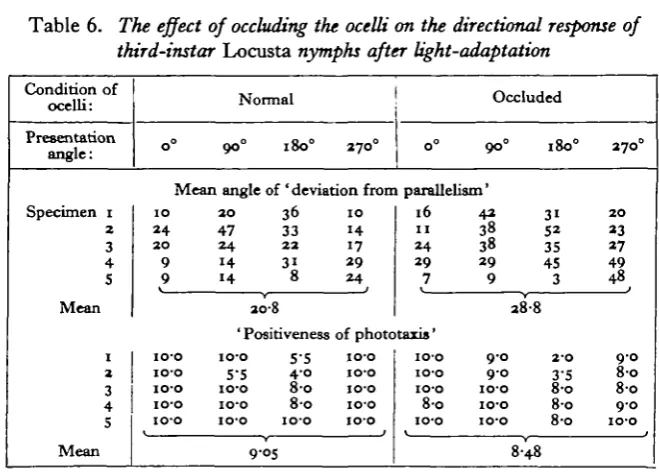
[image:16.451.60.390.187.424.2]tion angles. As ocellar occlusion was found to have an effect only after light-adaptation no observations were made for the dark-adapted state. The sequence of dark- and light-adaptation and of ocellar occlusion as described in the previous experiment was however retained. Statistical analysis of the results shown in Table 6 indicated that occlusion of the ocelli increased the angular ' deviation from parallelism' (P<o-oi), but appeared to have no significant effect on the 'positive-ness of phototaxis'. These results thus only partly confirmed the results of the previous experiment using fifth-stage nymphs.
Table 6. The effect of occluding the ocelli on the directional response of
third-instar Locusta nymphs after light-adaptation
Condition of ocelli: Presentation angle: Specimen i 2 3 4 S Mean I z 3 4 5 Mean o° Normal
oo° 180° 270°
Mean angle of 'deviation frorr IO 2 4 2O 9 9 io-o io-o IO'O io-o io-o 2O 36 47 33 24 22 14 3i 14 8 20-8 ' Positiveness 100 55 5-5 4-o io-o 8-o io-o 8-o io-o io-o 9-05 1 0 14 17 2 9 2 4 0° Occluded
9 0 °
1 parallelism' 16 11 2 4 29 7 of phototaxis' IO-O io-o io-o io-o io-o io-o IO-O io-o 8-o IO-O 4 2 38 38 2 9 9 9 0 9 0 io-o io-o io-o 180° 31 52 35 45 3
2 8 8
2-O 3-5 8-o 8 0 8-o 8-48 27o° 2 0 23 27 49 48 J 9 0 8 0 8 0 9 0 io-o
Final experiments were made to investigate the part played by the ocelli in phototaxis when the compound eyes are occluded. Hoppers with the ocelli alone functional were placed at varied distances from, and at different angles to, a source of illumination. Their paths shown in Fig. 13 were found to have a strong resem-blance to those made by completely bund hoppers. To confirm this observation the following experiment was designed.
blind specimens will exhibit no directional response. Movement will be random and the mean angle of 'deviation from parallelism' will be 45 degrees. A final statistical test was made to ascertain whether the experimental values obtained with the ocelli alone functional differed significantly from this expected mean. A non-significant probability was obtained, indicating that the hoppers behaved as if blind.
[image:17.451.147.305.153.469.2]Filter
Fig. 13. Paths made by nfth-instar nymphs of Locusta with the compound eyes occluded and the ocelli functional.
These experiments have shown that the phototactic response of walking hoppers depends on their state of photic adaptation. Dark-adapted hoppers exhibit a light compass reaction and walk approximately at right angles to a light source, with fixation of the stimulus by a set of ommatidia in the lateral region of one compound eye. Light-adapted hoppers progress towards the source with fixation of the stimulus in the anterior regions of both compound eyes. It is difficult to explain the mechanism responsible for these two types of orientation. It has been shown (Roeder, 1953) that light-adaptation may be described as a loss in sensitivity of the eye and that an increase in light intensity is required to cause recurrence of a response. Presumably light-adaptation in the locust results in a decrease in the
234
[image:18.451.46.408.209.457.2]sensitivity of the compound eyes, the lateral ommatidia are then unable to fix the source and a response may be mediated only by the more sensitive ommatidia of the anterior regions of both compound eyes. Occlusion of the ocelli was shown to decrease the efficiency of orientation only when the sensitivity of the eye is decreased by light-adaptation and when a response is evoked by the stimulation of-the ommatidia of the anterior regions of the compound eyes. When the compound eyes are occluded, the ocelli alone are not capable of mediating a directional response under the light conditions of the laboratory, and the insects behave as if blind.
Table 7. The effect of occluding the ocelli on the directional response of
fifth-instar Locusta nymphs when the compound eyes are also blackened
Condition of compound eyes: Condition of ocelli: Type of adaptation: Presentation angle: Specimen 1 2 3 4 Mean 1 2 2 4 Mean o° 33 36 2 6 5 1 6 0 6 0 7-0 7 - 0
Occluded
Occluded
9O° 1800 27OC
Mean angle of
56
4b
66
4 0
46
i - o
4-5 2-O I-O 3 45 54 4 1 59 6 3 1 5 1 59 5 1 0 ° Occluded Normal Dark
00° 180° 27o°
deviation from parallelism' 16 38 49 39 31 52 59 49 60 53 44 36 46-8 ' Positiveness of phototaxis' i - o
3-o
i - o
'•5
97
5-o
6 - 0
4'5
7 - 0 7-0 7 - 0
6-5
7 - 0
O-O 2-O
S-o 3-0 6 5 3-0 5-0 o-o
4 6 6
58
39 56
7 0
6 0 7 - 0 5 - 0
4-5 o° 2 0 44 33 66 7-0 7-0 5-5
4 - 0
Occluded
Normal
Light
00° 1800
5i 45 37 50 64 35 48 60
47-9
7-0 i - o 5-o 5'° 4-5 o-o 4-0 1-s 4-25 270° 7 i 60 44 38 4-5 5-o
3 - 0
4-0
t
DISCUSSION
Bozler (1926), Parry (1947) and Von Buddenbrock (1937), have concluded that the ocelli stimulate the compound eyes thereby serving a photokinetic function. That the ocelli play a part in phototaxis has been suggested by Miiller (1931) and Friederichs (1931), Kalmus and Von Buddenbrock, but that the ocelli appear to play no part in immobile orientation (photo-akinesis) has been demonstrated by Volkonsky (1939). Lowne (1878), Homann (1924), Wolsky (1933), Parry (1947) and Lubbock (1889) suggest that the ocelli possibly perceive light intensity or quick changes in light intensity.
The present work has shown that the efficiency of phototactic reactions mediated by the compound eyes is under certain conditions significantly reduced when the ocelli are occluded. In Calliphora their influence is manifest only under conditions of high light intensity when the less efficient response appears to be mediated by the antero-lateral ommatidia. In Locusta their influence is manifest only when the sensitivity of the compound eyes is reduced by light-adaptation, and when orienta-tion depends on the stimulaorienta-tion of the anterior part of the eye. In both species the experimentally observed behaviour may be explained by the following theory. Orientation of normal Calliphora is such that there is equal stimulation of the anterior regions of both compound eyes, but on the occlusion of the ocelli this arrangement is upset. It is suggested that ocellar occlusion results in a decrease in the sensitivity of the ommatidia of the anterior region of the compound eye, that they are then unable to function together and that orientation is mediated by the antero-lateral ommatidia. By this process the decrease in sensitivity of the eye is made good by less direct responses in which a greater number of ommatidia become stimulated. This theory is substantiated by the results obtained with
Locusta, for a decrease in the efficiency of response of this species is evident only
when normal orientation is mediated by the anterior regions of the compound eyes, and not when the response is effected by the lateral ommatidia of one eye. It is possible that the ocelli function in co-ordinating the responses mediated by the contra- and ipsi-lateral ommatidia, described by Mast (1923). It must be pointed out that the effect of occluding the ocelli of Locusta is manifest only when the sensitivity of the compound eye is reduced by light-adaptation. Under these conditions the effect of occlusion may be more evident than when orientation is mediated by highly sensitive compound eyes. Also, in Calliphora the influence of the ocelli is evident only when stimulated by a high light intensity. It is suggested that the degree to which the ocelli influence the response depends on the intensity of stimulation and the state of sensitivity of the compound eyes.
To conclude this discussion on the contribution of the ocelli to phototaxis, one may consider the efficient phototactic orientation of normal insects to be the result of directional responses mediated by the compound eyes, the efficiency of movement being maintained by the ocelli which correct directional deviations. The suggestion that the absence of ocellar stimulation resulting from occlusion decreases the sensitivity of the anterior regions of the compound eyes does not imply that a physical change occurs in these facets, but that there is a decrease in the excitation of the nerve elements from these receptors. Such a decrease in nervous excitation
will not only be manifest in a decrease in the efficiency of directional response, but also in the speed of reaction or photokinetic response to stimulation. In immobile orientation or photo-akinesis, however, where efficiency or speed of movement is not the essential criterion of response, the stimulatory function of the ocelli to the nervous system will not be evident.
SUMMARY
1. By determining the appropriate physical constants of the ocellus it is shown that in both Calliphora and Locusta the focal plane lies much deeper than the retinal space so that the eye cannot perceive form with any accuracy.
2. The large visual fields afforded by their position on the head and the position and shape of their retinae suggest that the ocelli are efficient light-gathering units. 3. The ocelli alone are unable to mediate phototactic responses to light of the intensities employed in these experiments.
4. The efficiency of phototactic reactions mediated by the compound eyes is, under certain conditions, significantly greater when the ocelli are intact than when they are occluded.
5. In Calliphora this stimulatory influence of the ocelli is not manifest at a low light intensity.
6. In Locusta nymphs, ocellar occlusion produces an effect only when the compound eyes are light-adapted and orientation depends on light stimulating the anterior part of the eye.
7. In both species, the experimentally observed behaviour is explicable on the theory that ocellar occlusion causes a decrease in the sensitivity to light of the anterior part of the compound eye.
The writer wishes to offer his sincere thanks to Prof. O. W. Richards, Dr N. Waloff and Mr R. G. Davies for their interest in the work and helpful comments on the draft of this paper. Acknowledgement is also made to the Anti-Locust Research Centre for the supply of locust hoppers.
REFERENCES
BOZLER, E. (1926). Experimentelle Untersuchungen tiber die Funktion der Stimaugen der Insekten. Z. vargl. Physiol. 3, 145-82.
BRANDT, H. (1937). Untersuchungen ilber die Anderung der photo- und geotaktischen Reaktionen der Nonnenraupe Lyvumtria monacha L. im Verlaufe des Raupenlebens. Z. vergl. Physiol. M, 188-97.
BUDDENBROCK, W. VON (1937). Grundriss der vergleichenden Physiologie, pp. 567. Berlin. DEMOLL, R. & SCHEURTNO, L. (1912). Die Bedeutung der Ocellen der Insekten. Zool. Jb. (Abt. 3.
AUg. Zool. Pkysiol.), 31, 519-628.
DETHIER, V. (1942). The dioptric apparatus of lateral ocelli. I. The comeal lens. J. Cell. Comp. Phytiol. 19, 301-13.
FRIEDERICHS, H. (1931). Die Funktionen der Ocellen bei den Lepidopteren. Int. ent. Z. 35, 326-32. HESSE, R. (1908). Das Sehen der niederen Tiere, pp. 47. Jena.
KALMUS, H. (1945). Correlations between flight and vision, and particularly between wings and ocelli, in insects. PTOC. R. Ent. Soc. Lond. A, 20, 84-96.
KENNEDY, J. (1945). Observations on the mass migration of desert locust hoppers. Trans. R. Ent. Soc. Lond. 95, 247-62.
KOLBE, H. (1893). Einfuhrung die Ketmtnis der Insekten, pp. 709. Berlin.
LINK, E. (1909a). Ober die Stirnaugen der Neuropteren und Lepidopteren. Zool. Jb. (Abt. 2. Anat.), 37, 213-40.
LrNK, E. (1909A). Uber die Stirnaugen der hemimetabolen Insekten. Zool. Jb. (Abt. 2. Anat.), vj, 281-376.
LOWNE, B. (1870). The Anatomy and Physiology of the Blow Fly, pp. 121. London.
LOWNE, B. (1878). On the modifications of the simple and compound eyes of insects. Phil. Trans. 169,
577-6O2-LUBBOCK, J. (1889). The Senses, Instincts and Intelligence of Animals tcith Special Reference to Insects,
pp. 292. London.
MAST, S. (1923). Photic orientation in insects with special reference to the Drone-fly, Eristatis tenax and the Robber-fly, Erax rufibarbis. J. Exp. Zool. 38, 109—205.
MOLLER, E. (1931). Experimentelle untereuchungen an Bienen und Ameisen uber die Funktions-weise der Stimocellen. Z. vergl. Physiol. 14, 348-83.
MOLLER, J. (1826). ZUT vergleichenden Physiologic des Gcsichtssittnes der Menschen und der Tiere,
pp. 462. Leipzig.
PARRY, D. (1947). The function of the insect ocellus. J. Exp. Biol. 24, 211-19. ROEDER, K. (1953). Insect Physiology, pp. 1100. London.
VOLKONSKY, M. (1939). Sur la photo-akinese des Acridiens. Arch. Inst. Pasteur Algtr. 17, 194-220. WELLINGTON, W. (1953). Motor responses evoked by the dorsal ocelli of Sarc'ophaga aldrichi and
the orientation of the fly to plane polarised light. Nature, Lond., 17a, 1177—9.
WOLSKY, A. (1930). Optische Untersuchungen Uber die Bedeutung und Funktion der Insekten-ocellen. Z. vergl. Physiol. 12, 783-7.