Systematic Review
Models as instruments to optimize hospital processes
Name Floor Cornelissen
Study Technische Bedrijfskunde
Examinator Prof. J.J. Krabbendam
Second reader Ir. R. Middel
External reader Dr. P. Bakker and Ir. J. van Sambeek
Index
INDEX ...2
PREFACE ...3
INTRODUCTION ...4
PART I: A SYSTEMATIC REVIEW...5
1.1WHAT IS A SYSTEMATIC REVIEW...5
1.2WHY A SYSTEMATIC REVIEW...5
1.3HOW TO PERFORM A SYSTEMATIC REVIEW...6
1.3.1 Define the research objective ...6
1.3.2 Look for all studies addressing the question ...7
1.3.3 Sift the studies and select the relevant ones...8
1.3.4 Assess the quality of the studies...9
1.3.5 Collect the information to reach the objective review...9
1.3.6 Interpret results ...9
1.4EVALUATION OF THE USE OF SYSTEMATIC REVIEWS IN MANAGEMENT SCIENCE...9
PART II: PROTOCOL FOR SYSTEMATIC REVIEW...12
2.1INTRODUCTION...12
2.2OBJECTIVE OF THE REVIEW...12
2.3REVIEW METHOD...12
2.4DATABASES WE WILL USE...13
2.5CRITERIA...13
2.5.1 Inclusion criteria ...13
2.5.2 Exclusion criteria ...14
2.6DEFINE THE SEARCH STRATEGY...14
2.7COLLECT THE INFORMATION TO REACH THE RESEARCH OBJECTIVE...15
PART III: THE ARTICLE ...17
APPENDIX A. SEARCH WORDS ...36
APPENDIX B. RESULTS OF THE SEARCH ...38
APPENDIX C. REFLECTIEVERSLAG ...42
Preface
This report is the final assignment for my bachelor Industrial Engineering and Management at the University of Twente. The Amsterdam Medical Centre (AMC) initiated the assignment. After two years of working on this assignment I am content with the results, which are presented in this report.
Introduction
Hospitals’ identity as a health community slowly transposes to the identity of an enterprise. Hospitals get bigger, apply higher relative amounts of non-medical employees, get more critical customers and operate in an increasingly competitive climate. The traditional conflicting pressures of maximizing the quality of patient care versus ensuring organizational survival have become especially acute due to recent economic pressures. (Williams et al. 2005). This new situation for hospitals requires an increased professionalism of hospital management to be able to make the right decisions. To support the hospital management in making the right decisions, managerial models can be used. A model can help to understand the behavior of a system without actually changing the system.
The primary objective of this research was to search for literature concerning models for the design and control of processes concerning patient flows within departments in a hospital. These models must be appropriate to get insight in and to consider different scenarios with the aim to optimize the performance of these departments. The secondary objective was to find if there was any relation between the type of problems described in the article and the model types used. The third objective was to find out how usable these models are for managerial decision-making. Therefore this study also reflects on the applicability of the models results and the models extend of being generic.
To reach the objective a systematic review was performed. The systematic review is a method for finding and criticize “all” the published literature on a specific topic. It is impossible to explore all published literature, because not all the literature is stored properly. However, a systematic review is the method that comes closest to this objective.
When conducting the systematic review it became clear that not much information was found on systematic reviews in the management science. That is why the first part of the report consists of a manual with guidelines how to perform a proper systematic review in the management science. In this part there is also a briefly reflection on the usability of the systematic review in the management science.
PART I: A Systematic Review
1.1 What is a systematic review
A systematic review is a review that strives to comprehensively identify, track down, and appraise all the literature on a specific topic1.
In 1979 Archie Cochrane's (British epidemiologist) published the seminal 'Effectiveness and efficiency', which urged health care practitioners to make use of systematic reviews to increase the reliability of the health care system. In the same year the first overview was published on the topic of perinatal trails. To simplify the search for published studies and to promote more systematic reviews, the need for databases containing registered studies increased. In 1982 the World Health Organisation funded a microcomputer for the storage of studies in a database. In the last ten years the databases evolved enormously and made it easier to conduct a systematic review. In 1993 the Cochrane Collaboration, named after Archi Cochrane, was founded. The Cochrane Collaboration is an international not-for-profit and independent organization, dedicated to make up-to-date, accurate information about the effects of healthcare readily available worldwide. It produces and disseminates systematic reviews of healthcare interventions and promotes the search for evidence in the form of clinical trials and other studies of interventions2. Nowadays systematic reviews are a highly accepted research technique in health care.
Few systematic reviews have been applied in the specialism of health care management3. This is remarkable, since it is so widely accepted in the health care. In systematic reviews, the aim is usually to collect all relevant research about one specific topic in order to assess ‘the real truth’ among the often many contradictions. When the topic concerns a causal relation that is the basis for an optimal treatment or diagnosis method, finding a ‘real truth’ is often possible. In management science this is more complicated, due to the many elements and relations within the managed system and the large differences between specific situations. Based on these differences, the method for performing a systematic review in the health care cannot be completely used when performing a systematic review in the management science. In the following subsections the method for performing a systematic review in the management science based on the handbook developed by the Cochrane Collaboration4.
1.2 Why a systematic review
There are several reasons to perform a systematic review. These are stated beneath.
- Annually more articles are published then one person can read. In the electronic library of the University of Twente more then 3000 magazines are founded when looking for management magazines. A systematic review can help to select the right
1 Petticrew, 2003
2
The evolution of the Cochrane Library, Star and Chalmers, 2003
3
Elkhuizen et al, 2003
4
information from this huge amount of information in an appropriate way. This information can help by rational decision-making.
- Systematic reviews can prevent researchers to explore a topic that has already been explored, which will save a lot of time and money.
- Systematic reviews can help explain inconsistency and conflicts in different researches, provided that the researches are comparable.
- Systematic reviews are mostly performed by more then one person. This will increase the accuracy and minimize the bias.
- The explicit methods used in a systematic review allow a valuation of what already has been done.
1.3 How to perform a systematic review
As to be expected from the name, the systematic review has to be performed systematically. According to the Cochrane Collaboration handbook a systematic reviewer has to perform the following six steps5.
• Define the research objective
• Look for all studies addressing the question
• Sift the studies to select relevant ones
• Assess the quality of the studies
• Collect the information to reach the research objective
• Interpret results
In these steps there are several decisions a reviewer needs to make which can cause a consistent deviation from the truth, because for one reason the reviewer can have prejudices. For example the decision which criteria will be used for selecting literature. It is important to establish the methods and strategies that will be used during the process beforehand to make sure that during the review this process is preserved, as in any scientific research. This should be done as extensive and well defined as possible and documented in a protocol. This will prevent that changes in the methods and strategies during the review will occur. If during the review the reviewers run into problems concerning the protocol, the protocol can be adjusted but it needs to be documented and explained thoroughly.
In the next paragraphs a profound explanation of the six steps of the review will be given. These steps will concentrate on systematic reviews in the management science.
1.3.1 Define the research objective
Defining the research objective is the most important step of the review. It will be a guide for collecting and selecting studies in the next step. It should therefore be done extensively and discussed with several others.
Verschuren and Doorewaard made four requirements, which can be used to define a profound objective6. These four requirements are:
- The objective needs to be useful
5
For the guidelines of a systematic review in the health care sector see http://www.cochrane-net.org/openlearning/
6
- The objective needs to be performable in the available amount of time. - The objective needs to be formulated unambiguous.
- The objective needs to indicate which knowledge the research will generate.
The result of this step is a clear defined research objective.
1.3.2 Look for all studies addressing the question
For the systematic review a thoroughly search through information sources is needed to find relevant studies. For making a thoroughly search it is necessary to conduct the following steps.
1) Define the criteria for selecting the studies 2) Select the information sources which will be used
3) Develop a good and sensitive search strategy for searching through the different information sources
4) Search through the information sources according to the search strategy
Define the criteria
The criteria defined in this step operationalize the review objective and are used to decide which studies should be included or exluded from the review. These criteria can also be used to define the keywords for the search in the selected databases. In this step inclusion and exclusion criteria can be formulated. Inclusion criteria are the criteria which include a study and exclusion criteria exclude a study. It is not necessary to formulate exclusion criteria, but these will be useful in excluding the studies in a following step.
Select the information sources which will be used
Selecting the information sources is an important step because you do not want to miss a relevant study. This is very hard to achieve and might not even be possible in most reviews, because many studies are never published or not documented properly. At some point, the effort required to find more relevant articles becomes too high. Unfortunatly is that point hard to determine in advance. Most researchers look as far and as wide as possible, while taking into account the biases that can occur when finding studies.
When selecting the information sources for the review the following issues need to be considered:
- To make sure that the search is sensitive, it is necessary to search in more than one place, because no single database, journal or book will contain all the relevant studies.
- It can happen that a study is in a foreign language. This should not be a reason to exclude it from the review.
- The information sources should come from more then one country, to minimize bias.
Develop a search strategy
In the recent years the use of electronic databases is enormously increased. This has simplified the performance of a systematic review, because the studies in a database are stored systematically. With the use of keywords, relevant articles can be easily found.
Some databases work with standard keywords which are listed in the database and given to the studies in the database by the managers of the database. To find standard keywords which are usefull for the review the inclusion and exclusion criteria can be used, because they determine which study will be in the systematic review. After finding seemingly usefull standard keywords it it necesarry to test these keywords by evalutating if the search with a certain standard keyword results in relevant studies for the review. If a relevant study is found the standard keyword can be used for the review, if not it should be discarded. The other standard keywords of the founded study should also be evaluated for relevance.
In the search for the revelant studies also free text words can be used. These words are formulated by the reviewer and not standard for the database. The standard keywords are determined by a person and as said before, a person can make mistakes and for example overlook a keyword. To make sure that this will not influence the review, free text words are used. When searching through the database the search machine will look for these words in the whole text of the studies.
If the information sources and search strategy are determined, the thoroughly search through these sources starts. This results in a number of studies that could be relevant for the review and a list of inclusion and exclusion criteria.
1.3.3 Sift the studies and select the relevant ones
In the preface step the result could easily be thousands of relevant studies. It is impossible and not necessary to read all the studies completely. They need to be sifted. This is done by reading the abstracts7 of the possibly relevant studies and comparing them with the inclusion and exclusion criteria. In this stage a mistake is easily made, because when looking at a lot of studies, it is easy to miss some information and mistakenly include or exclude a study. Also the reader will have certain prejudices which will also influence the decision to include a study. To minimize these mistakes and biases it is recommended to let more then one person read all the abstracts, which is also essential in all the following steps. After the individual evaluations of the studies by the reviewers, the results will be compared. When differences occur these need to be solved in a discussion between the readers. If it can not be solved in a discussion, another objective person could help to resolve the differences.
After the first sifting it is necessary to do another sifting by reading the full texts of the selected studies. Also in this stage it is recommended to do the reading with more than one person to minimize mistakes and biases.
After the selection, the references of the studies should be checked for more relevant studies for the review.
The result of this step is a list of studies that will be included in the review.
7
1.3.4 Assess the quality of the studies
The studies in the list of the previous step are selected based on their relevance for the review. The next step is to determine the quality of these studies. When studies with lower quality will be excluded from the review, the risk of error and bias in the review will be reduced. Quality is a subjective conception, which makes it hard to establish standard quality aspects. It is useful to make a list of all the factors that can influence the quality of a study. From this list the factors relevant and important for the review are used to assess the quality. The next step is to collect information of these factors in the included studies.
In this step the issues of minimising mistakes and biases are the same as when we considered these in the step of selecting the studies. So also in this step it is recommended to let more than one person assess the quality of the different studies.
The result of this step is the quality of all the studies included in the review.
1.3.5 Collect the information to reach the objective review
In this step the information to reach the research objective is collected. Before the start of collecting the information, it needs to be exactly clear what information needs to be collected from the studies. What information is needed will follow out the formulated research objective. When this is determined the search in every study can start.
The result of this step is the needed information from all the studies.
1.3.6 Interpret results
In the last step the information gathered in the previous step will be analysed, commented and when possible combined. In this step the reviewer must be aware not to compare or combine results from not comparable studies. A method to avoid this is to first sort the studies in categories that can be compared and combined.
The result of this step is the analysis of the selected studies.
1.4 Evaluation of the use of systematic reviews in management science
Although the systematic review has advantages, it also has some disadvantages. In this chapter these disadvantages are being discussed and the usability of systematic reviews in management science is shortly evaluated. For this evaluation the reliability and quality of the results and the feasibility are also evaluated.
Reliability and quality of the results
When discussing the accuracy of the systematic review the following question needs to be adressed; would two reviewers with different backgrounds and beliefs come to the same conclusions when performing a systematic review with the same research objective?
Although the selection of different keywords might seam to happen very easily it is mimized when the the reviewers follow the strict guidelines of a systematic review. The two most important guidelines that have a considerably effect on minimizing the differences are the fact that a systematic review needs to be conducted by two persons and the fact that the selected standard keywords carefully need to be evaluated for relevance.
When the reviewers use well structured databases with standard keywords the risk of selecting different keywords is also minimized.
As said above the use of properly structured databases is very important in perfroming a good systematic review. Among other things the quality of the databases depends on the number of studies stored in it and the manner in which they are stored. Are standard keywords used and how are the standard keywords determined per article?
The two databases that are mostly used in health care are Pubmed and Embase. Together these databases cover almost all the relevant articles on health care. The articles in these databases are stored systematically with the use of standard keywords, which simplifies the search for relevant articles. In management science no such database exists. The largest abstract and citation database (Scopus) does not make use of standard keywords. This makes it harder for the reviewer to search systematically through such a database. It contains also the risk that despite of a systematic procedure of reviewing, not all relevant literature may be found.
The determination of the standard keywords is done by humans who can make mistakes. These mistakes can lead to missing relevant articles for the review. As said in chapter 1.3.2. this can be resolved by using free text words, but this will lead to more (not relevant) articles for the review and so an increase in the time to review all the articles. So the better the standard keywords are defined the less free text words are necessary which will lead to less not relevant articles.
Feasibility
The major drawback of a systematic review is the time it takes to perform one. When performing a systematic review you need a lot of time to systematically search for relevant articles. This drawback is even more visible in a systematic review in the management science due to the fact that there are no good structured databases as described above.
Before starting a systematic review it is recommended to first define how much time and effort the reviewers are willing to invest in the research. Then try to find out if it is possible to conduct a systematic review in this time period. Although it is not easy to investigate this, a quick search through the (standard keywords) databases can give a good indication. Are there relevant standard keywords for the proposed research objective? If there are it will save time because the search through the databases is easier. It can also give an indication of the amount of articles that are published on the subject of the systematic review. The more articles found, the more time it will take to review them all and the more complicated it becomes to compare the articles with each other.
Usability
PART II: Protocol for systematic review
2.1 Introduction
Decision makers in hospitals are more and more in need of instruments that can help them to control their costs and at the same time keep providing good and on time health care. We are particularly interested in the way hospitals design and control their processes, because industry taught us that great profits could be made here (Hopp & Spearman). Of course hospitals are no industrial enterprises, but we believe many parallels can be found between many processes.
Hospitals are relatively complex, due to many stakeholders, many integrated product lines and the nature of the main product: creating better quality of life. Because of this complexity, it will be very difficult – if not impossible – to find one instrument that restrains the design and control of a whole hospital. Therefore we will focus on a single department to optimize.
2.2 Objective of the review
To find and criticize literature about models for the design and control of processes concerning patient flows within departments in a hospital. These models must be appropriate to get insight in one scenario or to consider different scenarios with the aim to optimize the performance of these departments.
2.3 Review method
We will use the following steps to complete the systematic review, which will be explained in the later paragraphs:
1. Select the databases we will use;
2. Formulate inclusion and exclusion criteria; 3. Define the search strategy;
4. Define the key-words and free text words for the different inclusion criteria and databases;
5. Search for literature in databases with defined key-words;
6. Deciding about relevance based on title, abstract and exclusion criteria;
7. Selection of articles based on full text;
8. Collect the information to reach the research objective;
2.4 Databases we will use
To make sure we would not miss a relevant article we selected three different databases for our review, two medical databases and one management science database. These three are selected because these are the databases that are most frequently used. We reflected our choice with a librarian of the University of Twente. Beneath is a short description of the three selected databases.
- Medline (articles from 1950 to august 2006);
Medline is for the most medical practitioners the most important database for finding useful (references of) articles. Medline is a service of the U.S. National Library of Medicine that includes 4500 medical magazines published in more than 70 countries. The database contains over 16 million articles back to the 1950s8.
- Embase (articles from 1980 to august 2006);
Embase is a European biomedical database which contains bibliographic records based on scientific articles in the biomedical area and is especially strong in its coverage of drug and pharmaceutical research. Embase contains over 11 million records from 1980 to present. Although Embase is similar to Medline in that it contains bibliographic records of biomedical articles, Medline does not cover 1800 of the 4800 journals covered by Embase9
.
- EBSCO: Business Source Elite (articles from 1985 to august 2006).
Business Source Elite provides full text coverage for nearly 1,100 business publications and economics journals, including nearly 500 peer-reviewed publications. In addition to the full text, this database offers indexing and abstracts for more than 1,750 journals back to 1985. Business Source Elite contains full text from the world's top management and marketing journals10.
Also relevant references to other studies in the selected articles will be traced and used.
2.5 Criteria
In this step we define the criteria we will use to select the relevant articles. We decided to formulate inclusion and exclusion criteria. The inclusion criteria will be used for searching through the databases. The exclusion criteria will be used for the selection of studies after the search through the databases is completed.
2.5.1 Inclusion criteria
1) Articles containing a model that deals with the design and/or control of a process; 2) Articles with models concerning patient flows that can be applied on departments
within a hospital. Articles may concentrate on optimizing the performance of either a whole department or a function or process within a department;
8
Handleiding voor het zoeken in Pubmed, LUMC, mei 2003
9
www.embase.com
10
Models, Statistical
Models, Economic
Models, Econometric
3) Articles using simulation based, descriptive or analytical models. We both look for models that tell us how to come to the optimal situation, and models that directly suggest a specific design;
4) Articles containing models those directly aim on improvement of the performance of the process. Performance is defined as the product quality, customer service, flexibility, timeliness, reliability, safety, quality of work, and service.
2.5.2 Exclusion criteria
1) Articles using models that have the goal to optimize more than one department at a time;
2) Articles not published in peer-reviewed journals or published as a full paper in conference proceedings;
3) Articles concerning models that support medical considerations;
4) Articles with models primary concerning implementation of organizational change; 5) Articles suggesting models that primary forecast or predict demand or length of stay; 6) Articles containing models that primary demonstrate relationships;
7) Articles concerning software and/or hardware and IT with no direct effect on patient flows;
8) Articles suggesting models that describe an organizational structure.
2.6 Define the search strategy
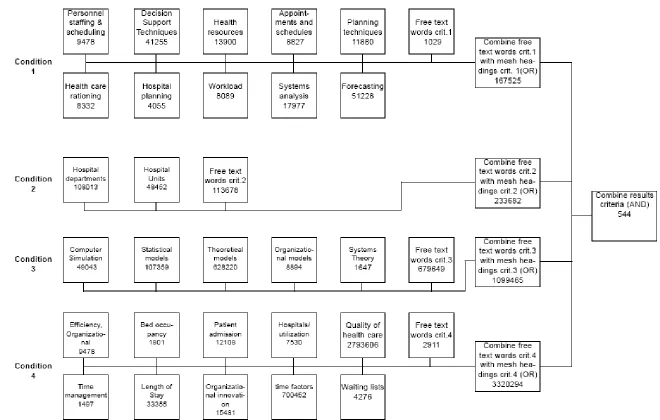
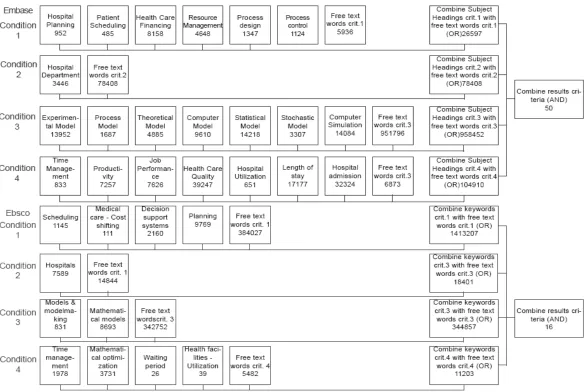
To achieve a thoroughly search in the databases we will make use of the inclusion criteria. All the studies for the review must suffice the four formulated inclusion criteria. To achieve that we formulated per criteria different standard keywords and free text words.
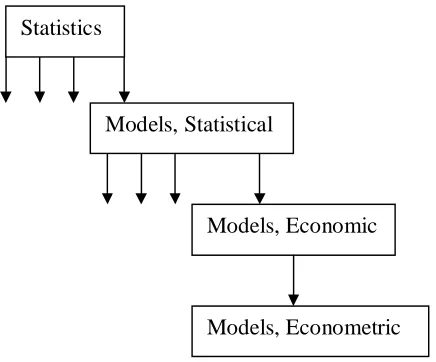
The standard keywords (Pubmed: Mesh headings, Embase: Subject Headings and Ebsco: Subject terms) are determined by searching through these keywords. We will start with searching for the mesh headings and use these to find the standard keywords for Embase and Ebsco. In Medline the mesh headings are listed in a tree diagram with the broader headings (headings) at the top and the narrower headings (subheadings) as branches (see figure 1). The definitions of the mesh headings are also listed in this tree.
[image:14.612.107.325.536.717.2]We used this tree to determine the relevant mesh headings for our review. Embase and Ebsco make also use of tree diagrams. When we will find a possible relevant mesh heading, we first test it if the heading results in relevant articles. If not than the mesh heading is discarded. Ebsco is not a medical database and that is why we choose to use slightly different free text words to make sure we only get articles concerning hospitals. The defined words can be found in Appendix A.
With the defined keywords and free text words we will search through the databases per criteria with the OR statement. This means that only one of the keywords or free text words needs to be found in the article to include the article for that criterion.
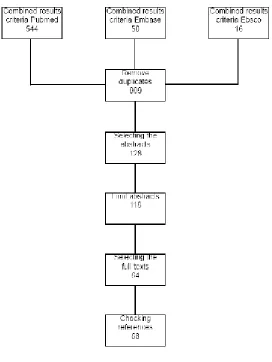
In the next step we will combine the results of the four criteria with the AND statement. This means that every article must contain one or more of the words defined for every criterion. In the next step we will combine the three databases and remove duplicates. The duplicates will be removed by Reference Manager. Reference Manager is a software programme that saves and manages all the founded references (title, author, abstract etc of the founded studies). This programme can also removes the duplicates in the references11.
The results of the accomplished search are listed in Appendix B.
2.7 Collect the information to reach the research objective
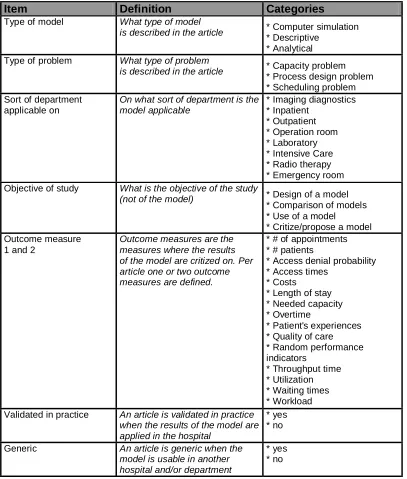
After selecting the relevant articles we will determine for every study the results concerning the objective review. The information we will collect for the studies is listed in table 1. We decided to collect information in seven areas. The first five are areas with respect to the content and the last two are with respect to the quality of the study. For all the areas we determined several categories in which the study can fall. These categories are also listed in table 1. It could be that during the reading process we find out that some of the categories are not used or well defined. Because of that we will consider the categories again after reading all the articles.
When reading the studies and dividing them into the categories we ran into problems with the definition of conceptions of especially the last three categories. That is why we clarified these definitions. We also added some categories and items during the reading process to make sure we could reach our objective.
11
Table 1: The information that will be collected for the review
Item Definition Categories
Type of model What type of model
is described in the article * Computer simulation * Descriptive
* Analytical Type of problem What type of problem
is described in the article * Capacity problem
* Process design problem * Scheduling problem Sort of department
applicable on
On what sort of department is the model applicable
* Imaging diagnostics * Inpatient
* Outpatient * Operation room * Laboratory * Intensive Care * Radio therapy * Emergency room Objective of study What is the objective of the study
(not of the model) * Design of a model
* Comparison of models * Use of a model
* Critize/propose a model Outcome measure
1 and 2
Outcome measures are the measures where the results of the model are critized on. Per article one or two outcome measures are defined.
* # of appointments * # patients
* Access denial probability * Access times
* Costs
* Length of stay * Needed capacity * Overtime
* Patient's experiences * Quality of care * Random performance indicators
* Throughput time * Utilization * Waiting times * Workload Validated in practice An article is validated in practice
when the results of the model are applied in the hospital
* yes * no
Generic An article is generic when the model is usable in another hospital and/or department
PART III: The Article
Models as instruments to optimize hospital processes: a systematic
review
J.R.C. van Sambeek F.A. Cornelissen
P.J.M. Bakker J.J. Krabbendam
Jasper R.C. van Sambeek, MSc, is Management Consultant, Berenschot, Utrecht, The Netherlands; Department of Quality and Process Innovation, Academic Medical Center/University of Amsterdam, Amsterdam, the Netherlands; Department of Operations,
Organisations & Human Resources, University of Twente, Enschede, the Netherlands. E-mail: [email protected].
Floor A. Cornelissen, is associated with University of Twente, Enschede, the Netherlands. E-mail: [email protected]
Piet J.M. Bakker, MD, PhD, is Head of Department of Quality and Process Innovation, Academic Medical Center/University of Amsterdam, Department of Quality and Process
Innovation, Amsterdam, the Netherlands. E-mail: [email protected].
Koos (J.J.) Krabbendam, BSc, MSc, PhD, is Professor of Operations Management, Department of Operations, Organisations & Human Resources, University of Twente,
Enschede, the Netherlands. E-mail: [email protected].
Abstract
Intro duc tion
“Man is a tool using animal…. Without tools he is nothing, with tools he is all.”
--Thomas Carlyle
Hospitals’ identity as a health community slowly transposes to the identity of an enterprise. Hospitals get bigger, apply higher relative amounts of non-medical employees, get more critical customers and operate in an increasingly competitive climate. Average patient stay has been reduced considerably and the number of outpatient versus inpatient alters continuously, resulting in less intensive patient-care giver relationships. The traditional conflicting pressures of maximizing the quality of patient care versus ensuring organizational survival, have become especially acute due to recent economic pressures. (Williams et al. 2005) These developments have resulted in more complex and business-like organizations that have brought more challenges to deal with. The complexity of the system causes ambiguity in terms of how an individual’s work should be performed and how the work of many individuals should be successfully coordinated into an integrated whole. (Spear 2005) This new situation for hospitals requires an increased professionalism of hospital management to be able to make the right decisions.
One of the most significant problems which management has to deal with is the use of hospital’s limited resources in relation to increasing demand for both quantity and desired service level. The challenge is to manage the system consisting of arrivals, activities and resources. While facing this challenge, managers meet three main types of problems: 1. Capacity problems; what kind and what amount of resources to attract
2. Process design problems; which process steps to make use of and in what order 3. Scheduling problems; at what moment to allocate which resources to which patients These problems become more and more complex, due to many uncertainties in the system, better represented as the four types of variability. First, patient arrival variability is caused by the unpredictable moment that patients enter with their demand for service. Second, variability of demand represents the variation in type and amount of care patients require. Third, routing variability is the variation in process steps and their order within patient flows. Fourth, process time variability is the fluctuation in duration of process steps. These types of variability are the main source of the problems managers face, concerning design and control of hospital processes.
To deal with the main problems concerning managing the systems in a hospital, traditional clinical research methods barely suffice. Randomized controlled trials and controlled experiments cannot be carried out adequately, due to too many dependent variables. Moreover, those methods are too risky and expensive, and consequently in general not suitable in these situations. Therefore there is an increasing need for tools to predict the consequences of different alternative scenarios. In complex situations decision makers can use managerial models that predict the results of a scenario. A model helps to understand the behavior of a system without actually changing the system.
they usually describe modeling techniques, not models that have been practically applied in hospitals. Systematic reviews of the literature in this field are especially rare. Reviews generally deal with a specific range of models, such as computer simulation models. (Lehaney B 1995; Marshall et al. 2005; Fone et al. 2003) This study focuses on various kinds of decision supporting models and is thus not limited to a specific range of models. In addition, instead of focusing on the whole hospital, it only deals with processes within specific hospital departments. First of all, the complexity of the hospital organization and the amount of different kinds of processes make it extremely hard to generate a straight forwarded solution to the main challenge for the whole hospital. Designing a model at this level would be very abstract and result in information with insufficient value. Secondly, focusing on the whole hospital is very often not necessary. According to the theory of constraints, attacking ‘bottleneck’ processes or departments is the fastest and most effective way to streamline flows through an organization (Goldratt EM & Cox J 1992).
The primary objective of this study was to search for literature concerning models for the design and control of processes concerning patient flows within departments in a hospital. These models must be appropriate to get insight in and to consider different scenarios with the aim to optimize the performance of these departments. The secondary objective was to find if there was any relation between the type of problems and the model types used. The third objective was to find out how usable these models are for managerial decision making. Therefore this study also reflects on the applicability of the models results and the models extend of being generic.
Theo retical b ackground
The first concern is to set down clear definitions. Apart from a formulation for a model, types of models and problems have to be defined to find out which models are used for which problems.
Problem types
Many classifications for problem types are possible. A classification has been chosen that fits best our primary objective, based on two theoretical frameworks. In Slack’s framework (Slack et al. 2003) operations management problems are classified in the topics design, planning and control and improvement. According to our objective, all problems relevant to this review are related to improvement, but the improvement always concerns the process design or the planning and control in hospitals. Therefore the topic improvement does not occur in the classification in this review. According to the framework for hospital planning and control (Hans et al. 2007), planning and control has different appearances. The framework distinguishes four hierarchical levels; strategic, tactic, operational offline and operational online, which are successively described as ‘capacity dimensioning’, ‘allocation’, ‘scheduling’ and ‘control’. In our classification the capacity problems correspond with ‘capacity dimensioning’, scheduling problems contain both ‘allocation’ and ‘scheduling’. The relevant scheduling problems in this context do not contain the level ‘control’, since our concern is patient flows and not patients who are already present in the hospital. The managerial decisions relevant in this study occur ‘before the action’, not during the action (online). In literature scheduling problems often deal with rostering: assigning human resources to shifts. This kind of problems does not belong to our definition of scheduling problems, since they also do not directly deal with patient flows. In summary the employed classification for problem types is:
- Capacity problems;
- Scheduling problems.
What is a model?
A model is a wide notion with many possible and employed explanations. A wide definition of a model is an artificially created system that represents reality. A system is a compilation of elements which are related, so that no elements are isolated from the remaining (De Leeuw 2000). Law (Law & Kelton 2000) defines a model as ‘a set of assumptions about how a system works, to try to gain some understanding of how the system behaves’. The most significant aspect of this formulation is the last part. The models we seek for give insight in consequences of possible managerial decisions (scenarios) to set up or change a system and therefore insight in its behavior. Leeuw (De Leeuw 2000) adds the notion that the way a model is built, depends on the aim of use, which means that many possible models can be of use for a given system. According to our objective the definition employed in this review is therefore: a representation of a real system that gives insight in the system’s behavior, with interfaces with reality corresponding with the aim of use.
The traditional model types are the physical model and the descriptive model. Descriptive models give insight in a system’s behavior by describing relationships between aspects of the system. Physical models imitate real shapes and sometimes movements of a system. Applications of physical models still occur in civil technique and building development, however not as a tool for hospital managers and therefore these are irrelevant for this study. Later modeling development brought us mathematical models. They represent a system in terms of logical and quantitative relationships that are then manipulated and changed to see how the system reacts. Mathematical models can be divided in analytical models, which are able to gain exact information on questions of interest, and simulation models, where true characteristics of a system are estimated. The pre-assumption is that different model types perform best depending on the type of problem. In summary:
1. Descriptive models; models that visually or textually represent a solution. A descriptive model is flexible and often easy to understand and use, however they lack a quantitative and accurate insight in system behavior.
2. Analytical models; models that can calculate output measures of interest for fictive scenario’s. The advantage is that they are exact and quantitative, but usually difficult to interpret it’s results. In complex processes they often ignore too many factors to be able to compare its quantitative results with reality.
Metho ds
Search Strategy
We selected three different databases. The medical database Medline containing articles from 1950 through 2006, the medical database Embase containing articles from 1980 through 2006 and the management science database Business Source Elite (BSE) containing articles from 1985 through 2006. For our search trough the databases we formulated inclusion and exclusion criteria (listed in Table 1).
Inclusion Criteria Exclusion criteria
Articles containing a model that deals with the design and/or control of a process
Articles using models that have the goal to optimize more than one department at a time Articles with models concerning patient
flows that can be applied on departments within a hospital. Articles may concentrate on optimizing the performance of either a whole department or a function or process within a department
Articles not published in peer-reviewed journals or published as a full paper in conference proceedings
Articles using simulation based, descriptive or analytical models. We both look for models that tell us how to come to the optimal situation, and models that directly suggest a specific design
Articles concerning models that support medical considerations
Articles containing models those directly aim on improvement of the performance of the process. Performance is defined as the product quality, customer service, flexibility, timeliness, reliability, safety, and quality of work
Articles with models primary concerning implementation of organizational change
Articles suggesting models that primary forecast or predict demand or length of stay Articles containing models that primary demonstrate relationships
Articles concerning software and/or hardware and IT with no direct effect on patient flows Articles suggesting models that describe an organizational structure
Table 1 - Inclusion and Exclusion criteria
(subject headings). Not all the MeSH headings had corresponding subject headings so the results of the subject headings were also evaluated for relevance. From the relevant abstracts, we derived free-text words for each criterion to increase the specificity of our search strategy.
In Business Source Elite (BSE) the MeSH and Subject headings were used to find corresponding BSE keywords in the same way as finding the corresponding subject headings. BSE is not a medical database, which resulted in slightly different keywords and free text words. The keywords and free-text words are listed in the appendix.
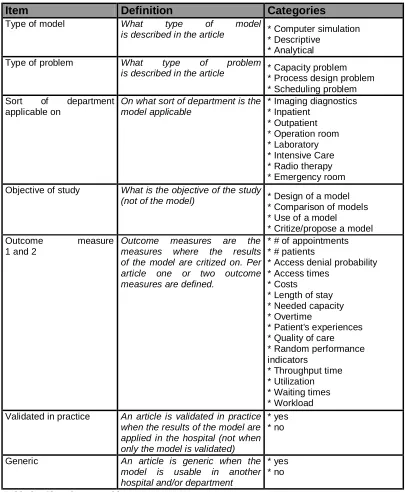
To suffice all the criteria the articles needed to contain at least one keyword or free-text word per criteria. After performing our search with the selected keywords and free-text words, articles were then selected based on the title and abstract. Two reviewers independently evaluated titles and abstracts to select articles for the review. The two reviewers determined together through discussion of which article the full text was useful for the review. This was done based on the inclusion and exclusion criteria. In case of disagreement a third reviewer was consulted. Full publications of all selected abstracts were obtained (in electronic or printed form) for the two reviewers to evaluate the full text. The results of the evaluations were compared and the differences in opinions were solved through discussion. When the final list of the included articles was finished, the references of these articles were evaluated for relevance. Seemingly relevant referred papers were obtained and evaluated in the same way as the other papers.
Item Definition Categories
Type of model What type of model
is described in the article * Computer simulation
* Descriptive * Analytical Type of problem What type of problem
is described in the article * Capacity problem
* Process design problem * Scheduling problem Sort of department
applicable on
On what sort of department is the model applicable
* Imaging diagnostics * Inpatient
* Outpatient * Operation room * Laboratory * Intensive Care * Radio therapy * Emergency room Objective of study What is the objective of the study
(not of the model) * Design of a model
* Comparison of models * Use of a model
* Critize/propose a model Outcome measure
1 and 2
Outcome measures are the
measures where the results of the model are critized on. Per article one or two outcome measures are defined.
* # of appointments * # patients
* Access denial probability * Access times
* Costs
* Length of stay * Needed capacity * Overtime
* Patient's experiences * Quality of care * Random performance indicators
* Throughput time * Utilization * Waiting times * Workload Validated in practice An article is validated in practice
when the results of the model are applied in the hospital (not when only the model is validated)
* yes * no
Generic An article is generic when the model is usable in another hospital and/or department
[image:23.612.99.504.78.570.2]* yes * no
Table 2 - Classification table
Results
Overview
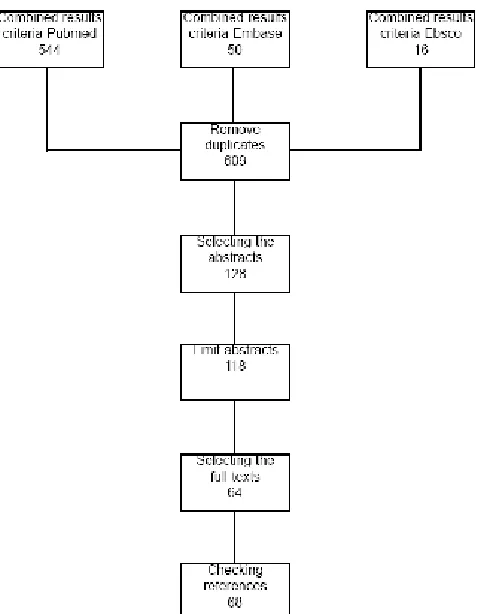
Swedish. 10 articles were excluded from the review, because the full texts could not be obtained. The 118 articles were evaluated by the reviewers, who selected 64 articles that met the inclusion and exclusion criteria.
[image:24.612.172.413.157.464.2]Most articles were excluded because they modeled more than one department or were not related to patient flows. The references of the selected articles were evaluated to seek more relevant articles. This resulted in four extra articles relevant for the review.
Data collection
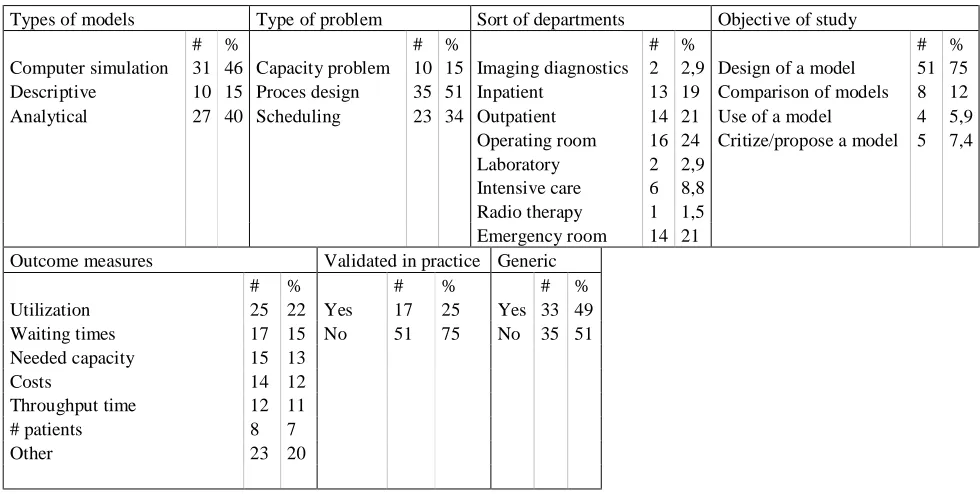
From the selected studies we collected the data summarized in the table 2.
Types of models Type of problem Sort of departments Objective of study
# % # % # % # %
Computer simulation 31 46 Capacity problem 10 15 Imaging diagnostics 2 2,9 Design of a model 51 75 Descriptive 10 15 Proces design 35 51 Inpatient 13 19 Comparison of models 8 12 Analytical 27 40 Scheduling 23 34 Outpatient 14 21 Use of a model 4 5,9
Operating room 16 24 Critize/propose a model 5 7,4
Laboratory 2 2,9
Intensive care 6 8,8
Radio therapy 1 1,5
Emergency room 14 21
Outcome measures Validated in practice Generic
# % # % # %
Utilization 25 22 Yes 17 25 Yes 33 49
Waiting times 17 15 No 51 75 No 35 51
Needed capacity 15 13
Costs 14 12
Throughput time 12 11
# patients 8 7
Other 23 20
[image:25.612.80.570.104.351.2]
Table 3 - Collected data
As illustrated in Table 3 only 15% of the studies contain descriptive models. Analytical (40%) and computer simulation (46%) models are evidently used more. Half of the studies (51%) examine a process design problem, while scheduling problems and capacity problems successively represent 34% and 15%. The models are for the greater part applicable on the operating room (24%), emergency room (21%) and outpatient (21%) departments.
Type of problem and model
The relation between the type of problem and model is illustrated in Figure 3. Descriptive models are only used for process design problems. The figure states that capacity and scheduling problems are comparable with each other. The only difference is that capacity problems are slightly evaluated more with analytical models and scheduling problems more with computer simulation models. Process design problems are evaluated with all types of models, but most often with simulation models.
11 12
10 15 10 6 4
Anal ytical C omputer simul ation De scriptive
S ch e d u li n g P ro c e s d e s ig n C a p a c it y p ro b le m 0 2 4 6 8 10 12 1 9 7 4 1 9 7 5 1 9 7 8 1 9 7 9 1 9 8 1 1 9 8 3 1 9 8 4 1 9 8 5 1 9 8 9 1 9 9 0 1 9 9 1 1 9 9 3 1 9 9 4 1 9 9 5 1 9 9 6 1 9 9 7 1 9 9 8 1 9 9 9 2 0 0 0 2 0 0 1 2 0 0 2 2 0 0 3 2 0 0 4 2 0 0 5 2 0 0 6 Descriptive Computer simulation Analytical Count of Types of models
year
Types of models
Type of problems related to the other categories
In Table 4 the relations between the problem type and the other categories is shown.
# % # % # % total
Emergency room 1 7% 11 79% 2 14% 14
Imaging diagnostics 0% 1 50% 1 50% 2
Inpatient 3 23% 8 62% 2 15% 13
Intensive care 3 50% 2 33% 1 17% 6
Laboratory 0% 2 100% 0% 2
Operation room 3 19% 3 19% 10 63% 16
Outpatient 0% 7 50% 7 50% 14
Radio therapy 0% 1 100% 0% 1
No 4 11% 17 49% 14 40% 35
Yes 6 18% 18 55% 9 27% 33
No 10 20% 21 41% 20 39% 51
Yes 0% 14 82% 3 18% 17
Utilization 2 8% 10 40% 13 52% 25
Waiting times 0 0% 9 53% 8 47% 17
Needed capacity 8 53% 5 33% 2 13% 15
Costs 2 14% 6 43% 6 43% 14
Throughput time 0 0% 9 75% 3 25% 12
# patients 1 13% 6 75% 1 13% 8
Other 3 13% 15 63% 6 25% 24
[image:27.612.102.480.99.376.2]Department Generic Validated Outcome measure Scheduling Proces design Capacity problem Problem type
Table 4 - Relation between problem type and other categories
In the operating room mostly scheduling problems are examined (63%). Process design problems occur in every department, but mostly in the emergency room (79%) and inpatient (62%) departments.
[image:27.612.108.480.106.378.2]Type of models related to the other categories
Table 5 reveals the relations between the problem type and the other categories.
# % # % # % total
Emergency room 4 29% 6 43% 4 29% 14
Imaging diagnostics 1 50% 0% 1 50% 2
Inpatient 8 62% 3 23% 2 15% 13
Intensive care 1 17% 4 67% 1 17% 6
Laboratory 0% 1 50% 1 50% 2
Operation room 8 50% 8 50% 0% 16
Outpatient 4 29% 9 64% 1 7% 14
Radio therapy 1 100% 1
No 4 11% 31 89% 0% 35
Yes 23 70% 0% 10 30% 33
No 22 43% 27 53% 2 4% 51
Yes 5 29% 4 24% 8 47% 17
Utilization 12 48% 12 48% 1 4% 25
Waiting times 7 41% 10 59% 0 0% 17
Needed capacity 6 40% 8 53% 1 7% 15
Costs 7 50% 4 29% 3 21% 14
Throughput time 2 17% 9 75% 1 8% 12
# patients 5 63% 3 38% 0 0% 8
Other 9 38% 5 21% 10 42% 24
Department Generic Validated Outcome measure Descriptive Computer Simulation Analytical Model type
[image:27.612.102.460.478.717.2]What stands out in this table is that descriptive models are always generic, on the other hand computer simulation models are never generic. Analytical models are most of the times generic. Also remarkable in Table 5 is that analytical and computer simulation models are barely validated in practice. On the other hand most of the descriptive models are validated in practice.
Discussion
Few systematic reviews have been applied in the specialism of health care management (Elkhuizen et al. 2006). This is remarkable, since the systematic review is a widely used and highly accepted research technique in health care. In systematic reviews, the aim is usually to collect all relevant research about one specific topic in order to assess ‘the real truth’ among the often many contradictions. When the topic concerns a causal relation that is the basis for an optimal treatment or diagnosis method, finding a ‘real truth’ is often possible. In management research this is more complicated, due to the many elements and relations within the managed system and the large differences between specific situations. Besides, this study made clear that the search itself is also more complicated in the topic of health care management. Despite the well outlined and clearly defined inclusion and exclusion criteria, the subject appeared to be widespread. Literature was found in journals about general management, operational research, operations management, health management and various hospital departments such as anesthesia, radiology, intensive care, surgery and emergency care. This shows the significance to consult various databases when searching for health care management topics. Unfortunately the comparability of the databases, especially between management databases and medical databases, is insufficient. Moreover the supply of mesh headings or keywords in management databases badly matches the aim of systematically searching for health care management literature and the management mesh headings or keywords in health care databases are inadequately developed. As a result, searching for articles about optimization of hospital processes is a time consuming activity and contains the risk that despite of a systematic procedure of reviewing, not all relevant literature may be found.
outpatient, OR and ED departments. Here, the same often used outcome measures are used as for analytical models, replenished by throughput time.
It is useful for managers to know which model type to choose in a given situation. All relevant models within this review are aimed to attack a managerial problem that can be classified in one of the three types of problems; capacity problems, process design problems and scheduling problems. The most obvious relation between model type and problem type is that descriptive models were only found for process design problems. Capacity and scheduling problems are attacked by both analytical and computer simulation models in about the same proportion. Process design problems, the most encountered problem, are somewhat more attacked by computer simulation models than by the other two model types. Furthermore no significant relations could be distinguished. No article mentioned about the required expertise, the time needed and the costs of the model. Obviously this information is relevant concerning the choice of a model. In fact the reasoning for the chosen model type was absent in all relevant studies. It presumes that the choice for a specific type of model is for the bigger part based on the available expertise and resources.
For this review a managerial model is defined as a representation of a real system that gives insight in the system’s behavior, with interfaces with reality corresponding with the aim of use. The aim of use is to help the manager confronted with a problem, to solve the problem by giving insight in the consequences of different scenarios. Based on this insight, management can decide to change aspects of the organization (or not) and in what matter. It is striking that the absolute majority of the papers didn’t mention about the managers’ decision based on the models outcomes. In other words, it was not possible to find prove that the models are used in the way they are meant for. This leads to the assumption that often the mean becomes the objective, that is building the model is more important than using it. A probable explanation is that models written about in peer-reviewed literature are mainly built by researchers meant for scientific reasons in stead of application in practice. This could be a bias in our review, because we only searched in scientific databases. We are perfectly aware of the fact that a huge amount of effective models are used by managers, which is not published about. We suggest to researchers to pay more attention for basing the similarities on the aim of a model; a simpler model is often possible and more effective.
Co nclusion
Models for the design and control of processes concerning patient flows within departments in a hospital are frequently applied for managerial problems in hospitals. Our review resulted in a promising amount of papers, but few reported the consequences of the implementation of the model’s results, especially not analytical models and computer simulation models. This makes it hard or impossible to evaluate the usability of the models. Furthermore no clear relation between a problem type or situation and the most effective model type could be found. Which model suits best depends on many parallel factors. In general descriptive models suit best when it must be generic and qualitative and computer simulation models suit best when situations are complex with high extends of variability and results must be specific and quantitative.
Ref erence List
• 2001, "Experts: cut costs of ED observation", ED Manag. vol. 13, no. 6, pp. 64-6, suppl.
• Asplin, B. R., Magid, D. J., Rhodes, K. V., Solberg, L. I., Lurie, N., & Camargo, C. A., Jr. 2003, "A conceptual model of emergency department crowding",
Ann.Emerg.Med., vol. 42, no. 2, pp. 173-180.
• Benneyan, J. C. 1997, "An introduction to using computer simulation in healthcare: patient wait case study",J.Soc.Health Syst., vol. 5, no. 3, pp. 1-15.
• Brahimi, M. & Worthington, D. 1991, "Queueing Models for Out-Patient
Appointment Systems -- A Case Study", The Journal of the Operational Research Society, vol. 42, no. 9, pp. 733-746.
• Browne, G., Lam, L., Giles, H., McCaskill, M., Exley, B., & Fasher, B. 2000, "The effects of a seamless model of management on the quality of care for emergency department patients", J.Qual.Clin.Pract., vol. 20, no. 4, pp. 120-126.
• Chin, L. & Fleisher, G. 1998, "Planning model of resource utilization in an academic pediatric emergency department", Pediatr.Emerg.Care, vol. 14, no. 1, pp. 4-9.
• Clague, J. E., Reed, P. G., Barlow, J., Rada, R., Clarke, M., & Edwards, R. H. 1997, "Improving outpatient clinic efficiency using computer simulation", Int.J.Health Care Qual.Assur.Inc.Leadersh.Health Serv., vol.10, no. 4-5, pp. 197-201.
• Coats, T. J. & Michalis, S. 2001, "Mathematical modelling of patients flow through an accident and emergency department", Emerg.Med.J, vol. 18, no. 3, pp. 190-192.
• Connelly, L. G. & Bair, A. E. 2004, "Discrete event simulation of emergency department activity: a platform for system-level operations research",
Acad.Emerg.Med., vol. 11, no. 11, pp. 1177-1185.
• Costa, A. X., Ridley, S. A., Shahani, A. K., Harper, P. R., De, S., V, & Nielsen, M. S. 2003, "Mathematical modelling and simulation for planning critical care capacity", Anaesthesia, vol. 58, no. 4, pp. 320-327.
• De Leeuw, A. C. J. 2000, Bedrijfskundig Management Van Gorcum, Assen.
• Delaney, G. P., Gebski, V., Lunn, A. D., Lunn, M., Rus, M., Manderson, C., & Langlands, A. O. 1997, "Basic Treatment Equivalent (BTE): a new measure of linear accelerator workload", Clin.Oncol.(R.Coll.Radiol.), vol. 9, no. 4, pp. 234-239.
• Dexter, F. & Macario, A. 1999, "Decrease in case duration required to complete an additional case during regularly scheduled hours in an operating room suite: a computer simulation study", Anesth.Analg., vol. 88, no. 1, pp. 72-76.
• Dexter, F., Macario, A., & O'Neill, L. 2000, "Scheduling surgical cases into overflow block time- computer simulation of the effects of scheduling strategies on operating room labor costs", Anesth.Analg., vol. 90, no. 4, pp. 980-988.
• Dexter, F., Macario, A., & Traub, R. D. 1999, "Which algorithm for scheduling add-on elective cases maximizes operating room utilizatiadd-on? Use of bin packing
algorithms and fuzzy constraints in operating room management", Anesthesiology, vol. 91, no. 5, pp. 1491-1500.
• Dexter, F. & Traub, R. D. 2002, "How to schedule elective surgical cases into specific operating rooms to maximize the efficiency of use of operating room time",
Anesth.Analg., vol. 94, no. 4, pp. 933-42, table.
• Edwards, R. H., Clague, J. E., Barlow, J., Clarke, M., Reed, P. G., & Rada, R. 1994, "Operations research survey and computer simulation of waiting times in two medical outpatient clinic structures", Health Care Anal., vol. 2, no. 2, pp. 164-169.
• el-Darzi, E., Vasilakis, C., Chaussalet, T., & Millard, P. H. 1998, "A simulation modelling approach to evaluating length of stay, occupancy, emptiness and bed blocking in a hospital geriatric department", Health Care Manag.Sci., vol. 1, no. 2, pp. 143-149.
• Elkhuizen, S. G., Limburg, M., Bakker, P. J., & Klazinga, N. S. 2006, "Evidence-based re-engineering: reengineering the evidence--a systematic review of the literature on business process redesign (BPR) in hospital care", Int.J Health Care
Qual.Assur.Inc.Leadersh.Health Serv., vol. 19, no. 6-7, pp. 477-499.
• Fone, D., Hollinghurst, S., Temple, M., Round, A., Lester, N., Weightman, A., Roberts, K., Coyle, E., Bevan, G., & Palmer, S. 2003, "Systematic review of the use and value of computer simulation modelling in population health and health care delivery", J.Public Health Med., vol. 25, no. 4, pp. 325-335.
• Fowler, D. G. 1998, "Development of a computer simulation for laboratory planning", Clin.Lab Sci., vol. 11, no. 5, pp. 280-284.
• Fries, B. E. & Ginsberg, A. S. 1979, "The effect of delay rules in controlling unscheduled visits to hospitals", Med.Care, vol. 17, no. 9, pp. 967-972.
• Fries, B. E. & Marathe, V. P. 1981, "Determination of optimal variable-sized multiple-block appointment systems", Oper.Res., vol. 29, no. 2, pp. 324-345.
• George, J. A., Fox, D. R., & Canvin, R. W. 1983, "A hospital throughput model in the context of long waiting lists", J.Oper.Res.Soc., vol. 34, no. 1, pp. 27-35.
• Goldratt EM & Cox J 1992, The Goal a process of ongoing improvement North River Press.
• Gorunescu, F., McClean, S. I., & Millard, P. H. 2002, "Using a queueing model to help plan bed allocation in a department of geriatric medicine", Health Care Manag.Sci., vol. 5, no. 4, pp. 307-312.
• Graff, L. G. & Radford, M. J. 1990, "Formula for emergency physician staffing", Am.J.Emerg.Med., vol. 8, no. 3, pp. 194-199.
• Hamilton, W. F. 1974, "Systems analysis in emergency care planning", Med.Care, vol. 12, no. 2, pp. 152- 162.
• Hancock, W. M., Martin, J. B., & Storer, R. H. 1978, "Simulation-based occupancy recommendations for adult medical/surgical units using admissions scheduling systems", Inquiry, vol. 15, no. 1, pp. 25-32.
• Hans, E. W., Van Houdenhoven, M., & Wullink, G. A framework for Hospital Planning and Control. University of Twente. 2008. Ref Type: Unpublished Work
• Haronson-Daniel, L., Paul, R. J., & Hedley, A. J. 1996, "Management of queues in out-patient departments: the use of computer simulation", J.Manag.Med., vol. 10, no. 6, pp. 50-8, 3.
• Huang, X. M. 1995, "A planning model for requirement of emergency beds", IMA J.Math.Appl.Med.Biol., vol. 12, no. 3-4, pp. 345-353.