A Note on Typing Feature Structures
Shuly Wintner
∗Anoop Sarkar
†University of Haifa University of Pennsylvania
Feature structures are used to convey linguistic information in a variety of linguistic formalisms. Various definitions of feature structures exist; one dimension of variation is typing: unlike untyped feature structures, typed ones associate a type with every structure and impose appropriateness constraints on the occurrences of features and on the values that they take. This work demon-strates the benefits that typing can carry even for linguistic formalisms that use untyped feature structures. We present a method for validating the consistency of (untyped) feature structure specifications by imposing a type discipline. This method facilitates a great number of compile-time checks: many possible errors can be detected before the grammar is used for parsing. We have constructed a type signature for an existing broad-coverage grammar of English and implemented a type inference algorithm that operates on the feature structure specifications in the grammar and reports incompatibilities with the signature. We have detected a large number of errors in the grammar, some of which are described in the article.
1. Introduction
Feature structures are used by a variety of linguistic formalisms as a means for rep-resenting different levels of linguistic information. They are usually associated with more elementary structures (such as phrase structure rules or trees) to provide an addi-tional dimension for stating linguistic generalizations. A variant of feature structures, typed feature structures, provide yet another dimension for such generalizations. It is sometimes assumed that typed feature structures have linguistic advantages over untyped ones and that they are, in general, more efficient to process. In this article we show how typing can be useful also for systems that manipulate untyped feature structures.
We present a method for validating the consistency of feature structure specifica-tions by imposing a type discipline. This method facilitates a great number of compile-time checks: many possible errors can be detected before the grammar is used for pars-ing. Typed systems are used in one linguistic theory, Head-Driven Phrase Structure Grammar (HPSG) (Pollard and Sag 1994), and we present here a different application of them for theories that employ untyped feature structures. We constructed a type signature for the XTAG English grammar (XTAG Research Group 2001), an existing broad-coverage grammar of English. Then, we implemented a type inference algorithm that operates on the feature structure specifications in the grammar. The algorithm re-ports occurrences of incompatibility with the type signature. We have detected a large number of errors in the grammar; four types of errors are described in the article.
The technique we propose was incorporated into the XTAG grammar development system, which is based on the tree-adjoining grammar (TAG) formalism (Joshi, Levy,
∗Department of Computer Science, University of Haifa, Mount Carmel, 31905 Haifa, Israel. E-mail: [email protected]
and Takahashi 1975), lexicalized (Schabes, Abeill ´e, and Joshi 1988) and augmented by unification-based feature structures (Vijay-Shanker and Joshi 1991). Tree-adjoining languages fall into the class of mildly context-sensitive languages and as such are more powerful than context-free languages. The TAG formalism in general, and lexicalized TAGs in particular, are well-suited for linguistic applications. As first shown by Joshi (1985) and Kroch and Joshi (1987), the properties of TAGs permit one to encapsulate diverse syntactic phenomena in a very natural way.
The XTAG grammar development system makes limited use of feature structures that can be attached to nodes in the trees that make up a grammar. Typically, feature structures in XTAG are flat: nesting of structures is very limited. Furthermore, all fea-ture strucfea-tures in XTAG are finitely bounded: the maximum size of a feafea-ture strucfea-ture can be statically determined. During parsing, feature structures undergo unification as the trees they are associated with are combined. But unification in XTAG is actually highly limited: since all feature structures are bounded, unification can be viewed as an atomic operation. Although the method we propose was tested on an XTAG gram-mar, it is applicable in principle to any linguistic formalism that uses untyped feature structures, in particular, to lexical-functional grammar (Kaplan and Bresnan 1982).
2. The Problem
XTAG is organized such that feature structures are specified in three different com-ponents of the grammar: a Tree database defines feature structures attached to tree families; aSyndatabase defines feature structures attached to lexically anchored trees; and aMorphdatabase defines feature structures attached to (possibly inflected) lexical entries.
As an example, consider the verbseems. This verb can anchor several trees, among which are trees of auxiliary verbs, such as the tree βVvx, depicted in Figure 1. This tree, which is common to all auxiliary verbs, is associated with the feature structure descriptions listed in Figure 1 (independently of the word that happens to anchor it).1
When the tree βVvx is anchored byseems, the lexicon specifies additional constraints on the feature structures in this tree:
seem betaVvx VP.b:<mode> = inf/nom, V.b:<mainv> = +
Finally, since “seems” is an inflected form, the morphological database specifies more constraints on the node that this word instantiates, as shown in Figure 2.
The actual feature structures that are associated with the lexicalized tree anchored by “seems” are the combination of the three sets of path equations. This organization leaves room for several kinds of errors, inconsistencies, and typos in feature structure manipulation. Nothing in the system can eliminate the following possible errors:
Undefined features: Every grammar makes use of a finite set of features in the feature structure specification. As the features do not have to be declared, however, certain bogus features can be introduced unintentionally, either through typos or because of poor maintenance. In a grammar that has an assign-case feature, the following statement is probably erroneous:
V.b:<asign-case> = acc.
V.t:<agr> = VP_r.b:<agr>
V.t:<assign-case> = VP_r.b:<assign-case> V.t:<assign-comp> = VP_r.b:<assign-comp>
V.t:<displ-const set1> = VP_r.b:<displ-const set1> V.t:<mainv> = VP_r.b:<mainv>
V.t:<mode> = VP_r.b:<mode> V.t:<neg> = VP_r.b:<neg> V.t:<tense> = VP_r.b:<tense> VP.t:<assign-comp> = ecm VP.t:<compar> =
VP.t:<displconst set1> = VP_r.b:<compar> =
-VP_r.b:<conditional> = VP.t:<conditional> VP_r.b:<perfect> = VP.t:<perfect>
[image:3.612.106.457.92.285.2]VP_r.b:<progressive> = VP.t:<progressive>
Figure 1
An example tree and its associated feature structure descriptions.
seems seem V <agr pers> = 3, <agr num> = sing, <agr 3rdsing> = +, <mode> = ind, <tense> = pres,
<assign-comp> = ind_nil/that/rel/if/whether, <assign-case> = nom
Figure 2
The morphological database entry forseems.
Undefined values: The same problem can be manifested in values, rather than features. In a grammar wherenomis a valid value for theassign-case fea-ture, the following statement is probably erroneous:V.b:<assign-case> = non.
Incompatible feature equations: The grammar designer has a notion of what paths can be equated, but this notion is not formally defined. Thus, it is possible to find erroneous path equations such asVP.b:<assign-case> = V.t:<tense>.
Such cases go undetected by XTAG and result in parsing errors. For example, the statementV.b:<asign-case> = accwas presumably supposed to constrain the gram-matical derivations to those in which theassign-casefeature had the valueacc. With the typo, this statement never causes unification to fail (assuming that the feature asign-caseoccurs nowhere else in the grammar); the result is overgeneration.
Note that nothing in the above description hinges on the particular linguistic formalism or its implementation. The same problems are likely to occur in every system that manipulates untyped feature structures.2
3. Introducing Typing
The problems discussed above are reminiscent of similar problems in programming languages; in that domain, the solution lies intyping: a stricter type discipline provides means for more compile-time checks to be performed, thus tracking potential errors as soon as possible. Fortunately, such a solution is perfectly applicable to the case of feature structures, as typed feature structures (TFSs) are well understood (Carpenter 1992). We briefly survey this concept below.
TFSs are defined over asignatureconsisting of a set of of types (Types) and a set of features (Feats). Types are partially ordered bysubsumption (denoted “”). The least upper bound with respect to subsumption oft1andt2is denotedt1t2. Each type is associated with a set of appropriate features through a function Approp: Types× Feats → Types. The appropriate values of a feature F in a type t have to be of specified (appropriate) types. Features are inherited by subtypes: whenever Fis ap-propriate for a typet, it is also appropriate for all the types t’such that t t. Each featureFhas to be introduced by some most general typeIntro(F) (and be appropriate for all its subtypes).
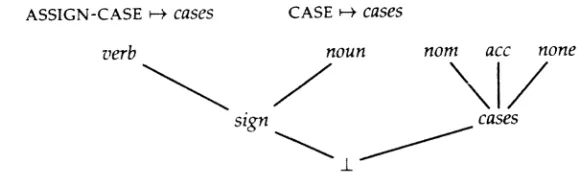
Figure 3 graphically depicts a type signature in which greater (more specific) types are presented higher and the appropriateness specification is displayed above the types. For example, for every feature structure of type verb, the feature assign-case is appropriate, with values that are at least of type cases:Approp(verb, assign-case) =cases.
A formal introduction to the theory of TFSs is given by Carpenter (1992). In-formally, a TFS over a signatureTypes,, Feats,Appropdiffers from an untyped feature structure in two aspects: a TFS has a type; and the value of each feature is a TFS—there is no need for atoms in a typed system. A TFS Awhose type ist is well-typediff every featureFinAis such thatApprop(t,F)is defined; every featureFin Ahas value of typet such thatApprop(t,F)t; and all the substructures of Aare well-typed. It istotally well-typedif, in addition, every featureFsuch thatApprop(t, F)is defined occurs inA. In other words, a TFS is totally well-typed if it has all and only the features that are appropriate for its type, with appropriate values, and the same holds for all its substructures.
Totally well-typed TFSs are informative and efficient to process. It might be prac-tically difficult, however, for the writer of a grammar to specify the full information such a structure encodes. To overcome this problem,type inferencealgorithms have been devised that enable a system to infer a totally well-typed TFS automatically from a partial description. Partial descriptions can specify
• the type of a TFS:V.t:verb
• a variable, referring to a TFS:VP.b:assign-case:X
• a path equation:VP.b:assign-case = NP.t:case
Figure 3
A simple type signature.
• a feature-value pair:NP.b:case:acc
• a conjunction of descriptions:V.t:(sign,assign-case:none)
The inferred feature structure is the most general TFS that is consistent with the partial description. The inferencefailsiff the description is inconsistent (i.e., describes no feature structure). See Figure 4 for some examples of partial descriptions and the TFSs they induce, based on the signature of Figure 3.
4. Implementation
To validate feature structure specifications in XTAG we have implemented the type in-ference algorithm suggested by Carpenter (1992, chapter 6). We manually constructed a type signature suitable for the current use of feature structures in the XTAG gram-mar of English (XTAG Research Group 2001). Then, we applied the type inference algorithm to all the feature structure specifications of the grammar, such that each feature structure was expanded with respect to the signature.
Type inference is applied off-line, before the grammar is used for parsing. As is the case with other off-line applications, efficiency is not a critical issue. It is worth noting, however, that for the grammar we checked (in which, admittedly, feature structures are flat and relatively small), the validation procedure is highly efficient. As a benchmark, we checked the consistency of 1,000 trees, each consisting of two to fourteen nodes. The input file, whose size approached 1MB, contained over 33,000 path equations. Validating the consistency of the benchmark trees took less than 33 seconds (more than a thousand path equations per second).
4.1 The Signature
The signature for the XTAG grammar was constructed manually, by observing the use of feature equations in the grammar and consulting its documentation. As noted above, most feature structures used in the grammar are flat, but the number of features in the top level is relatively high. The signature consists of 58 types and 56 features, and its construction took a few hours. In principle, it should be possible to construct signatures for untyped feature structures automatically, but such signatures will of course be less readable than manually constructed ones.
4.2 Results
Figure 4 Inferred TFSs.
can be classified into four different types: ambiguous names, typos, undocumented features, and plain errors.
4.2.1 Ambiguous Names. Ambiguous names are an obvious error, but one that is not easy to track without the typing mechanism that we discuss in this article. As the XTAG grammar has been developed by as many as a dozen developers, over a period of more than a decade, such errors are probably unavoidable. Specifically, a single name is used for two different features or values, with completely different intentions in mind.3 We have found several such errors in the grammar.
The feature genwas used for two purposes: in nouns, it referred to thegender, and took values such as masc, fem, or neuter; in pronouns, it was a boolean feature denoting genitive case. We even found a few cases in which the values of these in-compatible features were equated. As another example, the value nom was used to denote both nominative case, where it was an appropriate value for thecasefeature, and to denote a nominal predicate, where it was the appropriate value of the mode feature. Of course, these two features have nothing to do with each other and should never be equated (hence, should never have the same value). Finally, values such as nilornonewere used abundantly for a variety of purposes.
4.2.2 Typos. Another type of error that is very difficult to track otherwise are plain typos. The best example is probably a feature that occurred about 80% of the time as relpronand the rest of the time asrel-pron:
S_r.t:<relpron> = NP_w.t:<rel-pron>
4.2.3 Undocumented Features. We have found a great number of features and values that are not mentioned in the technical report documenting the grammar. Some of them turned out to be remnants of old analyses that were obsolete; others indicated a need for better documentation. Of course, the fewer features the grammar is using, the more efficient unification (and, hence, parsing) becomes.
Other cases necessitated updates of the grammar documentation. For example, the feature displ-constwas documented as taking boolean values but turned out to be a complex feature, with a substructure under the featureset1. The featuregen(in its gender use) was defined at the top level of nouns, whereas it should have been under theagrfeature.
4.2.4 Other Errors. Finally, some errors are plain mistakes of the grammar designer. For example, the specification S_r.t:<assign-case> = NP_w.t:<assign-case> im-plies that assign-caseis appropriate for nouns, which is of course wrong; the spec-ification S_r.t:<case> = nom implies that sentences have cases; and the specifica-tion V.t:<refl> = V_r.b:<refl> implies that verbs can be reflexive. Another ex-ample is the specification D_r.b:<punct bal> = Punct_1.t:<punct>, which handles the balancing of punctuation marks such as parentheses. This should have been either
D_r.b:<punct> = Punct_1.t:<punct> or D_r.b:<punct bal> = Punct_1.t:<punct bal>.
4.3 Additional Advantages
Since the feature structure validation procedure practically expands path equations to (most general) totally well-typed feature structures, we have implemented a mode in which the system outputs the expanded TFSs. Users can thus have a better idea of what feature structures are associated with tree nodes, both because all the features are present, and because typing adds information that was unavailable in the untyped specification. As an example, consider the following specification:
PP.b:<wh> = NP.b:<wh> PP.b:<assign-case> = nom
PP.b:<assign-case> = N.t:<case> NP.b:<agr> = N.t:<agr>
NP.b:<case> = N.t:<case> N.t:<case> = nom/acc
When it is expanded by the system, the TFS that is output for PP.b is depicted in Figure 5 (left). Note that the type of this TFS was set to p or v or comp, indicating that there is not sufficient information for the type inference procedure to distinguish among these three types. Many features that are not explicitly mentioned are added by the inference procedure, with their “default” (most general) values.
[52]p_or_v_or_comp( wh:[184]bool, assign-comp:[54]comps, rel-pron:[55]rel-prons, trace:[56]bot, equiv:[57]bool, compar:[58]bool, super:[59]bool, neg:[60]bool, assign-case:[304]nom) [289]noun( wh:[290]bool, agr:[298]agrs( num:[118]nums, pers:[119]persons), conj:[299]conjs, control:[300]bot, displ-const:[302]constituents( set1:[153]bool), case:[304]nom, definite:[305]bool, const:[306]bool, rel-clause:[307]bool, pron:[308]bool, quan:[309]bool, gerund:[312]bool, refl:[313]bool, gen:[314]gens, compl:[316]bool) Figure 5 Expanded TFSs.
5. Further Research
We have described in this article a method for validating the consistency of feature structure specifications in grammars that incorporate untyped feature structures. Al-though the use of feature structures in XTAG is very limited, especially since all fea-ture strucfea-tures are finitely bounded, the method we describe is applicable to feafea-ture structure–based grammatical formalisms in general; in particular, it will be interesting to test it on broad-coverage grammars that are based on unbounded feature structures, such as lexical functional grammars.
We have applied type inference only statically; feature structures that are created at parse time are not validated. By modifying the unification algorithm currently used in XTAG, however, it is possible to use TFSs in the grammar and apply type inference at run time. This will enable detection of more errors at run time and provide for better representation of feature structures and possibly for more efficient unifications. In a new implementation of XTAG (Sarkar 2000), feature structure specifications are not evaluated as structures are being constructed; rather, they are deferred to the final stage of processing, when only valid trees remain. We plan to apply type inference to the resulting feature structures in this implementation, so that run-time errors can be detected as well.
Acknowledgments
This work was supported by an IRCS fellowship and NSF grant SBR 8920230. The work of the first author was supported by the Israel Science Foundation (grant number 136/01-1).
References
Carpenter, Bob. 1992.The Logic of Typed Feature Structures. Cambridge Tracts in
Theoretical Computer Science. Cambridge University Press, Cambridge, England. Joshi, Aravind K. 1985. “Tree adjoining
grammars: How much context sensitivity is required to provide a reasonable structural description.” In D. Dowty, I. Karttunen, and A. Zwicky, editors,
Joshi, Aravind K., L. Levy, and M. Takahashi. 1975. Tree adjunct grammars.Journal of Computer and System Sciences10(1):136–163.
Kaplan, Ronald and Joan Bresnan. 1982. “Lexical functional grammar: A formal system for grammatical representation.” In J. Bresnan, editor,The Mental
Representation of Grammatical Relations. MIT Press, Cambridge, Massachusetts,
pages 173–281.
Kroch, Anthony S. and Aravind K. Joshi. 1987. “Analyzing extraposition in a tree adjoining grammar.” In G. Huck and A. Ojeda, editors,Discontinuous Constituents, Syntax and Semantics, volume 20. Academic Press, pages 107–149.
Pollard, Carl and Ivan A. Sag. 1994.
Head-Driven Phrase Structure Grammar. University of Chicago Press and CSLI Publications, Chicago, Illinois, and Stanford, California.
Sarkar, Anoop. 2000. “Practical experiments in parsing using tree adjoining
grammars.” InProceedings of the Fifth Workshop on Tree Adjoining Grammars, TAG+ 5, Paris, France, May 25–27. Schabes, Yves, Anne Abeill ´e, and
Aravind K. Joshi. 1988. “Parsing strategies with ‘lexicalized’ grammars: Application to tree adjoining grammars.” In
Proceedings of the 12th International Conference on Computational Linguistics (COLING’88), volume 2, pages 579–583, Budapest, Hungary, August.
Vijay-Shanker, K. and Aravind K. Joshi. 1991. “Unification based tree adjoining grammars.” In J. Wedekind, editor,
Unification-Based Grammars. MIT Press, Cambridge, Massachusetts.