Reconstructing Native Language Typology from Foreign Language Usage
Yevgeni Berzak CSAIL MIT
Roi Reichart Technion IIT
Boris Katz CSAIL MIT
Abstract
Linguists and psychologists have long been studying cross-linguistic transfer, the influence of native language properties on linguistic performance in a foreign lan-guage. In this work we provide empirical evidence for this process in the form of a strong correlation between language simi-larities derived from structural features in English as Second Language (ESL) texts and equivalent similarities obtained from the typological features of the native lan-guages. We leverage this finding to re-cover native language typological similar-ity structure directly from ESL text, and perform prediction of typological features in an unsupervised fashion with respect to the target languages. Our method achieves 72.2% accuracy on the typology predic-tion task, a result that is highly competi-tive with equivalent methods that rely on typological resources.
1 Introduction
Cross-linguistic transfer can be broadly described as the application of linguistic structure of a speaker’s native language in the context of a new, foreign language. Transfer effects may be expressed on various levels of linguistic perfor-mance, including pronunciation, word order, lex-ical borrowing and others (Jarvis and Pavlenko, 2007). Such traces are prevalent in non-native English, and in some cases are even cele-brated in anecdotal hybrid dialect names such as “Frenglish” and “Denglish”.
Although cross-linguistic transfer was exten-sively studied in Psychology, Second Language Acquisition (SLA) and Linguistics, the conditions under which it occurs, its linguistic characteristics as well as its scope remain largely under debate
(Jarvis and Pavlenko, 2007; Gass and Selinker, 1992; Odlin, 1989).
In NLP, the topic of linguistic transfer was mainly addressed in relation to the Native Lan-guage Identification (NLI) task, which requires to predict the native language of an ESL text’s au-thor. The overall high performance on this classi-fication task is considered to be a central piece of evidence for the existence of cross-linguistic trans-fer (Jarvis and Crossley, 2012). While the success on the NLI task confirms the ability to extract na-tive language signal from second language text, it offers little insight into the linguistic mechanisms that play a role in this process.
In this work, we examine the hypothesis that cross-linguistic structure transfer is governed by thetypological properties of the native language. We provide empirical evidence for this hypothe-sis by showing that language similarities derived from structural patterns of ESL usage are strongly correlated with similarities obtained directly from the typological features of the native languages.
This correlation has broad implications on the ability to perform inference from native language structure to second language performance and vice versa. In particular, it paves the way for a novel and powerful framework for comparing native languages through second language performance. This framework overcomes many of the inher-ent difficulties of direct comparison between lan-guages, and the lack of sufficient typological doc-umentation for the vast majority of the world’s lan-guages.
Further on, we utilize this transfer enabled framework for the task of reconstructing typolog-ical features. Automated prediction of language typology is extremely valuable for both linguistic studies and NLP applications which rely on such information (Naseem et al., 2012; T¨ackstr¨om et al., 2013). Furthermore, this task provides an ob-jective external testbed for the quality of our native
language similarity estimates derived from ESL texts.
Treating native language similarities obtained from ESL as an approximation for typological similarities, we use them to predict typological features without relying on typological annotation for the target languages. Our ESL based method yields 71.4% – 72.2% accuracy on the typology re-construction task, as compared to 69.1% – 74.2% achieved by typology based methods which de-pend on pre-existing typological resources for the target languages.
To summarize, this paper offers two main con-tributions. First, we provide an empirical result that validates the systematic existence of linguistic transfer, tying the typological characteristics of the native language with the structural patterns of for-eign language usage. Secondly, we show that ESL based similarities can be directly used for predic-tion of native language typology. As opposed to previous approaches, our method achieves strong results without access to any a-priori knowledge about the target language typology.
The remainder of the paper is structured as fol-lows. Section 2 surveys the literature and positions our study in relation to previous research on cross-linguistic transfer and language typology. Section 3 describes the ESL corpus and the database of typological features. In section 4, we delineate our method for deriving native language similar-ities and hierarchical similarity trees from struc-tural features in ESL. In section 5 we use typolog-ical features to construct another set of language similarity estimates and trees, which serve as a benchmark for the typological validity of the ESL based similarities. Section 6 provides a correla-tion analysis between the ESL based and typology based similarities. Finally, in section 7 we report our results on typology reconstruction, a task that also provides an evaluation framework for the sim-ilarity structures derived in sections 4 and 5.
2 Related Work
Our work integrates two areas of research, cross-linguistic transfer and cross-linguistic typology.
2.1 Cross-linguistic Transfer
The study of cross-linguistic transfer has thus far evolved in two complementary strands, the lin-guistic comparative approach, and the computa-tional detectionbased approach. While the
com-parative approach focuses on case study based qualitative analysis of native language influence on second language performance, the detection based approach revolves mainly around the NLI task.
Following the work of Koppel et al. (2005), NLI has been gaining increasing interest in NLP, cul-minating in a recent shared task with 29 partici-pating systems (Tetreault et al., 2013). Much of the NLI efforts thus far have been focused on ex-ploring various feature sets for optimizing classifi-cation performance. While many of these features are linguistically motivated, some of the discrimi-native power of these approaches stems from cul-tural and domain artifacts. For example, our pre-liminary experiments with a typical NLI feature set, show that the strongest features for predicting Chinese are strings such as China and in China. Similar features dominate the weights of other lan-guages as well. Such content features boost clas-sification performance, but are hardly relevant for modeling linguistic phenomena, thus weakening the argument that NLI classification performance is indicative of cross-linguistic transfer.
Our work incorporates an NLI component, but departs from the performance optimization orien-tation towards leveraging compuorien-tational analysis for better understanding of the relations between native language typology and ESL usage. In par-ticular, our choice of NLI features is driven by their relevance to linguistic typology rather than their contribution to classification performance. In this sense, our work aims to take a first step to-wards closing the gap between the detection and comparative approaches to cross-linguistic trans-fer.
2.2 Language Typology
The second area of research, language typology, deals with the documentation and comparative study of language structures (Song, 2011). Much of the descriptive work in the field is summa-rized in the World Atlas of Language Structures (WALS)1 (Dryer and Haspelmath, 2013) in the
form of structural features. We use the WALS fea-tures as our source of typological information.
Several previous studies have used WALS fea-tures for hierarchical clustering of languages and typological feature prediction. Most notably, Teh et al. (2007) and subsequently Daum´e III (2009)
predicted typological features from language trees constructed with a Bayesian hierarchical cluster-ing model. In Georgi et al. (2010) additional clus-tering approaches were compared using the same features and evaluation method. In addition to the feature prediction task, these studies also evalu-ated their clustering results by comparing them to genetic language clusters.
Our approach differs from this line of work in several aspects. First, similarly to our WALS based baselines, the clustering methods presented in these studies are affected by the sparsity of available typological data. Furthermore, these methods rely on existing typological documen-tation for the target languages. Both issues are obviated in our English based framework which does not depend on any typological information to construct the native language similarity struc-tures, and does not require any knowledge about the target languages except from the ESL essays of a sample of their speakers. Finally, we do not com-pare our clustering results to genetic groupings, as to our knowledge, there is no firm theoretical ground for expecting typologically based cluster-ing to reproduce language phylogenies. The em-pirical results in Georgi et al. (2010), which show that typology based clustering differs substantially from genetic groupings, support this assumption.
3 Datasets
3.1 Cambridge FCE
We use the Cambridge First Certificate in English (FCE) dataset (Yannakoudakis et al., 2011) as our source of ESL data. This corpus is a subset of the Cambridge Learner Corpus (CLC)2. It
con-tains English essays written by upper-intermediate level learners of English for the FCE examination. The essay authors represent 16 native lan-guages. We discarded Dutch and Swedish speak-ers due to the small number of documents avail-able for these languages (16 documents in total). The remaining documents are associated with the following 14 native languages: Catalan, Chinese, French, German, Greek, Italian, Japanese, Korean, Polish, Portuguese, Russian, Spanish, Thai and Turkish. Overall, our corpus comprises 1228 uments, corresponding to an average of 87.7 doc-uments per native language.
2http://www.cambridge.org/gb/elt/
catalogue/subject/custom/item3646603
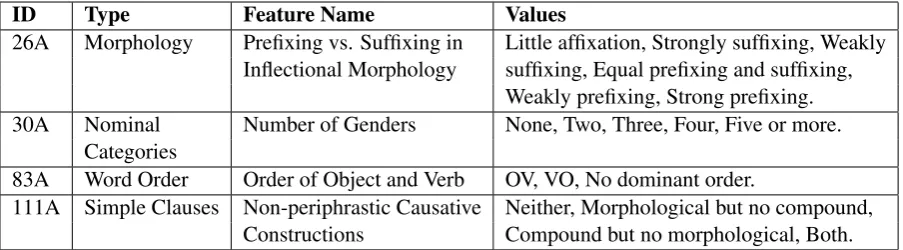
3.2 World Atlas of Language Structures We collect typological information for the FCE native languages from WALS. Currently, the database contains information about 2,679 of the world’s 7,105 documented living languages (Lewis, 2014). The typological feature list has 188 features, 175 of which are present in our dataset. The features are associated with 9 linguistic cat-egories: Phonology, Morphology, Nominal Cate-gories, Nominal Syntax, Verbal CateCate-gories, Word Order, Simple Clauses, Complex Sentences and Lexicon. Table 1 presents several examples for WALS features and their range of values.
One of the challenging characteristics of WALS is its low coverage, stemming from lack of avail-able linguistic documentation. It was previously estimated that about 84% of the language-feature pairs in WALS are unknown (Daum´e III, 2009; Georgi et al., 2010). Even well studied languages, like the ones used in our work, are lacking values for many features. For example, only 32 of the WALS features have known values for all the 14 languages of the FCE corpus. Despite the preva-lence of this issue, it is important to bear in mind that some features do not apply to all languages by definition. For instance, feature 81B Languages with two Dominant Orders of Subject, Object, and Verb is relevant only to 189 languages (and has documented values for 67 of them).
We perform basic preprocessing, discarding 5 features that have values for only one language. Further on, we omit 19 features belonging to the category Phonology as comparable phonological features are challenging to extract from the ESL textual data. After this filtering, we remain with 151 features, 114.1 features with a known value per language, 10.6 languages with a known value per feature and 2.5 distinct values per feature.
Following previous work, we binarize all the WALS features, expressing each feature in terms of k binary features, where k is the number of values the original feature can take. Note that beyond the well known issues with feature bi-narization, this strategy is not optimal for some of the features. For example, the feature 111A
ID Type Feature Name Values
26A Morphology Prefixing vs. Suffixing in Little affixation, Strongly suffixing, Weakly Inflectional Morphology suffixing, Equal prefixing and suffixing,
Weakly prefixing, Strong prefixing. 30A Nominal Number of Genders None, Two, Three, Four, Five or more.
Categories
83A Word Order Order of Object and Verb OV, VO, No dominant order.
[image:4.595.74.526.62.187.2]111A Simple Clauses Non-periphrastic Causative Neither, Morphological but no compound, Constructions Compound but no morphological, Both.
Table 1: Examples of WALS features. As illustrated in the table examples, WALS features can take different types of values and may be challenging to encode.
4 Inferring Language Similarities from ESL
Our first goal is to derive a notion of similarity be-tween languages with respect to their native speak-ers’ distinctive structural usage patterns of ESL. A simple way to obtain such similarities is to train a probabilistic NLI model on ESL texts, and in-terpret the uncertainty of this classifier in distin-guishing between a pair of native languages as a measure of their similarity.
4.1 NLI Model
The log-linear NLI model is defined as follows:
p(y|x;θ) = P exp(θ·f(x, y))
y0∈Y exp(θ·f(x, y0)) (1)
wherey is the native language,xis the observed English document and θ are the model parame-ters. The parameters are learned by maximizing the L2 regularized log-likelihood of the training dataD={(x1, y1), ...,(xn, yn)}.
L(θ) =Xn
i=1
logp(yi|xi;θ)−λkθk2 (2)
The model is trained using gradient ascent with L-BFGS-B (Byrd et al., 1995). We use 70% of the FCE data for training and the remaining 30% for development and testing.
As our objective is to relate native language and target languagestructures, we seek to control for biases related to the content of the essays. As pre-viously mentioned, such biases may arise from the essay prompts as well as from various cultural fac-tors. We therefore define the model using only un-lexicalizedmorpho-syntactic features, which cap-ture structural properties of English usage.
Our feature set, summarized in table 2, contains features which are strongly related to many of the structural features in WALS. In particular, we use features derived from labeled dependency parses. These features encode properties such as the types of dependency relations, ordering and distance be-tween the head and the dependent. Additional syntactic information is obtained using POS n-grams. Finally, we consider derivational and in-flectional morphological affixation. The annota-tions required for our syntactic features are ob-tained from the Stanford POS tagger (Toutanova et al., 2003) and the Stanford parser (de Marneffe et al., 2006). The morphological features are ex-tracted heuristically.
4.2 ESL Based Native Language Similarity Estimates
Given a document x and its author’s native lan-guagey, the conditional probabilityp(y0|x;θ)can
be viewed as a measure of confusion between lan-guagesyandy0, arising from their similarity with
respect to the document features. Under this in-terpretation, we derive a language similarity ma-trixS0
ESLwhose entries are obtained by averaging these conditional probabilities on the training set documents with the true labely, which we denote asDy ={(xi, y)∈D}.
SESL0 y,y0 =
1
|Dy| P
(x,y)∈Dy
p(y0|x;θ) ify0 6=y
1 otherwise (3)
For each pair of languagesyandy0, the matrix
S0
ESL contains an entry SESL0 y,y0 which captures
the average probability of mistakingy fory0, and
an entryS0
Feature Type Examples
Unlexicalized labeled dependencies Relation =prepHead =VBNDependent =IN
Ordering of head and dependent Ordering =rightHead =NNSDependent =JJ
Distance between head and dependent Distance =2Head =VBGDependent =PRP
POS sequence between head and dependent Relation =detPOS-between =JJ
POS n-grams (up to 4-grams) POS bigram =NN VBZ
Inflectional morphology Suffix =ing
[image:5.595.96.511.61.173.2]Derivational morphology Suffix =ity
Table 2: Examples of syntactic and morphological features of the NLI model. The feature values are set to the number of occurrences of the feature in the document. The syntactic features are derived from the output of the Stanford parser. A comprehensive description of the Stanford parser dependency annotation scheme can be found in the Stanford dependencies manual (de Marneffe and Manning, 2008).
confusion. We average the two confusion scores to receive the matrix of pairwise language similarity estimatesSESL.
SESLy,y0 =SESLy0,y = 12(SESL0 y,y0 +SESL0 y0,y)
(4) Note that comparable similarity estimates can be obtained from the confusion matrix of the clas-sifier, which records the number of misclassifica-tions corresponding to each pair of class labels. The advantage of our probabilistic setup over this method is its robustness with respect to the actual classification performance of the model.
4.3 Language Similarity Tree
A particularly informative way of representing language similarities is in the form of hierarchi-cal trees. This representation is easier to inspect than a similarity matrix, and as such, it can be more instrumental in supporting linguistic inquiry on language relatedness. Additionally, as we show in section 7, hierarchical similarity trees can out-perform raw similarities when used for typology reconstruction.
We perform hierarchical clustering using the Ward algorithm (Ward Jr, 1963). Ward is a bottom-up clustering algorithm. Starting with a separate cluster for each language, it successively merges clusters and returns the tree of cluster merges. The objective of the Ward algorithm is to minimize the total within-cluster variance. To this end, at each step it merges the cluster pair that yields the minimum increase in the overall within-cluster variance. The initial distance ma-trix required for the clustering algorithm is de-fined as1−SESL. We use the Scipy
implemen-tation3 of Ward, in which the distance between a
newly formed cluster a∪b and another clusterc
is computed with the Lance-Williams distance up-date formula (Lance and Williams, 1967).
5 WALS Based Language Similarities
In order to determine the extent to which ESL based language similarities reflect the typological similarity between the native languages, we com-pare them to similarities obtained directly from the typological features in WALS.
The WALS based similarity estimates between languagesyandy0are computed by measuring the
cosine similarity between the binarized typologi-cal feature vectors.
SW ALSy,y0 =
vy ·vy0
kvykkvy0k (5)
As mentioned in section 3.2, many of the WALS features do not have values for all the FCE lan-guages. To address this issue, we experiment with two different strategies for choosing the WALS features to be used for language similarity compu-tations. The first approach, calledshared-all, takes into account only the 32 features that have known values in all the 14 languages of our dataset. In the second approach, calledshared-pairwise, the similarity estimate for a pair of languages is deter-mined based on the features shared between these two languages.
As in the ESL setup, we use the two matrices of similarity estimates to construct WALS based hierarchical similarity trees. Analogously to the ESL case, a WALS based tree is generated by the
3http://docs.scipy.org/.../scipy.
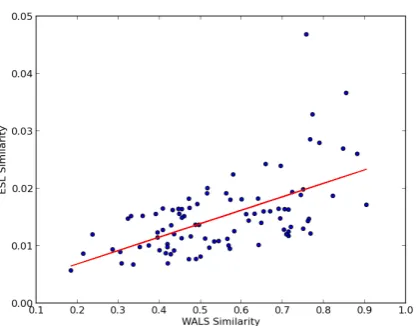
Figure 1: shared-pairwise WALS based versus ESL based language similarity scores. Each point represents a language pair, with the vertical axis corresponding to the ESL based similarity and the horizontal axis standing for the typological
shared-pairwise WALS based similarity. The scores correlate strongly with a Pearson’s coeffi-cient of 0.59 for theshared-pairwiseconstruction and 0.50 for theshared-allfeature-set.
Ward algorithm with the input distance matrix1−
SW ALS.
6 Comparison Results
After independently deriving native language sim-ilarity matrices from ESL texts and from typo-logical features in WALS, we compare them to one another. Figure 1 presents a scatter plot of the language similarities obtained using ESL data, against the equivalent WALS based similar-ities. The scores are strongly correlated, with a Pearson Correlation Coefficient of 0.59 using the
shared-pairwise WALS distances and 0.50 using theshared-allWALS distances.
This correlation provides appealing evidence for the hypothesis that distinctive structural pat-terns of English usage arise via cross-linguistic transfer, and to a large extent reflect the typologi-cal similarities between the respective native lan-guages. The practical consequence of this result is the ability to use one of these similarity structures to approximate the other. Here, we use the ESL based similarities as a proxy for the typological similarities between languages, allowing us to re-construct typological information without relying on a-priori knowledge about the target language typology.
In figure 2 we present, for illustration purposes,
the hierarchical similarity trees obtained with the Ward algorithm based on WALS and ESL similar-ities. The trees bear strong resemblances to one other. For example, at the top level of the hier-archy, the Indo-European languages are discerned from the non Indo-European languages. Further down, within the Indo-European cluster, the Ro-mance languages are separated from other Indo-European subgroups. Further points of similarity can be observed at the bottom of the hierarchy, where the pairs Russian and Polish, Japanese and Korean, and Chinese and Thai merge in both trees. In the next section we evaluate the quality of these trees, as well as the similarity matrices used for constructing them with respect to their ability to support accurate nearest neighbors based recon-struction of native language typology.
7 Typology Prediction
Although pairwise language similarities derived from structural features in ESL texts are highly correlated with similarities obtained directly from native language typology, evaluating the absolute quality of such similarity matrices and trees is challenging.
We therefore turn to typology prediction based evaluation, in which we assess the quality of the induced language similarity estimates by their ability to support accurate prediction of unseen ty-pological features. In this evaluation mode we project unknown WALS features to a target lan-guage from the lanlan-guages that are closest to it in the similarity structure. The underlying assump-tion of this setup is that better similarity structures will lead to better accuracies in the feature predic-tion task.
Typological feature prediction not only pro-vides an objective measure for the quality of the similarity structures, but also has an intrinsic value as a stand-alone task. The ability to infer typolog-ical structure automattypolog-ically can be used to create linguistic databases for low-resource languages, and is valuable to NLP applications that exploit such resources, most notably multilingual parsing (Naseem et al., 2012; T¨ackstr¨om et al., 2013).
(a) Hierarchical clustering using WALS based shared-pairwisedistances.
[image:7.595.75.284.60.244.2](b) Hierarchical clustering using ESL based distances. Figure 2: Language Similarity Trees. Both trees are constructed with the Ward agglomerative hi-erarchical clustering algorithm. Tree (a) uses the WALS basedshared-pairwiselanguage distances. Tree (b) uses the ESL derived distances.
between several values, we iteratively expand the group of nearest languages until neither of these cases applies.
To predict features using a hierarchical cluster tree, we set the value of each target language fea-ture to its majority value among the members of the parent cluster of the target language, excluding the target language itself. For example, using the tree in figure 2(a), the feature values for the target language French will be obtained by taking ma-jority votes between Portuguese, Italian and Span-ish. Similarly to the matrix based prediction, miss-ing values and ties are handled by backmiss-ing-off to a
larger set of languages, in this case by proceeding to subsequent levels of the cluster hierarchy. For the French example in figure 2(a), the first fall-back option will be the Romance cluster.
Following the evaluation setups in Daum´e III (2009) and Georgi et al. (2010), we evaluate the WALS based similarity estimates and trees by con-structing them using 90% of the WALS features. We report the average accuracy over 100 random folds of the data. In theshared-allregime, we pro-vide predictions not only for the remaining 10% of features shared by all languages, but also for all the other features that have values in the target lan-guage and are not used for the tree construction.
[image:7.595.74.285.279.458.2]Importantly, as opposed to the WALS based prediction, our ESL based method does not re-quire any typological features for inferring lan-guage similarities and constructing the similarity tree. In particular, no typological information is required for the target languages. Typological fea-tures are needed only for the neighbors of the tar-get language, from which the features are pro-jected. This difference is a key advantage of our approach over the WALS based methods, which presuppose substantial typological documentation for all the languages involved.
Table 3 summarizes the feature reconstruction results. The ESL approach is highly competitive with the WALS based results, yielding comparable accuracies for the shared-allprediction, and lag-ging only 1.7% – 3.4% behind theshared-pairwise
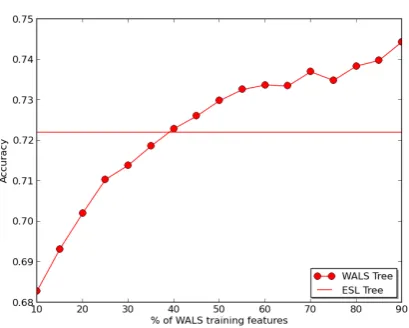
construction. Also note that for both WALS based and ESL based predictions, the highest results are achieved using the hierarchical tree predictions, confirming the suitability of this representation for accurately capturing language similarity structure. Figure 3 presents the performance of the strongest WALS based typological feature com-pletion method, WALSshared-pairwisetree, as a function of the percentage of features used for ob-taining the language similarity estimates. The fig-ure also presents the strongest result of the ESL method, using the ESL tree, which does not re-quire any such typological training data for ob-taining the language similarities. As can be seen, the WALS based approach would require access to almost 40% of the currently documented WALS features to match the performance of the ESL method.
Method NN 3NN Tree WALSshared-all 71.6 71.4 69.1 WALSshared-pairwise 73.1 74.1 74.2
[image:8.595.309.514.62.226.2]ESL 71.4 70.7 72.2
Table 3: Typology reconstruction results. Three types of predictions are compared, nearest neigh-bor (NN), 3 nearest neighneigh-bors (3NN) and near-est tree neighbors (Tree). WALS shared-all are WALS based predictions, where only the 32 fea-tures that have known values in all 14 languages are used for computing language similarities. In the WALS shared-pairwise predictions the lan-guage similarities are computed using the WALS features shared by each language pair. ESL re-sults are obtained by projection of WALS features from the closest languages according to the ESL language similarities.
its ability to extract strong typologically driven signal, while being robust to the partial nature of existing typological annotation which hinders the performance of the baselines. Given the small amount of ESL data at hand, these results are highly encouraging with regard to the prospects of our approach to support typological inference, even in the absence of any typological documen-tation for the target languages.
8 Conclusion and Outlook
We present a novel framework for utilizing cross-linguistic transfer to infer language similarities from morpho-syntactic features of ESL text. Trad-ing laborious expert annotation of typological fea-tures for a modest amount of ESL texts, we are able to reproduce language similarities that strongly correlate with the equivalent typology based similarities, and perform competitively on a typology reconstruction task.
Our study leaves multiple questions for future research. For example, while the current work ex-amines structure transfer, additional investigation is required to better understand lexical and phono-logical transfer effects.
Furthermore, we currently focuse on native lan-guage typology, and assume English as the foreign language. This limits our ability to study the con-straints imposed on cross-linguistic transfer by the foreign language. An intriguing research direction would be to explore other foreign languages and compare the outcomes to our results on English.
Figure 3: Comparison of the typological fea-ture completion performance obtained using the WALS tree withshared-pairwise similarities and the ESL tree based typological feature comple-tion performance. The dotted line represents the WALS based prediction accuracy, while the hor-izontal line is the ESL based accuracy. The horizontal axis corresponds to the percentage of WALS features used for constructing the WALS based language similarity estimates.
Finally, we plan to formulate explicit models for the relations between specific typological fea-tures and ESL usage patterns, and extend our ty-pology induction mechanisms to support NLP ap-plications in the domain of multilingual process-ing.
Acknowledgments
We would like to thank Yoong Keok Lee, Jesse Harris and the anonymous reviewers for valuable comments on this paper. This material is based upon work supported by the Center for Brains, Minds, and Machines (CBMM), funded by NSF STC award CCF-1231216, and by Google Faculty Research Award.
References
Richard H Byrd, Peihuang Lu, Jorge Nocedal, and Ciyou Zhu. 1995. A limited memory algorithm for bound constrained optimization. SIAM Journal on Scientific Computing, 16(5):1190–1208.
[image:8.595.79.289.62.120.2]Marie-Catherine de Marneffe and Christopher D Man-ning. 2008. Stanford typed dependencies manual.
URL http://nlp. stanford. edu/software/dependencies manual. pdf.
Marie-Catherine de Marneffe, Bill MacCartney, Christopher D Manning, et al. 2006. Generating typed dependency parses from phrase structure parses. InProceedings of LREC, volume 6, pages 449–454.
Matthew S. Dryer and Martin Haspelmath, editors. 2013. WALS Online. Max Planck Institute for Evo-lutionary Anthropology, Leipzig.
Susan M Gass and Larry Selinker. 1992. Language
Transfer in Language Learning: Revised edition,
volume 5. John Benjamins Publishing.
Ryan Georgi, Fei Xia, and William Lewis. 2010. Comparing language similarity across genetic and typologically-based groupings. In Proceedings of the 23rd International Conference on Computa-tional Linguistics, pages 385–393. Association for Computational Linguistics.
Scott Jarvis and Scott A Crossley. 2012. Approaching language transfer through text classification: Explo-rations in the detection-based approach, volume 64. Multilingual Matters.
Scott Jarvis and Aneta Pavlenko. 2007. Crosslinguis-tic influence in language and cognition. Routledge. Moshe Koppel, Jonathan Schler, and Kfir Zigdon.
2005. Determining an author’s native language by mining a text for errors. In Proceedings of the eleventh ACM SIGKDD international conference on
Knowledge discovery in data mining, pages 624–
628. ACM.
Godfrey N Lance and William Thomas Williams. 1967. A general theory of classificatory sorting strategies ii. clustering systems.The computer jour-nal, 10(3):271–277.
M. Paul Lewis. 2014. Ethnologue: Languages of the world. www.ethnologue.com.
Tahira Naseem, Regina Barzilay, and Amir Globerson. 2012. Selective sharing for multilingual dependency parsing. InProceedings of the 50th Annual Meet-ing of the Association for Computational LMeet-inguis-
Linguis-tics: Long Papers-Volume 1, pages 629–637.
Asso-ciation for Computational Linguistics.
Terence Odlin. 1989. Language transfer:
Cross-linguistic influence in language learning.
Cam-bridge University Press.
J.J. Song. 2011. The Oxford Handbook of Linguistic
Typology. Oxford Handbooks in Linguistics. OUP
Oxford.
Oscar T¨ackstr¨om, Ryan McDonald, and Joakim Nivre. 2013. Target language adaptation of discriminative transfer parsers. Proceedings of NAACL-HLT.
Yee Whye Teh, Hal Daum´e III, and Daniel M Roy. 2007. Bayesian agglomerative clustering with co-alescents. InNIPS.
Joel Tetreault, Daniel Blanchard, and Aoife Cahill. 2013. A report on the first native language identi-fication shared task. NAACL/HLT 2013, page 48. Kristina Toutanova, Dan Klein, Christopher D
Man-ning, and Yoram Singer. 2003. Feature-rich part-of-speech tagging with a cyclic dependency network.
InProceedings of the 2003 Conference of the North
American Chapter of the Association for Computa-tional Linguistics on Human Language
Technology-Volume 1, pages 173–180. Association for
Compu-tational Linguistics.
Joe H Ward Jr. 1963. Hierarchical grouping to opti-mize an objective function. Journal of the American statistical association, 58(301):236–244.