Abstract- Heavy metals in plating wastewater are considered as one of the must-treated contaminants and the adsorption using low-cost materials has been studied as the cost-effective alternative. Based on the parameter (Qo) calculated from
Langmuir isotherm, Cu (1.68 mg/g) had a higher affinity to waste-reclaimed adsorbent than Zn (0.06 mg/g). The removal efficiency of metal ions (i.e. Cu and Zn) at various pHs was tested, and it was revealed that the removal of metal ions was interpreted by both adsorption and precipitation. The optimum pH for the removal (i.e. both adsorption and precipitation) of both Cu and Zn was 9, and the highest adsorption of Cu and Zn was observed at the pH of 5 for the artificial solution and at the pH of 7 for plating wastewater. Moreover, unlike the adsorption of Cu and Zn in the artificial solution, Cu and Zn in plating wastewater was adsorbed even at the pH of 12. To examine adsorption phenomenon, the relationship of the surface charge of adsorbent and the pH of solution was evaluated by measuring pzc (point of zero charge) of waste-reclaimed adsorbent. The pzc value of waste-reclaimed adsorbent was 6.27. Therefore, the optimum pH for adsorption should be over 6.27, which indicated the negative surface charge. However, it seemed unclear to be explained by surface charge, and other surface characteristics like ion exchange ability needed to be considered and evaluated.
Key words: copper, zinc, waste-reclaimed adsorbent, adsorption, precipitation, plating wastewater
.
I. INTRODUCTION
Heavy metals in plating wastewater are considered as one of the must-treated contaminants and the adsorption using low-cost materials has been studied as the cost-effective
Manuscript received July 16, 2010. (Write the date on which you submitted your paper for review.) This work was supported in part by Korea Ministry of Environment as: The GAIA project (173-092-012) and BK 21 of Korea. Hoon-Young Jo is with the Department of Chemical Engineering, Hanyang University, Seoul, 133-791, South Korea (e-mail:[email protected]) Si-Hyun Do is with the Department of Chemical Engineering, Hanyang University, Seoul, 133-791, South Korea (e-mail: [email protected]). Yoon-Seok Jang is with the Department of Chemical Engineering, Hanyang University, Seoul, 133-791, South Korea ( e-mail: [email protected]). Sung-Ho Kong was with the Department of Chemical Engineering, Hanyang University, Seoul, 133-791, South Korea (corresponding author to provide phone:82-2-2220-0489;fax:82-2-2293-8551;e-mail:[email protected])
alternative. This variety and complexity of effluents makes the removal process of heavy metals more difficult. Currently, the chemical flocculation followed by precipitation is the most widely used technique for heavy metals, but the efforts to find alternatives have been continued. The alternatives to remove heavy metals are adsorption, ion exchange, phytoextraction, ultra filtration, reverse osmosis, and electro dialysis. Among these, adsorption using low-cost adsorbents such as chitosan, zeolies, waste slurry, and lignin were tested to remove various types of heavy metals and this could be a cost-effective process with well performance [1].
Adsorption of various materials (i.e. metal ions, inorganic and organic compounds) depends on both surface chemistry and pore distribution of adsorbent, and the phenomena of adsorption of metal ions could be explained by surface characteristic, including ion exchange ability, surface charge, etc. The importance of ion exchange ability was appeared in several publications [2-4]. Synthetic zeolite, which had the ability of the hydronium ion exchanges, can be assigned to the higher metal ions removal [3]. Moreover, in ion exchange process, one suggested that the diffusion of exchangeable ions through the channel/void of adsorbent is the rate determining step [2], while Blanchard et al. reported that the surface reaction is the rate determining step and the exchange rate kinetic order is two [4]. In addition to ion exchange ability, the surface charge of adsorbent could be also considered as one of parameters to affect the adsorption process. The point of zero charge (pzc) is defined by the zero charge of surface, which the sum of positive equals the sum of negative. Depending on the pH value of the aqueous phase, the surface charge of adsorbent could be developed as either positive or negative. If pH (solution) < pzc, the surface is positively charged, and if pH (solution) > pzc, then the surface is negatively charged [5].
Zeolite, which is known for a popular adsorbent, has been studied to remove metal ions and its adsorption capacity for Zn and Cu were ranged as 0.04-5.5 mg/g and 0.37-5.1 mg/g, respectively [1]. Moreover, the selectivity of zeolite for metal ions has been reported as Pb2+ > NH4+ > Ba2+ > Cu2+, Zn2+ > Cd2+, Sr2+> Co2+ by Blanchard et al. [4], while that was as Pb2+> Cd2+> Cs+ > Cu2+ > Co2+ > Cr3+ > Zn2+ > Ni2+ > Hg2+ by Zamzow et al. [6]. Recently, fly ash was evaluated for adsorption of Cu, and it was reported that the adsorption capacity of 1.39 mg of Cu2+/g was earned at the pH of 8.0 [7]. It was also found that adsorption capacity increased with an
The Removal of Metal Ions (Cu
2+
and Zn
2+
)
using Waste-reclaimed Adsorbent for Plating
Wastewater Treatment Process
increase of CaO in fly ash.
In this study, we conducted a study on removal of heavy
metals (Cu and Zn) by using a waste-reclaimed adsorbent. Samples of the plating wastewater have been taken from the
industrial zone located at Ansan, Korea, and the adsorption of Cu and Zn has been carried out at batch reactor. At present, the adsorption phenomenon of metal ions on waste-reclaimed adsorbent was evaluated on basis of the relationship of the surface charge of adsorbent and the pH of solution, and later, other explanations like ion exchange ability will be adapted.underline.
II. MATERIALS AND METHODS
2.1. Characteristics of waste-reclaimed adsorbent
[image:2.595.314.550.241.489.2]Waste-reclaimed adsorbent was taken from department of material engineering, Kyonggi University. It passed through 3-6 mesh (sieve size), washed with distilled water, dried in an oven at 105 oC for 3 h, and stored in desiccators. Chemical compositions of waste-reclaimed adsorbent were shown in Table 1.
Table 1. Chemical compositions of waste-reclaimed adsorbent
SiO2 Al2O3 Fe2O3 CaO MgO Na2O K2O TiO2P2O5 MnO C ZrO2Ig.loss Total
45.58 18.60 8.08 2.17 0.78 0.18 0.51 1.33 0.24 0.05 18.07 0.33 4.07 100.00
2.2. Batch experiment
The removal of metal ions using waste-reclaimed adsorbent at various pHs was carried out using the single batch system, which was a 40 mL glass vial with caps. Batch experiments were conducted using 10g of waste-reclaimed adsorbent with 20mL of solution at different pH (i.e. 3, 5, 7, 9, and 12). The pH of solution was adjusted by adding 0.1 N HNO3 and 0.1 N NaOH (KANTO). The concentration of Cu and Zn was 20 mg/L, respectively. These prepared batch reactors were mounted on orbital shaker at 200 rpm for 24 h. Controls, which were without adsorbent, were also prepared to check the portion of precipitation. The experiment of adsorption isotherm was conducted with the same condition except the concentration of Cu and Zn, which were ranged from 5 to 50 mg/L, respectively. After 24 h of reaction time, the reactor was retrieved from shaker, and 2 mL of supernatant was filtered through 0.45-um Teflon filter. The diluted sample dilute with pH 3 was stored at refrigerator until the analytical procedure was preceded. The mass distribution of metal ions can be expressed as following equations.
Total mass of metal ions = metal ions remaining in the aqueous phase + metal ions
removed (1)
Metal ions removed = metal ions adsorbed on adsorbent + metal ions precipitated by pH
of solution (2)
2.3. Analytical procedures
Concentrations of metal ions were determined by ICP (1000 IV Inductively Coupled Plasma). The micrographs of waste-reclaimed adsorbent were obtained using a JSM-700F scanning electron microscopy (SEM) and Energy Dispersive Spectroscopy (EDS). Point of zero charge (pzc) of waste-reclaimed adsorbent was determined by the mass titration method [5].
III. RESULTS AND DISCUSSIONS
3.1. The surface of waste-reclaimed adsorbent
(a)
(b)
(c)
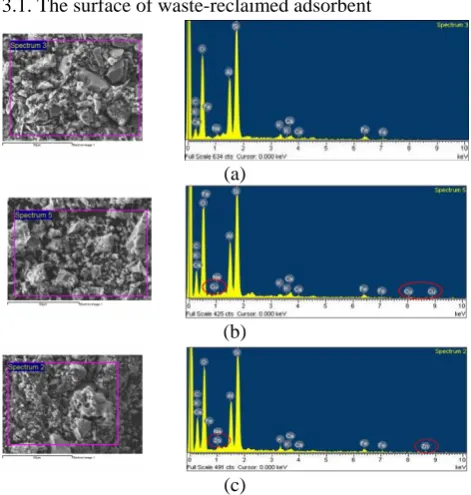
Fig.1. Energy Dispersive Spectroscopy (EDS) spectra collected onto the rectangular zones of Scanning Electron Microscopy (SEM): (a) raw material, (b) after adsorption of Cu (c) after adsorption of Zn [experimental condition: T = 25 o
C, reaction time = 24 h, waste-reclaimed adsorbent dosage = 10 g, volume of solution = 20 mL, initial concentration of Cu = 20 mg/L, the pH of batch reactor: 5.0].
SEM-EDS analysis (Fig. 1.) revealed the existence of Cu and Zn on waste-reclaimed adsorbent. This technique was used to provide information on the association of Cu and Zn in absorbent. Furthermore, EDS analysis was indicated to analyze the elemental constitution of Cu-impregnated and Zn-impregnated in absorbent.
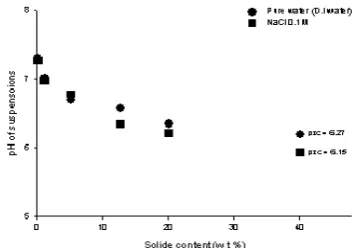
Fig. 2. Point of zero charge of waste-reclaimed adsorbent. The measured point of zero charge of waste-reclaimed adsorbent was 6.15 with 0.1 M NaCl and 6.27 with pure water. Because of the negligible difference of pzc between NaCl and pure water, the measured pzc was determined as 6.27.
3.3. Adsorption isotherms
(a)
(b)
Fig. 3. (a) Langmuir and (b) Freundlich isotherms for adsorption of copper and zinc on waste-reclaimed adsorbent [experimental condition: T = 25 oC, t = 24 h, adsorbent dosage = 10 g, volume of solution = 20 mL, and the pH of solution: 5.0]
These results showed that both Langmuir and Freundlich isotherm could demonstrate the behavior of Cu and Zn adsorption on waste-reclaimed adsorbent. Values of coefficients were shown in Table 2. Based on the parameter
[image:3.595.305.527.155.575.2](Qo) calculated from Langmuir isotherm, Cu had a higher affinity to waste-reclaimed adsorbent than Zn. Moreover, the adsorption capacity of waste-reclaimed adsorbent for both Cu and Zn was similar to that of zeolite, which was reported as 0.37 - 5.1 mg/g for Cu and 0.04 - 5.5 mg/g for Zn, respectively [1].
Table 2. Coefficients for Langmuir and Freundlich isotherms
Langmuir Freundlich
Qo(mg/g) b(L/g) R2 Kf(L/g) 1/n R2 Cu 1.68 0.0005 0.999 0.886 0.977 0.998
Zn 0.60 0.0132 0.997 1.187 0.789 0.988
3.4. The effect of pH
(a) Artificial solution
[image:3.595.75.267.334.654.2](b) Plating wastewater
Fig. 4. The effect of pH on the removal of metals ion using a adsorbent [experimental condition: T = 25 ℃, t = 24 h, adsorbent dosage = 10 g, volume of solution = 20 mL (a) initial Cu = 0.376 mg and Zn = 0.414 mg and (b) initial Cu = 0.227 mg and Zn = 0.492 mg]
observed above the pH of 6.27. However, it was observed that the power of precipitation was dominant over that of adsorption. Therefore, the highest adsorption at pH 5 could be interpreted by other concepts like ion exchange.
The Cu and Zn distribution of surface of absorbent was studied by SEM-EDS analysis. As amount (mass, mg) of Cu and Zn was not able to determine, another analysis detected Cu and Zn with adsorbent in extraction. It was measured in 0.15 mg of Cu and 0.14 mg of Zn for desorption with 0.1N HNO3.
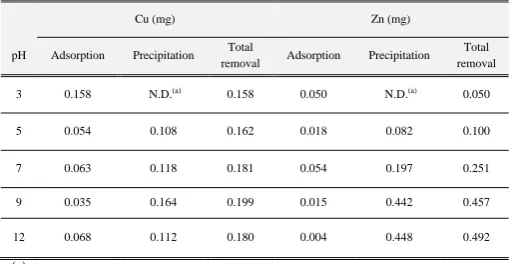
In real plating wastewater, the behavior of Zn removal was similar to that in the artificial solution while the point of the highest Cu removal shifted to pH 9. Moreover, the behavior of adsorption in plating wastewater was different from that in artificial solution. The results showed that the optimum pH for adsorption was the pH of 7. Interestingly, the adsorption of Cu was observed, even at the pH of 12.
[image:4.595.305.549.192.273.2]Overall, the optimum pH for the removal of both Cu and Zn was 9, and the highest adsorption of Cu and Zn was observed in the pH ranged 5 to 7. To explain those observations, other theories need to be evaluated.
Table 4. Removal of metal ions in the artificial solution [experimental condition T = 25℃, t = 24hr, adsorbent dosage = 10g and volume of solution = 20mL, initial Cu = 0.376 mg and Zn = 0.414 mg]
Cu (mg) Zn (mg)
pH Adsorption Precipitation Total
removal Adsorption Precipitation Total removal
3 0.311 0.006 0.317 0.151 N.D.(a) 0.151 5 0.350 0.013 0.363 0.240 0.002 0.242 7 0.076 0.289 0.365 0.179 0.070 0.249 9 0.007 0.361 0.368 0.003 0.404 0.407 12 0.004 0.367 0.371 0.002 0.412 0.414 (a)
: not detected
Table 5. Removal of metal ions in the plating wastewater [experimental condition T = 25℃, t = 24hr, adsorbent dosage = 10g and volume of solution = 20mL, initial Cu = 0.227 mg and Zn = 0.492 mg]
Cu (mg) Zn (mg) pH Adsorption Precipitation Total
removal Adsorption Precipitation Total removal 3 0.158 N.D.(a) 0.158 0.050 N.D.(a) 0.050 5 0.054 0.108 0.162 0.018 0.082 0.100 7 0.063 0.118 0.181 0.054 0.197 0.251 9 0.035 0.164 0.199 0.015 0.442 0.457 12 0.068 0.112 0.180 0.004 0.448 0.492 (a)
: not detected
[image:4.595.48.288.402.543.2]The increase in the Si+, Ca+, K+, Mg+ and Na+ content in the total amount of the exchangeable cations released from Cu and Zn indicate effectiveness of the conditioning. However, this is also evident from the decrease in Na+ content of Zn solution when compared to Cu solution.
Table 6. Effect of conditioning on metal adsorption and each exchangeable cation to total release amount (mass, mg) [experimental condition: T = 25 oC, t = 24 h, adsorbent dosage = 10 g, volume of solution = 20 mL, and the pH of solution: 5.0]
Solution Exchangeable cation (mg)
Si+ Ca+ K+ Mg+ Na+
Water 0.13 0.31 0.17 0.09 0.44
Cu 0.15 0.34 0.22 0.13 0.71
Zn 0.16 0.35 0.20 0.12 0.55
Acknowledgment
This work was supported by the Korea Environmental Industry & Technology Institute (KEITI, Project No.:2010-07001-0126-0) and BK 21 of Korea.
V.REFERENCES
[1] Sanhya Babel and Tonni Agustiono Kurniawan, “Low-cost adsorbents for heavy metals uptake from contaminated water: a review,” Journal of Hazardous
Materials, B97 (2003), pp 21.
[2] D. Nibou, H. Mekatel, S. Amokrane, M. Barkat and M. Trari, “Adsorption of Zn2+ ions onto NaA and NaX zeolites: Kinetic, equilibrium and thermodynamic studies,” Journal of Hazardous Materials, 173 (2010), pp 637.
[3] S.K. Pitcher, R.C.T. Slade and N.I. Ward, “Heavy metal removal from motorway stormwater using zeolites,”
Science of the Total Environment, 334-335 (2004), pp
161.
[4] Blanchard G., Maunaye M., Martin. G., “Removal of heavy metals from waters by means of means of natural zeolites,” Water Research, 18 (1984), pp 1501.
[5] J.P. Reymond and F. Kolenda, “Estimation of the point of zero charge of simple and mixed oxides by mass titration,” Powder Technology 103 (1999), pp 30.
[6] Zamzow M., Eichbaum B. R., Sandgren K.R., Shanks D.E., “ Removal of heavy metal and other cations from wastewater using zeolites,” Sep. Sci. Technol., 25 (1990), pp 1555.
[7] K.K. Panday, G. Prasad and V.N. Singh, “Inexpensive Adsorption Technique to Remove Cr(VI) from Aqueous Solutions,” Water Research, 19 (1985) pp 869.
[8] A.P. Annachhatre, N.N. Win, S. Chandrkrachang,
[image:4.595.41.304.620.752.2]Second Asia-Pacific Symposium, Asian Institute of Technology, Bangkok, Thailand, 1996 pp169.
[9] Ali, A.A., El-Bisthawi, R., “Removal of Lead and Nickel Ions Using Zeolite Tuff”, Journal of Chemical