Low Cost Multipurpose Android Controlled
Automation System using ESP8266
Mamata Patil
1, Prajakta Mestry
2, Manisha Jha
3, Anushka Malunjkar
4, Prof. Veena Kiragi
51, 2, 3, 4Students, 5Assistant Professor, Department of Computer Engineering, Indira College of Engineering and Management, Pune Abstract: A constant mechanized framework through which one can deal with the electronic machines with the assistance of Android advanced mobile phones or PC's. In the current framework the mechanization is done through Bluetooth, which has separate impediments. In our task we will conquer this constraint with the assistance of Wi-Fi module ESP866. Utilizing this we will almost certainly control lights, electric fan and other electronic machines through an internet browser utilizing our portable or PC. These AC mains apparatuses will be associated with transfers which are constrained by the ESP8266. ESP8266 is a standout amongst the most well known and minimal effort Wi-Fi module accessible in the market today. The proposed framework is better from the adaptability and adaptability perspective than the industrially accessible robotization frameworks. Keywords: Automation, Wi-Fi, ESP8266, Relay, Android, Sensors.
I. INTRODUCTION
The ubiquity of computerization has been expanding significantly as of late because of impressive reasonableness and effortlessness through advanced cell and tablet availability. The mechanization framework coordinates electrical gadgets with one another. Gadgets might be associated through a system to permit control by a PC and may permit remote access from the web. Through the incorporation of data advances with the earth, framework and apparatuses can convey in a coordinated way which results in accommodation, vitality proficiency and security benefits. This undertaking advances the structure of ongoing mechanization and security framework utilizing the Wi-Fi module ESP8266. The ESP8266 Wi-Fi Module is an independent System on Chip (SOC) with incorporated Transmission Control Protocol/Internet Protocol (TCP/IP) convention stack that can give any microcontroller access to your Wi-Fi arrange. The ESP8266 is able to do either facilitating an application or offloading all Wi-Fi organizing capacities from another application processor. The ESP8266 module is a very savvy board with a tremendous, and consistently developing, network. Electronic machines are associated with the information/yield ports of ESP8266 alongside the electrical extension and their status is passed to the ESP8266. The android running OS in any telephone associated with a system can get to the status of the electronic machines through an application. It shows the plan and usage of computerization framework that can screen and control the machines by means of telephone or PC.
A. Objectives
1) We are providing android as well as web application through which user can access the system. 2) User can switch on/off the devices (light, fan, fridge, geyser, etc.)
3) User can increase/decrease intensity of light.
4) User will get notification there is sudden increase in temperature. 5) User will get notification if there is any motion near locker in house. 6) User can set time for switching on/off the button.
II. DESIGN PROPOSED SYSTEM
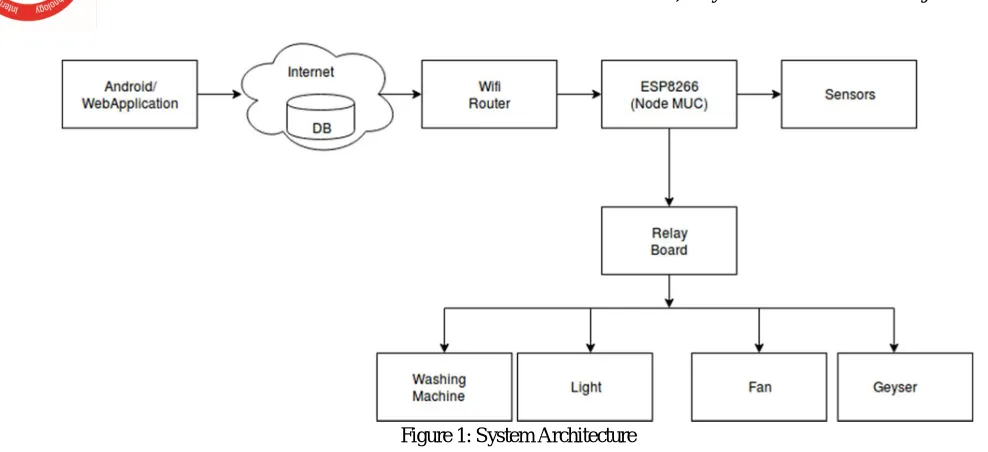
Figure 1: System Architecture
Intelligent automation system reduces the human efforts and saves time by overcoming the traditional methods of detecting the faults in home appliances and fixing it by using sensors. Microcontroller sends digital values to the server through the wireless sensor. Here we are using two wireless sensors one for the sender and another is for receiver. Server is handling all the system after receiving the sensors value it will check or compare these value to the actual value which is already store in the database as well cloud. Here we are using a private cloud for the backup. If the receive value is greater than the actual value it will send the alert message to the particular shop or the agency as well as the admin.
A. Automation
In this paper we are going to use ESP8266, which will be easy to use in the switch board and two components such as a sensor module and the controller. We will be able to control the small home automation system anywhere in the world.
B. Power Supply
ESP8266 operates at 3.3V and consumes around 100mAmp current, for designing of its power supply you can use LM1117-3.3V Low drop out (LDO) linear regulator which is having current capacity of 800mAmp. Remember that, this regulator is low drop out regulator. It is better to give 5V as input to the regulator to avoid over heating of regulator.
C. Hardware and Software Requirements 1) Hardware Requirements
a) ESP8266 (Arduino with Wi-Fimodule)
b) Solid state Relay 100A AC 240V
c) Switch Board
d) Android Phone (Android 3.0 +)
e) Temperature Humidity Sensor(DHT 11)
f) Passive Infrared Sensor (PIR sensor)
g) Light Dimmer Module
2) Software Requirements
a) Java (1.6+)
b) Arduino Software (IDE) (1.2+)
c) android studio (3.0+)
d) eclipse mars IDE (3.0+)
e) Spring and hibernate
f) Chrome (any internet browser)
D. ESP8266 Wi-Fi Module
The ESP8266 Wi-Fi Module is a SOC with coordinated TCP/IP convention stack that can give any microcontroller access to your Wi-Fi organize. The ESP8266 is prepared to do either facilitating an application or offloading all Wi-Fi organizing capacities from another application processor. This module has a sufficiently incredible on-board preparing and capacity ability that enables it to be coordinated with the sensors and other application explicit gadgets through its GPIOs with insignificant improvement in advance and negligible stacking amid runtime. Its high level of on-chip mix considers insignificant outer hardware, including the front-end module, is intended to possess negligible PCB region. The ESP8266 bolsters APSD for VoIP applications and Bluetooth concurrence interfaces, it contains a self-aligned RF enabling it to work under every working condition, and requires no outer RF parts.
1) Qualities of ESP8266 a) Direct Wi-Fi support. b) 802.11 b/g/n/e/I support.
c) P2P Discovery, P2P GO (Group Owner) mode, GC (Group Client) mode and P2P Management of Power.
d) Security highlights, for example, 802.11i which gives pre-confirmation, and TSN.
[image:3.595.163.426.327.459.2]e) Seamless meandering help.
Figure 2: ESP8266 Wi-Fi Module
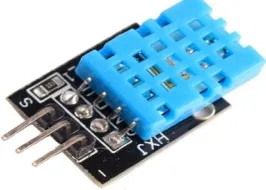
E. DHT Sensor
DHT sensor is utilized to gauge the temperature and dampness, we utilize the DHT11 sensor with the sensor board. It is an ease temperature and moistness sensor. It is modest in value this will makes it helpful for testing or activities where you don't require new readings on numerous occasions for a second. The gadget requires just three associations with the Pi, +3.3V, ground and one GPIO stick. The gadget itself has four sticks however one of them isn't utilized. The modules have three sticks and are anything but difficult to associate specifically to the Pi's GPIO header.
[image:3.595.218.351.616.711.2]F. Passive Infrared Sensor(PIR)
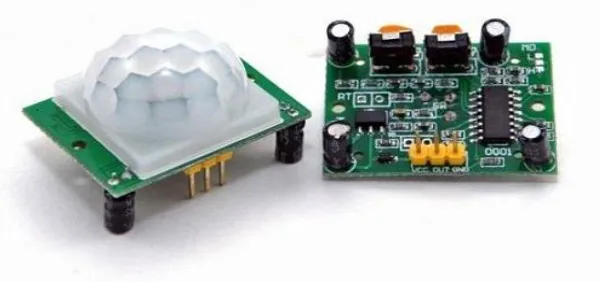
An aloof infrared sensor is an electronic sensor that estimates infrared light emanating from articles in its field of view. They are regularly utilized in PIR-based movement locators. The PIR sensor itself has two spaces in it, each opening is made of an uncommon material that is touchy to IR.
[image:4.595.156.456.174.315.2]
Figure 3: Passive infrared sensor (PIR sensor)
G. Solid state Relay 100A AC 240V
[image:4.595.165.463.392.571.2]A relay is an electrically operated switch. Many relays use an electromagnet to mechanically operate a switch, but other operating principles are also used, such as solid-state relays.
Figure 4: Solid state Relay 100A AC 240V
H. AC Light Dimmer Module
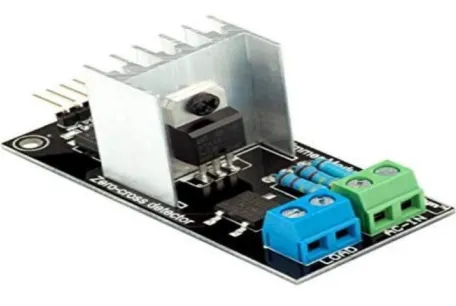
The AC Dimmer is intended to control the rotating current voltage, which can exchange current up to 220V (5A~10A) (TRIAC BTA16 for 600V/16A however we don't prescribe up capacity to this dimension). Much of the time, Dimmer is accustomed to turning power ON/OFF for lights or warming components, it can likewise be utilized in fans, siphons, air cleaners, e.t.c. Of late, Dimmer has turned into a frequently utilized choice for the keen home frameworks. For instance, when you have to easily change the light brilliance. The light is gradually turning ON or OFF, making an agreeable air. Dimmer works best with fiber lights. It's less steady with low brilliance LED lights, however with moderate and high splendor it will play out a strong activity. Note that luminescent lights (gas release lights) don't bolster darkening.
Figure 5: AC Light Dimmer module
III. EXTERNAL INTERFACE REQUIREMENTS A. User Interface
The UI will include the utilization of important symbols, which will enable the client to effectively recognize alternatives accessible. The catches and capacities by which the client can communicate with the Home Automation System are portrayed underneath. 1) The diverse stages that are unmistakable to the User and Administrator are:
a) Website: The client will almost certainly get to the fundamental site from any internet browser.
b) Login: Here the client needs to enter username and secret word. On the off chance that the secret phrase isn't right or the username doesn't exist, the client is told.
c) Main Menu: Once the client signs in, a route menu will enable the client to choose the alternatives accessible. 2) The principle menu ought to give the accompanying usefulness;
a) Device Status: The client can take a gander at the gadget status. This will show whether a gadget is as of now on or off. For example a light might be as of now exchanged on and thusly must be killed by the client.
b) Turn On/Off Device: The client turns on/off gadget.
c) Log Out: The client logs out. The client is presently kept from interfacing with the Home Automation System. This makes it difficult to press the back catch on the program and attempt to come back to the principle page.
3) The accompanying things will be noticeable to the Administrator: a) Add/Remove Device: This page enables the head to include/expel gadgets
b) Add/Remove Users: Here the Administrator can include clients and decide their dimension of access to gadget
B. Hardware Interface
The equipment frames the Client Premises Equipment (CPE) which gives the proper interfaces to sensors and actuators in the home. These modules are composed by a 32-bit ESP8266 framework on-chip running a firmware written in C++ programming language. It is necessitated that the CPE gives control of lightings, machines, security locks and others, just as observing of the house conditions, for example, the room temperature, dampness and light status. It should give interfaces to client cooperation just as Internet network. Accordingly, the implanted equipment is additionally separated into: controller, control gadget actuators and coordinated sensors.
C. Software Interface
D. Communications Interfaces
Web attachment is observed to be the most reasonable for constant bi-directional, full-duplex, tenacious association from an internet browser to a server. The Web Application Communication Protocol (WAMP) is an open standard Web attachment sub convention which furnishes application steering that works with various 26 dialects. WAMP permits a disseminated framework with approximately coupled applications parts impart in delicate continuous. It is worked over Web attachment correspondence convention and JSON information serialization. JSON is an open, language-autonomous, intelligible, information trade arrangement to preferably between work, store, and exchange information between frameworks. It is intended to be straightforward, conventional, organized, human and machine clear, and utilized over the Internet. It utilizes a printed information design with Unicode encoding and it is without fat instead of its XML partner.
[image:6.595.236.378.253.477.2]IV. RESULTS AND DISCUSSIONS
Figure 6: Android App Appliances Status Module
[image:6.595.134.502.521.727.2]Figure 8: Add\Delete User Module
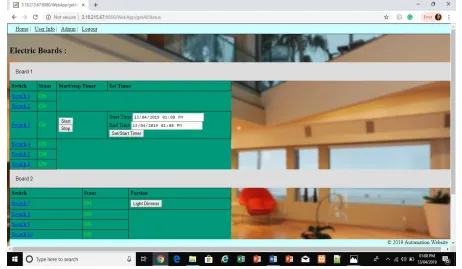
Admin can add\edit\delete user and assign role to the user. Admin can manage user data dynamically. Proper validations are given to inputs.
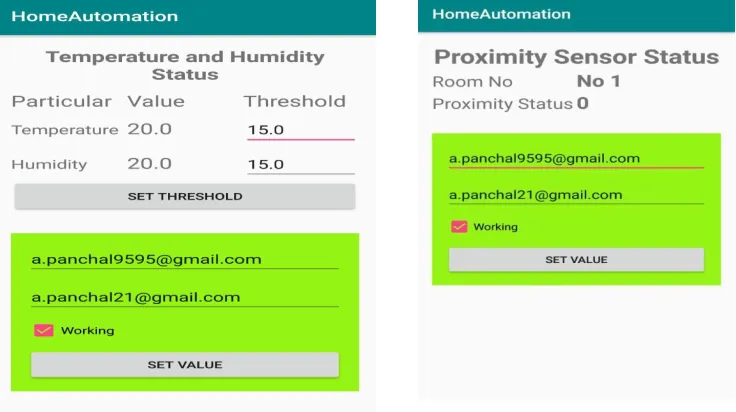
[image:7.595.77.539.455.724.2]User can switch on\off devices also can set time for switching on/off connection. Room temperature status is displayed and status of temperature if exceeded above threshold value, then system will notify user.
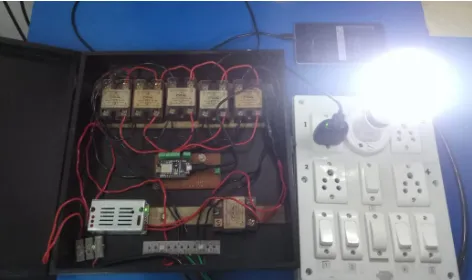
Figure 10: On Board Output (Bulb ON)
V. FUTURE SCOPE
This project can be enhanced to control the speed of the fan or volume of the buzzer etc. Device controlling can be done using Internet of Things –IoT technology. We can provide security by placing camera near door which will send image of visitors.
VI. CONCLUSION
The prime goal of this paper is to utilize the Smartphone or PC to control the electronic apparatuses remotely. The advances utilized in this undertaking are Android Studio, Java and Python. These stages are Free Open Source Software additionally we use ESP8266 wifi module which cost is so less, so the general execution cost is low and can be effectively designed. Client can without much of a stretch communicate with framework utilizing android telephone/tablet. This computerization framework has been tentatively demonstrated to work palatably by interfacing test apparatuses to it and the machines were effectively controlled structure a remote cell phone. Along these lines an ease robotization framework was effectively structured, executed and tried.
VII. ACKNOWLEDGEMENT
It gives us great pleasure in presenting the preliminary project report on ‘Low Cost Multipurpose Android Controlled Automation System using ESP8266’. We would like to take this opportunity to thank our internal guide Prof. Veena Kiragi for giving us all the help and guidance we needed. We are really grateful to her for her kind support. Her valuable suggestions were very helpful. We are grateful to Dr. Deepak Dharrao project co-ordinator for his guidance.
We are also grateful to Dr. Poornashankar, Head of Computer Engineering Department, Indira College of Engineering and Management for her indispensable support, suggestions. In the end our special thanks to Prof. Sunil Admute, principal, Indira College of Engineering and Management for his support and suggestions.
REFERENCES
[1] “A Low Cost Home Automation System Using Wi-Fi Based Wireless Sensor Network Incorporating Internet of Things (IoT)”, Vikram N., Harish K.S, Nihaal M.S, Raksha Umesh, Shetty Aashik Ashok Kumar: Dept. of Electrical and Electronics Engineering, 2017.
[2] “A Review paper on Home Automation System Based on Internet of Things Technology”, Swati Tiwari, Rahul Gedam: Chouksey Engineering College, Chhattisgarh, 2016.
[3] “Home Automation on ESP8266”, M.S. Malathi, A. Gowsalya, M. Dhanushyaa, A. Janani: Coimbatore, India, 2017.
[4] “Intelligent Smart Home Automation and Security System Using Arduino and Wi-fi”, J. Chandramohan, R. Nagarajan, K. Satheeshkumar, N. Ajithkumar, P.A. Gopinath, S. Ranjithkumar: Dept. of Electrical and Electronics Engineering, 2017.
[5] “IOT Based Smart Security and Smart Home Automation”, Sudha Kousalya, G. Reddi Priya, R. Vasanthi, B Venkatesh: Department of ECE, 2018.
[6] “Smart Home Automation System using Android Application”, Prof.H.B.Shinde, Abhay Chaudhari, Prafull Chaure, Mayur Chandgude, Pratik Waghmare: Department of Computer Engineering, 2017.
[7] Wenbo, Yan, Wang Quanyu, and GaoZhenwei. "Smart home implementation based on Internet and WiFi technology." Control Conference (CCC), 2015 34th Chinese. IEEE, 2015.
Mamata Patil: B.E. Department of Computer Engineering, Indira College of Engineering and Management, [email protected]
Prajakta Mestry: B.E. Department of Computer Engineering, Indira College of Engineering and Management, [email protected]
Manisha Jha: B.E. Department of Computer Engineering, Indira College of Engineering and Management, [email protected]
Anushka Malunjkar: B.E. Department of Computer Engineering, Indira College of Engineering and Management, [email protected]