1555
©IJRASET: All Rights are Reserved
Prediction of User Behavior Pattern in Multimedia
Social Network
Deepa Ashok Patil
1, Dr. Pushpa Mohan
21M-Tech, 2Associate Professor, Computer Science, CMR Institute of Technology, Bengaluru
Abstract: Over the last decade, social networks (MSNs) have evolved and evolved, exploding and hugely penetrating into every area of our lives, our free time, and our work. Through mobile Internet and mobile devices, users can access MSN at anytime, anywhere in the name of any identity, including role and group. As a result, interaction between users and MSNs becomes more complex and complicated. This article has mainly broadened and enriched the situation analysis framework for the particular social area called SocialSitu. Furthermore, a novel algorithm for the originalization analysis of users based on the classic Generalized Sequential Pattern (GSP) was proposed. We've used the enormous amount of user behavior records to explore the frequent sequence mode required to predict user intent. In our experiment, two general types of intentions were selected: playing and sharing multimedia, which are most common on MSNs, based on the intentionalization algorithm. Using the Intellectual Property Behavior analysis of users, we have determined that each user's optimal behavior patterns and behavior patterns are different due to his / her identity variations in a large amount of session data.
Keywords
: Multimedia Social Network, Scenario Analysis, intention prediction, behavior pattern & big dataI. INTRODUCTION
A. Overview
The quick improvement of interactive media informal organizations (MSNs) is driving tremendous development in clients and advanced substance.
It is likewise advantageous for clients to get to computerized content in MSNs with a substantial video record. In the meantime, the cooperation among client and client, client and framework is expanding. Hence, today is trying to investigate social sight and sound systems, giving auspicious and quick customized administrations considering the mind boggling association. The principal responsibilities of this paper are two-overlay.
An improvement and extension of the situ theory for the social space, that is, the online life condition, by thinking about the variable identity of the customer (checking employment and gathering) and the other new and complete a novel estimation for lead examination and examination recommend the mining of customers. The basic vision of the work is to moreover anticipate the increasingly more significant point and mind of the customers subject to a considerable number of past exercises.
B. Existing System
In online networking systems, the client has various jobs in various gatherings. The various recognizable pieces of proof that the client has may make the client's expectation change. The difference in aim mirrors the adjustment in client's conduct. The Situ Theory does not completely break down the aim of clients with various characters in the online networking condition. Shen et al set forward a calculation which thinks about the encompassing condition and informal community relationship. This calculation could utilize the client's circumstance, inclination, and interpersonal organization relationship. Zhang et al introduced an improved N-gram expectation model to anticipate the conceivable future web get to demand of the server log information. Bar-david et al that current innovation made to endeavor to foresee the area of moving client as per recorded direction of moving articles. Lee et al. in an occasion molding conduct model and a standard enlistment calculation.
1) Disadvantages
a) In Bar-David et al strategy the dynamic idea of the moving conduct may prompt mistakes in expectation.
b) Users' information are high clamor and discrete in MSNs, particularly portable interpersonal organizations, and these. Information cannot be utilized for examination and mining in time.
1556
©IJRASET: All Rights are Reserved
C. Problem Statement
The current MSNs condition dynamically requires situation care. Customers' condition and lead are dynamic, and an individual's desire is moreover to change. In order to acclimate to the dynamic changes of customer identities in the social region, this paper grows and improves the Situ speculation, and makes a SocialSitu framework for the web based life frameworks
D. Proposed System
To all the more likely comprehend the expectations of clients in MSN, we have to analyze the online personal conduct standards of clients on the Internet. To begin with, the exceeding of the situ hypothesis for the social domain, that is, the internet based life environment, ought to be enhanced and stretched out by considering the variable personality of the client in another and complete way. Then again, a novel calculation for personal conduct standard examination and client mining is proposed. This task has fundamentally widened and enhanced the circumstance examination system for the specific social zone called SocialSitu. Moreover, a novel calculation has been proposed for the client's intentionalization investigation.Advantages
1) This paper widens and improves the Situ speculation, and amasses a SocialSitu structure for the electronic life frameworks.
2) We organized and achieve the objective serialization figuring in intelligent media relational associations. The customer's persistent point gathering mode is procured through the desire serialization count.
II. LITERATURESURVEY
I have studied several papers based on user predictions. Few of them are as follows:
A. First paper which I have contemplated is named as "Dimensional Situation Analytics: from Data to Wisdom" which was distributed by H. Ming, C. K. Chang, and J. Yang,. In the late 80s, Ackoff first proposed a scholarly characterization upon the substance of human identity, which included Data, Information, Knowledge and Wisdom, or DIKW. Its applications join power association, essential initiative speculation, territory express structure theory, programming arrangement way of reasoning robotization, etc to give a few precedents. For the most part subject to our past work on human driven situation looks at, we propose a dimensional condition examination towards another view on the DIKW chain of significance. By intertwining utilitarian Map Reduce enlisting perspective, we present in this paper a novel (MR)2 perspective, which implies two consecutive Map Reduce that cut over the cutoff points between Data, Information, Knowledge and Wisdom. We battle that our (MR)2 perspective advances broad fundamental administration and along these lines, offers new bits of learning in data change from data to savvy.
B. The second paper named as "A setting mindful mixed media structure toward individual informal community administrations" which is distributed by M. A. Rahman, H. N. Kim, A. El Saddik, and W. Gueaieb. People use distinctive Internet-based organizations including relational associations to lead endeavors of separated orders, for instance, edifying, capable, informative, interests, prosperity, recreational, academic, and news. Various people not simply keep up association with different organizations yet moreover share information with their social ties in their step by step life. Not with standing, an individual just exhausts a subset of organizations and necessities to talk with a subset of social ties at some irregular setting. In this paper, we present a framework called Sense Face that utilization substantial data starting from one's body sensor framework and intuitive media information contained inside Internet-based organizations to propose setting careful organizations and system of interest. We present the point by point structure and execution of the framework and offer our preliminary test results.
1557
©IJRASET: All Rights are Reserved
III. THEORETICALBACKGROUND
A. Data Mining
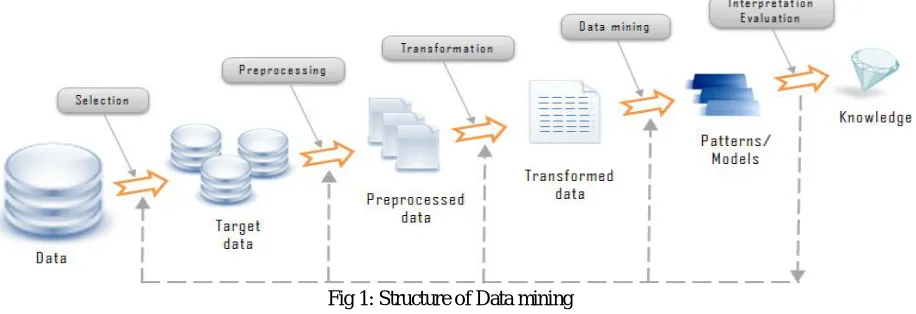
[image:3.595.78.536.218.375.2]For the most part, information mining (once in a while called information or learning disclosure) is the way toward examining information from alternate points of view and outlining it into valuable data - data that can be utilized to expand income, cuts costs, or both. Information mining programming is one of various explanatory apparatuses for investigating information. It enables clients to break down information from a wide range of measurements or points, classify it, and abridge the connections recognized. Actually, information mining is the way toward discovering connections or examples among many fields in expansive social databases.
Fig 1: Structure of Data mining
B. How Data Mining Works?
While generous scale information advancement has been creating separate trade and legitimate systems, data mining gives the association between the two. Data mining programming separates associations and models in set away trade data reliant on open-completed customer questions. A couple of sorts of informative writing computer programs are open: genuine, man-made intelligence, and neural frameworks. Generally, any of four sorts of associations are searched for:
1) Classes: Put away data is used to discover data in predestined social events. For example, a restaurant system could mine customer purchase data to choose when customers visit and what they ordinarily demand. This information could be used to extend traffic by having each day specials.
2) Clusters: Information things are collected by astute associations or customer tendencies. For example, data can be mined to
recognize promote parts or buyer affinities.
3) Associations: Information can be mined to recognize affiliations. The ale diaper point of reference is an instance of associated mining.
4) Sequential Designs: Information is mined to imagine individual lead measures and examples. For example, an outside equipment retailer could predict the likelihood of a backpack being acquired reliant on a buyer's purchase of versatile beds and climbing shoes.
C. Data Mining Consists of five Major Elements
1) Extract, transform, and load transaction data onto the data warehouse system.
2) Store and manage the data in a multidimensional database system.
3) Provide data access to business analysts and information technology professionals.
4) Analyze the data by application software.
5) Present the data in a useful format, such as a graph or table.
D. Characteristics of Data Mining
1) Large Quantities Of Data: The volume of data so great it has to be analyzed by automated techniques e.g. satellite information, credit card transactions etc.
2) Noisy, Incomplete Data: Imprecise data is the characteristic of all data collection.
3) Complex Data Structure: conventional statistical analysis not possible
1558
©IJRASET: All Rights are Reserved
IV. SYSTEMREQUIREMENT
1) Processors : Pentium IV
2) Ram : 4GB
3) Storage : 20GB or Higher
4) Keyboard : Standard Keyboard
1) Platform : Windows XP/7
2) IDE/Tool : MyEclipse 8.6
3) Coding : Java(JDK 1.7)
4) Web Technology : Servelet,JSP
5) Web Server : Tomcat6.0
6) Database : MySQL 5.0
V. SYSTEMDESIGN
A. System Architecture
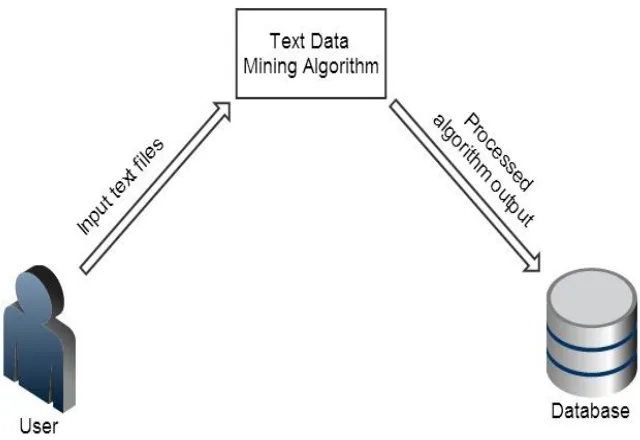
[image:4.595.151.471.441.661.2]The structure and conduct of a framework is the reasonable plan which is characterized by framework engineering. The design depiction can be said as the formal portrayal of a framework, which is composed in a manner to help thinking about the auxiliary properties of a framework. It gives an appropriate arrangement by which an undertaking is created. It additionally incorporates definitions about the framework parts or building squares of the general framework. The Fig. 2 demonstrates the framework design of the proposed framework.
Fig 2: System Architecture
1559
©IJRASET: All Rights are Reserved
B. Flow Chart of User
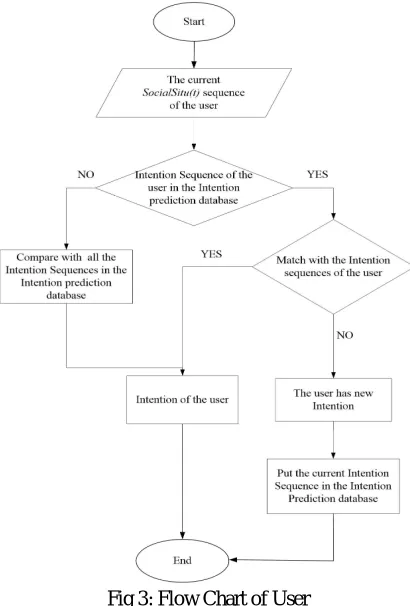
[image:5.595.201.406.162.465.2]Flowcharts are utilized to separate an unpredictable procedure into basic advances (meant by various boxes) that are associated by bolts. It begins toward the start of the procedure and finishes each progression the procedure until the end. Flowcharts can likewise tell the best way to manage issues that may happen amid the procedure.
Fig 3: Flow Chart of User
The Fig. 3 shows the flow chart of the system in which it depicts to predict the user intentions of the system.
C. Class Diagram
A class chart in the Bound together Demonstrating Language (UML) is a sort of static structure graph that depicts the structure of a framework by demonstrating the framework's classes, their qualities, tasks (or strategies), and the connections among the classes. It clarifies which class contains data.
[image:5.595.138.437.557.746.2]1560
©IJRASET: All Rights are Reserved
The Fig. 4 shows the class diagram of the system in which the admin is able to authorize users, view users, view User’s post, View Intention analysis, view uploaded videos, and upload videos. Similarly user can send friend request, view friend requests, post multimedia & view them.
D. Sequence Diagram
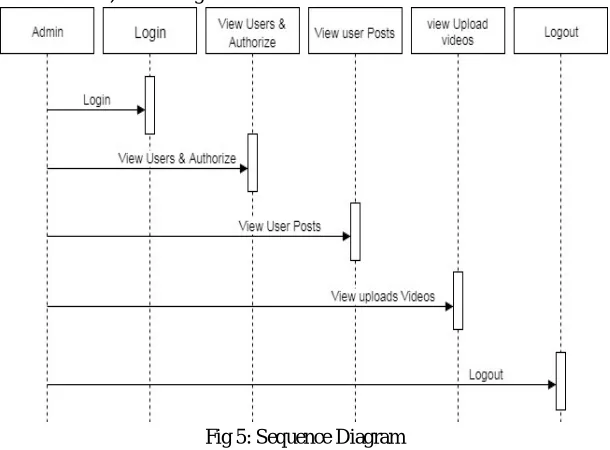
A grouping outline in Brought together Demonstrating Language (UML) is a sort of collaboration chart that indicates how forms work with each other and in what request. It is a develop of a Message Grouping Diagram. Arrangement charts are now and then called occasion graphs, occasion situations, and timing outlines.
Fig 5: Sequence Diagram
The Fig. 5 shows the sequence diagram of the system in which the admin is able to authorize users, view users, view user’s post, view uploaded videos.
VI. IMPLEMENTATION
A. Modules
1) Admin Module: The current sequence of a user is compared with intention sequences of the user in the database to predict the current intention of the user to make a rapid and timely response to the user’s request and provide a personalized service, intention prediction flowchart .The ending point of each Intention(i) sequence is used as the result.
2) User Module: The user has at least one goal in MSNs, and this corresponds to at least one intention sequence. The user’s intention sequence with a specific goal is saved to the database.
[image:6.595.151.456.209.434.2]3) Intention Sequence Generation: SocialSitu(t) arrangement of client from beginning stage to target accomplishment, to be specific I={SocialSitu(1),SocialSitu(2), ..., SocialSitu(n)} , nϵN , SocialSitu(1) alludes to the beginning stage; SocialSitu(n) alludes to the completion moment that the objective is accomplished. Here, SocialSitu(t) grouping is straightforwardly related to the objective accomplishment. Through the aim arrangement, the client accomplishes the objective.
1561
©IJRASET: All Rights are Reserved
In the figure 6, each direct alludes toward SocialSitu(t) at a specific minute. The point startj (1 ≤j ≤ n, jϵN ) alludes to the beginning stage of Intention(i). These beginning stages can be the equivalent or unique. End alludes to the closure purpose of Intention(i). Each stripe of SocialSitu(t) arrangement alludes to the grouping made by various SocialSitu(t) that the client go from beginning stage to completion point. With the exception of the completion point, similar hubs may exist in each arrangement of Intention(i). In the MSNs, there is something like one grouping which relates to the client's expectation, namely i ϵN,i ≥1 .
B. Intention serialization Algorithm
1) Info: DataSet: DS, the Base Help: Min_Support, Client's Objective: G '
2) Yield: SocialSitu(t) Arrangement
SituBehaviorAnalytics ( DS, Min_Support, G' )
a) Start
b) for j ←1 to n //n shows the quantity of client's objective
c) for t ← 0 to T
d) Support( SocialSitu (t) ⇒ g 'j ) = P ( SocialSitu (t ) ∪ g 'j );
e) endfor
f) if (Backing ( SocialSitu (t) ⇒ g 'j )>Min_Support)
g) L1 = SocialSitu(t) ; //the 1-visit thing sets L1
h) endif
i) for k ← 2 to m and Lk −1 ≠ Invalid
j) Generate competitor sets Ck ;
k) Support ( Ck ⇒ g 'j ) = P ( Ck ∪ g 'j );
l) if (Backing ( Ck ⇒ g 'j )>Min_Support)
m) Lk = Ck ;
n) endif
o) endfor
p) Intention(i) = Lk ∪ g 'j ;
q) endfor
r) End
VII. RESULTS
The following snapshots define the results or outputs that are obtained after step by step execution of all modules of the system.
A. Admin Web Page
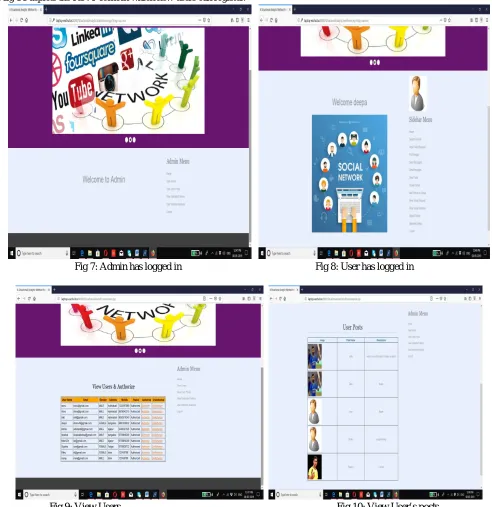
The fig. 7 depicts the login page of the web app of the admin which contains Admin ID, password and sign in button, which is used to authenticate the Admin. The Admin ID and password are predefined in the database. Once the Admin is authenticated then he is allowed to move to the next page.
B. User Web Page
The fig. 8 depicts the view user module in which the user can create groups, send friend requests, upload multimedia files, view uploaded files, comment on multimedia shared files & there is a logout button.
C. View Users page
The fig. 9 depicts that the admin can view users & authorizes or unauthorizes the new users from admin side.
D. View User’s Post
The fig 10 depicts that from admin end the admin can view user’s posts.
E. View Group Members
1562
©IJRASET: All Rights are Reserved
F. Send Friend Request
The Fig 12 depicts that the user can send friend request to others.
G. User Intentions
The fig 13 depicts that we can predict user intentions through serialization algorithm such as we can obtain support & confidence to predict user behaviour.
H. Registration
The fig 14 depicts the RSVP form in which new users can register.
Fig 7: Admin has logged in Fig 8: User has logged in
[image:8.595.54.546.220.727.2]
1563
©IJRASET: All Rights are Reserved
[image:9.595.54.538.109.456.2].
Fig 11: View Group members Fig 12: Send friend Requests
.
Fig 13: User’s Intention Fig14: User Registration
VIII. CONCLUSION
[image:9.595.67.532.383.705.2]1564
©IJRASET: All Rights are Reserved
REFERENCES
[1] R. Bar-David and M. Last, "Setting mindful area expectation," fifth International Workshop on Mining Ubiquitous and Social Environments (MUSE 2014), pp. 165-185, Sep. 2014.
[2] W. P. Lee and K. H. Lee, "Making cell phone administration suggestions by anticipating clients' expectations: A setting mindful methodology," Inf. Sci., vol. 277, pp. 21-35, Sep. 2014.
[3] V. Radhakrishna, S. A. Aljawarneh, P. V. Aljawarneh, and K.- K. R. Choo, "A tale fluffy gaussian-based disparity measure for finding similitude fleeting affiliation designs," Soft Comput., preprint, 18 Nov. 2016, doi: 10.1007/s00500-016-2445-y.
[4] J. Huang, F. Nie, H. Huang, Y. C. Tu, and Y. Lei, "Social trust forecast utilizing heterogeneous systems," ACM Trans. Knowl. Discov. Information, vol. 7, no. 4, 2013, doi: 10.1145/2541268.2541270.
[5] Y. G. Shen, G. S. Guo, and J. J. WU, "A Context-mindful Community Filtering Algorithm on Mobile Recommendation," Science Technology and Engineering, vol. 8, pp. 49-52+64, Aug. 2014.
[6] H. Ming, C. K. Chang, and J. Yang, "Dimensional Situation Analytics : from Data to Wisdom," Proc Int Comput Software Appl Conf, vol. 1, pp. 50-59,
Jul. 2015, doi: 10.1109/COMPSAC.2015.199.