Home Safety, Security and Automation using IOT
Vasim Ansari
1, Rijvana Mulani
2, Dr. Jitendra Shinde
31, 2
Student, 3Principal, AAEMF COE BHIMA SPPU, Pune
Abstract: In this day and age automatic framework are being favored over the manual framework with the fast increment in the quantity of client of the web over the previous decade has made internet a vital part of life and ‘IoT’ is the most recent and rising web innovation. ‘Internet of Thing' is a developing system of an ordinary system into a modern system that can share data and finish the task while you are busy with other tasks. Home safety security and automation using ‘IoT' is a framework that perfectly utilize PC's or cell phone to control fundamental home appliances and highlights naturally through the web from any place around the globe. In this paper, we present a home Safety, Security and Automation using ‘IoT’ uses Microcontroller ATMEGA328that utilizing the incorporation of a cloud. The wireless communication, to provide the user with remote control of various light, fans and appliances within their home and storing the data in the cloud
I. INTRODUCTION
A. Overview
Homes of the 21st century will end up being progressively self-controlled and modernized in view of the comfort it gives, especially when used in a private home. Home automation framework is an Implies that enable clients to control electric apparatuses of changing kind. Many existing, dug in home computerization structures rely upon wired correspondence. This does not speak to an issue until the moment that the structure is orchestrated well early and presented in the midst of the physical improvement of the structure. Regardless, for formally existing structures the use cost goes high. Strikingly, Remote systems can be of unimaginable help for automation structures. With the movement of remote advances, for instance, Wi-Fi, cloud sorts out in the progressing past, remote structures are used every day and everywhere.
B. Central Purposes Of Home Automation Structures
In today’s world, the wireless system like Wi-Fi become most common in home networking .use of wireless technologies gives several advantages that could not be accomplished using a wired network only.
1) Reduced establishment costs: First and premier, establishment costs are essentially decreased since no cabling is important. Wired arrangements require cabling, where material and additionally the expert laying of links (e.g. into dividers) is costly.
2) System adaptability and simple augmentation: Deploying a remote system is particularly beneficial when, because of new or
changed prerequisites, expansion of the system is essential. Rather than wired establishments, in which cabling expansion is dreary. This makes remote establishments fundamental speculation.
3) Aesthetical advantages: Apart from covering a bigger zone, this ascribes full’s aesthetical prerequisites also. And incorporate agent structures with all-glass engineering and verifiable structures where plan or studio reasons don't permit the laying of links.
4) Integration of cell phones: With remote systems, partner cell phones, for example, PDAs and Smartphones with the computerization framework winds up conceivable all over the place and whenever, as a gadget's correct physical area is not any more pivotal for an association (as long as the gadget is in reach of the system).
II. RELATED WORK
A. Sirsath N. S, Dhole P. S, Mohire N. P, Naik S. C &Ratnaparkhi N.S
B. Deepali, Javale, Mohd. Mohsin, Shreerang Nandanwar
This paper put advances the plan of home mechanization and security framework utilizing Android ADK. The plan depends on an independent installed framework board Android ADK (Accessory Development Kit) at home. Home apparatuses are associated with the ADK and correspondence is built up between the ADK and Android cell phone or tablet. The home machines are associated with the information/yield ports of the implanted framework board and their status is passed to the ADK. We would build up a verification to the framework for approved individual to get to home machines. The gadget with ease and adaptable to less change deeply is much significant. It exhibits the structure and usage of computerization framework that can screen and control home machines through android telephone or tablet. The prime goal of this paper is to help impeded/old matured individuals. It gives essential thought of how to control different home machines and give security utilizing Android telephone/tab. The outline comprises of Android telephone with home automation application, Arduino Mega ADK. A client can collaborate with the Android and send control flag to the Arduino ADK which thus will control other implanted gadgets/sensors
C. Basma M. Mohammad El-Basioni, Sherine M. Abd El-kader, and Mahmoud Abdelmonim Fakhreldin
This paper proposes another plan for the keen home utilizing the remote sensor arrange and the biometric advancements. The proposed framework utilizes the biometric in the verification for home passage which upgrades home security just as effectiveness of home entering process. The proposed brilliant home Wireless Biometric Smart Home (WB-SH) plan is one of only a handful couple of structures or it is the main structure that tends to the incorporation between the remote sensor organize and biometric in structure shrewd homes. The structure of the framework is portrayed and the consolidated correspondences are broke down, additionally an estimation for the entire framework cost is given which is something ailing in a ton of other brilliant home plans offers. The expense of the entire WB-SH framework is resolved to be roughly $6000, which is an appropriate expense as for the expenses of existing frameworks and regarding its offered administrations. WB-SH is intended to be fit for fusing in a structure mechanization framework and it very well may be connected to workplaces, facilities, and different spots. The paper closes with a creative ability for the eventual fate of the savvy home when utilizes the biometric innovation in a bigger and progressively complete structure.
III. FRAMEWORK ANALYSIS
A. Issue Definition
Home Automation frameworks confront four principle challenges, these are a mind-boggling expense of possession, rigidity, poor reasonability, and trouble in accomplishing security. The principal destinations of this exploration are to plan and actualize a home computerization framework utilizing IoT that is fit for controlling and automizing the vast majority of the house apparatuses through a simple reasonable web interface. The Implemented framework has incredible adaptability by utilizing Wi-Fi innovation to interconnect its conveyed sensors to a home automation server. This will diminish the arrangement cost and will build the capacity of redesigning, and framework reconfiguration.
B. Implemented System Feature
IV. SYSTEM DESIGN AND IMPLEMENTATION
A. Implemented Home Automation System
Figure: 1:- Implemented Model of Home Safety, Security, and Automation Using Iot Model
The Implemented model of the home automation framework is as appeared in the figure1. The model comprises of various sensors like temperature, gas, and movement. At first the Microcontroller ATMEGA328 interfaces with the web through Wi-Fi module. At the point when the association is built up, it will begin perusing the parameters of sensors like p1, p2, p3 and so on. The threshold levels for the required sensors are set as t1, t2, t3 and so on. The sensor information is sent to the web server and put away in the cloud. The information can be broke down anyplace whenever. In the event that the sensor parameters are more prominent than the limit level then the particular caution a1, a2, a3 and so forth will be raised and the required activation has improved the situation the controlling of the parameters. In the Implemented display the temperature, gas leakage, movement in the house is checked. The temperature and movement identification are put away in the cloud for investigation. In the event that the temperature surpasses the edge level then the cooler will turn on naturally and it will off when the temperature comes to control. So also when there is a leakage of gas n the house caution is raised giving the alarm sound. The required lights are turned on/off naturally by identifying the light outside the house. The client can likewise screen the electric apparatuses through the web by means of a web server. On the off chance that the lights or any electrical machines are left on inrush can be seen and killed remotely through basically composing the IP address of the web server.
B. Implemented Home Automation System Functions
The Implemented home automation system has the capabilities to control the following components in users home and monitor the following alarms: Temperature and humidity, Motion detection, Fire and smoke detection. The Implemented system can control the following appliance: Lights on/off, Fan on/off, On/off a different appliance.
C. Software Design
1) Front End Design: HTML is a format that defined a computer on how to display a web page. The documents themselves are plain text files with special "tags" or codes that a web browser uses to interpret and display information on your computer screen. HTML stands for Hyper Text Markup Language; an HTML file is a text file containing small markup tags. The markup tags tell the Web browser how to display the page. An HTML file must have an htm or HTML file extension.
D. Implementation Setup
Figure 2:- Sequence of Activation HAS
[image:4.612.164.447.486.637.2]Figure 2 represents the succession of exercises in the HAS. At the point when the association is built up, it will begin perusing the parameters of sensors like p1, p2, p3 and so forth. The limit levels for the required sensors are set as t1, t2, t3 and so on. The sensor information is sent to the web server and put away in the cloud. The information can be investigated anyplace whenever. On the off chance that the sensor parameters are more noteworthy than the limit level then the particular caution a1, a2, a3 and so forth will be raised and the required activation has improved the situation the controlling of the parameters.
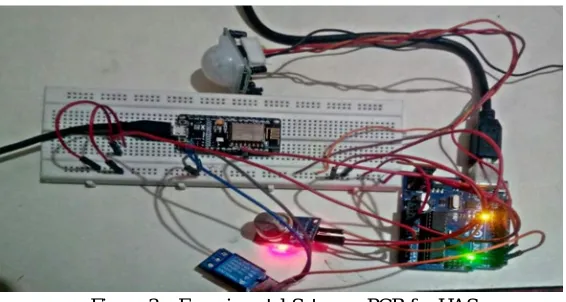
Figure 3: Experimental Setup on PCB for HAS
V. RESULTS
Figure 4: Web Server Page
After the effective association with the server, the information of the sensor is sent to the web server for checking of the framework. Figure 4 demonstrates the web server page which will enable us to screen and control the framework. By entering the allocated IP address in the internet browser this web server page will show up. The web server gives the data about the temperature in better places of the house and movement state in the house. It likewise gives the status of the different electrical machines like light, fan and so on which we can control remotely.
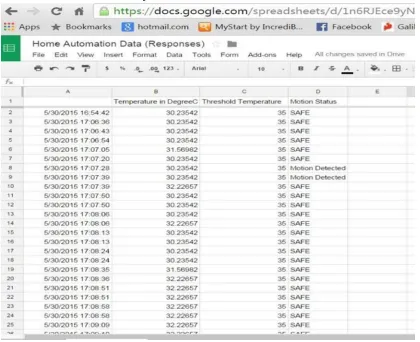
Figure 5: Database of The Sensors Data Stored In The Cloud
[image:5.612.96.516.303.645.2]VI. COMPARISON WITH THE RELATED SYSTEM Parameter System A Home Automation using Cloud Network and Mobile Devices System B Home Automation and Security System Using
Android ADK
System C Smart Home Design using Wireless Sensor
Network and Biometric Technologies
System D Home Safety, Security
And, Automation Using IoT. (our system)
Using of Internet of thing Yes No No Yes
Microcontroller 89C51 I
Microcontroller ATMEGA2560 Microcontroller ATMEGA128 Microcontroller ATMEGA328 Microcontroller
Trainer kit 89C51 I
Microcontroller Board
Arduino Mega ADK ATMEGA128
Development Board
Arduino Uno Development Board
Communication Type Serial communication Serial communication Serial communication Serial communication
Controlling with the help of
Android mobile or pc android phone or
tablet
Mobile remote control web link
Security low medium highest High
Complexity high medium highest Low
Cost medium high highest Low
Special function It control appliances
through mobile or pc, and it also allow the
user to server using GUI.
develop an authentication to the system for authorized
person to Access home
appliances.
developed the smart home using wireless sensor network and the biometric technologies
It can also control appliances when the
web connectivity is off, and allow user to
control appliances using android app
VII. COMPARISON RESULT WITH OUR SYSTEM
As we compare the above table we get existing systems having more Complexity, high cost. System (A) uses 89C51 I Microcontroller which is belongs to 8051 microcontroller family.Atmega328 is faster than 8051 as it uses lesser number of clock cycles for instruction execution. And In Atmega328 you can use internal oscillator, saving additional circuitry. But in 8051 you have to add an external crystal oscillator. If you have to use PWM in Atmega328, there are dedicated pins and timer modes. It is much easier to use PWM in Atmgea328 than in 8051, in which you have to do everything by yourself. Whereas system (B), system (C), system (D) uses ATMEGA2560, ATMEGA128, ATMEGA328 Respectively. There are many features that are common to all Arduino boards, making them very versatile. All Arduino boards are based around the ATMEGA AVR series microcontrollers from ATMEL which feature both analog and digital pins. Only difference between the (systems A) provide ATMEGA 2560 and Arduino Uno uses ATMEGA328P and Mega provides you plenty of GPIO’s, plenty in the sense way to much more than Arduino Uno. All systems have the same communication type which is serial communication. And some systems are controlled using mobile and pc. Using mobile and pc, provided limited controlling ability. Those we use web link to provide increasing in controllability. As we see the security aspect in the first system there is no security. Whereas in the third system uses the biometric system gives security to the home but no security on controlling device. To overcome this problem we use web link server, whereas only an authorized person can control the appliances. And our system is less complex with Low cost as compared to the other home automation system.
VIII. CONCLUSION AND FUTURE WORK
A. Conclusion
B. Future Work
Utilizing this framework as structure, the framework can be extended to incorporate different choices which could incorporate home security highlight like catching the photograph of an individual moving around the house and putting away it onto the cloud. This will decrease the information stockpiling than utilizing the CCTV camera which will record constantly and stores it. The framework can be extended for vitality observing, or climate stations. This sort of a framework with particular changes can be actualized in the medical clinics for handicap individuals or in ventures where a human attack is inconceivable or hazardous, and it can likewise be executed for ecological observing.
REFERENCES
[1] Sirsath N. S, Dhole P. S, Mohire N. P, Naik S. C &Ratnaparkhi N.S Department of Computer Engineering, 44, Vidyanagari, Parvati, Pune-411009, India University of Pune, “Home Automation using Cloud Network and Mobile Devices”.
[2] .DeepaliJavale, Mohd. Mohsin, ShreerangNandanwar “Home Automation and Security System Using Android ADK” in International Journal of Electronics Communication and Computer Technology (IJECCT) Volume 3 Issue 2 (March 2013).
[3] CharithPerera, Student Member, IEEE, ArkadyZaslavsky, Member, IEEE, Peter Christen,andDimitriosGeorgakopoulos, Member, IEEE "Context-Aware Computing for The Internet of Things: A Survey". IEEE COMMUNICATIONS SURVEYS & TUTORIAL.
[4] CharithPerera_y, ArkadyZaslavskyy, Peter Christen_ and DimitriosGeorgakopoulosy Research School of Computer Science, The Australian National University, Canberra, ACT 0200, Australia yCSIRO ICT Center, Canberra, ACT 2601, Australia ” CA4IOT: Context Awareness for Internet of Things”. [5] Vinaysagar K N,Kusuma S M Home automation using internet of things e-ISSN:2395-0056,p-ISSN:2395-0072
[6] JayavardhanaGubbi, RajkumarBuyya, SlavenMarusic,aMarimuthuPalaniswamia, “Internet of Things (IoT): A Vision, Architectural Elements, and Future Directions”.
[7] S.P. Pande, Prof.PravinSen, "Review On Home Automation System For Disabled People Using BCI" in IOSR Journal of Computer Science (IOSR-JCE) e- ISSN: 2278-0661, p-ISSN: 2278-8727 PP 76-80.
[8] Basil Hamed, “Design & Implementation of Smart House Control Using LabVIEW” at International Journal of Soft Computing and Engineering (IJSCE) ISSN: 2231-2307, Volume-1, Issue-6, January 2012.
[9] Basma M. Mohammad El-Basioni1, Sherine M. Abd Elkader2, and Mahmoud Abdelmonim Fakhreldin3, “Smart Home Design using Wireless Sensor Network and Biometric Technologies” at Volume 2, Issue 3, March 2013.
[10] Inderpreet Kaur, “Microcontroller Based Home Automation System With Security” at IJACSA) International Journal of Advanced Computer Science and Applications, Vol. 1, No. 6, December 2010.
[11] . Ansari vasim R A, Rijvana Implemented paper on Home safety, security and automation using ‘IoT’ IJRASET ISSN:2321-9653;
[12] Ansari vasim, Mulanirizwana survey on a different kind of home automation system using iot, c IJRASET ISSN:2321-9653; IC Value:45.98; SJImpact factor:6.887 volume6 IssueXI,nov 2018-Available at www.ijraset.com
[13] Anandhavalli d, noorul s. Mubina,bharthimubina. smart home automation control using Bluetooth and gsm. ISSN(Online):2347-1697 international journal of informative & futuristic research (ijifr) volume -2 issue-8 april2015
[14] Shruthiraghvan and girimas.tewolde.cloud-based low-cost home monitoring and automation system. proceeding of the 2015 ASEE North Central Section Conference .american society of engineering education
[15] . R.HArinath et al, International Journal of computer science and mobile computing, vol.4 issue4, April-2015,pg158-167
[16] R.arvindhan,M.ramnathan,D.sanjalkumar,R.kishor home automation using Wi-Fi interconnection. International Research Journal of engineering and technology(IRJET) Volume-04issue03-MAR-2017e-ISSN:2395-0056,p-ISSN:2395-0072.www.irjet.net
[17] .Prof.H.B.Shinde, Abhay Chaudhary,prafullchaure,mayorchandgude, smart home automation system using android application International Research journal of engineering and technology(IRJET) Volume-04issue04-APR-2017 e-ISSN:2395-0056,p-ISSN:2395-0072.www.irjet.net