Digitalized Automatic Ration Material Distribution
System
Mr.V.Anbazhagan1, Mrs.K.Dhivya 2
1
Department of ECE, IFET College of Engineering
2
Assistant Professor of ECE, IFET College of Engineering
Abstract: The ration distribution faces lots of controversial issues like corruption and adulteration. The inaccurate measuring of the goods by the ration shop workers knowingly or unknowingly. Till now consumers are standing in a long queue to buy ration material. To overcome this problem using automatic ration material distribution. The ration shop will be opened 24/7. From home, you can find the items available at the ration shop. The consumer details are stored in the central database. In ration shop consumer to enter the data like smart card number, password, account number, a quantity of the material. The consumer collects the material, the amount taken from the consumer account. Finally, the message sends to consumer phones. These project corruption free ration working system. It definitely provides transparency and also enhances the direct communication of the consumer with the government.
Keyword: Microcontroller, Automated Measurement, GSM Module.
I. INTRODUCTION
The government provides ration material to the people at the lowest price. The material such as rice, sugar, wheat, and kerosene etc. are distributed every month. The distribution of ration material is not an easy task in India. India is the second largest populated country in the world. Depending on the number of members in the family and the annual income, the quantity of the material will be fixed. The ration shop for food products will be given subsidy on the cost of food products based on their ration card type like above the poverty line and below the poverty line. The ration material does not reach up to poor people and needy. Because of human mistakes such as corruption, illegal smuggling, and inaccuracy in the weight of the material. This proposed project is automatic ration material distribution. The whole process easy to use, efficient, reliable and smart. It prevents corruption and smuggling of goods by dealers and works.
II. LITERATURE SURVEY
The existing conventional ration distribution system has the primary issues of renewing the ration card every year by the customers due to the corruption done by the ration storekeepers like selling food grains to market to make the profit.
To avoid this problem M.Aishwarya proposed the "Automatic ration material dispensing system". In this proposed work, an automatic ration material distribution system is implemented using GSM and RFID technology. This system replaces the ration cards by RFID tags. The whole system is controlled using the ARM7 controller.
M.Pallikonda Rajesekaran proposed the "Automatic smart ration distribution system for prevention of civil supplies hoarding in India". This project is an electronic device with smart features like IOT interfacing, smart measuring of goods, ration card scanner. R.Padmavathi suggested the "Digitalized Aadhar Enabled ration distribution using smart card". The working algorithm has been divided into 3 parts namely cardholder authentication, ration distribution, intruder alert.
U.Krishnan proposed the "Digitalized e-ration system". To replace manual work in the public distribution system by an automated system which will be installed at the ration shop. "Automation in rationing system" means the distribution of essential commodities to a large number of people through a network on a recurring basis in an automated way through IOT.
III. PROPOSED SYSTEM
IV. COMPONENTS
SG90 mini servo motor LDR
LED
GSM SIM 800L Power module LM2596 Arduino mega
Power 5v adaptors
V. BLOCK DIAGRAM
VI. MATERIALS AND METHODS
Automated ration system is divided into two parts:
1) Hardware: The hardware system can be sub-divided into three parts:
2) GSM Module: This GSM module is interfaced with Arduino Mega to send SMS to the cardholder of the ration shop.
3) Measuring System: This setup is operated through a servo motor and mechanical timing arrangement interfaced with Arduino Mega board.
4) LDR: The LDR devices depend on the light, when light falls on the LDR then the resistance decreases and increases in the dark. 5) Software: The software demand for this project is as follow
Arduino embedded language for interfacing all the hardware with the Arduino software and its hardware requirement board. Python is used to create the customer login page.
VII. DESIGN AND IMPLEMENTATION
The containers are connected in series, where the LED and LDR are fixed in opposite sides of each container. If light from the LED did not hit the LDR means, then resistance increases and the Arduino will consider that there is some material present in-between the LED and LDR. Suppose if the light from the LED hit the LDR means, then resistance decreases and the Arduino will consider that there is no material present in-between the LED and LDR.
The consumer sends a ‘status' message to ration shop number, in return the consumer receives the availability of goods and its details from the ration shop. The consumer can access the availability of the goods in the shop of their locality through GSM, by which they need not go back and it saves people time and increases the efficiency.
Container
Rice, sugar, wheat
Open/close
Arrangement
Motor
Arduino
Mega
Webpage
(If password yes thenonly system starts)
The Arduino mega Microcontroller here used to control the operations of LED, LDR, GSM, and servo motors. LDR has connected the Arduino analog pins, LED and servo are connected to the Arduino digital pins. GSM transmitter is connected to the receiver of Arduino and the GSM receiver is connected to the transmitter of a transmitter of Arduino
The front end is created using python language, where the user can enter the details which are then checked with the database which contains the predefined data. If the user enters the correct details then their requested materials will be provided to the user else it displays an error message.
Fig1
The fig1 shows the login page, where the consumer can log in by using their smart card number and password. The consumer has the provision to choose between languages (English and Tamil).
[image:3.612.198.412.563.723.2]Fig2
Fig 2 shows the online payment. Where the consumer can enter their 12 digit bank account number, which is already linked with the smart card. After the consumer is provided with their requested materials the equivalent money will be debited from their bank account.
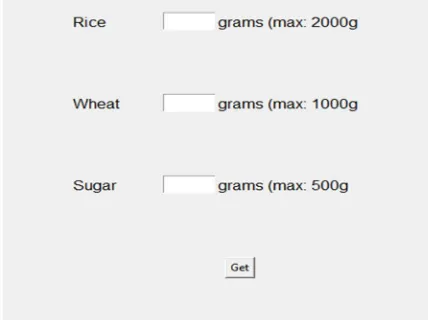
The fig3 shows the quantity details, where the consumer can enter the required quantity of materials by refereeing the maximum quantity. If the consumer entered quantity is greater than the maximum quantity, then it displays a warning message.
After gathering the required quantity details from the consumer, the products are been provided to the consumer. The servo motors are used for the purpose of opening and closing the container. Based on the quantity the servo motors keep the containers open until it provides the required quantity of materials to the consumers.
After the consumers receive their requested materials, the total cost will be displayed on the screen, and that amount will be debited from their bank account and the SMS will be sent to the consumer.
VIII. RESULT
By actualizing this proposed work, an approved individual would be empowered to purchase the apportion materials without the intercession of people. Straightforwardness is accomplished and in this manner, there is a decrease in the debasement. The message will be sent to the administration about administering after everything being apportioned. The test results demonstrate that the proposed framework is anything but difficult to get to and keep the apportion from robbery movement.
IX. CONCLUSION
Through this paper, we have made aim to present another innovation which evacuates the wrongs of the current framework and furthermore has its very own points of interest which are helpful for other applications. In old apportion appropriation framework the proportion isn't given to the destitute individuals, the downside is overwhelmed by our framework. Subsequent to approving keen card subtleties with the secret phrase the merchandise are provided to the client. In this framework, apportion Materials (sugar, rice, oils and so forth) disseminated through a programmed system with no assistance of people. All data point by point in a database for the more recognizable expert check. The proposed framework can maintain a strategic distance from defilement
X. FUTURE SCOPE
REFERENCE
[1] M.Aishwarya, “Automatic Ration Material Dispensing System,” International Conference on Trends in Electronics and Informatics (ICEI), 2017, IEEE,
DOI:10.1109/ICOEI.2017.8300825.
[2] Dr.M.PallikondaRajesekaran,”Automatic Smart Ration Distribution System for Prevention of Civil Supplies Hoarding in India,”4th International Conference on Advanced Computing and Communication Systems (ICACCS), 2017, IEEE, DOI: 10.1109/ICACCS.2017.8014593.
[3] Mrs. PadmavathiR,“Digitalized Aadhar enabled ration distribution using smart card”,2nd IEEE International Conference on Recent Trends in Electronics, Information & Communication Technology(RTEICT),2017,IEEE, DOI: 10.1109/RTEICT.2017.8256670
[4] K.Balakarthik,”Closed-Based Ration Card System using RFID and GSM Technology,’’ vol.2, Issue 4, Apr 2013.
[5] MahammadShafi.K.Munidhanalakshmi,“e–Ration Shop: An Automation Tool for Fair Price Shop under the Public Distribution System in the State of Andhra Pradesh”, International Journal of Computer Applications.