Enhancement in Heat Transfer by Using Wire Coil
Inserts in Tubular Heat Exchanger
Pratapsinha P. Mohite1, Kiran D. Kadam2, A.R.Acharya3, Ashok Pise4
1, 2, 3, 4
Mechanical Engineering Department, Government College of Engineering, Karad, India
Abstract: There are mainly two methods to enhance the performance of heat exchanger namely active and passive. In this study the wire coil inserts having three different cross sections namely circular, triangular and square with three different pitches(10, 20, 30mm) with 2mm wire diameter were used. The performance is investigated under constant wall heat flux condition and laminar regime in the Reynolds number ranging from 500 to 2200. Here distilled water is used as working fluid. The Nusselt number enhancement for circular, triangular, and square is from 3.73 to 15.26%, 5.54 to 17.24% and 6.08 to 21.26% respectively. Result shows that square cross section spring with pitch 10mm shows better performance among all the springs. Keywords: Heat exchanger, Wire coil insert, laminar regime, Reynolds number, Nusselt number.
I. INTRODUCTION
A heat exchanger is a device which is constructed to facilitate the heat transfer between one medium to another medium efficiently. If the heat exchange efficiency of the heat exchanger is low then it became prime aspect to increase the effectiveness of heat exchanger to recover the energy. Recovery of energy is of prime importance to optimize the energy consumption in industry. To achieve maximum utilization of thermal energy, several heat transfer enhancement techniques have been used in many thermal engineering applications such as nuclear reactor, chemical reactor, chemical process, automotive cooling, refrigeration, and heat exchanger, etc. Heat transfer enhancement techniques are powerful tools to increase heat transfer rate and thermal performance of heat exchangers. The objective behind the increase is to reduce the size of the heat exchanger required for a specific thermal service, to improve the capacity of an existing heat exchanger or to reduce the pumping power. Another advantage is the reduction of the driving force of the temperature, which reduces the generation of entropy and increases the efficiency of the second law.
There are two methods by which the performance of heat exchanger can be increased namely active and passive. In active methods external power source is required where as in passive methods augmentation is achieved by turbulent promoters. There are many turbulent promoters which can be used like twisted tape, wire coils, axial and radial guide vane, spiral fin etc, in this present work different cross section of wire coils having three different pitches is used and the performance is compared with the plain tube with constant wall heat flux condition and in laminar regime having Reynolds number ranging from 500 to2200. The working fluid used is distilled water,
II. LITERATUREREVIEW
Sibel Gunes et al. [1] has experimentally investigated heat transfer and pressure drop in a tube inserted with wire in turbulent flow regime. The result shows that the wires having low diameter and high pitches are not thermodynamically advantages. Promvonge [2] has studied the effect of circular and square cross section wire coil and he shows that square cross section wire coil shows better performance. Pengxiao Li et al. [6] studied a new tube insertion, called centrally hollow narrow twisted tape and its effect on the improvement of heat transfer in conditions of laminar flow that is simulated numerically. Compared to conventional twisted tape, the optimum heat transfer performance of the new type of tape increases to 28%. The results indicate that, under laminar flow conditions, the transverse hollow twisted tape is a very promising high-performance tube insert.
Reynolds number ranging from 600 to 1600. According to his study the heat transfer enhancement for centrally hollowed twisted tape near about 22.4 % than that of the conventional twisted tape. The results shows that centrally hollowed twisted tape are good high performance tube inserts and also friction factor increment is less as compared with the heat transfer enhancement.
Madhu kasturi [9] experimentally studied the effect circular cross section wire insert having three different pitches in the turbulent regime. Results revels that Nusselt number and friction factor values are higher than that of the plain tube. Also the wire coil gives good performance for Reynolds number below 10000.
The literature review revels that number of experiments carried out by using the twisted tape in laminar and turbulent flow and also it shows that good increment. One researcher madhu studied the effect of wire coil with circular cross section in turbulent regime. The results are quite good and also the pressure drop is less as compared with other inserts. In this study three different cross section of the wire coil are experimentally investigated in the laminar regime Reynolds number ranging from 500 to 2200 with constant wall heat flux condition.
III. EXPERIMENTAL
A. Apparatus
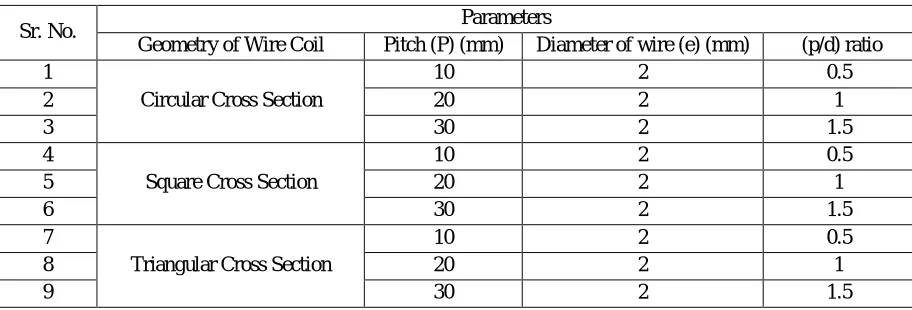
[image:2.612.101.518.313.458.2]The experimental set up is as shown in the following figure. It consists of a copper tube on which nichrome heater is mounted. Variable displacement pump by pass valve is used to pump the water in the tube. chiller and control panel also used as shown in figure. The springs are of steel material and extrusion process is used to manufacture the spring. The sketch of the wire coil is as shown in the figure and the dimensions of springs are given in the following table
Fig.1 Tubular Heat Exchanger set up Fig.2 Sketch of wire coil
Table 1 Dimensions Of Wire Coils
Sr. No. Parameters
Geometry of Wire Coil Pitch (P) (mm) Diameter of wire (e) (mm) (p/d) ratio 1
Circular Cross Section
10 2 0.5
2 20 2 1
3 30 2 1.5
4
Square Cross Section
10 2 0.5
5 20 2 1
6 30 2 1.5
7
Triangular Cross Section
10 2 0.5
8 20 2 1
9 30 2 1.5
B. Experimental Procedure
[image:2.612.78.534.491.646.2]C. Data Reduction Heat gained by the water is given by
=ṁ ∆ ………(1) The heat transfer coefficient can be calculated by
ℎ=
× ( − )
……….(2)
Nusselt number and Prandtle number can be calculated by
Nu = , ………(3) P = ……… (4)
The thermal performance factor is calculated by
………..(5)
The friction factor is calculated by
f = × ×∆
× × ……….(6)
D. Uncertainty Analysis
Uncertainty of Nusselt number, Reynolds number and friction factor can be determined by the following expression respectively
( )
= + + ………(7)
( )
= + + + ……….(8)
= + + + + (∆ )
∆ ………(9)
IV. RESULTSANDDISCUSSIONS
A. Validation of Experimental Results
The following co relations are used to validate the experimental results Sider-Tate equations is used to validate the nusselt number of plain tube
Nu = 1.86 RePr . ….……..………(11)
Darcy friction factor for laminar flow is given by
f=64/Re ………(12)
Fig.3 and fig.4 shows that the calculated values of Nusselt number from the experimental readings are close to the theoretical values given by the Sider Tate correlation with deviation from 2.62% to 6.31% and friction factor deviation is from 9.46% to 19.09%.
B. Effect Of Reynolds Number On Following Parameters In Circular Cross Section Spring 1) Nusselt number
2) Friction factor
[image:4.612.58.504.123.266.2]3) Thermal performance factor
Fig.5 Nusselt number vs Reynolds number Fig.6 Friction factor vs Reynolds number
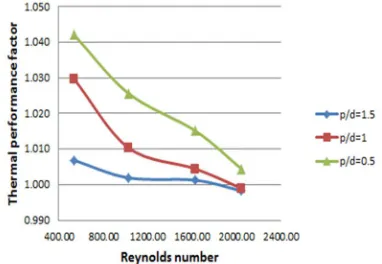
As the Reynolds number increases how the Nusselt number, friction factor and the thermal performance factor behaves is shown in the figure 5, 6 and 7 respectively. The figure 5 shows that as the Reynolds number increases Nusselt number, increases. On comparing with the plain tube without coil Nusselt number of circular coil having p/d values 0.5, 1and 1.5 increases from 7.62% to 15.26% , 6.19% to 11.78% and 3.73% to 5.74% respectively.
[image:4.612.217.408.419.551.2]Figure 6 shows that as the Reynolds number increases friction factor decreases. The increase in friction factor when compared with the plain tube having p/d values 05., 1 and 1.5 is from 23.00% to 35.28% , 15.10% to 27.90 and 12.21% to 15.81% respectively. Figure 7 shows that as the Reynolds number increases the thermal performance factor decreases. The values of thermal performance factor for circular cross section having p/d values 0.5, 1 and 1.5 are 1.0044 o 1.0421, 0.989 to 1.0297 and 0.9983 to 1.0069
respectively
Fig.7 Thermal performance factor vs Reynolds number
C. Effect Of Reynolds Number On Following Parameters In Triangular Cross Section Spring 1) Nusselt number
2) Friction factor
3) Thermal performance factor
As the Reynolds number increases how the Nusselt number, friction factor and the thermal performance factor behaves is shown in the figure respectively. The fig.8 shows that as the Reynolds number increases Nusselt number, increases. On comparing with the plain tube without coil Nusselt number of triangular coil having p/d values 0.5, 1 and 1.5 increases from 11.97% to 17.24% , 7.70% to 13.54% and 5.54% to 9.78% respectively.
Fig.8 Nusselt number vs Reynolds number Fig.9 Friction factor vs Reynolds number
Figure10 shows that as the Reynolds number increases the thermal performance factor decreases. The values of thermal performance factor for circular cross section having p/d values 0.5, 1 and 1.5 are 1.0344 to 1.0596, 1.0144 to 1.0457 and 0.9973 to 1.0262 respectively.
Fig.10 Thermal performance factor vs Reynolds number
D. Effect Of Reynolds Number On Following Parameters In Square Cross Section Spring 1) Nusselt number
2) Friction factor
3) Thermal performance factor
Fig.11 Nusselt number vs Reynolds number Fig.12 Friction factor vs Reynolds number
Figure 12 shows that as the Reynolds number increases friction factor decreases. The increase in friction factor when compared with the plain tube having p/d values 05., 1 and 1.5 is from 30.90% to 37.27% , 24.71% to 35.59% and 16.17% to 25.21% respectively. Figure 13 shows that as the Reynolds number increases the thermal performance factor decreases. The values of thermal performance factor for circular cross section having p/d values 0.5, 1 and 1.5 are 1.0468 to 1.0910, 1.0285 to 1.0550 and 1.0091 to 1.0386 respectively
Fig. 13 Thermal performance factor vs Reynolds number
V. CONCLUSIONS
For the laminar flow in circular tube having turbulent promoters of three different cross section and three different pitch to diameter is used. The Nusselt number, friction factor and thermal performance factor is being experimentally investigated for the above inserts. Results shows that among three cross section circular, triangular and square cross section the square cross section gives the highest values of Nusselt number, friction factor and thermal performance factor. Especially the square cross section having p/d 0.5 gives the maximum values. So from the result square cross section is the best, triangular cross section is not as effective as square but more effective than circular cross section wire coils.
VI. ACKNOWLEDGMENT
The authors wish to acknowledge the funding support received from TEQIP PHASE -3 by GCE karad.
REFERENCES
[1] F.P. Incropera, P.D. Witt, T.L. Bergman, A.S. Lavine, Fundamentals of Heat and Mass Transfer, John-Wiley & Sons, 2006.
[2] Pongjet Promvonge, “Thermal performance in circular tube fitted with coiled square wires” Science Direct Energy Conversion and Management 49 (2008)
980–987
[3] Sibel Gunes, Veysel Ozceyhan, Orhan Buyukalaca “Heat transfer enhancement in a tube with equilateral triangle cross sectioned coiled wire inserts” Science
Direct Experimental Thermal and Fluid Science 34 (2010) 684–69
[4] Khwanchit Wongchareea, Smith Eiamsa-ard, “Heat transfer enhancement by twisted tapes with alternate-axes and triangular, rectangular and trapezoidal
wings”, Chemical Engineering and Processing 50 (2011) 211–219. Journal homepage: www.elsevier.com/locate/cep
[5] A. E. Zohir and M.A. Habib “HEAT TRANSFER CHARACTERISTICS IN A DOUBLE PIPE HEAT EXCHANGER EQUIPPED WITH COILED
CIRCULAR WIRES” Journal of Engineering Sciences, Assiut University, Vol. 40, No. 3, pp.731 -744, May 2012
[6] A. G. Matani, Swapnil Dahake, “Experimental Study On Heat Transfer Enhancement In A Tube Using Counter/Co-Swirl Generation”, International Journal of
Application or Innovation in Engineering and Management. Vol. 2 issue 3 March 2013 100-105
[7] Pengxiao Li, Zhichun Liu, Wei Liu, Gang Chen, “Numerical study on heat transfer enhancement characteristics of tube inserted with centrally hollow narrow
twisted tapes”, International Journal of Heat and Mass Transfer 88 (2015) 481-491.
[8] Jaypal Mali, Girisg Patil, A.R.Acharya, A.T.Pise,“Heat Transfer Enhancement With Centrally Hollow Twisted tape and Al2O3 Water Based Nanofluid in
Tubular Heat Exchanger”, International Conference on Innovative Trends in Engineering Research – 2016
[9] Madhu l. Kasturi, Mohammad Junaid, A.R.Acharya “Effect of wire coil turbulators on pressure drop and heat transfer augmentation in circular tube”
International Conference on Innovations in Information Embedded System and Communication Systems 2017