Impact of Buffer Size on Different Drop Policies
(DLR, MOFO and E-Drop) for MaxProp Routing
Protocol in DTN
Vijay Kumar Samyal1, Dr. Yogesh Kumar Sharma2 1, 2
Ph.D Research Scholar, 2Department of Computer Science & I.T, Shri Jagdishprasad Jhabarmal Tibrewala University, Jhunjhunu (India)
Abstract: Delay Tolerant Network (DTN) is advanced class of Ad-hoc Network. The routing protocol used in Ad-hoc network such as AODV, DSR, DSDV and LAR are not used for DTN network because in DTN network end-to-end path is not available all the times. To transmit messages between source and destination node it uses store-carry-forward (SCF) approach. The messages are stored in the nodes in network which has finite buffer space. Whenever the node buffer space is full it discards the newly arrival message or dropped the message from its buffer space. It is difficult to identify the message which is removed or dropped from the buffer, a researcher implements various buffer drop policies such as the first in first out (FIFO), Drop oldest, Drop large, Drop last, Drop Random (DR), Drop Least Recently Received (DLR), Evict most forward first (MOFO) and E-drop drop policies etc. In this paper we compare and analysis the performances of three buffer management drop policies (i.e. DLR, MOFO, E-Drop) for MaxProp DTN routing protocol.
Keywords: Delay Tolerant Network, Drop Least Recently Received (DLR), Evict most forward first (MOFO), E-drop and MaxProp.
I. INTRODUCTION
Delay Tolerant Networks (DTNs) are wireless network in which end-to-end path is not exit all the time between the source and the destination of message [1]. In such a network delivery of message is challenges. To deal with these challenges, researchers design the store-carry-forward method to disseminate message. In this method source node store and carry a message in its buffer space while moving and forward to encountering node, until the destination node is reached. To enhance the delivery probability of message in such a network, the first routing algorithm i.e. Epidemic routing[2] is proposed to flood same copies of message to all encountered nodes until the destination is reached. Based on this principle many routing algorithms [3,4,5,6,7,8]using limited copies of messages are developed.
Even a large involvement that have been invested in design of DTN routing protocols, it is evicted that in storage of message for long time and its replication make buffer space full and effect the router performance. A critical issue is to select which message to be dropped from buffer space when it full, therefore efficient drop policy is required to overcome congestion and improve the delivery probability.
II. EXISTING BUFFER MANAGEMENT POLICIES
The following are the existing buffer management policies which control the message drop when buffer is full [9].
A. First In First Out (FIFO)
The message is dropped from the buffer space on the basis of first in first out strategy.
B. Drop Oldest
The message with shortest remaining lifetime (TTL) in the network is dropped.
C. Drop Large
D. Drop Last
It dropped the newly received message.
E. Drop Random
The selection of message to be dropped is randomly in the network. policy message which has the size up to the threshold set value is selected as victim to be drop first [11].
III. PROTOCOL UNDER EVALUATION
A. MaxProp Routing Protocol
MaxProp [12] is flooding-based in nature, in that if a contact is discovered, all messages which are not retaining by the contact will attempt to be replicated and forwarded (often called as summary vector exchange). MaxProp identify the priority of message i.e. which messages should be forwarded first and which messages should be dropped first. MaxProp maintains an ordered queue based on the destination of each message, ordered by the estimated likelihood of a future transitive path to that destination.
The MaxProp routing protocol estimates a node metric, P(a, b), alike to Prophet routing protocol. When two nodes a and b encounter, the link between these node strengthen by adding a constant α value is set to 1 in this protocol. After that these two nodes split their delivery predictability towards all the nodes including each other by 1 + α so that the sum of all delivery predictability remains 1.
( , ) = ( , )+
( , ) = ( , )
(1 + )
where α ∈ [0,1] is the updating constant, which is set to 1, and c is every other node including b.
IV. PERFORMANCE METRICS
In this section, we evaluate the performances of different drop policies such as DLR, MOFO and E-Drop on MaxProp DTN protocol. The results are evaluated on the basis of various metrics like Message Delivery Probability (MDP), Average Delivery Latency (ADL), Number of Message Drop (NMD) and Overhead Ratio (OHR) under different scenarios. These metrics are defined as follows [13,14]:
A. Delivery probability
It is defined as the ratio of the number of messages actually delivered to the destination and the number of messages sent by the sender.
Message Delivery Probability (MDP) = number of message delivered to destination/ number of message sent by sender
B. Average Delivery Latency (ADL)
Average of total time taken to deliver the message to the destination node.
C. Number of Message drop
Number of Message drop is the ratio of message drop during transmission to destinations among all messages generated
D. Overhead Ratio (OHR):
OHR =no. of relayed messages −no. of delivered messages no. of deliverd messages
V. SIMULATION AND RESULTS
mentioned in Table 1. The simulation is modeled as a network of mobile nodes positioned randomly within an area (4500 x 3400 m2).
TABLE 1 Parameter Setting Parameter Pedestrians (P) Cars (C)
No. of hosts 50 50
Speed 0.5-1.5 km/h 2.7- 13.9 km/h
Router MaxProp
Buffer Capacity 2-10MB Message size 200, 500 KB Message Inter-arrival Time 25-35 seconds Transmission speed 5Mbps World Size (meters) 4500 x 3400m Simulation Time 72,000 sec
The various drop policies are evaluated by varying buffer size under MaxProp routing protocol.
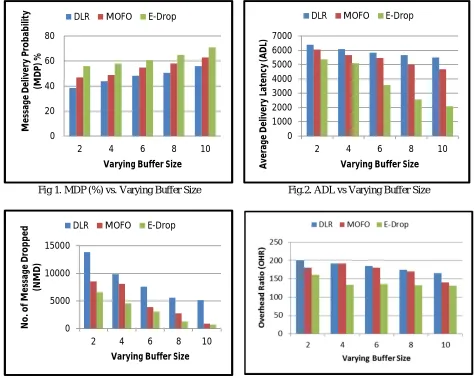
Fig 1. MDP (%) vs. Varying Buffer Size Fig.2. ADL vs Varying Buffer Size
Fig.3. NMD vs Varying Buffer Size Fig.4. OHR vs Varying Buffer Size
0 20 40 60 80
2 4 6 8 10
M e ss ag e D e liv e ry P ro b a b ili ty (M D P ) %
Varying Buffer Size
DLR MOFO E-Drop
0 1000 2000 3000 4000 5000 6000 7000
2 4 6 8 10
A ve ra ge D e liv er y La te n cy (A D L)
Varying Buffer Size
DLR MOFO E-Drop
0 5000 10000 15000
2 4 6 8 10
N o . o f M e ss a ge D ro p p ed (N M D )
Varying Buffer Size
[image:3.612.67.541.333.711.2]The following points are analyzed form above mentioned figures
E. From fig.1. It has been seen that in MaxProp routing protocol the delivery probability of DLR, MOFO and E-Drop policies is increases with increasing the buffer size.
F. Reason of this is that as the buffer size increases, more buffer capacity becomes available to store and carry more messages, in this manner enhancing the performance.
G. E-drop policy has the highest delivery probability among all the drop policies. Its delivery probability increase with increasing the buffer size. Its minimum delivery probability is 55.93% at buffer size 2MB and its maximum delivery probability is 70.99% at buffer size 10MB.
H. Form fig 2. The ADL of E-Drop policy is minimum as compared to other drop policies such as DLR and MOFO. I. The ADL of all drop policies are maximum at buffer size 2MB and minimum at buffer size 10MB.
J. The ADL of E-Drop policy decreased abruptly while the corresponding MDP increase abruptly (as shown in fig 1). K. Fig 3. Shows that all drop policies NMD are higher at buffer size 2MB and lower at buffer size 10MB.
L. The reason behind that is smaller the buffer size, more number of messages are dropped from buffer. With increasing buffer size, the messages dropped for buffer are gradually decreases. Hence the corresponding delivery probability increases (As shown in fig. 1.).
M. The NMD in case E-Drop policy is very less as compared to other drop policies because E-Drop policy dropped only those messages which are equal to the incoming message size.
N. Form fig.4. it has been observed that the OHR of E-Drop policy is lesser as compared to the other policies such as DLR and MOFO.
O. As the OHR of DLR, MOFO and E-Drop policies are decreases gradually with increasing buffer size form 2MB to 10 MB, its corresponding MDP is gradually increases (as shown in fig.1.).
P. In DLR, MOFO and E-drop policies the OHR is condensed by avoiding unnecessary drop and communication.
VI. CONCLUSION
In this paper different buffer management drop policies (DLR, MOFO and E-Drop) are compared under MaxProp routing protocol. The simulation results show that E-Drop policy performs well as compared to DLR and MOFO policy. The delivery probability of E-Drop policy is improves 17% and 9% over DLR and MOFO policies with parameter varying buffer size 2MB-10MB.
REFERENCES
[1] K. Fall, “A Delay-Tolerant Network Architecture for Challenged Internets,” Proc. On Applications, Technologies, Architectures and Protocols for Computer Communications (SIGCOMM), New York, USA, 2003, pp. 27–34.
[2] A. Vahdat, D. Becker, et al. Epidemic routing for partially connected ad hoc networks. Technical report, CS-200006, Duke University, 2000.
[3] T. Spyropoulos, K. Psounis, and C. S. Raghavendra. Spray and wait: an efficient routing scheme for intermittently connected mobile networks. WDTN’05, pages 252–259, New York, NY, USA, 2005. ACM.
[4] T. Matsuda and T. Takine. (p,q)-epidemic routing for sparsely populated mobile ad hoc networks. IEEE Journal on Selected Areas in Communications, 26(5):783–793, 2008.
[5] P. Mundur, M. Seligman, and J. N. Lee. Immunity-based epidemic routing in intermittent networks. In 5th Annual IEEE Communications Society Conference on Sensor, Mesh and Ad Hoc Communications and Networks, SECON ’08,, pages 609–611, 2008.
[6] E. Bulut, Z. Wang, and B. Szymanski. Cost-effective multiperiod spraying for routing in delay-tolerant networks. IEEE/ACM Transactions on Networking, 18(5):1530–1543, 2010.
[7] P. Juang, H. Oki, Y. Wang, M. Martonosi, L. S. Peh, and D. Rubenstein. Energy-efficient computing for wildlife tracking: Design tradeoffs and early
experiences with zebranet. SIGARCH Comput. Archit. News, 30(5):96–107, Oct. 2002.
[8] E. Altman, G. Neglia, F. De Pellegrini, and D. Miorandi. Decentralized stochastic control of delay tolerant networks. In INFOCOM’09, pages 1134–1142, 2009.
[9] Rashid, S., Ayub, Q., Zahid, M. S. M., and Abdullah, A. H. (2011). E-DROP: An Effective Drop Buffer Management Policy for DTN Routing Protocols. International Journal of Computer Applications. 13(7): 8-13.
[10] Yun Li ,Ling Zhao, Zhanjun Liu, Qilie Liu, “N-Drop: Congestion Control Strategy under Epidemic Routing in DTN”,2008.
[11] Q.Ayub, S. Rashid, ”T-Drop: An optimal buffer management policy to improve QoS in DTN routing protocols”, Journal of Computing, Vol.2, ISSUE 10. [12] J. Burgess et al., “Maxprop: Routing for Vehicle-Based Disruption-Tolerant Networks,” Proc. IEEE INFOCOM 2006, Apr. 2006, pp. 1–11.
[13] V. K. Samyal, S. S. Bamber and N. Singh, “Impact of Buffer Size on Delay Tolerant Network Routing Protocols,” Proc. Australian Journal of Information Technology and Communication Vol II, Issue I, 2015, pp. 44-47.
AUTHOR BIOGRAPHIES
*Vijay Kumar Samyal received a Bachelor of Engineering degree in Computer Science & Engineering from Punjab Technical University, Jalandhar in 2000, and Master in Technology degree in Computer Science & Engineering from GNE, Ludhiana, P.T.U Regional Campus, Punjab, India in 2009. Presently working as Assistant Professor in the Department of Computer Sc. & Engg. at Malout Institute of Management & Information Technology (MIMIT), Malout , Punjab. Since April 2016 he has joined as a research scholar in Shri Jagdishprasad Jhabarmal Tibrewala University, Jhunjhunu (India). His research interests are in Wireless Networks and Delay Tolerant Networks (DTNs).