A Circumstantial Systematic Method for User
Demeanor Pattern in Multimedia Social Networks
Mahamad Rafeeq 1 and Md Ateeq Ur Rahman2, 1
Research Scholar, Dept. of Computer Science & Engineering, SCET, Hyderabad, India 2
Professor and Head, Dept. of Computer Science & Engineering, SCET, Hyderabad, India
Abstract: The goal of partial video copy detection is to go looking out one or further segments of a matter video that have (transformed) copies throughout an enormous dataset. Previous connected analysis throughout this field used either small-scale datasets or big datasets with simulated partial copies by imposing several pre-defined transformations (e.g., measure changes) as a results of the very long annotation of real copies. The past decade has witnessed the emergence and progress of transmission social networks (MSNs), that have explosively and hugely enhanced to penetrate each corner of our lives, leisure and work. Moreover, mobile net and mobile terminals change users to access to MSNs at anytime, anywhere, on behalf of any identity, together with role and cluster. Therefore, the interaction behaviors between users and MSNs have become additional comprehensive and complex. This paper primarily extended and enriched true analytics framework for the particular social domain, named as SocialSitu, and any projected a unique algorithmic program for users’ intention serialisation analysis supported classic Generalized ordered Pattern
(GSP). we have a tendency to leveraged the massive volume of user behaviors records to explore the frequent sequence mode that's necessary to predict user intention. Our experiment elite 2 general forms of intentions: taking part in and sharing of transmission, that ar the foremost common in MSNs, supported the intention serialisation algorithmic program underneath totally different minimum support threshold (Min_Support). By exploitation the users’ microscopic behaviors analysis on intentions, we have a tendency to found that the best behavior patterns of every user
under the Min_Support, and a user’s behavior patterns ar totally different because of his/her identity variations during a giant volume of sessions information.it's still unknown but well the techniques developed on simulated datasets perform on real copies, that ar much more troublesome and too advanced to be simulated. throughout this paper, we've got a bent to introduce a large-scale video copy data (VCDB) with over 100,000 videos, and over 9,000 copy pairs found by manual annotation. A progressive system of video copy detection is evaluated on VCDB to suggests the restrictions of existing techniques. we've got a bent to together worth deep learning choices learned by a pair of neural networks: one is severally trained on a definite dataset and conjointly the choice is ready-made to affect the copy detection task. Our analysis suggests that every one the prevailing techniques, similarly because the deep learning choices, ar faraway from satisfactory in detection advanced real copies.
Index Terms: Multimedia social networks, situation analytics, intention prediction, behavior pattern, big data, content-centric
I. INTRODUCTION
desires. Moreover, the user’s context and behavior area unit dynamic. Some studies show that the characteristics of the dynamic modification can have totally different effects during a user’s potential desires. A user’s intention may be mirrored through the exploit attributes of the user’s scenario awareness and feedback on resources. The system will formulate a timely customized service for the user supported user’s intention, which can increase the user’s service expertise. In social media networks, the user has totally different roles in several teams. the various identifications that the user has might cause the user’s intention to alter. The modification of intention reflects the modification in user’s behavior. The Situ theory doesn't totally meet the analysis of the intention of users with totally different identities within the social media setting. This paper’s motivation is to research the user’s intention sequence mode(s) in social media networks. the most important contributions of this paper area unit 2 folds. One is to counterpoint and extend the Situ theory outreaching for social domain, that's the social media scheme, through freshly and comprehensively considering user’s changeable identity (including role and group), and also the different is to propose a completely unique formula for users’ behavior pattern analysis and mining. The vital vision of the work is to additional predict users’ additional and deeper intention and mental supported an oversized volume of previous actions. The remaining components of this paper area unit as follows: Section two shows the progress in connected studies; following section shows the extension of the Situ framework; Section four introduces the intention publishing formula; the experiment and its results of the publishing algorithm area unit thoroughly bestowed in Section 5; and eventually conclusions area unit drawn.
II. RELATED WORKS
Chang studied the importance and influence of the situation analysis theory and Situ framework on software engineering, yet as introduced the Situframework thoroughly, that may offer users with personalized service by characteristic the new intention of the user and also the time period update of service . Ming etal raised a spatial situation analysis supported the Situtheory and also the projected (MR)2 paradigm promoted comprehensive decision-making that is tributary tothe transformation info}, information, knowledge, and wisdom (DIKW) . Rahman et al declared that, in a given environment, the user may share information with friends in the social circle through the a part of the welfare work which they're concerned in. so that they suggests a SenseFacen framework to advocate services for users by mistreatment sensory activity information from the user sensing element network and multimedia system info. Shen et al suggests an algorithmic rule that considers the encircling environment and social network relationship. This algorithm may create use of user’s recognized state of affairs, preference, and social network relationship to amass user’s nearest neighbours through the calculation of the
user's comprehensive state of affairs similarity, and predict the potential state of affairs user preference to create a recommendation . Tong et al combined with the characteristics of net of things, to discuss information acquisition, modelling and intelligent processing etc by taking matters awareness method as the itinerary . Hence, it is important to use a completely unique situational awareness for computing services to produce users with a lot of personalized functions, together with multimedia system
recommendation service , bespoke security and privacy one, so forth. In order to permit sensible phone users to access the service simply and timely, Lee et al designed a recommendation mechanism to predict user’s intention and activate applicable service; associate degree event-conditionbehavior model and a rule induction algorithmic rule was used o find out behavior patterns of sensible phone users, and then, created use of their behavior pattern to predict and recommend the acceptable service for the users. In order to raised perceive users’ intention in MSNs, we
to create a generic transmission annotation platform, that returns reliable results for various transmission analysis issues. this enables for higher data generation, and improves the economical retrieval of transmission resources.
A. Existing System
The speedy development of transmission Social Networks (MSNs) causes the tremendous growth of users and digital contents. It’s in addition convenient for users to access digital contents in MSNs with a large-scale video dataset. Meanwhile, the interaction between user and user, user and system can increase. Therefore, providing users with timely and quickly custom-made services considering the advanced interaction is presently a challenge inside the study of transmission social networks. usually speaking, transmission computing could also be rotten into three all completely different stages, from datacentric transmission compression, content-centric transmission communication and content analysis, to user-centric social media analysis till of late, beside user trust modeling , propagation ways in which mining [5, 6] and digital right sharing , and digital forensics. However, understanding and predicting what transmission content users’ real needs in many things and contexts haven't been well studied . Context-Aware (CA) was initial projected by Schilit et al in 1994. They made public context as a result of the set of location, people shut, objects, and conjointly the changes of the objects. Prof. Carl K. Chang Jiang projected the Situ theory by combining the service setting with state of affairs awareness to handle the dynamic update or development of service at run time. therefore the service can meet the impulsive needs of users and provide users with custom-made service. thus on adapt to the dynamic service setting and build a timely answer the feedback of service setting, social media services additional and additional want state of affairs awareness. In social media networks, the creature could also be a advanced and open system. The individual’s intention can modification at any time, that in addition causes a modification inside the user's needs. Moreover, the user’s context and behavior square measure dynamic. Some studies show that the characteristics of the dynamic modification will have all completely different effects throughout a user’s potential needs. A user’s intention could also be reflected through the exploit attributes of the user’s state of affairs awareness and feedback on resources. The system can formulate a timely custom-made service for the user supported user’s intention, which may increase the user’s service experience. In social media networks, the user has all completely different roles in many groups. the varied identifications that the user has may cause the user’s intention to change. The modification of intention reflects the modification in user’s behavior. The Situ theory does not all meet the analysis of the intention of users with all completely different identities inside the social media setting. This paper’s motivation is to analysis the user’s intention sequence mode(s) in social media networks. the foremost necessary contributions of this paper square measure a pair of folds. One is to complement and extend the Situ theory outreaching for social domain, that is the social media theme, through freshly and comprehensively considering user’s changeable identity (including role and group), and conjointly the various is to propose a very distinctive formula for users’ behavior pattern analysis and mining. The very important vision of the work is to extra predict users’ extra associated deeper intention and mental supported an outsized volume of previous actions. The remaining elements of this paper square measure as follows: Section 2 shows the progress in connected studies; following section shows the extension of the Situ framework; Section four introduces the intention commercial enterprise formula; the experiment and its results of the commercial enterprise formula square measure completely presented in Section 5; and eventually conclusions square measure drawn.
III. PROPOSED SYSTEM
Chang studied the importance and influence of things analysis theory and Situ framework on software package engineering, however as introduced the Situframework completely, which will supply users with customized service by characteristic the new intention of
the user and conjointly the fundamental quantity update of service . dynasty etal raised a abstraction state of affairs analysis supported the Situtheory and conjointly the projected (MR)2 paradigm promoted comprehensive decision-making that's tributary tothe transformation info}, info, knowledge, and knowledge (DIKW) . Rahman et al declared that, during a given setting, the user might share info with friends within the social circle through the a neighborhood of the work that they are involved in. in order that they suggests a SenseFacen framework to advocate services for users by pattern activity info from the user sensor network and multimedia information. Shen et al suggests Associate in Nursing algorithm that considers the skirting setting and social network relationship. This algorithmic program might produce use of user’s recognized state of affairs, preference, and social network relationship to amass user’s nearest neighbours through the calculation of the
taking matters awareness technique because the itinerary . Hence, it's vital to use a very distinctive situational awareness for computing services to provide users with loads of customized functions, along with multimedia
recommendation service , tailor-made security and privacy one, so forth. so as to allow wise phone users to access the service merely and timely, Lee et al designed a recommendation mechanism to predict user’s intention and activate applicable service; academic degree event-conditionbehavior model and a rule induction algorithm was used o decide behavior patterns of wise phone users, and then, created use of their behavior pattern to predict and advocate the appropriate service for the users. so as to raised understand users’ intention in MSNs, we
greatly ought to be compelled to explore users’ on-line social behavior patterns . because of gift web property and portable transmission devices, it's never been very easy to supply and distribute new transmission resources like videos, photos, and audio. This ever-increasing production finishes up in Associate in Nursing information overload for shoppers, that considerations economical transmission retrieval techniques. transmission resources are going to be expeditiously retrieved exploitation their knowledge, but the transmission analysis ways in which might automatically generate this knowledge unit of measurement presently not reliable enough for terribly numerous transmission content. A reliable and automatic methodology for analyzing general transmission content is needed. we've got a bent to introduce a domain-agnostic framework that annotates transmission resources exploitation presently on the market transmission analysis ways in which. By using a three-step reasoning cycle, this framework can assess and improve the quality of transmission analysis results, by consecutively (1) combining analysis results effectively, (2) predicting that ends might would really like improvement, and (3) invoking compatible analysis ways in which to retrieve new results. By exploitation linguistics descriptions for the web services that wrap the transmission analysis ways in which, compatible services are going to be automatically elect. By exploitation additional linguistics reasoning on these linguistics descriptions, entirely completely different|the various} services are going to be repurposed across different use cases. we've got a bent to evaluated this problem-agnostic framework at intervals the context of video face detection, and showed that it's capable of providing the foremost effective analysis results regardless of the input video. The planned methodology can operate a basis to make a generic transmission annotation platform, that returns reliable results for numerous transmission analysis problems. this allows for higher knowledge generation, and improves the economical retrieval of transmission resources.
[image:4.612.201.380.419.713.2]IV. SYSTEM ARCHITECTURE
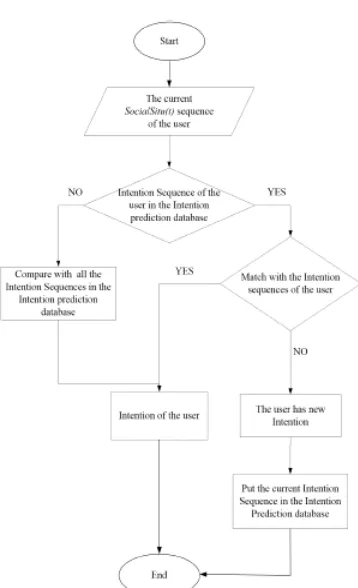
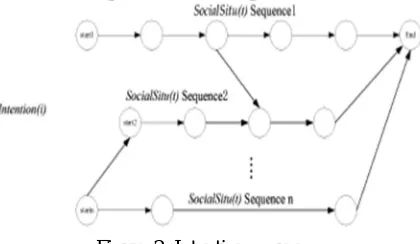
All frequent SocialSitu(t) related to a definite goal action in associate extremely user’s historical access record incorporates an intention sequence. The user features a minimum of 1 goal in MSNs, and this corresponds to a minimum of 1 intention
[image:5.612.201.411.185.307.2]sequence. The user’s intention sequence with a specific goal is saved to the knowledge. this sequence of a user is compared with intention sequences of the user within the info to predict this intention of the user to create a quick and timely response to the user’s request and provide a personalized service, intention prediction programing language is shown in Fig.1. A key draw back during this paper may be a thanks to confirm the user’s Intention sequence. The association rule that was projected by Agrawal et al in 1993 is used to hunt out out the affiliation among numerous things in associate extremely lots of abundance of data. DS could also be a group that represents the entire dealing set where each attribute is termed as Associate in Nursing item.
Figure 2: Intention sequence
A. Module Description
After careful analysis the system has been identified to have the following:
1) User module: User module , the new user should register application form , before enter the particular site, after login , user should create the profile for that particular login user, then only unknown user or friends , can find out your profile based on your name or images or based on particular place, user can share images and unknown user can give comment for particular images, if unknown people give a any comment for your image, you can view that person profile , then you want to your friend list that particular person you can add it.
2) Upload and share Images: User can share images and unknown user can give comment for particular images, if unknown people give a any comment for your image, you can view that person profile , then you want to your friend list that particular person you can add it. User can share any kind of image, friend list and other unknown user can view your images based on your privacy setting.
3) Comment for particular images: User can give comment for share and upload images and give image related commend you can add that particular person in your friend list. Then you want to your friend list that particular person you can add it. User can share any kind of image, friend list and other unknown user can view your images based on your privacy setting.
4) Admin Module: Admin module,admin is a super user ,admin can view the all the user details,admin can view the user pridiction details also.. can view the chart based on user activites
5) Chart Module:The past decade has witnessed the emergence and progress of multimedia social networks (MSNs), which have explosively and tremendously increased to penetrate every corner of our lives, leisure and work. Moreover, mobile Internet and mobile terminals enable users to access to MSNs at anytime, anywhere, on behalf of any identity, including role and group. Therefore, the interaction behaviors between users and MSNs are becoming more comprehensive and complicated.
V. CONCLUSION
The existing MSNs atmosphere increasingly wants scenario awareness. Users’ atmosphere and behavior area unit dynamic, associated associate degree individual’s intention is to boot to alter. therefore on adapt to the dynamic changes of user identities inside the social domain, this paper extends and enriches the Situ theory, and builds a SocialSitu framework for the social media networks. we tend to tend to vogue and
achieve the intention business enterprise decree transmission social networks. The user’s frequent intention sequence mode is obtained through the intention serialisation rule. once the user’s confirm changes,
Besides, we'll use the SocialSitu and conjointly the projected rule to boost multimedia recommendation system and a few killer applications in MSNs. The past decade has witnessed the emergence and progress of transmission social networks (MSNs), that have explosively and hugely magnified to penetrate each corner of our lives, leisure and work. Moreover, mobile net and mobile terminals change users to access to MSNs at anytime, anywhere, on behalf of any identity, together with role and cluster. Therefore, the interaction behaviors between users and MSNs are getting additional comprehensive and complex. This paper primarily extended and enriched things analytics framework for the precise social domain, named as SocialSitu, and any projected a completely unique formula for users’ intention serialisation analysis supported classic Generalized consecutive Pattern
(GSP).
REFERENCES
[1] Y. G. Jiang and J. J. Wang, “Partial Copy Detection in Videos: A Benchmark and an Evaluation of Popular Methods,” IEEE Trans. Big Data, vol. 2, no. 1, pp. 32-42, Jan/Mar 2016, doi:10.1109/TBDATA.2016.2530714.
[2] B. De Meester, R. Verborgh, P. Pauwels, W. De Neve, E. Mannens, and R. Van de Walle, “Towards robust and reliable multimedia analysis through semantic integration of services,” Multimedia Tools Appl., vol. 75, no. 22, pp. 14019-14038, Nov. 2016
[3] Z. Zhang and K. Wang, “A Trust Model for Multimedia Social Networks,” Soc. Netw. Anal. Min., vol. 3, no. 4, pp. 969-979, Dec. 2013
[4] Z. Zhang and B. B. Gupta, “Social Media Trustworthiness and Security: Overview and New Direction,” Future Generation Computer Systems, submitted for publication
[5] W. Feng, Z. Zhang, J. Wang, and L. Han, “A Novel Authorization Delegation for Multimedia Social Networks by using Proxy Re-encryption,” Multimedia Tools Appl., vol. 75, no. 21, pp. 13995-14014, Nov. 2016
[6] Z. Zhang and K. Wang, “A Formal Analytic Approach to Credible Potential Path and Mining Algorithms for Multimedia Social Networks,” Comput J., vol. 58, no.4, pp. 668 678, Sep. 2015
[7] Z. Zhang, Z. Wang, and D. Niu, “A Novel Approach to Rights Sharing-Enabling Digital Rights Management for Mobile Multimedia,” Multimedia Tools Appl., vol. 74, no. 16, pp. 6255- 6271, Aug. 2015
[8] A. Azfar, K.-K. R. Choo, and L. Liu, “Forensic Taxonomy of Android Social Apps,” J. Forensic Sci., preprint, Nov. 2016, doi: 10.1111/1556-4029.13267 [9] D. Quick and K.-K. R. Choo, “Big forensic data management in heterogeneous distributed systems: quick analysis of multimedia forensic data,” Softw. Pract.