©IJRASET: All Rights are Reserved
160
The Comparative Study and Optimization of Foot
Rest by using Composite Sisal Fibre as
Replacement for Aluminium, along with Weight
and Strength Optimization
Niranjan Kandhare1, Prof. V. M. Bansode2, Prof. S. M. Jadhav3 1
PG Student, Department of Mechanical Engineering, NBN Sinhgad School of Engineering, Ambegaon (Bk), Pune-411041
2, 3
Asst Professor, Department of Mechanical Engineering, NBN Sinhgad School of Engineering, Ambegaon (Bk), Pune, India.
Abstract: Use of natural fibres is growing in day to day life. Sisal fibre is one of those fibres. Sisal fibre is used to increase the strength of any component. The actual two-wheeler foot rest study is carried out. The sisal fibre foot rest is fabricated in order to replace the actual aluminium foot rest and then the study is carried out between the original and sisal fibre model of foot rest. The main aim of project is to optimize footrest of two-wheeler using natural fibre composite. The foot rest is composed of sisal fibre. The 3D model is drawn with the help of CATIA V5 software. The analysis is done by using ANSYS 19.2 software. Three different orientations of sisal fibre are considered for analysis. The three-point bending experimental testing is done with the help of Universal Testing Machine.
The simulation and experimental results are compared. From experimentation peak load for aluminium is 640N and for sisal fibre is 1820N this shows that strength of the footrest is increased. The weight of the aluminium and sisal fibre is 305.8 g and 136.5 g respectively.
From this it can be seen that 55% weight reduction is done. Amongst three orientations of sisal fibre sample 1 i.e., sisal fire footrest with orientation 0°-0°-0°-0°-0°-0°-0°-0° gives lesser deformation compared to other two samples which has orientation as 0°-45°-0°-45°-0°-45°-0°-45° and 0°-90°-0°-90°-0°-90°-0°-90°. So, it can be concluded that sample1 of sisal fibre footrest can be used as a replacement of aluminium.
Keywords: Foot Rest, Sisal Fiber, Optimization, Composite Material
I. INTRODUCTION
Characteristic fiber is a kind of sustainable sources and another age of fortifications and enhancements for polymer based materials. The improvement of normal fiber composite materials or ecologically inviting composites has been a hotly debated issue as of late because of the expanding natural mindfulness. Regular strands are one such capable material which replaces the engineered materials and its related items for the less weight and vitality preservation applications. The utilization of normal fiber fortified polymer composites and regular based pitches for supplanting existing manufactured polymer or glass fiber strengthened materials in colossal.
Car and flying machines businesses have been effectively creating various types of common strands, chiefly on hemp, flax and sisal and bio resins frameworks for their inside parts. High explicit properties with lower costs of regular fiber composites are making it alluring for different applications.
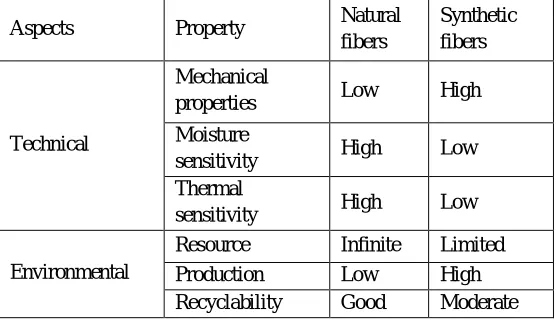
The uses of common filaments are developing in numerous parts, for example, cars, furniture, pressing and development. This is for the most part because of their preferences contrasted with engineered filaments, for example minimal effort, low weight, less harm to handling hardware, improved surface completion of shaped parts composite, great relative mechanical properties, plenteous and inexhaustible assets.
©IJRASET: All Rights are Reserved
161
Table 1. Correlation between regular strands and engineered filaments
Aspects Property Natural
fibers
Synthetic fibers
Technical
Mechanical
properties Low High
Moisture
sensitivity High Low
Thermal
sensitivity High Low
Environmental
Resource Infinite Limited
Production Low High
Recyclability Good Moderate
A. Sisal Fiber
Sisal Fiber is a standout amongst the most generally utilized characteristic fiber and is effectively accessible. It is get from sisal plant. The plant, referred to formally as Agave sisalana. These plants produce rosettes of sword-molded forgets which begin toothed, and slowly lose their teeth with development. Each leaf contains various long, straight filaments which can be evacuated in a procedure known as decortication. Amid decortication, the leaves are beaten to evacuate the mash and plant material, deserting the extreme strands. The strands can be spun into string for twine and material creation, or pulped to make paper items.
Sisal fiber is completely biodegradable, green composites were created with soy protein sap altered with gelatin. Sisal fiber, adjusted soy protein tars, and composites were portrayed for their mechanical and warm properties. It is exceptionally inexhaustible asset of vitality. Sisal fiber is particularly tough and a low support with insignificant mileage. Its fiber is unreasonably intense for materials and textures. It isn't appropriate for a smooth divider complete and furthermore not suggested for wet territories.
The fine surface of Sisal takes colors effectively and offers the biggest scope of colored shades of every common fiber. Zero pesticides or substance composts utilized in sisal farming. It is a hardened fiber generally utilized in making twine, rope and furthermore dartboards Sisal fiber is produced from the vascular tissue from the sisal plant (Agave sisalana). It is utilized in car contact parts (brakes, grips), where it grants green solidarity to performs, and for upgrading surface in coatings application.
B. Properties of Sisal Fiber
1) Sisal Fiber is extraordinarily solid with a low support with insignificant mileage.
2) It is Recyclable.
3) Sisal strands are acquired from the external leaf skin, evacuating the internal mash.
4) It is accessible as plaid, herringbone and twill.
5) Sisal strands are Anti-static, does not pull in or trap dust particles and does not assimilate dampness or water effectively.
6) The fine surface takes colors effectively and offers the biggest scope of colored shades of every characteristic fiber.
7) It displays great sound and effect engrossing properties.
8) Its leaves can be treated with normal borax for imperviousness to fire properties.
C. Utilizations of Sisal Fiber
From old occasion’s sisal has been the main material for horticultural twine in view of its quality, strength, capacity to extend, proclivity for specific dyestuffs, and protection from weakening in salt water.
1) Sisal is utilized regularly in the delivery business for mooring little art, lashing, and dealing with freight.
2) It is utilized in vehicle industry with fiberglass in composite materials.
3) Other items created from sisal fiber incorporate spa items, feline scratching posts, lumbar help belts, floor coverings, shoes, fabrics and circle supports.
©IJRASET: All Rights are Reserved
162
II. LITERATUREREVIEW
J. Naveen Presented the Paper on Mechanical and physical properties of sisal and crossover sisal fiber-fortified polymer composite[1] in this sisal fiber might be a potential safeguard for polymer composites. past its antiquated applications ropes mats and so on sisal fiber includes potential applications inside the flying machine and vehicle divisions. the physical and mechanical practices of sisal fiber rely upon the supply age and area in any case in like manner on their fiber measurement primer temperature check length and strain rate. fiber surface modification or treatment improves surface relationship between the deliquescent sisal
fiber and furthermore the hydrophobic substance compound network. this prompts a markdown in wetness absorption Associate in
Nursingd an improvement of mechanical properties. surface modification wires: one peroxide impels change of respectability
responses a couple of silane treatment deliquescent attributes are frequently modified by indicating long chain structures onto the sisal fiber three stomach area dying down specialist and salt treatment shaping a brutal sisal fiber surface that improves the contact a district of the fiber with the framework and four warmth treatment. the mechanical and physical practices of sisal fiber-based synthetic compound composites are hard to the gathering approach fiber length fiber introduction fiber volume division and sort of lattice utilized either thermosetting or thermoplastics sisal fiber-based cream composites take pleasant states of their individual constituents. dead all the split mechanics and break strength of sisal fiber-based composites ought to be thought of altogether. the relationship between the mechanical properties and furthermore the social event methodology ought to be created to utilize sisal
fiber successfully in various applications. glass sisal fiber cream composites were conveyed and their mechanical properties were reviewed. consequently to boot the aftereffects of dealing with parameters medications check length and structures on overall and amazing cost kevlar carbon fiber sisal fiber cross breed composites still can't be examined. the reusing methodology and life-cycle appraisal of sisal fiber and crossover sisal fiber-based composites must be asked in regards to inside and out. reusing of composites might be an enchanting subject of investigation directly that may offer reserve benefits
B. ZuccarelloPresented the Paper on Optimal Manufacturing And Mechanical Characterization Of High Performance Biocomposites Reinforced By Sisal Fibers.[2] The developing energy in regards to eco-sensible materials inside the main edge age vehicle customary improvement bundling has affected the augmentation of the examination works directing biocomposites. in any case starting at as of late the first idea has been committed to the improvement of short fiber biocomposites for non-right hand applications while exclusively 2 or 3 works have contemplated winning biocomposites for essential applications. thusly the movement of essential biocomposites from liberal fundamental strands as sisal filaments might be an outcome anticipated from built up pros in any case not yet developed. to pass on a guarantee to the utilization of tip prime biocomposites contained by an unpracticed structure strengthened by sisal filaments this work proposes an accumulation technique that licenses to initiate exceptional quality unidirectional biocomposites with fiber volume partition up to seventieth. altogether it utilizes unidirectional sewed surfaces appropriately secured in investigation working environment from driving edge strands Associate in Nursingd a restoring underneath a bona fide weight cycle. the examination with free learning low down recorded as an extreme duplicate has exhibit anyway the anticipated biocomposites show mechanical properties over a concentrated smidgen of biocomposites portrayed recorded as a printed version so they will totally substitute not exclusively materials as steel nuclear number 13 and optical fiber reinforced plastics in any case moreover phenomenal biocomposites revived by consistently costly filaments.
M. Aslana Presented the Paper on Tribological And Mechanical Performance Of Sisal-Filled Waste Carbon And Glass Fiber Hybrid Composites.[3] This examination has been done to show utilization of trademark filaments in light of the fact that the potential substitute of built strands in tribo-composites. the terrible wear lead and mechanical properties of waste sisal/glass sisal/carbon blend fiber invigorated plastic pp composites were inquired about amid this examination. results demonstrated that broadening the sisal fiber weight content inside the composites builds the consistent of breaking down. the scratched spot volume of sisal/glass cross breed composites demonstrated normally not up to those of sisal/carbon ewer composite for an equivalent blend degrees. this gathers expansion of sisal strands on waste carbon and optical fiber propped pp composites diminished the adaptability of tribological execution. notwithstanding the implies that just as of sisal strands as a trademark substitute fiber supply to abuse short carbon fiber composites cause normal properties Associate in Nursing expansion of sisal filaments to abuse glass composites shows lower densities tantamount mechanical and scratched zone volumes than that of waste optical fiber composites. this shows sisal strands are regularly utilized rather than glass filaments. the checking negatron micrographs of the break surfaces display that the wetting relationship of sisal and optical fiber with pp framework is best than those of the sisal carbon cross breed composites. furthermore the depleted surfaces of the sisal and its cross breed composites show vertical segments free sections humbler scale wrinkling and exchange layers.
©IJRASET: All Rights are Reserved
163
on the utilization of meager external layers of Sisal Fiber-Cement Composites (SiFCC) together with a center layer of Polypropylene Fiber-Reinforced Lightweight Concrete (PFRLC). The impact of sisal filaments was concentrated in two distinctive ways, short sisal strands (50 mm) arbitrarily conveyed in the lattice, and long unidirectional adjusted sisal strands (700 mm) connected by a cast hand layup method. Lightweight totals and polypropylene strands were utilized in the solid layer shaping the board's center so as to lessen its thickness and improve its post breaking rigidity and vitality retention limit. The conduct of the sandwich boards in four-point twisting test is depicted, and the different disappointment instruments are accounted for. Mechanical properties of both SiFCC and PFRLC were acquired, which were additionally utilized in the numerical reenactments. Draw off tests were performed to assess the bond quality between the external SiFCC layers and the center PFRLC. The outcomes uncovered that the long sisal filaments were increasingly successful regarding giving to the board higher flexural limit than when utilizing short sisal strands, long strands guaranteed the improvement of an avoidance solidifying conduct pursued by the arrangement of various breaks, while short sisal filaments advanced a conditioning reaction in the wake of splitting.
Luciano Machado Gomes Presented the Paper on Novel Fiber Metal Laminate Sandwich Composite Structure With Sisal Woven Core.[5] In this Fiber metal covers (FMLs) have been broadly used to fabricate airframe parts. This work portrays novel sisal fiber fortified aluminum overlays (SiRALs) that have been set up by virus squeezing procedures and tried under elastic, flexural and sway stacking. The immaculate sisal texture and the sisal fiber strengthened composites (SFRCs) were likewise tried to comprehend the distinction in mechanical execution of the sisal fiber metal overlays. The SiRALs accomplished the most noteworthy modulus and quality, yet in addition the most elevated explicit properties. The mean explicit elasticity and modulus of the SIRALs achieved increments of 132% and 267%, individually, when contrasted with the sisal fiber strengthened composites (SFRCs). In addition, the mean explicit flexural quality and modulus of the SiRALs were altogether higher than SFRCs, uncovering increments of 430% and 973%, individually. A delamination crack mode was noted for SiRALs under twisting testing. The SiRALs can be viewed as promising and reasonable composite materials for auxiliary and multifunctional applications.
M. R. Sanjay Presented the Paper on Applications of Natural Fibers and Its Composites: An Overview[6]. In the present situation, there has been a quick consideration in innovative work in the regular fiber composite field because of its better formability, bounteous, inexhaustible, financially savvy and eco-accommodating highlights. This paper shows a blueprint on common strands and its composites used as a piece of various business and designing applications. In this survey, numerous articles were identified with utilizations of regular fiber strengthened polymer composites. It gives insights regarding the potential utilization of normal filaments and its composite materials, mechanical and physical professional perties and a portion of their applications in building parts.
Malla Surya Teja Presented the Paper on Experimental Investigation of Mechanical and Thermal properties of sisal fiber fortified composite and impact of SiC filler material [7]. With a perspective on investigating the potential utilization of characteristic recourses, we made an endeavor to create sisal fiber polymer composites by hand lay-up strategy. Common fiber composites are inexhaustible, shabby and biodegradable. Their simple accessibility, lower thickness, higher explicit properties, lower cost, agreeable mechanical and warm properties, non-destructive nature, makes them an appealing environmental choice to glass, carbon or other man-made engineered strands. In this work, the impact of SiC on mechanical and warm properties of common sisal fiber composites are researched. The composite has been made with and without SiC consolidating common sisal fiber with polyester as holding material. The trial results displayed that the elasticity of composite with 10%SiC 2.53 occasions more noteworthy than that of composite without SiC. The effect quality of composite with 10% SiC is 1.73 occasions more prominent than that of composite without SiC plain polyester. Warm properties examined incorporate warm conductivity, explicit warmth limit, warm diffusivity, warm debasement and solidness. Three unique examples with 0%, 5%, 10% SiC powder are considered. With the expansion of SiC filler powder, warm conductivity builds, explicit warmth limit steadily expands then reductions, warm diffusivity increments and warm strength improves with Sic powder.
©IJRASET: All Rights are Reserved
164
M. Indra Reddy Presented the Paper on Comparative Evaluation on Mechanical Properties of Jute, Pineapple leaf fiber and Glass fiber Reinforced Composites with Polyester and Epoxy Resin Matrices.[9]during this Environmental cognizance associate degreed an increasing worry with the nursery impact have refreshed the event, car, and pressing enterprises to look for economical materials which will supersede customary designed chemical compound filaments. traditional strands seem to be an honest choice since they're promptly accessible in stringy structure and may be faraway from plant leaves at very low expenses. during this work we've got contemplated the mechanical properties of the composites created by invigorating Jute, Pineapple leaf fiber and optical fibre as 1:1:1 proportion into a polyester and epoxy gum. The fiber content within the composite was fluctuated from zero.18 to 0.42 by volume portion and also the sort of mechanical properties, for instance, pliable, flexural and sway properties for every state of affairs were examined. The outcomes demonstrate that the Jute, Pineapple leaf fiber and optical fibre fortified epoxy composite displayed desirable mechanical properties over Jute, Pineapple leaf fiber and optical fibre polyester composite.
III. PROBLEM STATEMENT
The Comparative study and optimization of foot rest by using Composite Sisal fibre as replacement for aluminium, along with weight and strength optimization.
A. Objective
1) To Optimize footrest by using sisal fibre instead of aluminium as Footrest material
a) To reduce weight of footrest at least 40%.
b) To find better orientation for sisal fibre material.
2) To increase strength of footrest by 20% to 30%.
3) To validate simulation results by experimental results and achieve the error below 5%.
B. Scope
1) Sisal fiber is considered as a alternate material for footrest.
2) Simulation of actual and sisal fiber footrest using ANSYS software.
3) Experimental Validation for ANSYS Results.
IV. METHODOLOGY
1) Step 1: Literature survey.
2) Step2: Components required for the project are decided
3) Step 3: 3 D Model and drafting in CATIA software.
4) Step 4: The Analysis of the component will be done with the help of ANSYS using FEA.
5) Step 5: After Manufacturing the Model with sisal fiber the Experimentation testing carried out by using Universal Testing Machine.
6) Step 6: Comparative analysis between simulation and experimental results and then Results and conclusions will be drawn.
V. DESIGN
A. CAD
Computer aided design(CAD) is the utilization of PC frameworks (or workstations) to help in the creation, alteration, examination, or improvement of a structure. Computer aided design programming is utilized to build the efficiency of the planner, improve the nature of configuration, improve correspondences through documentation, and to make a database for assembling. Computer aided design yield is regularly as electronic documents for print, machining, or other assembling tasks. The term CADD (for Computer Aided Design and Drafting) is likewise utilized.
Its utilization in planning electronic frameworks is known as electronic structure computerization (EDA). In mechanical structure it is known as mechanical plan robotization (MDA) or PC supported drafting (CAD), which incorporates the way toward making a specialized illustration with the utilization of PC programming.
©IJRASET: All Rights are Reserved
165
As per standard dimensions footrest is designed using CATIA software
B. Meshing
ANSYS Meshing is a broadly useful, shrewd, robotized superior item. It creates the most suitable work for exact, proficient Multiphysics arrangements. A work appropriate for a particular examination can be created with a solitary mouse click for all parts in a model. Full powers over the choices used to produce the work are accessible for the master client who needs to calibrate it. The intensity of parallel preparing is naturally used to diminish the time you need to hang tight for work age.
Making the most proper work is the establishment of building reenactments. ANSYS Meshing knows about the sort of arrangements that will be utilized in the undertaking and has the fitting criteria to make the most appropriate work. ANSYS Meshing is naturally incorporated with every solver inside the ANSYS Workbench condition. For a brisk investigation or for the new and inconsistent client, a usable work can be made with a single tick of the mouse. ANSYS Meshing picks the most suitable choices dependent on the investigation type and the geometry of the model. Particularly advantageous is the capacity of ANSYS Meshing to naturally exploit the accessible centers in the PC to utilize parallel preparing and in this manner essentially lessen an opportunity to make a work. Parallel cross section is accessible with no extra expense or permit prerequisites.
[image:6.612.96.532.82.250.2]Fig.No.1 CATIA Model
Fig.No.2 CATIA Model Contact Region
Fig.No.3 Meshing of Aluminium Model
Hence, Tetrahedral type of mesh is used. Element size is taken as 2mm
Total no. of Nodes for Aluminium is 56735 Total no. of Elements for Aluminium is 30862
Fig. 4 Meshing of Sisal Fibre Model
Hence, Tetrahedral type of mesh is used. Element size is taken as 2mm
[image:6.612.63.548.454.683.2]©IJRASET: All Rights are Reserved
166
Fig.No.5 Load applied on Aluminium Model Fig.No.6 Total Deformation of Aluminium ModelFig. 7 Equivalent Stress of Aluminium Model Fig.No.8 Load applied on Sisal Fibre Model
C. Analysis
The Finite Element Method (FEM), is a numerical technique for taking care of issues of building and scientific material science. Ordinary issue zones of intrigue incorporate basic investigation, heat exchange, liquid stream, mass transport, and electromagnetic potential. The scientific arrangement of these issues for the most part require the answer for limit esteem issues for halfway differential conditions. The limited component strategy plan of the issue results in an arrangement of mathematical conditions. The technique yields estimated estimations of the questions at discrete number of focuses over the space. To tackle the issue, it subdivides an enormous issue into littler, more straightforward parts that are called limited components. The straightforward conditions that model these limited components are then gathered into a bigger arrangement of conditions that models the whole issue. FEM then uses variational techniques from the math of varieties to surmise an answer by limiting a related mistake work. Contemplating or investigating a marvel with FEM is frequently alluded to as limited component examination (FEA).
D. Total Deformation
The complete twisting and directional disfigurement are general terms in limited component techniques regardless of programming being utilized.
[image:7.612.55.515.304.661.2] [image:7.612.67.510.522.685.2]©IJRASET: All Rights are Reserved
167
Fig. 9 Total deformation of sisal fiber Model Fig. 10 Equivalent stress of Sisal fibre model
Table 2. Total deformation and equivalent stress comparision between aluminium and sisal fibre on the basis of ansys results.
Total deformation
Equivalent stress
Aluminium 1.3308 mm 249.01 Mpa
Sisal fibre 0.2386 mm 249.04 Mpa
VI. FABRICATION
A. Hand lay-up Technique
[image:8.612.143.469.569.708.2]Hand lay-up technique is the quiet simple technique of composite processing. The infrastructural arrangement for this method is also minimal. The processing steps are very simple. First of all, a release gel or wax is sprayed on the mold surface to avoid the sticking of Sisal fiber to the surface. Thin plastic sheets are used at the top and bottom of the mold plate to get good surface finish of the product. Reinforcement in the form of woven mats or chopped standard mats are cut as per the mold size and placed at the surface of mold after Perspex sheet. Then polymer material in liquid form is mixed thoroughly in suitable proportion with a prescribed hardener (curing agent) and poured into the surface of mat already placed in the mold. The polymer material is uniformly spread with the help of brush. Second layer of Sisal fiber is placed on the polymer surface by 0 - 0orientation pattern and a roller is moved with a mild pressure on the Sisal fiber layer to remove any air trapped as well as the excess polymer present. The process is repeated for each layer of polymer and mat, till the required layers are stacked. The 3 different Sisal fiber specimen with changing Material orientation pattern are made. Material orientation pattern are followed by 0° - 0°- 0°- 0°- 0°- 0°- 0°- 0°,0° - 45°-0° - 45°-0° - 45°-0° - 45°,0° - 90°-0° - 90°-0° - 90°-0° - 90°. After placing the plastic sheet, release gel is sprayed on the inner surface of the top mold plate which is the kept on the stacked layers and the pressure is applied. After curing either at room temperature or at some specific temperature, mold is opened and the developed composite foot Rest part is taken out and further processed.
©IJRASET: All Rights are Reserved
168
Fig. 13Peak load of Aluminium Foot restVII. EXPERIMENTAL ANALYSIS
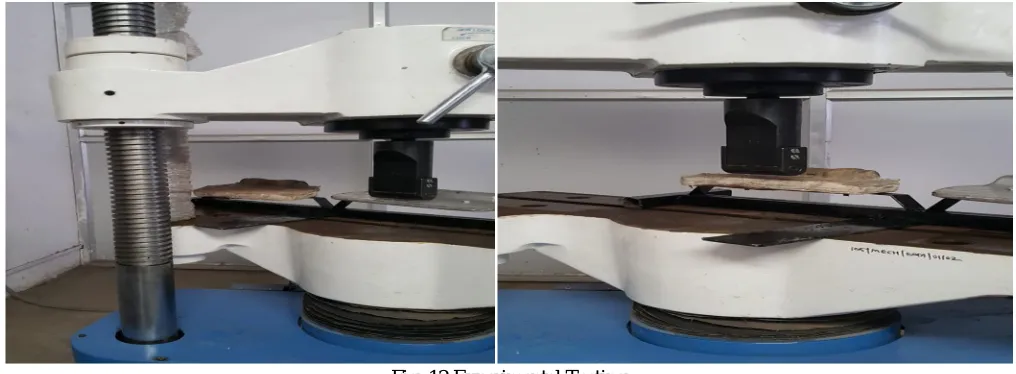
The UTM is a servo hydraulic fluid-controlled machine, consists of a two column dynamically rated load frame with the capacity of load up to 100kN (dynamic), hydraulic power pack (flow rate 45 litre/minute) and 8800 Fast Track 8800 Controller test control systems is stand alone, fully digital, single axis controller with an inbuilt operating panel and display. The controller is fully portable and specifically designed with all the condition for materials testing requirement. This controller has position to system, load and strain control capability. The software’s available with the machine are: (a) Merlin Testing Software for Tensile Test system (b) da/dN Fatigue Crack Propagation Test system. (c) Kic Fracture Toughness Test system. (d) Jic Fracture Toughness Test system.
Fig. 12 Experimental Testing
Experimental testing is carried out on UTM. Supports are given at two points and 350N load is applied on specimen as shown in figure.
[image:9.612.53.546.404.538.2]VIII. RESULT
Table 3. Total deformation comparision between aluminium and sisal fibre on the basis of FEA & Test results.
Material (Foot Rest specimens)
Material orientation
pattern
Load
(N)
Total Deformation
(FEA)mm
Total Deformation
(Test)mm
Aluminium - 350 0.85 0.9
Sisal fiber 1 0°-0°-0°-0°-0°-
0°-0°-0° 350 2.044 2
Sisal fiber 2 0°0°
-45°-0°-45°-0°-45° 350 2.450 2.5
Sisal fiber 3 0°0°
[image:9.612.42.287.404.531.2]-90°-0°- 9-90°-0°--90°-0°- 90° 350 2.722 2.7
[image:9.612.126.479.596.735.2]©IJRASET: All Rights are Reserved
169
A. For Aluminium foot rest Peak load from UTM compression testing was found to be 640N & design load is 350N and which proves design is within the safety limit & also has load bearing capacity.
B. For Sisal fiber foot rest Peak load from testing was found to be 1820N & design load is 350N & which proves design is within the safety limit & also has load bearing capacity.
C. Aluminium footrest shows total deformation of 0.85mm in simulation and 0.9mm in experimentation.
D. Composite sisal fibre footrest sample 1,2, 3 shows total deformation of 2.044 mm, 2.450mm and 2.722mm respectively in the simulation and total deformation of 2 mm, 2.5mm and 2.7mm respectively in the experimentation.
IX. CONCLUSION
A. Footrest is optimized by using sisal fibre instead of aluminium as footrest material.
B. Due to the use of Sisal fiber material for foot rest weight of specimen reduced by 55%.
C. From the results it can be seen that strength of the footrest is increased by more than 30%.
D. Validation of simulation results is done by experimental results and error is achieved below 5%.
E. From result table it conclude that sisal fiber with 0°-0°-0°-0°-0°-0°-0°-0° Material orientation has minimum deformation that is 2 mm. ( Experimental Test )
X. ACKNOWLEDGEMENT
The author would like to take the opportunity to thank who gave us their indebted assistance. I wish to extend my cordial gratitude with profound thanks to our internal guide Prof. V. M. Bansode. I am also thankful to Prof. S. M. Jadhav, PG Coordinator for his overwhelming support and invaluable guidance. My sincere thanks and deep gratitude to Head of Department, Prof. D. H. Burande and other faculty members. At last but not least I express my sincere thanks to the Institute’s Principal Dr. S. D. Markande, for providing us infrastructure and technical environment.
REFERENCES
[1] J. Naveen, M. Jawaid, P. Amuthak kannan, M. Chandrasekar, “Mechanical And Physical Properties Of Sisal And Hybrid Sisal-fiber-Reinforced Polymer Composite”, ELSEVIER, (2019)
[2] B. Zuccarello, G. Marannano, A. Mancino, “Optimal Manufacturing And Mechanical Characterization Of High Performance Bio composites Reinforced By Sisal Fibers”, Composite Structures (2018),doi:https:??doi.org/10.1016/j.compstruct.2018.04.007
[3] M. Aslana, M. Tufanb, T. Küçükömeroğlu, “Tribological And Mechanical Performance Of Sisal-Filled Waste Carbon And Glass Fibre Hybrid Composites”, Composites Part B (2018), doi: 10.1016/j.compositesb.2017.12.039
[4] Cristina Frazão, Joaquim Barros, “Development Of Sandwich Panels Combining Sisal Fiber-Cement Composites And Fiber-Reinforced Lightweight Concrete”, (2017), doi: 10.1016/j.cemconcomp.2017.11.008
[5] Luciano Machado Gomes Vieiraa, Júlio Cesar Dos Santos, TúlioHallakPanzera, Juan Carlos Campos Rubioa, FabrizioScarpa, “Novel Fibre Metal Laminate Sandwich Composite Structure With Sisal Woven Core”, ELSVIER, Industrial Crops and Poducts 99 (2017) 189 - 195
[6] M. R. Sanjay, G. R. Arpitha, L. Laxmana Naik, K. Gopalakrishn, B. Yogesh, “Applications of Natural Fibers and Its Composites: An Overview”, Scientific Research Publishing, Natural Resources, 2016, 7, 108-114
[7] Malla Surya Teja, M V Ramana, D Sriramulu and C J Rao, “Experimental Investigation Of Mechanical And Thermal Properties Of Sisal Fibre Reinforced Composite And Effect Of Sic Filler Material” 2016 IOP Conf. Ser.: Mater. Sci. Eng. 149 012095
[8] M. Ramesh, K. Palanikumar, K. Hemachandra Reddy, “Comparative Evaluation on Properties of Hybrid Glass Fiber- Sisal/Jute Reinforced Epoxy Composites.” , ELSEVIER, ICMPC 2017