Data Set for Compositional Distributional
Semantics
Laura Rimell
∗University of Cambridge Computer Laboratory
Jean Maillard
∗University of Cambridge Computer Laboratory
Tamara Polajnar
∗ University of Cambridge Computer LaboratoryStephen Clark
∗ University of Cambridge Computer LaboratoryThis article introducesRELPRON, a large data set of subject and object relative clauses, for the evaluation of methods in compositional distributional semantics. RELPRON targets an intermediate level of grammatical complexity between content-word pairs and full sentences. The task involves matching terms, such as “wisdom,” with representative properties, such as “quality that experience teaches.” A unique feature ofRELPRONis that it is built from attested properties, but without the need for them to appear in relative clause format in the source corpus. The article also presents some initial experiments onRELPRON, using a variety of composition methods including simple baselines, arithmetic operators on vectors, and finally, more complex methods in which argument-taking words are represented as tensors. The latter methods are based on the Categorial framework, which is described in detail. The results show that vector addition is difficult to beat—in line with the existing literature—but that an implementation of the Categorial framework based on the Practical Lexical Function model is able to match the performance of vector addition. The article finishes with an in-depth analysis ofRELPRON, showing how results vary across subject and object relative clauses, across different head nouns, and how the methods perform on the subtasks necessary for capturing relative clause
∗University of Cambridge Computer Laboratory, William Gates Building, 15 JJ Thomson Avenue, Cambridge, UK. E-mail:{laura.rimell;jean.maillard;tamara.polajnar;stephen.clark}@cl. cam.ac.uk.
Submission received: 10 April 2015; revised version received: 15 April 2016; accepted for publication: 25 May 2016.
semantics, as well as providing a qualitative analysis highlighting some of the more common errors. Our hope is that the competitive results presented here, in which the best systems are on average ranking one out of every two properties correctly for a given term, will inspire new approaches to the RELPRONranking task and other tasks based on linguistically interesting constructions.
1. Introduction
The field of compositional distributional semantics (Mitchell and Lapata 2008; Clark, Coecke, and Sadrzadeh 2008; Baroni, Bernardi, and Zamparelli 2014) integrates distributional semantic representations of words (Sch ¨utze 1998; Turney and Pantel 2010; Clark 2015) with formal methods for composing word representations into larger phrases and sentences (Montague 1970; Dowty, Wall, and Peters 1981). In recent years a number of composition methods have been proposed, including simple arithmetic operations on distributional word vectors (Mitchell and Lapata 2008, 2010), multi-linear operations involving higher-order representations of argument-taking words such as verbs and adjectives (Baroni and Zamparelli 2010; Coecke, Sadrzadeh, and Clark 2010), and composition of distributed word vectors learned with neural networks (Socher, Manning, and Ng 2010; Mikolov, Yih, and Zweig 2013). To compare such approaches it is important to have high-quality data sets for evaluating composed phrase representations at different levels of granularity and complexity.
Existing evaluation data sets fall largely into two categories. Some data sets focus on two to three word phrases consisting of content words only (i.e., no closed-class function words), including subject–verb, verb–object, subject–verb–object, and adjective–noun combinations (Mitchell and Lapata 2008, 2010; Baroni and Zamparelli 2010; Vecchi, Baroni, and Zamparelli 2011; Grefenstette and Sadrzadeh 2011; Boleda et al. 2012; Boleda et al. 2013; Lazaridou, Vecchi, and Baroni 2013). Such data sets have been essential for evaluating the first generation of compositional distributional models, but the relative grammatical simplicity of the phrases—in particular, the absence of function words—leaves open a wide range of compositional phenomena in natural language against which models must be evaluated.1
Other data sets, including those used in recent SemEval and *SEM Shared Tasks (Agirre et al. 2012, 2013; Marelli et al. 2014; Agirre 2015), focus on pairs of full sentences, some as long as 20 words or more. The evaluation is based on a numeric similarity measure for each sentence pair. These data sets represent a more realistic task for lan-guage technology applications, but reducing sentence similarity to a single value makes it difficult to identify how a model performs on subparts of a sentence, or on specific grammatical constructions, masking the areas where models need improvement.2
In the domain of syntactic parsing, a call has been made for “grammatical construction-focused” parser evaluation (Rimell, Clark, and Steedman 2009; Bender et al. 2011), focusing on individual, often challenging syntactic structures, in order to tease out parser performance in these areas from overall accuracy scores. We make an analogous call here, for a wider range of compositional phenomena to be investigated in compositional distributional semantics in the near future.
1 Exceptions are the data sets of Bernardi et al. (2013) and Pham et al. (2013), which include determiners such astwo,most, andnoin the phrases to be composed; see Section 2.1.
This article begins to answer that call by presentingRELPRON, a data set of noun phrases consisting of a noun modified by a relative clause. For example,building that hosts premieresis a noun phrase containing a subject relative clause (a relative clause with an extracted subject), and in our data set describes a theater; while person that helicopter saves contains an object relative clause, and in our data set describes a sur-vivor. The RELPRON data set is primarily concerned with the analysis of a particular type of closed-class function word, namely, relative pronouns (that, in our examples); function words have traditionally been of greater concern than content words for formal semantics, and we address how this focus can be extended to distributional semantics.
Relative clauses, although still fairly short and therefore more manageable than full sentences, are nevertheless more grammatically complex than the short phrases in previous data sets, because of the relative pronoun and the long-distance relationship between the verb and the extracted argument—known as the head noun of the relative clause (building, person). The aim ofRELPRONis to expand the variety of phrase types on which compositional distributional semantic methods can be evaluated, thus help-ing to build these methods up step-by-step to the full task of compositional sentence representations.
RELPRONis a large (1,087 relative clauses), corpus-based, naturalistic data set, in-cluding both subject and object relative clauses that modify a variety of concrete and abstract nouns. The relative clauses are matched with terms and represent distinctive properties of those terms, such aswisdom: quality that experience teaches, andbowler: player that dominates batsman. A unique feature of RELPRON is that it is built from attested properties of terms, but without the properties needing to appear in relative clause form in the source corpus.
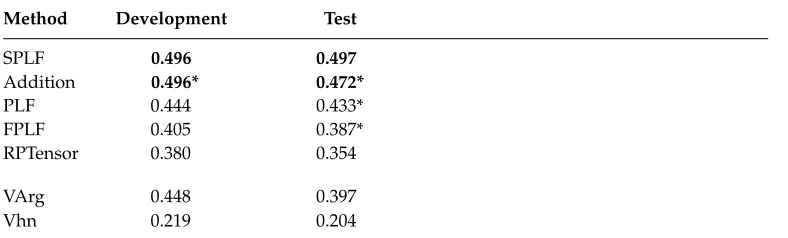
This article also presents some initial experiments on RELPRON, using a variety of composition methods. We find that a simple arithmetic vector operation provides a challenging baseline, in line with existing literature evaluating such methods, but we are able to match this baseline using a more sophisticated method similar to the Practical Lexical Function (PLF) model of Paperno, Pham, and Baroni (2014). We hope that the compositional methods presented here will inspire new approaches.
2. Motivation forRELPRON
Relative clauses have been suggested as an interesting test case for compositional distributional semantic methods by Sadrzadeh, Clark, and Coecke (2013) and Baroni, Bernardi, and Zamparelli (2014). One of the main inspirations forRELPRONis the pilot experiment of Sadrzadeh, Clark, and Coecke, in which terms such as carnivore are matched with descriptions such asanimal who eats meat. However, the data set is small and all examples are manually constructed. RELPRONaims to provide a larger, more realistic, and more challenging testing ground for relative clause composition methods. RELPRON falls into the general category of cross-level semantic similarity tasks (Jurgens, Pilehvar, and Navigli 2014), which involve comparing phrases of different lengths; in this case, a single word with a short phrase. The task of matching a phrase with a single word can be thought of as a special case of paraphrase recogni-tion. However, restricting one of the phrases to a word means that the experiment is better controlled with regard to composition methods; because we know that we have available high-quality, state-of-the-art distributional representations of single words, the only unknown is the composed phrase representation, whereas a comparison of two composed phrases can be more difficult to interpret.
The RELPRON task is similar to the definition classification task of Kartsaklis, Sadrzadeh, and Pulman (2012), which targeted verb phrase composition. In that task, methods were tested on their ability to match a term (in this case a verb) with its defini-tion (usually of the form verb–object), such asembark: enter boat or vessel. However, the definitions of Kartsaklis, Sadrzadeh, and Pulman were mined from a set of dictionaries, whereas theRELPRONrelative clauses are not limited to dictionary definitions.
Because there is an intuitive definition-like “flavor” to some relative clauses, we considered using dictionary definitions as a source of relative clauses for the data set. However, in practice we found that short, natural definitions in relative clause format are rare in dictionaries. For example, definitions for the wordtelescopefrom three different dictionaries, two of them learner dictionaries, are shown in Example (1).
telescope a monocular optical instrument possessing magnification for ob-serving distant objects (Wiktionary)
telescope an important tool for astronomy that gathers and focuses light (Simple Wikipedia)
telescope a cylinder-shaped device for making objects that are far away look nearer and larger, using lenses and curved mirrors (Cambridge Advanced Learner’s Dictionary)
(1)
Only the Simple Wikipedia definition uses a relative clause to define the term, and would still require significant editing to shorten the phrase. Instead, we collect relative clauses that express representative properties, not necessarily definitions, of the term, as seen in Example (2).
telescope device that astronomers use telescope device that detects planets telescope device that observatory has
Figure 1
Terminology used to describe the terms and properties inRELPRON: subject relative clause above, object relative clause below.
Collecting properties rather than definitions allows for several phrases to be associated with each term, and substantially broadens the number and type of corpora that can be used as sources for the relative clauses.
Figure 1 introduces some terminology for describing the terms and properties in the data set.3 Aterm is a single word which is associated with a set of descriptive
phrases. Semantically, each descriptive phrase is apropertyof the term. Syntactically, each descriptive phrase is a noun phrase containing a relative clause. For the sake of brevity, we often refer to the whole noun phrase containing the relative clause as a relative clause, when we believe this will not lead to confusion. We saysubject relative clause or object relative clause(or subject property or object property) to indicate which argument of the verb has been extracted. Thehead nounof the relative clause is the extracted noun, and is a hypernym of the term; for example,deviceis a hypernym of telescope. The subject or object that remains in situ in the clause we call theargumentof the verb, and the general term for the subject or object role isgrammatical function. The relative clauses inRELPRONare restrictive relative clauses, because they narrow down the meaning of the head noun. In contrast, a non-restrictive relative clause provides incidental situational information; for example,a device, which was in the room yesterday.
Our goal was to construct a data set containing at least 1,000 properties in the form of relative clauses. To make the ranking task more challenging, we chose groups of terms that share a head noun. For example,telescope,watch,button, andpipeare all subclasses ofdevice, so their relative clauses will all begindevice that.... Because the relative clauses are not definitions, each term can be associated with multiple properties; we selected between four and ten properties per term.
The construction ofRELPRONalso takes a novel approach to producing evaluation data sets that target a particular grammatical construction. Rather than mining exam-ples of the construction directly from a corpus, which may be difficult because of data sparsity, the properties in RELPRON did not have to occur in relative clause format in our source corpus. Instead, the properties were obtained from subject–verb–object (SVO) triples such asastronomer uses telescope, and joined with head nouns such asdevice. The head nouns are also attested in the corpus as heads of relative clauses in general, though not necessarily with these specific properties. The relative clauses inRELPRON are thereforenaturalistic, plausible, andcorpus-based, without having to be attested in the exact relative clause form in which they ultimately appear in the data set.
The canonical task on theRELPRONdata set is conceived as a ranking task. Given a term, a system must rank all properties by their similarity to the term. The ideal system will rank all properties corresponding to that term above all other properties. This is analogous to an Information Retrieval task (Manning, Raghavan, and Sch ¨utze 2008), where the term is the query and the properties are the documents, with the identifying properties for a given term as the relevant documents. Evaluation can make use of standard Information Retrieval measures; in this article we use Mean Average Precision (MAP).
2.1 Existing Evaluation Data Sets
Most existing evaluation data sets for compositional distributional semantics have been based on small, fixed syntactic contexts, typically adjective–noun or subject–verb– object. Mitchell and Lapata (2008) introduce an evaluation that has been adopted by a number of other researchers. The task is to predict human similarity judgments on subject–verb phrases, where the similarity rating depends on word sense disambigua-tion in context. For example,horse runis more similar tohorse gallopthan tohorse dissolve, whereascolors runis more similar to colors dissolvethan tocolors gallop. Compositional models are evaluated on how well their similarity judgments correlate with the human judgments. Mitchell and Lapata (2010) introduce a phrase similarity data set consisting of adjective–noun, verb–object, and noun–noun combinations, where the task again is to produce similarity ratings that correlate well with human judgments. For example, large numberandgreat majorityhave high similarity in the gold-standard data, whereas further evidence and low cost have low similarity. This data set formed the basis of a shared task at the GEMS 2011 workshop (Pad ´o and Peirsman 2011). Grefenstette and Sadrzadeh (2011) and Kartsaklis and Sadrzadeh (2014) introduce analogous tasks for subject–verb–object triples. In the disambiguation task,people try dooris more similar topeople test doorthan topeople judge door. In the similarity task,medication achieve result anddrug produce effecthave high similarity ratings, whereasauthor write bookanddelegate buy landhave low ratings. Sentence pairs with mid-similarity ratings tend to have high relatedness but are not mutually substitutable, such asteam win matchandpeople play game.
Other evaluations have made use of the contrast between compositional and non-compositional phrases, based on the intuition that a successful non-compositional model should produce phrase vectors similar to the observed context vectors for composi-tional phrases, but diverge from the observed context vectors for phrases known to be non-compositional. Reddy, McCarthy, and Manandhar (2011) introduce an evaluation based on compound nouns like climate change (compositional) and gravy train (non-compositional). Boleda et al. (2012, 2013) evaluate models on a data set involving intersective adjectives in phrases likewhite towel(compositional) and non-intersective adjectives in phrases like black holeandfalse floor(non-compositional). The data from the shared task of the ACL 2011 Distributional Semantics and Compositionality work-shop (Biemann and Giesbrecht 2011) are also relevant in this context.
SICK data set (Marelli et al. 2014) is based on image and video description corpora, with named entities removed and other normalization steps applied, in order to remove phenomena outside the scope of compositional distributional semantic models. Additional sentences are added based on linguistic transformations that vary the meaning of the original sentence in a controlled fashion. However, this data set is not designed for targeted evaluation of models on specific compositional linguistic phenomena, especially because many of the sentence pairs exhibit significant lexical overlap; for example,An airplane is in the air, An airplane is flying in the air.
Some recent data sets have extended the range of linguistic phenomena that may be evaluated. Cheung and Penn (2012) test the ability of compositional models to detect semantic similarity in the presence of lexical and syntactic variation, for example, among the sentencesPfizer buys Rinat,Pfizer paid several hundred million dollars for Rinat, and Pfizer’s acquisition of Rinat. Bernardi et al. (2013) introduce a data set comparing nouns to noun phrases, including determiners as function words; for example,duelis compared to two opponents (similar), various opponents (dissimilar), and two engineers (dissimilar). Pham et al. (2013) introduce a data set involving full sentences from a limited grammar, where determiners and word order vary; for example,A man plays a guitaris compared toA guitar plays a manandThe man plays a guitar.
3. TheRELPRONData Set
One challenge in targeting specific grammatical constructions for evaluation is that the more linguistically interesting constructions can be relatively rare in text corpora. The development ofRELPRONtakes a novel approach, using a syntactic transformation to assemble properties in relative clause form without the properties needing to appear in this syntactic form in the source corpus. The properties were obtained from SVO triples such asastronomer uses telescope, and joined with head nouns such asdevice, a hypernym oftelescope, to create the relative clausedevice that astronomer uses. The source corpus used for constructing the data set was the union of a 2010 Wikipedia download and the British National Corpus (BNC) (Burnard 2007). Here we describe the steps in the construction ofRELPRON.
3.1 Selection of Candidate Head Nouns
To make the data set maximally challenging, we designed it with multiple terms (hy-ponyms) per head noun (hypernym). This ensures that the composition method cannot rely solely on the similarity between the term and the head noun—say, traveler and person—and fail to consider the verb and argument in the relative clause.
We began by selecting a set of candidate head nouns, each of which would need to have a number of good candidate terms. To improve the naturalness of the examples, we chose candidate head nouns from among nouns frequently used as heads of relative clauses in the source corpus. We used a simple regular expression search for nouns occurring in the pattern “a[n]NOUNthat|who|which,” considering as candidates the 200 most frequent results. We manually excluded nouns where thethat-clause could be an argument of the noun, for examplestatement,decision, andbelief.
because we wanted to avoid extremely abstract nouns like entity, which has many distant hyponyms but few direct ones. Second, the hyponyms should be mostly unigrams, because we wanted to avoid multiword terms such as remote control. For simplicity, we considered only the first WordNet sense of each candidate head noun.4 Occasionally, we utilized the WordNet level one down from the frequent head noun in the corpus; for example, the corpus search yielded substance, but we used its di-rect hyponym material as a head noun, because it had more direct hyponyms of its own.
3.2 Selection of Candidate Terms
Following the selection of candidate head nouns, we chose candidate terms. For each candidate head noun, one author (Rimell) manually selected candidate terms from among the full list of WordNet hyponyms. Only one word was chosen from each WordNet synset, on the grounds that members of the same synset would not be suf-ficiently distinguishable from one another by their properties. Generally this was the first unigram member of the synset. For example, the WordNet hyponyms forbuilding include the synset in Example (3).
dormitory, dorm, residence hall, hall, student residence (3)
From this synset dormitory was kept as a candidate term. On the other hand, the WordNet hyponyms forqualityinclude the synset in Example (4).
economy, thriftiness (4)
Here economy was discarded on the basis that its primary sense is not relevant, and thriftiness was kept as a candidate term. Entire synsets were discarded when they seemed to be a poor example of the head noun, seemed to be too ambiguous, or consisted only of multi-word or proper noun entries. A multi-word term was very occasionally edited to make a unigram.
Next, potential terms were filtered by frequency. Based on initial exploration of the data, we passed along for manual annotation only those candidate terms that occurred at least 5,000 times in the source corpus, to maximize the chances that there would be enough SVO triples for annotation (see Section 3.3). Finally, candidate terms that appeared in WordNet as hyponyms of more than one candidate head noun were removed. For example,surgerycould be anactivityor aroom;schoolcould be abuilding or anorganization. We believed that the inclusion of such terms would complicate the data set and the evaluation unnecessarily.
3.3 Extraction of SVO Triples
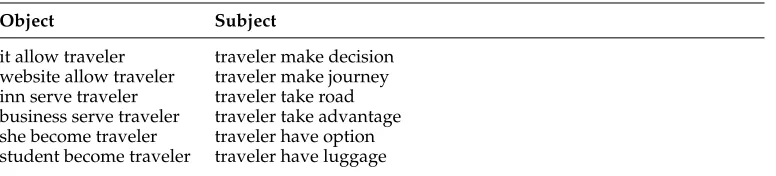
For each candidate term, candidate properties were obtained from the source corpus by extraction of all triples in which the term occurred in either subject or object position. We used a version of the corpus lemmatized with Morpha (Minnen, Carroll, and Pearce
Table 1
Sample SVO triples extracted from the source corpus for the candidate termtraveler.
Object Subject
it allow traveler traveler make decision website allow traveler traveler make journey inn serve traveler traveler take road business serve traveler traveler take advantage she become traveler traveler have option student become traveler traveler have luggage
2001) and parsed with the C&C Tools (Clark and Curran 2007) to obtain the subject and object relations. A minimum frequency cutoff of six occurrences per verb, per grammat-ical function (subject/object), per candidate term was applied. Properties containing proper noun arguments were removed. Table 1 shows some sample triples extracted from the corpus prior to manual annotation.
3.4 Conversion to Relative Clause Form
The candidate properties were converted to relative clause form prior to annotation, by joining the head noun with the relevant part of the SVO triple, using the templateterm: headnoun that V Ofor a subject property, orterm: headnoun that S Vfor an object property. Using the examples from Table 1,inn serve travelerthus becametraveler: person that inn serve; andtraveler make journeybecametraveler: person that make journey. For simplicity, that was used as the relative pronoun throughout the data set, although some head nouns are more likely to appear withwhoorwhich.
3.5 Manual Annotation of Properties
The manual annotation step was the stage at which candidate head nouns, terms, and properties were filtered for the final data set. Only terms with at least four good proper-ties, and head nouns with at least four terms, were retained after this step. Annotation was continued until the data set reached the desired size.
killers in general. Lexical ambiguity and parser errors contributed other unsuitable candidates.
Two of the authors (Rimell and Clark) selected good properties from among the candidates for each term, looking for what we called identifying properties. Such a property should distinguish a term from other hyponyms of its head noun, both those inRELPRON, and ideally other examples of the head noun as well (barring near-synonyms such as traveler and voyager). As a further guideline for annotation, we defined an identifying property as one that distinguishes a term because it mainlyor canonicallyapplies to the term in question, compared with other examples of the head noun. For example,person that tavern serveswas not judged to be a good property for traveler. It does not distinguish atravelerfrom other examples of people, because serving travelersis not the main or canonical purpose of a tavern (since the majority of people who eat and drink in a tavern are not traveling). On the other hand, person that hotel accommodates is a good property, because, although hotels might accommodate other people (e.g., for meetings or in a restaurant), their main and canonical purpose is to accommodate travelers. A more subtle example is the propertydevice that bomb has, a candidate property fortimer. This property does not uniquely distinguishtimer from among other devices, because bombs contain multiple (sub-)devices, but we felt that a timer was such a canonical part of a bomb that this could be considered a good property fortimer.
For a given head noun (hypernym), the annotator began with a random selection of ten candidate terms (hyponyms) from the candidates selected as in Section 3.2. For each candidate term, the annotator chose up to ten good properties. Once ten had been found, annotation stopped on that term, even if more good properties might have been available, because the aim was a broad and balanced data set rather than recall of all good properties. Not all terms had ten good properties. We required a minimum of four, otherwise the candidate term was discarded and another candidate randomly selected from the list of candidates. We also required a minimum of four terms per head noun, otherwise the entire head noun was discarded and another chosen from the list of candidates.
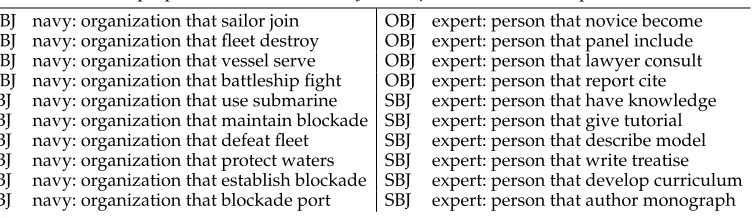
The two annotators originally worked together on a small set of data. After the annotation guidelines were refined, the head nouns were divided between the an-notators. As a final check, all properties were reviewed and discussed; any property on which the annotators could not agree was discarded. We aimed for a balance of subject and object relative clauses for each term, but this was not always possible. Some head nouns were very unbalanced in this respect: personterms tended to have better subject properties thanks to their agentivity, such as philosopher: person that interprets world; whereas quality terms tended to have better object properties because of their lack of agentivity, such aspopularity: quality that artist achieves. We also tried to make the data set more challenging by choosing properties with lexical confounders when we noticed them. For example, team: organization that loses matchanddivision: organization that team joins share the lemma team, which means a ranking method cannot rely on lexical overlap between the term and the property as an indicator of similarity. Table 2 shows the full list of selected properties for two terms in the development set,navyand expert.
Table 2
Full list of selected properties for the termsnavyandexpertfrom the development set.
OBJ navy: organization that sailor join OBJ expert: person that novice become OBJ navy: organization that fleet destroy OBJ expert: person that panel include OBJ navy: organization that vessel serve OBJ expert: person that lawyer consult OBJ navy: organization that battleship fight OBJ expert: person that report cite SBJ navy: organization that use submarine SBJ expert: person that have knowledge SBJ navy: organization that maintain blockade SBJ expert: person that give tutorial SBJ navy: organization that defeat fleet SBJ expert: person that describe model SBJ navy: organization that protect waters SBJ expert: person that write treatise SBJ navy: organization that establish blockade SBJ expert: person that develop curriculum SBJ navy: organization that blockade port SBJ expert: person that author monograph
mammal, material, organization, person, phenomenon, player, quality, room, scientist, vehicle, woman.5
3.6 Final Data Set
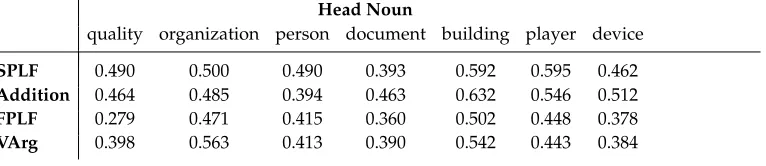
After annotation was complete, the data were divided into test and development sets. The division was made by head noun (hypernym), with all terms (and therefore properties) for a given head noun appearing in either the test or the development set. Assuming that terms with the same head noun are good mutual confounders, this split was chosen to maximize the difficulty of the task. We arranged the split so that both sets contained a range of concrete and abstract head nouns. We also ensured that both sets contained the maximum possible number of lexical confounders.
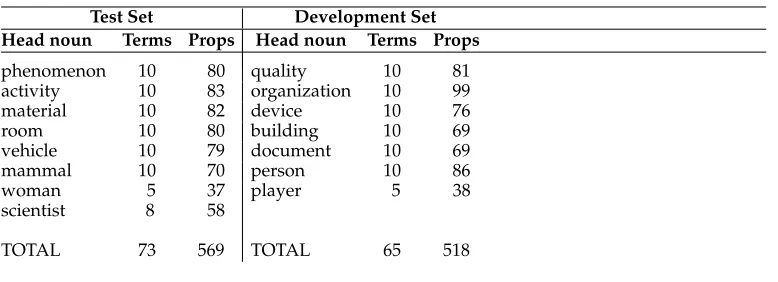
The final data set consists of 1,087 properties, comprising 15 head nouns and 138 terms. This is divided into a test set of 569 properties, comprising 8 head nouns and 73 terms; and a development set of 518 properties, comprising 7 head nouns and 65 terms. The total number of terms and properties by head noun is given in Table 3. Overall, the data set includes 565 subject and 522 object properties, with the distribution across test and development sets as shown in Table 4.
4. Composition Methods: Background
This section surveys some of the composition methods that have been proposed in the distributional semantics literature, focusing on the methods applied in this article. We also include a short section giving more of a historical perspective, contrasting current work in computational linguistics with that from cognitive science in the 1980s and 1990s. Although in our experiments we do use neural embeddings (Mikolov, Yih, and Zweig 2013) as input vectors to the composition, we leave the application of neural networks to the modeling of the relative pronoun itself as important future work. Hence in this section we leave out work using recurrent or recursive neural networks
Table 3
Total number of terms and properties by head noun inRELPRON.
Test Set Development Set Head noun Terms Props Head noun Terms Props
phenomenon 10 80 quality 10 81
activity 10 83 organization 10 99
material 10 82 device 10 76
room 10 80 building 10 69
vehicle 10 79 document 10 69
mammal 10 70 person 10 86
woman 5 37 player 5 38
scientist 8 58
TOTAL 73 569 TOTAL 65 518
specifically designed for composition, such as Socher, Manning, and Ng (2010), Socher et al. (2013), and Hermann, Grefenstette, and Blunsom (2013).
In this section, we are agnostic about how the vector representations are built. Many of the composition techniques we describe can be equally applied to “classical” distributional vectors built using count methods (Turney and Pantel 2010; Clark 2015) and vectors built using neural embedding techniques. It may be that some composition techniques work better with one type of vector or the other—for example, there is evi-dence that elementwise multiplication performs better with count methods—although research comparing the two vector-building methods is still in its infancy (Baroni, Dinu, and Kruszewski 2014; Levy and Goldberg 2014; Milajevs et al. 2014; Levy et al. 2015). Section 5 provides details of how our vector representations are built in practice.
4.1 Simple Operators on Vectors
[image:12.486.49.439.525.663.2]The simplest method of combining two distributional representations, for example, vectors for fastandcar, is to perform some elementwise combination, such as vector
Table 4
Total number of subject and object properties by head noun inRELPRON.
Test Set Development Set Head noun Sbj Obj Head noun Sbj Obj
phenomenon 38 42 quality 16 65
activity 46 37 organization 54 45
material 30 52 device 40 36
room 38 42 building 37 32
vehicle 38 41 document 21 48
mammal 41 29 person 59 27
woman 20 17 player 29 9
scientist 58 0
addition or elementwise multiplication. As a method of integrating formal and distri-butional semantics, these operators appear to be clearly inadequate a priori, not least because they are commutative, and so do not respect word order. Despite this fact, there is a large literature investigating how such operators can be used for phrasal composi-tion, starting with the work of Mitchell and Lapata (2008, 2010) (M&L subsequently).
The additive model from M&L has the general form:
p=Au+Bv (5)
whereuandvare word (column) vectors inRn(e.g., −→
fastand−car→),p∈Rnis the vector for the phrase resulting from composition ofuandv(−−−−→fast car), andA∈Rn×nandB∈Rn×n are matrices that determine the contribution ofuandvtop. However, M&L make the simplifying assumption that only theith components ofuand vcontribute to theith component ofp, which yields the form:
p=αu+βv (6)
The parametersα,β∈Rallow the contributions ofuandvto be weighted differently, providing a minimal level of syntax-awareness to the model. For example, ifuis the vector representation for an adjective, andvthe vector representation for a noun,vmay be given a higher weight because it provides the linguistic head for the resulting noun phrase; whereas ifu is an intransitive verb and v a noun, u may be weighted more highly.
The multiplicative model presented by M&L has the general form:
p=C(u⊗v) (7)
whereu⊗vis the tensor, or outer, product ofuandv, andCis a tensor of order 3, which projects the tensor product ofuandvonto the space ofp(which is assumed to be the same space as that containinguandv). Under similar simplifying assumptions to the additive model, the multiplicative model has the form:
p=uv (8)
whererepresents elementwise multiplication, that is,pi=ui·vi, wherepi is theith coefficient of p. In this simpler model,C simply picks out the diagonal in theu⊗v tensor.
One obvious question to consider is how well such simple operators scale when applied to phrases or sentences longer than a few words. Polajnar, Rimell, and Clark (2014) and Polajnar and Clark (2014) suggest that elementwise multiplication performs badly in this respect, with the quality of the composed representation degrading quickly as the number of composition operations increases. Vector addition is more stable, but Polajnar, Rimell, and Clark suggest that the quality of the composed representation degrades after around 10 binary composition operations, even with addition.
operation decomposesv(the argument) into two components, one parallel touand the other perpendicular, and dilatesvin the direction ofu:
p=(u·u)v+(λ−1)(u·v)u (9)
M&L also consider the tensor product, which is an instance of the general multi-plicative model described above (when C is the identity operator), and described in Section 4.4, but find that it performs poorly on their phrasal composition tasks and data sets, using classical count vectors. One of the potential problems with the tensor product is that the resulting phrase vector lives in a different vector space from the argument vectors, so that−→fast⊗ −car→, for example, lives in a different space from−car→. Hence M&L also discuss circular convolution, a technique for projecting a vector in a tensor product space onto the original vector space components (Plate 1991).
4.2 The Categorial Framework
Because the majority of the methods used in our experiments are variants of the Categorial framework, this section provides a fairly detailed description of that framework.
In an attempt to unite a formal, Montague-style semantics (Montague 1970; Dowty, Wall, and Peters 1981) with a distributional semantics, Coecke, Sadrzadeh, and Clark (2010) and Baroni, Bernardi, and Zamparelli (2014) both make the observation that the semantics of argument-taking words such as verbs and adjectives can be represented using multi-linear algebraic objects.6 This is the basis for the Categorial framework
(Coecke, Sadrzadeh, and Clark 2010), which uses higher-order tensors—a generaliza-tion of matrices—for words which take more than one argument. The Categorial frame-work has vectors and their multi-linear analogues as native elements, and provides a natural operation for composition, namely, tensor contraction (see Section 4.2.2). It therefore stands in contrast to frameworks for compositional distributional semantics that effectively take the logic of formal semantics as a starting point, and use distribu-tional semantics to enrich the logical representations (Garrette, Erk, and Mooney 2011; Lewis and Steedman 2013; Herbelot and Copestake 2015).
It is important to note that the Categorial framework makes no commitment to how the multi-linear algebraic objects are realized, only a commitment to their shape and how they are combined. In particular, the vector spaces corresponding to atomic categories, such as noun and sentence, do not have to bedistributional in the classical sense; they could bedistributedin the connectionist sense (Smolensky 1990), where the basis vectors themselves are not readily interpretable (the neural embeddings that we use in this article fall into this category).
4.2.1 Composition as Matrix Multiplication. A useful starting point in describing the framework is adjectival modification. In fact, the proposal in Baroni and Zamparelli (2010) (B&Z hereafter) to model the meanings of adjectives as matrices can be seen as
red −car→ −−−→red car
R11R12R13 R14R15
R21R22R23 R24R25
R31R32R33 R34R35
R41R42R43 R44R45
R51R52R53 R54R55
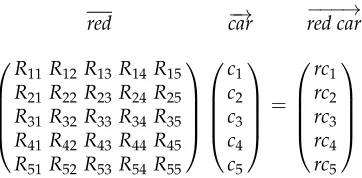
[image:15.486.55.236.61.150.2] c1 c2 c3 c4 c5 = rc1 rc2 rc3 rc4 rc5 Figure 2
Matrix mulitiplication for adjective–noun combinations.
an instance of the Categorial framework (and also an instance of the general framework described in Baroni, Bernardi, and Zamparelli [2014]). The insight in B&Z is that, in theoretical linguistics, adjectives are typically thought of as having a functional role, mapping noun denotations to noun denotations. B&Z make the transition to vector spaces by arguing that, in linear algebra, functions are represented as matrices (the linear maps). This insight provides an obvious answer to the question of what the com-position operator should be in this framework, namely, matrix multiplication. Figure 2 shows how the context vector forcaris multiplied by the matrix forredto produce the vector forred car. In this simple example, the noun space containing−car→=(c1,. . .,c5)T
and−−−→red car=(rc1,. . .,rc5)Thas five basis vectors, which means that a 5×5 matrix,red,
is required for the adjective.
The second contribution of B&Z is to propose a method for learning theredmatrix from supervised training data. What should the gold-standard representation for−−−→red car be? B&Z argue that, given large enough corpora, it should ideally be the context vector for the compoundred car; in other words, the vector forred carshould be built in exactly the same way as the vector for car. These context vectors for phrases are generally known as holistic vectors. The reason for the adjective matrix is that it allows the generalization of adjective–noun combinations beyond those seen in the training data. The details of the B&Z training process will not be covered in this section, but briefly, the process is to find all examples of adjective–noun pairs in a large training corpus, and then use standard linear regression techniques to obtain matrices for each adjective in the training data. These learned matrices can then be used to generalize beyond the seen adjective–noun pairs. So if tasty artichoke, for example, has not been seen in the training data (or perhaps seen infrequently), the prediction for the con-text vector −−−−−−−−−→tasty artichoke can be obtained, as long as there are enough examples of tasty X in the data to obtain the tastymatrix (via linear regression), and enough oc-currences ofartichoketo obtain the−−−−−→artichokevector.
Testing is performed by using held-out context vectors for some of the adjective– noun pairs in the data, and seeing how close—according to the cosine measure—the predicted context vector is to the actual context vector for each adjective–noun pair in the test set. The learning method using linear regression was compared against various methods of combining the context vectors of the adjective and noun, such as vector addition and elementwise multiplication, and was found to perform significantly better at this prediction task.
which was also the grammar formalism used by Montague (1970). The original papers setting out the tensor-based compositional framework (Clark, Coecke, and Sadrzadeh 2008; Coecke, Sadrzadeh, and Clark 2010) used pregroup categorial grammars (Lambek 2008), largely because they share an abstract mathematical structure with vector spaces. However, other forms of categorial grammar can be used equally as well in practice, and here we use Combinatory Categorial Grammar (CCG; Steedman 2000), which has been shown to fit seamlessly with the tensor-based semantic framework (Grefenstette 2013; Maillard, Clark, and Grefenstette 2014). With a computational linguistics audience in mind, we also present the framework entirely in terms of multi-linear algebra, rather than the category theory of the original papers.
A matrix is a second-order tensor; for example, the redmatrix mentioned earlier lives in the N⊗N space, meaning that two indices—each corresponding to a basis vector in the noun space N—are needed to specify an entry in the matrix.7 Noting that N⊗Nis structurally similar to the CCG syntactic type for an adjective (N/N)— both specify functions from nouns to nouns—a recipe for translating a syntactic type into a semantic type suggests itself: Replace all slash operators in the syntactic type with tensor product operators. With this translation, the combinators used by CCG to combine syntactic categories carry over seamlessly to the meaning spaces, maintaining what is often described as CCG’s “transparent interface” between syntax and semantics. The seamless integration with CCG arises from the (somewhat trivial) observation that tensors are linear maps—a particular kind of function—and hence can be manipulated using CCG’s combinatory rules.
Here are some example syntactic types, and the corresponding tensor spaces in which words with those types are semantically represented (using the notationsyntactic type : semantic type). We first assume that all atomic types have meanings living in distinct vector spaces:8
r
noun phrases,NP:Nr
sentences,S:SReplacing each slash in a complex syntactic type with a tensor product operator results in the following meaning spaces, following the CCG result-leftmost convention for both the syntactic and semantic types:
r
Intransitive verb,S\NP:S⊗Nr
Transitive verb, (S\NP)/NP:S⊗N⊗Nr
Ditransitive verb, ((S\NP)/NP)/NP:S⊗N⊗N⊗Nr
Adverbial modifier, (S\NP)\(S\NP) :S⊗N⊗S⊗Nr
Preposition modifyingNP, (NP\NP)/NP:N⊗N⊗N7 The tensor productV⊗Wof two vector spacesV∈RnandW∈Rmis annm-dimensional space spanned by elements of the form−→v ⊗ −→w; that is, pairs of basis vectors ofVandW. An elementa∈V⊗Wcan be written asP
aij−→vi⊗ −→wjwhereaijis a scalar.
Hence the meaning of an intransitive verb, for example, is a particular matrix, or second-order tensor, in the tensor product spaceS⊗N. The meaning of a transitive verb is a “cuboid,” or third-order tensor, in the tensor product spaceS⊗N⊗N. In the same way that the syntactic type of an intransitive verb can be thought of as a function— taking anNPand returning anS—the meaning of an intransitive verb is also a function (linear map)—taking a vector inNand returning a vector in S. Another way to think of this function is that each element of the matrix specifies, for a pair of basis vectors (one fromNand one fromS), how a value on the givenNbasis vector contributes to the result for the givenSbasis vector.
In order to see how the tensors combine with their arguments, consider the follow-ing CCG derivation involvfollow-ing an intransitive verb, with the correspondfollow-ing semantic type under its syntactic type:
Basil sleeps NP S\NP N S⊗N
<
S S
(10)
Let the meaning of Basilbe −−→Basil∈N and sleeps be sleeps∈S⊗N; then applying the sleepsoperator (matrix) to its argument −−→Basilis an example of the more general ten-sor contraction operation from multi-linear algebra. We refer readers to Maillard, Clark, and Grefenstette (2014) for details of how the additional combinators of CCG— such as forward and backward composition, backward-crossed composition, and type-raising—naturally apply to the tensor-based semantic representations, and how tensor contraction applies in this more general setting.
4.2.3 Existing Implementations of the Categorial Framework.There are a few existing imple-mentations of the Categorial framework, focusing mostly on adjectives and transitive verbs. The adjective implementation is that of B&Z as described in Section 4.2.1, where linear regression is used to learn each adjective as a mapping from noun contexts to adjective–noun contexts, with the observed context vectors for the noun and adjective– noun instances as training data. Because an adjective–noun combination has noun phrase meaning, the noun space is the obvious choice for the space in which the composed meanings should live. Maillard and Clark (2015) extend this idea by showing how the skip-gram model of Mikolov, Yih, and Zweig (2013) can be adapted to learn adjective matrices as part of a neural embedding objective.
For verb–argument composition, the question of sentence spaces arises.9 A transi-tive verb such aschaselives inS⊗N⊗N, and can therefore be represented as
X
ijk
Cijk(−→si ⊗ −→nj ⊗ −→nk) (11)
for some choice of coefficientsCijk. Grefenstette et al. (2011) choose S=N⊗N, using the tensor product of the noun space with itself as the sentence space. Their concrete implementation learns the verb by counting observed n(s),n(o)pairs where n(s) is the subject andn(o)the object ofV. The final representation forVis then
V=
NV X
i=1
−→
n(is)⊗ −→
ni(o) (12)
whereNVis the number of instances ofVin the corpus, and (n(is),n
(o)
i ) are the subject and object nouns for the ith instance of V. This method of learning the verb tensor is known as therelationalmethod, because it captures relations between subject and object features. Composition with a particular subject and object reduces to taking the tensor product of the subject and object, and performing elementwise multiplication with the verb matrix, yielding a sentence meaning inN⊗N. Sentence meanings can be compared with one another by taking the cosine of their angle in sentence space. One problem with this approach is that sentences with transitive verbs live in a different space than sentences with intransitive verbs, so sentences with different grammatical structures cannot be directly compared.
Kartsaklis, Sadrzadeh, and Pulman (2012) introduce another sentence space, by settingS=N. To achieve this, while training the verb in the same way as the relational method, they embed theN⊗Ntensor intoN⊗N⊗N space, by copying the subject or object slices of the original tensor; for example, in the copy-object method the repre-sentation forVis
V=
NV X
i=1
−→
ni(s)⊗ −→
ni(o)⊗ −→
n(io) (13)
Representing sentence meaning in the noun space confers the advantage that words, phrases, and sentences of any grammatical structure can be compared with one another, but it is an open question whether the features in the noun space, whether distributional or not, are appropriate or adequate for representing sentence meaning.
An alternative way of learning the transitive verb tensor parameters is presented in Grefenstette et al. (2013), using a process analogous to B&Z’s process for learning adjectives. Two linear regression steps are performed. In the first step, a matrix is learned representing verb–object phrases, that is, a verb that has already been paired with its object. For example, the matrix foreat meatis learned as a mapping from corpus instances such asdogsanddogs eat meat. The full tensor foreatis then learned withmeat as input and theeat meatmatrix as output. Essentially, the subject mapping is learned in the first step, and the object mapping in the second.
examples for a given verb have frequency-matched random nouns substituted in the argument positions. One tensor investigated has dimensions K×K×S, where K is the number of noun dimensions and S has two dimensions, each ranging from 0 to 1. The parameters of the tensor are learned so that when combined with a subject and object, a plausibility judgment is produced. Polajnar, Rimell, and Clark (2015) investigate a distributional sentence space based on the wider discourse context, in which the meaning of a sentence is represented as a distributional vector based on context words in the surrounding discourse, making the sentence space completely distinct from the noun space.10
Existing implementations of the Categorial framework have investigated learning up to third-order tensors (for transitive verbs). However, in practice, syntactic categories such as ((N/N)/(N/N))/((N/N)/(N/N)) are not uncommon in the wide-coverage CCG grammar of Hockenmaier and Steedman (2007); such a category would require an eighth-order tensor. The combination of many word–category pairs and higher-order tensors results in a huge number of parameters to be learned in any implementation. As a solution to this problem, various ways of reducing the number of parameters are being investigated, for example, using tensor decomposition techniques (Kolda and Bader 2009; Fried, Polajnar, and Clark 2015), and removing some of the interactions encoded in the tensor by using only matrices to encode each predicate–argument combination (Paperno, Pham, and Baroni 2014; Polajnar, Fagarasan, and Clark 2014).
For this article, the problem of large numbers of parameters arises in the modeling of the relative pronoun, because its CCG type is (NP\NP)/(S\NP) for subject relative clauses or (NP\NP)/(S/NP) for object relative clauses, resulting in a fourth-order tensor, N⊗N⊗S⊗N. Given the limited amount of training data available (see Section 5.5.1), we do not attempt to model the full tensor, but investigate two approximations, based on the methods of Paperno, Pham, and Baroni (2014). First, by modeling the transitive verb with two matrices—one for the subject interaction and the other for the object—we are able to model the verb as a pair of matrices with semantic typeS⊗N. This approx-imation is described in Section 5.2.2, and allows us to reduce the relative pronoun to a third-order tensor,N⊗N⊗S(Section 5.5.1). Second, we apply the same “decoupling” approximation to the relative pronoun, in order to represent the relative pronoun as a pair of matrices (Section 5.5.4), which can be learned independently of one another.
4.3 Relative Clause Composition
Two approaches to modeling relative clauses have been proposed in the compositional distributional semantics literature, both within the Categorial framework, although neither one has received a large-scale implementation. Both approaches are based on the fact that the relative clause (interpreted strictly, without the head noun) is a noun mod-ifier, so the relative pronoun must map the meaning of the composed verb–argument phrase to a modifier of the head noun. In set theoretic terms, the relative pronoun signals the intersection between the set of individuals denoted by the head noun, and those denoted by the verb–argument phrase. For example, inaccuracy: quality that correction improves, accuracy is both a quality and a thing that is improved by correction.
Clark, Coecke, and Sadrzadeh (2013) and Sadrzadeh, Clark, and Coecke (2013) propose an interpretation of relative clauses based on Frobenius algebra. The transitive verb is represented by a third-order tensor that combines with its argument by tensor
contraction. The relative pronoun introduces a Frobenius operator that “discards” the third dimension of the verb tensor, allowing information to flow from the composed verb and argument to the head noun. In practice, this operator allows the verb to be represented as a matrix. The relative clause therefore takes the form of a vector, which is then composed with the head noun (−→n) by elementwise multiplication:11
−→
n (V−→o) (subject relative clause, with verb V and objecto) (14) −
→
n (VT−→s ) (object relative clause, with verb V and subjects) (15)
This method corresponds to an intuition that elementwise multiplication represents intersection, emphasizing those features that are shared by the head noun and the composed verb–argument phrase. As described in Section 2, this method has been tested on a toy data set by Sadrzadeh, Clark, and Coecke (2013), using relational verb matrices; we test it onRELPRONin this article.
Baroni, Bernardi, and Zamparelli (2014) propose a method for learning a relative pronoun as a fourth-order tensor that maps verb–argument phrases to noun modifiers. The proposed method would use multi-step linear regression to learn: (1) in the first step, verb–argument matrices, such as a chase cats matrix from training data such as hdogs, dogs chase catsi; (2) in the second step, noun modifier matrices, such as athat chase catsmatrix from training data such as hanimal, animal that chases catsi; and (3) in the third step, a tensor for the relative pronounthat, using the matrices from steps 1 and 2 with matched predicates. The final tensor would thus be learned from paired matrices such aschases cats, that chases cats. Under this approach, the intersective semantics of the relative pronoun must be captured within the tensor. Although the necessary training data might be relatively sparse, particularly for holistic relative clause vectors, Baroni, Bernardi, and Zamparelli (2014) hypothesize that they are sufficiently common to learn a general representation for the relative pronoun. We test a similar approach in this article, using holistic relative clause vectors to learn a tensor representing the relative pronoun (Section 5.5.1), though with single-step linear regression and a simplification of the verb representation that allows the tensor to be third- rather than fourth-order. We also learn a variant that represents the relative pronoun as a pair of matrices (Section 5.5.4) and requires learning fewer parameters.
4.4 Historical Perspective
The general question of how to combine vector-based meaning representations in a compositional framework is a relatively new question for computational linguistics, but one that has been actively researched in cognitive science since the 1980s. The question arose because of the perceived failure of distributed models in general, and connection-ist models in particular, to provide a suitable account of compositionality in language (Fodor and Pylyshyn 1988). The question is also relevant to the broad enterprise of
artificial intelligence (AI) in that connectionist or distributed representations may seem to be in opposition to the more traditional symbolic systems often used in AI.
Smolensky argues for the tensor product as the operation that binds a predicate to an argument in the distributed meaning space (Smolensky 1990; Smolensky and Legendre 2006). Smolensky represents a structure as possessing a set ofroles,ri, which, for a particular instance of the structure, also has a set offillers,fi (the roles arebound to fillers). The vector representation of a role–filler pair is obtained using the tensor product, and the representation for a complete structure,s, of role–filler pairs is the sum of the tensor products for each pair:
s=X i
fi⊗ri (16)
A dependency tree, for example, is naturally represented this way, with the roles being predicates paired with grammatical relations, such asobject of eat, and the fillers being heads of arguments, such ashotdog. The vector representation of eat hotdog is −−−→
hotdog⊗−−−−→eat dobj. The vector representation of a whole dependency tree is the sum of the tensor products over all the dependency edges in the tree.
Smolensky and Legendre (2006) argue at length for why the tensor product is appro-priate for combining connectionist and symbolic structures. A number of other propos-als for realizing symbolic structures in vector representations are described, including Plate (2000) and Pollack (1990). Smolensky’s claim is that, despite perhaps appearances to the contrary, all are special cases of a generalized tensor product representation.
Clark and Pulman (2007) suggest that a similar scheme to Smolensky’s could be applied to parse trees for NLP applications, perhaps with the use of a convolution kernel (Haussler 1999) to calculate similarity between two parse trees with distributed representations at each node. A similar idea has been fleshed out in Zanzotto, Ferrone, and Baroni (2015), showing how kernel functions can be defined for a variety of compo-sition operations (including most of the operations discussed in this article), allowing the similarity between two parse trees to be computed based on the distributional representations at the leaves and the composed representations on the internal nodes.
There are similarities between Smolensky’s approach and the Categorial frame-work from Section 4.2, in that tensor representations are central to both. However, in Smolensky’s approach, the tensor product is the operation used for composition of the predicate and its argument, whereas tensor contraction is the composition operation in the Categorial framework.
5. Composition Methods: Implementation
This section provides a more detailed description of the methods we have tested on RELPRON, ranging from some trivial lexical baselines, through to the simple arithmetic operators, and finally more sophisticated methods based on the Categorial framework. Both count-based vectors and neural embeddings have been investigated.
5.1 Word Vectors
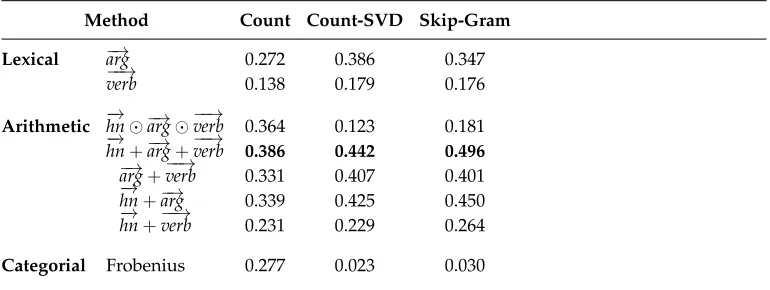
5.1.1 Count-Based Vectors (Count).For historical completeness we include classical count-based vectors in this article, although these large vectors are impractical for more sophisticated tensor learning. These vectors are used only for the baseline results (Section 6, Table 5), including the Frobenius algebra composition method of Sadrzadeh, Clark, and Coecke (2013).
Count-based word vectors were built from a 2013 download of Wikipedia, using the settings from Grefenstette and Sadrzadeh (2011). The top 2,000 words in the corpus (excluding stopwords) were used as features, with a co-occurrence window of three content words on either side of the target word (i.e., with stopwords removed before applying the window), and co-occurrence counts weighted as the probability of a context word given the target word divided by the overall probability of the context word (Mitchell and Lapata 2008). We found that these settings achieved the best result on the transitive verb composition task of Grefenstette and Sadrzadeh (2011).
5.1.2 Reduced Count-Based Vectors (Count-SVD).As a variant on the classical count-based vectors, we also present baseline results (Section 6, Table 5) on a count-based space reduced with Singular Value Decomposition (SVD), which produces dense vectors more comparable to neural embeddings.
Word vectors were built from the same 2013 Wikipedia download, using the settings of Polajnar, Fagarasan, and Clark (2014). The top 10,000 words in the corpus (excluding stopwords) were used as features, with sentence boundaries defining the co-occurrence window, and co-occurrence counts weighted with the t-test statistic (Curran 2004). SVD was used to reduce the number of dimensions to 300. Following Polajnar and Clark (2014), context selection (with n=140) and row normalization were performed prior to SVD.
5.1.3 Neural Embeddings (Skip-Gram).Our main results in Section 6 are produced using neural embeddings. These types of vectors have proven useful for a wide variety of tasks in recent literature, and in our early experiments with tensor, learning provided the best results on theRELPRONdevelopment data and other composition tasks. For our methods, in addition to the word vectors, we required holistic vectors to use as targets for training the verb and relative pronoun matrices and tensors. The holistic vectors were also obtained using neural embeddings.
Word vectors were built using a re-implementation of skip-gram with negative sampling (Mikolov et al. 2013) on a lemmatized 2015 download of Wikpedia. We used a window of ten words on either side of the target, with ten negative samples per word occurrence, and 100-dimensional target and context vectors. All lemmas occurring fewer than 100 times in the corpus were ignored.12The context vectors produced during word vector learning were retained for use during training of the holistic vectors for phrases.
Verb matrices and relative pronoun matrices and tensors require holistic vectors to serve as training targets for linear regression. These vectors represent the observed contexts in which instances of verbs or relative pronouns with their arguments are found in the Wikipedia corpus. We tagged and parsed the corpus with the Stanford Parser (Chen and Manning 2014). For learning of verb matrices, we extracted verb– subject and verb–object pairs, ensuring that each pair occurred within a transitive verb
construction. For learning of relative pronoun matrices and tensors, we extractedhhead noun, verb, argumenti tuples that occurred within relative clause constructions. To identify relative clauses, we looked for characteristic dependency subtrees containing the Stanford Universal Dependency labels RELCL and PRONTYPE=REL. The gram-matical role of the relative pronoun argument of the verb, and of the verb’s in situ argument, determined whether it was a subject or object relative clause. We used a small number of manually defined heuristics to help limit the results to true relative clauses, for example, to exclude cases of clausal complementation on the verb, as inan incident that left one government embarrassed.
The contexts of our extracted verb–argument pairs and relative clause tuples were used to train holistic vectors using our implementation of skip-gram, only retaining phrases that occurred at least twice in the corpus. For holistic vectors, we followed Paperno, Pham, and Baroni (2014) and used a wider window of 15 words on either side of the target. Skip-gram has a random component in the initialization of vectors. In order to ensure that the learned holistic and word vectors were in the same vector space, we trained both using the same context vectors.
5.2 Verb Matrices
In this section we describe two methods used for constructing verb matrices for the composition methods based on the Categorial framework.
5.2.1 Relational Verb Matrices.Using the relational method of Grefenstette and Sadrzadeh (2011), as described in Section 4.2.3, verb matrices were built as a sum of outer products of their subject–object pairs. Pairs were subject to a minimum per-verb count of 2 and a minimum frequency of 100 for both nouns in the 2013 Wikipedia download, and not weighted by frequency.
5.2.2 Decoupled Verb Matrices with Linear Regression.All of the Categorial methods require a representation for the transitive verb in the relative clause. Based on the CCG category (S\NP)/NP of a transitive verb, this is a third-order tensor, S⊗N⊗N. The relative pronoun has a CCG type of (NP\NP)/(S\NP) or (NP\NP)/(S/NP), resulting in a fourth-order tensor,N⊗N⊗S⊗N. In order to make the learning of a relative pronoun tensor tractable, we make use of the method introduced by Paperno, Pham, and Baroni (2014) and Polajnar, Fagarasan, and Clark (2014) in order to reduce the semantic type of the transitive verb to S⊗N. This method models a transitive verb as two second-order tensors (matrices), one governing the interaction of the verb with its subject and the other with its object, and has been shown to reproduce sentence semantics without loss of accuracy. This “decoupling” approximation for the transitive verb allows the relative pronoun to be modeled as a third-order tensor,N⊗N⊗S.
Specifically, we adopt the approach of Paperno, Pham, and Baroni (2014). For each verbVwe learn a pair of matricesVS,VO. These matrices are used by Paperno, Pham,
and Baroni to calculate the vector for an SVO triple (s,V,o) as in Equation (17), which also gives a lexicalized example.
We also adopt the modification of Gupta, Utt, and Pad ´o (2015), in which the word vector for the verb is not added to the composition result, because this formulation was found to yield more accurate results. With this modification, we calculate the vector for an SVO triple (s,V,o) as in Equation (18).
VS−→s +VO−→o ex. eatS−cat→+eatO−−−−→mouse (18)
Verb matrices were learned using L2 ridge regression (Hoerl and Kennard 1970),
also known as L2-regularized regression. For a given verb V, the training data for
VS consisted of (subject vector, holistic subject–verb vector) pairs, and the training
data forVO consisted of (object vector, holistic verb–object vector) pairs. In addition,
each pair was weighted by the logarithm of its number of occurrences in the corpus, which we found improved performance on theRELPRONdevelopment set. Regression was implemented in Python using standard NumPy operations, and we optimized the regularization parameter on theRELPRONdevelopment set, using MAP scores and the SPLF composition method described in Section 5.5.3. A single regularization parameter was used globally for all verbs and set to 75 after tuning.
5.3 Simple Composition Methods
In this section we describe our relative clause composition methods. We first present the baseline methods, consisting of lexical comparisons, simple arithmetic operators, and the Frobenius algebra method of Clark, Coecke, and Sadrzadeh (2013) and Sadrzadeh, Clark, and Coecke (2013). We then introduce our main methods, all of which, like the Frobenius algebra method, are based on the Categorial framework, but which differ according to whether and how the relative pronoun is modeled. All of our main methods are implemented using neural embedding vectors.
5.3.1 Lexical Baselines. Two simple lexical similarity baselines (Lexical) set the vector representation of the property equal to the verb vector or the argument vector. No composition is involved. These baselines check whether a system can predict the simi-larity between, for example,travelerandperson that hotel servesby the similarity between travelerandhotel(argument) ortravelerandserve(verb). We do not have a lexical baseline consisting of the head noun, because this would not produce a well-defined ranking of properties, given that many properties share the same head noun (person in this example).
5.3.2 Arithmetic Operators.Arithmetic composition methods (Arithmetic) are the vector addition and elementwise vector product (Mitchell and Lapata 2008, 2010) of the vectors for the three lexical items in the property: head noun, verb, and argument. For vector addition, we also perform ablation to determine the contribution of each lexical item. The relative pronoun itself is not modeled in the composed representation for the arithmetic operators. Although the arithmetic operators are simple, vector addition has proven a difficult baseline to beat in many composition tasks.
5.4 Frobenius Algebra Baseline
framework for relative clauses, and was described in detail in Section 4.3. The composi-tion of the relative clause vector is shown in Equacomposi-tions (19)–(20), for subject and object relative clauses, respectively, whererepresents elementwise multiplication; note that unlike the other Categorial methods, there is a single verb matrix, which is learned as a relational matrix.
− →
n (V−→o) ex. −−−−→device(detect−planet)−−−→ (subject) (19) −→
n (VT−→s) ex. −−−−→device(playT−−−−−−→shepherd) (object) (20)
5.5 Composition Methods within the Categorial Framework
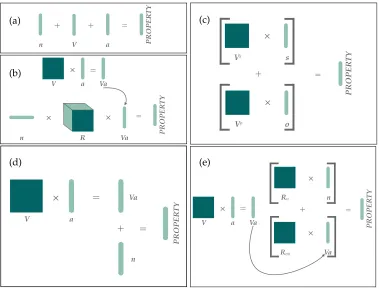
In the next sections we describe the main composition methods evaluated in this article. These methods are based on the Categorial framework, as is the Frobenius algebra base-line; however, the methods described here are all implemented with Skip-Gram vectors, and matrices and tensors learned by linear regression. Figure 3 gives a schematic view of these composition methods.
5.5.1 Tensor Composition Method (RPTensor).TheRPTensormethod models the relative pronoun as a third-order tensor R. Learning a relative pronoun tensor from holistic
[image:25.486.54.433.325.620.2]+ + V a n = PR OPE R T Y × × V a × Va R n = Va = PR OPE R T Y (a) (b) o s
×
×
+
Vs Vo = PR OPE R T Y (c)×
V a Va n+
=
=
PR OPE R T Y (d) × V a Va n × × Rn Rva + = Va = PR OPE R T Y (e) Figure 3vectors for relative clauses was suggested by Baroni, Bernardi, and Zamparelli (2014), but to our knowledge this is the first implementation of a function word tensor. We learn two separate tensors RS and RO for subject and object relative clauses, respectively,
because we assume that the relative pronoun may have a different semantics in each case.
The relative pronoun tensors have the type N⊗N⊗S, and combine via tensor contraction with the head noun vector and the vector resulting from verb–argument composition. Here and in subsequent sections, −→n is the head noun vector, and−→a is the argument vector, which may be the object (in a subject relative clause) or the subject (in an object relative clause). The composition of the relative clause vector is shown in Equations (21)–(22), for subject and object relative clauses, respectively.
−→
n RS(VO−→a) ex. −−−−→device thatS(detectO−planet)−−−→ (subject) (21) −→
n RO(VS−→a) ex. −−−−→device thatO(playS−−−−−−→shepherd) (object) (22)
Note that the appropriate verb matrix, subject or object, is first contracted with its argument, so that the relative pronoun is composing the head noun with the verb– argument phrase (a vector).
As with the verb matrices, the relative pronoun tensors RS and RO are learned
by weightedL2 ridge regression, where the training data consist of (head noun vector,
holistic verb–argument vector, holistic relative clause vector) tuples. The regularization parameter was optimized on theRELPRONdevelopment set using MAP scores and set to 80 for both tensors.
The power of the tensor comes from the fact that it captures the interaction between the head noun and the composed verb–argument phrase, and hence models the relative pronoun in a meaningful way that composition methods such as vector addition, which omits the pronoun entirely, do not. However, capturing these interactions leads to a large number of parameters, and the sparsity of training data is therefore a challenge in training the full tensor model. Our corpus of 72M sentences contained only around 800K occurrences of relative clauses, compared with over 80M verb–subject and verb– object occurrences (4M types); and this was heavily unbalanced across subject and object relative clauses, with 771K subject relative clause occurrences (222K types) compared with 21K object relative clause occurrences (only 8K types).