Descriptions with Contextually
Appropriate Intonation
Michael White
∗ The Ohio State UniversityRobert A. J. Clark
∗∗ University of EdinburghJohanna D. Moore
† University of EdinburghGenerating responses that take user preferences into account requires adaptation at all levels of the generation process. This article describes a multi-level approach to presenting user-tailored information in spoken dialogues which brings together for the first time multi-attribute decision models, strategic content planning, surface realization that incorporates prosody prediction, and unit selection synthesis that takes the resulting prosodic structure into account. The system selects the most important options to mention and the attributes that are most relevant to choosing between them, based on the user model. Multiple options are selected when each offers a compelling trade-off. To convey these trade-offs, the system employs a novel presentation strategy which straightforwardly lends itself to the determination of information structure, as well as the contents of referring expressions. During surface realization, the prosodic structure is derived from the information structure using Combinatory Categorial Grammar in a way that allows phrase boundaries to be determined in a flexible, data-driven fashion. This approach to choosing pitch accents and edge tones is shown to yield prosodic structures with significantly higher acceptability than baseline prosody prediction models in an expert evaluation. These prosodic structures are then shown to enable perceptibly more natural synthesis using a unit selection voice that aims to produce the target tunes, in comparison to two baseline synthetic voices. An expert evaluation and f0 analysis confirm the superiority of the generator-driven intonation and its contribution to listeners’ ratings.
1. Introduction
In an evaluation of nine spoken dialogue information systems, developed as part of the DARPA Communicator program, the information presentation phase of the dialogues
∗1712 Neil Ave., Columbus, OH 43210, USA. Web:http://www.ling.ohio-state.edu/~mwhite/. ∗∗10 Crichton Street, Edinburgh, Scotland EH8 1AB, UK. Web:
http://www.cstr.ed.ac.uk/ssi/people/robert.html.
†10 Crichton Street, Edinburgh, Scotland EH8 1AB, UK. Web:http://www.hcrc.ed.ac.uk/~jmoore/.
Figure 1
Typical information presentation phase of a Communicator dialogue.
was found to be the primary contributor to dialogue duration (Walker, Passonneau, and Boland 2001). During this phase, the typical system sequentially presents the set of options that match the user’s constraints, as shown in Figure 1. The user can then navi-gate through these options and refine them by offering new constraints. When multiple options are returned, this process can be exacting, leading to reduced user satisfaction.
As Walker et al. (2004) observe, having to access the set of available options sequen-tially makes it hard for the user to remember information relevant to making a decision. To reduce user memory load, we need alternative strategies for sequential presentation. In particular, we require better algorithms for:
1. selecting the most relevant subset of options to mention, as well as the attributes that are most relevant to choosing among them; and
2. determining how to organize and express the descriptions of the selected options and attributes, in ways that are both easy to understand and memorable.1
In this article, we describe how we have addressed these points in the FLIGHTS2 system, reviewing and extending the description given in Moore et al. (2004). FLIGHTS follows previous work (Carberry, Chu-Carroll, and Elzer 1999; Carenini and Moore 2000; Walker et al. 2002) in applying decision-theoretic models of user preferences to the generation of tailored descriptions of the most relevant available options. Multi-attribute decision theory provides a detailed account of how models of user preferences can be used in decision making (Edwards and Barron 1994). Such preference models have been shown to enable systems to present information in ways that are concise and
1 An issue we do not address in this article is whether a multimodal system would be more effective than a voice-only one. We believe that these needs, and in particular the need to express information with contextually appropriate prosody, are also highly relevant for multimodal systems. We also note that there is still strong demand for voice-oriented systems for eyes-busy use and for the blind.
tailored to the user’s interests (Carenini and Moore 2001; Walker et al. 2004; Carenini and Moore 2006). Decision-theoretic models have also been commercially deployed in Web systems.3
To present multiple options, we introduce a novel strategy where the best option (with respect to the user model) is presented first, followed by the most compelling remaining options, in terms of trade-offs between attributes that are important to the user. (Multiple options are selected only when each offers a compelling trade-off.) An important property of this strategy is that it naturally lends itself to the determination of information structure, as well as the contents of referring expressions. Thus, to help make the trade-offs among the selected options clear to the user, FLIGHTS (1) groups attributes that are positively and negatively valued for the user, (2) chooses referring ex-pressions that highlight the salient distinguishing attributes, (3) determines information structure and prosodic structure that express contrasts intelligibly, and (4) synthesizes utterances with a unit selection voice that takes the prosodic structure into account. As such, FLIGHTS goes beyond previous systems in adapting its output according to user preferences at all levels of the generation process, not just at the levels of content selection and text planning.
Our approach to generating contextually appropriate intonation follows Prevost (1995) and Steedman (2000a) in using Combinatory Categorial Grammar (CCG) to convey the information structure of sentences via pitch accents and edge tones. To adapt Prevost and Steedman’s approach to FLIGHTS, we operationalize the information structural notion of theme to correspond to implicit questions that necessarily arise in presenting the trade-offs among options. We also refine the way in which prosodic structure is derived from information structure by allowing for a more flexible, one-to-many mapping between themes or rhemes and intonational phrases, where the final choice of the type and placement of edge tones is determined byn-gram models. To investigate the impact of information structural grammatical constraints in our hybrid rule-based, data-driven approach, we compare realizer outputs with those of baseline n-gram models, and show that the realizer yields target prosodic structures with signif-icantly higher acceptability than the baseline models in an expert evaluation.
The prosodic structure derived during surface realization is passed as prosodic markup to the speech synthesizer. The synthesizer uses this prosodic markup in the text analysis phase of synthesis in place of the structures that it would otherwise have to predict from the text. The synthesizer then uses the context provided by the markup to enforce the selection of suitable units from the database. To verify that the prosodic markup yields improvements in the quality of synthetic speech, we present an exper-iment which shows that listeners perceive a unit selection voice that aims to produce the target prosodic structures as significantly more natural than either of two baseline unit selection voices that do not use the markup. We also present an expert evaluation and f0 analysis which confirm the superiority of the generator-driven intonation and its contribution to listeners’ ratings.
The remainder of this article is structured as follows. Section 2 presents our ap-proach to natural language generation (NLG) in the information presentation phase of a FLIGHTS dialogue, including how multi-attribute decision models are used in content selection; how rhetorical and information structure are determined during dis-course planning; how lexical choice and referring expressions are handled in sentence planning; how prosodic structures are derived in surface realization; and how these
Figure 2
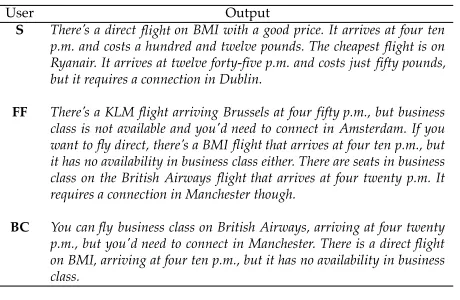
Tailored descriptions of the available flights for three different user models.
prosodic structures compare to those predicted by baselinen-gram models in an expert evaluation. Section 3 describes how the prosodic structures are used in the unit selection voice employed in the present study, and compares this voice to the baseline ones used in our perception experiment. Section 4 provides the methods and results of the perception experiment itself, along with the expert prosody evaluation and f0 analysis. Section 5 compares our approach to related work. Finally, Section 6 concludes with a summary and discussion of remaining issues.
2. NLG in FLIGHTS
2.1 Tailoring Flight Descriptions
To illustrate how decision-theoretic models of user preferences can be used to tailor descriptions of the available options at many points in the generation process, let us consider the following three hypothetical users of the FLIGHTS system:
Student (S) A student who cares most about price, all else being equal.
Frequent Flyer (FF) A business traveler who prefers business class, but cares most about building up frequent-flyer miles on KLM.
Business Class (BC) Another business traveler who prefers KLM, but wants, above all, to travel in business class.
Suppose that each user is interested in flying from Edinburgh to Brussels on a certain day, and would like to arrive by five o’clock in the afternoon. FLIGHTS begins the dialogue by gathering the details necessary to query the database for possible flights. Next, it uses the preferences encoded in the user model to select the highest ranked flight for each user, as well as those flights that offer interesting trade-offs. These flights are then described to the user, as shown in Figure 2.4
For the student (S), the BMI flight is rated most highly, because it is a fairly in-expensive, direct flight that arrives near the desired time. The Ryanair flight is also
mentioned as a possibility, as it has the best price; it ends up ranked lower overall than the BMI flight though, because it requires a connection and arrives well in advance of the desired arrival time. For the KLM frequent flyer (FF), life is a bit more complicated: A KLM flight with a good arrival time is offered as the top choice, even though it is a connecting flight with no availability in business class. As alternatives, the direct flight on BMI (with no business class availability) and the British Airways flight with seats available in business class (but requiring a connection) are described. Finally, for the must-have-business-class traveler (BC), the British Airways flight with business class available is presented first, despite its requiring a connection; the direct flight on BMI is offered as another possibility.
Although user preferences have an immediately apparent impact on content se-lection and ordering, they also have more subtle effects on many aspects of how the selected content is organized and expressed, as explained subsequently.
Referring expressions: Rather than always referring to the available flights in the same way, flights of interest are instead described using the attributes most relevant to the user: for example,direct flight,cheapest flight,KLM flight.
Aggregation: For conciseness, multiple attributes may be given in a single sentence, subject to the constraint that attributes whose values are positive (or negative) for the user should be kept together. For example, inThere’s a KLM flight arriving Brussels at four fifty p.m., but business class is not available and you’d need to connect in Amsterdam, the values of the attributesairlineandarrival-timeare considered good, and thus are grouped together to contrast with the values of the attributes
fare-classandnumber-of-legs, which are considered bad.
Scalar terms: Scalar modifiers likegood, as ingood price, andjust, as injust fifty pounds, are chosen to characterize an attribute’s value to the user relative to values of the same attribute for other options.
Discourse cues: Attributes with negative values for the user are acknowledged using discourse cues, such asbutandthough. Interesting trade-offs can also be signaled using cues such asif-conditionals.
Information structure and prosody: Compelling trade-offs are always indicated via prosodic phrasing and emphasis, as in(There AREseats in business class)theme (on the British Airways flight)rheme (that arrives at four twenty p.m.)rheme, where the di-vision of the sentence into theme and rheme phrases is shown informally using parentheses, and contrastive emphasis (onARE) is shown using small caps. (See Section 2.6.2 for details of how emphasis and phrasing are realized by pitch accents and edge tones.)
2.2 Architecture
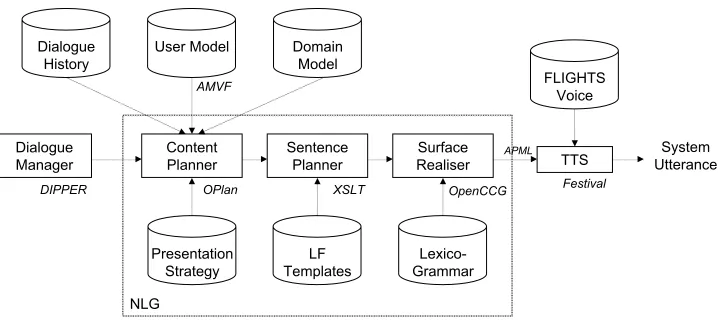
The architecture of the FLIGHTS generator appears in Figure 3. OAA (Martin, Cheyer, and Moran 1999) serves as a communications hub, with the following agents responsi-ble for specific tasks: DIPPER (Bos et al. 2003) for dialogue management; a Java agent that implements an additive multi-attribute value function (AMVF), a decision-theoretic model of the user’s preferences (Carenini and Moore 2000, 2006), for user modeling; OPlan (Currie and Tate 1991) for content planning; Xalan XSLT5and OpenCCG (White
Figure 3
FLIGHTS generation architecture.
2004, 2006a, 2006b) for sentence planning and surface realization; and Festival (Taylor, Black, and Caley 1998) for speech synthesis. The user modeling, content planning, sen-tence planning, and surface realization agents are described in the ensuing subsections. FLIGHTS follows a typical pipeline architecture (Reiter and Dale 2000) for NLG. The NLG subsystem takes as input an abstract communicative goal from the dialogue manager. In the information presentation phase of the dialogue, this goal is to describe the available flights that best meet the user’s constraints and preferences. Given a communicative goal, the content planner selects and arranges the information to convey by applying the plan operators that implement its presentation strategy. In so doing, it makes use of three further knowledge sources: the user model, the domain model, and the dialogue history. Next, the content plan is sent to the sentence planner, which uses XSLT templates to perform aggregation, lexicalization, and referring expression generation. The output of sentence planning is a sequence of logical forms (LFs). The use of LF templates represents a practical and flexible way to deal with the interaction of decisions made at the sentence planning level, and further blurs the traditional distinction between template-based and “real” NLG that van Deemter, Krahmer, and Theune (2005) have called into question. Each LF is realized as a sentence using a CCG lexico-grammar (Steedman 2000a, 2000b). Note that in contrast to the generation archi-tectures of, for example, Pan, McKeown, and Hirschberg (2002) and Walker, Rambow, and Rogati (2002), the prosodic structure of the sentence is determined as an integral part of surface realization, rather than in a separate prosody prediction component. The prosodic structure is passed to the Festival speech synthesizer using Affective Presentation Markup Language (de Carolis et al. 2004; Steedman 2004), or APML, an XML markup language for the annotation of affect, information structure, and prosody. Festival uses the Tones and Break Indices (Silverman et al. 1992), or ToBI,6 pitch accents and edge tones—specified as APML annotations—in determining utterance phrasing and intonation, and employs a custom synthetic voice to produce the system utterances.
2.3 User Modeling
FLIGHTS uses an additive multi-attribute value function (AMVF) to represent the user’s preferences, as in the GEA real estate recommendation system (Carenini and Moore 2000, 2006) and the MATCH restaurant recommendation system (Walker et al. 2004). Decision-theoretic models of this kind are based on the notion that, if anything is valued, it is valued for multiple reasons, where the relative importance of different reasons may vary among users.
The first step is to identify good flights for a particular origin, destination, and arrival or departure time. The following attributes contribute to this objective: arrival-time,departure-time,number-of-legs,total-travel-time,price, airline, fare-class, and layover-airport. As in MATCH, these attributes are arranged into a one-level tree.
The second step is to define a value function for each attribute. A value function maps from the features of a flight to a number between 0 and 1, representing the value of that flight for that attribute, where 0 is the worst and 1 is the best. For example, the function for total-travel-time computes the difference in minutes between the flight’s arrival and departure times, and then multiplies the result by a scaling factor to obtain an evaluation between 0 and 1. The functions for theairline,layover-airport, andfare-classattributes make use of user-specified preferred or dispreferred values for that attribute. In the current version of these functions, a preferred value is given a score of 0.8, a dispreferred value 0.2, and all other values 0.5.7
The structure and weights of the user model represent a user’sdispositionalbiases about flight selection.Situationalfeatures are incorporated in two ways. The requested origin and destination are used as a filter when selecting the set of available options by querying the database. In contrast, the requested arrival or departure time—if specified—is used in the corresponding attribute’s evaluation function to give a higher score to flights that are closer to the specified time. If an arrival or departure time is not specified, the corresponding attribute is disabled in the user model.
As in previous work, the overall evaluation of an option is computed as the weighted sum of its evaluation on each attribute. That is, iff represents the option being evaluated,Nis the total number of attributes, andwiandviare, respectively, the weight and the value for attributei, then the evaluationv(f) of optionf is computed as follows:
v(f)=
N
i=1
wivi(f)
To create a user model for a specific user, two types of information are required. The user must rank the attributes in order of importance, and he or she must also specify any preferred or dispreferred attribute values for theairline,layover-airport, and
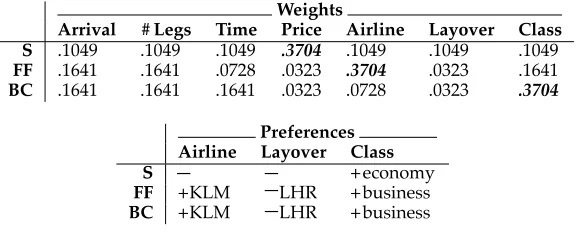
fare-classattributes. In FLIGHTS, we also allow users to specify a partial ordering of the rankings, so that several attributes can be given equal importance when registering to use the system. Figure 4 shows the user models for the student (S), frequent-flyer (FF), and business-class (BC) users discussed earlier; because no departure time is specified in the sample query,departure-timeis not included in these examples.
Figure 4
Sample user models.
Based on the user’s ranking of the attributes, weights are assigned to each attribute. As in previous work, we use Rank Order Centroid (ROC) weights (Edwards and Barron 1994). This allows weights to be assigned based on rankings, guaranteeing that the sum will be 1. ThenthROC weightwRn ofNtotal weights is computed as follows:
wRn = 1
N N
i=n 1
i
We extend these initial weights to the partial-ordering case as follows. If attributes i. . .jall have the same ranking, then the weight of each will be the mean of the relevant ROC weights; that is,
( j
k=i
wRk)/(j−i+1)
As a concrete example, if there is a single highest-ranked attribute followed by a three-way tie for second, thenw1=wR1, andw2=w3 =w4 = 13(w
R
2 +w
R
3 +w
R
4).
2.4 Content Planning
Figure 5
Algorithm for selecting the options to describe.
preferences in order for it to do its job of helping to identify good flights for the user to consider.8 A similar observation underlies thecandidate/critiquemodel of Linden, Hanks, and Lesh’s (1997) Web-based system.
Selecting the Options to Describe. In determining whether an option is worth mention-ing, we make use of two measures. Firstly, we use thez-score of each option; this mea-sures how far the evaluationv(f) of an optionf is from the mean evaluation. Formally, it is defined using the mean (µV) and standard deviation (σV) of all evaluations, as follows:
z(f)=(v(f)−µV)/σV
We also make use of thecompellingnessmeasure described by Carenini and Moore (2000, 2006), who provide a formal definition. Informally, the compellingness of an attribute measures its strength in contributing to the overall difference between the evaluation of two options, all other things being equal. For options f,g, and threshold valuekc, we define the setcomp(f,g,kc) as the set of attributes that have a higher score forf than forg, and for which the compellingness is abovekc.
The setSelof options to describe is constructed as follows. First, we include the top-ranked option. Next, for all of the other options whosez-score is above a thresholdkz, we check whether there is an attribute of that option that offers a compelling trade-off over the already selected options; if so, we add that option to the set.9This algorithm is presented in Figure 5.
For the BC user model, for example, this algorithm proceeds as follows. First, it selects the top-ranked flight: a connecting flight on British Airways with availability in business class. The next-highest-ranked flight is a morning flight, which does not have any attributes that are compellingly better than those of the top choice, and is therefore skipped. However, the third option presents an interesting trade-off: even though business class is not available, it is a direct flight, so it is also included. None of the other options above the threshold present any interesting trade-offs, so only those two flights are included.
8 Of course, if the user model could be relied upon to contain perfect information, the system could always just recommend a single best flight; however, because we do not expect our models to capture a user’s preferences perfectly, we have designed the system to let the user weigh the alternatives when there appear to be interesting trade-offs among the available options.
The selected flights for the other sample user models show similar trade-offs, as mentioned in the discussion of Figure 2. For FF, the selected flights are a connecting, economy-class flight on the preferred airline; a direct, economy-class flight on a neutral airline; and a connecting, business-class flight on a neutral airline. For S, the top choices are a reasonably cheap direct flight that arrives near the desired time, and an even cheaper, connecting flight that arrives much earlier in the day.
Selecting the Attributes to Include. When selecting the attributes to include in the de-scription, we make use of an additional measure, s-compellingness. Informally, the s-compellingness of an attribute represents the contribution of that attribute to the evaluation of a single option; again, the formal definition is given by Carenini and Moore (2000, 2006). Note that an attribute may be s-compelling in either a positive or a negative way. For an optionf and thresholdkc, we define the sets-comp(f,kc) as the set of attributes whose s-compellingness forf is greater thankc.
The setAttsof attributes is constructed in two steps. First, we add the most com-pelling attributes of the top choice. Next, we add all attributes that represent a trade-off between any two of the selected options; that is, attributes that are compellingly better for one option than for another. The algorithm appears in Figure 6.
For the BC user model, the s-compelling attributes of the top choice are arrival-time andfare-class; the latter is also a compelling advantage of this flight over the second option. The advantage of the second option over the first is that it is direct, so
number-of-legsis also included. A similar process on the other user models results inprice,arrival-time, andnumber-of-legsbeing selected for S, andarrival-time,
fare-class,airline, andnumber-of-legsfor FF.
2.4.2 Planning Texts with Information Structure.Based on the information returned by the content selection process, together with further information from the user model and the current dialogue context, the content planning agent develops a plan for presenting the available options. A distinguishing feature of the resulting content plans is that they contain specifications of theinformation structureof sentences (Steedman 2000a), including sentence theme (roughly, the topic the sentence addresses) and sentence rheme(roughly, the new contribution on a topic).
Steedman (2000a) characterizes the notions of theme and rheme more formally by stating that a theme presupposes a rheme alternative set, in the sense of Rooth (1992), while a rheme restricts this set. Because Steedman does not fully formalize the discourse update semantics of sentence themes, we have chosen to operationalize themes in FLIGHTS in one particular way, namely, as corresponding to implicit questions that arise in the context of describing the available options. Our reasoning is as follows. First, we note that a set of alternative answers corresponds formally to the meaning of a question. Next, we observe that whenever a flight option presents a compelling trade-off
Figure 6
for a particular attribute, it at least partially addresses the question of whether there are any flights that have a desirable value for that attribute; moreover, whenever a flight is presented that has a less-than-optimal value for an attribute, its mention implicitly raises the question of whether any flights are available with a better value for that attribute. Finally, we conclude that by specifying and realizing content as thematic, the system can help the user understand why a flight option is being presented, since the theme (by virtue of its presupposition) identifies what implicit question—that is, what trade-off—the option is addressing.
In all, the content planner’s presentation strategy performs the following functions:
r
marking the status of items asdefinite/indefiniteand predications as theme/rhemefor information structure;r
determiningcontrastbetween options and attributes, or between groups of options and attributes;r
groupingandorderingof similar options and attributes (e.g., presenting the top scoring option first vs. last);r
choosing the contents ofreferring expressions(e.g., referring to a particular option by airline); andr
decomposingstrategies into basic dialogue acts and hierarchically organized rhetorical speech acts.The presentation strategy is specified via a small set (about 40) of content planning operators. These operators present the selected flights as an ordered sequence of op-tions, starting with the best one. Each flight is suggested and then further described. As part of suggesting a flight, it is identified by its most compelling attribute, according to the user model. (Recall that any selected flight options beyond the highest ranked one must offer a compelling trade-off.) Flights are additionally identified by theirairline, which we deemed sufficiently significant to warrant special treatment (otherwise the strategy is domain-independent).
The information for the first flight is presented as all rheme, as no direct link is made to the preceding query. Each subsequent, alternative flight is presented with its most compelling attribute in the theme, and the remaining attributes in the rheme. For instance, consider the student example (S) in Figure 2. After presenting the BMI flight— which has a good price, is direct, and arrives near the desired time—the question arises whether there are any cheaper alternatives. Because the second option haspriceas its most compelling attribute—and given that it is the least expensive flight available—it is identified astheCHEAPEST flight, with this phrase forming the theme of the utterance. As another illustration, consider the business-class traveler example (BC) in Figure 2. After presenting the British Airways flight, which has availability in business class but is not direct, the question arises whether there are any direct flights available. The presentation of the second option addresses this implicit question, introducing the BMI flight with the theme phraseThere is aDIRECTflight.
Figure 7
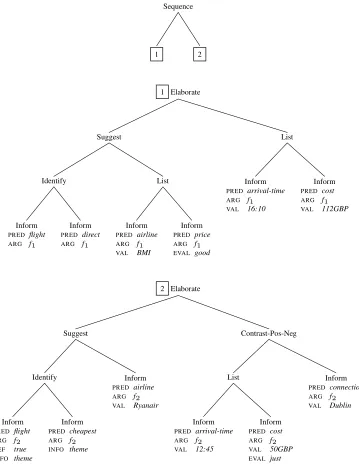
Content plan for student example (S).
(rheme marking is the default); the subgoal for the option type is also marked for definiteness (indefinite is the default), as thecheapestattribute uniquely identifies the flight. The remaining information for the second flight is presented in terms of a contrast between its positive and negative attributes, as determined by the user model.
Figure 8
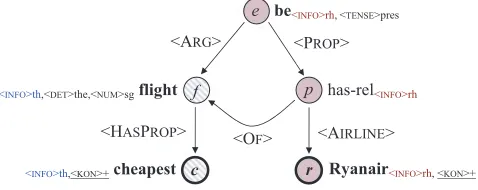
Semantic dependency graph produced by the sentence planner for(TheCHEAPESTflight)theme(is onRYANAIR)rheme.
related to Kruijff-Korbayov ´a et al.’s (2003) use of theme phrases to link utterances with questions under discussion (Ginzburg 1996; Roberts 1996) in an information-state based dialogue system. An interesting challenge that remains for future work is to determine to what extent our presentation strategy can be generalized to handle theme/rheme partitioning, both for explicit questions across turns as well for implicit questions within turns.
2.5 Sentence Planning
The sentence planning agent uses the Xalan XSLT processor to transform the output of the content planner into a sequence of LFs that can be realized by the OpenCCG agent. It is intended to be a relatively straightforward component, as the content planner has been designed to implement the most important high-level generation choices. Its pri-mary responsibility is to lexicalize the basic speech acts in the content plan—which may appear in referring expressions—along with the rhetorical speech acts that connect them together. When alternative lexicalizations are available, all possibilities are included in a packed structure (Foster and White 2004; White 2006a). The sentence planner is also responsible for adding discourse markers such as alsoandbut, adding pronouns, and choosing sentence boundaries. It additionally implements a small number of rhetorical restructuring operations for enhanced fluency.
The sentence planner makes use of approximately 50 XSLT templates to recursively transform content plans into logical forms. An example logical form that results from applying these templates to the content plan shown in Figure 7 appears in Figure 8 (with alternative lexicalizations suppressed). As described further in Section 2.6.1, the logical forms produced by the sentence planner are semantic dependency structures,10which make use of aninfofeature to encode theme/rheme partitioning, and akonfeature to implement Steedman’s (2006) notion ofkontrast(Vallduv´ı and Vilkuna 1998). Following Steedman, kontrast is assigned to the interpretations of words which contribute to distinguishing the theme or rheme of the utterance from other alternatives that the context makes available.
In order to trigger the inclusion of context-sensitive discourse markers such asalso andeither, the sentence planner compares theinformacts for consecutive flight options
to see whether acts with the same type have the same value.11 These same checks can also trigger de-accenting. For example, when two consecutive flights have no seats in business class, the second one can be described using the phraseit hasNO AVAILABILITY in business class either, wherebusiness classhas been de-accented.
The development of the XSLT templates was made considerably easier by the ability to invoke OpenCCG to parse a target sentence and then use the resulting logical form as the basis of a template. (See Section 3 for a description of how the target sentences in the FLIGHTS voice script were developed.) Using LF templates, rather than templates at the string level, makes it simpler to uniformly handle discourse markers such as alsoandeither, which have different preferred positions within a clause, depending in part on which verb they modify. LF templates also simplify the treatment of subject– verb agreement. Additionally, by employing LF templates with a single theme/rheme partition, it becomes possible to underspecify whether the theme and rheme will be realized by one intonational phrase each or by multiple phrases (see Section 2.6.2). At the same time, certain aspects of the LF templates can be left alone, when there is no need for further analysis and generalization.
As noted earlier, the use of LF templates further blurs the traditional distinction between template-based and “real” NLG that van Deemter, Krahmer, and Theune (2005) have called into question. In the case of referring expressions especially, LF templates in FLIGHTS represent a practical and flexible way to deal with the interaction of decisions made at the sentence planning level, as the speech acts identifying flight options are considered together with the other basic and rhetorical speech acts in the applicability conditions for the templates that structure clauses. In this way, options can be identified not only in definite NPs, such asthe CHEAPESTflight, but also inthere-existentials and conditionals, such asthere is aDIRECTflight onBMIthat . . .orif you prefer to flyDIRECT, there’s aBMIflight that . . .. We may further observe that the traditional approach to gen-erating referring expressions (Reiter and Dale 2000), where a distinguishing description for an entity is constructed during sentence planning without regard to a user model, would not fit in our architecture, where the user model drives the selection of a referring expression’s content at the content planning level.
Although the use of LF templates in XSLT represents a practical approach to handling sentence planning tasks that were not the focus of our research, it is not one that promotes reuse, and thus it is worth noting which aspects of our sentence planner would pose challenges for a more declarative and general treatment. The bulk of the templates concern domain-specific lexicalization and are straightforward; given the way these were developed from the results of OpenCCG parsing, it is conceiv-able that this process could be largely automated from example input–output pairs. The templates for adding pronouns and discourse markers require more expertise but remain reasonably straightforward; the templates for rhetorical restructuring and choosing sentence boundaries, in contrast, are fairly intricate. In principle, satisfactory results might be obtained using a more general set of options for handling pronouns, discourse markers, and sentence boundaries, together with an overgenerate-and-rank methodology; we leave this possibility as a topic for future research.
2.6 Surface Realization
2.6.1 Chart Realization with OpenCCG.For surface realization, we use the OpenCCG open source realizer (White 2004, 2006a, 2006b). A distinguishing feature of OpenCCG is that
it implements a hybrid symbolic-statistical chart realization algorithm that combines (1) a theoretically grounded approach to syntax and semantic composition, with (2) the use of integrated language models for making choices among the options left open by the grammar. In so doing, it brings together the symbolic chart realization (Kay 1996; Shemtov 1997; Carroll et al. 1999; Moore 2002) and statistical realization (Knight and Hatzivassiloglou 1995; Langkilde 2000; Bangalore and Rambow 2000; Langkilde-Geary 2002; Oh and Rudnicky 2002; Ratnaparkhi 2002) traditions. Another recent approach to combining these traditions appears in Carroll and Oepen (2005), where parse selection techniques are incorporated into an HPSG realizer.
Like other realizers, the OpenCCG realizer is partially responsible for determining word order and inflection. For example, the realizer determines thatalsoshould prefer-ably follow the verb inThere is also a very cheap flight on Air France, whereas in other cases it typically precedes the verb, as inI also have a flight that leaves London at 3:45 p.m.It also enforces subject–verb agreement, for example, betweenisandflight, or betweenareand seats. Less typically, in FLIGHTS and in the COMIC12 system, the OpenCCG realizer additionally determines the prosodic structure, in terms of the type and placement of pitch accents and edge tones, based on the information structure of its input logical forms. Although OpenCCG’s algorithmic details have been described in the works cited above, details of how prosodic structure can be determined from information structure in OpenCCG appear for the first time in this article.
The grammars used in the FLIGHTS and COMIC systems have been manually written with the aim of achieving very high quality. However, to streamline grammar development, the grammar has been allowed to overgenerate in areas where rules are difficult to write and where n-gram models can be reliable; in particular, it does not sufficiently constrain modifier order, which in the case of adverb placement especially can lead to a large number of possible orderings. Additionally, it allows for a one-to-many mapping from themes or rhemes to edge tones, yielding one-to-many variants that differ only in boundary type or placement. As will be explained subsequently, we consider this more flexible, data-driven approach to phrasing to be better suited to the needs of generation than would be a more direct implementation of Steedman’s (2000a) theory, which would require all phrasing choices to be made at the sentence planning level.
We have built a language model for the system from the FLIGHTS speech corpus described in Section 3.1. To enhance generalization, named entities and scalar adjectives have been replaced with the names of their semantic classes (such as TIME, DATE, CITY, AIRLINE, etc.), as is often done in limited domain systems. Note that in the corpus and the model, pitch accents are treated as integral parts of words, whereas edge tones and punctuation marks appear as separate words. The language model is a 4-gram back-off model built with the SRI language modeling toolkit (Stolcke 2002), keeping all 1-counts and using Ristad’s (1995) natural discounting law for smoothing. OpenCCG has its own implementation for run-time scoring; in FLIGHTS, the model additionally incorporates an a/an-filter, which assigns a score of zero to sequences containing a followed by a vowel, oranfollowed by a consonant, subject to exceptions culled from bigram counts.
2.6.2 Deriving Prosody. CCG is a unification-based categorial framework that is both linguistically and computationally attractive. We provide here a brief overview of CCG; an extensive introduction appears in Steedman (2000b).
Figure 9
A simple CCG derivation.
Figure 10
A CCG derivation with non-standard constituents.
A grammar in CCG is defined almost entirely in terms of the entries in the lexicon, which are (possibly complex) categories bearing standard feature information (such as verb form, agreement, etc.) and subcategorization information. CCG has a small set of rules which can be used to combine categories in derivations. The two most basic rules are forward (>) and backward (<) function application. These rules are illustrated in Figure 9, which shows the derivation of a simple copular sentence (with no prosodic information).13In the figure, the noun and proper name receive atomic categories with labelsnandnp, respectively. The remaining words receive functional categories, such as
sdcl\np/(sadj\np) for the verbis; this category seeks a predicative adjective (sadj\np) to its right and annpto its left, and returns the categorysdcl, for a declarative sentence. Note thatdclandadjare values for theformfeature; other features, such as those for number and case, have been suppressed in the figure (as has the feature label,form).
CCG also employs further rules based on the composition (B), type raising (T), and substitution (S) combinators of combinatory logic. These rules add an element of associativity to the grammar, making possible multiple derivations with the same semantics. They are crucial for building the “non-standard” constituents that are the hallmark of categorial grammars, and which are essential for CCG’s handling of coor-dination, extraction, intonation, and other phenomena. For example, Figure 10 shows how the category for therecan be type-raised and composed with the category foris in order to derive the constituentthere is a direct flight(sdcl/(sadj\np)), which cuts across
the VP in traditional syntax. Because there is a direct flightcorresponds to the theme phrase, andon BMI to the rheme phrase, in the first clause of the second sentence in
[image:16.486.51.298.60.132.2]Figure 11
A derivation of theme and rheme phrases.
the business-class (BC) example in Figure 2, the derivation in Figure 10 also shows how CCG’s flexible notion of constituency allows the intonation structure and information structure to coincide, where the intonation coincides with surface structure, and the information structure is built compositionally from the constituent analysis.
In Steedman (2000a), theme and rheme tunes are characterized by distinct patterns of pitch accents and edge tones. The notation for pitch accents and edge tones is taken from Pierrehumbert (1980) and ToBI (Silverman et al. 1992). We have implemented a re-duced version of Steedman’s theory in OpenCCG, where theme tunes generally consist of one or more L+H* pitch accents followed by a L-H% compound edge tone at the end of the phrase,14 and rheme tunes consist of one or more H* pitch accents followed by a L- or L-L% boundary at phrase end. Additionally,yes/noquestions typically receive a H-H% final boundary, and L-H% boundaries are often used as continuation rises to mark the end of a non-final conjoined phrase.
The key implementation idea in Steedman’s (2000a) approach is to use features on the syntactic categories to enforce information structural phrasing constraints—that is, to ensure that the intonational phrases are consistent with the theme/rheme partition in the semantics. For example, ifthere is a direct flightcorresponds to the theme andon BMIthe rheme, then the syntactic features ensure that the intonation brackets the clause as(there is a direct flight) (on BMI), rather than(there) (is a direct flight on BMI) or(there is) (a direct flight on BMI), etc. To illustrate, Figure 11 shows, again from the parsing perspective, how theme and rheme phrases are derived in OpenCCG for the subject NP and VP of Figure 9, respectively. (To save space, pitch accents and edge tones will henceforth be written using subscripts and string elements, rather than appearing on a separate tonal tier.) In the figure, the category forcheapesthas theinfofeature on each
atomic category set to th(eme), andRyanair has itsinfo feature set torh(eme), due to the presence of the L+H* and H* accents, respectively. The remaining words have no accents, and thus their categories have a variable (M, forEME) as the value of theinfo
feature on each atomic category.15All the words also have a variable (O) as the value of theownerfeature, discussed subsequently, on each atomic category. As words combine into phrases, the info variables serve to propagate the theme or rheme status of a phrase; thus, the phrasethe cheapestL+H∗flighthas categorynpth,O, whereasis on RyanairH∗ ends up with categorysdcl,rh,O\nprh,O. Because these two phrases have incompatibleinfo
values, they cannot combine before being “promoted” to intonational phrases by their respective edge tones. In this way, the constraint that phrasing choices respect the theme/rheme partition is enforced.
The edge tones allow complete intermediate or intonational phrases to combine by changing the value of the info feature to phr(ase) in the result category.16 Note that the argument categories of the edge tones do not select for a particular value of the
info feature; instead, L-H% hassh$1 as its argument category, whereas L-L% hasss$1,
whereh(earer)ands(peaker)are the respective values of theownerfeature.17Combination with an edge tone unifies theownerfeatures throughout the phrase. In a prototypical theme phrase, the hearer is the owner, whereas in a rheme phrase, the speaker is the owner.
Like other compositional grammatical frameworks, CCG allows logical forms to be built in parallel with the derivational process. Traditionally, theλ-calculus has been used to express semantic interpretations, but OpenCCG instead makes use of a more flexible representational framework, Hybrid Logic Dependency Semantics (Baldridge and Kruijff 2002; Kruijff 2003), or HLDS. In HLDS, hybrid logic (Blackburn 2000) terms are used to describe semantic dependency graphs, such as the one seen earlier in Figure 8. As discussed in White (2006b), HLDS is well suited to the realization task, in that it enables an approach to semantic construction that ensures semantic monotonicity, simplifies equality tests, and avoids copying in coordinate constructions.
To illustrate, four lexical items from Figure 11 appear in Example (1). The three words are derived by a lexical rule which adds pitch accents and information structure features to the base forms. The format of the entries is lexeme category, where the category is itself a pair in the formatsyntax:logical form. The logical form is a conjunction of elementary predications (EPs), which come in three varieties: lexical predications, such as @Ebe; semantic features, such as @ETENSEpres; and dependency relations, such as @EARGX.
(1) a. cheapestL+H∗ nX,th,O/nX,th,O: @XHASPROPP∧@Pcheapest∧
@PINFOth∧@POWNERO∧@PKON+
b. RyanairH∗ npX,rh,O: @XRyanair∧
@XINFOrh∧@XOWNERO∧@XKON+
15 In practice, variables likeMare replaced with “fresh” variables (such asM 1) during lexical lookup, so that theMvariables are distinct for different words.
16 The $ variables range over a (possibly empty) stack of arguments, allowing the edge tones to employ a singles$1\s$1category to combine withs/(s\np),s\np, and so on. As indicated in the figure, the new
value of theinfofeature (phr) is automatically distributed throughout the arguments of the result category.
c. is sE,dcl,M,O\npX,M,O/(sP,adj,M,O\npX,M,O) : @Ebe∧ @ETENSEpres∧@EARGX∧@EPROPP∧ @EINFOM∧@EOWNERO∧@EKON–
d.L-H% sphr$1\sh$1
In these entries, the indices (or nominals, in hybrid logic terms) in the logical forms, such as X, P, and E, correspond to nodes in the semantic graph structure, and are linked to the syntactic categories via theindexfeature. Similarly, the syntactic features
info and owner have associatedINFO and OWNER features in the semantics. As discussed previously, in derivations the values of the info and owner features are propagated throughout an intonational phrase, which has the effect of propagating the values of theINFOandOWNERsemantic features to every node in the dependency graph corresponding to the phrase. In this way, a distributed representation of the theme/rheme partition is encoded, in a fashion reminiscent of Kruijff’s (2003) approach to representing topic–focus articulation using hybrid logic. By contrast, theKON fea-ture (cf. Section 2.5) is a purely local one, and thus appears only in the semantics. Note that because the edge tones do not add any elementary predications, one or more edge tones—and thus one or more intonational phrases—may be used to derive the same theme or rheme in the logical form.
To simplify the semantic representations the sentence planner must produce, Open-CCG includes default rules that (where applicable) propagate the value of theINFO feature to subtrees in the logical form, set theOWNERfeature to its prototypical value, and set the value of the KONfeature to false. When applied to the logical form for the semantic dependency graph in Figure 8, the rules yield the HLDS term in Exam-ple (2). After this logical form is flattened to a conjunction of EPs, lexical instantiation looks up relevant lexical entries, such as those in Example (1), and instantiates the variables to match those in the EPs. The chart-based search for complete realizations proceeds from these instantiated lexical entries.
(2) @e(be∧ TENSEpres∧ INFOrh∧ OWNERs∧ KON–∧
ARG(f∧flight)∧ DETthe∧ NUMsg∧ INFOth∧ OWNERh∧ KON–∧
HASPROP(c∧cheapest∧ INFOth∧ OWNERh∧ KON+))∧
PROP(p∧has-rel∧ INFOrh∧ OWNERs∧ KON–∧
OFf∧
AIRLINE(r∧Ryanair∧ INFOrh∧ OWNERs∧ KON+)))
Given our focus in FLIGHTS on using intonation to express contrasts intelligibly, we have chosen to employ hard constraints in the OpenCCG grammar on the choice of pitch accents and on the use of edge tones to separate theme and rheme phrases. However, the grammar only partially constrains the type of edge tone (as explained previously), and allows the theme and rheme to be expressed by one or more intona-tional phrases each; consequently, the final choice of the type and placement of edge tones is determined by the n-gram model. To illustrate, consider Example (3), which shows how the frequent flyer sentence seen in Figure 2 is divided into four intonational phrases. Other possibilities (among many) allowed by the grammar include leaving out the L-L% boundary betweenflightandarriving, which would yield a phrase that’s likely to be perceived as too long, or adding a L- or L-L% boundary between there’sand a, which would yield two unnecessarily short phrases.
To allow for this flexible mapping between themes and rhemes and one or more into-national phrases, we take advantage of our distributed approach to representing the theme/rheme partition, where edge tones mark the ends of intonational phrases with-out introducing their own elementary predications. As an alternative, we could have associated a theme or rheme predication with the edge tones, which would be more in line with Steedman’s (2000a) approach. However, doing so would make it necessary to include one such predication per phrase in the logical forms, thereby anticipating the desired number of output theme and rheme phrases in the realizer’s input. Given that the naturalness of intonational phrasing decisions can depend on surface features like phrase length, we consider the distributed approach to representing theme/rheme status to be better suited to the needs of generation.
2.7 Comparison to Baseline Prosody Prediction Models
As noted in Section 2.2, spoken language dialogue systems often include a separate prosody prediction component (Pan, McKeown, and Hirschberg 2002; Walker, Rambow, and Rogati 2002), rather than determining prosodic structure as an integral part of surface realization, as we do here. Although it is beyond the scope of this article to compare our approach to a full-blown, machine learning–based prosody prediction model, we do present in this section an expert evaluation that shows that our approach outperforms strong baselinen-gram models. In particular, we show that the informa-tion structural constraints in the grammar play an important role in producing target prosodic boundaries, and that these boundary choices are preferred to those made by ann-gram model in isolation.
According to Pan, McKeown, and Hirschberg (2002, page 472), word-basedn-gram models can be surpringly good: “The word itself also proves to be a good predictor for both accent and break index prediction. . . . Since the performance of this [word] model is the best among all the [single-feature] accent prediction models investigated, it seems to suggest that for a CTS [Concept-to-Speech] application created for a specific domain, features like word can be quite effective in prosody prediction.” Indeed, although their best accent prediction model exceeded the word-based one, the difference did not reach statistical significance (page 485). Additionally, word predictability, measured by the log probability of bigrams and trigrams, was found to significantly correlate with pitch accent decisions (pages 482–483), and contributed to their best machine-learned models for accent presence and boundary presence.18
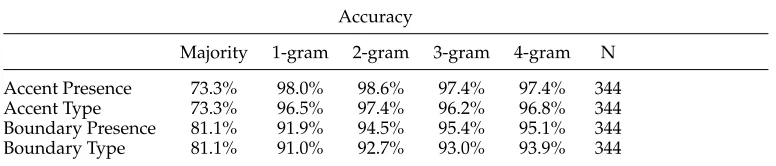
As baselinen-gram models, we trained 1- to 4-gram models for predicting accents and boundaries using the FLIGHTS speech corpus (Section 3.1), the same corpus used to train the realizer’s language model. The baselinen-gram models are factored language models (Bilmes and Kirchhoff 2003), with words, accents, and boundaries as factors. The accent models have accent as the child variable and 1–4 words as parent variables, starting with the current word, and including up to three previous words. The boundary models are analogous, with boundary as the child variable. With these models, each maximum likelihood prediction of pitch accent or edge tone is independent of all other choices, so there is no need to perform a best-path search. The majority baseline predicts no accent and no edge tone for each word.
Table 1
Baseline pitch accent and boundary prediction accuracy against target tunes.
Accuracy
Majority 1-gram 2-gram 3-gram 4-gram N
Accent Presence 73.3% 98.0% 98.6% 97.4% 97.4% 344
Accent Type 73.3% 96.5% 97.4% 96.2% 96.8% 344
Boundary Presence 81.1% 91.9% 94.5% 95.4% 95.1% 344
Boundary Type 81.1% 91.0% 92.7% 93.0% 93.9% 344
We tested the realizer and the baselinen-gram models on the 31 sentences used to synthesize the stimuli in the perception experiment described in Section 4 (see Figure 13 for an example mini-dialogue). None of the test sentences appear verbatim in the FLIGHTS speech corpus. The test sentences contain target prosodic structures intended to be appropriate for the discourse context. Given these structures, we can quantify the accuracy with which the realizer is able to reproduce the pitch accent and edge tone choices in the target sentences, and compare it to the accuracy with whichn-gram models predict these choices using maximum likelihood. Note that the target prosodic structures may not represent the only natural choices, motivating the need for the expert evaluation described further subsequently.
Although the realizer is capable of generating the target prosodic structure of each test sentence exactly, the test sentence (with its target prosody) is not always the top-ranked realization of the corresponding logical form, which may differ in word order or choice of function words. Thus, to compare the realizer’s choices against the target accents and boundaries, we generatedn-best lists of realizations that included the target realization, and compared this realization to others in the n-best list with the same words in the same order (ignoring pitch accents and edge tones). In each case, the target realization was ranked higher than all other realizations with the same word sequence, and so we may conclude that the realizer reproduces the target accent and boundary choices in the test sentences with 100% accuracy.
The accuracy with which the baselinen-gram models reproduce the target tunes is shown in Table 1. As the test sentences are very similar to those in the FLIGHTS speech corpus, the accent model performs remarkably well, with the bigram model reproducing the exact accent type (including no accent) in 97.4% of the cases, and agreeing on the choice of whether to accent the word at all in 98.6% of the cases. The boundary model also performs well, though substantially worse than the realizer, with the 4-gram model reproducing the boundary type (including no boundary) in 93.9% of the cases, and agreeing on boundary presence in 95.1% of the cases.19
Inspired by Marsi’s (2004) work on evaluating optionality in prosody prediction, we asked an expert ToBI annotator, who was unfamiliar with the experimental hypotheses under investigation, to indicate for each test sentence the range of contextually appro-priate tunes by providing all the pitch accents and edge tones that would be acceptable
Table 2
Examples comparing target tunes to baseline prosody prediction models, with expert corrections (Items 07-2 and 06-1).
(a) target the only directL+H∗flight L-H% leaves at 5:10H∗L-L% . edits none
n-grams the only directH∗flight leaves at 5:10H∗L-L% . edits the only directL+H∗flight L- leaves at 5:10H∗L-L% .
(b) target there ’s a directH∗flight on British AirwaysH∗with a goodH∗price L-L% . edits there ’s a directH∗flight on British AirwaysH∗L- with a goodH∗price L-L% . n-grams there ’s a directH∗flight on British AirwaysH∗L-L% with a goodL+H∗
price L-L% . edits none
for each word.20 However, our annotator found this task to be too difficult, in part because of the difficulty of coming up with all possible acceptable tunes, and in part because of dependencies between the choices made for each word. For this reason, we instead chose to follow the approach taken with the Human Translation Error Rate (HTER) post-edit metric in MT (Snover et al. 2006), and asked our annotator to indicate, for the target tune and then-gram baseline tune, which accents and boundaries would need to change in order to yield a tune appropriate for the context. For the n-gram baseline tune, we used the choices of the bigram accent model and the 4-gram boundary model.
Examples of how the target tunes (and realizer choices) compare to those of the baseline accent and boundary prediction models appear in Table 2, along with the corrections provided by our expert ToBI annotator.21 In Table 2(a), the target tune, which contains the theme phrasethe only directL+H∗flight L-H%, was considered fully acceptable. By contrast, with the tune of then-gram models, the H* accent ondirectwas not considered acceptable for the context, and at least a minor phrase boundary was considered necessary to delimit the theme phrase. In Table 2(b), we have an example where the target tune was not considered fully acceptable: Although the target consisted of a single, all-rheme intonational phrase, with no intermediate phrases, our annotator indicated that at least a minor phrase break was necessary after British Airways. The n-gram models assigned a major phrase break at this point, which was also considered acceptable. Note also that then-gram models had a L+H* accent ongood, in contrast to the target tune’s H*, but both choices were considered acceptable.
Table 3 shows the number of accent and boundary corrections for all 31 test sen-tences at different levels of specificity. Overall, there were just 10 accent or boundary corrections for the target tunes, versus 24 for those of the baseline models, out of 688 total accent and boundary choices, a significant difference (p = 0.01, Fisher’s Exact Test [FET], 1-tailed). With the accents, there were fewer corrections for the target tunes, but not many in either case, and the difference was not significant. Of course, with a
20 We thank one of the anonymous reviewers for this suggestion. Note that in Marsi’s study, having one annotator indicate optionality was found to be a reasonable approximation of deriving optionality from multiple annotations.
Table 3
Number of prosodic corrections of different types in all utterances and theme utterances for the target tunes and the ones selected byn-gram models. Items in bold are significantly different at p = 0.05 or less by a one-tailed Fisher’s Exact Test.
All Utts Theme Utts
Target n-grams Target n-grams
Total corrections 10 24 3 11
Accents 4 7 2 5
Presence 3 4 2 3
Boundaries 6 17 1 6
Presence 2 13 0 4
Major 0 9 0 3
larger sample size, or with test sentences that are less similar to those in the corpus, a significant difference could arise. With the boundaries, out of 344 choices, the target tunes had six corrections, only two of which involved the presence of a boundary, and none of which involved a missing major boundary; by contrast, the n-gram baseline had 17, 13, and 9 such corrections, respectively, a significant difference in each case (p = 0.02, p = 0.003, p = 0.002, respectively, FET). In the subset of 12 sentences involving theme phrases, where the intonation is more marked than in the all-rheme sentences, the target tunes again had significantly fewer corrections overall (3 vs. 11 corrections out of 220 total choices; p = 0.03, FET), and the difference in boundary and boundary presence corrections approached significance (p = 0.06 in each case, FET).
[image:23.486.51.438.616.664.2]Having shown that the information structural constraints in the grammar play an important role in producing target realizations with contextually appropriate prosodic structures—in particular, in making acceptable boundary choices, where the choice is not deterministically rule-governed—we now briefly demonstrate that the realizer’s n-gram model (see Section 2.6.1) has an important role to play as well. Table 4 compares the realizer’s output on the test sentences against its output with the language model disabled, in which case an arbitrary choice is effectively made among those outputs allowed by the grammar. Not surprisingly, given that the grammar has been allowed to overgenerate, the realizer produces far more exact matches and far higher BLEU (Papineni et al. 2001) scores with its language model than without. Looking at the dif-ferences between the realizer’s highest scoring outputs and the target realizations, the differences largely appear to represent cases of acceptable variation. The most frequent difference concerns whether an auxiliary or copular verb is contracted or not, where either choice seems reasonable. Most of the other differences represent minor variations in word order, such asdirectH∗Air FranceH∗flightvs.directH∗flight on Air FranceH∗. By
Table 4
Impact of language model on realizer choice.
Exact Match BLEU
Realizer 61.3% 0.9505
contrast, many of the outputs chosen with no language model scoring contain unde-sirable variation in word order or phrasing; for example: Air FranceH∗ directH∗ flight instead ofdirectH∗flight on Air FranceH∗, andyou L- though would need L- to connectH∗in AmsterdamH∗L-instead ofyou’d need to connectH∗in AmsterdamH∗though L-L%.
2.8 Interim Summary
In this section, we have introduced a presentation strategy for highlighting the most compelling trade-offs for the user that straightforwardly lends itself to the determina-tion of informadetermina-tion structure, which then drives the choice of prosodic structure during surface realization with CCG. We have also shown how phrase boundaries can be determined in a flexible, data-driven fashion, while respecting the constraints imposed by the grammar. An expert evaluation demonstrated that the approach yields prosodic structures with significantly higher acceptability than strongn-gram baseline prosody prediction models. In the next two sections, we show how the generator-driven prosody can be used to produce perceptibly more natural synthetic speech.
3. Unit Selection Synthesis with Prosodic Markup
In this section we describe the unit selection voices that we employed in our perception experiment (Section 4). Three voices in total were used in the evaluation: GEN, ALL, and APML. Each was a state-of-the-art unit selection voice using the FestivalMultisyn speech synthesis engine (Clark, Richmond, and King 2007). The GEN voice, used as a baseline, is a general-purpose unit selection voice. The ALL voice is a voice built using the same data as the GEN voice but with the addition of the data from the FLIGHTS speech corpus described in Section 3.1. The APML voice augments the in-domain data in the ALL voice with prosodic markup, which is then used at run-time by the synthesizer in conjunction with marked-up input to guide the selection of units.
To provide in-domain data for the ALL and APML voices, we needed to record a suitable data set from the original speaker used for the GEN voice. We describe the process of constructing this speech corpus for FLIGHTS next, in Section 3.1. Then, in Section 3.2, we describe the unit selection voices in detail, along with how the in-domain data was used in building them.
3.1 The FLIGHTS Speech Corpus
The FLIGHTS speech corpus was intended to have a version of each word that needs to be spoken by the system, recorded in the context in which it will be spoken. This context can be thought of as a three-word window centered around the given word, together with the word’s target pitch accent and edge tone, if any. This would theoretically provide more than sufficient speech data for a full limited domain voice, and a voice using this data would be guaranteed to have a unit sequence for any sentence generated by FLIGHTS where each individual unit is a tight context match for the target unit.
questions, confirmations, and other responses that the system makes. We then made use of an algorithm designed by Baker (2003) to iterate through the filler combinations for each utterance template to provide a suitable recording script.22
To illustrate, Example (4) shows an example utterance template, along with two utterances in the recording script created from this template. The example demonstrates that having multiple slots in a template makes it possible to reduce the number of sen-tences that need to be recorded to cover all possible combinations of fillers. With (b) and (c) recorded as illustrated to fill the template in (a), we would then have the recorded data to mix and match the slot fillers with two different values each to synthesize eight different sentences. It is also often possible to use the fillers for a slot in one utterance as the fillers for a slot in another utterance, if the phrase structure is sufficiently similar. A more complex case is shown in Example (5), involving adjacent slots. In this case, it is not sufficient to just record one example of each possible filler, as the context around that filler is changed by the presence of other slots; instead, combinations of fillers must be considered (Baker 2003).
(4) a. It arrives atTIMEH∗L-H% and costs justAMOUNTH∗L-L%, but it requires a connectionH∗inCITYH∗L-L%.
b. It arrives at sixH∗p.m.H∗L-H% and costs just fiftyH∗poundsH∗L-L%, but it requires a connectionH∗in ParisH∗L-L%.
c. It arrives at nineH∗a.m.H∗L-H% and costs just eightyH∗poundsH∗L-L%, but it requires a connectionH∗in PisaH∗L-L%.
(5) a. There areNUMH∗MODH∗flights L-L% fromCITYH∗toCITYH∗ today L-L%.
b. There are twoH∗earlierH∗flights L-L% from BordeauxH∗to AmsterdamH∗ today L-L%.
The recording script presented similar utterances in blocks. It made use of small caps to indicate intended word-level emphasis and punctuation to partially indicate desired phrasing, as the speaker was not familiar with ToBI annotation. The intended dialogue context for the utterances was discussed with our speaker, but the recordings did not consist of complete dialogues, as using complete dialogues would have been too time consuming. The recording took place during two afternoon sessions and yielded approximately two hours of recorded speech. The resulting speech database consisted of 1,237 utterances, the bulk of which was derived from the utterances that describe flight availability.
The recordings were automatically split into sentence-length utterances, each of which had a generated APML file with the pitch accents and edge tones predicted for the utterance. The prosodic structures were based on intuition, as there was no corpus of human–human dialogues sufficiently similar to what the system produces that could have been used to inform prosodic choice.
The recordings were then manually checked against the predicted APML, by listen-ing to the audio and looklisten-ing at the f0 contours to see if the pitch accents and edge tones matched the predicted ones. In the interest of consistency, changes were only