An Estimate of an Upper Bound for the
Entropy of English
Peter E Brown*
Vincent J. Della Pietra*
Robert L. Mercer*
IBM T.J. Watson Research Center
Stephen A. Della Pietra*
Jennifer C. Lai*
We present an estimate of an upper bound of 1.75 bits for the entropy of characters in printed English, obtained by constructing a word trigram model and then computing the cross-entropy between this model and a balanced sample of English text. We suggest the well-known and widely available Brown Corpus of printed English as a standard against which to measure progress in language modeling and offer our bound as the first of what we hope will be a series of steadily decreasing bounds.
1. Introduction
We present an estimate of an upper bound for the entropy of characters in printed English. The estimate is the cross-entropy of the 5.96 million character Brown Corpus (Kucera and Francis 1967) as measured by a word trigram language model that we constructed from 583 million words of training text. We obtain an upper bound of 1.75 bits per character.
Since Shannon's 1951 paper, there have been a number of estimates of the entropy of English. Cover and King (1978) list an extensive bibliography. Our approach differs from previous work in that
1. We use a much larger sample of English text; previous estimates were based on samples of at most a few hundred letters.
2. We use a language model to approximate the probabilities of character strings; previous estimates employed human subjects from whom probabilities were elicited through various clever experiments.
3. We predict all printable ASCII characters.
2. Method
Our estimate for the entropy bound is based upon the well-known fact that the cross- entropy of a stochastic process as measured by a model is an upper bound on the entropy of the process. In this section, we briefly review the relevant notions.
2.1 Entropy, Cross-Entropy, and Text Compression
Suppose X = {... X-2, X - l , Xo, X1, X2...} is a stationary stochastic process over a finite alphabet. Let P denote the probability distribution of X and let Ep denote expectations
with respect to P. The entropy of X is defined b y
H(X) =_ H(P) =_ -EplogP(Xo l X_I,X_2,...).
(1) If the base of the logarithm is 2, then the entropy is m e a s u r e d in bits. It can be s h o w n thatH(P)
can also be expressed asH(P)
= l i m - E p l o g P ( X o [ X - 1 , X - 2 , . . . , X _ n ) = l i m - 1 E p l o g P ( X 1 X 2 . . . X n ) . (2)If the process is ergodic, then the Shannon-McMillan-Breiman theorem (Algoet a n d Cover 1988) states that almost surely
H(P)
= lim - 1 logP(X1X2... Xn).
(3)n---* cx~ y/
Thus, for an ergodic process, an estimate of
H(P)
can be obtained from a k n o w l e d g e of P on a sufficiently long sample d r a w n r a n d o m l y according to P.W h e n P is not k n o w n , an u p p e r b o u n d to
H(P)
can still be obtained from an approximation to P. Suppose that the stationary stochastic process M is a model for P. The cross-entropy of P as m e a s u r e d b y M is defined b yH(P,M) =-- -Ep logM(Xo l X_I,X_2,...).
(4) U n d e r suitable regularity conditions, it can be s h o w n thatH(P,M)
= l i m - E p l o g M ( X o l X _ I , X _ E , . . . , X _ n ) = l i m - 1 - E p l o g M ( X 1 X 2 . . . X n ) .n'--+ CX~ n " - * DO n
(s)
If P is ergodic, then it can be s h o w n that almost surely for PH(P,
M) = lim - 1logM(XIX2... Xn).
(6)n ---+ o o n
The cross-entropy
H(P, M)
is relevant to us since it is an u p p e r b o u n d on the entropyH(P).
That is, for a n y m o d e l M,H(P) < H(P,M).
(7)The difference between
H(P, M)
a n dH(P)
is a measure of the inaccuracy of the m o d e l M. More accurate models yield better u p p e r b o u n d s on the entropy. Combining Equa- tions (6) a n d (7) we see that almost surely for P,H(P) <
lim - 1 logM(X1X2... Xn).
(8)n---*OO n
Entropy a n d cross-entropy can be u n d e r s t o o d from the perspective of text com- pression. It is well k n o w n that for a n y uniquely decodable coding scheme (Cover a n d Thomas 1991),
Ep I(XIX2... Xn) ~ -Ep
loge(XlX2...
Xn) , (9) whereI(X1X2...Xn)
is the n u m b e r of bits in the encoding of the stringX1X2...Xn.
Combining Equations (2) a n d (9), we see that
H(P)
is a lower b o u n d on the average n u m b e r of bits per symbol required to encode a long string of text d r a w n from P:H(P) <__
lira1Ep I(X1X2...Xn).
(10)Brown et al. An Estimate of an Upper Bound for the Entropy of English
On the other hand, an arithmetic coding scheme (Bell, Cleary, and Witten 1990) using model M will encode the sequence
xlx2... Xn
inIM(XlX2... Xn) = r -- logM(XlX2... Xn) + 11
(11)
bits, where [r] denotes the smallest integer not less than r. Combining Equations (7) and (11) we see that
H(P,M)
is the number of bits per symbol achieved by using model M to encode a long string of text drawn from P:H(P,M)
= limllM(X1X2...Xn).
(12)n---*oo n
2.2 The Entropy Bound
We view printed English as a stochastic process over the alphabet of 95 printable ASCII characters. This alphabet includes, for example, all uppercase and lowercase letters, all digits, the blank, all punctuation characters, etc. Using Equation (8) we can estimate an upper bound on the entropy of characters in English as follows:
1. Construct a
language model M
over finite strings of characters.2. Collect a reasonably long
test sample
of English text.3. Then
H(English) <_ __1 log M(test sample),
n
(13)
where n is the number of characters in the sample.
We emphasize that for this paradigm to be reasonable, the language model M must be constructed
without knowledge of the test sample.
Without this proscription, one might, for example, construct a model that assigns probability one to the test sample and zero to any other character string of the same length. Even quite subtle use of knowledge of the test sample can have a profound effect on the cross-entropy. For example, the cross-entropy would be noticeably lower had we restricted ourselves to characters that appear in the test sample rather than to all printable ASCII characters, and would be lower still had we used the actual vocabulary of the test sample. But these values could not be trumpeted as upper bounds to the entropy of English since Equation (13) would no longer be valid.3. The Language M o d e l
In this section, we describe our language model. The model is very simple: it captures the structure of English only through token trigram frequencies. Roughly speaking, the model estimates the probability of a character sequence by dissecting the sequence into tokens and spaces and computing the probability of the corresponding token sequence. The situation is slightly more complicated than this since, for a fixed token vocabulary, some character sequences will not have any such dissection while others will have several. For example, the sequence
abc xyz
might not have any dissection while the sequencebedrock
might be dissected as one token or as two tokens without an intervening space.dissections by considering the token sequences to be hidden. The model generates a sequence of characters in four steps:
1. It generates a hidden string of
tokens
using a token trigram model. 2. It generates aspelling
for each token.3. It generates a
case
for each spelling.4. It generates a
spacing
string to separate cased spellings from one another.The final character string consists of the cased spellings separated by the spacing strings.
The probability of the character string is a sum over all of its dissections of the joint probability of the string and the dissection:
M(character~tring) = ~
M(character~string, dissection).
(14)dissections
The joint probability of the string and a dissection is a product of four factors:
M ( character_string, dissection) =
Mtoken (tokens) Mspetl (spellings I tokens) Mease (cased_spellings [ spellings, tokens)
Mspace( character_string I cased_spellings, spellings, tokens).
(15)3.1 The Token Trigram Model
The token trigram model is a second-order Markov model that generates a token string tit2.., tn by generating each token
ti,
in turn, given the two previous tokensti-1
and ti-2. Thus the probability of a string isn
Mtoken(tlt2... tn)= Mtoken(tlt2) I-I Mtoken(ti ] ti-2ti-1)
i=3
(16)
The conditional probabilities Mtoken(t 3 [
tit2)
are modeled as a weighted average of four estimatorsfi
Mtoken(t3 ] tlt2) = &3(tlt2)f3(t31tlt2)q-.~2(tlt2)f2(t3 I t 2 ) q - ~ l ( t l t 2 ) f l ( t 3 ) q - / ~ O ( t l t 2 ) f o , (17)
where the weights ,~i satisfy ~ ),i = 1 and /~i ~ 0.
Brown et al. An Estimate of an Upper Bound for the Entropy of English
frequency in the held-out segment. Similarly, when c(tlt2) is small, but c(t2) is large, we expect/k3(tlt2) to be close to 0 and &2(tit2) to be close to 1.
The token vocabulary consists of
1. 293,181 spellings, including a separate entry for each punctuation character;
2. a special unknown_token that accounts for all other spellings;
3. a special sentenced;oundary_token that separates sentences.
3.2 The Spelling Model
The spelling model generates a spelling $1s2... Sk given a token. For any token other than the unknown_token and sentence_boundary_token, the model generates the spelling of the token. For the sentence_boundary_token, the model generates the null string. Finally, for the unknown_token, the model generates a character string by first choosing a length k according to a Poisson distribution, and then choosing k characters independently and uniformly from the printable ASCII characters. Thus
Mspell(SlS2...
Sk [ unknown_token) = ~. )~k e -.~-k e ,(18)
where & is the average number of characters per token in the training text, 4.1, and 1/p is the number of printable ASCII characters, 95.
3.3 The Case Model
The case model generates a cased spelling given a token, the spelling of the token, and the previous token. For the unknown_token and sentence_boundary_token, this cased spelling is the same as the spelling. For all other tokens, the cased spelling is obtained by modifying the uncased spelling to conform with one of the eight possible patterns
L + U + UL + ULUL + ULLUL + UUL + UUUL + LUL +
Here U denotes an uppercase letter, L a lowercase letter, U + a sequence of one or more uppercase letters, and L + a sequence of one or more lowercase letters. The case pattern only affects the 52 uppercase and lowercase letters.
The case pattern C for a token t is generated by a model of the form:
Mcase(C [ t,b) = / ~ 2 ( t ) f ( C I t , b) + / ~ l ( t ) f ( C I b) + ,~0(t). (19)
Here b is a bit that is 1 if the previous token is the sentence_boundary_token and is 0 otherwise. We use b to model capitalization at the beginning of sentences.
3.4 The Spacing Model
a good job of predicting the null spacing that precedes many punctuation marks. For strings of blanks, the number of blanks is determined by a Poisson distribution.
3.5 The Entropy Bound
According to the paradigm of Section 2.2 (see Equation (13)), we can estimate an upper bound on the entropy of characters in English by calculating the language model probability
M(character_string)
of a long string of English text. For a very long string it is impractical to calculate this probability exactly, since it involves a sum over the different hidden dissections of the string. However, for any particular dis- sectionM(character-string) > M(character-string, dissection).
Moreover, for our model, a straightforward partition of a character string into tokens usually yields a dissection for which this inequality is approximately an equality. Thus we settle for the slightly less sharp boundH(English) <_ __1 log M(character_string, dissection)
n (20)
where
dissection
is provided by a simple finite state tokenizer. By Equation (15), the joint probabilityM(characterstring, dissection)
is the product of four factors. Consequently, the upper bound estimate (20) is the sum of four entropies,H(English) < Htoken(character-string) + Hspell(character-string)
+ Hcase (character_string)
+ Hspacing
(character-string).
(21)4. The Data
4.1 The Test Sample
We used as a test sample the Brown Corpus of English text (Kucera and Francis 1967). This well-known corpus was designed to represent a wide range of styles and varieties of prose. It consists of samples from 500 documents, each of which first appeared in print in 1961. Each sample is about 2,000 tokens long, yielding a total of 1,014,312 tokens (according to the tokenization scheme used in reference [Kucera and Francis 1967]).
We used the Form C version of the Brown Corpus. Although in this version only proper names are capitalized, we modified the text by capitalizing the first letter of every sentence. We also discarded paragraph and segment delimiters.
4.2 The Training Data
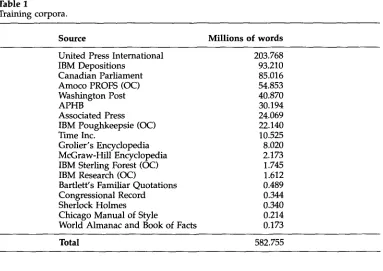
We estimated the parameters of our language model from a training text of 583 million tokens drawn from 18 different sources. We emphasize that this training text
does not
include the test sample.
The sources of training text are listed in Table 1 and include text from:1.
.
several newspaper and news magazine sources: the Associated Press; the United Press International (UPI); the
Washington Post;
and a collection of magazines published by Time Incorporated;Brown et al. An Estimate of an Upper Bound for the Entropy of English
Table 1
Training corpora.
Source M i l l i o n s of words
United Press International 203.768
IBM Depositions 93.210
Canadian Parliament 85.016
Amoco PROFS (OC) 54.853
Washington Post 40.870
APHB 30.194
Associated Press 24.069
IBM Poughkeepsie (OC) 22.140
Time Inc. 10.525
Grolier's Encyclopedia 8.020
McGraw-Hill Encyclopedia 2.173
IBM Sterling Forest (OC) 1.745
IBM Research (OC) 1.612
Bartlett's Familiar Quotations 0.489
Congressional Record 0.344
Sherlock Holmes 0.340
Chicago Manual of Style 0.214
World Almanac and Book of Facts 0.173
Total 582.755
3. two literary sources: a collection of novels a n d m a g a z i n e articles f r o m the A m e r i c a n Printing H o u s e for the Blind (APHB) and a collection of Sherlock H o l m e s novels a n d short stories;
4. several legal a n d legislative sources: the 1973-1986 proceedings of the C a n a d i a n parliament; a sample issue of the Congressional Record; a n d the depositions of a court case involving IBM;
5. office c o r r e s p o n d e n c e (OC) from IBM and from Amoco;
6. other miscellaneous sources:
Bartlett's Familiar Quotations,
theChicago
Manual of Style,
a n dThe World Almanac and Book of Facts.
4.3 T h e T o k e n V o c a b u l a r y
We constructed the token v o c a b u l a r y b y taking the u n i o n of a n u m b e r of lists includ- ing:
1. two dictionaries;
2. t w o lists of first a n d last names: a list d e r i v e d f r o m the IBM on-line p h o n e directory, a n d a list of n a m e s we p u r c h a s e d from a m a r k e t i n g c o m p a n y ;
3. a list of place n a m e s d e r i v e d from the 1980 U.S. census;
[image:7.468.31.414.63.334.2]Table 2
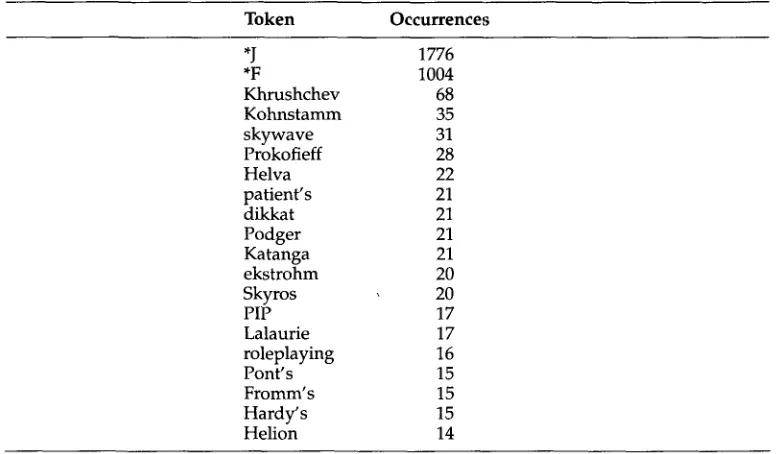
Tokens in the test sample but not in the 293,181-token vocabulary.
Token Occurrences
*J 1776
*F 1004
Khrushchev 68
Kohnstamm 35
skywave 31
Prokofieff 28
Helva 22
patient's 21
dikkat 21
Podger 21
Katanga 21
ekstrohm 20
Skyros 20
PIP 17
Lalaurie 17
roleplaying 16
Pont's 15
Fromm's 15
Hardy's 15
Helion 14
The resulting vocabulary contains 89.02% of the 44,177 distinct tokens in the Brown Corpus, and covers 99.09% of 1,014,312-token text. The twenty most frequently occur- ring tokens in the Brown Corpus not contained in our vocabulary appear in Table 2. The first two, *J and *F, are codes used in the Brown Corpus to denote formulas and special symbols.
5. Results and C o n c l u s i o n
The cross-entropy of the Brown Corpus and our model is 1.75 bits per character. Table 3 shows the contributions to this entropy from the token, spelling, case, and spacing components (see Equation (21)). The main contribution is, of course, from the token model: The contribution from the spelling model comes entirely from predicting the spelling of the unknown_token. The model here is especially simple-minded, predicting each of the 95 printable ASCII characters with equal probability. While we can easily do better, even if we were able to predict the characters in u n k n o w n tokens as well as we predict those in known tokens, the contribution of the spelling model to the entropy would decrease by only 0.04 bits. Likewise, we can entertain improvements to the case and spacing models but any effect on the overall entropy would be small. Our bound is higher than previous entropy estimates, but it is statistically more reliable since it is based on a much larger test sample. Previous estimates were nec- essarily based on very small samples since they relied on h u m a n subjects to predict characters. Quite apart from any issue of statistical significance, however, it is probable that people predict English text better than the simple model that we have employed here.
[image:8.468.51.439.83.310.2]Brown et al. An Estimate of an Upper Bound for the Entropy of English
Table 3
Component contributions to the cross-entropy.
Component Cross-Entropy (bits)
Token 1.61
Spelling 0.08
Case 0.04
Spacing 0.02
Total 1.75
al. 1977). The cross-entropy we report here is just the base two logarithm of the char- acter perplexity of a sample of text with respect to a language model. For a number of natural language processing tasks, such as speech recognition, machine translation, handwriting recognition, stenotype transcription, and spelling correction, language models for which the cross-entropy is lower lead directly to better performance.
We can also think of our cross-entropy as a measure of the compressibility of the data in the Brown Corpus. The ASCII cod4 for the characters in the Brown Corpus has 8 bits per character. Because only 95 of the characters are printable, it is a straightforward matter to reduce this to 7 bits per character. With a simple Huffman code, which allots bits so that common characters get short bit strings at the expense of rare characters, we can reach 4.46 bits per character. More exotic compression schemes can reach fewer bits per character. For example, the standard UNIX command compress, which employs a Lempel-Ziv scheme, compresses the Brown Corpus to 4.43 bits per character. Miller and Wegman (1984) have developed an adaptive Lempel-Ziv scheme that achieves a compression to 4.20 bits per character on the Brown Corpus. Our language model allows us to reach a compression to 1.75 bits per character.
We do not doubt that one can reduce the cross-entropy below 1.75 bits per charac- ter. A simple way to do this is to find more reliable estimates of the parameters of the model by using a larger collection of English text for training. We might also consider structural changes to the model itself. Our model is static. One can imagine adaptive models that profit from the text in the early part of the corpus to better predict the later part. This idea is applicable to the token model and also to the spelling model.
From a loftier perspective, we cannot help but notice that linguistically the trigram concept, which is the workhorse of our language model, seems almost moronic. It captures local tactic constraints by sheer force of numbers, but the more well-protected bastions of semantic, pragmatic, and discourse constraint and even morphological and global syntactic constraint remain unscathed, in fact unnoticed. Surely the extensive work on these topics in recent years can be harnessed to predict English better than we have yet predicted it.
[image:9.468.32.420.87.170.2]References
Algoet, P. and Cover, T. (1988). "A sandwich proof of the Shannon-McMillan-Breiman theorem." Annals of Probability
16(2):899-909.
Bahl, L., Baker, J., Jelinek, E, and Mercer, R. (1977). "Perplexity--a measure of the difficulty of speech recognition tasks." In Program, 94th Meeting of the Acoustical Society of America 62:$63, Suppl. no. 1. Bell, T. C., Cleary, J. G., and Witten, I. H.
(1990). Text Compression. Englewood Cliffs, N.J.: Prentice Hall.
Cover, T., and King, R. (1978). "A convergent gambling estimate of the entropy of English." IEEE Transactions on Information Theory 24(4):413-421.
Cover, T. M., and Thomas, J. A. (1991).
Elements of Information Theory. New York: John Wiley.
Jelinek, F., and Mercer, R. L. (1980). "Interpolated estimation of Markov source parameters from sparse data." In Proceedings, Workshop on Pattern Recognition in Practice, Amsterdam, The Netherlands. Kucera, H., and Francis, W. (1967).
Computational Analysis of Present-Day American English. Providence, R.I.: Brown University Press.
Miller, V. S., and Wegman, M. N. (1984). "Variations on a theme by Ziv and Lempel." Technical Report RC 10630, IBM Research Division.