Abstract— The problem of heterogeneity between ontologies may occur in the use of multiple ontologies of the same domain. The integration of ontologies provides a solution to the heterogeneity problem. In this study, we investigate the ontology integration problem and propose a layer based framework as a solution to the problem. The framework compares the concepts of reference ontologies based on their semantics along with their syntax in the concept matching process of ontology integration. The semantic relationship of a concept with other concepts between ontologies and the provision of user confirmation (only for the problematic cases) are also taken into account in this process. We cast the problem to find the effectiveness of proposed frameworks by providing a comparison of the proposed concept matching technique with the existing techniques. The result demonstrates the efficacy and success of the proposed framework.
Index Terms— Concept matching, heterogeneity, knowledge sharing, ontology integration
I. INTRODUCTION
MPROVEMENTS in global communication technologies over the last ten years have resulted in substantial changes in the speed of information exchange. This change has raised problems for information sharing in the field of information technology. At present, enterprises have moved towards the concept of embracing globalization and internationalization strategies. This perception has introduced the concepts of mergers, acquisitions, joint ventures and partnerships. Traditionally, enterprises only share physical assets in collaboration but now they also need to share and integrate their knowledge. The communication of knowledge between organizations has increased through technological advancements [1].
The semantic web proposed by Tim Berners-Lee (1993) provides a solution to the problem of knowledge sharing between enterprise applications over web [7]. The semantic web provides a mechanism through ontologies to structure the data in a way which is machine understandable. An ontology is defined as “a formal, explicit specification of a shared conceptualization” [23]. Within this definition: formal indicates to the meaning of the specification; explicit refers to explicitly defined concepts, properties and axioms; shared means is machine understandable; and
Manuscript submitted March 23, 2012;
Q. Umer is a MSc-Res Candidate in Computer Science with the University of Hull, Scarborough Campus, Filey Road, Scarborough YO11 3AZ, United Kingdom (phone: +44 (0) 1723 357113;e-mail: [email protected]).
D. Mundy is with the School of Arts and New Media, University of Hull, Scarborough Campus, Filey Road, Scarborough YO11 3AZ, United Kingdom (phone: +44 (0) 1723 357113;e-mail: [email protected]).
conceptualization refers to how an object/concept is defined in a particular area of interest.
Ontology integration is an approach to exchanging knowledge between enterprises. The process of ontology integration involves the comparison of concepts within different ontologies. This comparison of concepts can be made by comparing the syntax, semantics and/or taxonomy (relationships) of the concepts. Concept matching between two ontologies is a primary task to overcome the problem of ontology heterogeneity [6, 15, 16, 36, 40]. For example; the concepts: clerk and steno can be used interchangeably in different ontologies. They can be considered as being semantically similar, but the syntax of these concepts has nothing in common. Therefore, an effective ontology integration process should incorporate the syntax, semantics and relationships.
This paper introduces a framework for ontology integration which measures concept matching through performing syntactical, semantic and structural comparisons between concepts. This process improves the result of concept matching and provides a better solution to the problem of ontology integration. Section II provides the background knowledge of the problem and literature review. The proposed framework is discussed in detail in Section III. Experiments and the results of the proposed framework are discussed in Section IV. Section V discusses the benefits and the future work associated with the research.
II. BACKGROUND AND LITERATURE REVIEW
This section provides background knowledge to the research and discusses the state of the art of ontology integration and concept matching process.
A. Ontology
The word ontology has its roots in the field of philosophy. Ontology is the philosophical study of the nature of being and existence [24, 35]. In philosophy, an ontology is used as a theory of the nature of existence [35], which has to establish the reality by defining the concepts and their relationships with each other [38]. On the other hand, ontology has been defined as “a specification of a conceptualization” [22] in the context of knowledge sharing. Within this context ontology is also defined as “a description of the concepts and relationships that can exist for an agent or community of an agent” [22]. This helps in knowledge sharing and reuse. However, an ontology describes the semantics of available data in the field of computer science [38]. Chandrasekaran (1999) has defined ontology as a representational vocabulary in a specific domain [10].
Semantically Intelligent Semi-Automated
Ontology Integration
Q. Umer and D. Mundy
Ontologies are gaining popularity, mainly because they promise: a shared and common understanding of concepts between entities [18].
B. Semantic Web
The study of semantics is a scientific and philosophical study of meaning in natural and artificial languages. The goal of the semantic web is that of machine understandability, leading to automated decision making. In order to accomplish this goal, all the data on the web whether textual or multimedia should be semantically tagged with relevant metadata. The ability of machines to process web resources can be achieved through more specific explanation of resource content with a semantic mark-up called meta-data [4]. The metadata helps the software agents to understand the data and make decisions by utilizing it [3]. Concepts such as contextual advertisements, intelligent tagging, relatedness and relevance between different tags have all arisen in relation to the semantic web [26]. The layered framework of the semantic web contains an ontology layer sitting in the middle of the structure, just above the Resource Description Framework (RDF).
The ontology development process includes understanding of the domain, identification of the required concept in that particular domain, and the relationship between concepts. It is followed by the identification of terms which best describe the concept and their relationships. The three approaches of building ontologies are [21]:
A Top-Down Approach which starts with the most abstract concepts and then drills them down to more specific concepts. This approach provides good control over the level of detail, although there might be mistakes in choosing the top level abstract concept. This gives rise to instability within the model and requires a reworking of levels.
A Bottom-Up Approach tries to identify the more specific concepts and then goes on to generalize them to more abstract concepts. According to [21], this approach requires a lot of effort to identify the relationships, which might lead to inconsistencies and rework.
A Middle-Out Approach identifies the core terms and then specification and generalization is carried out in both directions. Researchers [42] appreciate this approach due to its stable nature.
C. Ontology Integration
Ontology integration is a process of building new ontologies by using available ontologies through an ontology development environment. Ontology integration can be broken down into the following three different scenarios, as defined by Pinto in 1977 [17].
Ontology Reuse - an existing ontology may be used as a platform from which to construct a new or extended ontology. The new or extended ontology would contain the existing ontology plus the addition of further concept(s). The original ontology would remain unchanged [37]. A software toolkit was developed for ontology development, reuse, and maintenance in the On-To-Knowledge Project [19]. Stumme and Mädche (2001) proposed a method of reuse and merging ontologies based on the merging of global
ontologies, which were similar to global databases [41]. In the process of integration with a reuse ontology approach, the concepts from existing ontologies may be taken according to the following four ways: without any change in definitions; with some modification in definitions; without any change in hierarchy (super-concept, sub-concept or sibling-concept relationships); or with some modification within the hierarchy (super-concept, sub-concept or sibling-concept relationships).
Ontology Mapping - is another approach which is used by many researchers [25, 37] for ontology integration. In ontology mapping, the integrated ontology O contains the rules of mapping concepts between existing ontologies A and B. In the process of ontology mapping, generic rules are defined for the concepts contained within the integrated ontology O. Each concept from the existing ontology A is taken, compared and associated with the concepts of the existing ontology B [12]. Ontology mapping basically provides an easy way to access and exchange information between ontologies by providing a common layer [25].
Ontology Merging - is another approach to combine different ontologies to create a unified ontology [37]. In the process of ontology merging, a new ontology is built in the same domain, and includes unified concepts, terms, definitions, etc. from existing ontologies. This process involves at least two existing ontologies A, B and the integrated ontology O, where the domains of the existing and integrated ontologies are the same. The integrated ontology O is a more general ontology created by using the gathered knowledge from the existing ontologies A and B of the same domain.
D. Concept Matching Techniques
At the foundation of ontology integration is the very important task of concept matching. This section reviews the existing techniques to concept matching. Several techniques are used to measure the similarity of concepts between two or more ontologies for concept matching. These concepts are generally matched on the basis of schema, instance, or both (hybrid) [2, 15, 16].
E. Schema-based Concept Matching Technique
In schema based techniques, similarity is measured at the structural level. Matching at the structural level can be performed in two ways:
Graph-based concept matching transforms the existing ontologies into a labeled graph. This approach suggests that where you have nodes (x and y) considered to be similar across different ontologies, that neighboring nodes to x and y, should also be somehow similar (definition, type or axiom etc.) [13].
Semantic Knowledge Articulation Tool (SKAT) [31], ONtology compositION (ONION) [32], PROMPT [33], Anchor-PROMPT [34], Context Matching (CTXMATCH) Algorithm [8], CTXMATCH2 [9], American Society of Clinical Ontology (ASCO) Algorithm [28] and ASCO2 [5] are some tools and algorithms that use the schema-based concept matching technique.
F. Instance-based Concept Matching Technique
The instance-based concept matching approach considers similarities between ontologies using the actual concepts instead of their relationships with other concepts. This technique is divided into the following methods:
String-based concept matching considers the names of concepts in ontologies for matching. In this technique, the similarity between the names of concepts is calculated on the basis of string matching. The five most commonly used methods of string matching are: (1) Edit-Distance – the distance of matching concepts from the root is calculated in order to reduce the cost of operation [33, 34]; (2) Normalisation – different string operations; (3) String equality – a method that compares the strings and results as true or false; (4) Sub-string test – a matching of strings in which a comparison of substrings is also considered; and (5) Token-based distance – a method that considers tokens (small word groupings) within the string of multiple words.
Language-based concept matching is used to find out the relatedness of concepts where the concepts are taken as words in any natural language. Natural Language Processing (NLP) techniques are used to identify the meaning of the words used for the concept, based on the linguistic relation between words e.g. synonyms. WordNet is an example implementation tool for use in language-based concept matching.
Constraint-based concept matching considers the definition of concepts to identify the similarity between concepts, for example; type comparison, attribute comparison, and domain comparison.
TROPES Taxonomy building Tool (T-TREE) [13], CAIMAN [27], Formal Concept Analysis MERGE (FCA– MERGE) [41] and GLUE [13] are examples that use the instance-based concept matching technique.
G. Hybrid Concept Matching Technique
In this technique both schema-based and instance-based concept matching techniques are combined to integrate the ontologies. Information Flow Theory (IF-Map) [25], OWL Light Aligner [30], Ontology MAP (oMAP) [40], Risk Minimization based Ontology Mapping (RiMOM) [29] and Semantic Matching (SM) [20] are examples of hybrid concept matching technique
III. PROPOSED FRAMEWORK
Figure 1 illustrates a block diagram which explains the flow of the proposed framework. The proposed framework takes two ontologies (A, B) named as reference ontologies and converts them into a tree structure using the schema of the ontologies. Each reference ontology tree contains all the concepts of the reference ontology. Each concept in the tree includes the term used for the concept, the meaning of the
term, and the relationship with other neighbouring concepts (super-concept, sub-concept and sibling-concepts).
Reference Ontologies (A,B)
Concept Matcher (CM)
Concept Integrator (CI)
Integrated Ontology (O)
Fig. 1. Block Diagram of Proposed Framework
After converting the reference ontologies into a tree format, both trees are forwarded to the Concept Matcher (CM) for the identification of matching concepts. The CM provides a layered based approach to measuring the similarity between concepts across the reference ontologies. The CM may physically involve the user in a process of confirming similarity or not, in complex cases. Complex cases may include concepts: that are not identified as similar semantically; that have the same term but a different definition; or do not have any matching concepts.
The CM transfers concepts which have been identified as matching to the Concept Integrator (CI). The CI integrates the matching concept in order to build the integrated ontology. The processes of identification of matching concepts and the integration of these will continue until all the concepts from both reference ontologies are merged into the integrated ontology.
Finally, the CI provides an integrated ontology as output. The integrated ontology will contain all the matching concepts of the reference ontologies identified by the CM or verified from the user.
A. Layered Based Approach of Concept Matching
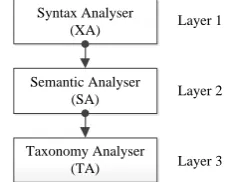
The CM performs the task of the identification of concept matching through three layers of activity. Each layer executes a specific task. The layers are named Syntax Analyser (XA), Semantic Analyser (SA) and Taxonomy Analyser (TA). The functionality of XA, SA and TA is explained below.
Syntax Analyser (XA)
Semantic Analyser (SA)
Taxonomy Analyser (TA)
Layer 1
[image:3.595.378.486.86.200.2]Layer 3 Layer 2
Fig. 2. Layers of Concept Matching Approach
The XA, SA and TA use the terms, definitions of the terms, synonyms of the terms and definitions of the synonyms in the process of matching. The definitions of the terms and their synonyms are collected from WordNet.
Syntax Analyzer (XA)
[image:3.595.370.484.594.685.2]comparing the strings of the terms, or by finding a first term from the list of synonyms of the second term if the strings are not matched (same). The XA marks the concepts as similar or not-similar syntactically and passes these to the SA. The process of XA can also be explained as in
𝑇1 = 𝑇2
𝑤ℎ𝑒𝑟𝑒
𝑇1 ∈ 𝐶1, 𝑇2 ∈ 𝐶2, O1 ≠ O2, SynSet(String(T1)) ≠ ∅,
SynSet(String(T2)) ≠ ∅ (1)
if
(String (T1) = String (T2)) or (String (T1) ∈ SynSet (String (T2))) or (String (T2) ∈ SynSet (String (T1)))
which means that the term T1 of concept C1 from ontology O1 will be equal to the term T2 of concept C2 from ontology O2, if the string of T1 is equal to the string of T2, or the string of T1 is part of the list of synonyms of the string of T2 (wherein the list of synonyms T2 should not be empty), or the string of T2 is part of the list of synonyms of the string of T1 (wherein the list of synonyms T1 should not be empty).
Semantic Analyzer (SA)
The SA takes marked concepts from the XA whether they are similar or not-similar. The SA uses the definitions of the terms of the concepts and their synonyms to enhance the concept matching process. The understanding of the meaning of the terms in the particular domain is very important in the concept matching process. The SA first compares the definitions of both terms (syntactically similar or not-similar). Both concepts will be declared similar semantically if the SA has found the meaning (definition) of the terms to be similar. The next step of the SA executes if the terms meanings are different. In this case, the SA takes the definitions of the synonyms for the first term and compares with the definition of the second term. For example, the terms ‘Clerk’ and ‘Steno’ are not syntactically similar. However, the SA would find both terms to be similar because the meaning is equivalent. The XA would mark the concepts as similar, or not-similar semantically and would pass them to the TA. The functionality of the SA can be described mathematically as in
𝑇1 = 𝑇2
𝑤ℎ𝑒𝑟𝑒
𝑇1 ∈ 𝐶1, 𝑇2 ∈ 𝐶2, O1 ≠ O2, SynSet(String(T1)) ≠ ∅, SynSet(String(T2)) ≠ ∅, Def(String (T1)) ≠ ∅,
Def(String (T2)) ≠ ∅ (2) if
{(String (T1) = String (T2)) or (String (T1) ∈ SynSet (String (T2))) or (String (T2) ∈ SynSet (String (T1)))} and {Def(String (T1)) = Def(String (T2))}
which means that two concepts will be declared similar semantically if the string of T1 is equal to the string of T2, or the string of T1 is part of the list of synonyms of the string of T2, or the string of T2 is part of the list of synonyms of the string of T1. However, this involves a compulsory condition (Def(String(T1))=Def(String(T2))) which verifies the similarity of the definition associated with each term. The SA confirms that the term T1 of concept C1 belongs to ontology O1, the term T2 of concept C2 belongs to ontology O2, the list of synonyms T1 should not be empty, the list of synonyms T2 should not be empty, the term T1 should have a definition, the term T2 should have a definition, and both ontologies are not equal, before starting the process of
concept matching.
Taxonomy Analyzer (TA)
The TA takes the semantically similar concepts and compares them based on the hierarchical information associated with them. The TA gathers all the super terms up to the root term of the terms being compared. The TA also compares the super terms and their definitions to confirm the hierarchy of the matching concepts before passing the information regarding the matching concepts to the CI. For example; the term Male is a sub-concept of the Person term in the first ontology, and the term Boy is a sub-concept of the Person term in the second ontology. The terms Male and Boy are semantically similar and both terms have a semantically equal super concept. Therefore, the integrated term should be placed under the term Person in an integrated ontology.
The Super, Sub and Sibling Concept Identification for TA and CI
The following equations relate to the identification of super concepts. The equations explain the process of how the TA identifies super concepts for semantic comparison. The TA collects all super concepts by using the structural information of the concept and then compares them based on their semantics. The TA declares the match as not-similar if it finds any semantic dissimilarity between concepts across ontologies. The TA uses a Top-Down Approach (root to nodes in tree structure) for the checking of structural similarity.
Sibling Concept Identification of T1 and T2 where
𝑇1 ∈ 𝐶1, 𝑇2 ∈ 𝐶2, O1 ≠ O2 (3) if
(Dis(T1) = Dis(T2)) and (Super(T1) = Super(T2)) Super Concept Identification of T1 and T2 where
𝑇1 ∈ 𝐶1, 𝑇2 ∈ 𝐶2, X1 ∈ 𝐶1, 𝑋2 ∈ 𝐶2, O1 ≠ O2, X = Super
Concept to Map (4)
if
X1 = T1 → Inherit(Super(X1)) X2 = T2 → Inherit(Super(X2)) X= (X1 = X2)
Sub Concept Identification of T1 and T2 where
𝑇1 ∈ 𝐶1, 𝑇2 ∈ 𝐶2, X1 ∈ 𝐶1, 𝑋2 ∈ 𝐶2, O1 ≠ O2, X = Sub Concept
to Map (5)
if
X1 = X1 → Inherit(Super(T1)) X2 = X2 → Inherit(Super(T2)) X= (X1 = X2)
IV. EXPERIMENTS AND RESULTS
In order to evaluate the effectiveness of the proposed framework, the implemented concept matching techniques are compared with SIMTO (a technique of concept matching identification) [15] as SIMTO claims the concept matching based on syntax, semantic and structure of the concepts. On the other hand, SIMTO is already compared with other existing concept matching techniques by using two case scenarios. We have also taken and used those scenarios for experiments. The following are the limitations of SIMTO that we found during experiments.
A. Limitations of SIMTO
SIMTO compares the concepts based on syntax but does not use the synonyms of the terms in syntactic comparison. SIMTO had not considered the two concepts similar if the term of the first concept is a synonym of the term used for the second concept.
SIMTO does not consider the semantic meaning of the parent concepts during integration. It is observed that the two similar concepts declared by SIMTO have semantically different parent concepts.
B. Performance Analysis of Proposed Framework
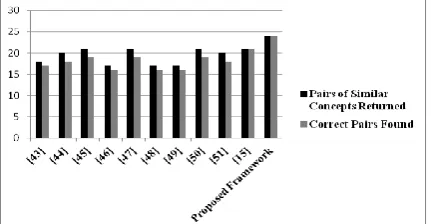
[image:5.595.62.278.665.777.2]The proposed framework considers the limitations of SIMTO mentioned in the previous section for ontology integration. The proposed framework involves the semantics of hierarchal concepts of the reference concepts during the concepts comparison. Figure 3 gives a comparison between the pairs of similar concepts returned and the correct pairs found. The black and grey bars in the graph represent the pairs of similar concepts returned and correct pairs found respectively.
Fig. 3. Performance Comparison between Proposed Framework and Existing Techniques of Test Case Scenario 1
The expected returned pair of concepts of SIMTO and the proposed framework was 12 and 14 respectively. In another experiment, the expected returned pair of concepts of SIMTO and the proposed framework was 21 and 24 respectively as shown in Figure 4.
Fig. 4. Performance Comparison between Proposed Framework and
Existing Techniques of Test Case Scenario 2
Although, SIMTO returned pairs of similar concepts and the correct pairs found are as equal as the proposed framework. However, the expected return pair of concepts was different in SIMTO and the proposed framework.
It is observed that semantic comparison of hierarchal concepts while comparing the two concepts introduced by the proposed framework gives the better results as compared to SIMTO and other existing methods.
V. CONCLUSION AND FUTURE WORK
The proposed framework of ontology integration supports and uses a hybrid approach of concept matching in order to combine the advantages of different concept matching approaches. The use of a hybrid approach of concept matching improves the concept matching technique by combining the outcomes (gathered from different concept matching approaches). The proposed concept matching technique mostly relies on the semantics of the concepts. User confirmation is also involved in the concept matching process for complicated cases in terms of their semantics and hierarchy. User involvement does not decrease the efficiency of the concept matching process; however, it improves the quality of the results, and decreases the chances of unwanted or incorrect results. On the other hand, the comparison of the concepts also involves structural comparison between concepts, which enhances the results of the concept matching. The structural comparison helps in taking decisions regarding the similarity of concepts, as the structure contains the information related to the semantic relationships of concepts. The proposed approach of comparing concepts based on their semantics and structure along with their syntax is a better way of concept comparison. This approach may increase the processing time but it is very effective in order to achieve the required results in ontology integration.
In the testing and analysis phase of the proposed framework, it is observed that the improvement in the concept matching process of the proposed framework may enhance the results of ontology integration. The possible improvements are the following:
Domain specific vocabularies should be used with general purpose vocabulary to get the better results for the semantic comparison. This will help in implementing the proposed framework across multiple domains.
String based comparison between concepts can be ignored in order to increase the running time of the concept matching algorithms involved in the proposed framework.
The standardized domain specific vocabularies should be used in ontology building. This may reduce the problem of heterogeneity between ontologies and the complexity of the ontology integration process.
REFERENCES
[1] Achterbergh, J. and Vriens, D. (2002) Managing Viable Knowledge. SystemsResearchandBehavioralScience, Vol. 19, 3.
[3] Amardeilh, F. (2009) Semantic Annotation and Ontology Population. IGI Global.
[4] Aufaure, M.-A., et al. (2008) Metadata and Ontology-Based Semantic
Web Mining. Data Warehousing and Mining Concepts
Methodologies Tools and Applications, Vol. 33, pp. 531-3556. [5] Bach, T. L. and Dieng-Kuntz, R. (2005) Measuring Similarity of
Elements in OWL DL Ontologies. In: Contexts and Ontologies AAAI Workshop. Springer.
[6] Bendeck, F. (2008) WSM-P Workflow Semantic Matching Platform. PhD, University of Trier.
[7] Berners-Lee, T., Hendler, J. and Lassila, O. (2001) The Semantic Web. Scientific American Magazine May, 2001.
[8] Bouquet, P., et al. (2003) A SAT-based algorithm for context matching. In: Proceedings of the 4th international and interdisciplinary conference on Modeling and using context. Stanford, CA, USA. Springer-Verlag.
[9] Bouquet, P., et al. (2006) Bootstrapping semantics on the web: meaning elicitation from schemas. In: Proceedings of the 15th international conference on World Wide Web. Edinburgh, Scotland. ACM.
[10] Chandrasekaran, B., Josephson, J. R. and Benjamins, V. R. (1999) What Are Ontologies, and Why Do We Need Them? IEEE Intelligent Systems, Vol. 14, 1, pp. 20-26.
[11] Doan, A., et al. (2003) Ontology Matching: A Machine Learning Approach. In: Handbook on Ontologies in Information Systems. pp. 397-416.
[12] Ehrig, M. and Staab, S. (2004) QOM -- Quick Ontology Mapping. In: 3rd International Semantic Web Conference (ISWC2004). Hiroshima, Japan.
[13] Euzenat, J. (1993) Brief overview of T-TREE: the TROPES Taxonomy building Tool. In: 4th ASIS SIG/CR Classification Research Workshop.
[14] Euzenat, J. and Valtchev, P. (2004) Similarity-based ontology alignment in OWL-lite. In: 15th European Conference on Artificial Intelligence (ECAI). Valencia (ES). pp. 333-337.
[15] Farooq, A. (2009) Similarity Identification and Measurement between Two Web Ontologies. Doctor of Philosophy (PhD), University of Engineering & Technology.
[16] Farooq, A. and Shah, A. (2010) Similarity Identification and Measurement between Ontologies. Journal of American Science, Vol. 6, 4, pp. 67-85.
[17] Farquhar, A., et al. (1995) Collaborative Ontology Construction for Information Integration.
[18] Fensel, D., et al. (2001) OIL: An Ontology Infrastructure for the Semantic Web. IEEE Intelligent Systems, Vol. 16, 2, pp. 38-45. [19] Fensel, D., et al. (2000) On-to-knowledge: Ontology-based tools for
knowledge management. In: Proceedings of the eBusiness and eWork. Citeseer, pp. 18-20.
[20] Giunchiglia, F., Yatskevich, M. and Shvaiko, P. (2007) Semantic Matching: Algorithms and Implementation. Journal On Data Semantics.
[21] Gómez-Pérez, A., Fernández-López, M. and Corcho, O. (2004) Ontological Engineering: With Examples from the Areas of Knowledge Management, E-commerce and the Semantic Web. Springer.
[22] Gruber, T. (1992) What is an Ontology? [WWW]. Available from: http://www-ksl.stanford.edu/kst/what-is-an-ontology.html [Accessed March 01, 2012].
[23] Gruber, T. R. (1993a) Toward Principles for the Design of Ontologies Used for Knowledge Sharing. International Journal Human-Computer Studies, Vol. 43, pp. 907-928.
[24] Gruber, T. R. (1993b) A Translation Approach to Portable Ontology Specifications. Knowledge Acquisition, Vol. 5, 2, pp. 199-220. [25] Kalfoglou, Y. and Schorlemmer, M. (2003) IF-Map: an ontology
mapping method based on Information Flow theory. Journal on Data Semantics Vol. 1, 1, pp. 98-127.
[26] Kinsella, S., et al. (2008) From Web 1.0 to Web 2.0 and back -: how did your grandma use to tag? In: Proceedings of the 10th ACM workshop on Web information and data management. Napa Valley, California, USA. ACM.
[27] Lacher, M. S. and Groh, G. (2001) Facilitating the Exchange of Explicit Knowledge through Ontology Mappings. In: Proceedings of the Fourteenth International Florida Artificial Intelligence Research Society Conference. AAAI Press.
[28] Le, B. T., Dieng-Kuntz, R. and Gandon, F. (2004) ON ONTOLOGY MATCHING PROBLEMS for building a corporate Semantic Web in a multi-communities organization. In: Proceedings of the 6th International Conference on Enterprise Information Systems.
[29] Li, Y., et al. (2006) Result of Ontology Alignment with RiMOM at OAEI’06. In: Ontology Alignment Evaluation Initiative.
[30] Loup, D. (n.d.) Ontology Alignment [WWW]. Available from: http://www.iro.umontreal.ca/~owlola/alignment.html [Accessed 29 February 2011].
[31] Mitra, P., Wiederhold, G. and Jannink, J. (1999) Semi-automatic Integration of Knowledge Sources. In: Proceedings of Fusion 99 Sunnyvale, USA. pp. 572-581.
[32] Department of Information Engineering and Computer Science, University of Trento, Italy (2000) A Graph-Oriented Model for Articulation of Ontology - DIS, Italy.
[33] Noy, N. F. and Musen, M. A. (2000) PROMPT: Algorithm and Tool for Automated Ontology Merging and Alignment. In: Proceedings of the Seventeenth National Conference on Artificial Intelligence and Twelfth Conference on Innovative Applications of Artificial Intelligence. AAAI Press.
[34] Noy, N. F. and Musen, M. A. (2001) Anchor-PROMPT: Using Non-Local Context for Semantic Matching. In: Proceedings Of The Workshop On Ontologies And Information Sharing At The International Joint Conference On Artificial Intelligence.
[35] Özsu, M. T. and Liu, L. (2009) Encyclopedia of Database Systems. 1 edition. New York, USA, Springer.
[36] Pedersen, T., et al. (2007) Measures of semantic similarity and relatedness in the biomedical domain. Journal of Biomedical Informatics, Vol. 40, 3, pp. 288-299.
[37] Pinto, H. S. (1999) Some Issues on Ontology Integration. Praxis Vol. 18, pp. 1-12.
[38] Seco, N. A. L. (2005) Computational Models of Similarity in Lexical Ontologies. Masters in Computer Science, University College Dublin. [39] Shah, A. F. A. A. (2010) Similarity Identification and Measurement between Ontologies. Journal of American Science, Vol. 6, 4, pp. 67-85.
[40] Straccia, U. and Troncy, R. (2005) oMAP: Combining classifiers for aligning automatically OWL ontologies. Web Information Systems Engineering–WISE 2005, Vol. 3806, pp. 133-147.
[41] Stumme, G. and Maedche, A. (2001) FCA-MERGE: Bottom-Up Merging of Ontologies.
[42] Uschold, M. and King, M. (1995) Towards a Methodology for Building Ontologies. In: Workshop on Basic Ontological Issues in Knowledge Sharing, held in conjunction with IJCAI-95.
[43] Maedche, A., and Staab, S., “Measuring similarity between ontologies”, Proceedings of the International Conference on Knowledge Engineering and Knowledge Management (EKAW), pp. 251–263, Spain, 2002.
[44] Paolo Bouquet, Luciano Serafini, Stefano Zanobini, “Semantic Coordination: A New Approach and an Application”, ISWC 2003, LNCS 2870, pp.130-145, 2003.
[45] John Li, “LOM: A Lexicon-based Ontology Mapping Tool”, Proceedings of the Performance Metrics for Intelligent Systems (PerMIS. ‟04), 2004.
[46] K. Kotis and G.A. Vouros, The HCONE Approach to Ontology Merging, in: Proc. of the First European Semantic Web Symposium, LNCS 3053, Springer, 2004, pp. 137-151.
[47] Mitra, P and Wiederhold, G, “Resolving Terminological Heterogeneity in Ontologies”, Proceedings of the ECAI‟02 workshop on Ontologies and Semantic Interoperability, 2002.
[48] B.T. Le, R. Dieng-Kuntz and F. Gandon, On ontology matching problem (for building a corporate semantic web in a multi-communities organization), in: Proceedings of the 6th International Conference on Enterprise Information Systems, 2004.
[49] Hariri, B., Abolhassani, H., Khodaei, A., “A new Structural Similarity Measure for Ontology Alignment”, In proceedings of the 2006 International Conference on Semantic Web & Web Services, pp.36-42 , USA, 2006.
[50] Alasoud, A., Haarslev,V., and Shiri, N. An Effective Ontology Matching Technique. In Proceedings of the 17th International Symposium on Methodologies for Intelligent Systems (ISMIS'08), LNAI 4994, pp. 585–590, 2008.