Framework for Quality Assurance
Approving authority Academic Provost
Approval date 10 September 2014
Advisor Deputy Academic Registrar | Academic Services
[email protected] | (07) 373 57726
Next scheduled review 2018
Document URL http://policies.griffith.edu.au/pdf/Framework for Quality Assurance.pdf
TRIM document 2014/0000529
Description This policy outlines the framework for the University's planning and quality assurance system.
Related documents
Strategic Plan
University Reviews Policy
[Quality Assurance System] [Planning Framework] [Planning and Review Cycle] [Budget Model] [Academic Element and Administrative Division Reviews] [Professional Accreditation] [Planning, Delivery and Review of Programs, Courses and Teaching] [Stakeholder Surveying] [Annual Performance Reviews of Senior Managers] [Annual Performance Reviews of Academic Staff] [Benchmarking] [Appendix 1 – Griffith’s Planning and Quality Assurance System] [Appendix 2 – Responsibility for the Process of Academic and
Administrative Review]
1.
QUALITY ASSURANCE SYSTEM
Griffith's Planning and Quality Assurance System (see Appendix 1) is based on the Plan-Implement-Review-Improve (PIRI) model of quality assurance and improvement, and consists of the following linked elements:
a planning framework
a systematic planning and review cycle
a budget model that supports implementation of the University's strategic priorities Academic Element and Administrative Division reviews
professional accreditation
planning, delivery and review of programs, courses and teaching stakeholder surveying
annual performance reviews of senior managers annual performance reviews of academic staff benchmarking
2.
PLANNING FRAMEWORK
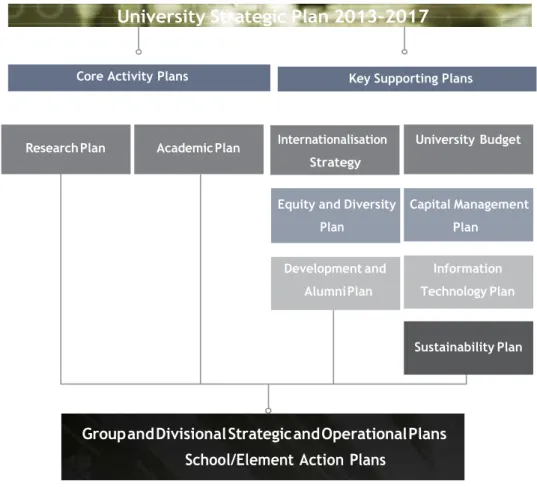
Griffith's planning framework consists of a series of linked plans and policies that guide the implementation of the University's strategic priorities. This framework consists of:
a) the University's Strategic Plan that sets targets benchmarked against publicly available sector-wide performance data; and
b) a cascading model in which the Strategic Plan and targets are used to drive the operational plans and key performance indicators within University-wide portfolios of research, equity and learning and teaching, and those of academic groups and administrative divisions. In turn, the strategic and operational plans and targets of each academic group inform the targets and improvement plans of the academic elements (the Schools/Departments).
The framework is depicted below.
Figure 1: Key strategic planning framework and quality enhancement processes associated with Strategic Plan 2013 – 2017.
Plans are implemented in groups and divisions and progress towards targets are reviewed through the University's annual planning and review cycle.
3.
PLANNING & REVIEW CYCLE
The University has developed a systematic planning and review cycle for the review and implementation of group and divisional plans consisting of an evidence-based, strategic review of performance against key performance indicators, the identification of desirable improvements, integrated operational planning and budgeting, and implementation of strategic actions. Group/divisional strategic plans operate on a five-year cycle, whereas operational plans operate on a one-year cycle. All operational plans clearly specify actions, responsibilities and budget provisions. The Planning Cycle occurs in line with a published annual planning and budgeting timetable as follows: Review 1 (March - April) - the annual planning cycle begins with an annual strategic review of performance against the University's key performance indicators (KPIs), at group, and school/departmental level.
Operational and Strategic Planning (May-August) - if necessary, each group and administrative
division updates its strategic plan in the light of the review of performance gaps, to focus on areas where the need for improvement, as revealed in the strategic review, is greatest. Each group or
Core Activity Plans Key Supporting Plans
Research Plan Academic Plan University Budget
Equity and Diversity Capital Management Plan Development and
Alumni Plan
Information Technology Plan
Sustainability Plan
divisional strategic plan reflects the University's Strategic Plan, and other relevant plans as they apply to groups and divisions. Work commences on the development of operational plans in June for the academic groups and administrative divisions for the following year, to achieve their planned strategic outcomes and to identify budget implications. Academic elements (the Schools/Departments) also establish action plans in response to local review of performance against strategic KPIs.
Finalising the Operational Planning (September-November) - once University budget allocations
are finalised, groups and divisions complete their operational plans. Group and divisional plans are developed in consultation with senior managers in each of the groups and divisions. The plans specify responsibilities for implementation to relevant senior managers, provide key performance indicators against which to evaluate progress, and allocate budget resources within the Group accordingly. The Vice Chancellor, Academic Provost and Deputy Vice Chancellors meet with each of the group Pro Vice Chancellors, the Vice President (Corporate Services and the Pro Vice Chancellors (Information Services) and (International), in November to consider the operational plan for the subsequent year.
Annual Progress Report – At the November meeting with the Vice Chancellor, the Academic
Provost, Deputy Vice Chancellors, Vice President (Corporate Services) and Pro Vice Chancellors also present a report reviewing their area’s progress in implementation of the operational plan for the preceding 12 months.
Implementation (commencing December for the following year) – Plans for Groups and Divisions
are implemented over the subsequent year, including actions designed to achieve priorities for improvement.
4.
BUDGET MODEL
The University's budget model supports implementation of the University's strategic priorities by: ensuring closer alignment between resources and the University's strategic priorities and providing
capacity for strategic investment;
transparently attending to income and expenses in the distribution mechanism, thereby providing a direct incentive to increase income and/or reduce expenditure, and to increase the return on activities; and
rewarding research and learning performance.
5.
ACADEMIC ELEMENT & ADMINISTRATIVE DIVISION REVIEWS
Griffith's strategic and operational planning is supported by five-yearly reviews of academic elements and support service divisions. These reviews involve self-assessment, benchmarking against comparable units, engagement with stakeholders and external peer review. Academic reviews may be conducted at group or school/departmental level. Similarly, administrative reviews may be conducted at the level of Division, an Office or other organisational cluster, depending on the circumstances. Each review leads to recommendations for improvement. The element being reviewed is required to complete an implementation plan for the recommendations, and to report back to Executive Group, Academic Committee and Council on progress towards implementation 18-months after the review is finalised. There is an expectation that all recommendations will be implemented by the 18-month progress report.
6.
PROFESSIONAL ACCREDITATION
Professional accreditation delivers external quality assurance for the University's programs as it certifies that the Griffith graduate meets the purpose of a range of professions. Input from employers, industry and other stakeholders to program planning and review processes help ensure the relevance of Griffith's curriculum and appropriateness of graduate competencies. These inputs are enshrined in
the planning processes set out in University's program, course and assessment policies to ensure external and internal expert scrutiny of structure, content, teaching and assessment strategies and outcomes.
7.
PLANNING, DELIVERY & REVIEW OF PROGRAMS, COURSES AND TEACHING
The University undertakes regular reviews of programs, courses and teaching by:
Program planning - groups develop an annual Program Profile Plan (PPP) as part of their
operational plan, which specifies new programs the group wishes to introduce, together with timeframes for program withdrawals, major changes and program reviews. The PPP is informed by the Academic Plan, the strategic priorities of the group, annual program-monitoring data, relevant recommendations from academic element reviews, professional accreditation processes, campus profiles and student demand. The PPP outlines the business case, market analysis, marketing strategy, and plans for funding the development of planned programs, and justification for proposed withdrawal of programs. The PPP aims to better align program planning and strategic objectives, improve the management of new program proposals, and the quality of curriculum development within program proposals.
Program development and approval - new programs approved for development are progressed in
accordance with the Program Planning, Development, Approval and Review Processes which ensures that distinctive features of Griffith programs are embedded in program and course curriculum.
Program monitoring and review – program monitoring data, which assesses each program's
performance against a standard set of indicators, are provided to Program Directors and the relevant Dean annually. On the basis of the data the relevant Dean selects a sample of programs for which an Annual Program Review and Improvement report (APRI) is required. From each Group’s selected APRIs Programs Committee or the Board of Graduate Research chooses a sample to ensure programs are systematically updated through internal review and revision. In addition, all programs are subject to a more extensive review at least once in every five year period for the purpose of continuous improvement, benchmarking, curriculum renewal and reaccreditation. The Dean has formal responsibility for the initiation and conduct of 5 yearly program reviews. In addition to these processes Programs Committee selects annually a number of transnational programs and their providers for the purpose of review.
Student Experience of Courses (SEC) and Teaching (SET) - Experience @ Griffith collects
feedback on courses and teaching from students using survey instruments. Data from student experience of courses and teaching (SEC and SET) instruments are used to inform the continuous improvement process in learning and teaching. Student feedback on all courses is collected each and every time they are offered using SEC, feedback on teaching is collected using SET at least every second year or every second time a staff member teaches a course, whichever is the sooner.
Curriculum tracking – The University’s online course profile system contains information about how
course content, teaching strategies, and assessment contribute to the course’s learning outcomes. This enables tracking of moderation processes used in each course to assure the consistency and comparability of student achievement outcomes across campuses, over time and with cognate courses internal and external to the University. It also enables monitoring of the implementation of the University’s key strategic initiatives (internationalisation, work-integrated learning and blended learning) within the curriculum at course and program levels.
Course review and improvement – Course Convenors are required to reflect on feedback about
the course with a view to improving it. This process of reflection may be documented in a range of ways. However, Course Convenors are encouraged to complete a Course Improvement Plan (CIP) once student feedback from the SEC has been received. The next time the course is offered, there is a requirement that Course Convenors report in the Previous Student Feedback section of
the Course Profile, improvements and changes made to the course as a result of feedback.
Appendix 2 specifies those responsible for the various processes of academic and administrative review.
8.
STAKEHOLDER SURVEYING
Regular internal and external surveys of students, staff and employers are conducted in order to measure satisfaction and to identify areas in need of improvement.
9.
ANNUAL PERFORMANCE REVIEWS OF SENIOR MANAGERS
As part of the Griffith Planning Cycle, the Academic Provost, Vice President (Corporate Services), Deputy and Pro Vice Chancellors are required to report annually to the Vice Chancellor on progress towards implementing the previous year's operational plan for their group or division. This information informs annual performance review, performance planning and remuneration outcomes.
10. ANNUAL PERFORMANCE REVIEWS OF ACADEMIC STAFF
Academic Work @ Griffith provides a framework for the allocation of academic work, performance
reviews and promotion of academic staff. This framework ensures:
greater flexibility in academic work allocations, allowing staff to concentrate in areas of strength and of strategic value to the University;
specification of promotion criteria that reward staff for excellence and impact in their chosen areas of emphasis; and
annual performance reviews against Academic Group performance expectation by level, work allocation profile and agreed performance objectives that reflect negotiated career trajectories, past performance and the strategic priorities of the school, group and University.
Academic Work @ Griffith supports the University's planning framework by aligning staff resources with core priorities.
11. BENCHMARKING
Benchmarking involves the comparison of Griffith’s performance in terms of its key outcome indicators, structures, processes and practices with data from relevant organisations.
The University engages in four different types of benchmarking:
sector benchmarking - a comparison with other universities of performance outcomes using publicly available data, or of processes and practices within the sector in selected areas, with a view to identifying areas for improvement.
whole-of-institution benchmarking - a comparison of a range of processes, activities and practices with one or more university partners, with a view to identifying strengths or weaknesses as the basis for improvement, or identifying those leading to excellent outcomes and exchanging information about them with a view to implementation.
discipline-specific benchmarking - comparison of the performance of one discipline area in another university to inform future planning and goal-setting.
standards-based benchmarking - analysing processes, practices and outcomes against a generally agreed set of standards, such as those set by professional bodies, national associations or international bodies.
The choice of benchmarking type depends on the strategic objectives being served by the benchmarking activity.
APPENDIX 2: RESPONSIBILITY FOR THE PROCESS OF ACADEMIC AND
ADMINISTRATIVE REVIEW
Level of Responsibility Who is Responsible Responsible forInstitution Academic Provost
Establishing clear accountabilities for the monitoring and review of academic and administrative elements, programs, courses and teaching.
Providing an effective quality improvement framework. This includes the provision of appropriate policies and guidelines (including staff promotion, development and probation policies, the publication of evaluative/review/quality improvement data, grievance procedures to counteract misuse of such data) and other relevant support (such as access to professional development, advice and evaluative tools, and financial support).
Vice President (Corporate Services)
The management of data systems to collate and report performance data at the levels of group, school, program, course and individual teacher in a useable form.
The management of administrative support for implementation of the University’s planning and review policies and processes. Academic and
Administrative Elements
Academic Provost
Ensuring University reviews of academic elements and administrative divisions take place (i.e. that policies and guidelines are implemented).
Vice President (Corporate Services)
Ensuring that information relating to the performance of academic elements is accessible to relevant University bodies such as Executive Group, Academic Committee and the Council.
Group PVCs, Deans, Heads of Schools,
Directors
Ensuring implementation of the annual planning and review processes within academic or administrative elements.
Ensuring preparation of the Review Submission for an academic or administrative/support area, the implementation of the Review recommendations and the Action Plan, and preparation of progress reports as required.
Program Program Director
Preparing Annual Program Review and Improvement Report (APRI) including recommendations for improvement as required by the relevant Dean.
Ensuring that information relating to the quality of their School’s programs is accessible to relevant Head of School, Deans and PVC.
Head of School Ensuring program monitoring and review takes place (i.e. that policies and procedures are implemented).
Relevant Deans Ensuring that information relating to the quality of programs in their academic area is accessible to relevant University bodies such as Academic Committee, the Learning and Teaching Committee (LTC), Programs Committee, Group Pro Vice Chancellors, Dean (Learning Futures) and Director (Learning Futures) and to the Academic Provost.
Course Head of School Ensuring course evaluation takes place and that evaluation outcomes are addressed as appropriate.
Ensuring that information relating to the quality of their Schools’ courses is collected and accessible to relevant Deans and Program Directors.
Course Convenor
Initiating the process of course evaluation.
Collecting and analysing course evaluation data (including SEC).
Development and implementation of improvement plans in response to student feedback.
Completing the Student Feedback section of the Course Profile, the next time the course is taught, for the purpose of reporting feedback from the previous student cohort.
Teaching Individual Teacher
Initiating the process of teaching evaluations in conjunction with the Course Convenor.
Collecting and analysing teaching evaluation data (including SET).
Discussing teaching and evaluation data with the Course Convenor and supervisor.
Course Convenor
Overseeing the process of teaching evaluations for their course.
Head of School Ensuring information relating to the quality of teaching within their school/courses is accessible to Deans (Academic) and discussed within staff annual reviews.
Supervisor Discussing teaching quality with the staff member on a regular informal basis and on a formal basis annually as part of the academic review process, and plans for continuous improvement, including review of SET and SEC and other sources of information about teaching quality.
All levels Students Under the Griffith University Student Charter students are expected to provide constructive feedback on teaching, learning and other academic activities.